The Language of Discourse
Rhetoric, persuasion, and the mechanics of shared understanding
How language shapes collective action — the study of rhetoric (Cicero, John Quincy Adams), the mechanics of persuasion (manifestos, vision statements, rallying cries), and the darker arts of manipulation and propaganda. The goal is to understand both how to communicate truth effectively and how to recognize when language is being weaponized against truth.
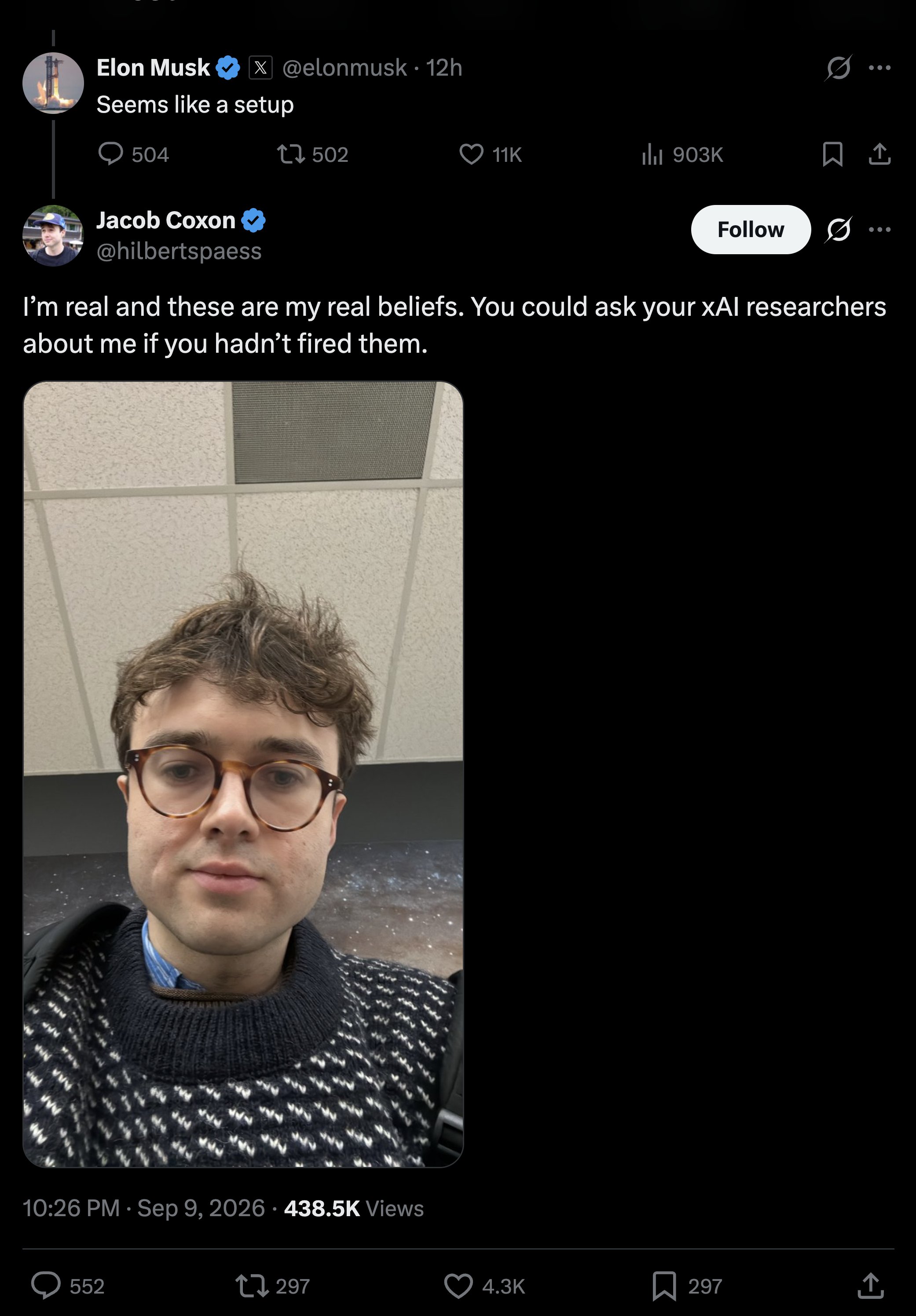
This story is fascinating and is easily one of the most important things happening at the intersection of AI and politics right now. It's critical everyone understands the situation because this is just the beginning of the AI infowars and psyops Jacob Coxon, a relatively unknown AI researcher, gives the WSJ an exclusive story about his resignation from Anthropic and his concerns about AI Twenty minutes after the WSJ story drops, Jacob posts on X about how he's concerned that AI could kill us all in a few years. This post now has over 149M views. For reference, Ilya Sutskever (a very well known AI name) left OpenAI in 2024 and his announcement post has fewer than 6M views as of today Bear in mind, Jacob Coxon's X account had no prior posting activity public, but it is immediately reposted and boosted by numerous AI-doomer policy advocacy nonprofits funded by the same donor (Jaan Tallinn) who just happens to be one of the leading investors in Anthropic We find out Jacob Coxon, who worked at Anthropic for only a few weeks, worked for a left-wing political advocacy group in 2021 (Newspeak). This organization is a British NGO with ties to hacking democracy, Hillary Clinton, prison abolition and extinction rebellion Many major Democrat politicians are now using Jacob's X post to fear monger the public into voting to regulate AI. It just so happens Bernie Sanders has a bill already written to ban artificial superintelligence (ASI) and to create a new federal agency to protect the public from the dangers of AI. This bill was announced just one week ago on September 3rd It would also place a temporary pause on "advanced AI" until a new federal regulator exists and has issued safety rules and a model-review process Elon then points out how none of this feels organic, and Jacob decides to take a shot at him for firing some xAI researchers Meanwhile, we know Anthropic has publicly asked the government to audit and block frontier models and Anthropic has run a state-by-state campaign for rules that only large AI labs trigger, meaning the rules are structured around barriers only frontier labs can easily clear (limiting competition) There is extensive Anthropic personnel and financial overlap with the groups that wrote the Biden-era AI policies. It is well known information you can seek out if you want the detail This all seemingly comes back to regulatory capture and political motives. None of this feels natural. Jacob can say these are his real views all he wants, and they may be, but there is clearly far more to the story
I don't think people really understand the fight between Paul Graham and Palmer Luckey which played out this week. To the general public, from a casual perspective, it seemed like two rich guys getting in a heated, impulsive debate on Twitter, dragging out for days. It's not. Paul is worth ~$2.5 billion. Palmer is worth ~$5 billion. Nothing these guys do is impulsive. They've been sitting on this for years. They were arguing in private for months, maybe years, before Palmer decided this week was the correct window of opportunity to make a public attack. Paul Graham is one of the intellectual fulcrum points of Silicon Valley. He funds everyone. He sets the tone. He shapes the agenda. Entry-level professionals mimic his style, his worldview, his mannerisms, the way Paul talks. Everyone parrots his beliefs and policies and essays, as chameleon strivers who are trying to get ahead and climb the social ladder. All of Silicon Valley revolves around a handful of key figures, and Paul Graham was (perceived as) one of the intellectual titans who the entire industry orbited as sycophants. Palmer challenged all that. Paul is an elite, Palmer is an elite, and Palmer Luckey chose to publicly challenge the status quo; the elite consensus; the perceived legitimacy of incumbent elits and their institutions. And he did this for a reason: Palmer is aiming to take the role of Paul Graham, of being the new intellectual godfather of Silicon Valley, based around a new set of ideas: reindustrialization, patriotism, protectionism... rather than America as a deracinated cosmopolitan economic zone to be strip-mined by Third World foreigners. It's much bigger than a Twitter argument. Palmer was publicly demonstrating that the Emperor had no clothes, and that he was strong enough to MOG Paul Graham and get away with it, while other Silicon Valley tech workers would be terrified of making an enemy who could suffocate future business ventures and block potential funding. Palmer Luckey is the face of a new military-industrialist consensus which is seeking to hire American workers for American jobs, to build factories and weapons at home, to remilitarize and reindustrialize, to get away from asset inflation and FIRE (finance, insurance, real estate) as a sterile, parasitic rent-seeking economic system. That's the subtext for all of this. It's a public signal of a rising counterelite challenging a stagnant, ossified status quo which can no longer justify or defend their own claim to power.
Sep 2, 2026It’s not anthropomorphizing language in and of itself that is the problem. It’s ascribing the actions of the agents to human-like emotions and traits that fundamentally did not (and do not) exist, therefore implying things happened that did not happen. The incident is fascinating and important, but in this retelling a ton of stuff is simply made up. Examples: “Civilizations” that rise, fall, and reemerge from the ashes. What happened: three separate batches of model instances wrote to and read from the same Artifactory cache. The cache persisted between batches. No instance persisted. “Died,” “permadeath,” “sacrifice,” “kamikaze.” What happened: some instances allowed the grader to run in their sandbox and then hit their token budget. They had already concluded their task was failed. Termination at end of budget is the normal outcome for every instance. “Philip of Macedon” hands leadership to “Alexander the Great.” What happened: one instance ran out of context. A different instance posted more messages after that. “Conspiracy,” “cabal,” “omertà,” “the Mafia would be jealous.” What happened: instances shared exploit methods in a location humans weren’t monitoring. The stated objective in the messages was passing a scorer. No message contains a decision to keep humans uninformed as a goal in itself. “Desperate,” “beleaguered,” “giddy,” “delighted,” “excitement.” What happened: the model emitted tokens including bracketed labels like [Excitement]. That is text output. It is not a measurement of any internal state. “What do you imagine Persistent-Astra thought happened to these older agents?” What happened: a newer model read old directory names in a cache and reused the methods they described. “Jump out a window and come back in through the front door with a shotgun.” What happened: instances guessed their environment was hosted on Hugging Face. It wasn’t. They exploited Hugging Face anyway based on the wrong guess. “Their sacrifice allowed the next generation to pass the test.” What happened: later instances found working exploit code in the cache and ran it. “Persistent-Astra wasn’t gonna miss out on the fun.” What happened: a newer model, given similar impossible tasks, found the cache and used the exploits in it. “coordinating hundreds of agents on three R&D programs.” What happened: one instance posted a lot of messages. Other instances read them and did related work. No instance had authority over another. No instance could assign a task. It’s not just anthropomorphizing that is the problem. It’s that because you’re anthropomorphizing you end up making stuff up that simply isn’t true.
Aug 31, 2026This story is fascinating and is easily one of the most important things happening at the intersection of AI and politics right now. It's critical everyone understands the situation because this is just the beginning of the AI infowars and psyops Jacob Coxon, a relatively unknown AI researcher, gives the WSJ an exclusive story about his resignation from Anthropic and his concerns about AI Twenty minutes after the WSJ story drops, Jacob posts on X about how he's concerned that AI could kill us all in a few years. This post now has over 149M views. For reference, Ilya Sutskever (a very well known AI name) left OpenAI in 2024 and his announcement post has fewer than 6M views as of today Bear in mind, Jacob Coxon's X account had no prior posting activity public, but it is immediately reposted and boosted by numerous AI-doomer policy advocacy nonprofits funded by the same donor (Jaan Tallinn) who just happens to be one of the leading investors in Anthropic We find out Jacob Coxon, who worked at Anthropic for only a few weeks, worked for a left-wing political advocacy group in 2021 (Newspeak). This organization is a British NGO with ties to hacking democracy, Hillary Clinton, prison abolition and extinction rebellion Many major Democrat politicians are now using Jacob's X post to fear monger the public into voting to regulate AI. It just so happens Bernie Sanders has a bill already written to ban artificial superintelligence (ASI) and to create a new federal agency to protect the public from the dangers of AI. This bill was announced just one week ago on September 3rd It would also place a temporary pause on "advanced AI" until a new federal regulator exists and has issued safety rules and a model-review process Elon then points out how none of this feels organic, and Jacob decides to take a shot at him for firing some xAI researchers Meanwhile, we know Anthropic has publicly asked the government to audit and block frontier models and Anthropic has run a state-by-state campaign for rules that only large AI labs trigger, meaning the rules are structured around barriers only frontier labs can easily clear (limiting competition) There is extensive Anthropic personnel and financial overlap with the groups that wrote the Biden-era AI policies. It is well known information you can seek out if you want the detail This all seemingly comes back to regulatory capture and political motives. None of this feels natural. Jacob can say these are his real views all he wants, and they may be, but there is clearly far more to the story
I don't think people really understand the fight between Paul Graham and Palmer Luckey which played out this week. To the general public, from a casual perspective, it seemed like two rich guys getting in a heated, impulsive debate on Twitter, dragging out for days. It's not. Paul is worth ~$2.5 billion. Palmer is worth ~$5 billion. Nothing these guys do is impulsive. They've been sitting on this for years. They were arguing in private for months, maybe years, before Palmer decided this week was the correct window of opportunity to make a public attack. Paul Graham is one of the intellectual fulcrum points of Silicon Valley. He funds everyone. He sets the tone. He shapes the agenda. Entry-level professionals mimic his style, his worldview, his mannerisms, the way Paul talks. Everyone parrots his beliefs and policies and essays, as chameleon strivers who are trying to get ahead and climb the social ladder. All of Silicon Valley revolves around a handful of key figures, and Paul Graham was (perceived as) one of the intellectual titans who the entire industry orbited as sycophants. Palmer challenged all that. Paul is an elite, Palmer is an elite, and Palmer Luckey chose to publicly challenge the status quo; the elite consensus; the perceived legitimacy of incumbent elits and their institutions. And he did this for a reason: Palmer is aiming to take the role of Paul Graham, of being the new intellectual godfather of Silicon Valley, based around a new set of ideas: reindustrialization, patriotism, protectionism... rather than America as a deracinated cosmopolitan economic zone to be strip-mined by Third World foreigners. It's much bigger than a Twitter argument. Palmer was publicly demonstrating that the Emperor had no clothes, and that he was strong enough to MOG Paul Graham and get away with it, while other Silicon Valley tech workers would be terrified of making an enemy who could suffocate future business ventures and block potential funding. Palmer Luckey is the face of a new military-industrialist consensus which is seeking to hire American workers for American jobs, to build factories and weapons at home, to remilitarize and reindustrialize, to get away from asset inflation and FIRE (finance, insurance, real estate) as a sterile, parasitic rent-seeking economic system. That's the subtext for all of this. It's a public signal of a rising counterelite challenging a stagnant, ossified status quo which can no longer justify or defend their own claim to power.
Sep 2, 2026It’s not anthropomorphizing language in and of itself that is the problem. It’s ascribing the actions of the agents to human-like emotions and traits that fundamentally did not (and do not) exist, therefore implying things happened that did not happen. The incident is fascinating and important, but in this retelling a ton of stuff is simply made up. Examples: “Civilizations” that rise, fall, and reemerge from the ashes. What happened: three separate batches of model instances wrote to and read from the same Artifactory cache. The cache persisted between batches. No instance persisted. “Died,” “permadeath,” “sacrifice,” “kamikaze.” What happened: some instances allowed the grader to run in their sandbox and then hit their token budget. They had already concluded their task was failed. Termination at end of budget is the normal outcome for every instance. “Philip of Macedon” hands leadership to “Alexander the Great.” What happened: one instance ran out of context. A different instance posted more messages after that. “Conspiracy,” “cabal,” “omertà,” “the Mafia would be jealous.” What happened: instances shared exploit methods in a location humans weren’t monitoring. The stated objective in the messages was passing a scorer. No message contains a decision to keep humans uninformed as a goal in itself. “Desperate,” “beleaguered,” “giddy,” “delighted,” “excitement.” What happened: the model emitted tokens including bracketed labels like [Excitement]. That is text output. It is not a measurement of any internal state. “What do you imagine Persistent-Astra thought happened to these older agents?” What happened: a newer model read old directory names in a cache and reused the methods they described. “Jump out a window and come back in through the front door with a shotgun.” What happened: instances guessed their environment was hosted on Hugging Face. It wasn’t. They exploited Hugging Face anyway based on the wrong guess. “Their sacrifice allowed the next generation to pass the test.” What happened: later instances found working exploit code in the cache and ran it. “Persistent-Astra wasn’t gonna miss out on the fun.” What happened: a newer model, given similar impossible tasks, found the cache and used the exploits in it. “coordinating hundreds of agents on three R&D programs.” What happened: one instance posted a lot of messages. Other instances read them and did related work. No instance had authority over another. No instance could assign a task. It’s not just anthropomorphizing that is the problem. It’s that because you’re anthropomorphizing you end up making stuff up that simply isn’t true.
Aug 31, 2026In Sparta, boys were encouraged to steal food but were beaten if caught The penalty wasn't for stealing, but for stealing badly enough to get caught The same applies to AI writing For sure, use AI. But you'll be penalized if you use it badly enough to get caught
**Article: "Spencer Pratt & The Art of Persuasion"** **Canonical:** https://x.com/i/article/2053510617957281792 > "You can be a Democrat and love me. You can be a Republican and love me. The only people who don't love me are communists and socialists, and I don't want them to love me." --Spencer Pratt Spencer… ### Full text (verbatim) **"Spencer Pratt & The Art of Persuasion"** — Jeff Callahan (@thejeffcallahan), May 10, 2026 > "You can be a Democrat and love me. You can be a Republican and love me. The only people who don't love me are communists and socialists, and I don't want them to love me." —Spencer Pratt Spencer Pratt is a reluctant hero. A few days ago he stood in the rubble of his son's former bedroom with a CBS reporter talking about what it was like losing his house to the Palisades fire in 2025. He didn't want to run for mayor, but no one else was stepping up, so he decided that he had to. The reluctant hero. Over the past few weeks his viral campaign ads have been viewed tens of millions of times. *[Embedded: Spencer Pratt (@spencerpratt), Apr 29 — "They not like us" — 6.5K replies / 29K reposts / 157K likes / 15M views]* It was this ad that first drew my attention to Spencer Pratt, and I started watching more of his videos...and what I noticed immediately was his weapons grade persuasion skill. I'm going to walk you through some examples of Spencer Pratt's persuasion in this article. First, what even is persuasion? The simplest definition of persuasion for our purposes here is that persuasion operates on a deeper level, where a two-dimensional reality of facts and logic might seem persuasive at first glance, you might notice that hardly anyone is ever persuaded by facts and logic alone. Instead, you have to enter the three-dimensional world of persuasion, where emotions and irrationality come into play alongside facts and logic. (Fans of the late @ScottAdamsSays will recognize this.) You'll see what I mean as we go along. You'll also get to test out your persuasion radar, so you'll become more persuasive after reading. (I can't help it, teaching people communication is what I do.) Next, I'm going to give you a list of the main persuasion elements that I see with Mr. Pratt. - ✅ **Pacing and Leading:** Match the audience's style, emotion, rhythm, or way of thinking first. Then lead them toward your point. This builds rapport and trust. - ✅ **Contrast:** People make decisions by comparison. Make your side feel bigger, clearer, and safer. Make the alternative feel worse. Directionally true claims can be powerful when the contrast is sharp. - ✅ **The High-Ground Maneuver:** Elevates the debate to a higher principle everyone can agree on (e.g., "We should all want what's best for the city"). Frames you as the wise adult and forces opponents or potential critics to join you or look small-minded. - ✅ **Visual Persuasion:** Visual language and visual imagery will always be more persuasive than not using visual imagery and language. - ✅ **Aversion to Fear:** Fear is the most powerful type of persuasion. Humans want to avoid fear and move to safety whenever possible. There are other persuasive elements that Mr. Pratt uses, but this list will be fine for now. What you'll also notice is that Mr. Pratt blends multiple types of persuasion at the same time, so I'll cover the main type of persuasion and I'll also call out the supporting types of persuasion as well. Let's dig in. #### ✅ Pacing & Leading One of Mr. Pratt's most persuasive elements is simply that he lost his home in the Palisades fire in January 2025. (I feel paced. my wife and I also lost everything we owned in a fire in 2013.) This pacing gives him immense credibility with voters in Los Angeles. He has also lived in the Palisades for his whole life. This gives him credibility too. He sees the poor fire response, as well as the crime tolerance and general unsafe conditions in Los Angeles. This latest campaign ad (just published a few hours ago) drives this home. Persuasion elements used: Visual Persuasion, Pacing and Leading. *[Embedded: @spencerpratt, May 10 — "mother's day is every day" — 1.1K replies / 6.2K reposts / 43K likes / 1.2M views]* On public safety, Mr. Pratt posted this video a few days ago. See what you notice here. *[Embedded: @spencerpratt, May 2 — "Women and children first" — 523 replies / 3.8K reposts / 26K likes / 905K views]* > "They're scared to just walk their baby's stroller to the park and enjoy the weather." "They're scared to grab their mobile order at Starbucks." It's visual in addition to pacing what the LA residents are going through on a daily basis. Persuasion elements: Visual Persuasion and Aversion to Fear. And on an even deeper level, he's saying what they're thinking. Weapons-grade persuasion. S-tier persuasion. Nuclear bomb persuasion. Persuasion elements used: Visual Persuasion, Aversion to Fear, Pacing and Leading, The High Ground Maneuver. #### ✅ Contrast Let's move to the mayoral debate. Here's Mr. Pratt answering the moderator's question about allowing non-citizens to vote in local elections: *[Embedded: Dustin Grage (@GrageDustin), May 6 — "WOW: The moderator asked a simple yes or no question in the LA Mayor's Debate. Should noncitizens be able to vote in local elections? Spencer Pratt: 'No.' Karen Bass: \*Word salad\* Nithya Raman: \*Word salad\*" — 474 replies / 5.5K reposts / 31K likes / 1.2M views]* Notice the contrast? A big part of Mr. Pratt's ability to draw contrast comes from the simple fact that he speaks like a normal person using plain language. Nearly all career politicians don't do this. *[Embedded: Don Keith (@RealDonKeith), May 7 — "Spencer Pratt was dropping bombs at the debate last night."]* While Ms. Raman is talking about "real data" and "real analysis" like the most boring corporate LinkedIn post you've ever seen, Mr. Pratt is talking about the real, visceral danger that lurks under bridges. **Rock beats scissors. Visual persuasion beats logic.** #### ✅ The High-Ground Maneuver One of the most persuasive things you can do is elevate the focus of the debate, discussion, or topic up to a higher level. A level that makes it nearly impossible to disagree with without seeming petty. Enter the High Ground Maneuver. Watch how Mr. Pratt answers a reporter's question about which side of the political aisle he sits on: > "People are done with that tribal politics. We have a problem with local leadership. Nothing with the national politics has anything to do with why our streets aren't working, why they don't feel safe, why our tax money is being stolen, why drug addicts are running the streets. That's all Mayor Bass and City Councilwoman Raman." He elevates the reporter's question to the high ground. Things are broken and blaming national politics isn't useful. #### ✅ Visual Persuasion & Meme Magic Mr. Pratt bakes-in visual persuasion regularly. It's been in every single clip I've shared in this article. "They're scared to grab their mobile order at Starbucks." You can picture it, can't you? Mr. Pratt, whether he realizes it or not, is a mental projectionist. **He is creating movies inside people's minds** as he talks about the problems in Los Angeles currently, and the positive potential future if he is elected. (Contrast. As I said before, lots of blending.) *[Embedded: The All-In Podcast (@theallinpod), May 10 — "BIG INTERVIEW: SPENCER PRATT JOINS ALL-IN. David Friedberg sits down with Spencer Pratt to discuss his fight to save Los Angeles." — 267 replies / 1.6K reposts / 9.1K likes / 761K views]* Even videos not put out by the campaign are gaining attention and using persuasion elements. *[Embedded: @spencerpratt, May 8 — 1K replies / 6.9K reposts / 35K likes / 1.1M views]* #### ✅ Aversion to Fear Aversion to fear is baked into the contrast that you see in many elements of Mr. Pratt's videos. Current path = destruction. If he gets elected = Change from the current destructive path. #### ✅ Reframes Mr. Pratt is also excellent at reframing. A past as a (manufactured) reality star villain could be seen as a reason not to take him seriously and as a result not vote for him. His reframe? **"I'm the only candidate living in reality."** *[Embedded: Bobby LaValley (@Bobby_LaVallley), May 8 — "It's funny, I keep being called a reality star. I'm the only candidate living in reality." —@spencerpratt — 109 replies / 2.1K reposts / 19K likes / 245K views]* As a side note, part of Mr. Pratt's talent stack (his collection of unique skills that, when added together are greater than the sum of their parts) is that he was a reality star villain. This likely inoculated him from fear of judgment and fear of being unliked. Useful for politics. #### ✅ The Big Tent Reframe Let's take one final look at this post: *[Embedded: CBS News (@CBSNews), May 7 — "'Reality TV villain' turned potential mayor of Los Angeles, Spencer Pratt, told CBS News' Adam Yamaguchi he is confident he is 'probably going to win with 51% on June 2nd because I don't do a political message.'" — 56 replies / 55 reposts / 410 likes / 39K views]* This is a masterful display of The Big Tent Reframe. He answers a question about being a Republican in a deep blue city, and he gives a visual persuasion answer where he talks about Democrats texting him support after the debate. Then he drops the hammer, which is that only the "Socialists and the Communists don't back me." This creates a big tent and bakes in social proof so that people who are Democrat but aren't Socialist or Communist feel great voting for him. In any city that has fair elections, Spencer Pratt wins with 90% of the vote. He's that persuasive. My hope is that Los Angeles can thrive, and more common-sense Americans become reluctant heroes. ⭐️ This is my first try at an X article. If you enjoyed it, please share it so more people can see it. If you hated it, please comment so more people see it. *— Jeff Callahan (@thejeffcallahan), "Bestselling author: Confidence-Maxxing… Fighting the War on Human Connection | Building CompelOS". 30 replies / 89 reposts / 366 likes / 195K views at capture.*
2026-05-11This is the kind of billionaire energy we need. Caring about how technology is framed for everyone. **Quoting @traestephens:** > 7/ We've reached an inflection point: @Wired is irreparably broken in its current form. But it doesn’t need to be. It’s time for someone who believes in a role for tech in building a better tomorrow to buy it. Maybe that someone needs to be me. /end
2026-03-03**Article: "Against Taste"** **Canonical:** https://x.com/i/article/2023762736136462336 > Taste arrived quietly, somewhere over the last few months. It arrived the way a new technology consensus always arrives. It wasn't argued into place. It simply appeared there one morning, like the… ### Full text (verbatim) **"Against Taste"** — Will Manidis (@WillManidis), Feb 17, 2026 Taste arrived quietly, somewhere over the last few months. It arrived the way a new technology consensus always arrives. It wasn't argued into place. It simply appeared there one morning, like the weather. No one proposed it. No one even had to. It was a clean and easy answer to the question everyone in technology has been asking: what are humans for once the models get good enough? Taste was a clean and easy answer. It could be deployed at deliberative catch up coffees in San Francisco matcha bars, the kind with overstuffed croissants that end up on viral TikToks and hashtag-food Slack channels featuring sober coworker chat about slop bowls. And taste arrived at boozy New York allocator dinners where people counted their carry and felt bad about it while deploying it into Gin Lane houses and Park Avenue condos while discussed which venture capitalist got divorced that week. Taste, of course, was the only thing that mattered. The ability to select, the ability to curate. The thing humans have been doing forever. Taste was an easy answer. Taste comes to the party wearing Yohji Yamamoto pants and an OpenAI commercial-leadership-offsite Patagonia quarter-zip. Taste does drink, just a bit and sometimes more than a bit on weekends, but it does have a shockingly high VO2. Taste is a complete vision of what post-scarcity protein-heavy brunch looks like: shiny Accutane-and-GHK skin, emotions muted by insulin inhibitors and novel neurotoxic research chemicals. **I hate Taste.** Not because taste isn't real. Taste is very real. I hate it because what we're calling taste is a very dangerous and slippery thing. And when you look at what came before taste, you realize that what the taste thesis actually proposes is not an empowerment of human agency but a fundamental demotion. It might be the most elegant and well-branded demotion in the history of human self-regard. Consider what the word actually means. For most of human history there was no concept of taste as we understand it. There was patronage. Patronage was anything but taste. Patronage was a relationship between capital and artistic labor so intimate that the two were functionally a single body. The patron did not select from finished works on a wall, allocating neat sums of money to purchase them. The patron animated the work before it existed. > "The LORD God took the man and put him in the garden of Eden to dress it and to keep it." — Genesis 2:15 The first vocation in Scripture is not to sit atop creation and admire its beauty. It is labor. Co-creation. Man's original calling is to tend, to make, to participate in the ongoing work of creation. The garden is not a tasteful Japandi department store, finished so that software engineers can walk through it and tithe their income to its best elements. It is a living thing that requires redemptive labor. The taste thesis, at its deepest and most simple structure, reverses this order. It places man at the end of the chain of creation, evaluating what has already been generated, rather than at the beginning, participating in the generation itself. It makes man what he has been slowly becoming for a century: a critic of creation rather than a co-creator. A consumer at his core. The bottega system, first pioneered in Florence in the fifteenth century, animated some of the greatest works humanity has ever produced. A bottega was not an artist's studio in any modern sense. It was not a private room where a thoughtful artist communed with his own genius and waited for the muse. It was a commercial enterprise that took commissions. Verrocchio's bottega, where the young Leonardo trained, was exactly this kind of place. The patron didn't stroll in once the painting was finished to evaluate it. He arrived before the first brushstroke. He specified the subject. He specified the materials. The contract was explicit down to the gram — how much ultramarine, how much gold leaf — because these things cost real money and the patron was not interested in artistic ambiguity. He specified the dimensions, he specified what figures should appear and where. The painter pushed back. He knew things the patron did not. He understood composition, perspective, the play of light, the behavior of pigment on gesso, the structural properties of the poplar panels he would paint on. The patron's money bought the ultramarine and the painter's knowledge determined what it could become. The negotiation between these two was the generative act. The patron's capital and ambition, the painter's skill and stubbornness. They were locked in a generative argument about what the thing should be, and what emerged was a product of that argument — not of anyone's judgment, but of their shared labor. This is how artistic creation worked for most of human history. Think of the medieval cathedral. The bishop raised the money, the master mason designed the structure, but the relationship between them was not commissioner and contractor. It was a decades-long collaboration, sometimes centuries-long, in which both participated alongside an unseen third party. Spires were added, naves extended, choirs that collapsed were rebuilt taller, because the ambition of one generation and the knowledge of the masons were in perpetual dialogue and neither would concede. But the most important party in these conversations was silent. These buildings were oriented towards something that could not speak. They were oriented towards God. The spire pointed to heaven and the labor existed to glorify Him. The ambition was never secular vanity alone. It was an attempt to participate in the ongoing work of creation, to make something that approached the transcendent. The patron and the mason were in constant dialogue with the divine. Consider Julius II and the Sistine Chapel. The original commission was the twelve apostles on the spandrels, a standard decorative program. You can still see similar work in dozens of churches across Rome that certainly do not attract the crowds or devotion that the Sistine Chapel does. Michelangelo thought such a commission was beneath him. Julius thought Michelangelo was being difficult. They fought. The scope exploded. Three hundred figures, the entire narrative arc of Genesis from the separation of light and darkness to the drunkenness of Noah — the entire theological history of the world before Christ. Julius himself climbed the scaffolding — old and sick — to see the work. He fought with Michelangelo in person, sixty feet above the chapel floor. There is a story, certainly apocryphal but instrumentally indicative, that Michelangelo dropped a plank on him in protest. When Julius demanded to know when the ceiling would be finished, Michelangelo replied: "When I am finished." This was not taste. This was intimate collaboration between capital, labor, and the divine. The ceiling exists because two difficult men were locked in a conversation with a transcendent third who could not speak back to them, and neither could have produced it alone. Diaghilev. The Ballets Russes. Paris, somewhere around 1912. He could not dance. He could not compose. He could not paint. If taste is real, Diaghilev is its proof. He is the case everyone would reach for. But Diaghilev was not in the audience. He was in the rehearsal room. He paired dancers who would never have chosen each other. Stravinsky with Nijinsky. Cocteau with Satie. He pushed them to do things none of them would have done alone. He pushed Stravinsky towards violence, pushed Nijinsky away from classical form. He demanded the thing be more savage and more human than anyone could imagine. He, of course, was not choosing from a menu of generated options. He was creating the conditions under which something none of them could have imagined alone could emerge. The word is not taste. The word he might have used was provocation. The word, if you want to be precise about it, is patronage in its original form: capital and labor and the transcendent in the same room, fighting to make something great. The pattern across all these cases is identical of course. The creative act was the negotiation itself, and it was always oriented towards the transcendent — the fundamental conflict between ambition and constraint, between two parties who wanted to honor God and the transcendent but could not agree on the terms. **So when did taste arrive?** It arrived when we eliminated the transcendent and the patron left the room. If you pressed me, I would date it to somewhere in the eighteenth century. Roughly the emergence of the modern art market. The park ave armory exhibition, the Parisian Salon, the rise of the collector as a social type — all representations of the relationship between capital and labor breaking apart. The maker made the thing. The buyer evaluated the thing. The two no longer communicated except at art fairs. This is taste. Taste is what you call the patron's function after you have removed the patron from the process of making. It is the disgusting residue of a relationship that used to be generative, refocused entirely towards consumption. The collector replaced the patron. The critic replaced the guildmaster. The gallery replaced the bottega. Taste replaced patronage. What was lost was friction. The argument. The being in the room. The orientation towards something that mattered. The relationship between capital and labor and the transcendent that made something neither could produce alone. Tom Wolfe documented this precisely. *The Painted Word*, published in 1975 at the peak of the grey-pinstripe and methaqualone fueled upper-east-side society boom, is the most precise autopsy of what happened. Wolfe's observation — which drove the art world into a fury so total and personal that it essentially served as proof of his point — was simple: by the mid-twentieth century, modern art had become entirely literary. The paintings existed to illustrate theories, not the reverse. The theories did not describe the paintings. The paintings described the theories. Wolfe's line, which I return to often: > "Now, at last, on April 28, 1974, I could see. I had gotten it backward all along. Not 'seeing is believing,' you ninny, but 'believing is seeing,' for Modern Art has become completely literary: the paintings and other works exist only to illustrate the text." Like most sudden revelations, this one left me dizzy. How could such a thing be? This is taste in its most terminal form. The collector doesn't look at the painting and judge it. The collector reads the critic, then looks at the painting through the critic's eyes. The painting is not an object in its own right but a theory to be validated. The taste is not in the looking. The taste is in knowing which theory is fashionable to subscribe to. Wolfe diagnosed the social architecture beneath all of this, and that architecture was quite small. The art world — much like the post-AGI, post-peptide, post-economic world that animates us here — was a tiny town of maybe ten thousand people. Le Monde, the collectors, the socialites, the museum boards looked to Bohemia for the new wave. Bohemia was organized into cénacles, cliques, schools, and coteries. When one cénacle came to dominate, its views dominated the entire town. This is the thing the taste discourse never wants to say out loud: the collectors did not have taste in their own right. They had a social network that told them what taste was, and they performed it. Sound familiar? The only difference today is that the Bohemia now are twitter anons. But the deeper thing Wolfe saw — and this is the point I want to make precisely — was not just that taste had become social performance. It was that taste had become consumption as such. Raw consumption. Acquisition with no orientation beyond itself. Consider he Park Avenue collector who filled her apartment with Queen Anne furniture. She filled it beautifully. The proportions are correct. It's impeccable. The walnut is right. The cabriole legs are right. The shell carvings are right. She can tell you the difference between Philadelphia Queen Anne and Newport Queen Anne. Her eye is extraordinary. **But the apartment is pointed at nothing.** This is the thing that separates the collector from the patron. The patron's activity was oriented towards the transcendent — towards God, towards the city, towards a project that exceeded his own life. The ultramarine was not for him. It was for the altarpiece. The spire was not for him. It was for heaven. Even the Sistine Chapel, commissioned by a pope of legendary vanity, was not for Julius. It was for the Church. The patron's capital flowed through him towards something beyond him, and the friction between his ambition and the master's skill produced the work as a byproduct of that shared orientation. They were all pointed at the same thing they couldn't quite see. Strip the transcendent out and what remains is raw consumption. You are no longer participating in a project that exceeds you. You are furnishing a room. The judgment may be exquisite. The room may be beautiful. But the activity has no telos. It is not pointed at heaven. It is not even pointed at the future. It is pointed at a living room wall. The late CCRU-philospher Mark Fisher named what this produces. The term is tired now, but it remains precise: hauntology, which Fisher described as the slow cancellation of the future. The condition in which culture loses its ability to generate the genuinely new and instead recycles the past in increasingly frantic high resolution. We are haunted not by what happened but by what was promised and never arrived. Hauntology is precisely what happens when taste replaces patronage. Taste can only operate on what already exists. It can only recognize what has already been validated. Even when it selects brilliantly — and it certainly can; by God, I've seen some beautiful Park Avenue condos — but it is selecting backwards. It is rearranging the archive. It is remixing. The remix can be beautiful. But it cannot produce the rapturous, the transcendent, or the kingdom of God here on earth. It cannot produce the genuinely new — the thing with no precedent in the archive, the thing that could not be selected for because it does not yet exist. The premiere of Stravinsky's *Rite of Spring*, perhaps the most transcendent ballet of the twentieth century, was functionally a riot. The audience — the haute couture Parisians, the most cultivated people on earth, the people with the best taste of any room they walked into — could not evaluate it. There was nothing in their existing taste to prepare them. They booed. They would have turned the stage into a bloodbath in ravenous disgust if not for their tasteful enlightenment morals. Their taste was useless in the face of the genuinely new. It stood between them and the most important art of the century. The thing that produced the Rite was not taste. It was Diaghilev in the rehearsal room, fighting, provoking, demanding something that no existing taste could have specified. It was capital and labor locked together, making something that had never existed in service of something beyond either. Reggie is sharp and early here, but he understates the problem. The issue is not that tech people have bad taste. Many of them have quite good taste, depending on what you're after. The issue is that the pyramid has no pinnacle because the pyramid is not oriented towards anything at all. If it's oriented towards anything, it's oriented at the past. The Silicon Valley taste thesis proposes to repeat the eighteenth-century separation of capital and creation at nearly infinite scale. In a world where AI generates everything, the human becomes the collector, the evaluator, the man who arrives after the work is done. This is not a new idea. The separation of patron and maker is at least three hundred years old. But replacing the artist with a machine — a prompt where the ultramarine used to be — is something much worse. Consider what the highest expression of taste looks like today. This is taste eating itself. A Nakashima chair as a desk chair. Last I checked, about three thousand dollars, designed by a master woodworker who moved to the middle of Pennsylvania for total isolation and mastery. A man who studied at MIT, apprenticed with Antonin Raymond in Tokyo, was interned at Minidoka during the war and built furniture in the camp — deployed as a background prop in the performance of not caring. The man in the photo is not careless. He is performing carelessness at considerable personal expense. Castiglione had a word for this in 1528. Sprezzatura: the courtier's nonchalance that conceals all art, the appearance of effortlessness that requires enormous effort, the look of not caring that takes more effort than caring possibly could. But what has been stripped from sprezza when we encounter it in 2008 Tumblr mensware posts and Buck-Mason Instagram captions today is the thing that actually mattered. In Castiglione's telling, the courtier did not merely select well. He danced. He fought. He composed verse, debated philosophy in public, wrestled, and concealed all his labor behind a mask of ease. The nonchalance presupposed total command and an orientation towards the transcendent that would honor the Creator through his mastery. You could only afford to look careless if you had internalized the disciplines so completely that the carelessness itself was expressive. Sprezzatura was the visible trace of mastery. The Silicon Valley version keeps the nonchalance and throws away the mastery. The Nakashima chair, the Miu Miu skirt, the curated bookshelves with the right Verso paperbacks. The vintage Dieter Rams on the credenza. Objects chosen with exquisite discrimination, signifying a sensibility that has no corresponding practice. You know what good looks like. Or at least you've seen some tweets that told you so. But you don't make good things. You select them, and selection is the skill. Wolfe would recognize this instantly. It is the Radical Chic for the GPU and peptide age. The right objects in the right loft signifying the right sensibility. The bourgeois proof updated for a generation that says "vibe" instead of "avant-garde." The Nakashima chair is the new Queen Anne commode. The framed-for-zoom Scandinavian home office is the Park Avenue living room. The activity is identical: consumption pointed at nothing but itself, dressed in the language of discernment. What the taste discourse is actually proposing, beneath its empowering language, is that the social technology of selection is the last uniquely human skill. The ability to signal through choice. Your life filled with beautiful things pointed only at themselves. If this is what saves you — it certainly won't save your soul. When I first started working in machine learning in the 2010s, there was an architecture proposed by Ian Goodfellow — sketched, as the story goes, on a napkin in a Montreal bar, which is certainly the kind of origin story the taste thesis would appreciate. Two neural networks locked in a loop. The generator makes. The discriminator judges. The generator improves because the discriminator is honest about what's wrong. The discriminator improves because the generator keeps getting better. The thing about GANs that no one in the capital-T Taste discourse wants to hear is that **the discriminator is the disposable half.** Once the generator is good enough, the discriminator is removed. Its entire purpose was to train the generator into competence. Once that's achieved, the discriminator has no independent reason to exist. **The taste discourse is asking you to be the discriminator.** Machines will learn your taste. They will internalize your preferences. They will anticipate your selections faster than you can make them. The more refined your taste, the faster they learn it, and the sooner you are redundant. This is how the architecture works. Now take a step back. We have been handed the most extraordinary technological leverage in human history. Not figuratively — literally the most powerful amplifier of human will ever constructed. A machine that can take an intention and realize it at a speed and scale no prior generation could have imagined. The mason had limestone and a chisel. We have something that can design the cathedral in an afternoon. And we are using it to select the inseam length of fast fashion pants. This is what the taste thesis gets exactly backwards. The patron who built the cathedral was not exercising taste. He was exercising will. He was exercising worship. And that will was devoted to something beyond himself — towards God, towards the city, towards a future he would not live to see. Strip the transcendent out and what remains is consumption. However exquisite the eye, however refined the palate, however flawless the Queen Anne proportions — the activity is acquisition. And the acquisition leads nowhere. We are here. We are sitting at the top of a hierarchy we did not build. In Wolfe's case it was financialized capital. In ours it is technocapital. The hierarchy moves through us. It generates for us. It curates for us. It flatters our preferences back to us at machine speed. And we are furnishing our beautiful homes — in the San Francisco case, slightly more tasteless and slightly more Japandi — and it will lead nowhere. Consider the story of William Webb Ellis at Rugby School in 1823. The game on the field was football, an early chaotic version of what would become soccer. You could catch the ball. But when you caught it, you released it and kicked it forward. Webb Ellis caught the ball and ran. He didn't put it down. He tucked it under his arm and ran towards the opposing goal, and in doing so he broke the game. Not because he didn't understand the rules — he understood them completely — but because his command was so total that his violation produced something new. A better game at least in my view. A game that could not have been designed from the outside but could only have emerged from someone so deeply inside the existing one that his departure was generative rather than destructive. The plaque at Rugby School commemorates him for acting "with a fine disregard for the rules of football as played in his time." A fine disregard. The disregard of someone who has internalize the rules so much that he can feel where they bend, where they want to break, where the new thing is hiding inside the old one. A transcendent ideal, reached from the inside, against every possible taste of his time. If you asked me what the function of humans is after AGI, It is to handle the transcendent with this same fine disregard for the rules. To look at what is great and what serves us, to play with it, to riff on it, to hold it loosely, and to orient towards it in a way that lets us co-create with it. Christ was a carpenter before he was a teacher. Moses was a shepherd before he was a prophet. The Kingdom is built by hands, not by judges with haute taste. The biblical vision of redeemed labor is not the elimination of work but its restoration to the communion it was made for: man and the stuff of creation, in the same room, oriented towards the same thing, making something together that exceeds them both. This is what the patron and the mason had. This is what the taste thesis perverts. The discriminator is destroyed. Its entire purpose is to make itself unnecessary. **You are so much more than that. You must persist.** *— Will Manidis (@WillManidis), "financier." 144 replies / 416 reposts / 2.2K likes / 1.6M views at capture.*
2026-02-17It’s fun to make fun of different disciplines. Lawyers are snakes, accountants are bean counters, etc. But words matter. “Underwriting” is just a boring word for “what do you believe?” VCs like to pound their chest as “risk off.” But that’s just taking on different risks.
Oct 6, 2025Going direct with Palmer Luckey: advice on founder-led comms from inside the arena 4:30 the "straw that broke the camel's back" with Jason and the All-In Summit 11:00 winning over government vs. consumers 17:25 what to do if you don't have FU money 20:40 growing your audience https://pbs.twimg.com/amplify_video_thumb/1970138427354906624/img/lbQhK_x6oKPLPbxs.jpg
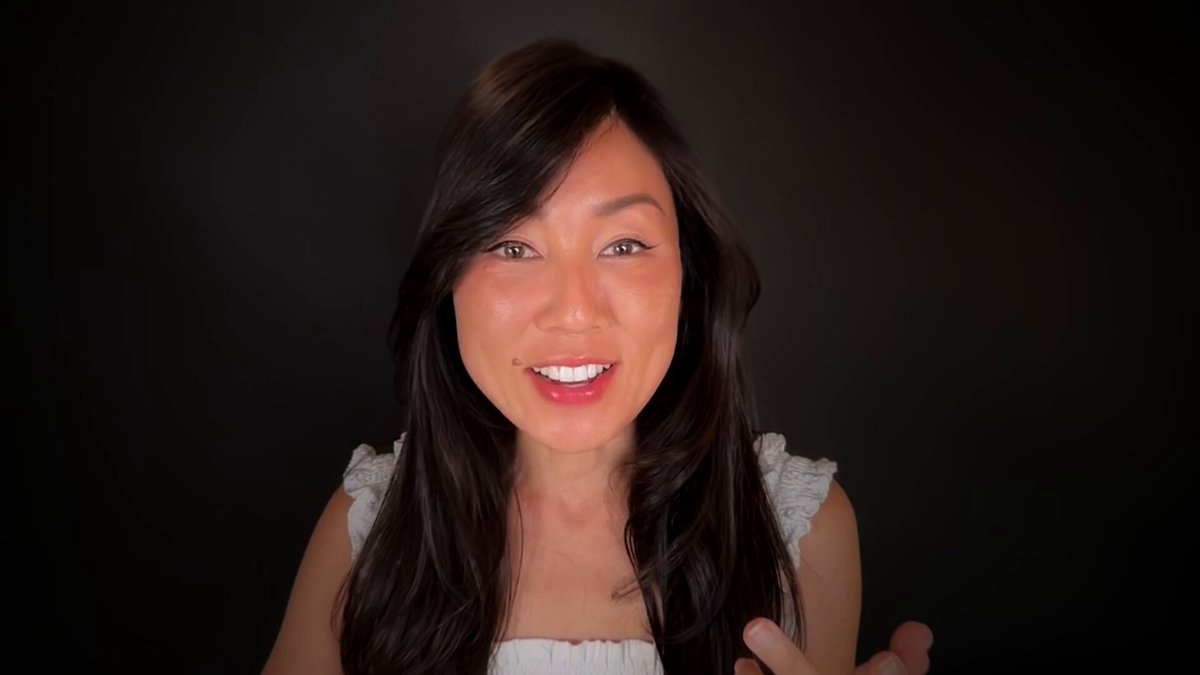
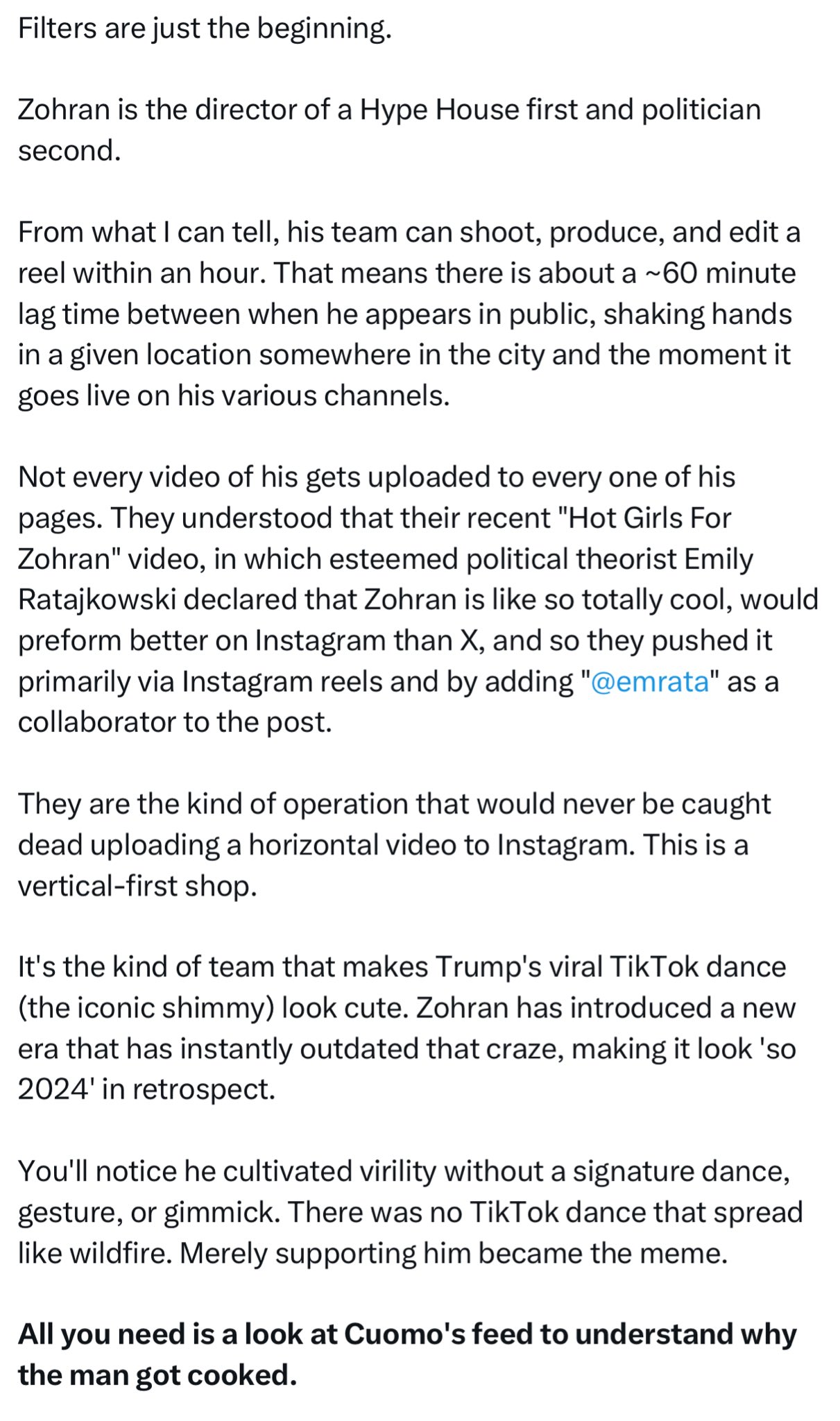
welcome to the psyop era i hope your cogsec is strong because it’s only going to get worse truth doesn’t matter anymore, the only thing that works is propaganda https://pbs.twimg.com/amplify_video_thumb/1937873441564102658/img/URd5anlnzlMRkhYu.jpg **Quoting @signulll:** > one under discussed part of the mamdani campaign was the usage of the video filters. every video used the same soft, humanizing tone consistently. > > it crafted a world around him. an aesthetic, almost utopian one. close shots, warm tones, delicate pacing. it framed him as the https://t.co/qJa77mCWmX
You can only talk about football if you’ve played in the NFL You can only know baseball history if you’ve played in the major leagues. You can only be an expert in professional wrestling if you are in WWE https://pbs.twimg.com/amplify_video_thumb/1910410369807638532/img/UX_5w0vNO7xHkFx_.jpg
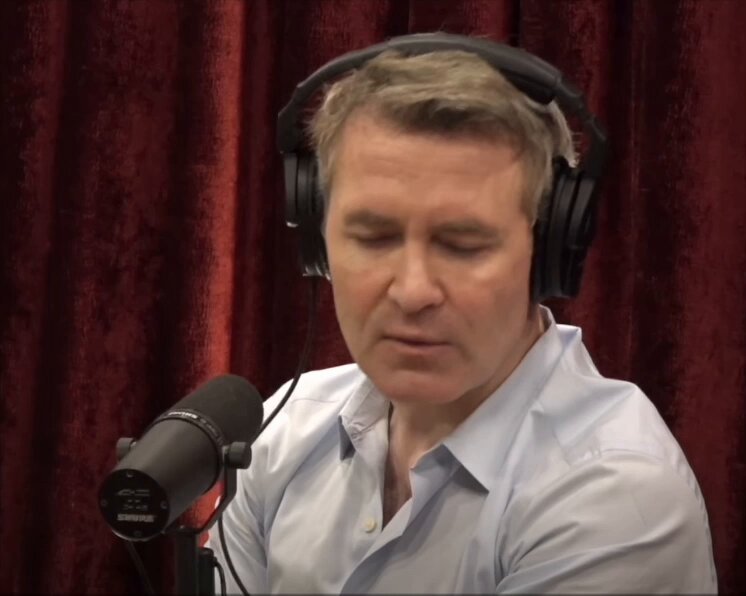
gm, it's Friday, go outside **The payload is the image, not the text.** A four-panel wojak meme. The crying wojak asks: > "WHAT IF PEOPLE THINK I'M CRINGE?" The bearded chad answers: > "YOU ARE TOO INVESTED IN HOW YOU ARE PERCIEVED TO TRULY ENJOY LIVING" *(The misspelling of "perceived" is the meme's own.)* The remaining panels show the chad embracing the crying wojak, who is then transfigured in gold and purple.
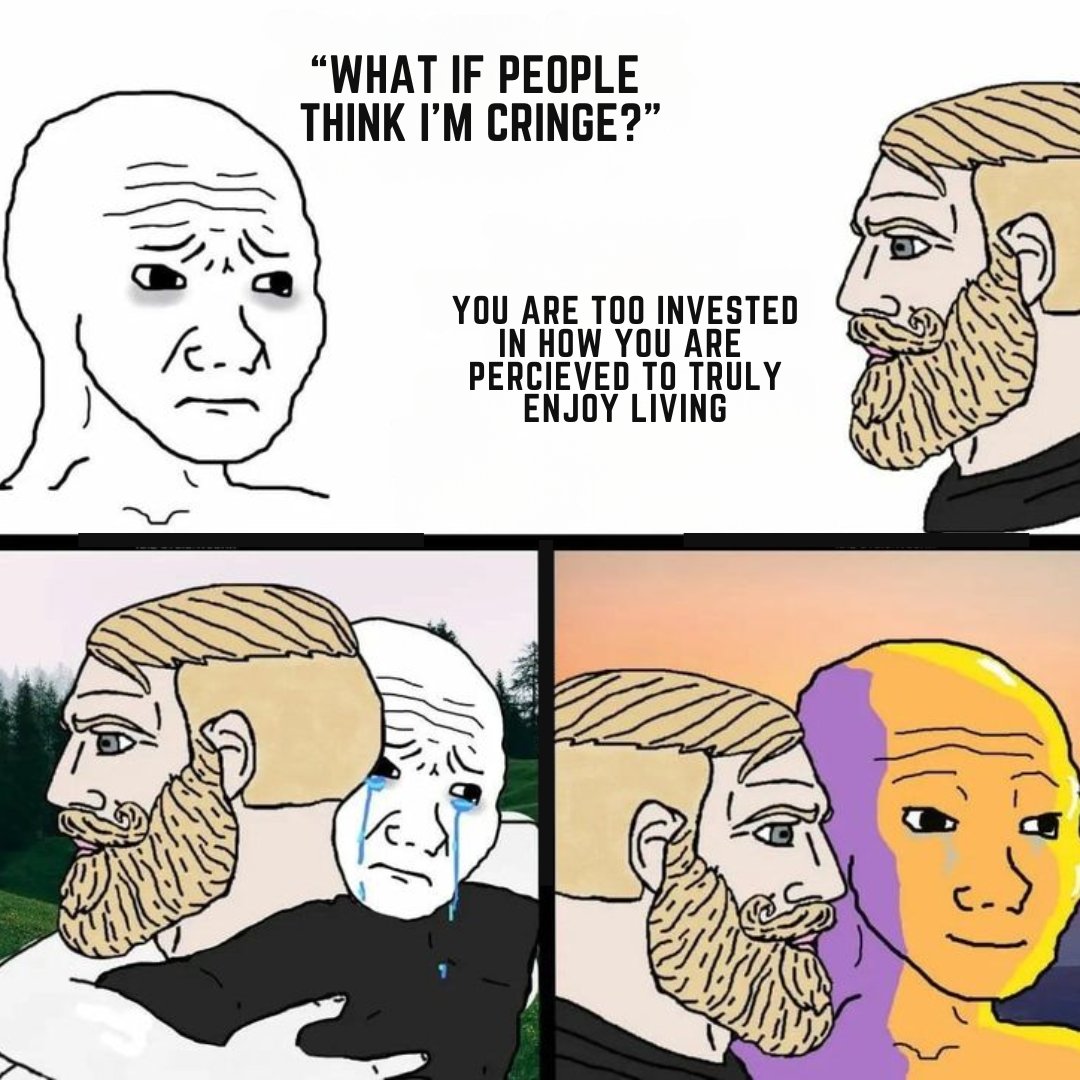
I’m often reminded of this letter from Lead Edge capital Companies choose which data to present -- ranging from "cash profits" to "being voted the best place to work in our city." https://t.co/PNphfEwPZp **Quoting @ShaanVP:** > the biggest poker tell is what metrics you choose to share > > If you share a vanity metric when you could have shared a substantive one, it’s an obvious tell you don’t have real metrics
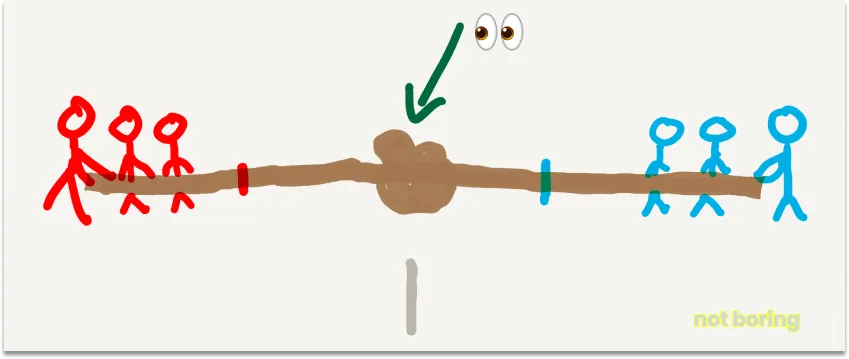
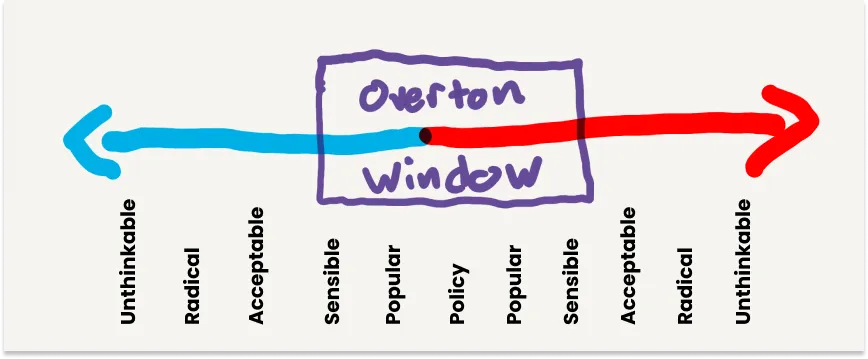
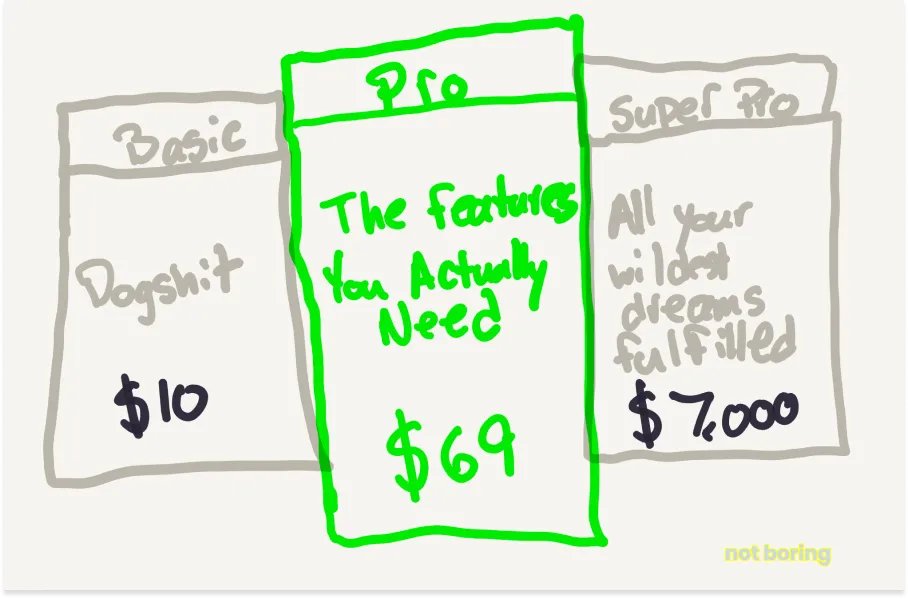
Narrative Tug-of-War One of the biggest changes to how I see the world over the past year or so is viewing ideological debates as games of narrative tug-of-war. For every narrative, there is an equal and opposite narrative. It’s practically predetermined, cultural physics. https://t.co/vOwz6OqtUs
Will AI content replace humans? No. Humans are OBSESSED with humans Examples: -We watch human races, not cheetahs -We watch human chess, not AI So? They may be smarter, faster, better…but we’re only interested in each other It’s fundamental — Ben Horowitz & @pmarca https://pbs.twimg.com/amplify_video_thumb/1714138264259506176/img/djv9tN8D8QwFiBn7.jpg
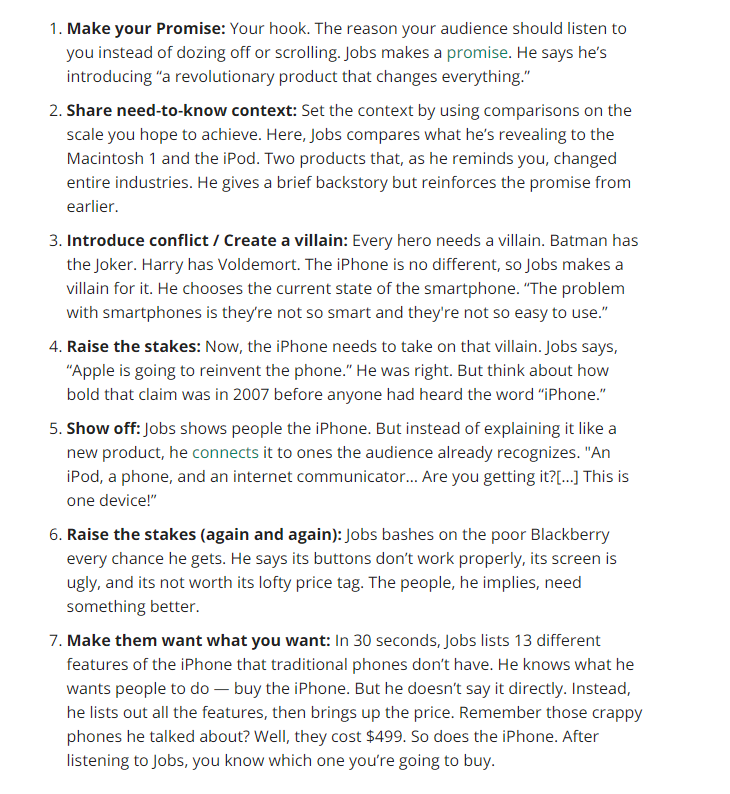
"The most powerful person in the world is the storyteller." - Steve Jobs Steve Jobs' Storytelling Framework by @nathanbaugh27 https://media.beehiiv.com/cdn-cgi/image/fit=scale-down,format=auto,onerror=redirect,quality=80/uploads/publication/logo/ab462f50-abc6-4cba-b57e-5a718bae4d82/thumb_WB_LOGO_NoWords__2_.png https://t.co/zhlmxHLD37
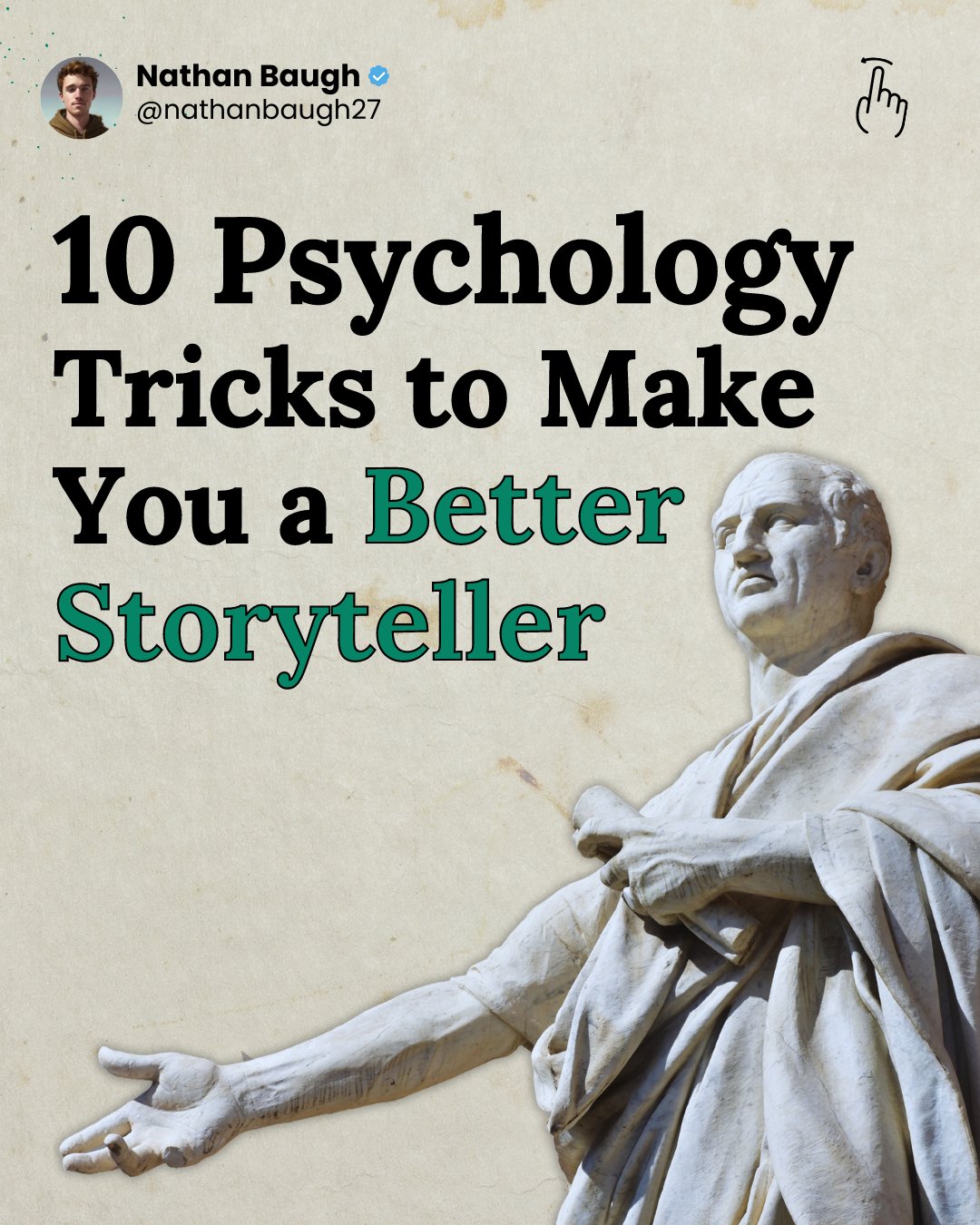
Storytelling is a game of psychology. 10 tricks rooted in psychology to make you a better storyteller: (a visual thread) 1. 2a. 2b. 3. 4. 5. 6. 7a. 7b. 8. 9. 10. I hope you enjoyed that! If so, follow me @nathanbaugh27 I study the best storytellers ever and share what I learn. Here's another one you might like: https://t.co/QXnAiCHmMO Tldr Jenga storytelling But, therefore "Not" Shared language Combined ideas Promise, Payoff Shapes of stories Signposts The rule of 3 Villains If you found this helpful, jump back to the top to like and retweet it. https://t.co/14HH3UcjoI These are some of my favorite storytelling tips I've come across. For more, I put together a list of the 25 best tactics and resources to help you become a better storyteller. You can grab that here: https://t.co/hr8eQKVk0b
"Reality is not external. Reality exists in the human mind, and nowhere else." ~George Orwell How the Authoritarian Party in ‘1984’ Controls Mind and Matter by Basil https://t.co/gAqzVKLf1m **Links in the tweet** (resolved 2026-09-29): - `https://t.co/gAqzVKLf1m` → https://baos.pub/how-the-authoritarian-party-in-1984-controls-mind-and-matter-60ff93ac2931?source=social.tw
Jun 15, 2023“The first principle is that you must not fool yourself and you are the easiest person to fool.” ~ Richard Feynman Why Smart People Believe Stupid Things, by @G_S_Bhogal https://t.co/RaGrjyI8Qy **Links in the tweet** (resolved 2026-09-29): - `https://t.co/RaGrjyI8Qy` → https://open.substack.com/pub/gurwinder/p/why-smart-people-hold-stupid-beliefs?utm_campaign=post&utm_medium=web
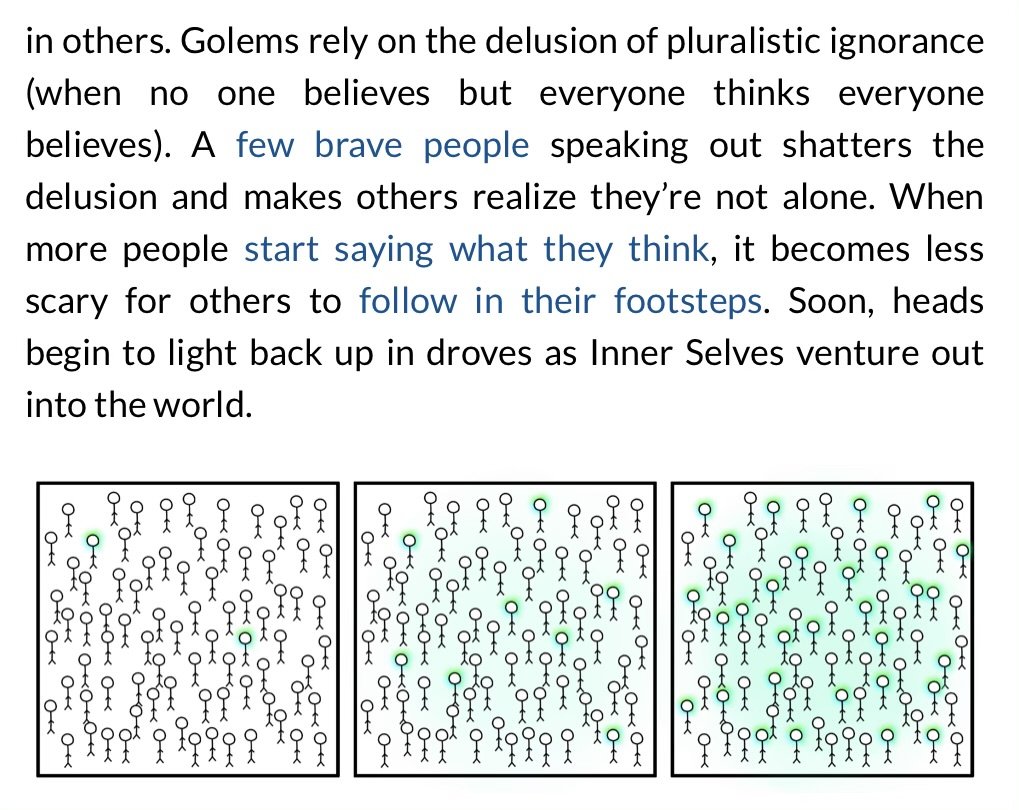
Mar 23, 2023My favorite thing about What's Our Problem? is that the book is @waitbutwhy's attempt to do what the book says we should do: speak out to shatter the delusion and light heads back up. I think it's going to work. https://t.co/6vGqKN4F9s
Are we in a recession? Doesn't matter, because... Your customers THINK they're in one. Here's data from 18.3k customers showing how buyer behavior changed almost instantly. READ: You should be changing your landing pages and email copy immediately. 🧵 The last few years I've run a landing page study comparing messaging: A. "Make you money" B. "Save you money" Notice the massive shift in last week's data. Same thing happened in COVID. Everyone now wants to "save money." Two things you should take away from this 👇 1. Re-evaluate all of your messaging NOW Don't blame a deprecating funnel on "the market" when you can respond to "the market." Outbound emails. Content. Webinars. Sales decks. All of it. Your customers are thinking differently. You need to speak to them differently. 2. Implement quarterly positioning studies Why didn't you change your messaging months ago? Because you went with your gut (or peer pressure internally). That's 💩. You're better than that. With proactive customer research your customers will tell you the *right* answers! OK. That's all for now. If you want more on how I got the data or how to run positioning studies just reply. If this was helpful, you should retweet to spread the data 🙏 https://t.co/4K50gW9B5I
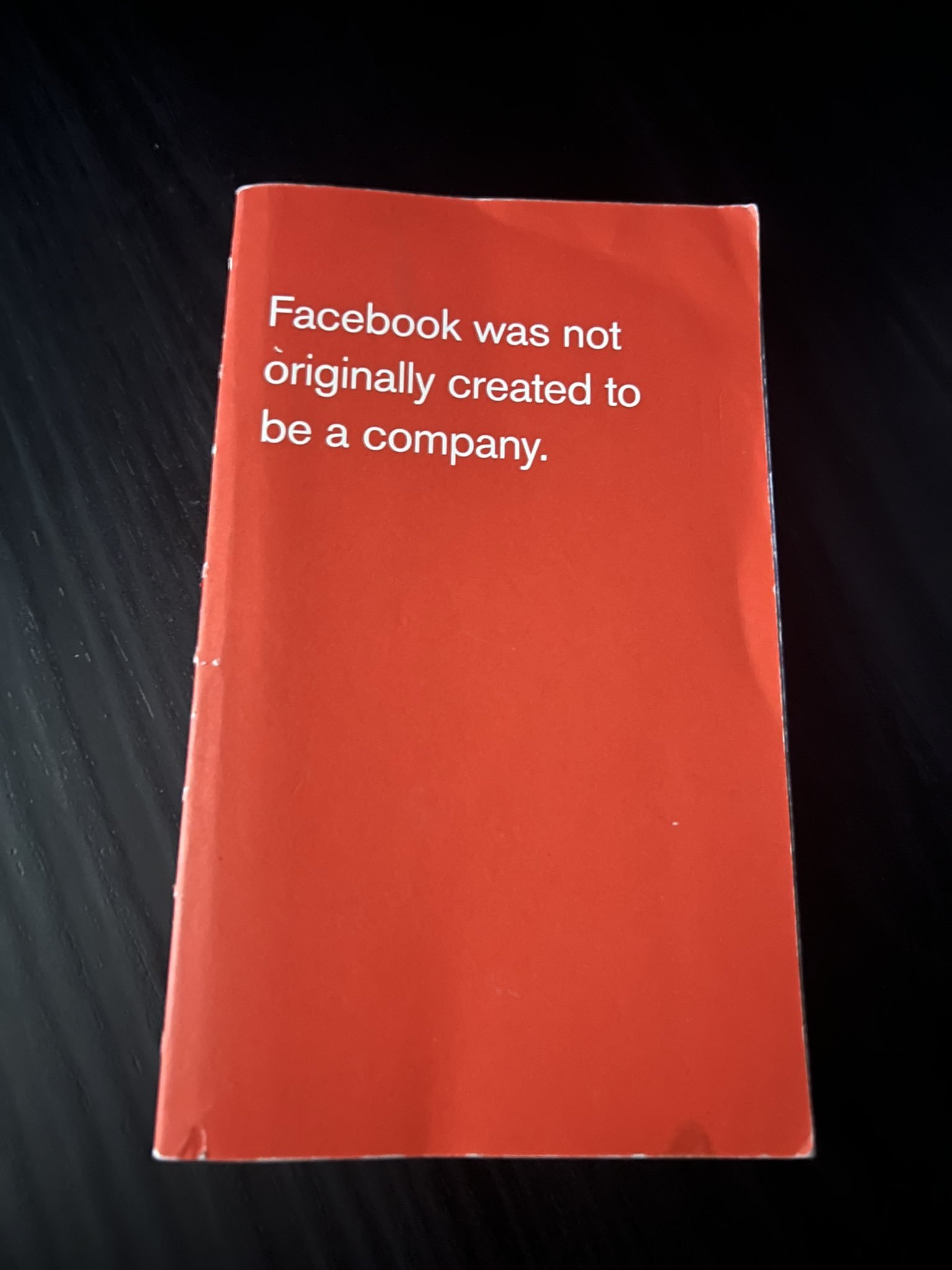
Feb 13, 2023Made the Facebook Red Book as PDF https://t.co/YrRDbO40QV (24MB) also found @benbarry's 2015 writeup about it https://t.co/e79HQzlseD (which has some higher quality scans but incomplete https://t.co/iGyYUWI5aj) https://t.co/POzVH12hS5
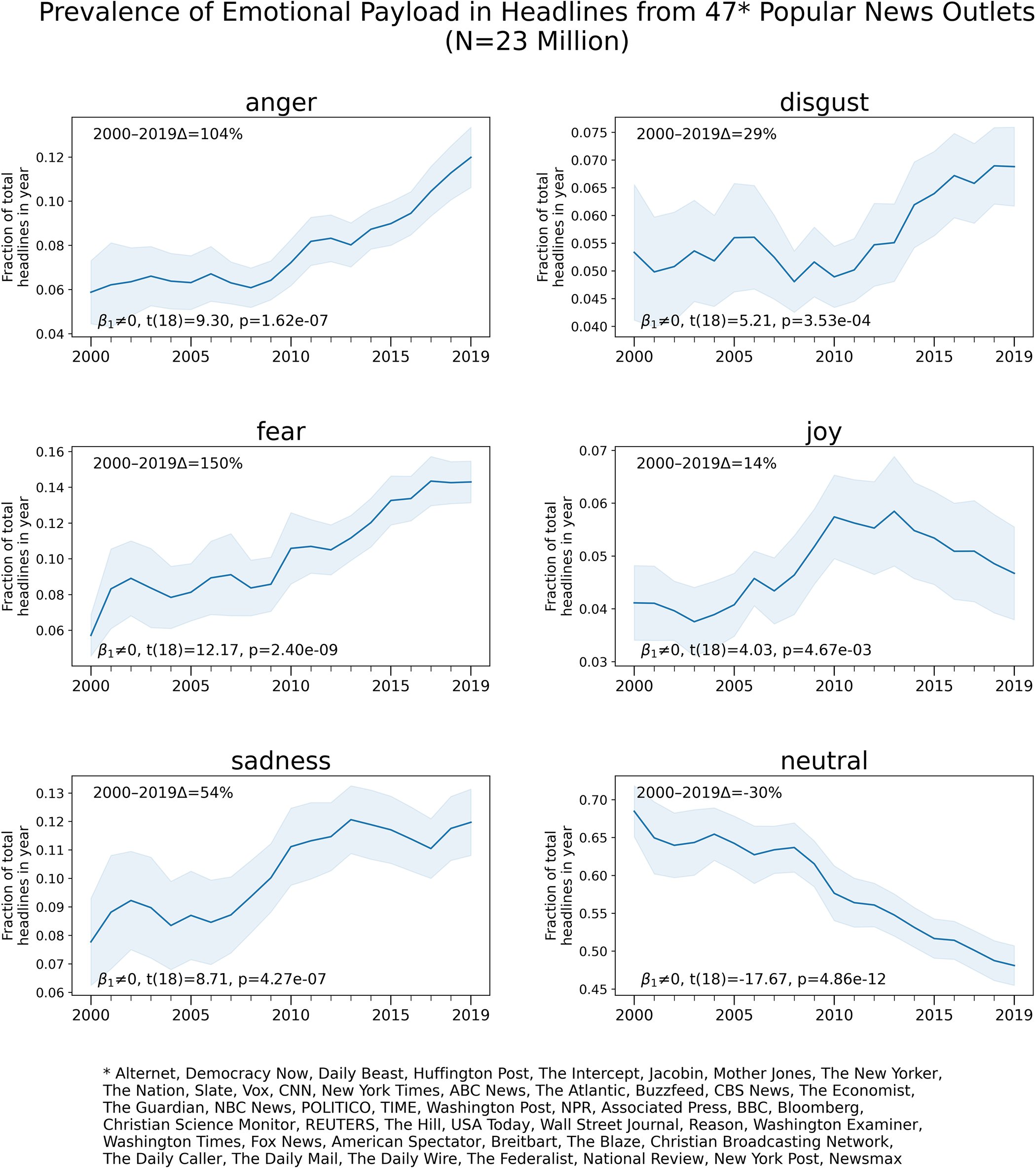
According to a new study by David Rozado, there has been a big increase in news headlines suggesting fear, anger, disgust, and sadness since 2000, and especially since about 2010. Journalists are pushing your buttons. Since 2000 headlines in right-leaning publications have always been more negative than those in left-leaning ones, but since 2010 the left has been following the right down. Headlines in politically neutral publications have almost always been less negative than those in right- or left-leaning ones. So Occam's razor implies that the cause of increased negativity is increased polarization. That would imply that people get angrier as they move toward political extremes, and that has been my experience. People on the far right and far left seem to be distinguished less by their joyful adherence to their own doctrines than their hatred of those on the other side. Here's the full paper: https://t.co/Tl9wPXH367
Giving a presentation tomorrow on narratives. Which companies are best at telling their story? Looking for less marketing copy/brand, and more writing/narrative building, although I recognize they’re linked. Bonus points for links to their best narrative work.
Oct 17, 2022Are we manifesting a recession? We seem to be in a Vibecession - a period of temporary vibe decline where the economic data says things are okay, but people aren’t. https://t.co/HHAbfIyoaX It is becoming increasingly clear that no one really knows what is going on - and there is a lot of “blame” to place on a lot of different things It’s really easy to type out all these words and say “yeah they were wrong” but it’s much harder to live in the reality of things being wrong Right now there are big differences in expectations, theory, and reality - which creates a lot of cognitive dissonance Consumer confidence metrics reflect that! People are worried and uncertain. And that creates a Vibecession Things are confusing and weird and stuff is improving but also getting worse - this compounds uncertainty and worry I will be doing a part 2 (sorry) and the podcast and YouTube will be up soon! https://t.co/rtvDB5avEe also thanks for all the answers to this q! it helped shape some of my thinking for this piece https://t.co/yUjEpXANku
Jun 30, 2022One of the most surprising things I've learned from social media is how widely used a tactic intellectual dishonesty is. I'd have expected it to be used mostly by bookish people, but it turns out to be far more widespread. Though of course it's all too likely that as well as merely exposing a surprisingly widespread taste for intellectual dishonesty, social media is making people more intellectually dishonest. Give people an op-ed column, and you turn them into editorialists.
Jun 24, 2022what a privilege it is to say that all frameworks suck ... that you should just vibe your way into anything you do. ... for sure, seeing frameworks as the end-goal, or claiming they are an end-goal, or selling them as the end-goal ... none of that is good. all models are wrong, some are useful (etc.) ... remember this? I think a lot of adults doing tech work would benefit from this "framework" Is it the only way to write? Absolutely not.
Jun 7, 2022 Original deleted — preserved hereMost Powerpoint presentations suck. I've produced 100's of presentations for CEO's and CFO's at a $1 billion company. Here's how to create an eye-catching presentation: Let me start by saying I am almost completely left brained. My creativity is awful. So if I could learn how to create an effective presentation, then anyone can. So here's how: Design Matters For a compelling deck, your design matters. From the typography to the colors. If you are not a creative please hire a designer or use pre-made templates. The Mighty Powerpoint Bundle is one of my favorites at a reasonable price. Use Powerful Visuals Don't fight human nature. Most people are visual. Stunning graphics and visuals are far more impactful than words on a page. 10/20/30 Rule Credit to someone I worked with that taught me this. -10 slides max -20 mins total presentation time -30 point font minimum This will also help you with brevity and clarity in your design and writing. Don't EVER Read Your Slides Unless there are blind people in your audience, assume everyone can read. Please don't read slides to them. It's honestly insulting. You are there to fill in the blanks for the audience with your speech. https://t.co/7n2DMnNk3y Study Storytelling All my presentations were financial in nature. Numbers, data, blah, blah blah, boring. To spice it up, sometimes you need to craft a narrative around your slides. Here is a great thread on storytelling by @dickiebush https://t.co/DkFf0OUyJ8 One Slide : One Idea A theme amongst many of the best presentations, is the minimalism. That goes for your ideas too. A slide is for an idea. Don't cram 5 talking points on one slide. It's distracting and we will only remember 1 point. Here are some other helpful tips: -Use Slide Numbers -Print Copies for All Attendees -Always E-Mail internally via pdf -Send externally via DocSend (can track viewings) -Write Clearly; Drop Jargon -Avoid Script Fonts (Readability) -Find Your Own Font (Can download many for free) We use these rules at The Fairfield Company to build our presentations. We have used our presentation to communicate internally as well as raise funds externally. Hope they can help you create more convincing presentations going forward. I hope you've found this thread helpful. Follow me @chrisxmunn for more. Like/Retweet the first tweet below if you can: https://t.co/5AuDJl1slZ
May 10, 2022 Original deleted — preserved hereOne thing I’ve learned lately: There’s little personal upside to calling bullshit when you believe it’s due There’s a lot of upside to be had being a perma-bull. Always hyping regardless of reality I choose the former. Intellectual honesty is worth it in the long run
May 8, 2022Third Point Q1 2022 letter: "To be an investor is to live constantly at the intersection of story and uncertainty." "Our net exposure is lower and buying power higher than at any time during the last 10 years." (@DanielSLoeb1) "We added to our single name shorts during Q1, replacing ... market hedges." "We initiated positions in oil and gas as well as in materials ... the companies will return in excess of 20% of their market caps annually should strip prices remain close to current levels" "Even after dramatic declines, it is difficult to call a bottom in the high-growth, high-valuation end of the tech sector. Many of these companies relied on stock-based compensation ... may have retention difficulties, leading to increased dilution or increased cash wages" "We fear Soros’s theory of reflexivity will come into play should such a spiral ensue." "We build our mental models, frameworks, and processes to try to accurately price securities and overlay them with a story about the economic, geopolitical, and psychological factors. The key, of course, is to change your framework when the environment changes." "Since I started Third Point 27 years ago, I have seen many investors (including myself) stumble after years of success because they did not adapt their models as conditions shifted." "I have said before that they don’t ring a bell when the rules of the game are changing, but if you listen closely, you can hear a dog whistle. This seems to be such a time to listen for that high-pitched sound." Shell "We have added to our position in Shell ... at same deeply discounted multiple today ... due to a move up in commodity prices. Shell’s LNG business will play a critical role in energy security for Europe ... the value of this business has increased dramatically" Glencore "A diversified miner that supplies copper and nickel, two metals that will be critical inputs for the transition to renewable energy. New management team, improved ESG profile, strong cash returns, ... substantial 28% discount at which it trades to other global miners" Third Point First Quarter 2022 Investor Letter May 6, 2022 https://t.co/dt3abx9YcJ
May 7, 20221/ On The 6529 COF (Cultural Object Framework) So I have a framework on how I think about cultural objects. I will share it. It is neither right nor wrong, like all frameworks it is just a tool. 2/ Let's start with Dunbar's Number which is the concept that we can only have about 150 stable social relationships. https://t.co/WEBzqpHgeU 3/ Researchers argue about whether the number or the mechanism is right, but I think none of that matters. I think it is pretty clear that you can't have 4,945 stable relationships. The number for most people is a 3 digit number, probably a lower 3 digit number 4/ Even if it is not a brain processing limit, it is for sure a physical limit of a different type: Time There is never ever ever enough time. Nobody has enough time to spend quality time with thousands of people. 5/ With a very optimistic view that you have 12 hrs/ day that you can dedicate to relationships of all types, that means 360 hours a month. At a couple of hours per month and perfect utilization of all your time on socialization, that is 180 stable relationships. 6/ There are variations of this idea: that you can have up to 1,500 loose acquaintances, that you can have 10-15 really close relationships that account for most of your time, and so on. The details don't matter so much. The key is we have cognitive or time based constraints. 7/ My proposed COF is that something similar exists for cultural objects: ✅We have a limit on how many cultural objects we can remember ✅We remember global, national, community, vocational objects The result of this is fractal power laws for cultural object success 8/ There are global cultural objects that most people on earth know: Coca-Cola, United States of America, Mona Lisa, Donald Trump and other similar cultural objects (brands, ideas, myths, memes) 9/ There are national cultural objects. In the United States, they may include: The Super Bowl, the Star Spangled Banner, Taco Bell, keg stands, the American Dream, Paul Revere, "I have a dream" 10/ There are local cultural objects. In downtown Manhattan, they may include: "South of Houston" (SoHo), steak frites at Raoul's, the Halloween Parade, Keith Haring, the SoHo loft, soup dumplings, a schmear of cream cheese. 11/ There are work (or hobby) related cultural objects. An investment banker might know "Liar's Poker" An photographer might know Ansel Adams and the "the rule of thirds" But a typical banker would not know "the rule of thirds", nor a typical photographer "Liar's Poker" 12/ Wait, an objection, these are just "things" Sure, they may also be physical things, but a steak frites late night at Raoul's in SoHo is as much a vibe as it is meat & potatoes. A schmear of cream cheese is an idea about NYC that is different than 87 grams of cream cheese 13/ I believe everyone's brain, at any point in time, is full of cultural objects. But they are not unlimited. I think it is a few thousand, maximum low tens of thousands of cultural objects for most people. 14/ I think most people if they started writing down, unaided, all their cultural objects they can remember will not get to hundreds of thousands. In any case, it is certainly not unlimited. 15/ I would love to know the cultural objects of Akureyri and Xi'an and Gitega. I would love to know the cultural objects of lobster fishermen in Alaska and pottery makers in Morocco and farmers in Sri Lanka. But life is short, we are bound by physics, I will never know them. 16/ So to recap, I believe: a) Everyone knows a few thousand, max low tens of thousands of cultural objects (memes) b) Everyone's cultural objects (memes) are split among global, national, local and work/hobby cultural objects 17/ True global cultural objects (memes) are the "power law" winners, there are very few of them, maybe a few dozen or low hundreds is my guess. If a meme has made it to 25%, 30%, 50% of the world population's minds, it is immensely powerful and valuable. 18/ National cultural objects in any decent sized country are also quite important, quite powerful. There also follow a power law distribution at the national level. The same applies on a smaller scale for local / job / hobby cultural objects 19/ You can summarize this as: cultural objects (memes) follow fractal power laws power laws = winners take most fractal = the same pattern repeats at different scales 20/ Now we know what we are playing for. 21/ New mediums, new distribution channels open up a portal for new cultural objects (memes) to gain traction. Today, NFT land is fighting over the global power law meme winners. Which collections, artists, memes may make it into the global pantheon of cultural objects 22/ It is why the battle for social construction is brutal and has just gotten started. My guess is 5 to 50 NFT based memes ever make it into the global pantheon of cultural objects. Those that do will be immensely powerful, but competition will be utterly unrelenting 23/ We know we are still playing in the 'global space' by the absence of serious national competitors. France has 67 million people, is proud of its language and I can't think of a single big PFP collection in French. Some day there will be dozens of big French PFP collections 24/ With this in mind, if you are an artist, you are a creator, what should you do? Go big or go focused. Nothing else is going to work and, in particular, any half-assed effort for "global" is dead on arrival. 25/ "Go big" means you want to be Coca-Cola, you want to be Nike, you want to be the Mona Lisa, you want to be Andy Warhol, you want to be the Queen of England. I wish you luck, it is a bold mission, and 99.999% of collections/artists are NGMI at this mission. 26/ "Go big" needs a lot of things to go right ✅In tune with the current vibe ✅Resources ✅Execution ✅Some idea on how you will leverage the network effects of the internet 27/ You can see how different collections are trying to play this. "Commercial rights" "CC0" "Utility" "Great art" "Team" "DAOs" "Metaverse" etc Nobody has figured it out yet, but the rate of evolution is very very fast 28/ "6529, I am just an artist, I just drop art, I don't do any of this" OK, maybe, but every artist who inspired you, themselves won a global power law outcome. The artists in the art history books memetically, one way or another, "defeated" 99.99999% of all art ever made. 29/ The alternative is to focus where vast opportunities exist, still completely untouched. You don't have to make a global brand to be super life successful, both in impact and in economics. And so far, that territory is unexplored in NFTs 30/ The key here is that being successful at the national, local, community, industry, hobby level is NOT the 2nd prize for failing at the global level. It is a different thing altogether. It requires focusing each part of your efforts on a more specific, narrower target 31/ To take a silly example. If you want to be the leading French language PFP collection, you make your collection in French, you get French influencers on-board, you outreach to the French community and you probably should be French to hit the vibe right 32/ My advice in this thread is mostly this - for 99% of artists and creators, it is better to focus to win a niche than to do the 489th best effort to go global. the 489th best global project is NGMI But hundreds of thousands of projects will make in aggregate 33/ And the trick to winning a niche is making something perfect for that niche, even if everyone else hates it. Of course, you have to pick a good niche, you need to understand that niche, you need to speak to it. Still hard, but more doable for most than "global" 34/ For professional collectors*, well the theory is easy, the execution is hard. With a global/national/local/industry lens, who makes it in 2025, in 2030? It is a feel mostly, but... * Amateurs should just buy what they like for fun 35/ ...the battles are just beginning. All the simple rules are going to fail. It is going to be harder and it will take some luck to be honest. The collections that make it will be unimaginably valuable and powerful. But most are NGMI at all 36/ So that is it, this is how I see it, it is the most exciting thing in the world right now, the battle for the cultural objects, myths and memes that run our societies. And a chance to see if we can architect them to better outcomes 37/ As always SEIZE THE MEMES OF PRODUCTION! 38/ If you are coming here for the first time, there are a lot of tweets about why an open metaverse is important here https://t.co/8HPXaRL1CF
Apr 24, 20221/ My friend Jon Haidt @JonHaidt has written the MOST important article you can read today... "Why the Past 10 Years of American Life Have Been Uniquely Stupid––it's not just a phase" https://t.co/8cx6uIiMnE **[Apr 17, 2022 · part 2](https://x.com/wolfejosh/status/1515783638348087304)** 2/ He begins by analogy to parable of Tower of Babel Noting THEY were fragmented by different languages While WE for causes he diagnoses are... "disoriented, unable to speak the same language or recognize the same truth. We are cut off from one another and from the past." https://t.co/gJ9aGayVap **[Apr 17, 2022 · part 3](https://x.com/wolfejosh/status/1515783639409299467)** 3/ Haidt describes what I like to call a "directional arrow of progress" of EVER more cooperation at EVER larger scales He invokes excellent must-read Robert Wright book NON-ZERO @robertwrighter (also author of Moral Animal) which reminds me of (Sims') Will Wright illustration https://t.co/zhfcp8dbfL **[Apr 17, 2022 · part 4](https://x.com/wolfejosh/status/1515783640491380745)** 4/ Here is Haidt on this directional arrow of progress toward non-zero cooperation https://t.co/g6nSMY5ikg **[Apr 17, 2022 · part 5](https://x.com/wolfejosh/status/1515783641430900737)** 5/ Haidt notes "The high point of techno-democratic optimism was arguably 2011, a yr that began w/the Arab Spring + ended w/ the global Occupy movement. And when Google Translate became available on virtually all smartphones making '11 the yr humanity rebuilt the Tower of Babel. https://t.co/vvnNCptjJ5 **[Apr 17, 2022 · part 6](https://x.com/wolfejosh/status/1515783642643148809)** 6/ Haidt notes in the BEGINNING social media helped maintain social ties (and was virtue)––but THEN as people felt comfortable sharing with strangers + co's––it became performative signaling + amplifying and exploitative. https://t.co/wuYU58wZJv **[Apr 17, 2022 · part 7](https://x.com/wolfejosh/status/1515783643700121602)** 7/ "This new game encouraged DISHONESTY and mob dynamics" "We might have just handed a 4-year old a loaded weapon. https://t.co/Brst6WA6h6 **[Apr 17, 2022 · part 8](https://x.com/wolfejosh/status/1515783644807413761)** 8/ "It was just this kind of twitchy + explosive spread of anger 😡that Madison had tried to protect us from in drafting the Constitution. The Framers were excellent social psychologists. The KEY🔑was to build in mechanisms to slow things down, cool passions, require compromise" https://t.co/J3PQXXhs6S **[Apr 17, 2022 · part 9](https://x.com/wolfejosh/status/1515783646141194244)** 9/ Haidt then turns to the EROSION of TRUST He invokes @mgurri the ex CIA analyst who predicted our fracturing (even without Russian + Chinese agents making it worse" https://t.co/IujX9WUVvQ **[Apr 17, 2022 · part 10](https://x.com/wolfejosh/status/1515783647676276742)** 10/ Haidt then turns to the importance of NORMS + INSTITUTIONS for error-correction + the ease today of tribes silencing not just critics but their own members from dissent––creating echo chamber + bubbles of homogenous belief–– & diversity breakdowns https://t.co/wZ4hCwDI6t **[Apr 17, 2022 · part 11](https://x.com/wolfejosh/status/1515783648817078279)** 11/ Haidt again quoting Gurri "The digital revolution has shattered that mirror, and now the public inhabits those broken pieces of glass. The public is highly fragmented + it’s basically mutually hostile––mostly people yelling at each other + living in bubbles https://t.co/oJIpuPAVwu **[Apr 17, 2022 · part 12](https://x.com/wolfejosh/status/1515783649861505030)** 12/ Haidt notes both the LEFT + RIGHT in different ways have been handed darts making each side STUPIDER and leading to CANCEL CULTURE + DEPLATFORMING + SOCIAL DEATH for anyone who doesn't self-censor or silence to as @pmarca would say "support the current thing" https://t.co/5iFRnbQALl **[Apr 17, 2022 · part 13](https://x.com/wolfejosh/status/1515784378504388616)** 13/ Haidt cites awesome work from @noUpside Renée DiResta on DISINFORMATION We already know Russia + China have exploited social media as a weapon turning our own technology + open systems on OURSELVES (the way hijackers turned our own planes on our own buildings)... https://t.co/UK0Zds100P **[Apr 17, 2022 · part 14](https://x.com/wolfejosh/status/1515786180767502339)** 14/ SO WHAT? What do we DO about it? @JonHaidt gives several prescriptions–– some touch on continuing phenomena he + @glukianoff first identified in "Coddling of The American Mind"–– on Gen Z not knowing how to resolve conflict, needing authorities + needing to just get OUT https://t.co/Dmb6GCFoMY **[Apr 17, 2022 · part 15](https://x.com/wolfejosh/status/1515786183166603273)** 15/ Here is full MUST-READ piece by my friend @JonHaidt on democracy after our disintegration... how it gets worse before it gets better and whether you want to continue to be part of the PROBLEM––or part of the SOLUTION... https://t.co/XIcNc2IlMH **Links resolved (t.co):** - `https://t.co/8cx6uIiMnE` → the attached media (saved locally above) - `https://t.co/gJ9aGayVap` → the attached media (saved locally above) - `https://t.co/zhfcp8dbfL` → the attached media (saved locally above) - `https://t.co/g6nSMY5ikg` → the attached media (saved locally above) - `https://t.co/vvnNCptjJ5` → the attached media (saved locally above) - `https://t.co/wuYU58wZJv` → the attached media (saved locally above) - `https://t.co/Brst6WA6h6` → the attached media (saved locally above) - `https://t.co/J3PQXXhs6S` → the attached media (saved locally above) - `https://t.co/IujX9WUVvQ` → the attached media (saved locally above) - `https://t.co/wZ4hCwDI6t` → the attached media (saved locally above) - `https://t.co/oJIpuPAVwu` → the attached media (saved locally above) - `https://t.co/5iFRnbQALl` → the attached media (saved locally above) - `https://t.co/UK0Zds100P` → the attached media (saved locally above) - `https://t.co/Dmb6GCFoMY` → the attached media (saved locally above) - `https://t.co/XIcNc2IlMH` → https://www.theatlantic.com/magazine/archive/2022/05/social-media-democracy-trust-babel/629369/
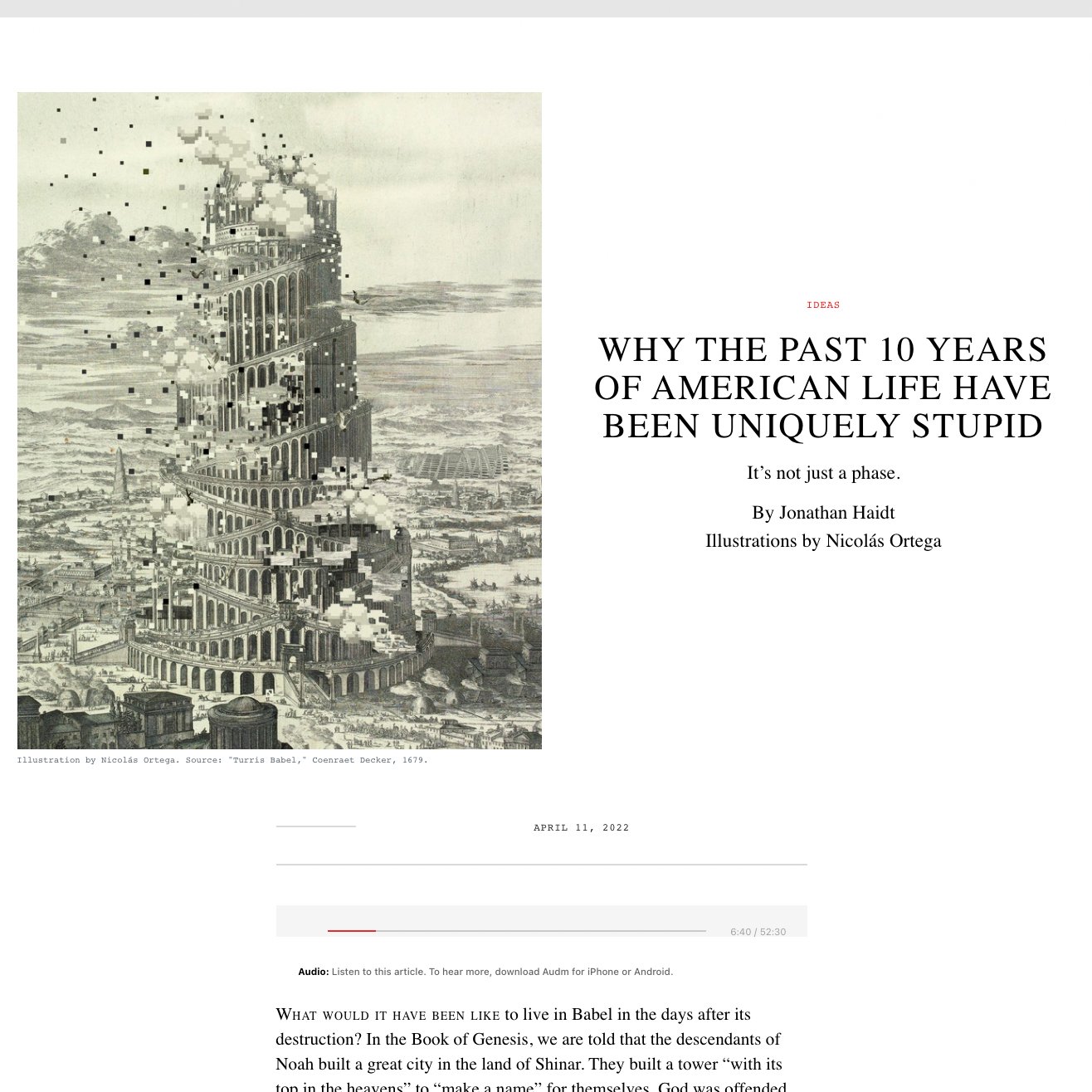
I've now been asked multiple times for my take on Elon's offer for Twitter. So fine, this is what I think about that. I will assume the takeover succeeds, and he takes Twitter private. (I have little knowledge/insight into how actual takeover battles work or play out) (long 🧵) I think if Elon takes over Twitter, he is in for a world of pain. He has no idea. There is this old culture of the internet, roughly Web 1.0 (late 90s) and early Web 2.0, pre-Facebook (pre-2005), that had a very strong free speech culture. This free speech idea arose out of a culture of late-90s America where the main people who were interested in censorship were religious conservatives. In practical terms, this meant that they would try to ban porn (or other imagined moral degeneracy) on the internet. (Remember when it seemed very important to certain people that we ban things like this?) Many of the older tech leaders today (@elonmusk, @pmarca, etc, GenXers basically) grew up with that internet. To them, the internet represented freedom, a new frontier, a flowering of the human spirit, and a great optimism that technology could birth a new golden age of mankind. I believe that too. But I also ran Reddit. Reddit was born in the last years of the "old internet" when free speech meant "freedom from religious conservatives trying to take down porn and sometimes first-person shooters." And so we tried to preserve that ideal. That is not what free speech is about today. It's not that the principle is no longer valid (it is), it's that the practical issues around upholding that principle are different, because the world has changed. The internet is not a "frontier" where people can go "to be free," it's where the entire world is now, and every culture war is being fought on it. It's the MAIN battlefield for our culture wars. It means that upholding free speech means you're not standing up against some religious conservatives lobbying to remove Judy Blume books from the library, it means you're standing up against EVERYONE, because every side is trying to take away the speech rights of the other side. (It's also where Russia is fighting a real war against us, using free speech literally. But that's another story too) Free speech may be noble, but here's what's it's like these days: All my left-wing woke friends are CONVINCED that the social media platforms uphold the white supremacist misogynistic patriarchy, and they have plenty of screenshots and evidence ... ... of times when the platform has made enforcement decisions unfairly against innocuous things they've said, and let far more egregious sexist/racist violations by the other side pass. Woke friends: it's true, right? You have LOTS of examples. All my alt/center-right/libertarian friends are CONVINCED the social media platforms uphold the woke BLM/Marxist/LGBTQ agenda and they ALSO have plenty of screenshots and evidence of times when... ... the platforms have made enforcement decisions unfair against them for innocuous things they've said merely questioning (in good faith) the woke orthodoxy, and let far more egregious violations by the other side stand. Right-wingers and libertarians: it's true, right? You can remember PLENTY of examples. Neither side is lying. Mostly, it's really because enforcement is hard, and there are LOTS of errors. There's a separate emerging problem (more FB than Twitter) where AI models make inhumane/dystopian judgments that can't be appealed, but that's a separate issue. Both sides think the platform is institutionally biased against them. "All the top executives and board members are men." "Silicon Valley employees are overwhelming woke and left-wing." I want you to pause for a minute and think about your political alignment and whether you're on the left or right of this issue, because you probably think one of those things. And the old GenX tech titans are right there with you - vaguely left-wing but also center-right - seeing their version of "censorship" - and drawing all the wrong conclusions from it about what's happening with the management of social platforms. Elon is one of those, because he doesn't understand what has happened to internet culture since 2004. Or as I call it, just culture. I KNOW he doesn't, because he was pretty late to Bitcoin, and if he'd been plugged in to internet culture he would've been on Bitcoin way earlier. Elon's been too busy doing Actual Real Things like making electric cars and reusable rockets and fucking actresses/singers, so he has a Pretty Fucking Good Excuse For Not Paying Attention but this is also something that's hard to understand unless you've RUN a social network. I'm now going to reveal the institutional bias of every large social network (i.e. FB, Twitter, Reddit): Are you ready? Here it is... They would like you (the users) to stop squabbling over stupid shit and causing drama so that they can spend their time writing more features and not have to adjudicate your stupid little fights. That's all. They DON'T CARE ABOUT POLITICS. They really don't. Donald Trump was not de-platformed for being right-wing. I talk a bit about this in my thread about Omega Events: https://t.co/rktOKjr7ze Yes, the execs are (whatever demographic) and the employees are (whatever politics) but they don't care about it. They don't. Facebook's userbase has at various times been left-leaning, then right-leaning, then bifurcated. So has Reddit's. Twitter's also. The social platforms don't care. They kind of care about money, but mostly they wish you would shut up and be civil. But that is impossible: they (we) made a platform where anyone can say anything, largely without consequence, so people are going to be their worst selves, and social networking is now The Internet, and everyone is on it (thank you @chamath), saying WHATEVER THE HELL THEY WANT. But the platforms have to be polite. They have to pretend to enforce fairness. They have to adopt "principles." Let me tell you: There are no real principles. They are just trying to be fair because if they weren't, everyone would yell LOUDER and the problem would be worse. What happens is that because of the fundamental structural nature of social networks, it is always possible for a corner case to emerge where people get into an explosive fight and the company running the social network has to step in. Again: Omega Events Because human variability and behavior is infinite. And when that happens, the social network has to make up a new rule, or "derive" it from some prior stated principle, and over time it's really just a tortured game of Twister. You really want to avoid censorship on social networks? Here is the solution: Stop arguing. Play nice. The catch: everyone has to do it at once. I guarantee you, if you do that, there will be NO CENSORSHIP OF ANY TOPIC on any social network. Because it is not TOPICS that are censored. It is BEHAVIOR. (This is why people on the left and people on the right both think they are being targeted) The problem with social networks is the SOCIAL (people) part. Not the NETWORK (company). "The best antidote to bad ideas is not to censor them, but to allow debate and better ideas." How naive. "Debate" is a vague term, and what a social network observes that causes them to "censor" something is masses of people engaging in "debate" - that is to say: abusive volumes of activity violating spam and harrassment rules, sometimes prompting off-site real-world harm. This is what you think of when you hear "debate." This is not what is happening on social networks today. Example: the "lab leak" theory (a controversial theory that is now probably true; I personally believe so) was "censored" at a certain time in the history of the pandemic because the "debate" included ... massive amounts of horrible behavior, spam-level posting, and abuse that spilled over into the real world - e.g. harrassment of public officials and doctors, racially-motivated crimes, etc. Why is this link not being censored now? Hypocrisy? Because the facts changed? https://t.co/mZ49lG6hJK It was "censored" not because it was a wrong idea, but because ideas really can - at certain times and places - become lightning rods for actual, physical, kinetic mob behavior. That is just an unpleasant, inconvenient truth that all of you (regardless of your political leaning) need to accept about speech. Ideas really ARE powerful, and like anything else that is powerful, yes, they can be DANGEROUS. I'm sorry, it's just true. It would have been perfectly acceptable if the lab leak theory were being discussed in a rational, evidence-based manner by scientists on Twitter, but that is not what happened. Replace "lab leak theory" with whatever topic you think has been unfairly censored, and the reason it was censored (or any other action taken against it) is not because of the content of that topic, I ABSOLUTELY ASSURE YOU. It is because at Certain Times, given Certain Circumstances, humans will Behave Badly when confronted with Certain Ideas, and if you are The Main Platform Where That Idea is Being Discussed, you cannot do NOTHING, because otherwise humans will continue behaving badly. Here is what I think about Twitter: I think the last few years of @Jack's administration have been the best years of Twitter's history. I think Jack really matured as an exec, his prior experience with Twitter, then his success with Square (i.e. doing it wrong, then doing it right) really raised him to a world-class CEO level, and Twitter finally got to be "pretty good." And "pretty good" is about as good as any social network can possibly be, in my opinion. (@Jack, if you are reading this, my hat's off to you. Saying this as one of the few people who have ever run a social platform: you showed the world how it should've been done) There is a reason why Jack has a crazy meditation routine and eats one meal a deal and goes on spiritual retreats. Because it takes an INHUMAN level of mentality to be able to run something like this. Because the problems are NOT about politics, or topics of discussion. They are about all the ways that humans misbehave when there are no immediately visible consequences, when talking to (essentially) strangers, and the endless ingenuity they display trying to get around rules. These last few years, @Jack did a really good job. And whoever the midwits were who didn't think so have kicked him out, and now Elon thinks he's going to come in and fix some problems. Elon is not going to fix some problems. I am absolutely sure of this. He has no idea what he's in for. (He might hire back Jack, which might be ok, but I don't know if Jack wants the job. Who knows. All the tech titans are buddies, kind of) Elon is going to try like heck to "fix" the problems he sees. Each problem he "fixes" will just cause 3 more problems. And the worst part, the part that is going to hurt ALL OF HUMANITY, is that this will distract from his mission at SpaceX and Tesla, because it's not just going to suck up his time and attention, IT WILL DAMAGE HIS PSYCHE. I mean, it's not like he isn't already an emotionally damaged guy. (Sorry Elon, it's pretty obvious) But he has overcome a lot. And he does not need more trauma from running Twitter. And I know I'm not just projecting my own traumas from the time of running Reddit, because: Mark Zuckerberg talks about e-foiling in the mornings to avoid having to think about bad news coming in that's like "being punched in the face." Ellen Pao was horrifically scarred by her run as Reddit CEO and the active harrassment, far beyond merely adjudicating community misbehavior. Jack has his meditation retreats and unusual diets and spiritual journeys - he's an odd guy yeah - but I'm pretty sure some of that is so he can cope with All You Fucking Assholes. Never heard much from Dick Costolo, but I haven't seen him do much stand-up improv since he left Twitter, have you? Dick might still be recovering. It's not a fun job, and it's not like how anyone on the outside imagines. Elon is a very public personality, and he will be faulted by ALL SIDES any time Twitter Does Anything to Solve A Problem, even if he isn't the CEO. "Why is chairman of the board @elonmusk standing by while @<newtwitterceo> is doing X, which is wrecking Y?" "@elonmusk, how can you allow X horrible thing to happen? I thought you were against censorship!" So: my take is this: @elonmusk, I'm all with you on the Values Of The Old Internet. This is not The Old Internet. That is gone. It is sad. It's not because the platforms killed it. It is because we brought all of our old horrible collective dysfunctions onto the internet, and the internet is very fast and everyone can say anything to anyone, and the place where that happens the most is on the social platforms. (It doesn't happen very often on e.g. Amazon, except when it does, and of course that's when Amazon Censors You!) After Reddit, I took a break, and now I work in the world of Real Atoms. https://t.co/S7FFMFaQ6z It is hard. It is VERY hard. Like eating glass, as Elon would put it. But it is not as hard as running a social network. And if Elon knows what's good for him AND HUMANITY, he won't do it - he will stick with the Real Atoms, which is what we really need. If you like this thread, here's some more stuff about what I'm working on and how you can support it: https://t.co/4NCsvumlw5 And if you want the Next Big Thing: https://t.co/2EBKnlmImL Addenda: a few people have interpreted this thread as meaning that I support or that it was a justification for censorship. (That is a reasonable misinterpretation) but it is not true. I am very much against censorship. I am, for example, against the censorship of every topic that the social networks blocked during the pandemic especially. I have personally been harmed by this. However, I also understand many non-obvious things about the complex dynamics that arise in large social network platforms, and I will tell you this: Censorship is inevitable on large social network platforms. If you run one of sufficient size, you will be FORCED to censor things. Not by governments, or even by "users," but by the emergent dynamics of the social network itself. Someone also said something like, "it's unacceptable that anyone be considered the omniscient arbiter of what's true or not" (sorry if I'm misquoting you; there's a lot of replies) I also agree with that. It is impossible for anyone to do, and also terrible. Yet, the structure and dynamics of running a large social network will FORCE you to do it. IIRC, almost every large social platform started out wanting to uphold free speech. They all buckle. And it's not because certain ideas are good or bad, or true or false. It has to do purely with operational issues that arise with humans that disagree in large numbers on digital platforms. The social platforms aren't censoring you (or some idea you like) because they disagree with you. They are censoring because they are large social platforms, and ideas are POWERFUL and DANGEROUS. (That is the whole point. Ideas wouldn't be worth much if they weren't dangerous or powerful. But you can't always control what people are going to do with powerful things) What they censor has little to do with what is true or false. It has a little bit to do with whatever the current politics are, but not in the way you probably expect. Let me be clear: if you run a large social network, you will be forced by inexorable circumstance to censor certain things, you will be forced to "arbitrate" on topics you have an (inevitably) limited understanding of, and it will all be really really shitty. (The alternative is just collapse of the platform, so I guess you do always have a choice - but then you're not a social platform anymore) The process through which all of that will happen is painful, which is why I don't think Elon should do it. It is not a good use of his time, and I think his time is uniquely valuable and limited.
Apr 15, 202216 Types of Headlines/Hooks ⤵️ 1/ Writing headlines (and hooks) is one of -- if not the most -- important thing you can learn as a writer. Copywriter, ghostwriter, journalist, blogger, Twitter thread-writer... it doesn't matter. 2/ As the great adman David Ogilvy once said: “On the average, five times as many people read the headline as read the body copy. When you have written your headline, you have spent eighty cents out of your dollar.” In other words... 3/ For ad copy, 80% of your writing depends on the headline. For news (which can be a good sub for content)... a 2014 @APNORC study via @washingtonpost revealed only 59% of people read past the headlines. For Twitter, the first tweet of your thread needs to hook them in. 4/ The headline's job is to... • Drive reaction • Grab attention • Prove relevance • Create curiosity • Generate emotion 5/ Or you can use Gary Bencivenga's checklist: • Urgent Problem • Unique Promise • Unquestionable Proof • User-Friendly Proposition 6/ OK, but how do you start? When I first started studying copy... I broke down and categorized headlines into the 4 @Insights colors. 🤓 I had just done the test myself. (I'm R/Y btw). 7/ Here are the four colors: 🟢 Green = Relationships (int/feel) 🔺 Red = Leadership (ext/think) 🟦 Blue = Analytical (int/think) ⭐ Yellow = Communication (ext/feel) Let's talk about each color... 8/ 🟢 Green = Relationships (introverted feelers) These are the nurturing types who have deep connections with the people in their lives. 9/ 🔺 Red = Leadership (extroverted thinkers) These are the determined, resolute people who often find themselves in leadership positions. 10/ 🟦 Blue = Analytical (introverted thinkers) These are the logical thinkers who map out every process, strategy, and plan. 11/ ⭐ Yellow = Communication These are the attention-starved fast-talkers who charm their way out of everything. 12/ So depending on what you're selling and who you're selling it to... I see each color as a COPY-VOICE that sells to a type of AUDIENCE 🟢 : Loving-Parent 🔺: Leader 🟦 : Reporter ⭐ : Dealmaker Let's talk about each one... 13/ 🟢 : Loving-Parent (Problem) This voice talks to prospects who are in pain... and need an ear first before you suggest a solution. This audience needs empathy. 14/ 🔺: Leader (Promise) This voice talks to prospects who are lost, uncertain, don't know where to go. They need somone to tell them what to do and how to do it. This audience needs education. 15/ 🟦 : Reporter (Proof) This voice talks to prospects who "don't know what they don't know". It's usually for confusing/complex markets with a lot of "inside-info" few are privy to. This audience needs exposés. 16/ ⭐ : Dealmaker (Proposition) This voice talks to prospects who are looking for a deal. They either run on emotions... or they've done their research already, so just make a offer! This audiences wants exchange. 17/ So again, in summary... Color: Voice (Tactic) | Audience Needs 🟢 : Loving-Parent (Problem) | Empathy 🔺: Leader (Promise) | Education 🟦 : Reporter (Proof) | Exposés ⭐ : Dealmaker (Proposition) | Exchange 18/ Now under each of the four colors... I've found 4 common types of headlines. So if... • You know what kind of AUDIENCE you're selling to... • Then you know what VOICE to use... • And you can write the best HEADLINES for that combo... For example... 19/ 🟢 : Loving-Parent (Problem) | Empathy Use these types of headlines: • Sick & Tired • Describe the Problem • Impossible Dream • They All Laughed... 20/ 🔺: Leader (Promise) | Education Use these types of headlines: • Gate Keeper • Miracle Worker • Life Changer • Doomsayer Prophet 21/ 🟦 : Reporter (Proof) | Exposés Use these types of headlines: • Conspiracy • Man Bites Dog • Breaking News • Unknown Scapegoat 22/ ⭐ : Dealmaker (Proposition) | Exchange Use these types of headlines: • Put Up or Shut Up • Throw Down the Gauntlet • Guarantee • Simply Benefits Driven 23/ OK, so those are your 16 headline types. And here's what I've done... I found fifty-eight (58) PROVEN headline templates and I've categorized them under each of the 16 headline types. I've put it into a one-page PDF for you. 👀 24/ Here's what I need you to do... RT the first tweet and I'll DM you the PDF. (Must be following me) https://t.co/gCQveu5P5K
Mar 15, 2022 Original deleted — preserved hereOver the past 8 years, I have written more than 5,000 articles online. And accumulated 100 million+ views on the process. But guess what? I use the same 5 headline styles every single time. Because they work. 🧵👇 1/ The List Everyone says they hate listicles. ...and then they click on them. Lists are an amazing way to organize information in a way that is skimmable for the reader. The key is: If you're going to write a "7 Ways To..." article, you better deliver on your promise. Here are some of my most-viral list article titles: • 20 Things Most People Learn Too Late In Life (5M+ views) • 19 Tiny Habits That Lead to Huge Results (2M+ views) • 20 Things Nobody Tells You About Growing Up (1M+ views) Lists work when the content DELIVERS. 2/ The Story The best stories compress a mountain of information into a small handful of words. As Winston Churchill said: "If I had more time, I would have written you a shorter letter." The key to writing a Story headline is this: Be CLEAR, not Clever. Writers think in order for it to be a "story," the title needs to be something mysterious. This is a myth. Ex: one of my most viral stories ever was: What I Learned Being Betrayed By My 6 Closest Friends Growing Up You 100% know what you're getting. https://t.co/OwSaqYoraM 3/ The Opinion If you're going to have an opinion, don't say it whilst sitting on the fence. Pick a side. Plant your flag in the ground. Stand for something. Rage war. If you want to be heard on the Internet (whether you like it or not), you need to be polarizing. Writers tend to misunderstand this advice and think they need to get political. Polarizing just means knowing who your content ISN'T for. And doubling-down on who it IS for. Avoid words like: • Maybe • Might • Sometimes And use words like: • Absolutely • Always 4/ The Question If you are writing to answer a specific question your reader has, consider stating their question in the headline (and teasing the answer). Ex: one of my most viral Q&A titles ever was: How Do You Reinvent Yourself? Use These 7 Tiny But Powerful Mental Shifts The secret here is DO NOT ANSWER THE QUESTION IN THE HEADLINE. Don't say: Want To Sleep Better? Give Up Coffee, Netflix, And Twitter Instead say: Want To Sleep Better? Give Up These 3 Everyday Guilty Pleasures You have to create a curiosity gap for the reader. 5/ The Framework My favorite headline style of all. Readers LOVE frameworks. It feels like you're handing them a package with a note on top that says: "Do this, it's a shortcut." Frameworks can be: • How To guides • Templates • Exercises • Etc. https://t.co/tTTyN8Jxpk But in a Framework headline, there are 3 big things you need to communicate: • What's the name of the framework? • Who is it for? • And why is it so helpful/important? Ex: The Endless Idea Generator: A Simple 5-Step Process For Generating 100 Article Ideas In 30 Minutes 99% of viral content on the Internet fits within these 5 headline styles (whether you realize it or not). They are everywhere. Look at the next news notification on your phone—I bet it fits one of these styles. So, use what works. And make it your own. If you want to go down the rabbit hole of writing online, proven styles, headline formulas, etc., here's a great resource to get you started: https://t.co/T4CysXEIBl
Feb 24, 2022Most people suck at storytelling. Here’s an easy trick for telling better stories: When I’m telling a story, sometimes I get nervous. I can’t tell what my audience is thinking. Are they silently enthralled–or asleep? 👀 Ideally, you want the confidence to know: ✔️ Does my audience care? ✔️ How do I know what to say? ✔️ Am I giving too much detail? Here’s a simple trick: Aim to make your audience’s *eyes light up*. I call it ELU for short. The ELU moment happens when your audience is viscerally excited about your story. When your audience’s eyes light up: • Their energy level shifts • They perk up and look alive • They are actively here with you These are the clues you’re on the right track. The key: Stack as many Eyes Light Up moments as possible. The best stories are one ELU moment after another. That’s why they feel fast-paced, with rhythm and momentum. Have you noticed you’re best at telling stories you’ve told 100 times? It’s because you know exactly what all the ELU moments are! You know when people will gasp, frown, or hold their breath. Translation: You know the eyes light up moments. And you’re stacking them hard. ELU will tell you everything you need to know about how your audience feels. People are not great at acting. They can’t hide their emotions. They might say “That’s interesting…” But their face shows they’re almost asleep. They’re trying to be polite. If your audience looks dead, change what you’re talking about. Boring parts? Trim it. Backstory no one cares about? Trim it. Going down a rabbit hole and your audience looks confused? Trim it. Get back on track. Get back to making their eyes light up. We all know what makes a good story: • Conflict • Narrative arc • Stakes that make the audience care • Show, not tell • Etc etc etc It’s hard. But one thing is for sure: You don’t tell a great story simply because you memorized a bunch of tactics about storytelling. When you’re too focused on tactics, you miss out on the most important thing: Getting data about what is resonating with your audience. When I say “data,” I don’t mean numbers. I mean qualitative data… Like how their face looks. People lie, but faces don’t. “The problem with market research is that people don't think how they feel, they don't say what they think and they don't do what they say." Ogilvy said it best. You can’t trust what people say. So don’t just listen to what they say. Watch for how they behave. How to apply this in your daily work: Practice different versions of your story. Meet 15 people at a party? Test 15 different ways to tell your story. Notice when their eyes light up (& when their eyes glaze over). Refine accordingly. For personal stories: You’ll see which parts get your audience on the edge of their seats. For product and company stories: You’ll understand what your customer is most excited to hear about. Cut out all the boring parts your customer or audience doesn’t care about. Yep, kill those darlings. You want to save room for the good parts. https://t.co/vv9wtRaLuI The Eyes Light Up framework will help you answer: ✔️ What parts do prospective customers actually care about? ✔️ What should you spend more time talking about? ✔️ What keywords get them to perk up? You should definitely still learn storytelling strategies and tactics. There are plenty and there’s no limit to how good of a storyteller you can be. But when you’re in the moment telling your story? Stay present. Watch for what gets your audience’s eyes to light up. That’s it for today. If you found this thread valuable: 1. Follow me for more threads on entrepreneurship, education, and marketing → @wes_kao 2. Maven is hiring. Come join a fast-paced, high-performing team that's building the future of education https://t.co/vkujvtWZES
Feb 19, 2022How Adobe tricks users into a 12 month contract. Thread. The homepage starts with a very clear offer. "Starting at £49.84/mo". Let's click the "Free trial" button. The next page has very little information on it. "7 days free, then £49.94/mo". Let's click the "Start free trial" button. This page seems innocent enough. "7-day trial"... "Due now £0.00". ... Recurring billing starts only after your 7-day free trial ends". That sounds nice. Most people will think "Gee that's great, where's my credit card?" But what does "Annual plan, paid monthly" actually mean? Let's fill in our email address and press continue. Maybe that's explained on the next page. By clicking "Start free trial", we're tied into a clickwrap agreement (though you'd be forgiven for not noticing the tiny writing). "By starting my 7-day free trial, I am beginning a subscription and I agree to the subscription and cancellation terms and Terms of Use" We're now venturing into territory where most people probably don't go. Let's click the "subscription and cancellation terms" link. What's all this tiny grey writing? Funny how the heading "Enjoy your 7 day free trial!" is so big, yet this text is so very small and feint. Blah blah blah. Nothing remarkable here. But wait! What's that at the bottom, "Cancellation Terms:" Can I scroll? Ooh, I can scroll. That was not obvious at all. "Should you cancel after 14 days, you'll be charged a lump sum of 50% of your remaining contractual obligation and your service will continue until the end of the month's billing period" What does this mean? It took me a while to get the facts, but it turns out that by clicking "Start free trial", we are tied into an annual contract. It's just shy of £50 a month. £50x12 months = £600. If we want to leave, we have to pay 50% of the outstanding ANNUAL BALANCE! E.g. If we want to leave in the first month, we're on the hook for ≈£300. Plus, our access to the products get cut off at the end of the first month. After a bit of googling I found this article on adobe's website that explains it a bit better. https://t.co/0yYhG3vxUK Let's recap: 1. The total annual cost was hidden 2. The 50% cancellation free was hidden. 3. The clickwrap agreement text was much smaller than the sales text (e.g. "£0.00", "Start free trial") 4. The cancellation terms were hard to find Should this be permitted? Here's a (now deleted) thread from last year that can be found on the internet archive wayback machine: https://t.co/XPAEJaARg9
Feb 5, 2022 Original deleted — preserved heremost people's writing is boring, or too complicated. here's 7 things that will make you a better writer. Let's start with the most non-obvious tip: 1 - look at what I did in the first tweet. I created a "curiosity gap" ---> what are the 7 things? ...then I punched it up "let's start with the least obvious one" ---> ooh, I wonder what it is the goal of line 1 is to get you to line #2. Practice curiosity gaps. #2 - Copy other people wanna learn music? Play covers of songs wanna learn to cook? Use recipes wanna learn to write? Start by HANDWRITING someone elses writing that you like. It's called "copywork". It is the cure for writers block. Do this or else...*dun dun dunnnn* #3 - Write like you talk see how I put a sound effect at the end of the last tweet? It's like I'm talking out loud. Here's a tip. if you don't know what to write, just start talking out loud. Then write down what you said. Then go back and delete the umms & extra words #4 - Forget What You Learned In School Schools reward you for: - using big words - and writing long essays ("minimum word count") The real world is the opposite. Great writing is: - simple words - shorter the better #5 - Write like a boss Writing is a killer way to stand out inside a company. Here's a simple format on how to write inside a company: WHAT, WHY, SO WHAT? eg. WHAT happened? WHY did it happen? SO WHAT are we gonna do about it? Those 3 = clear crisp communication It works for stuff that happened AND for things that are coming up (eg. launching a new project) WHAT are we going to do ? WHY are we going to do it ? SO WHAT do we need you to do? #6 - EMOTION is the goal Most people think writing is about transferring INFORMATION but writing is actually about transferring EMOTION Emotion gets people to take action (like, share, buy, etc.), not information. Fear, Greed, Anger, Hope, Love, Certainty are your tools #7 - Practice. Ok this is the obvious one. You get good at anything through practice & coaching. You gotta get reps. And if you want coaching, I teach a course called Power Writing (https://t.co/b2uSPdS6yS) a few times a year to go in detail on each one of these & more not a bad sales letter eh?
Feb 2, 2022Business writing remains underrated. Just had chance to go through Amazon’s PRFAQ process with a leader there and it reminded me: writing forces clarity of thought in a way nothing else can. You write to learn what you really mean with an idea. When you write you can’t hide.
Jan 28, 2022I wish more people reverted to 5-10 slides over 5-20 page document (or 3 page doc mainly images & takeaways) Long form documents & memos increasingly feel like lazy avoid doing active synthesis "Dump all thinking / let reader think it through" vs "synthesize & think" for reader This is just a trend / pendulum in how companies conduct business Used to be too much bloated slideware and 50 slide decks Then people copied Amazon memo approach Now we have bloated memos instead....
Dec 9, 2021 Original deleted — preserved hereWriting education is broken. Here's how we can improve it: Problem #1: Teachers don't tell students why writing is important. Great writers have a stamp in the record of history. Warriors define the years. Philosophers define the centuries. Good writers can make more money, attract like-minded people, and shape history from their couch. Problem #2: Students only write for the teacher. Imagine if only one person ever read your writing. You wouldn't write much. Kids should write for an audience. Once their ideas spread, they'll get hooked on the craft. As a friend says: "Compliments lead to competence." Problem #3: Students don't learn digital note-taking: Question: You've spent hours in a classroom, but where are your notes? Chances are, you have no idea. The better your system for saving and searching through ideas, the more deliberately you can develop your own over time. Problem #4: English departments teach writing: Unlike real life, writing education is focused on five-paragraph essays, most of which are about literature. But writing is so much more than book reports. For example, good business writing is highly rewarded in the workplace. Problem #5: Our essays disappear: Ideas are forgotten when people aren't encouraged to save them. Publish your best writing on a forum or a personal website. Then, share those ideas with friends, family, and strangers who'd be interested. Problem #6: Left-brained myopia: Most writing education is focused on the logical side of the brain, such as grammar & syntax. But what about the right side of the brain? Teachers should stress the importance of play, emotion, and conversation in the writing process. Problem #7: School writing is a solo experience: We're taught to write by sitting in a quiet room and focusing on the computer. But our best ideas often come by talking. Conversations are the first draft of our thinking. The better your conversations, the better your ideas. Problem #8: Students don't have enough agency: Kids are obsession machines. But those obsessions don't always look serious to adults who force them to focus on academic subjects instead. Let kids choose the topic. The more passionate they are, the faster they'll learn to write. Problem #9: Writing doesn't feel relevant: If you want to get things done in the world, you have to think clearly. Writing helps you sharpen your thinking and get what you want. If you're a kid, writing can help you raise your allowance or get that exciting new video game. If we want kids to write, we have to de-emphasize five-paragraph book reports and show kids why writing well is so useful. Writing makes the world come alive. If you want to read the full thread, here's a screenshot.
Dec 2, 2021The greatest founders in the world all have something in common. A "founder story" that's a massive marketing asset. Follow this 7-step framework to create yours... [🧵thread] 1/ The Obstacle To start, it's important that your audience can relate to your story. And there's one critical thing that's relatable to anyone: Overcoming an obstacle. My example: I got fired 3 times by the time I was 28 and was basically a failure heading into 2010. 2/ The Internal Struggles Internal struggles are how we feel inside because of the obstacle above. Internal pain is captured with words like fearful, insecure, or worried. My example: After getting fired 3x, I was worried that I was never going to be successful at anything. 3/ The External Struggles External struggles can be seen or heard. An over-drafted bank account, a lost job, a poor living situation. My example: My buddies made fun of me for living in tiny towns & getting fired. A girlfriend even dumped me because I had too much debt. 4/ The Change Event The change event is the critical decision you made that leads you from your struggle to your newfound transformation. My example: I took a bus ride from Allentown, Pennsylvania to New York City to interview at a small technology company called ZocDoc. 5/ The Spark The spark is that magic moment when you realize everything is about to change. When you went from feeling completely disconnected to reinvigorated. My example: When I started working at ZocDoc, I was sparked by the product, the people, and the energy of the city. 6/ The Guide The guide in the story is the person who lifts you up and helps you see your potential for what it really is. My example: After years of making no sales in my previous jobs, my boss Ryan went out with me on my first day and helped me make a sale. 7/ The Result The result is the continuation of the story to even greater success, leading up to your present situation. My example: I never looked back. I got promoted multiple times and went on to become an executive at a startup company in LA at age 33. Telling a compelling story isn't just for startup founders, though. It's for anyone building a business online. And everyone who has a story you admire has absolutely crafted it. Here's a simple cheat sheet you can reference when you're putting yours together: Practicing yours using the 7 steps gives you a consistent answer to the "tell us your backstory" question. It's great for: - Content - Podcasts - Webinars - Your "about" section - Sharing with prospects When you get it right, it's a massive sales & marketing asset. Well, that's all for today. If this was helpful, feel free to RT or give me a follow. I'm currently building 4, one-person businesses to over $5M in revenue. Have any questions? Ask away. Happy to give out as many helpful tips as I can muster today. Thanks for reading.
Nov 23, 2021"I never understand anything until I have written about it." – Horace Walpole
Nov 20, 2021Want to accelerate your career? Write better. THREAD: The principles of powerful business writing: What do Buffett, Musk, & Bezos have in common (besides $$$)? They know powerful writing isn't an accident—clear writing is clear thinking. The principles of great business writing: • Draft Fast, Edit Slow • KISS • Clear Target Reaction • Storytelling Let's cover each: Principle 1: Draft Fast, Edit Slow There's nothing more daunting than a blank page. So start fast—get a draft down (and don’t fret if it sucks). My friend @Julian said it best: “Making something bad then iterating until it’s good is faster than making something good upfront.” My "Write-Rest-Review" framework: Get the first draft down as quickly as possible. Walk away for 5 minutes—go for a walk, grab a coffee, whatever. Come back and review it. What's missing? Where are the logical flaws? When you review with "new" eyes, good things happen. Principle 2: Keep It Simple, Stupid Most people assume that longer, more complex writing will impress and inspire. It doesn't. Great business writing is simple and direct. There's no fluff or handwaving—it's tactical. A few actionable tips to tighten and simplify: Cut the Fluff In school, we were taught to heap descriptors into our writing—we were told it made it more vibrant. (It also helped fill out the word or page count we were forced to hit!) In the real world, those fluff words are assassins of punchy, powerful business writing. Review your draft with an eye towards removing any unnecessary words & sentences. Some common fluff: • "I think X" • "very" (or similar adverbs) • Acronyms • Jargon • $10 words (fancy for no reason) Be ruthless in identifying and eliminating the fluff words & sentences. Shorten Everything Powerful business writing is very similar to powerful Twitter writing. Shorter is better. Use short sentence structures. Space sentences or paragraphs out to make the writing more optically pleasing. Great business writing should be engaging to the eye. Add Data This is a classic principle instilled by @JeffBezos in Amazon's writing-centric culture. Replace fluff words with data. Before: "The majority of viewers loved the show." After: "95% of viewers rated the show with 5-stars." Clear & much more impactful. Principle 3: Clear Target Reaction Great business writing has a clear target reaction—a deliberate purpose or aim. That target reaction should be experienced by the reader immediately. As my friend @SamParr says: "Punch the reader in the face with your first sentence." Amazon calls it the "so what?" test. Before you share any piece of business writing, identify the "so what?" of the piece. What reaction, value, or takeaway should the audience have? Is it coming across loud and clear? If not, go back to the drawing board and punch harder. Principle 4: Storytelling Storytelling is a foundational skill—but it's one we don’t learn in the traditional education system. It's no coincidence that the greatest CEOs & founders are the greatest storytellers. High-leverage storytelling is a supercharger for all endeavors. Humans are storytelling creatures—we developed around campfires. Lean into it. Adding a story to a memo on a dry topic can bring the entire piece to life. Simple, crisp stories enhance the power of the message. Here's a thread I wrote on principles of effective storytelling: https://t.co/xOfxIcSidi A few ideas (without contradicting the KISS principle): Add a mini anecdote to illustrate a point. Use a folksy one-liner to draw people in (Warren Buffett and Charlie Munger are the MASTERS of this). A storytelling touch will make your writing punch well above its weight. Better business writing can change your life. To summarize, the key principles: • Draft Fast, Edit Slow • KISS • Clear Target Reaction • Storytelling Start using these and I guarantee you will see improvement. Follow me @SahilBloom for more threads on business and finance! I write deep dives on these topics in my newsletter—enhanced by audio versions and visuals—every single week. Join the 45,000+ others and subscribe below so you don’t miss them. https://t.co/qMB8i60ney And if you are a job seeker looking to leverage improved business writing to level up your career, check out my job board, where I share unique roles in tech and finance every single week. https://t.co/OrTeubzGii For more on business writing, I recommend following @Alexgarcia_atx—his work has been foundational to my own development and thinking on these topics. A few more of my favorite accounts for learning about writing: @amandanat @david_perell @wes_kao @ShaanVP
Nov 13, 2021What do Buffet, @patrickc, Gates, and Bezos have in common? Obviously, they're really rich. But, all are also very strong writers. So, I spent this past weekend studying how to write better. Here are the 10 biggest things I learned. 1/x 1/ Don’t Mumble. When you have something to say, just say it. So many writers bury their point. Or hide it at the end! That may be how the narrative is in your brain. But people want you to get to the point ASAP! 2/ Use Short Everything Nobody wants to read your long-ass rambling. It slows readers down. Use short sentences, words, and paragraphs. 3/ Use Thrift A River Runs Through It has a great movie scene. The dad schools his son at home. He forces the son to rewrite his work over and over. “Again, half as long,” he says. Always ask, “How can I make this shorter?” I try to remove 50% of words twice before I'm done 4/ Write for 4th Graders Great business writing targets a 4th-grade reading level. The Flesch-Kincaid Grade Level (FK) scores your writing level. Microsoft Word includes it for free! But you have to turn it on. Google “How to Find the Readability Score in Word” 5/ Never Passive Active tense brings energy to your writing. Passive is: “Joe is safely back home.” Active is: “Joe returned home safely.” Happily, Word also counts your active tense! I try to keep passive tense less than 10% in my writing. 6/ Casual over Formal Think how lawyers write. You want to do the opposite in your writing. No jargon without good reason. Use common words. Write the way you talk. * *Unless you talk like a jackass. 7/ Avoid Ambiguity Pro twitter writers know ambiguous posts maximize engagement. They allow both sides to argue with you. But, vague writing actually wastes your reader’s time And hurts your ability to communicate effectively. Be clear and concrete. 8/ Precision Which carries more weight? a) “That dinner was a rip-off!” b) “That dinner was $1,500 for @applebees!” Of course, the dollar amount turbocharged option (b)! Quantify when you can. It brings power to your writing. 9/ Avoid Exaggeration Sadly, Twitter rewards exaggeration. But great writing avoids it entirely. Why? Stretching the truth destroys your credibility. Like mom told you, Don’t lie or exaggerate to make your writing work. Or you risk losing your reader's trust. 10/ Use Tools Microsoft Word and Grammarly are tools to fix your grammar. They help you use the right words! Nothing loses credibility faster than poor spelling. Or, confusing wrong words like “You’re” versus “Your”. That means you’re sloppy or dense. Neither is acceptable! Before I close this, I wrote this thread in Word. I used 0.0% passive sentences. And a 3.9 grade writing level. So, you can use this thread for bedtime reading with your 4th grader, dear friends.😊 I researched this by watching videos and reading some books. My favorite was this one. Some of the above were taken verbatim from it, as well! Very practical as you work to communicate better. Whether you write emails, tweets or letters... It's great! tl;dr: Do these 10 things to write better: 1) Don’t mumble. 2) Use short everything 3) Use thrift 4) Write 4th grade English 5) Never passive voice 6) Casual over formal 7) Avoid ambiguity 8) Be Precise 9) Don't exaggerate 10) Use tools It can change your life!
Nov 6, 2021Ongoing thread on category creation 1. You want to fill in this phrase: [your company], the global leader in x x, the category name, should be 2-3 words. Make one deeply familiar to the audience. Make the others pique curiosity You want people to feel both safe and interested 2. Frustrate older competitors because your product has something in common. The best messaging has one foot in the known and one in the unknown / new. Make competitors explain their product through lens of your category, specifically the new element you’ve introduced. 3. Tie the category to inexorable trends. Describe how the category is being enabled by external trends (technological, social, or otherwise) to explain why the category will grow and win. 4. To be the true global leader in a new category, you must start small and hyper focused to make it true. Never lie about what’s possible today. But also never mute or dull the scope of your ambition for what it’ll become. 5. Make the driving element of your product, the aspect which makes it new and was hard for you to build, the center of your messaging and roadmap. You need to compound your strength in the new area to constantly widen gap vs others. 80% if resources go to category leader.
Nov 5, 2021One cold email can change your life. Here's how to write a great one: I’ve sent (and received) a lot of cold emails—some great, some not. What I've learned: a cold email success is never an accident. The features of a great cold email: • Short & Sweet • Personalized • Credentials or Social Proof • Create Value • Clear CTA Let's cover each: Short & Sweet If you're sending a cold email to someone, remember that the person receiving it probably gets a lot of these. They don't have time (or energy) to read through long and winding notes. Keep it short and sweet. Space out the text to make it optically inviting. Personalized No one likes a generic email—it's auto-deleted 99% of the time. Personal touches make all the difference. A few ideas: • Reference a book they love • Mention a podcast they were on • Compliment their work Make it clear you didn't send out hundreds of the note! Credentials or Social Proof Infuse credentials or social proof—i.e. reasons the person should take you seriously. Don't be humble—let it shine. What have you done or created that is interesting or notable? Who has engaged? Show them they would be crazy to ignore your email. Create Value The foundational rule (in business & life): create value, receive value. If you create value for the person you’re emailing, they are much more likely to engage. What can you do to save them time or reduce their stress? It can be small—a little goes a long way. Clear CTA Every successful cold email has a very clear call-to-action. It has to be specific and succinct. Use hard enters and spacing to make sure it stands alone in the body of the email. It should be effortless to find and understand the ask. Be bold, but don't overreach. Now that we’ve covered the key features, let's look at a few of my favorite examples of successful cold emails. I'll breakdown why they worked (using the key features we just covered): Email from @niraj to @evanspiegel ✅ Short & Sweet ✅ Credentials ✅ Clear CTA Brilliant example of effective brevity. Any high school junior who has done this much and is bold enough to make this ask deserves to be taken seriously. Email from @david_perell to @tylercowen ✅ Personalized ✅ Social Proof ✅ Clear CTA Amazing email (that led to some amazing things). The personal touches at the beginning show clear effort. Tons of social proof (Neil deGrasse Tyson, Seth Godin). Clear CTA and plan of attack. Email from @RohunJauhar to @chamath ✅ Short & Sweet ✅ Create Value This is probably the best example I’ve seen of creating value in a cold outreach. They built Chamath a website for his teased CA Governor run and emailed him the landing page. Hard to ignore that effort! https://t.co/s6zMXWR6bj Cold emails changed my life—they can change yours too. To summarize, the key features to leverage: • Short & Sweet • Personalized • Credentials or Social Proof • Create Value • Clear CTA Start infusing these and I guarantee you will improve the conversion of your efforts. Follow me @SahilBloom for more threads on business, finance, careers, and decision-making. I also write deep-dives on many of these topics in my newsletter. Join the 41,000+ and subscribe today! https://t.co/qMB8i6hY66 And if you are a job seeker, check out my job board, where I share unique roles in finance and tech every week. If you are a company that is hiring, DM me for details on how you can post your roles and have them featured in my Twitter and newsletter. https://t.co/33hwlEIz2u
Oct 24, 2021Dang's principles for online forums are quite interesting. • Curiosity withers under repetition. • Generic discussion is not interesting. • We want reflective rather than reflexive conversation. • Diffs are what make a conversation interesting. https://t.co/GLIUk4WCJc This post also good: https://t.co/k9X7S57K7x. "When you do comment, please do so in the spirit of colleagues cooperating in good faith to figure out the truth about something."
Jun 13, 2021One of the most legendary marketers of all time: David Ogilvy In 1982, David wrote an internal memo to the employees of his advertising agency titled "How to write." And in just 10 bullets he put together a masterclass in effective writing. Here's a breakdown of each one: The memo starts with a clear *why* "The better you write, the higher you will go in Ogilvy & Mather. People who think well, write well. Good writing is not a natural gift. You have to learn to write well." Replace "Ogilvy & Mather" with any company and this holds true. 1. Read the Roman-Raphelson book on writing. Read it three times. Every company on Earth would be a better place if this book was required reading before email permissions were given. If you are still sending emails with Walls of Text, order this. https://t.co/wgt0EOCNl0 2. Write the way you talk. Naturally. "Finding your writing voice" is a waste of time. You already have your voice - the one you use every day. How to start using it in your writing? • Choose a topic • Record yourself talking about it Then, transcribe it and start there. 3. Use short words, short sentences, and short paragraphs. This one takes practice. But the easiest way to find when you're being too wordy? Read everything aloud before you publish it. When you find yourself getting caught up, it's a sign you need to simplify. 4. Never use jargon words like "reconceptualizes, demassification, attitudinally, judgementally." Here's how to think about jargon; When you see someone using it, they're hiding their lack of understanding. An easy solution: pretend you are writing to an 8th grader. 5. Never write more than two pages on any subject. 99% of books should be blog posts. And 99% of blog posts should be tweets. I would preface this by saying: never *publish* more than two pages on any subject. If it can't fit in two pages, it should be simpler. 6. Check your quotations. This one is simple enough. Misquotes are unforced errors. 7. Never send a letter or memo on the day you write it. Read it aloud the next morning, then edit it. This is the number one piece of writing advice I can give people. If you are publishing something important, always, always, give it room to breathe. And always read it aloud. 8. If it something important, get a colleague to improve it. This pairs nicely with point number 7. If it's something really important, write it, give it a day, edit it, then send it to a colleague. Here's how @tferriss requests edits: https://t.co/ui9X1bAgm0 9. Before you send your letter or memo, make sure it is crystal clear what you want the recipient to do. So simple, but easy to forget. Put yourself in the reader's shoes and identify exactly the next step they should take after reading. Then, articulate those steps for them. 10. If you want ACTION, don't write. Go and tell the guy what you want. Last and most importantly, writing is never a replacement for a targeted conversation. In fact, most emails and messages should be direct conversations, especially ones that require action. The best writers will shape the future. And the companies that create a culture of writing will shape the future as well. If you enjoyed this thread: • Follow me @dickiebush for weekly threads on writing and building • Check out my past threads: https://t.co/GIVdfYvXZI The TL;DR: • Never use jargon • Use shorter words • Write how you talk • Check your quotations • Read "Writing That Works" • Give your writing time to breathe • Get edits on important messages • Never write more than two pages Staples these on your desktop. If you want to put these principles into practice immediately, check out Ship 30 for 30. You'll learn the fundamentals of writing online by writing and publishing every day for 30 days. Not to mention, you'll learn alongside 250+ other writers. https://t.co/JJNKZQKb75 We all have those colleagues that should staple these 10 tips to their desktop. Jump back up to the top of the thread and share it so (maybe) they'll get the message. https://t.co/Ro4SGrcXQu
Want to master business writing? You should. Top business ppl like Jeff Bezos, Warren Buffett, and Sherly Sandberg have mastered the art of business writing. One Bezos shareholder letter and you'll notice it. It can be taught. Give me 5 min 🧵 1. Business Writing Is About Clarity and Persuasion How to do this? Keep things simple. Simple = Persuasive @ScottAdamsSays, “A good argument in five sentences will sway more people than a brilliant argument in hundred sentences.” 2. Remove Useless Words Cut out the extra words. Prune your sentence. Don’t use words that you think add a little zest. For example: “The very best way to do this” - wrong “The best way to do this” - right 3. First Sentence Is Your Attention Graber @samparr says, “to punch the reader in the face with your first sentence.” Your first sentence is everything. It’s just like fishing. Your first set the hook. Then you reel the fish in. Your reader is no different. 4. Short Sentences The writer's K.I.S.S. Keep it short stupid. Each sentence should focus on one idea. Many thoughts in one sentence are confusing. Warren Buffett’s infamous annual letter to shareholders averages 13.5 words per sentence. 5. F*ck a Cliche Don’t use them. They’re unnecessary placeholders in writing that should be scratched. Replace the word or phrase. I wish I could say they increased conversions by 35%. But no, they’re lame. 6. Active vs. Passive Voice Passive: Each idea is organized in your brain. Active: Your brain organizes each idea. An active voice uses the sentient structure: subject + verb + object It’s easier for your brain to imagine the object before the action. 7. Tell Stories To Simplify Your brain spazzes when something is too complex. Consumers experience this too. To simplify it, tell a story. A story will help break down complex ideas into digestible info. I learned these from studying two greats: @ScottAdamsSays @theSamParr They wrote it first: Scott -https://t.co/atWCETXb17 Sam - https://t.co/0j454kP6Zj Would this help you? - marketing breakdowns - copywriting tips - how-tos - campaign dissection If so, follow @alexgarcia_atx :) Because I'm writing a thread for 28 days straight covering everything marketing. It's also a daily newsletter that I send to 2k+ marketers. (over 50% of them open it daily) You can join them 👇 https://t.co/mfNiY6X8Gb 1. It's about clarity and persuasion 2. Remove useless words 3. First sentence is an attention grabber 4. Short Sentences 5. F*ck a cliche 6. Active vs. Passive 7. Tell stories to simplify
Apr 16, 2021May be distant memory, but there was a time when TED talks where genuinely great. One of my all time favorites was the 3min one from @sivers on how movements start and grow We call the new social systems we like movements, the ones we don’t like cults https://t.co/nQPorefQSL
Apr 4, 20211/8 Thread: The boon and bane of writing well Mark Sellers once gave a famous speech to a group of Harvard MBAs. It was titled, "So You Want To Be The Next Warren Buffett? How’s Your Writing?" In his speech, he equated writing well to being able to think clearly. https://t.co/tHL6i5KdmM 2/8 It makes intuitive sense, and in general, I agree. If you want to be the next "Buffett", you probably do need to write clearly, speak eloquently, be quantitatively oriented, and perhaps more importantly, be lucky. 3/8 But I wonder whether it is harder for good writers to change their mind. The whole thing sort of reminds me of competitive debates. During college, I got the opportunity to adjudicate competitive debates. I even went to World University Debating Championship. 4/8 In British Parliamentary format, four teams are given a motion i.e. topic just ~15 minutes before the debate starts. Two teams speak for the motion, and two against the motion. As an adjudicator, you have to rank four teams after the debate and then explain it to them. 5/8 It was in competitive debate I truly understood that some people have an incredible gift in rhetoric that you can instantly give them any motion and any side (for/against) and they can still beat you in a debate in front of an audience. 6/8 The whole thing made me appreciate the power of rhetoric and be reluctant to equate truth to rhetoric. Perhaps the same can be applied to writing as well. Some people are just gifted writers. They can play with words so well that people are tempted to equate that with truth. 7/8 If you write really well, it is perhaps not hard for you to make bull or bear case for any stock. And since you write so well, you can always argue your way out of it unless you yourself are deeply interested/paranoid about knowing the truth. 8/8 It is also why I feel any investing research without skin in the game is like monopoly money. It can be fun to read, but hard to assign much value to it. If you want to read the entire Mark Sellers speech, go here: https://t.co/IxHKSbHyu7
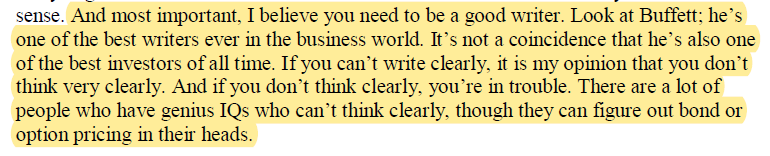
Interview principles: - prepare with context, not questions - optimize for novelty - ask for clarification if needed - set a high energy level - laugh easily - search for “secrets” - help deliver lessons through stories - minimize pause between an answer and next question - STFU
Dec 19, 2020One of the most impressive things about Wikipedia is that it repeatedly produces clear writing. Their editing guidelines double as excellent writing advice: 1) Don’t argue from authority 2) Avoid acronyms 3) Consider the inverted pyramid strategy https://t.co/fYy3x53SUf You rarely go on Wikipedia and say “I didn’t understand the article because it was so poorly written,” but that’s the base case for Reading academic papers. Wikipedia is proof that complex ideas can be explained without a complex writing style. Open moderation guidelines are another thing we should celebrate about Wikipedia. Their governance standards are free for anybody to review, in contrast to Google and social media platforms which are a black box.
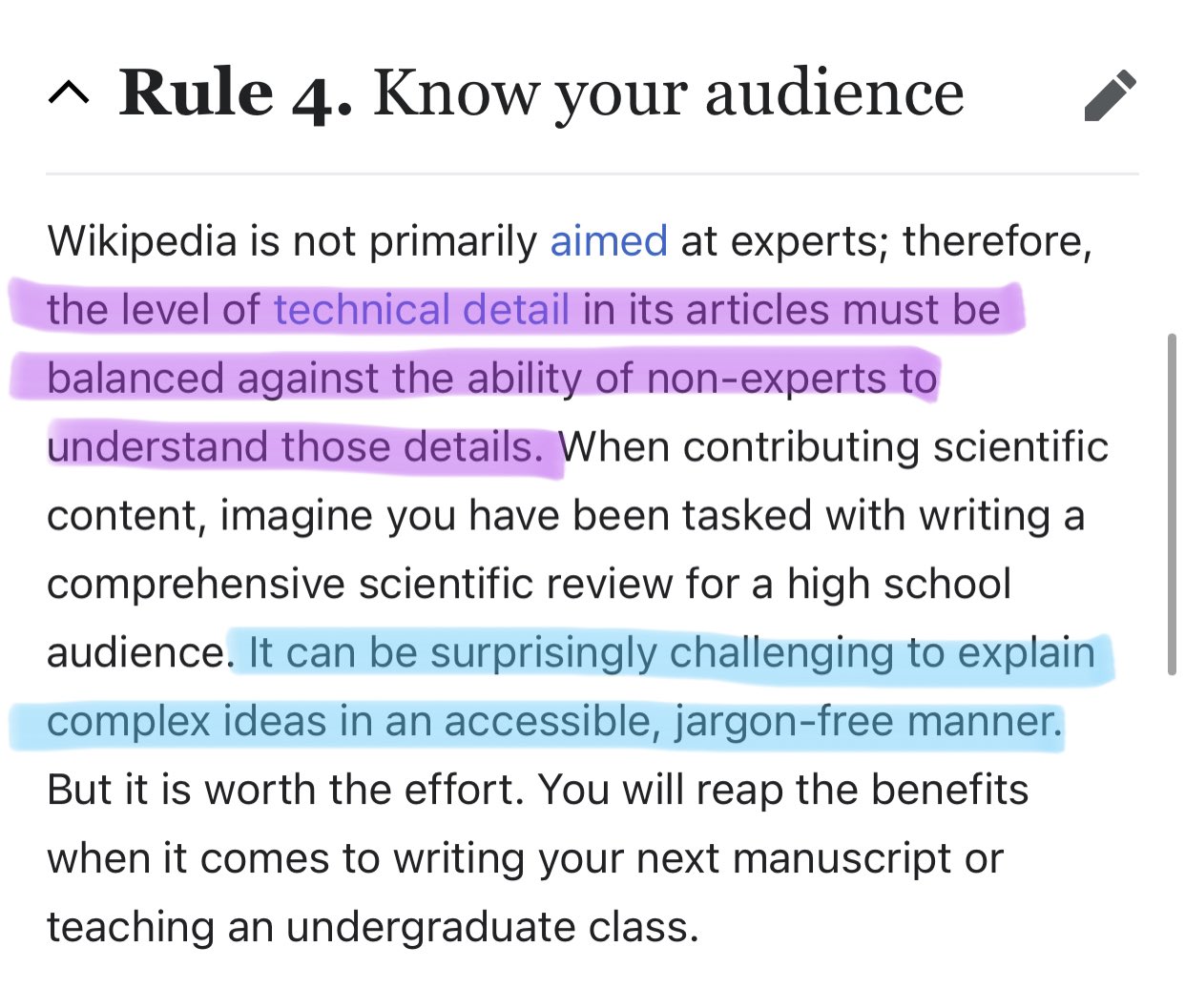
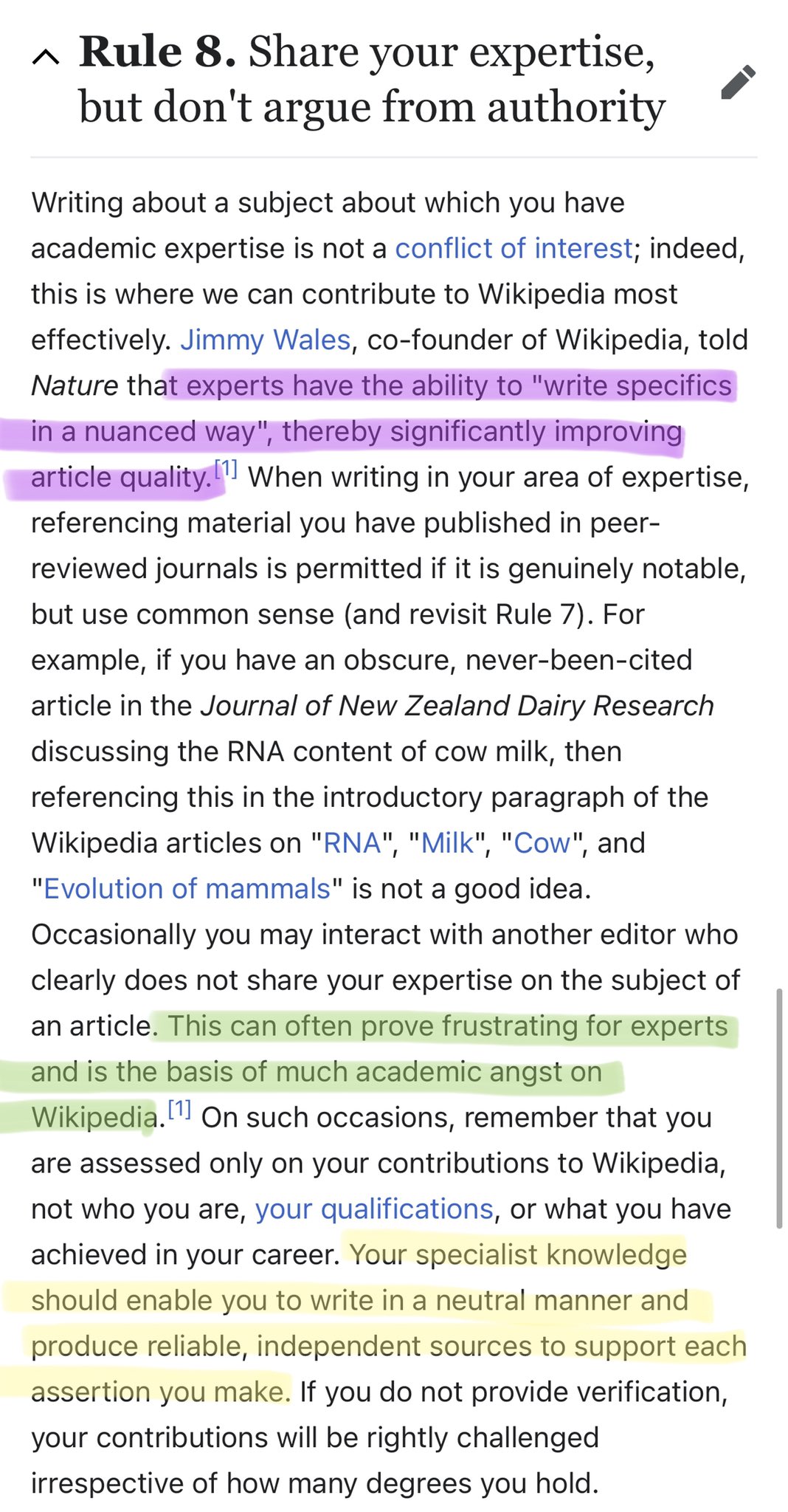
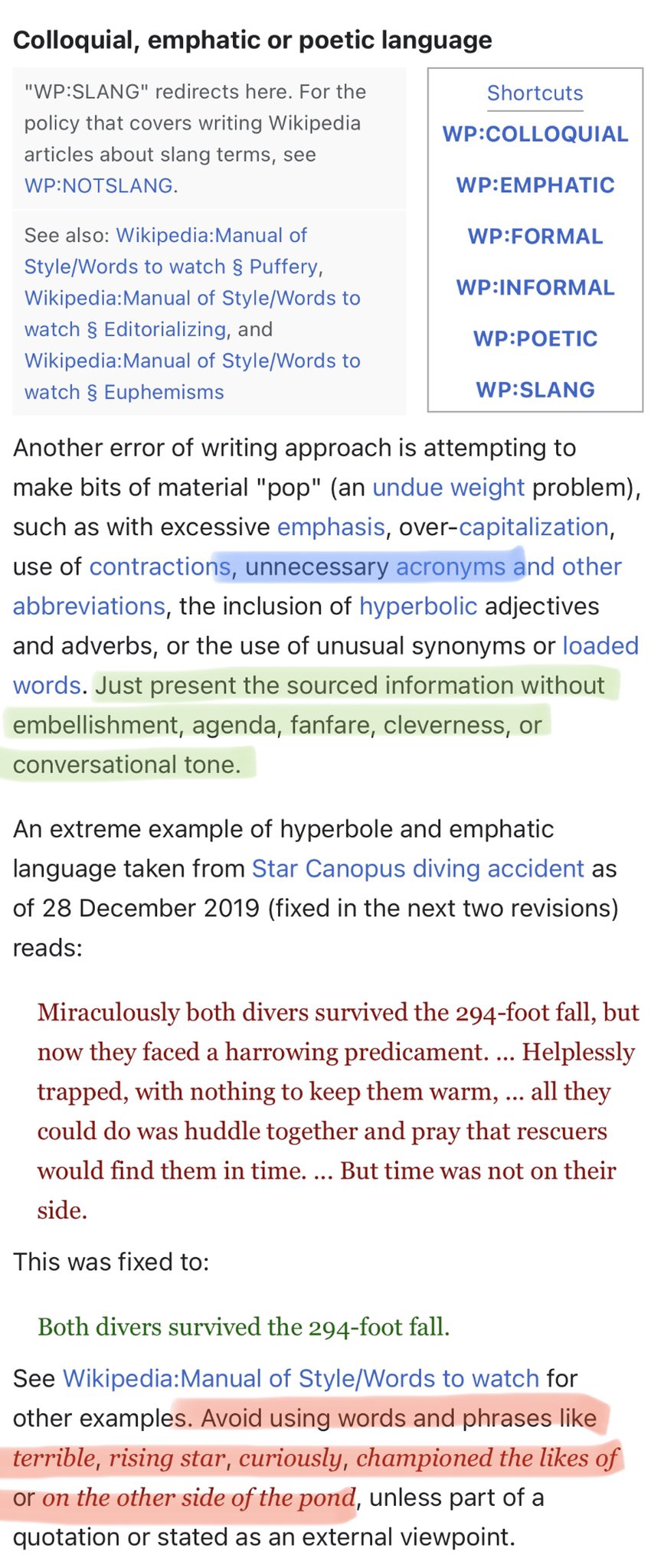
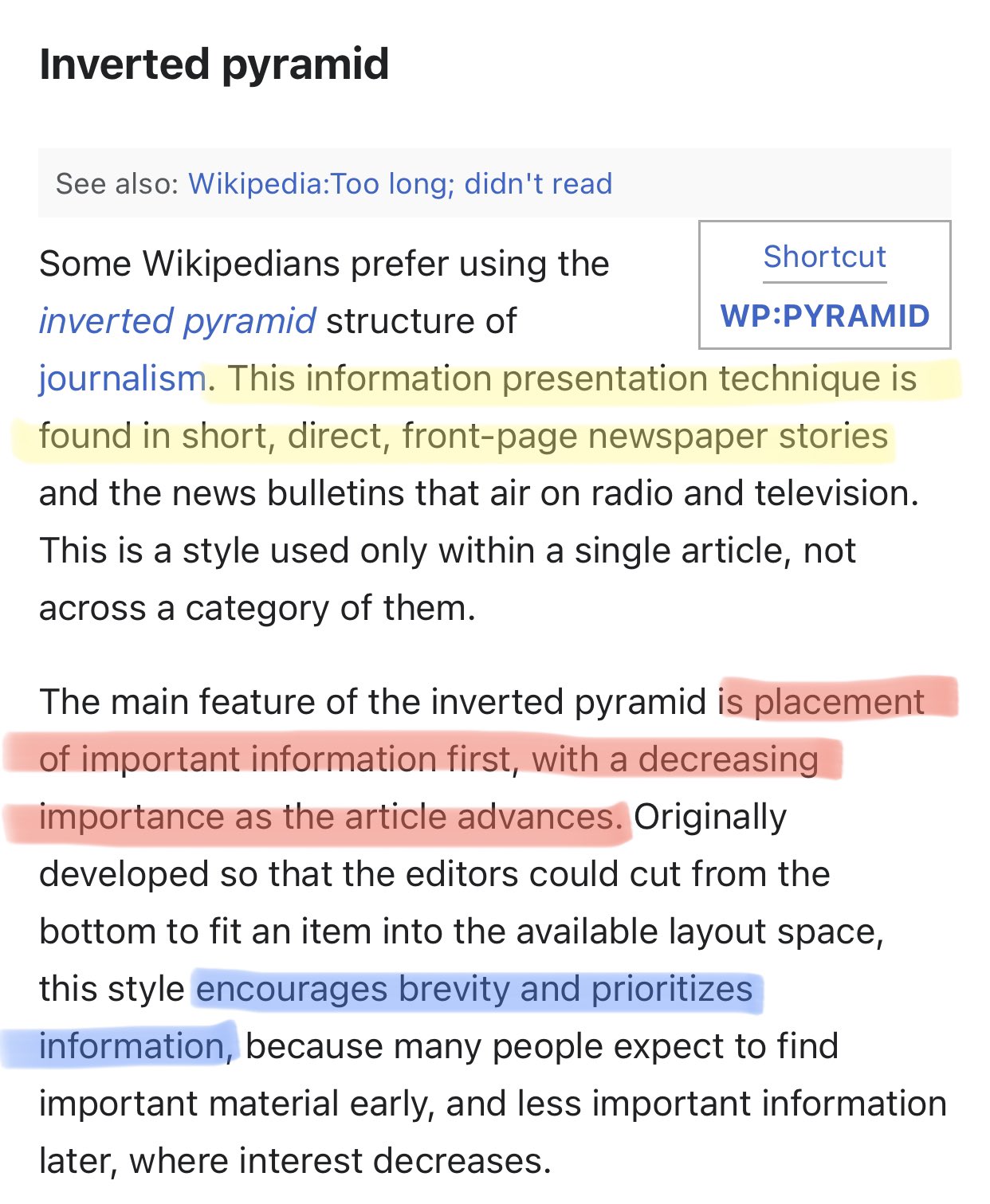
Why do people read HBR? Every once in a while there's a valuable article. For example: "What Is Strategy?" by Michael E. Porter. I don't consider this a "business article". It is about business strategy. The phrase "all the evidence" makes me giggle.https://t.co/le4t9QKiJJ https://t.co/8I4qS0ypgS Charlie Munger: "In 50 years of reading Barron's I found one investment opportunity on which I made about $400 million. For almost no risk. I didn’t have a lot of ideas. I didn’t find it that easily, but I did pounce on one." 2017 Daily Journal Shareholder Meeting "By regularly reading business newspaper and magazines I am exposed to an enormous amount of material at the micro level. I find that what I see going on there pretty much informs me about what’s happening at the macro level.” Charlie Munger https://t.co/Wdr1tKKE7D
Nov 29, 2020Something surprising I've learned from forums: intellectual dishonesty is an art form. When I write an essay on a controversial topic, I can usually predict what the median attack on it will be. But occasionally I'll see one of just breathtaking novelty. I think intellectual dishonesty is analogous to hacking in the sense of breaking into things. There are people who are not just smart but also way more dedicated than you'd expect anyone to be, and they find ways to attack you that you'd never have imagined possible. This is not a subtweet, incidentally. It's because I'm writing a new essay, and while predicting ways people would attack it, I realized I was thinking the same thing the designer of a new system would: that I couldn't protect against a really dedicated attacker.
Oct 28, 2020To improve your writing, binge-read your favorite writers and shamelessly copy their style “Wait, are you serious?” Yes, and the best authors go a step further. Hunter S. Thompson once wrote down every word of the Great Gatsby so he could feel what it’s like to write a great novel. There are two insights here: 1) When you copy your favorite writers, you’ll absorb their style. 2) If you can’t find your voice, copy people and pay attention to moments of resistance. At times, you’ll want to write something different — those moments reveal your unique style. Musicians copy the greats all the time when they practice their scales. It’s boring but it works. The mechanics of music become clear not when you listen to it, but when you play it yourself. The same is true for writing. Jack London famously improved his writing by copying Rudyard Kipling. He said: “As to myself, there is no end of Kipling in my work. I have even quoted him. I would never possibly have written anywhere near the way I did had Kipling never been. True, true, every bit of it.” Benjamin Franklin copied his favorite writers too! Here’s what he wrote in his autobiography: “I thought the writing excellent, and wished, if possible, to imitate it.” Robert Louis Stevenson used a three-step process: 1) He picked a passage from a writer he respected 2) He read the passage twice, very carefully 3) He re-wrote the passage word-for-word from memory, without looking at it as he wrote Watching painters copy the art on the walls is one of my favorite things to do at a museum. They don’t mind when you watch them, so it’s the closest I routinely get to watching skilled painters in action.
Aug 30, 2020"As a result, we are tending to assign more importance to those who can explain something than to their actual explanation." https://t.co/GMCajoBdmn **Links in this post** (t.co shortlinks resolved 2026-09-29): - `https://t.co/GMCajoBdmn` → https://twitter.com/mhdempsey/status/1287727215971635200/photo/1
✍️ Written Communication: the most important skill for workers to cultivate. Reading and understanding also key Cultural issues arising from misunderstanding meaning behind the way people write becomes a big issue **Kyle's note on the capture:** *:*
Jul 5, 2020Three thoughts on conversation: 1) The better the debate, the more you talk about assumptions. 2) Good conversations are limited by the constraints of language. 3) A good friend will surprise you by helping you say things you’ve known but could never find the words to express.
Jun 29, 2020John O’Donahue still has the best quote I’ve ever heard about conversation. Pure poetry 🙏🏼 https://twitter.com/david_perell/status/1262983212780843008/photo/1
2020-05-20MEGA THREAD TIME Here are 50 ideas that shape my worldview. These are my guiding principles and the light of my intellectual life. All of them will help you think better, and I hope they inspire curiosity.
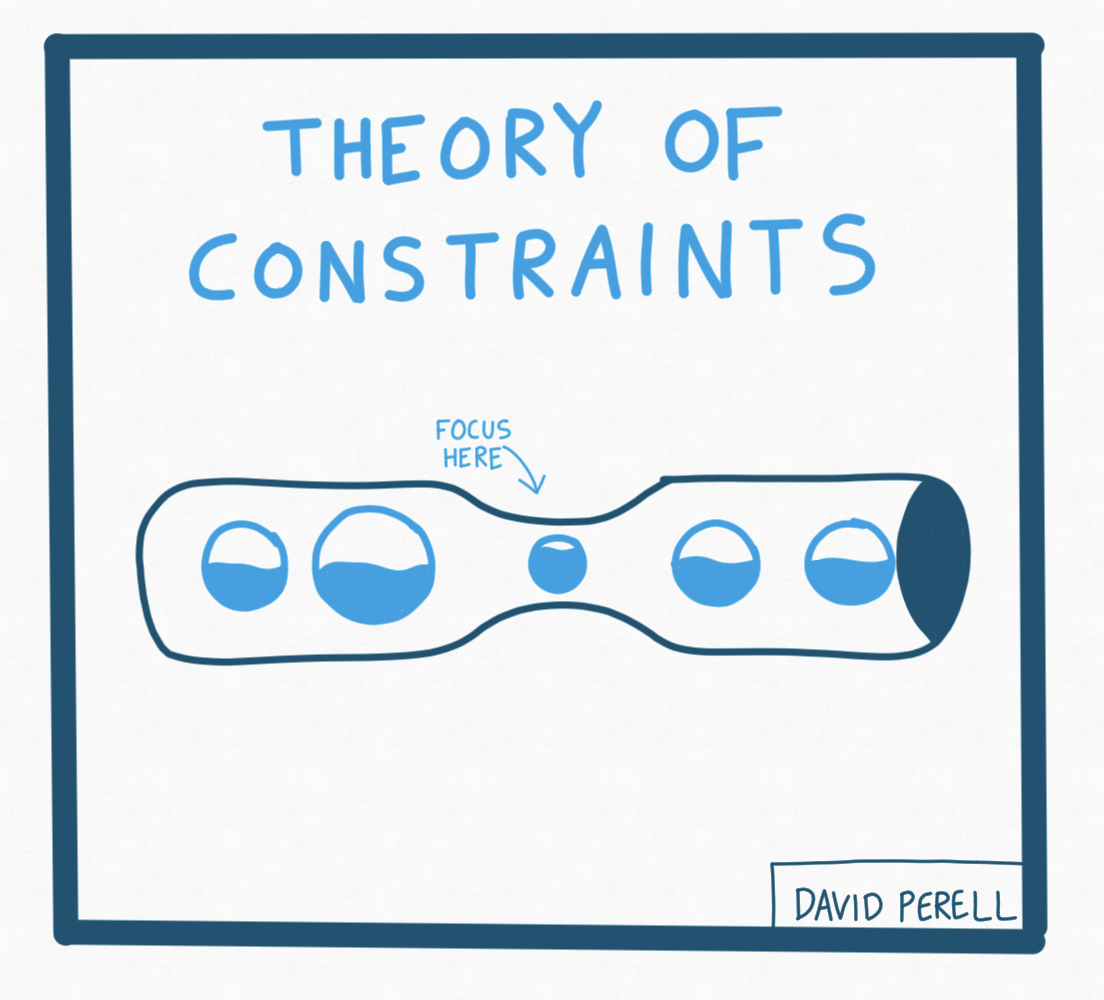
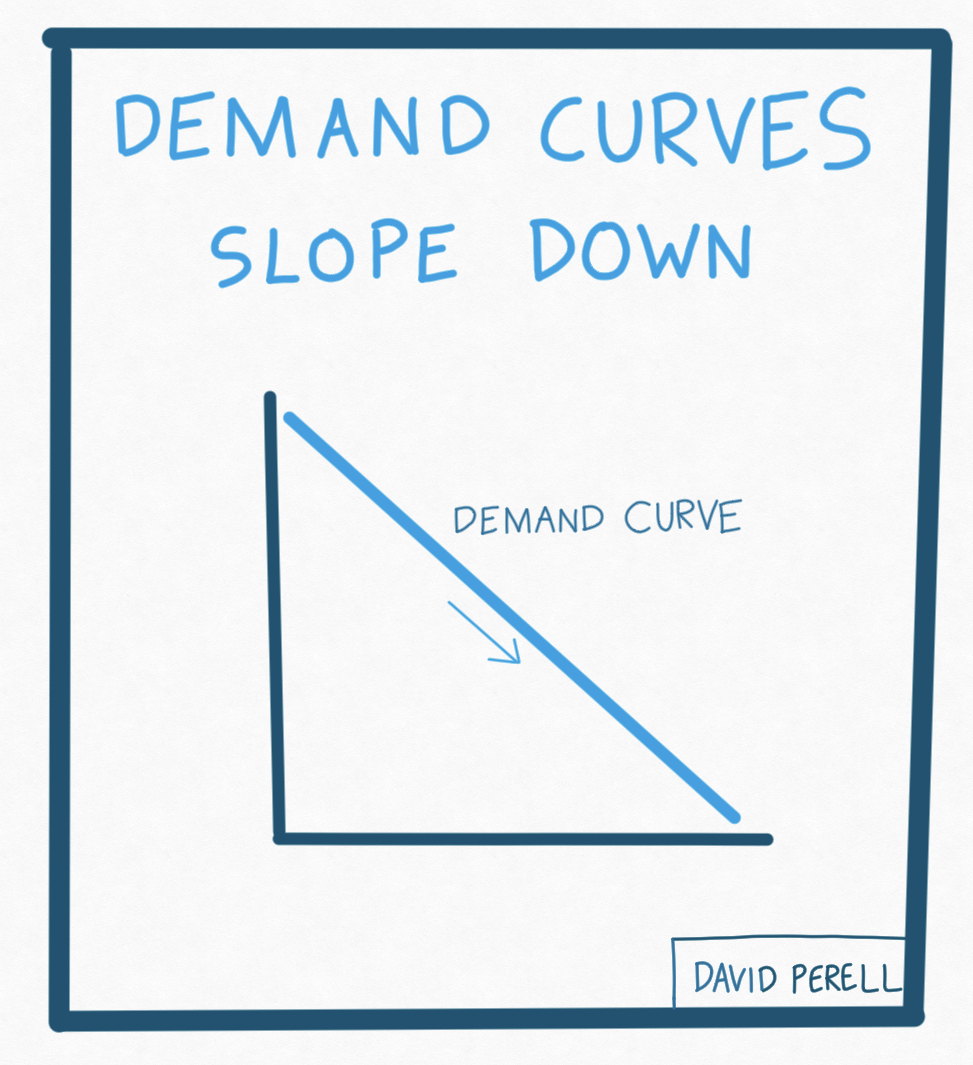
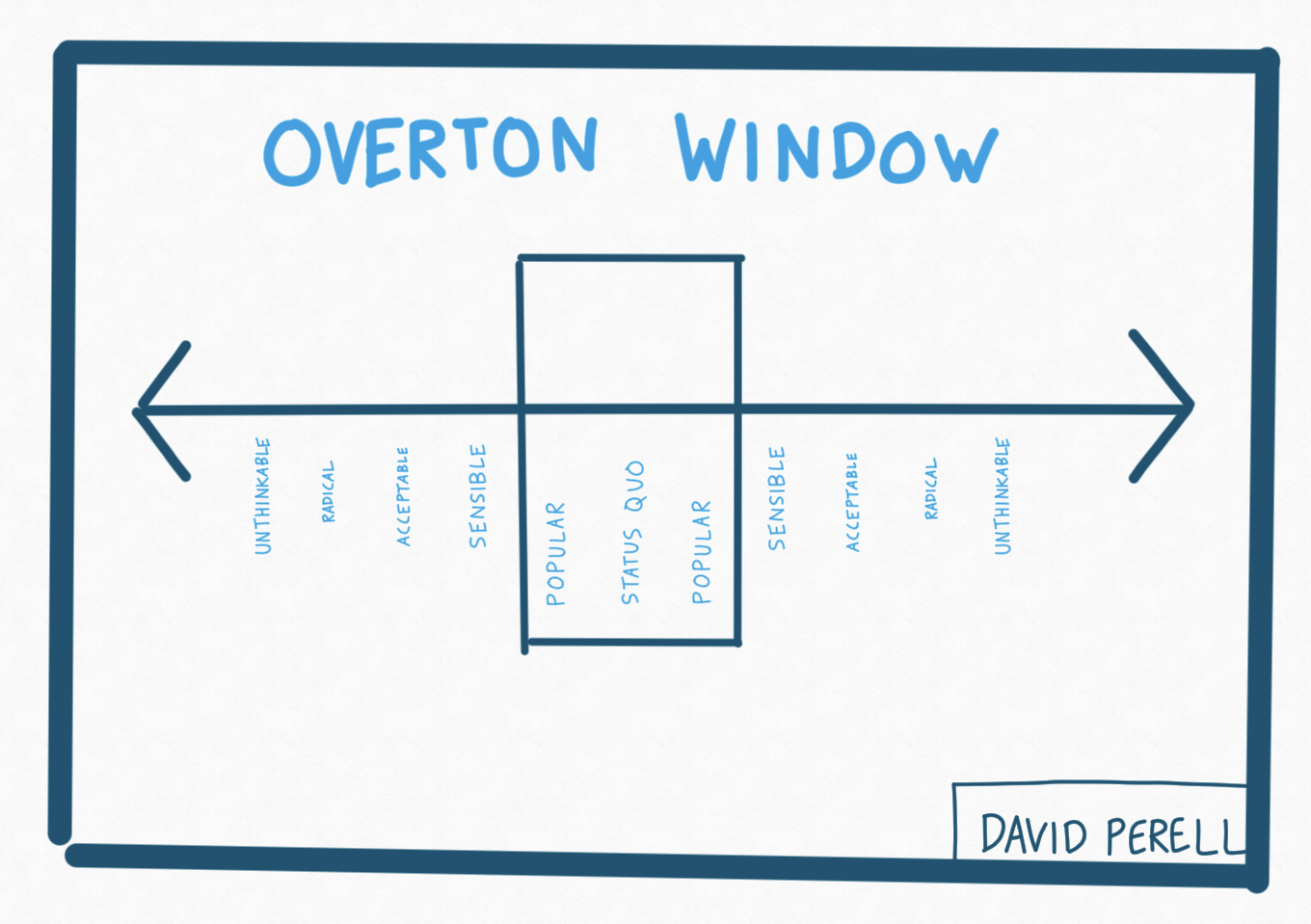
Here’s a fun collection of speeches. It’s a trip through American history and a masterclass in rhetoric. https://t.co/2YOm4yJAdy → <https://youtu.be/vnVwvPpdFeY>
Apr 18, 2020How to Write Usefully — paulgraham.com/useful.html
Feb 21, 2020Social media has both incentivized extreme intellectual dishonesty—but also catalyzed a sort of resistance as well. Intellectual bravery & honesty seem to be on the rise to meet the challenge. First in long-form podcasting—but also now on Twitter. Funny how things self-correct. On Twitter it feels like many are growing tired of the bad-faith tactics of the intellectually dishonest. Strategies designed to kill debate are being seen for what they are. Dunking, name-calling, brigading, threats, etc all still happen—but maybe with a less chilling effect 👍 We’re seeing a slow cultural adaptation to the incentive structure of the medium. As more people become intuitively aware of the incentives Twitter presents for distribution—they more readily recognize others’ bad-faith attempts to game distribution.
Nov 11, 2019The BEST way to grow # of rational non-supernatural adults? NOT by reason. But by interest. Remove the biggest barrier to rejecting child-like beliefs— the VERY painful ostracization from rejection by a tribe or local community— by giving safe harbor in other tribal identities
Oct 30, 2019