"You Sit on a Throne of Lies"
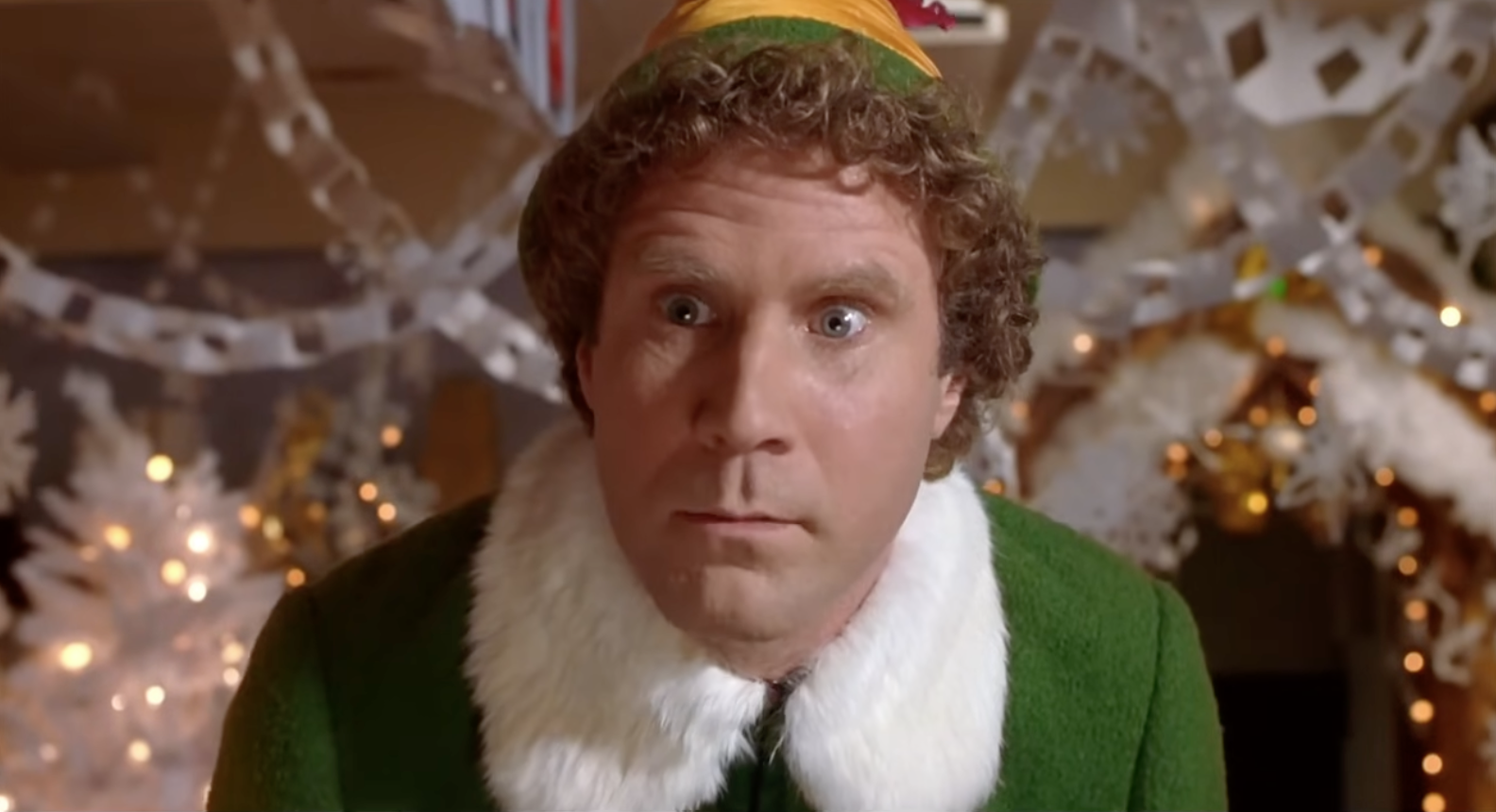
From my youth, I’ve believed in a very magical man.
Despite most adults feeling my belief is silly, childish even, I continue to believe.
The man who dons a red suit.
The man that manages to offer gifts to the entire world.
I believe that man can do miraculous things that I can’t explain.
Things that defy the laws of physics and logic that have defined every other aspect of my life.
The man who has songs written about him in dozens of different languages.
The man who inspired one of the most commercially impactful seasons of the year where people spend $1.2 trillion globally, in celebration.
That man, of course, is Jesus Christ.
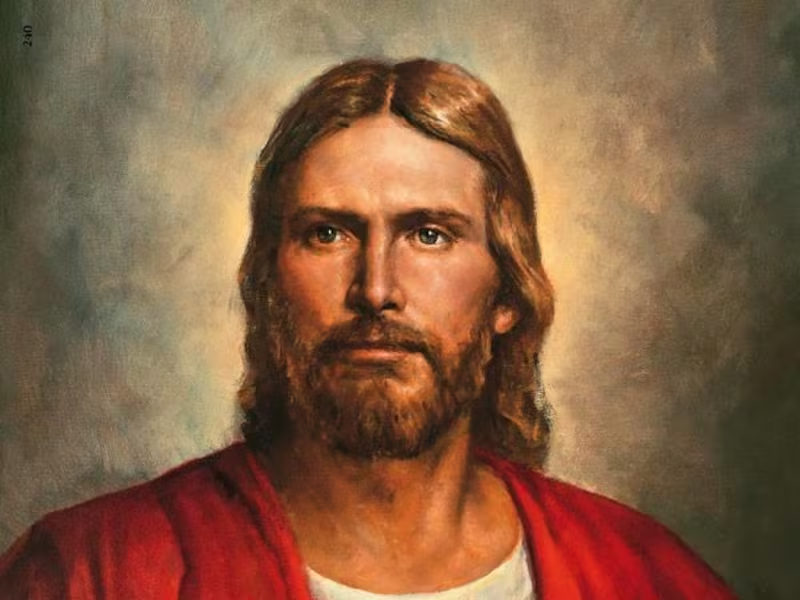
If I did my job right with that little epigraph, you may have briefly thought I was talking about Santa Claus up until you spotted the picture of Christ. And there’s the rub. The similarities.
Story time.
Growing up as a kid, I would write a letter every year. A list of all the things I wanted Santa Claus to bring me for Christmas. For a few years in a row, I would always include the same thing on my list; a particularly expensive gaming system. Each year, when I opened my presents, I would spot several of the things I had asked for, but not the gaming system. Santa, in my mind, was picking and choosing, and missing the most important thing on the list!
So, one year, when I was approaching the age where I was long in the tooth anyways to be a Claus Truther, I hatched a scheme. Instead of listing 15 or 20 things on my Christmas List, I would only list one. The most important one. I delivered it to my Mom, but received some pushback. “You need to include lots of things.” But I insisted that was all Santa would be hearing from me this year.
After several attempts to help me elaborate on what I might like that year, my Mom took me aside and gently explained that Santa Clause wasn’t real. That the Christmas List was a way to help give her ideas for things to get for me. And that the gaming system was too expensive, but she would love to get me other things.
My Mom did exactly what millions of other parents have done over generations. She reached the point where I was to be let in on the big secret. Santa wasn’t real. It was an elaborate story to bring children everywhere into the magic of Christmas and the importance of being good.
Now, my Angel Mother did nothing wrong. But that experience triggered a logical leap in my mind that stress tested a core fabric of who I was as a person up until that point. My immediate thought after that conversation?
“If Santa Claus isn’t real; what else isn’t real that everyone has been telling me about? Is Jesus pretend too?”
That quandary of imagination is at the heart of just about every Christmas movie. The desire to believe, only to be told by the world that you’re silly. Childish. In need of growing up. Just this year, I’ve watched several Christmas movies with my kids that pricked me heart.
Miracle on 34th Street. A young girl asks her Mom if she’s positive that Santa Claus isn’t real:
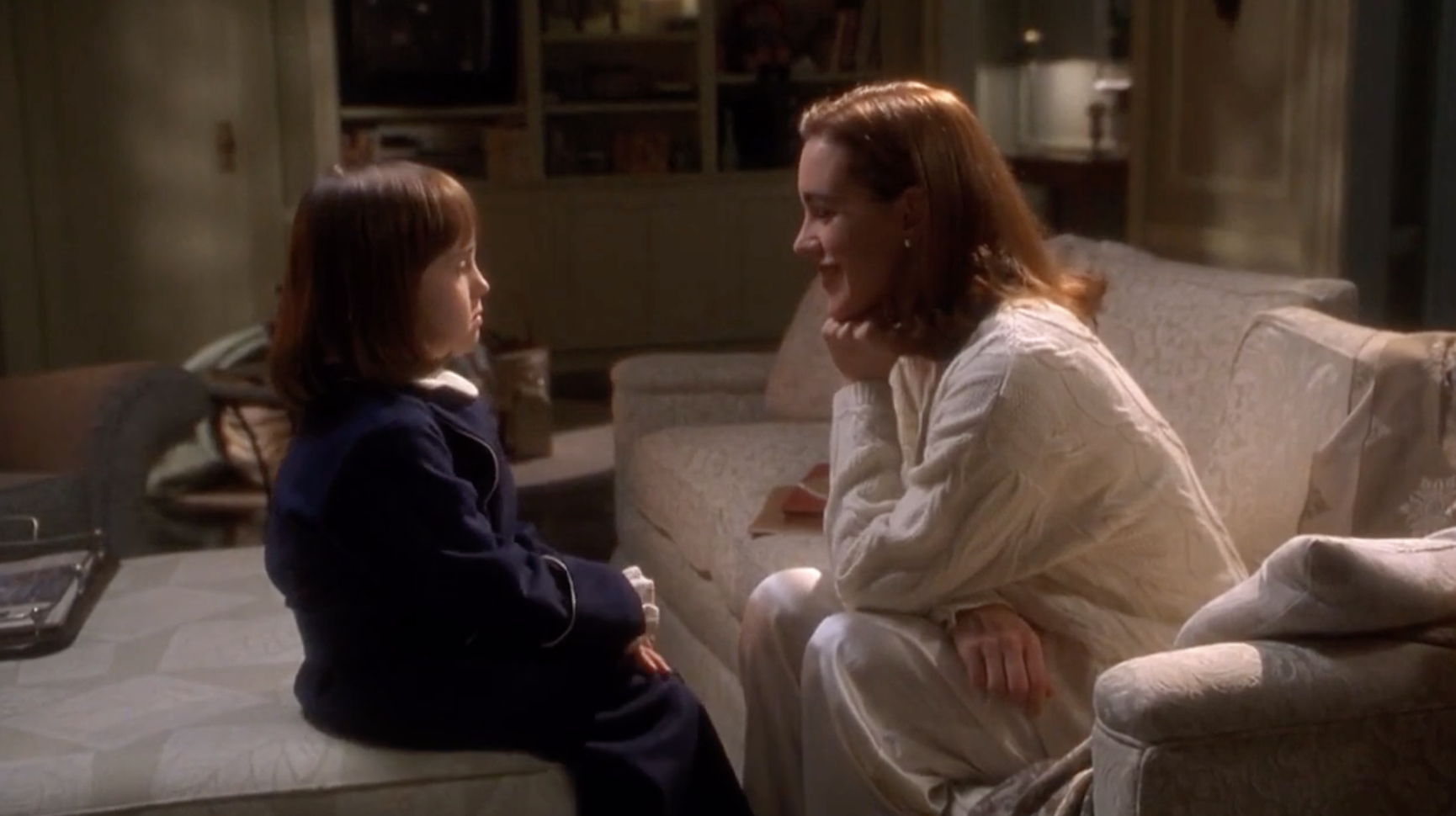
Susan: “You’re positive he’s not the real Santa Claus?” Dorey: “I thought that we talked about this. You understand what he is.” Susan: “What if we’re wrong? That would be extremely rude.” Dorey: “Well, we’re not wrong sweetheart.” Susan: “But all my friends believe in Santa Claus.” Dorey: “Well, most children your age do.” Susan: “How come I don’t?” Dorey: “Because you know the truth, and truth is one of the most important things in the world. To know the truth and to always be truthful with others and, more importantly, with yourself. Believing in myths and fantasies just makes you unhappy.” Susan: “Did you believe in Santa Claus when you were my age?” Dorey: “Yes.” Susan: “Were you unhappy?” Dorey: “Well, when all the things that I believed in turned out not to be true, yes, I was unhappy.”
Another example was The Santa Clause 2. In a sleigh ride, Scott Calvin talks to his son’s principal about her cynicism around Christmas, and she explains:

“I used to love Christmas… I believed in Santa so much I’d get in fights at school with kids who tried to tell me that he didn’t exist. And one day I came home with a bloody nose. That’s when my parents decided to tell me to… grow up. I was devastated, and… A person just wants something to believe in, you know?”
Those are just two examples we happened to watch this year, but the list goes on and on. Believing in Santa Claus is a core ideological crux of the Christmas narrative. And if there’s one thing that Hollywood has taught me, its that I don’t want to be these guys; one of the scrooges of fiction (despite Neil’s incredible sweaters).
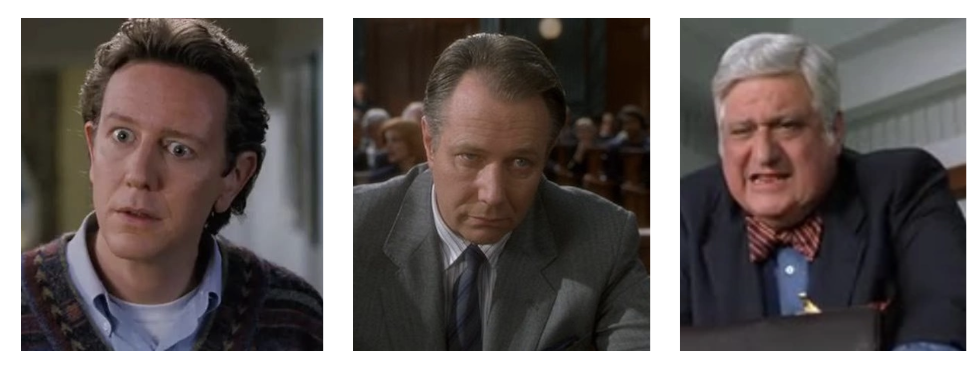
You can feel the yearning of children and grownups alike in these movies. In the words of the future Mrs. Claus, they just “want something to believe in.”
Heading into the holiday season, I wanted to reflect. Why don’t I try and convince my kids that Santa Claus is real? And why do the stories we tell have such far reaching effects, beyond just having a good time once a year?
The Noble Lie
In Plato’s Republic, Book III, there is introduced a critical concept that has shaped much of the moral framework for storytelling: the noble lie.
For Plato, it was the story of social hierarchy. Men made of different metal by God; finer creatures crafted of Gold, lesser of iron or brass. This year, I’ve been reading the Red Rising Saga by Pierce Brown; a science fiction future where men have colonized the solar system and leveraged a comparable class of genetic differentiation. Golds rule, Silvers count, Yellows heal, and so on. Plato’s analogy made flesh. From Plato to The Jackal, the justification is in unification, despite the noble lie.
There is an epistemological debate throughout history around a lie’s justifications. A noble truth? Or a consistent sin? St. Augustine debates the merits of whether a lie can be excused if its “useful.” Machiavelli sees it as a critical lesson to “learn how to use the nature of both men and beasts wisely to ensure the stability of [a] regime” with the force of a lion and the deception of a fox.
Everything from founding myths to unifying narratives rests on this idea of justification in elaboration. The mythology of the American Founders serves a particular unifying purpose and for that reason, its been allowed to persist; even defended vigorously. There’s a lot that’s been said about memetics and the way ideas percolate. Propaganda during WWII and the Cold War served what most see as both good and evil causes; supporting the American War Effort and propping up both the Socialist and the Communist machines.
So much of history is defined by a story’s “right” to be told. But cynicism has been the response of a world warped by manipulation. To me, people’s psyche’s have so often fractured in one of two directions: (1) it’s all a lie, so I don’t believe anything or in anything, or (2) it’s all a lie, so I’ll choose which lie I want to believe. That cannot be the ideal end state.
What Is Truth?
I find myself writing this exact line over, and over, and over again. Is there a definitive truth? Or is there simply preferable lies?
While there are plenty of different view points, I have to believe in truth; no matter the source. Rather than give way to cynical acceptance of the noble lies around us, I instead choose to embrace nuance; something else I have written about over, and over, and over, and over again.
Whether it comes to religion, economics, company building, relationships, or any other aspect of my life. I have to believe that there is truth. Nuanced truth, yes. But truth, nonetheless.
In many cases, one of the biggest obstacles is that the nuance is so haze-inducing that it renders the shape of truth completely immaterial. Something feels so complex and nuanced that it loses all definition. God, I think, can often feel this way. When I listen to the most prominent atheists, from Stephen Fry and Ricky Gervais to Richard Dawkins and Sam Harris, their skepticism always sounds exactly the same as the doubters in Christmas movies.
You listen to these grown people, living in a world where Santa Claus is legitimate canon. He does actually exist. Tim Allen does, actually, fly the sleigh. And they say things like “how can he get to every house in the world?” Meanwhile, apparently they, never once, have wondered, “where did these presents come from that I didn’t buy?” In a world where the magic is seen, acknowledged, and understood, they look like the biggest idiots around. Kids watching those movies know how ridiculously frustrating those skeptics manifest as.
The advantage that the atheists have in the real-world over these Santa-doubting scrooges in the movie is that the magic of God is woven into mystery. It can feel much harder to point to the tangible manifestations of his presence in the world. We can’t understand the things God says He can do. So, like the way doubters consider Santa Claus, the atheists default to equating a lack of understanding with the necessary status of fiction.
The Mystery of Godliness
In The Church of Jesus Christ of Latter-Day Saints, we have men chosen as apostles of Jesus Christ. At any given time, we typically we have 15 of them. Three in a First Presidency; akin to Peter, James, and John in the New Testament, and then 12 Apostles. One such man was J. Reuben Clark, and he offered a famous quote about truth:
“If we have the truth, it cannot be harmed by investigation. If we have not the truth, it ought to be harmed.”
Ironically, J. Reuben Clark was one of a few leaders of the LDS Church in the 50s through the 70s who engaged more with ideological purity than critical investigation. The Church has a few decades where it attempted to push away anyone who came with critical thinking. This, to many so-called Mormon Critics, is evidence that we don’t have the truth because we feared it would be harmed by investigation. This, I think, misses the point. Since then, the Church has taken significant strides to embrace scholarship and critical question asking.
In my perspective, a critical evaluation of any religion will come with a cross-section of historical, cultural, cosmological, and scientific details all mashed together with varying degrees of accuracy, believability, and explanation. As you sort through the details of the history and worldview espoused by any given belief system, you do have to come to a point of personal burden of proof. Any religion asks you to believe, you have to ponder in your heart the things you’ve learned and then ask if they’re true. Ask God, ask yourself, ask your conscience, ask your judgement, ask your spouse, your friends, your family. Ask, and ye shall receive. You can also apply a formula that Jesus Christ offers in the New Testament: “By their fruits, ye shall know them.”
My own investigation of Christianity, and specifically, the brand of it found within the Church of Jesus Christ of Latter-Day Saints has left me with a particular concoction:
- Personally-Held Beliefs: Families are forever. We shouldn’t be parted in death. My eternal place is not to boorishly praise God, its to become like Him. People don’t go to hell for not hearing about God. Progress is eternal. Intelligence is the substance of the universe.
- Historical Context: People in history did things at different times for different reasons. They can allow for human frailty while remaining within the boundaries of my personal beliefs.
- Unanswered Questions: Plenty of things that I don’t understand, but that I’ve determined are critical elements to my willingness to believe the overall system.
So when it comes to the need for truth, I’m willing to accept a nuanced, messy truth because it adheres to the confines of the acceptable framework I described above.
Now, take that framework and apply it to Santa Claus.
The Mystery of Santa Claus
My struggle with Santa Claus is that it is so well executed in how we weave it into reality. True, most of the narrative is shaped in books, movies, and stories. My kids get similar exposure to Darth Vader and Captain America. Then we start to tip-toe into the real world. We see Santa Claus at the mall. Again, my kids might see Captain America or Darth Vader at Disneyland.
But then, it crosses a threshold. The parents bring Santa Claus into their homes with milk, cookies, and maybe carrots for the reindeer. In the morning, children rub their sleepy eyes and see the cookies and milk gone, the carrots crunched, and the presents are here. Physical corroborating evidence, reinforced by their parents reassurance and the physical presence of the presents.
I, as a Christian parent, can encourage my children to believe in Jesus Christ and in Santa Claus. But by the time they are 8 or 9, they would have dramatically more evidence for the existence of Santa Claus than they do for the existence of Christ.
So what happens when, like I was, they are eventually let in on the secret? Santa Claus isn’t real. It’s all been part of an elaborate ploy to get you to believe in something that isn’t real. Why? So that you would be good little boys and girls? So that you could get presents? And don’t even get me started on the sadism of Elf on the Shelf.
What’s more, these children, raised by parents so desensitized by myth, narrative, noble lies, and preferred falsehoods, take on faith that these kids will eventually be “old enough” to just roll with the punches of finding out that this magical narrative they bought into is ripped out from under them and then they just keep moving.
Despite the magic they experienced, the gifts the received, or the joy (or guilt-induced good behavior) they pursued, it still ends in a disappointing reveal. This, fundamentally, structures a muscle for them that correlates belief to disappointment.
While Santa Claus may not be the most formative intellectual experience for most people, it is just one piece in a multi-faceted puzzle that leads so many of us to settle for either (1) it’s all a lie, so I don’t believe anything or in anything, or (2) it’s all a lie, so I’ll choose which lie I want to believe.
Again. That cannot be the ideal end state.
Something Worth Believing In
Probably one of the things I have returned to most frequently in my writing is a story from an exceptionally underrated movie called Secondhand Lions. I’ve touched on it over, and over, and over, and over again.
A young boy is living with his two elderly uncles and one of them has been telling stories of the other’s exploits in Africa. The boy is desperate to know from the could-be adventurer if the stories are true. So one night he finally confronts his uncle. “I need to know if those stories are true.” His response is instructive:
“Doesn’t matter if they’re true. If you want to believe in something then believe in it. Just because something isn’t true that’s no reason you can’t believe in it. Sometimes, the things that may or may not be true are the things that a man needs to believe in the most. That people are basically good. That honor, courage, and virtue mean everything. That power and money, money and power, mean nothing. That good always triumphs over evil. Doesn’t matter if it’s true or not, you see. A man should believe in those things because those are things worth believing in.”
People are not always basically good. Honor, courage, and virtue don’t always mean everything. Power and money often mean much more than nothing. Good does not always triumph over evil. These are not historically accurate as universal truths.
But the act of believing in them shapes who you are.
Santa Claus is not real. But believing that goodness is rewarded, that magic is real, and that the act of giving gifts makes us who we are? Those can also shape us.
Going back to my framework about any belief system. Another piece of the puzzle is distinguishing between instructive allegory and historical fact. Christ often taught in parables. He never intended, nor misled, his listeners to believe that the Good Samaritan was a real man, or the 10 Virgins were people he knew, or that the pearl of goodly price was in a friend’s bank account. He offered them as instructive narratives for a reason.
The story of Santa Claus is the same. It is instructive. I don’t try to convince my kids Santa Claus is real; cross my heart and hope to die. But I want to engage in the story with them. I want to learn the lessons that will shape them. And I love Christmas. I love the lights, and the presents, and the stories, and the traditions. A few days ago, I watched Klaus with my kids; another criminally underrated work of art. I love those moments.
But I also want my kids to distinguish that instructive narrative from what I want to teach them to be a certain reality.
Santa Claus isn’t real. Jesus Christ is real.
Jesus Christ literally walked the streets of Galilee and Judea.
He literally healed the sick and raised the dead.
He literally suffered in body and spirit for the sins of all mankind.
He literally died and rose again three days later.
He did that so that we can all live again. We can live with the loved ones with whom we tell these stories. We shape our lives not so they can be snuffed out like a candle, but so that we can continue to be shaped into eternity.
I want my children to know that stories can be instructive. But I also want my children to know that there is magic in this world. Magic is just mysteries we can’t explain. And there is plenty about Jesus Christ that we can’t explain. But that doesn’t mean it’s not real.
What Does This Have To Do With Investing?
I’ve always said I don’t write this blog for anyone but myself. Even still, I appreciate you letting me wax poetic (and particularly religious) this week. As we head into the Christmas season, I find myself feeling some of my very favorite feelings. Nostalgic. Pensive. Reflective. Excited. All of those things make me wrap together my perspectives when I see universal criticism for the choice to not celebrate the Santa narrative.
But as I reflect on my thinking professionally, I continue to see a thread I often pull on in my writing. Stories are powerful. Perhaps the most powerful force in the shared human experience. We so dramatically underestimate the stories we tell.
The stories we tell ourselves shape who we are.
The stories we tell our kids define their whole world.
The stories we buy into reflect our beliefs.
So I’ll leave you with this. Tread carefully. Reflect properly on the stories you buy into, and the stories you tell. The stories you perpetuate. Reflect critically on the implications of the stories you tell and the degree to which you believe them. I believe orange juice makes me feel better when I’m sick. But I wouldn’t try to cure cancer with it.
Storytelling is a beautiful force of nature. But like all forces of nature, it deserves to be respected.
Referenced in
- Richard Dawkins note