Kyle Harrison
← Bookshelf 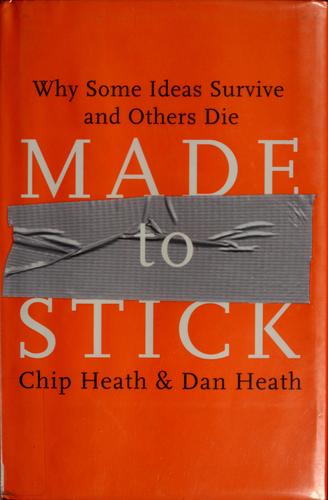
Made To Stick
Related from this site
Key Takeaways
Kyle, in 2016 in Books: I read Made to Stick approaching it from a business perspective and how to brand things, appeal to customers, all that jazz. Instead, I walked away with a new take on how to communicate any idea that I have, regardless of the context.
Connections
Books: Switch — another Chip Heath and Dan Heath book; same authors.
Highlights
Roam capture metadata — Author: Chip Heath Dan Heath · Reading Status: Books Read · Source: https://medium.com/@kwharrison13/2016-in-books-292d35ee68f0 · Tags: #Books Marketing
- ==Highlighted Quotes==
- ==START REVIEWING HERE>>>==
- “Research shows that people are more likely to make a charitable gift to a single needy individual than an entire impoverished region. We are wired to feel things for people, not for abstractions.”
- Referring to when one person taps a song, another person listens, and the tapper is baffled by why the listener doesn’t know what song it is — “It’s hard to be a tapper. The problem is that tappers have been given knowledge (the song title) that makes it impossible for them to imagine what it’s like to lack that knowledge. When they’re tapping, they can’t imagine what it’s like for the listeners to hear isolated taps rather than a song. This is the Curse of Knowledge. Once we know something, we find it hard to imagine what it was like not to know it. Our knowledge has “cursed” us. And it becomes difficult for us to share our knowledge with others, because we can’t readily re-create our listeners’ state of mind.”
- “A designer knows he has achieved perfection not when there is nothing left to add, but when there is nothing left to take away” (Antoine de Saint-Exupery)
- “The longer you work on a story, the more you can find yourself losing direction. No detail is too small. You just don’t know what your story is anymore” (Ed Cray)
- “Perhaps most surprisingly, mental simulations can also build skills. A review of thirty-five studies featuring 3,214 participants showed that mental practice alone — sitting quietly, without moving, and picturing yourself performing a task successfully from start to finish — improves performance significantly.”
- “We don’t always have to create sticky ideas. Spotting them is often easier and more useful. What if history teachers were diligent about sharing teaching methods that worked brilliantly in reaching students? What if we could count on the volunteers of nonprofit organizations to be on the lookout for symbolic events or encounters that might inspire other people in the organization? What if we could count on our bosses to take a gamble on important ideas?”
- What Sticks?
- Kidney heist. Halloween candy. Movie popcorn`.
- Sticky = understandable, memorable, and effective in changing thought or behavior
- Six principles: SUCCESs
- Simple. Unexpected. Concrete. Credible. Emotional. Stories.
- The Villain: Curse of knowledge — it’s hard to be a tapper.”
- Creativity starts with templates: Beat the curse with the SUCCESs checklist
-
- Simple
- Find the Core: Commander’s intent. Determine the single most important thing — “THE low-fare airline.” Invented pyramid: Don’t bury the lead. The pain of decision paralysis. Beat decision paralysis through relentless prioritization: “It’s the economy, stupid.” Clinic: Sun exposure. Names, names, names.
- Share the Core: Simple = core + compact. Proverbs: sound bites that are profound. Visual proverbs: The Palm Pilot wood block. How to pack a lot of punch into a compact communication: (1) use what’s there: Tap into existing schemas. The pomelo. (2) Create a high concept pitch: “Die Hard on a bus.” (3) Use a generative analogy: Disney’s ‘cast members.’
-
- Unexepcted
- Get attention: Surprise. The successful flight safety announcement. Break a pattern! Break people’s guessing machines (on a core issue). The surprise brow: a pause to collect information. Avoid gimmicky surprise — make it ‘postdictable.’ ‘The Nordie who…’ There will be no school next Thursday. Clinic: Too much on foreign aid?
- Hold attention: Interest. Create a mystery: What are Saturn’s rings made of? Screenplays as models of generating curiosity. The Gap Theory of Curiosity: Highlight a knowledge gap. Use the news-teaser approach: ‘Which local restaurant has slime in the ice machine?’ Clinic: Fund-raising. Priming the gap: How Roone Arledge made NCAA football interesting to nonfans. Hold long-term interest: the “pocketable radio” and the “man on the moon.”
-
- Concrete
- Help people understand and remember: Write with the concreteness of a fable (sour grapes.) Make abstraction concrete: The Nature Conservancy’s landscapes as eco-celebrities. Provide a concrete context: Asian teachers’ approach to teaching math. Put people in the story: accounting class taught with soap opera. Use the Velcro theory of memory: The more hooks in your idea, the better. Brown eyes, blue eyes: a simulation that “cured” racial prejudice.
- Help people coordinate: Engineers vs. manufacturers: Find common ground at a shared level of understanding. Set common goals in tangible terms: Our plan will land on Runway 4–22. Make it real: The ferraries go to Disney World. Why concreteness helps: white things versus white things in your refrigerator. Create a turf where people can bring the knowledge to bear: The VC pitch and the maroon portfolio. Clinic: Oral rehydration therapy. Talk about people, not data: Hamburger Helper’s in-home visits and “saddleback sam.”
-
- Credible
- Help people believe: The Nobel-winning ulcer insight that no one believed. Flesh-eating bananas.
- Eternal credibility: Authority and anti-authority. Pam Laffin, smoker.
- Internal credibility: Use convincing details. Jurors and the Darth Vader toothbrush. The dancing seventy three year old.
- Make statistics accessible. Nuclear warheads as BBs. The Human Scale principle. Stephen Covey’s analogy of a workplace to a soccer team. Clinic: Shark tank hysteria
- Find an example that passes the Sinatra test. “If you can make it there, you can make it anywhere.” Transporting Bollywood movies: “We handled Harry Potter and your brother’s board exams.” A business friendly environmentalist and the textile factory that actually purified the water that fed it — and yielded fabric that was edible.
- Use testable credentials. ‘Try before you buy.’ Where’s the beef? Snapple supports the KKK? Coaches: It’s easier to tear down than to build uip: Filling the emotional tank. NBA rookie orientation: ‘These women all have aids.’
-
- Emotional
- Make people care: The Mother Theresa principle: If I look at the one, I will act. People donate more to Rokia than to a huge swath of Africa. The Truth anti-smoking campaign: What made kids care was not health concerns but anticorporate rebellion.
- Use the power of association: The need to fight semantic stretch-the diluted meaning of ‘relativity’ and why ‘unique’ isn’t unique anymore. Transforming ‘sportsmanship’ and ‘honoring the game.’
- Appeal to self-interest (and not just base self-interest): Mail-order ads — “They laughed when I sat down at the piano…” WIIFY. Cable television in Tempe: Visualizing what it could do for you. Avoid Maslow’s basement: our false assumption that other people are baser than we are. Floyd Lee and his Iraq mess tent: ‘I’m in charge of morale.’
- Appeal to identity: The firemen who rejected the popcorn popper. Understand why people make decisions based on identity. (Who am I? What kind of situation is this? And what do people like me do in this kind of situation?) Clinic: Why study algebra? Don’t mess with Texas; Texans don’t litter. Don’t forget the Curse of Knowledge — don’t assume, like the defends of the duo piano, that others care at the same level that you do.
-
- Stories
- Get people to act
- Stories as simulation (tell people how to act): The day the heart monitor lied: how the nurse acted. Shop talk at Xerox; how the repairman acted. Visualizing ‘how I get here:’ simulating problems to solve them. Use stories as flight simulators. Clinic: Dealing with problem students.
- Stories as inspiration (give people energy to act): Jared, the 425-pound fast-food dieter. How to spot inspiring stories. Look for three key plots: Challenge (to overcome obstacles), Connection (to get along or reconnect), Creativity (to inspire a new way of thinking). Tell a springboard story; a story that helps people see how an existing problem might change. Stephen Denning at the World Bank: a health worker in Zambia. You can extract a moral from a story, but you can’t extract a story from a moral. Why speakers got mad when people boiled down their presentations to stories.
Referenced in
- Chip Heath note
- Dan Heath note
- Funding the Future note
- Why Books Don't Work note