Hijacking The Huckster's Hypebook
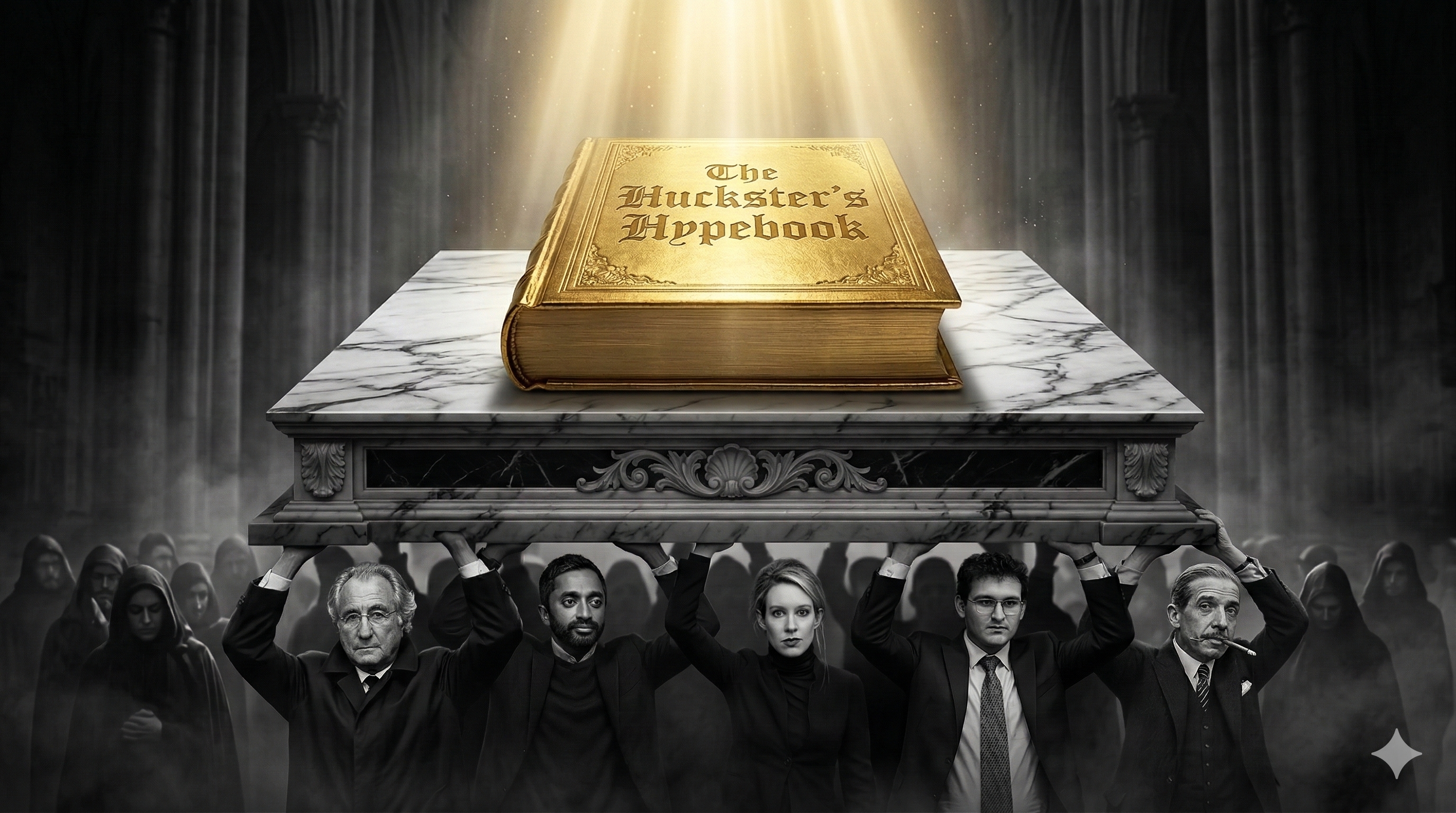
Stories run the world. Every movement, every nation, every life choice. They all stem from stories. From phenomenal cosmic stories about the makings of the universe and the identity of God down to the most minuscule motivations to wake up early and workout in the morning; every aspect of our existence revolves around a story that we’re choosing to believe.
Granted, plenty of it is subconscious biological framings and pre-programmings. But in terms of the active energy origination of our lives, the vast majority of it is dictated by stories.
Those stories, however, aren’t always good stories. Sometimes they’re stories woven together to prey on our fears. Nazi Germany is a hallmark of bad stories. Other times the stories are too good to be true… because they are. Frauds, cons, and fantasies.
One of the most disconcerting realities of capital allocation is the incredibly fine line between fraud and fancy. Are we investing ahead of future inflection? Or are we the last sucker at the dance? For every Sam Walton, there’s more than one Bernie Madoff. For every Steve Jobs, there’s more than one Elizabeth Holmes. For every Elon Musk, there’s more than one Adam Neumann.
Billions of dollars have been deployed both for good and for ill. Towards meaningful long-term outcomes and towards flash-in-the-pan fantasies. So much of my obsession with the art of capital allocation is in pursuit of more effective allocation. So when you see billions of dollars being deployed towards ineffectual missions, it grinds my gears.
So this is the attempt at a hijack. I want to try and hijack the playbook that the Huckster Elite have perfected to siphon billions of dollars. There are worthier causes that could use that capital to build real things, while leveraging the appeal of the more clandestine con folk.
The History of Hucksterism
There’s a rich history of the con that goes back hundreds of years. A personal favorite of mine is the invention of a country out of whole cloth. In the early 1800s, Gregor MacGregor raised the equivalent of ~$1B in today’s dollars and told the tale of Poyais; a nation in South America that he described as having a bustling economy with its own currency, coat of arms, and a 350-page guidebook to navigate the nation’s inner workings.
Hundreds of settlers set sail for a new life in this new nation, promised to provide fertile land, fresh fish, and deer just waiting to be hunted. What they found was completely unpopulated, unsettled jungle. More than half died of malaria and yellow fever. The promise of Poyais never materialized.
From Charles Ponzi, the namesake of the Ponzi scheme, to Bernie Madoff (where I assume the phrase “he madoff with other people’s cash” comes from). Fraud-laced hustles are far from one-offs. You can study undertakings like Wirecard, who raised ~$1B in 2019, rode a fabricated pool of $2B+ in revenue to a market cap of $20B+ before tanking into the ground.
We can learn from the tactics of FTX, Theranos, Fyre Festival, and dozens of others.
One of the immediate hesitations you might have with this comp set is that they’re not necessarily apples-to-apples. Hucksters come in all shapes and sizes.
Huckster Variants
- Straight-Up Fraud: These are the companies that we’ll describe as “actively” committing crimes. Wirecard fabricated bank statements, Luckin’ Coffee fabricated retail receipts, Charlie Javice made up users, Headspin made up fake invoices.
- Roads To Nowhere: Here’s where some tricky nuance comes in that requires this to be “the gospel according to Kyle.” Many (most) of the people in this bucket also committed crimes. But my sense is that they were “fake it ‘til you make it” tactics taken too far. Plenty of successful companies, like Reddit, faked users early on. Some just took it dramatically too far. And you could say the straight-up frauds were too, but faking a paper trail vs. faking capabilities feels different to me; so sue me (no… don’t sue me.) Theranos, FTX, Nikola Motors, Chesapeake Energy, all built their roads on crime. But then there’s Quibi, Stability AI, Juicero, Hopin. Not crimes… but not good.
- Bridges To Ugly: This, I would describe, as a uniquely difficult bucket to qualify for. Seemingly, no crime. Also, not failing to do what they said they would do. In fact, they did exactly what they said they would do. But it turned out to be just absolutely horrific business internals to the point where the collapse is caused not by a shifting macro or falsified narrative. It just turns out to be an ugly business. The only example of this I could think of? WeWork. Maybe there are others. But I think its a pretty unique story.
- Fakery In Flight: Here we tread dangerous water. Because, on these, the jury is still out. Prime example? Figure AI. The company has raised $2B+ at a valuation of $39B, all with effectively no revenue. Brett Adcock, the CEO, has claimed the company has a massive deployment unfolding at a BMW plant. But BMW pushed back on the details. Met with skepticism, Brett’s gotten spicy online, sometimes litigious. Who knows, maybe he’ll pull it off. Granted, we’re still waiting for his last company, Archer Aviation, to turn a profit.
Hype machines also go through evolutions. There are plenty of people who believed Tesla was a house of cards for years (some of them still believe that.) This is what I’m talking about; the fine line between fraud and fancy. Startups are, inherently, built on hot air. It can be difficult to toe the line between the two. But when things do turn to fraud, or even just ineffectual waste, like some of the non-criminal Quibi’s and Hopins of the world, it is a legitimate cost!
The Real Cost of Hucksterism
Let’s do some rough math (read: estimates). From 2000 to today, there was ~$3 trillion of venture capital deployed in the US. As we all know, a good chunk of venture-backed startups fail. At least ~50% of that went to zero, so $1.5 trillion. But, similar to the inequality of hucksters, not all failure is created equal. Break down all $3 trillion into a couple buckets:
- Big Wins: The mystical power law 20%; maybe ~$600B went into Google, Facebook, Uber, Airbnb, Stripe, etc.
- Modest Returns: The 1-3x returns that make up ~15%; ~$450B that didn’t return entire funds for investors, but didn’t lose money.
- Productive Failure: The ~25% of failures that make up a bedrock of what I’ve written about before as Silicon Valley’s accelerated failure archive; a “density of documented, autopsied, learned-from failures.” That’s like $750B of the total.
- Ineffectual Waste: This is a ~27% cut that starts to get into our playbook; the $800B that went to the 47th food delivery app, the 18th D2C mattress brand. This category exploded during ZIRP and took a lot of capital with it.
- Spectacular Failure: This is the 10% of capital that found its way into massive black eyes; $300B for Jawbone, Katerra, Hopin, Quibi, the SPAC-era, most of the SoftBank Vision Fund, or even going back to the Dot-Com blowups like Webvan and Pets.com.
- Outright Fraud: Finally, we have the ~3% that went to the criminals; $100B for FTX, Theranos, Nikola, Wirecard, SEC violations and DOJ indictments.
So what does that mean? The chunk I’m most concerned with is the ~40% of venture dollars since 2000 representing ~$1.2 trillion that went to ineffectual waste, spectacular failure, and outright fraud. Thats the allocated capital that we need to strategically reallocate; find a way to send it somewhere else.
How do we do that? We hijack the hypebook. I tried to drill into the characteristics that attracted capital towards that ~$1 trillion hole in the ground. Granted, a lot of it is “lie to your investors” or “commit crimes” or, in some very rare cases, murder people. So… you know. Don’t do that. Instead, I tried to separate the learnable components in hopes of offering it to founders who are building more worthwhile endeavors.
The Hypebook’s Table of Contents
Secrecy: Deflection & FOMO
In almost every case, secrecy was a big part of the equation. Theranos would have candidates sign NDAs before even being able to interview for the job. When employees left, they had their backpacks searched and even, on at least one occasion, when an employee refused, a Theranos co-founder called the police, saying the employee had “stolen property in his mind.” In fact, Theranos operated in stealth for a full decade from 2003 to 2013.
FTX had no board at all. When asked to create one, SBF’s response? “Go f*ck yourself.” The company split its audit between two small firms so no one ever saw the whole picture. Wire approvals were set to auto delete after signing.
One of the best canary in the coal mine stories of secrecy is when Hindenburg Research found out that Nikola Motors had forced the actors standing next to their demo truck to sign NDAs. As their report described the beginning of an insightful rabbit hole: “What proprietary secrets could an actor standing next to a truck possibly learn that require them to be muzzled?”
Wirecard would push for regulatory investigations of journalists and short sellers who dared to ask questions. There was even a massive spying operation against people who were speaking negatively about the company!
Artificial Urgency & Scarcity
Often, founders will pray on an investor’s loss aversion and FOMO. Like Kahneman’s prospect theory, “missing a winner is more painful than overpaying now.” My good friend, Matt Mazzeo, described this element of “borrowed conviction” that hucksters can instill in investors. No one is actually doing their own homework because they assume someone else is doing it. After a few rounds, you assume the company has been well-vetted. Mazz compared it to the CDO crisis. You have round after round of F-quality diligence rounds, all being packaged together into a, supposedly, AAA-funded company.
Hopin’s founder, Johnny Boufarhat, has been described as one of the best fundraisers in the game. As I’ve written about before, he managed to raise $1B for Zoom conferences. The company’s valuation went from $2B to $7.7B in less than 12 months. The ZIRP-fueled phenomenon created intense FOMO that turned professional investors into “dumb money” that were doing no diligence, despite frequently leading mark-up rounds. That company eventually tanked into the ground, being bought for ~$5M, with Boufarhat taking home ~$200M in secondary sales.
Media Manipulation as Air Cover
Theranos was constantly lauded as a breakthrough on Forbes, Inc., Time, etc. FTX had the infamous Sequoia profile where he was playing League of Legends while pitching. On top of that, he was a major donor and/or investor to publications like Semafor and ProPublica. He even appeared on stage NYT DealBook Summit after being indicted but before being charged!
Nikola Motors pursued public listing through a SPAC than enabled Trevor Milton to get online, and any media platform that would have him, to offer up what future prosecutors would describe as “lie after lie after lie.”
WeWork had an absolutely bananas profile of WeWork’s Adam Neumann where he said his aspirations included living forever, becoming the world’s first trillionaire, expanding WeWork to Mars, becoming Israel’s prime minister, and becoming “president of the world.” WeWork’s infamous S-1 from hell was clearly framed as a media document: it used the word “community” 150+ times, included Neumann’s personal mission statement about “elevating the world’s consciousness,” and positioned a commercial real estate company as a spiritual movement.
Hopin’s CEO had a media story to die for; a young founder with an autoimmune disease, confined to his house, who invented a virtual events platform right before COVID locked everyone indoors. The sympathy-inducing was palpable.
Quibi ran a $5.6M superbowl ad before it had even launched. Katerra called itself “the Tesla of construction.”
Not to mention the all-powerful 30 under 30 prison pipeline: SBF, Holmes, Charlie Javice, Martin Shkreli, and on and on.
Litigation As Cleanup
Theranos had a “threatener-in-chief” with David Boies who took 400K shares of stock in exchange for intimidating whistleblowers and racking up litigation. When whistleblowers did come forward, the pushback added up $400K in legal fees for the former employees.
Wirecard can only be described as deploying litigation at industrial scale. Suing everyone from large multinational publications to literal government entities. Wirecard had a half dozen elite law firms in multiple countries attacking any critics. When Singaporean authorities launched an investigation, Wirecard sued the investigators as individuals!
Nikola Motors spent $27.5M on legal expenses going after short sellers, including spending over $8M in advanced attorney fees for Milton himself.
Adam Neumann used structured litigation for personal enrichment, rather than defensively. From leasing his own properties to WeWork, or trademarking the “We” name and licensing it back, one report found he had gotten $1.7B in payments to himself.
Quibi has been described as a company more interested in legal warfare than product-market fit, given it was suing a competitor during its lackluster launch. Spending millions defending intellectual property that they couldn’t give away for free!
Validation By Association
Theranos had probably one of the most prestigious boards out there. Three former cabinet secretaries, two former senators, a retired admiral, a retired general. Tim Draper was defending Elizabeth Holmes, even after she was sentenced!
Quibi was right down the fairway for media mogul founder, Jeffrey Katzenberg, a former Disney exec and DreamWorks founder, that he brought his own “associative approval” to the table.
SBF paid Tom Brady $55M, Steph Curry $35M, and Larry David $10M, all to endorse FTX. Some people described the strategy as “credibility laundering.” It didn’t stop at individuals. The company spent $130M on an NBA sponsorship, $135M to name the Miami Heat stadium, and on and on.
Nikola Motors deliberately got large OEMs, like GM and Bosch, to invest in the company, framing it as having been vetted by “some of the largest organizations in the world.”
Adam Neumann had Jamie Dimon vouching for him, both personally and as the company’s banker. He brought along “the world’s smartest money” - - T. Rowe Price, Fidelity, Goldman Sachs, Harvard Management Company.
Personal Mythology
Elizabeth Holmes had her famous black turtleneck and deep voice. She said she had 50+ turtlenecks, even tracking down Issey Miyake to get her own authentic “Steve Jobs turtlenecks.” When she got drunk, she would let the deep voice slip. It was her way of “being taken seriously.”
SBF had his messy hair and cargo shorts. In fact, the company’s Bahamas HQ was supposedly designed based on SBF’s crazy hair. Michael Lewis, who wrote The Big Short, was following SBF around for a book during his fall from grace, and yet Lewis’ book still came out pretty grandiose / complimentary of SBF!
Adam Neumann is, honestly, more myth than man. Barefoot walks through the streets of New York, ayahuasca-laced corporate retreats, the mission of “elevating human consciousness.”
The founder of Wirecard cultivated the image of a quiet, brilliant Austrian technologist who “preferred letting the numbers speak.”
Hopin’s CEO? Every profile repeated the same arc: sick kid, bedroom coder, pandemic prophet, billionaire.
Invented Metrics as Goalpost Shifting
WeWork’s infamous Community Adjusted EBITDA that took out *checks notes* “marketing, G&A, development, design costs, building-level operating expenses including rent, utilities, building staff salaries, and amenities.” What’s even crazier? WeWork’s CFO said he got “no pushback from investors” on that metric…
I don’t even know how to begin to unpack FTX’s creation of its token dynamics as a mythical “metric.” SBF used Alameda to prop up the price of FTT and the rest is history.
Theranos was focused on “tests per drop,” saying the company could run 200+ diagnostic tests from a single drop of blood.
Trevor Milton would claim that the Nikola One had 1K horsepower, zero emissions, and a range that would make diesel trucks obsolete. Literally, just defying the laws of physics left and right.
Honestly, Wirecard’s entire revenue paradigm was invented. Revenue attributed to “third-party acquirers” (TPAs) was effectively fictitious. But because these TPAs were in international jurisdictions they were unauditable.
Renderings as Reality Substitutes
Nikola’s infamous electric semi rolling down a hill. Not only did the truck not have an engine, but the camera was tilted to make it look like it was rolling on flat ground. Not enough? The doors were also taped shut to avoid flapping on the go.
Theranos secretly acquired Siemens equipment and even faked blood tests. Magic Leap used CGI to generate supposed product demo videos; it was done by the same special effects company that made Mad Max and The Hobbit. Katerra showed sleek robotic assembly lines producing modular housing components but they literally never finished a construction.
And then there’s WeWork… honestly WeWork’s “rendering” was the S-1 itself. The infamous document that “presented” the commercial real estate company as a tech-enabled spiritual movement.
The Good, The Bad, & The Ugly
Plenty of bad behavior. Remember, the point of this is NOT “do more crimes.” But the are investors who deployed billions into these companies weren’t looking to support a fraud or get taken advantage of. Some of them were just stupid, granted. But a lot of them were well-meaning. What was it that they latched onto as indicative of a safe haven for capital? Here’s what I’ve tried to do: Learn what is worthy of being learned, and leave the rest behind.
In the same way that we can anecdotally learn from the list of Horrendous Hucksters, we can also learn from the Honest Hucksters. The companies that have also used big visions and lofty ambitions to attract attention and capital, but that have actually delivered. Companies like SpaceX, Tesla, Anduril, OpenAI, Amazon, Nvidia… even the Walt Disney Company could fit in this bucket! I’ll use that list as a backdrop to illustrate.
We Don’t Need The Secrecy

If there’s one element of the huckster’s playbook that I think has much less to teach the Honest Huckster, its secrecy. Granted, there are plenty of examples of trade secret protections or defense-related clearance. But one key example is the fact that Elon Musk famously open-sourced all of Tesla’s patents back in 2014! Anduril loves to talk about the products and projects its putting out when it can (barring secrecy requirements from the DOD).
Sam Altman has been criticized as not being “consistently candid,” but I would describe that as more of a personal characteristic than a company mentality. Just because OpenAI isn’t actually “open” doesn’t mean they’re hiding in the shadows.
Bezos’ shareholder letters were a multi-decade act of transparency. Jensen Huang might be the least secretive founder there is. They’ve made an entire business of building the CUDA ecosystem to be as transparent as possible.
Walt Disney would often use shell companies for land acquisition, but that was a strategic move to avoid speculators buying up land around his future parks. He, famously, aired the building of Disneyland live for ABC in a radically transparent marketing exercise.
The type of NDA-laden, litigation-heavy type of secrecy that many of the grandest hucksters have engaged in just isn’t very common in companies that are actually capable of achieving the grand ambitions that they lay out. So I think we can lay that element of the playbook aside as unnecessary for the Pure of Heart builders.
Calculated Urgency
Here’s the first clear actionable takeaway for the would-be Honest Huckster: artificial urgency vs. calculated urgency.
Some of the most effective Honest Hucksters have deliberately used urgency to drive the mission forward. SpaceX was often raising as a life-or-death need, especially in the early days when they were frequently blowing up their rockets. In 2008, Musk went to Founder’s Fund to raise ~$20M for their fourth attempt at launching the Falcon 1. Musk knew it would be their last try. But here’s the difference between the fiction and the fantasy… they actually did it! As Musk famously said, “fourth time’s the charm!”
Anduril is built on urgency, not because of the company’s artificial schedule, but because of the reality of the geopolitical environment in which the company is built. Tensions are rising, conflict is inevitable, and its only a matter of time until US military capacity is called into question.
Bezos leveraged some versions of operational urgency, like the famous “Day 1 philosophy,” saying that “Day 2 is stasis, followed by irrelevance, followed by excruciating painful decline, followed by death.”
Humans are, quite often, herd animals. Herd animals need to be shepherded. Without urgency, people default to stasis; to inactivity. Investors are a cornucopia of cognitive deficiencies. It’s not a matter of manipulation, its a matter of communication. Artificial urgency is trying to lie to shake people into action. Calculated urgency is the presentation of the facts so as to articulate the stakes.
Stories Worth Telling
In a Hype world of media manipulation and litigation for air cover, there is a surprising amount of emphasize on the truth over the myth. SpaceX has been live-streaming rocket launches for years, despite knowing that a large portion of them would explode. He made failure the story. Elon has done plenty of press, don’t get me wrong. And his predictions for Tesla are so famously wrong that there is an entire Wikipedia page dedicated to the 30+ times Elon has predicted autonomous vehicles from the company. But the story is about the myth and ambition of what’s possible. Not an artificial color palette to put lipstick on a pig. It’s to embrace the glory of what the pig could be in the future; warts and all.
Anduril is very similar. Palmer Luckey is a character in a larger cultural drama, always hitting the same notes in every conversation. The lie of the “End of History,” the rising geopolitical tensions, the industrial limitations of the US military base. Palmer is more than willing to get in fights with journalists about inaccurate coverage, but its never under the guise of hiding the truth. Its a representation of the idea that “no company can be hurt by the truth; and if it can, then maybe it deserves to be.”
OpenAI is much more complicated. I would describe Sam Altman as a policy propagandist; regulatory capture is front and center, served up with a plate of fear-mongering. But again… I still think the playbook here is nuanced. There’s plenty of press (plenty!) But every time its focused on the narrative opportunity and attemptive framing of the reality rather than a deliberate misrepresentation of facts (that is, unless you believe some of the more salacious OpenAI conspiracy theorists.)
Walt Disney was the quintessential proponent of “stories worth telling” working to provide direct access to the inner-workings of the reality of the park and projects. That being said, there’s plenty of propaganda. Disney famously edited the photos of Walt to get rid of the cigarettes in his hand. Though, I would chalk that up to future media manipulation. Walt Disney, in his hey day, was no golden child, but my opinion is his narrative forming focused on the reality of the accomplishments over the forced narrative put in place by manipulation and threats.
Again, the ways in which these companies do play into the common threads of the Huckster’s Hypebook are in places where they fit the mold. Amazon and Disney are also famously litigious, whether around IP protection or anti-trust defense. It’s not that these companies don’t “play the game,” but the reasons they play the game feel more strategic than defensive. They’re not trying to cover something up; they’re trying to reinforce what they believe is their need to succeed.
The Average of Who You Hang Out With
Where hucksters are hiding behind a smokescreen of “validation by association,” the reality of Honest Hucksters is that they are just naturally going to attract high quality people. But one key critical difference is that honesty can attract skill, hype can only attract panache.
Theranos is the perfect example. Impressive board? Absolutely. But was there a single medical expert? Not one. They had to keep the actual experts as far away as possible. Why? Because they smelled something fishy immediately.
Meanwhile, SpaceX attracted people like Tom Mueller, one of the world’s foremost rocket propulsion engineers. Anduril brought on Christian Brose, who was previously the staff director of the Senate Armed Services Committee under John McCain. People who bring legitimacy to a high-ambition vision.
Personal Mythology
If there is one thing that all of the characters we’ve brought into the conversation have in common, its personal mythology. From Elizabeth Holmes, SBF, and Adam Neumann on the one hand, and Elon Musk, Palmer Luckey, and Steve Jobs on the other. Each are unique representations of a “known quantity.” Jensen’s leather jackets, Steve Jobs (and Elizabeth Holmes’) turtlenecks, Palmer’s Hawaiian shirts, Elon’s autism. Delectable characteristics.
But here, again, you see a clear contrast. Many of the hucksters worked backwards from their “costumes.” Elizabeth Holmes was play acting with the turtlenecks and deep voice; same with SBF’s crazy hair or Neumann’s Jesus routine. They created a character they wanted to embody. The mythology is load-bearing; once you remove it, there’s nothing underneath.
The honest ones, one the other hand? The costumes often act as amplifies. Anyone who thinks Palmer Luckey is just a jabroni in a Hawaiian shirt isn’t paying attention. Whether you like him or not, he is clearly one of the sharpest minds of his generation. People who think Elon Musk is just an autistic leech on the government’s teat fundamentally misunderstands the highly technical role he’s played. Jensen, Bezos, Jobs; they’re all similar. Anyone who knows what they’re talking understands that they were all dramatically more capable than just being able to command an aura.
Fraud mythologies pull attention towards the founder to distract from the company / product. Honest mythologies, on the other hand, push attention outward to the product. After hearing the story, are you more intrigued by the founder or the product? In fact, the real question is whether the founder is the real product. Because if it is, that’s a con.
Beyond dawning a particularly unique uniform, whether its leather, leopard-print, or anything in between, I think this has more to do with who you are as a founder. When I asked some of my close friends who also happen to be quite successful investors, the most consistent pattern that each of them saw in the most effective fundraisers? Competent charisma. You could compare this to what I’ve written about before as “clarity of thought.”
Understanding North Star Metrics
Where hype enthusiasts are eager to anchor to metrics that best represent their narrative vs. the reality of the business, the Honest Hypers frequently have core metrics that make or break the business. Jeff Bezos famously eschewed GAAP earnings in favor of “free cash flow per share”. He saw earnings as misleading and focused on the long-term value of the business instead. Elon saw the core formula of SpaceX revolving around the cost per kilogram delivered to orbit. Walt Disney had his flywheel, Anduril has self-funded R&D.
The most consistent pattern is that honesty yields independently verifiable metrics vs. internal metrics of fluff. In particular, the goal of honest metrics are meant to be comparative. The hucksters will, instead, opt for a metric that no one else is measuring so that no one can really know what it means.
Embrace Reality, Warts & All
In a world of fake electric trucks rolling down hills and fake blood tests, the honest huckster embraces the good, bad, and ugly of reality. Tesla is willing to shatter the window of a cybertruck live, SpaceX will livestream exploding rockets, Anduril has a strict “no renderings” rule, OpenAI does live demos, Amazon hated powerpoint presentations and wanted raw thinking in writing.
I said it earlier, but the idea of “a good company can’t be hurt by the truth, and if it can, then maybe it deserves to be” is an exceptional guide. Representations of reality by companies that are still in the early days of building out their massive ambitions, the key differentiator is whether those renditions obfuscate reality or embrace it?
Go Forth, Hucking In Righteousness
The above is a long ocean of anecdotes. I did that deliberately, feeling like the best way to hijack the huckster’s hypebook is to see it in action. But I’ll also try and sum it up briefly here:
- Radical Candor: Secrecy is, more often than not, a smokescreen for incompetence. Rather than trying to keep everything under wraps, embrace the public reality of what you’re building. Debate openly the merits of your worldview and how it shapes the company you’re building. Silence the skeptics with the truth, rather than silencing truth with the lawyers.
- Calculated Urgency: Understand the stakes of what you’re building. Not because you want to make people move quick, but because you need people to move quick. A bias for action requires a consistent throughput of hyperactivity. When you are hyperactive, you will genuinely feel the pressure to move quickly rather than the performative version of urgency.
- Becoming the Chief Evangelist: Create spectacles, generate stories, present strong opinions strongly held, be the absolute best Chief Evangelist, not only for your company and product, but for the category generally. Use media, yes. Understand litigation strategically, sure. But, first and foremost, you are a prophet of the cause. Everything else comes second to that truth.
- Build Your Mythology: A company can only have one Chief Evangelist. It doesn’t have to be the CEO necessarily, but it should be. The person who is the most effective mouthpiece for the mission. Your mythology should be one of competence, not a con. Manifested, not manufactured.
- Lean Into Meritocracy: Rather than flashy names bringing validity, emphasize the sequencing of achievement, then validation, then more resources (capital, people, partners, etc.) Earn your validators by making them dependent on you, rather than paying them to stand next to you. Seek the validation of your “ride or dies” who understand the mission and the stakes. Not the stuffed shirts.
- Find Your Formula: As Will Manidis wrote in “Legible to capital”, every great company can be understood fundamentally as an equation / trade. Understand your North Star equation; your metric formula for success. Anchor every measurement around that. And have it be discernible reality, not performative theatre.
- Embrace Reality: Acknowledge that reality is messy, but do so in an aura of experimentation. You know the messiness of life because you have embraced it more wholeheartedly than anyone else could. You speak to that messiness with personal anecdotes, not theories.
Use this playbook for good. Unpack the details of these methods as they relate to commanding dramatically more capital. Never use them for evil. We have enough hucksters. Identify a quest worth pursuing, and then hijack the huckster’s hypebook to aggregate more capital to your pursuit of truth over the huckster’s pursuit of profit. God speed!