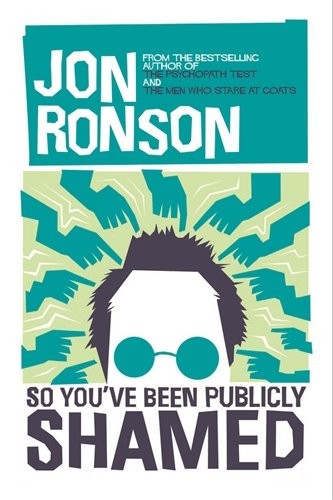
So You've Been Publicly Shamed
Key Takeaways
Kyle, in 2018 in Books: I first heard about Jon Ronson from a Reply All podcast episode where he told some of the same stories in the book. Camden actually ended up reading this book first and then encouraging me to follow suit. What really struck me about this book was his comparisons to public shamings in the olden days, with whippings, and the stocks, etc. What I can’t understand is that lack of human empathy in those situations. I remember as a kid feeling a deep fear of injustice; when other kids would get picked up against their will and thrown in a trash can, or things like that. Even if it wasn’t me, even if it wasn’t someone I knew, I felt so uncomfortable with that. How people can do anything like that is an enigma, but Ronson specifically points out the power of the internet in being able to intensify that experience, and it’s frightening.
The story that struck me the most was the vortex of shame that occurred at a tech conference. Two white guys were making inappropriate sexual comments behind a woman named Adria at the conference. Adria was offended, stood up, took a picture of the two guys, and tweeted it out. The online backlash was swift and merciless. One of the guys in particular, Hank, was targeted and fired from his job. He shared online that he had been fired, and the backlash turned and shifted its focus onto Adria, who was then also fired. This story reminded me of a John Oliver piece about online abuse and how much worse it is for women than for men. After an experience where the author was going to dress as a woman and see how he got treated, but was too afraid to do it — “Now, as I lay in my hotel room, I understood the truth of it. My terror of humiliation had closed a door. Great adventures that might have unfolded involving me dressed as a woman would never now unfold. I’d been constrained by the terror. It had blown me off course. Which, actually, meant that I was just like the vast majority of people.” A guy who decided to lie in a story because he thought it was important — “You want to do something in the world? Be willing to throw your life away. I was, ‘Fine. I’ll throw my life away. Fine.’” James Gilligan, a psychologist who studied chronic murder and suicide rates in Massachusetts prisons, said that all these prisoners would say the same kind of thing. “The men would all say that they had died. One inmate told me he feels like ‘food that is decomposing.’ These men’s souls did not just die. They have dead souls because their souls were murdered. How did it happen? A central secret. And that was secret was that they felt ashamed — deeply ashamed, chronically ashamed, acutely ashamed.’” It’s disorienting,” I said, “that the line between hell and redemption in the U.S. justice system is so fine.”
Jon Ronson reporting on the return of public shaming via social media. The highlights track an argument in four moves:
- This is a revival, not an invention. An 1800s sermon begging people to be less exuberant at executions; Ronson’s note that a comparable offence then drew the stocks. “For the first time in 180 years — since the stocks and the pillory were outlawed — we have the power” over the justice system.
- The shamers don’t check the outcome. “It didn’t seem to be crossing any of our minds to wonder whether the person we had just shamed was okay or in ruins.” Whatever the “pleasurable rush” is, “who would want to know?”
- The damage is asymmetric and lasting. The tech-conference case Kyle flagged as the one that struck him most: both parties lost their jobs, and one of them afterwards said “I distance myself from female developers.” Kyle connects it to a John Oliver piece on how much worse online abuse is for women.
- Shame doesn’t reform. James Gilligan’s prison work — “all violence being a person’s attempt to replace shame with self-esteem” — and the blunt verdict: “If shaming worked, if prison worked, then it would work. But it doesn’t work.”
Ronson’s conclusion is about the chilling effect rather than the individual cases: “We were creating a world where the smartest way to survive is to be bland” — a “giant echo chamber where what we believe is constantly reinforced” that makes for a more conformist age, not a less one.
Connections
Books: The Coddling of the American Mind — the adjacent argument about safety, speech and fragility. Nickel and Dimed — Ronson-style immersive reporting.
Concepts: Cancel Culture · Social Media · Free Speech — the mechanics this book documents; Institutionalized Belief In The Greater Fool shares its interest in crowd behaviour.
People: Jon Ronson.
- Social Media / Twitter — Jon Ronson’s 2015 investigation into internet pile-ons; documents how Reputation is destroyed in hours by Twitter mobs and how public Justice collapses into performance.
- Language of Discourse — the book belongs to the language-of-discourse cluster: how the norms governing public speech, shaming, and accountability evolved (and degraded) with the rise of social platforms.
Highlights
- “He looked as if he felt he were taking a risk even mentioning to me the existence of the terror. He meant that we all have ticking away within us something we fear will badly harm our reputation if it go out — some “I’m glad I’m not that” at the end of an “I’m glad I’m not me.” I think he was right. Maybe our secret is actually nothing horrendous. Maybe nobody would even consider it a big deal if it was exposed. But we can’t take that risk. So we keep it buried. Maybe it’s a work impropriety. Or maybe it’s just a feeling that at at any moment we’ll blurt something out during some important meeting that’ll prove to everyone that we aren’t proper professional people or, in fact, functional human beings. I think that even in these days of significant oversharing we keep this particular terror concealed.”
- “The sermon, by the Reverend Nathan Strong of Hartford, Connecticut, was an entreaty to people to be less exuberant at executions: ‘Do not go to that place of horror with elevated spirits and gay hearts, for death is there! Justice and judgement are there! The power of government, displayed in its most awful form, is there…The person who can go and look on death merely to gratify an idle humor is destitute both of humanity and piety.’”
- “If Jonah had been found guilty of ‘lying or publishing false news,’ in the 1800s, he would have been ‘fined, placed in the stocks for a period not exceeding four hours, or publicly whipped with not more than forty stripes.’”
- “It didn’t seem to be crossing any of our minds to wonder whether the person we had just shamed was okay or in ruins. I suppose that when shamings are delivered like remotely administered drone strikes nobody needs to think about how ferocious our collective power might be. The snowflake never feels responsible for the avalanche.”
- “A life had been ruined. What was it for: just some social media drama? I think our natural disposition as humans is to plod along until we get old and stop. But with social media, we’ve treated a stage for constant artificial high drama. Every day a new person emerges as a magnificent hero or a sickening villain. It’s all very sweeping, and not the way we actually are as people. What rush was overpowering us at times like this? What were we getting out of it?”
- “He was just like everyone who participates in mass online destruction. Who would want to know? Whatever that pleasurable rush that overwhelms us is — group madness or something else — nobody wants to ruin it by facing the fact that it comes with a cost.”
- “And his second message was that a smart orator could, if he knew the tricks, hypnotize the crowd into acquiescence or whip it up to do his bidding. LeBon listed the tricks: “A crowd is only impressed by excessive sentiments. Exaggerate, affirm, resort to repetition, and never attempt to prove anything by reasoning.”
- “I asked Mercedes what sorts of people gathered on 4chan. ‘A lot of them are bored, under-stimulated, over-persecuted, powerless kids,’ she replied. ‘They know they can’t be anything they want. So they went to the internet. On the Internet we have the power in situations where we would otherwise be powerless.’”
- “Part of the reason these kids have become experts on the Internet is because they don’t have power anywhere else. Skilled trade is shrinking. That’s why they went there. And then, holy sh**, it blew up.”
Kyle: The story that struck me the most was the vortex of shame that occurred at a tech conference. Two white guys were making inappropriate sexual comments behind a woman named Adria at the conference. Adria was offended, stood up, took a picture of the two guys, and tweeted it out. The online backlash was swift and merciless. One of the guys in particular, Hank, was targeted and fired from his job. He shared online that he had been fired, and the backlash turned and shifted its focus onto Adria, who was then also fired.
- “I asked Hank if he found himself behaving differently since the incident. Had it altered how he lived his life? ‘I distance myself from female developers a little bit now,’ Hank replied. ‘I’m not as friendly. There’s humor, but it’s very mundane. You just don’t know. I can’t afford another Donglegate.’ — ‘Give me an example,’ I said. ‘So you’re in your new workplace’ — Hank was offered another job right away — ‘and you’re talking to a female developer. In what way do you act differently toward her?’ ‘Well,’ Hank said, ‘We don’t have female developers at the place I’m working at now. So.’
- “‘You’ve got a new job now, right?’ I said to Adria. ‘No,’ she said.”
- “It seemed to me that all the people involved in the Hank and Adria story thought they were doing something good. But they only revealed that our imagination is so limited, our arsenal of potential responses so narrow, that the only thing anyone can think to do with an inappropriate shamer like Adria is to punish her with shaming. All of the shamers had themselves come from a place of shame and it really felt parochial and self-defeating to instinctively slap shame onto shame like a clumsy builder covering cracks.”
Kyle: This story reminded me of a John Oliver piece about online abuse and how much worse it is for women than for men. Kyle: After an experience where the author was going to dress as a woman and see how he got treated, but was too afraid to do it — “Now, as I lay in my hotel room, I understood the truth of it. My terror of humiliation had closed a door. Great adventures that might have unfolded involving me dressed as a woman would never now unfold. I’d been constrained by the terror. It had blown me off course. Which, actually, meant that I was just like the vast majority of people.”
- “We felt inexorably altered by the power of Mike’s narrative and became determined to take action. Most of us, it goes without saying, were inexorably altered back to how we’d been earlier that day by the time we’d had dinner or whatever.”
Kyle: A guy who decided to lie in a story because he thought it was important — “You want to do something in the world? Be willing to throw your life away. I was, ‘Fine. I’ll throw my life away. Fine.’”
- “The way we construct our consciousness is to tell the story of ourselves to ourselves, the story of who we believe we are. I feel that a really public shaming or humiliation is a conflict between the person trying to write his own narrative and society trying to write a different narrative for the person. One story tries to overwrite the other. And so to survive you have to own your own story.”
- “Prurient curiosity may not be great. But curiosity is. People’s flaws need to be written about. The flaws of some people lead to horrors inflicted on others. And then there are the more human flaws that, when you shine a light onto them, de-demonize people who might otherwise be seen as ogres.”
Kyle: James Gilligan, a psychologist who studied chronic murder and suicide rates in Massachusetts prisons, said that all these prisoners would say the same kind of thing. “The men would all say that they had died. One inmate told me he feels like ‘food that is decomposing.’ These men’s souls did not just die. They have dead souls because their souls were murdered. How did it happen? A central secret. And that was secret was that they felt ashamed — deeply ashamed, chronically ashamed, acutely ashamed.’”
- “So they grew up and — ‘all violence being a person’s attempt to replace shame with self-esteem’ — they murdered people.”
- “And after they were jailed, things only got worse. At Walpoke — Massachusett’s most riot-prone prison during the 1970s — officers intentionally flooded cells and put insects in the prisoner’s food. They forced inmates to lie face down before they were allowed to eat meals. Sometimes officers would tell prisoners they had a visitor. Prisoners almost never had visitors, so this was exciting to hear. Then the officer would say that the prisoner didn’t really have a visitor and that he was just kidding. And so on. “They thought these things would be how to get them to obey,” Gilligan told me. “But it did the exact opposite. It stimulated violence.”
- “”If shaming worked, if prison worked, then it would work,’ Jim said to me. ‘But it doesn’t work.’ He paused. ‘Look, some people need to go to prison forever. Some people are incapable…but most people…”
Kyle: It’s disorienting,” I said, “that the line between hell and redemption in the U.S. justice system is so fine.”
- “We were creating a world where the smartest way to survive is to be bland.”
- “We have always had some influence over the justice system, but for the first time in 180 years — since the stocks and the pillory were outlawed — we have the power to determine the severity of some punishments. And so we have to think about what level of mercilessness we feel comfortable with. I, personally, no longer take part in the ecstatic public condemnation of people unless they’ve committed a transgression that has an actual victim, and even then not as much as I probably should. I miss the fun a little. But it feels like when I became a vegetarian. I missed the steak, although not as much as I’d anticipated, but I could no longer ignore the slaughterhouse.”
- “Google has the informal corporate motto of ‘Don’t be evil,’ but they make money when anything happens online, even the bad stuff.”
- “Feedback loops. You exhibit some type of behavior (you drive at twenty-seven miles per hour in a twenty-five-mile-an-hour zone). You get instant real-time feedback for it (the sign tells you you’re driving at twenty-seven miles per hour). You decide whether or not to change your behavior as a result of feedback (you lower your speed to twenty-five miles per hour). Yo uget instant feedback for that decision too (the sign tells you [you slowed down]). And it all happens in the flash of an eye — in the few moments it takes you to drive past your speed sign.”
- “Maybe — as my friend the documentary maker Adam Curtis e-mailed me — they’re turning social media into “a giant echo chamber where what we believe is constantly reinforced by people who believe the same thing.”
- “We see ourselves as nonconformists, but I think all of this is creating a more conformist, conservative age. “Look!” we’re saying. “WE’RE normal! THIS is the average!” We are defining the boundaries of normality by tearing apart the people outside it.”
Kyle: {{youtube: https://youtu.be/PuNIwYsz7PI}}
Referenced in
- Jon Ronson note
- Language of Discourse note
- ReplyAll note
- The Castle — Adventures in a World of Unraveling Men note