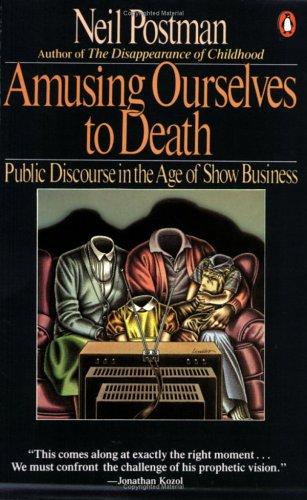
Amusing Ourselves To Death
Key Takeaways
Kyle, in 2024 in Books: Finally at the very end of the year I got around to reading the book that had made me think I should read Brave New World first. And I can say having read 1984 AND Brave New World it certainly hit close to home the contrast. More broadly, I’ve written before about “becoming unprogrammable” but its clearly easier said than done. The world is set up in such a way that we struggle to kick against the status quo of becoming entertained to the point of moving past feeling.
Postman’s media-ecology argument read with a recurring contemporary update — print culture vs. social-media culture mapped onto the original print-vs-television frame. Three threads:
-
Coherence collapses without print discipline. Postman’s argument that print structures public discourse around logic and coherence gets a sharp present-tense update: social-media culture is structured around loudness and conflict instead. Lying or self-contradiction is ideal in that environment because agreement and disagreement both amplify reach.
-
Information abundance has inverted the comprehensibility-of-the-world feeling. Typography’s spread once kindled hope that the world could be comprehended; the internet’s explosion kindled the opposite despair.
-
Educated populace as the structural defense. Same Educated Electorate and Voice of the People threads that run through The Death of Expertise and Romney — A Reckoning.
Connections
People: Neil Postman — the media-ecologist whose print-vs-television argument the whole book advances. Aldous Huxley — Postman’s thesis is that Huxley’s Brave New World (pleasure-as-control), not Orwell’s, was the accurate prophecy. George Orwell — the foil throughout; Postman argues Orwell’s externally-imposed oppression was the wrong fear. Benjamin Franklin — the Dunkers anecdote on doctrinal humility and the Colonial-print-culture passages. Daniel Webster — cited among the great lawyers who tried to “create a rationality for the law.” Thomas Jefferson — saw universal education as America’s best hope and tied citizenship to literacy. Alexander Hamilton — co-author (with Madison and Jay) of the Federalist Papers as a print-discourse exemplar. Henry David Thoreau — Walden’s “Maine and Texas have nothing to communicate” as an early critique of telegraphy. Alexis de Tocqueville — Democracy in America on pamphlets and on the legal profession as a privileged body of intellect. John Stuart Mill — his father’s faith that universal literacy plus suffrage would secure good government. Bertrand Russell — the “immunity to eloquence” the analytic reader brings to a text.
Concepts: Voice of the People — Kyle’s marginalia tags the lawyers’-rationality passage; the educated-citizenry-as-defense thread. Educated Electorate — Postman’s structural defense against media-driven triviality. Educated Populace — Kyle tags the constitutional-literacy passage on mature citizenship. Misinformation / Malinformation — television “altering the meaning of being informed” by creating disinformation; Kyle’s note on the language-and-worldview highlight. Open Source — Postman’s 1985-preface example of collaborative creativity (Linux) against collapsing communities.
Books: Brave New World — the Huxley/Postman pairing on entertainment-as-control, the book’s central argument. 1984 — Orwell’s pain-based dystopia set against Huxley’s pleasure-based one. Animal Farm — cited alongside 1984 and Darkness at Noon as a blueprint of thought-control. The Death of Expertise — same democratic-epistemology question. Romney — A Reckoning — educated-electorate thread. The Invention of Russia — the entertainment-vs-information thesis applied to Russian state TV; Kyle’s marginalia on both asks “Does our media inform? Or entertain?”
Highlights
- Communities have been replaced by demographics. Silence has been replaced by background noise. It’s a different world.
- A common critique was that he should have offered solutions; you can’t put the toothpaste back in the tube, after all, so what now?
- It is an exhortation to do something. It’s a counterpunch to what my father thought daily TV news was: “inert, consisting of information that gives us something to talk about but cannot lead to any meaningful action.”
- A new kind of collaborative creativity abounds, thanks to the “open source” movement, which gave us the Linux operating system. However, other communities are collapsing: Far fewer people join clubs that meet regularly, fewer families eat dinner together, and people don’t have friends over or know their neighbors the way they used to.
- His questions can be asked about all technologies and media. What happens to us when we become infatuated with and then seduced by them? Do they free us or imprison us? Do they improve or degrade democracy? Do they make our leaders more accountable or less so? Our system more transparent or less so? Do they make us better citizens or better consumers? Are the trade-offs worth it? If they’re not worth it, yet we still can’t stop ourselves from embracing the next new thing because that’s just how we’re wired, then what strategies can we devise to maintain control? Dignity? Meaning?
- Nor did he fear TV across the board (as some thought). Junk television was fine. “The A-Team and Cheers are no threat to our public health,” he wrote. “60 Minutes, Eyewitness News, and Sesame Street are.”
- We were keeping our eye on 1984. When the year came and the prophecy didn’t, thoughtful Americans sang softly in praise of themselves. The roots of liberal democracy had held. Wherever else the terror had happened, we, at least, had not been visited by Orwellian nightmares. But we had forgotten that alongside Orwell’s dark vision, there was another—slightly older, slightly less well known, equally chilling: Aldous Huxley’s Brave New World. Contrary to common belief even among the educated, Huxley and Orwell did not prophesy the same thing. Orwell warns that we will be overcome by an externally imposed oppression. But in Huxley’s vision, no Big Brother is required to deprive people of their autonomy, maturity and history. As he saw it, people will come to love their oppression, to adore the technologies that undo their capacities to think. What Orwell feared were those who would ban books. What Huxley feared was that there would be no reason to ban a book, for there would be no one who wanted to read one. Orwell feared those who would deprive us of information. Huxley feared those who would give us so much that we would be reduced to passivity and egoism. Orwell feared that the truth would be concealed from us. Huxley feared the truth would be drowned in a sea of irrelevance. Orwell feared we would become a captive culture. Huxley feared we would become a trivial culture, preoccupied with some equivalent of the feelies, the orgy porgy, and the centrifugal bumblepuppy. As Huxley remarked in Brave New World Revisited, the civil libertarians and rationalists who are ever on the alert to oppose tyranny “failed to take into account man’s almost infinite appetite for distractions.” In 1984, Huxley added, people are controlled by inflicting pain. In Brave New World, they are controlled by inflicting pleasure. In short, Orwell feared that what we hate will ruin us. Huxley feared that what we love will ruin us. This book is about the possibility that Huxley, not Orwell, was right.
- Today, we must look to the city of Las Vegas, Nevada, as a metaphor of our national character and aspiration, its symbol a thirty-foot-high cardboard picture of a slot machine and a chorus girl. For Las Vegas is a city entirely devoted to the idea of entertainment, and as such proclaims the spirit of a culture in which all public discourse increasingly takes the form of entertainment. Our politics, religion, news, athletics, education and commerce have been transformed into congenial adjuncts of show business, largely without protest or even much popular notice. The result is that we are a people on the verge of amusing ourselves to death.
- Although the Federal Communications Act makes no mention of it, those without camera appeal are excluded from addressing the public about what is called “the news of the day.”
- Although the Bible makes no mention of it, the Reverend Graham assured the audience that God loves those who make people laugh. It was an honest mistake. He merely mistook NBC for God.
- There is no shortage of critics who have observed and recorded the dissolution of public discourse in America and its conversion into the arts of show business. But most of them, I believe, have barely begun to tell the story of the origin and meaning of this descent into a vast triviality.
- We are all, as Huxley says someplace, Great Abbreviators, meaning that none of us has the wit to know the whole truth, the time to tell it if we believed we did, or an audience so gullible as to accept it.
- For on television, discourse is conducted largely through visual imagery, which is to say that television gives us a conversation in images, not words. The emergence of the image-manager in the political arena and the concomitant decline of the speech writer attest to the fact that television demands a different kind of content from other media. You cannot do political philosophy on television. Its form works against the content.
- I have remained steadfast to his teaching that the clearest way to see through a culture is to attend to its tools for conversation.
- I wondered then, as so many others have, as to why the God of these people would have included instructions on how they were to symbolize, or not symbolize, their experience. It is a strange injunction to include as part of an ethical system unless its author assumed a connection between forms of human communication and the quality of a culture.
- Speech, of course, is the primal and indispensable medium. It made us human, keeps us human, and in fact defines what human means. This is not to say that if there were no other means of communication all humans would find it equally convenient to speak about the same things in the same way. We know enough about language to understand that variations in the structures of languages will result in variations in what may be called “world view.” How people think about time and space, and about things and processes, will be greatly influenced by the grammatical features of their language.
Kyle: #Malinformation
- Each medium, like language itself, makes possible a unique mode of discourse by providing a new orientation for thought, for expression, for sensibility. Which, of course, is what McLuhan meant in saying the medium is the message.
- In Mumford’s great book Technics and Civilization, he shows how, beginning in the fourteenth century, the clock made us into time-keepers, and then time-savers, and now time-servers. In the process, we have learned irreverence toward the sun and the seasons, for in a world made up of seconds and minutes, the authority of nature is superseded.
- Philosophy cannot exist without criticism, and writing makes it possible and convenient to subject thought to a continuous and concentrated scrutiny. Writing freezes speech and in so doing gives birth to the grammarian, the logician, the rhetorician, the historian, the scientist—all those who must hold language before them so that they can see what it means, where it errs, and where it is leading.
- Northrop Frye has remarked, “the written word is far more powerful than simply a reminder: it re-creates the past in the present, and gives us, not the familiar remembered thing, but the glittering intensity of the summoned-up hallucination.”[3]
- What I mean to point out here is that the introduction into a culture of a technique such as writing or a clock is not merely an extension of man’s power to bind time but a transformation of his way of thinking—and, of course, of the content of his culture.
- Eyeglasses refuted the belief that anatomy is destiny by putting forward the idea that our bodies as well as our minds are improvable. I do not think it goes too far to say that there is a link between the invention of eyeglasses in the twelfth century and gene-splitting research in the twentieth.
- And our languages are our media. Our media are our metaphors. Our metaphors create the content of our culture.
- I must, first, demonstrate how, under the governance of the printing press, discourse in America was different from what it is now—generally coherent, serious and rational; and then how, under the governance of television, it has become shriveled and absurd.
- Besides, we do not measure a culture by its output of undisguised trivialities but by what it claims as significant. Therein is our problem, for television is at its most trivial and, therefore, most dangerous when its aspirations are high, when it presents itself as a carrier of important cultural conversations.
- You are mistaken in believing that the form in which an idea is conveyed is irrelevant to its truth. In the academic world, the published word is invested with greater prestige and authenticity than the spoken word. What people say is assumed to be more casually uttered than what they write. The written word is assumed to have been reflected upon and revised by its author, reviewed by authorities and editors.
- The written word endures, the spoken word disappears; and that is why writing is closer to the truth than speaking.
- It was not only a key element in the education of Athenians (far more important than philosophy) but a preeminent art form. To the Greeks, rhetoric was a form of spoken writing. Though it always implied oral performance, its power to reveal the truth resided in the written word’s power to display arguments in orderly progression.
- the concept of truth is intimately linked to the biases of forms of expression. Truth does not, and never has, come unadorned.
- As a culture moves from orality to writing to printing to televising, its ideas of truth move with it. Every philosophy is the philosophy of a stage of life, Nietzsche remarked. To which we might add that every epistemology is the epistemology of a stage of media development. Truth, like time itself, is a product of a conversation man has with himself about and through the techniques of communication he has invented.
- If you have learned how to get to meanings without aesthetic distraction, you are required to assume an attitude of detachment and objectivity. This includes your bringing to the task what Bertrand Russell called an “immunity to eloquence,” meaning that you are able to distinguish between the sensuous pleasure, or charm, or ingratiating tone (if such there be) of the words, and the logic of their argument.
- I want to show that in the eighteenth and nineteenth centuries, America was such a place, perhaps the most print-oriented culture ever to have existed.
- The first is that at no point do I care to claim that changes in media bring about changes in the structure of people’s minds or changes in their cognitive capacities. There are some who make this claim, or come close to it (for example, Jerome Bruner, Jack Goody, Walter Ong, Marshall McLuhan, Julian Jaynes, and Eric Havelock).[7] I am inclined to think they are right, but my argument does not require it. Therefore, I will not burden myself with arguing the possibility, for example, that oral people are less developed intellectually, in some Piagetian sense, than writing people, or that “television” people are less developed intellectually than either.
- I will say once again that I am no relativist in this matter, and that I believe the epistemology created by television not only is inferior to a print-based epistemology but is dangerous and absurdist.
- There are also claims that whatever power television might have to undermine rational discourse, its emotional power is so great that it could arouse sentiment against the Vietnam War or against more virulent forms of racism. These and other beneficial possibilities are not to be taken lightly.
- as typography moves to the periphery of our culture and television takes its place at the center, the seriousness, clarity and, above all, value of public discourse dangerously declines.
- The statement had its origins in Welfare’s complaint to Franklin that zealots of other religious persuasions were spreading lies about the Dunkers, accusing them of abominable principles to which, in fact, they were utter strangers. Franklin suggested that such abuse might be diminished if the Dunkers published the articles of their belief and the rules of their discipline. Welfare replied that this course of action had been discussed among his co-religionists but had been rejected. He then explained their reasoning in the following words: When we were first drawn together as a society, it had pleased God to enlighten our minds so far as to see that some doctrines, which we once esteemed truths, were errors, and that others, which we had esteemed errors, were real truths. From time to time He has been pleased to afford us farther light, and our principles have been improving, and our errors diminishing. Now we are not sure that we are arrived at the end of this progression, and at the perfection of spiritual or theological knowledge; and we fear that, if we should feel ourselves as if bound and confined by it, and perhaps be unwilling to receive further improvement, and our successors still more so, as conceiving what we their elders and founders had done, to be something sacred, never to be departed from.[1] Franklin describes this sentiment as a singular instance in the history of mankind of modesty in a sect.
Kyle: The problem when dogma replaces progression as the priority
- Whatever else may be said of those immigrants who came to settle in New England, it is a paramount fact that they and their heirs were dedicated and skillful readers whose religious sensibilities, political ideas and social life were embedded in the medium of typography.
- And although literacy rates are notoriously difficult to assess, there is sufficient evidence (mostly drawn from signatures) that between 1640 and 1700, the literacy rate for men in Massachusetts and Connecticut was somewhere between 89 percent and 95 percent, quite probably the highest concentration of literate males to be found anywhere in the world at that time.[2]
- from 1650 onward almost all New England towns passed laws requiring the maintenance of a “reading and writing” school, the large communities being required to maintain a grammar school, as well.[7] In all such laws, reference is made to Satan, whose evil designs, it was supposed, could be thwarted at every turn by education.
- From public schools shall general knowledge flow, For ’tis the people’s sacred right to know.[8]
- “More than any other device,” Lewis Mumford wrote of this shift, “the printed book released people from the domination of the immediate and the local; … print made a greater impression than actual events… . To exist was to exist in print: the rest of the world tended gradually to become more shadowy. Learning became book-learning.”[9]
- One significant implication of this situation is that no literary aristocracy emerged in Colonial America. Reading was not regarded as an elitist activity, and printed matter was spread evenly among all kinds of people. A thriving, classless reading culture developed because, as Daniel Boorstin writes, “It was diffuse. Its center was everywhere because it was nowhere: Every man was close to what [printed matter] talked about. Everyone could speak the same language. It was the product of a busy, mobile, public society.”[13]
- By 1772, Jacob Duché could write: “The poorest labourer upon the shore of the Delaware thinks himself entitled to deliver his sentiment in matters of religion or politics with as much freedom as the gentleman or scholar… . Such is the prevailing taste for books of every kind, that almost every man is a reader.”[14]
- Where such a keen taste for books prevailed among the general population, we need not be surprised that Thomas Paine’s Common Sense, published on January 10, 1776, sold more than 100,000 copies by March of the same year.[15] In 1985, a book would have to sell eight million copies (in two months) to match the proportion of the population Paine’s book attracted.
- Paine had less formal schooling than Shakespeare, and came from the lowest laboring class before he arrived in America. In spite of these disadvantages, Paine wrote political philosophy and polemics the equal in lucidity and vitality (although not quantity) of Voltaire’s, Rousseau’s, and contemporary English philosophers’, including Edmund Burke.
- Americans did not write many books in the Colonial period, which Benjamin Franklin tried to explain by claiming that Americans were too busy doing other things.
- Franklin’s reference to pamphlets ought not to go unnoticed. The proliferation of newspapers in all the Colonies was accompanied by the rapid diffusion of pamphlets and broadsides. Alexis de Tocqueville took note of this fact in his Democracy in America, published in 1835: “In America,” he wrote, “parties do not write books to combat each other’s opinions, but pamphlets, which are circulated for a day with incredible rapidity and then expire.”[25]
- For example, the Federalist Papers, an outpouring of eighty-five, essays written by Alexander Hamilton, James Madison, and John Jay (all under the name of Publius) originally appeared in a New York newspaper during 1787 and 1788 but were read almost as widely in the South as the North.
- As Richard Hofstadter reminds us, America was founded by intellectuals, a rare occurrence in the history of modern nations. “The Founding Fathers,” he writes, “were sages, scientists, men of broad cultivation, many of them apt in classical learning, who used their wide reading in history, politics, and law to solve the exigent problems of their time.”
- One sometimes hears it said, for example, that there is more printed matter available today than ever before, which is undoubtedly true. But from the seventeenth century to the late nineteenth century, printed matter was virtually all that was available. There were no movies to see, radio to hear, photographic displays to look at, records to play. There was no television. Public business was channeled into and expressed through print, which became the model, the metaphor and the measure of all discourse. The resonances of the lineal, analytical structure of print, and in particular, of expository prose, could be felt everywhere.
- What kind of audience was this? Who were these people who could so cheerfully accommodate themselves to seven hours of oratory? It should be noted, by the way, that Lincoln and Douglas were not presidential candidates; at the time of their encounter in Peoria they were not even candidates for the United States Senate. But their audiences were not especially concerned with their official status. These were people who regarded such events as essential to their political education, who took them to be an integral part of their social lives, and who were quite accustomed to extended oratorical performances.
- At the first debate in Ottawa, Douglas responded to lengthy applause with a remarkable and revealing statement. “My friends,” he said, “silence will be more acceptable to me in the discussion of these questions than applause. I desire to address myself to your judgment, your understanding, and your consciences, and not to your passions or your enthusiasms.”[3]
- For one thing, its attention span would obviously have been extraordinary by current standards. Is there any audience of Americans today who could endure seven hours of talk? or five? or three? Especially without pictures of any kind? Second, these audiences must have had an equally extraordinary capacity to comprehend lengthy and complex sentences aurally.
- People of a television culture need “plain language” both aurally and visually, and will even go so far as to require it in some circumstances by law.
- To understand the audience to whom Lincoln and Douglas directed their memorable language, we must remember that these people were the grandsons and granddaughters of the Enlightenment (American version). They were the progeny of Franklin, Jefferson, Madison and Tom Paine, the inheritors of the Empire of Reason, as Henry Steele Commager has called eighteenth-century America. It is true that among their number were frontiersmen, some of whom were barely literate, and immigrants to whom English was still strange. It is also true that by 1858, the photograph and telegraph had been invented, the advance guard of a new epistemology that would put an end to the Empire of Reason. But this would not become evident until the twentieth century.
- For all of the hoopla and socializing surrounding the event, the speakers had little to offer, and audiences little to expect, but language.
- This language is pure print. That the occasion required it to be spoken aloud cannot obscure that fact. And that the audience was able to process it through the ear is remarkable only to people whose culture no longer resonates powerfully with the printed word.
- Whenever language is the principal medium of communication—especially language controlled by the rigors of print—an idea, a fact, a claim is the inevitable result. The idea may be banal, the fact irrelevant, the claim false, but there is no escape from meaning when language is the instrument guiding one’s thought. Though one may accomplish it from time to time, it is very hard to say nothing when employing a written English sentence.
- From Erasmus in the sixteenth century to Elizabeth Eisenstein in the twentieth, almost every scholar who has grappled with the question of what reading does to one’s habits of mind has concluded that the process encourages rationality; that the sequential, propositional character of the written word fosters what Walter Ong calls the “analytic management of knowledge.” To engage the written word means to follow a line of thought, which requires considerable powers of classifying, inference-making and reasoning. It means to uncover lies, confusions, and overgeneralizations, to detect abuses of logic and common sense. It also means to weigh ideas, to compare and contrast assertions, to connect one generalization to another. To accomplish this, one must achieve a certain distance from the words themselves, which is, in fact, encouraged by the isolated and impersonal text. That is why a good reader does not cheer an apt sentence or pause to applaud even an inspired paragraph. Analytic thought is too busy for that, and too detached.
- In a culture dominated by print, public discourse tends to be characterized by a coherent, orderly arrangement of facts and ideas. The public for whom it is intended is generally competent to manage such discourse. In a print culture, writers make mistakes when they lie, contradict themselves, fail to support their generalizations, try to enforce illogical connections. In a print culture, readers make mistakes when they don’t notice, or even worse, don’t care.
Kyle: WILD. Polar opposite to a social media world. A social media culture isn’t structured around coherence and logic. It’s structured around loudness and conflict. Lying or contradicting yourself is ideal because the people who agree will buy in and the people who disagree will amplify your message.
- The spread of typography kindled the hope that the world and its manifold mysteries could at least be comprehended, predicted, controlled.
Kyle: Explosion of information on the internet has kindled the despair that the world and its manifold mysteries are incomprehensible, unpredictable, and out of control.
- John Stuart Mill’s autobiography: So complete was my father’s reliance on the influence of mankind, wherever [literacy] is allowed to reach them, that he felt as if all would be gained if the whole population were taught to read, if all sorts of opinions were allowed to be addressed to them by word and in writing, and if, by means of the suffrage, they could nominate a legislature to give effect to the opinion they adopted.[7]
- Because of The Age of Reason, Paine lost his standing among the pantheon of Founding Fathers (and to this day is treated ambiguously in American history textbooks).
- Perhaps that is why Henry Coswell remarked in 1839 that “religious mania is said to be the prevailing form of insanity in the United States.”[11] Yet it is essential to bear in mind that quarrels over doctrine between the revivalist movements of the eighteenth and nineteenth centuries and the established churches fiercely opposed to them were argued in pamphlets and books in largely rational, logically ordered language.
- It is a matter frequently overlooked in histories of America that in the eighteenth and nineteenth centuries, the legal profession represented “a sort of privileged body in the scale of intellect,” as Tocqueville remarked.
- But the great figures of American jurisprudence—John Marshall, Joseph Story, James Kent, David Hoffman, William Wirt and Daniel Webster—were models of intellectual elegance and devotion to rationality and scholarship. They believed that democracy, for all of its obvious virtues, posed the danger of releasing an undisciplined individualism. Their aspiration was to save civilization in America by “creating a rationality for the law.”[14]
Kyle: Voice of the People
- Indeed, the history of newspaper advertising in America may be considered, all by itself, as a metaphor of the descent of the typographic mind, beginning, as it does, with reason, and ending, as it does, with entertainment. In Frank Presbrey’s classic study The History and Development of Advertising, he discusses the decline of typography, dating its demise in the late 1860s and early 1870s. He refers to the period before then as the “dark ages” of typographical display.[19] The dark ages to which he refers began in 1704 when the first paid advertisements appeared in an American newspaper, The Boston News-Letter. These were three in number, occupying altogether four inches of single-column space. One of them offered a reward for the capture of a thief; another offered a reward for the return of an anvil that was “taken up” by some unknown party. The third actually offered something for sale, and, in fact, is not unlike real estate advertisements one might see in today’s New York Times:
- As late as 1890, advertising, still understood to consist of words, was regarded as an essentially serious and rational enterprise whose purpose was to convey information and make claims in propositional form.
- Public figures were known largely by their written words, for example, not by their looks or even their oratory. It is quite likely that most of the first fifteen presidents of the United States would not have been recognized had they passed the average citizen in the street. This would have been the case as well of the great lawyers, ministers and scientists of that era. To think about those men was to think about what they had written, to judge them by their public positions, their arguments, their knowledge as codified in the printed word.
- It is also the difference between living in a culture that provides little opportunity for leisure, and one that provides much. The farm boy following the plow with book in hand, the mother reading aloud to her family on a Sunday afternoon, the merchant reading announcements of the latest clipper arrivals—these were different kinds of readers from those of today. There would have been little casual reading, for there was not a great deal of time for that. Reading would have had a sacred element in it, or if not that, would have at least occurred as a daily or weekly ritual invested with special meaning. For we must also remember that this was a culture without electricity. It would not have been easy to read by either candlelight or, later, gaslight. Doubtless, much reading was done between dawn and the start of the day’s business. What reading would have been done was done seriously, intensely, and with steadfast purpose.
- It may be true, as Charles Beard wrote, that the primary motivation of the writers of the United States Constitution was the protection of their economic interests. But it is also true that they assumed that participation in public life required the capacity to negotiate the printed word. To them, mature citizenship was not conceivable without sophisticated literacy, which is why the voting age in most states was set at twenty-one, and why Jefferson saw in universal education America’s best hope.
Kyle: Educated Populace
- But at a considerable cost. For telegraphy did something that Morse did not foresee when he prophesied that telegraphy would make “one neighborhood of the whole country.” It destroyed the prevailing definition of information, and in doing so gave a new meaning to public discourse. Among the few who understood this consequence was Henry David Thoreau, who remarked in Walden that “We are in great haste to construct a magnetic telegraph from Maine to Texas; but Maine and Texas, it may be, have nothing important to communicate… . We are eager to tunnel under the Atlantic and bring the old world some weeks nearer to the new; but perchance the first news that will leak through into the broad flapping American ear will be that Princess Adelaide has the whooping cough.”[1]
- The potential of the telegraph to transform information into a commodity might never have been realized, except for the partnership between the telegraph and the press. The penny newspaper, emerging slightly before telegraphy, in the 1830s, had already begun the process of elevating irrelevance to the status of news.
- In fact, the first known use of the telegraph by a newspaper occurred one day after Morse gave his historic demonstration of telegraphy’s workability.
- It was not long until the fortunes of newspapers came to depend not on the quality or utility of the news they provided, but on how much, from what distances, and at what speed.
- Only four years after Morse opened the nation’s first telegraph line on May 24, 1844, the Associated Press was founded, and news from nowhere, addressed to no one in particular, began to crisscross the nation.
- By generating an abundance of irrelevant information, it dramatically altered what may be called the “information-action ratio.” In both oral and typographic cultures, information derives its importance from the possibilities of action.
- You may get a sense of what this means by asking yourself another series of questions: What steps do you plan to take to reduce the conflict in the Middle East? Or the rates of inflation, crime and unemployment? What are your plans for preserving the environment or reducing the risk of nuclear war? What do you plan to do about NATO, OPEC, the CIA, affirmative action, and the monstrous treatment of the Baha’is in Iran? I shall take the liberty of answering for you: You plan to do nothing about them.
- The news elicits from you a variety of opinions about which you can do nothing except to offer them as more news, about which you can do nothing.
- For the first time, we were sent information which answered no question we had asked, and which, in any case, did not permit the right of reply.
- The principal strength of the telegraph was its capacity to move information, not collect it, explain it or analyze it. In this respect, telegraphy was the exact opposite of typography.
- The line-by-line, sequential, continuous form of the printed page slowly began to lose its resonance as a metaphor of how knowledge was to be acquired and how the world was to be understood. “Knowing” the facts took on a new meaning, for it did not imply that one understood implications, background, or connections.
- To the telegraph, intelligence meant knowing of lots of things, not knowing about them.
- “Pictures,” Gavriel Salomon has written, “need to be recognized, words need to be understood.”[6]
- There is no such thing in nature as “man” or “tree.” The universe offers no such categories or simplifications; only flux and infinite variety. The photograph documents and celebrates the particularities of this infinite variety. Language makes them comprehensible.
- The words true and false come from the universe of language, and no other.
- Beneath its dying melody, a new note had been sounded, and photography and telegraphy set the key. Theirs was a “language” that denied interconnectedness, proceeded without context, argued the irrelevance of history, explained nothing, and offered fascination in place of complexity and coherence.
- To put it plainly, television is the command center of the new epistemology. There is no audience so young that it is barred from television. There is no poverty so abject that it must forgo television. There is no education so exalted that it is not modified by television. And most important of all, there is no subject of public interest—politics, news, education, religion, science, sports—that does not find its way to television. Which means that all public understanding of these subjects is shaped by the biases of television.
- Twenty years ago, the question, Does television shape culture or merely reflect it? held considerable interest for many scholars and social critics. The question has largely disappeared as television has gradually become our culture.
- I will try to demonstrate by concrete example that television’s way of knowing is uncompromisingly hostile to typography’s way of knowing; that television’s conversations promote incoherence and triviality; that the phrase “serious television” is a contradiction in terms; and that television speaks in only one persistent voice—the voice of entertainment.
- Television, in other words, is transforming our culture into one vast arena for show business.
- In watching American television, one is reminded of George Bernard Shaw’s remark on his first seeing the glittering neon signs of Broadway and 42nd Street at night. It must be beautiful, he said, if you cannot read.
- But what I am claiming here is not that television is entertaining but that it has made entertainment itself the natural format for the representation of all experience. Our television set keeps us in constant communion with the world, but it does so with a face whose smiling countenance is unalterable. The problem is not that television presents us with entertaining subject matter but that all subject matter is presented as entertaining, which is another issue altogether.
- When a television show is in process, it is very nearly impermissible to say, “Let me think about that” or “I don’t know” or “What do you mean when you say … ?” or “From what sources does your information come?” This type of discourse not only slows down the tempo of the show but creates the impression of uncertainty or lack of finish. It tends to reveal people in the act of thinking, which is as disconcerting and boring on television as it is on a Las Vegas stage. Thinking does not play well on television, a fact that television directors discovered long ago. There is not much to see in it. It is, in a phrase, not a performing art.
- William Buckley’s own program, Firing Line, occasionally shows people in the act of thinking but who also happen to have television cameras pointed at them. There are other programs, such as Meet the Press or The Open Mind, which clearly strive to maintain a sense of intellectual decorum and typographic tradition, but they are scheduled so that they do not compete with programs of great visual interest, since otherwise, they will not be watched.
- Prior to the 1984 presidential elections, the two candidates confronted each other on television in what were called “debates.” These events were not in the least like the Lincoln-Douglas debates or anything else that goes by the name. Each candidate was given five minutes to address such questions as, What is (or would be) your policy in Central America? His opposite number was then given one minute for a rebuttal. In such circumstances, complexity, documentation and logic can play no role, and, indeed, on several occasions syntax itself was abandoned entirely. It is no matter. The men were less concerned with giving arguments than with “giving off” impressions, which is what television does best.
- If on television, credibility replaces reality as the decisive test of truth-telling, political leaders need not trouble themselves very much with reality provided that their performances consistently generate a sense of verisimilitude.
- I should go so far as to say that embedded in the surrealistic frame of a television news show is a theory of anticommunication, featuring a type of discourse that abandons logic, reason, sequence and rules of contradiction. In aesthetics, I believe the name given to this theory is Dadaism; in philosophy, nihilism; in psychiatry, schizophrenia. In the parlance of the theater, it is known as vaudeville.
- I offer the following description of television news by Robert MacNeil, executive editor and co-anchor of the MacNeil-Lehrer Newshour. The idea, he writes, “is to keep everything brief, not to strain the attention of anyone but instead to provide constant stimulation through variety, novelty, action, and movement. You are required … to pay attention to no concept, no character, and no problem for more than a few seconds at a time.”[2] He goes on to say that the assumptions controlling a news show are “that bite-sized is best, that complexity must be avoided, that nuances are dispensable, that qualifications impede the simple message, that visual stimulation is a substitute for thought, and that verbal precision is an anachronism.”[3] Robert MacNeil has more reason than most to give testimony about the television news show as vaudeville act. The MacNeil-Lehrer Newshour is an unusual and gracious attempt to bring to television some of the elements of typographic discourse. The program abjures visual stimulation, consists largely of extended explanations of events and in-depth interviews (which even there means only five to ten minutes), limits the number of stories covered, and emphasizes background and coherence. But television has exacted its price for MacNeil’s rejection of a show business format. By television’s standards, the audience is minuscule, the program is confined to public-television stations, and it, is a good guess that the combined salary of MacNeil and Lehrer is one-fifth of Dan Rather’s or Tom Brokaw’s.
- The result of all this is that Americans are the best entertained and quite likely the least well-informed people in the Western world.
- Nonetheless, everyone had an opinion about this event, for in America everyone is entitled to an opinion, and it is certainly useful to have a few when a pollster shows up.
- It is probably more accurate to call them emotions rather than opinions, which would account for the fact that they change from week to week, as the pollsters tell us. What is happening here is that television is altering the meaning of “being informed” by creating a species of information that might properly be called disinformation.
- Walter Lippmann, for example, wrote in 1920: “There can be no liberty for a community which lacks the means by which to detect lies.”
- There is no great religious leader—from the Buddha to Moses to Jesus to Mohammed to Luther—who offered people what they want. Only what they need. But television is not well suited to offering people what they need. It is “user friendly.” It is too easy to turn off. It is at its most alluring when it speaks the language of dynamic visual imagery. It does not accommodate complex language or stringent demands. As a consequence, what is preached on television is not anything like the Sermon on the Mount.
- Though their messages are trivial, the shows have high ratings, or rather, because their messages are trivial, the shows have high ratings.
- I believe I am not mistaken in saying that Christianity is a demanding and serious religion. When it is delivered as easy and amusing, it is another kind of religion altogether.
- But what virtues attach to politics if Ronald Reagan is right? Show business is not entirely without an idea of excellence, but its main business is to please the crowd, and its principal instrument is artifice. If politics is like show business, then the idea is not to pursue excellence, clarity or honesty but to appear as if you are, which is another matter altogether.
- The distance between rationality and advertising is now so wide that it is difficult to remember that there once existed a connection between them.
- It is true, as George Steiner has remarked, that Orwell thought of Newspeak as originating, in part, from “the verbiage of commercial advertising.” But when Orwell wrote in his famous essay “The Politics of the English Language” that politics has become a matter of “defending the indefensible,” he was assuming that politics would remain a distinct, although corrupted, mode of discourse. His contempt was aimed at those politicians who would use sophisticated versions of the age-old arts of double-think, propaganda and deceit. That the defense of the indefensible would be conducted as a form of amusement did not occur to him. He feared the politician as deceiver, not as entertainer.
- A great believer in the traditional modes of political discourse, Clark prepared a small library of carefully articulated position papers on a variety of subjects from race relations to nuclear power to the Middle East. He filled each paper with historical background, economic and political facts, and, I thought, an enlightened sociological perspective. He might as well have drawn cartoons. In fact, Jacob Javits did draw cartoons, in a manner of speaking. If Javits had a carefully phrased position on any issue, the fact was largely unknown.
- But the commercial disdains exposition, for that takes time and invites argument. It is a very bad commercial indeed that engages the viewer in wondering about the validity of the point being made.
- For example, a person who has seen one million television commercials might well believe that all political problems have fast solutions through simple measures—or ought to. Or that complex language is not to be trusted, and that all problems lend themselves to theatrical expression. Or that argument is in bad taste, and leads only to an intolerable uncertainty.
- The point is that television does not reveal who the best man is. In fact, television makes impossible the determination of who is better than whom, if we mean by “better” such things as more capable in negotiation, more imaginative in executive skill, more knowledgeable about international affairs, more understanding of the interrelations of economic systems, and so on. The reason has, almost entirely, to do with “image.”
- It is a sobering thought to recall that there are no photographs of Abraham Lincoln smiling, that his wife was in all likelihood a psychopath, and that he was subject to lengthy fits of depression. He would hardly have been well suited for image politics. We do not want our mirrors to be so dark and so far from amusing.
- It follows from this that history can play no significant role in image politics. For history is of value only to someone who takes seriously the notion that there are patterns in the past which may provide the present with nourishing traditions.
- Czeslaw Milosz, winner of the 1980 Nobel Prize for Literature, remarked in his acceptance speech in Stockholm that our age is characterized by a “refusal to remember”; he cited, among other things, the shattering fact that there are now more than one hundred books in print that deny that the Holocaust ever took place.
- Television’s Bill Moyers inches still closer when he says, “I worry that my own business … helps to make this an anxious age of agitated amnesiacs… . We Americans seem to know everything about the last twenty-four hours but very little of the last sixty centuries or the last sixty years.”
- Orwell was wrong once again, at least for the Western democracies. He envisioned the demolition of history, but believed that it would be accomplished by the state; that some equivalent of the Ministry of Truth would systematically banish inconvenient facts and destroy the records of the past. Certainly, this is the way of the Soviet Union, our modern-day Oceania. But as Huxley more accurately foretold it, nothing so crude as all that is required. Seemingly benign technologies devoted to providing the populace with a politics of image, instancy and therapy may disappear history just as effectively, perhaps more permanently, and without objection.
- But Milton is careful to observe that in all the cases before his own time, there were only two types of books that, as he puts it, “the magistrate cared to take notice of”: books that were blasphemous and books that were libelous. Milton stresses this point because, writing almost two hundred years after Gutenberg, he knew that the magistrates of his own era, if unopposed, would disallow books of every conceivable subject matter.
- Whatever dangers there may be in a word that is written, such a word is a hundred times more dangerous when stamped by a press.
- To paraphrase David Riesman only slightly, in a world of printing, information is the gunpowder of the mind; hence come the censors in their austere robes to dampen the explosion.
- The Bill of Rights is largely a prescription for preventing government from restricting the flow of information and ideas.
- in the Age of Television, our information environment is completely different from what it was in 1783; that we have less to fear from government restraints than from television glut; that, in fact, we have no way of protecting ourselves from information disseminated by corporate America; and that, therefore, the battles for liberty must be fought on different terrains from where they once were.
- To put it plainly, a student’s freedom to read is not seriously injured by someone’s banning a book on Long Island or in Anaheim or anyplace else. But as Gerbner suggests, television clearly does impair the student’s freedom to read, and it does so with innocent hands, so to speak. Television does not ban books, it simply displaces them.
- Our Ministry of Culture is Huxleyan, not Orwellian. It does everything possible to encourage us to watch continuously. But what we watch is a medium which presents information in a form that renders it simplistic, nonsubstantive, nonhistorical and noncontextual; that is to say, information packaged as entertainment. In America, we are never denied the opportunity to amuse ourselves.
- I refer, first, to the fact that television’s principal contribution to educational philosophy is the idea that teaching and entertainment are inseparable. This entirely original conception is to be found nowhere in educational discourses, from Confucius to Plato to Cicero to Locke to John Dewey. In searching the literature of education, you will find it said by some that children will learn best when they are interested in what they are learning. You will find it said—Plato and Dewey emphasized this—that reason is best cultivated when it is rooted in robust emotional ground. You will even find some who say that learning is best facilitated by a loving and benign teacher. But no one has ever said or implied that significant learning is effectively, durably and truthfully achieved when education is entertainment.
- On the basis of his and other studies, Salomon has concluded that “the meanings secured from television are more likely to be segmented, concrete and less inferential, and those secured from reading have a higher likelihood of being better tied to one’s stored knowledge and thus are more likely to be inferential.”
- The point is that if you want money for the redundant purpose of getting children to watch even more television than they already do—and dramatizations at that—you have to escalate the rhetoric to Herculean proportions.
- I would suggest that The Voyage of the Mimi was conceived by someone’s asking the question, What is television good for?, not, What is education good for? Television is good for dramatizations, shipwrecks, seafaring adventures, crusty old sea captains, and physicists being interviewed by actor-celebrities. And that, of course, is what we have got in The Voyage of the Mimi. The fact that this adventure sit-com is accompanied by lavishly illustrated books and computer games only underscores that the television presentation controls the curriculum.
- If one were to read both 1984 and Animal Farm, and then for good measure, Arthur Koestler’s Darkness at Noon, one would have a fairly precise blueprint of the machinery of thought-control as it currently operates in scores of countries and on millions of people.
- When a population becomes distracted by trivia, when cultural life is redefined as a perpetual round of entertainments, when serious public conversation becomes a form of baby-talk, when, in short, a people become an audience and their public business a vaudeville act, then a nation finds itself at risk; culture-death is a clear possibility.
- Who is prepared to take arms against a sea of amusements? To whom do we complain, and when, and in what tone of voice, when serious discourse dissolves into giggles? What is the antidote to a culture’s being drained by laughter?
- To be unaware that a technology comes equipped with a program for social change, to maintain that technology is neutral, to make the assumption that technology is always a friend to culture is, at this late hour, stupidity plain and simple.
- And in this sense, all Americans are Marxists, for we believe nothing if not that history is moving us toward some preordained paradise and that technology is the force behind that movement.
- Americans will not shut down any part of their technological apparatus, and to suggest that they do so is to make no suggestion at all.
- The A-Team and Cheers are no threat to our public health. 60 Minutes, Eye-Witness News and Sesame Street are.
- What I suggest here as a solution is what Aldous Huxley suggested, as well. And I can do no better than he. He believed with H. G. Wells that we are in a race between education and disaster, and he wrote continuously about the necessity of our understanding the politics and epistemology of media. For in the end, he was trying to tell us that what afflicted the people in Brave New World was not that they were laughing instead of thinking, but that they did not know what they were laughing about and why they had stopped thinking.
Referenced in
- 2024 in Books essay
- Aldous Huxley note
- Alexis de Tocqueville note
- Approaching Zion book
- Bertrand Russell note
- Educated Electorate note
- Educated Populace note
- Enlightenment note
- Epistemology note
- George Orwell note
- Henry David Thoreau note
- John Stuart Mill note
- Lewis Mumford note
- Malinformation note
- Marshall McLuhan note
- Media Ecology note
- Neil Postman note
- No Sense of Place note
- Orality and Literacy note
- Print Culture note
- Television note
- The Assault on Reason book
- The Gutenberg Galaxy note
- The Invention of Russia book
- The Medium is the Message note
- Thomas Jefferson note
- Thomas Paine note
- Tyranny of the Majority note
- Voice of the People note