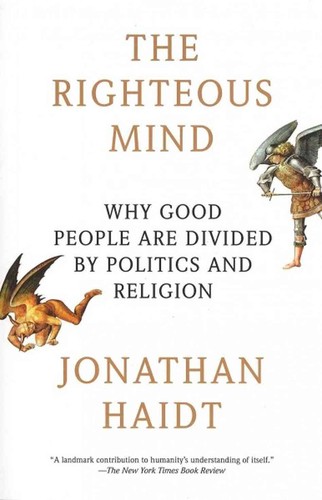
The Righteous Mind
Key Takeaways
Kyle, in 2018 in Books: I’m part of a Junto, a group that comes together to discuss thought-provoking ideas and work towards mutual improvement. As a group, we decided to read this book. As we worked through it, we continued to discuss the models that Haidt uses to describe our thought processes and it was spot on. One of the quotes that stuck out to me the most revolves around this idea of our reason acting as an internal lawyer to justify our actions:
Jonathan Haidt’s moral-psychology book read with explicit cross-reference to the recurring narrative-and-cohesion thread. Two threads:
-
Narrative as the substrate of social cohesion. Tomasello’s ultra-sociality argument tracks with Sapiens’s narrative-as-glue thesis — the role stories play in binding humans into cooperative groups.
-
Atheism as a luxury of efficient society. “Society operates so efficiently that communities are preferences rather than necessity.” A specific structural explanation for the post-religious turn that doesn’t require treating religion as merely irrational.
Connections
People: Jonathan Haidt, the author, develops Moral Foundations Theory and the social intuitionist (elephant-and-rider) model. Michael Tomasello supplies the shared-intentionality account of human ultrasociality (“two chimpanzees carrying a log”) that Haidt builds on. Robert F. Kennedy is quoted in the closing (“ask why not?”).
Concepts: Confirmation Bias — Haidt frames reasoning as an “inner lawyer” that seeks justification not truth, asking “Can I believe it?” vs. “Must I believe it?”. Reputation — Glaucon’s wager that virtue is reputational, and the “sociometer” as an internal gauge of relational value. Empathy is named “an antidote to righteousness,” the main lever for changing minds across a moral divide.
Books: Sapiens — directly cross-referenced; Tomasello’s ultrasociality argument tracks Sapiens’s narrative-as-glue thesis (the human mind as “a story processor”). Homo Deus — civilizational-trajectory parallel on the post-religious turn. The Crucible of Doubt — the religious-cohesion thread (religion as what people “achieve together what they cannot achieve on their own”). The Death of Expertise — moral-psychology adjacent, on motivated reasoning and partisan refusal of evidence.
- Why Facts Don’t Change Our Minds (James Clear) — James Clear’s essay Kyle tagged to this book on June 1st, 2020.
Highlights
- I hope to have given you a new way to think about two of the most important, vexing, and divisive topics in human life: politics and religion. Etiquette books tell us not to discuss these topics in polite company, but I say go ahead. Politics and religion are both expressions of our underlying moral psychology, and an understanding of that psychology can help to bring people together.
- The linkage of righteousness and judgmentalism is captured in some modern definitions of righteous, such as “arising from an outraged sense of justice, morality, or fair play.”4 The link also appears in the term self-righteous, which means “convinced of one’s own righteousness, especially in contrast with the actions and beliefs of others; narrowly moralistic and intolerant.”5 I want to show you that an obsession with righteousness (leading inevitably to self-righteousness) is the normal human condition. It is a feature of our evolutionary design, not a bug or error that crept into minds that would otherwise be objective and rational.
- If you think that moral reasoning is something we do to figure out the truth, you’ll be constantly frustrated by how foolish, biased, and illogical people become when they disagree with you.
- People bind themselves into political teams that share moral narratives. Once they accept a particular narrative, they become blind to alternative moral worlds.
- The Perfect Way is only difficult for those who pick and choose; Do not like, do not dislike; all will then be clear.
- Piaget wanted to know how the extraordinary sophistication of adult thinking (a cognitive butterfly) emerges from the limited abilities of young children (lowly caterpillars).
- They don’t understand that the total volume of water is conserved when it moves from glass to glass. He also found that it’s pointless for adults to explain the conservation of volume to kids. The kids won’t get it until they reach an age (and cognitive stage) when their minds are ready for it. And when they are ready, they’ll figure it out for themselves just by playing with cups of water.
- Kohlberg’s most influential finding was that the most morally advanced kids (according to his scoring technique) were those who had frequent opportunities for role taking—for putting themselves into another person’s shoes and looking at a problem from that person’s perspective.
- If you want your kids to learn about the physical world, let them play with cups and water; don’t lecture them about the conservation of volume. And if you want your kids to learn about the social world, let them play with other kids and resolve disputes; don’t lecture them about the Ten Commandments. And, for heaven’s sake, don’t force them to obey God or their teachers or you. That will only freeze them at the conventional level.
- Children construct their moral understanding on the bedrock of the absolute moral truth that harm is wrong.
- Schools and families should therefore embody progressive principles of equality and autonomy (not authoritarian principles that enable elders to train and constrain children).
- When you put individuals first, before society, then any rule or social practice that limits personal freedom can be questioned. If it doesn’t protect somebody from harm, then it can’t be morally justified. It’s just a social convention.
- Were people really condemning the actions because they foresaw these harms, or was it the reverse process—were people inventing these harms because they had already condemned the actions?
- These subjects were reasoning. They were working quite hard at reasoning. But it was not reasoning in search of truth; it was reasoning in support of their emotional reactions.
- We’re born to be righteous, but we have to learn what, exactly, people like us should be righteous about.
- To be human is to feel pulled in different directions, and to marvel—sometimes in horror—at your inability to control your own actions.
- Timaeus adds that a man who masters his emotions will live a life of reason and justice, and will be reborn into a celestial heaven of eternal happiness. A man who is mastered by his passions, however, will be reincarnated as a woman.
- Yet the result of the separation was not the liberation of reason from the thrall of the passions. It was the shocking revelation that reasoning requires the passions.
- Patterns, Thinking, and Cognition, by Howard Margolis,
- Given the judgments (themselves produced by the non-conscious cognitive machinery in the brain, sometimes correctly, sometimes not so), human beings produce rationales they believe account for their judgments. But the rationales (on this argument) are only ex post rationalizations.
- We do moral reasoning not to reconstruct the actual reasons why we ourselves came to a judgment; we reason to find the best possible reasons why somebody else ought to join us in our judgment.
- We make our first judgments rapidly, and we are dreadful at seeking out evidence that might disconfirm those initial judgments.43 Yet friends can do for us what we cannot do for ourselves: they can challenge us, giving us reasons and arguments (link 3) that sometimes trigger new intuitions, thereby making it possible for us to change our minds. We occasionally do this when mulling a problem by ourselves, suddenly seeing things in a new light or from a new perspective (to use two visual metaphors). Link 6 in the model represents this process of private reflection. The line is dotted because this process doesn’t seem to happen very often.44 For most of us, it’s not every day or even every month that we change our mind about a moral issue without any prompting from anyone else. Far more common
- The social intuitionist model offers an explanation of why moral and political arguments are so frustrating: because moral reasons are the tail wagged by the intuitive dog. A dog’s tail wags to communicate. You can’t make a dog happy by forcibly wagging its tail. And you can’t change people’s minds by utterly refuting their arguments.
- If you really want to change someone’s mind on a moral or political matter, you’ll need to see things from that person’s angle as well as your own. And if you do truly see it the other person’s way—deeply and intuitively—you might even find your own mind opening in response. Empathy is an antidote to righteousness, although it’s very difficult to empathize across a moral divide.
- When does the elephant listen to reason? The main way that we change our minds on moral issues is by interacting with other people. We are terrible at seeking evidence that challenges our own beliefs, but other people do us this favor, just as we are quite good at finding errors in other people’s beliefs. When discussions are hostile, the odds of change are slight. The elephant leans away from the opponent, and the rider works frantically to rebut the opponent’s charges. But if there is affection, admiration, or a desire to please the other person, then the elephant leans toward that person and the rider tries to find the truth in the other person’s arguments. The elephant may not often change its direction in response to objections from its own rider, but it is easily steered by the mere presence of friendly elephants (that’s the social persuasion link in the social intuitionist model) or by good arguments given to it by the riders of those friendly elephants (that’s the reasoned persuasion link). There are even times when we change our minds on our own, with no help from other people. Sometimes we have conflicting intuitions about something, as many people do about abortion and other controversial issues. Depending on which victim, which argument, or which friend you are thinking about at a given moment, your judgment may flip back and forth as if you were looking at a Necker cube (figure 3.1).
- But the bottom line is that when we see or hear about the things other people do, the elephant begins to lean immediately. The rider, who is always trying to anticipate the elephant’s next move, begins looking around for a way to support such a move.
- Why do we have this weird mental architecture? As hominid brains tripled in size over the last 5 million years, developing language and a vastly improved ability to reason, why did we evolve an inner lawyer, rather than an inner judge or scientist? Wouldn’t it have been most adaptive for our ancestors to figure out the truth, the real truth about who did what and why, rather than using all that brainpower just to find evidence in support of what they wanted to believe? That depends on which you think was more important for our ancestors’ survival: truth or reputation.
- Glaucon’s thought experiment implies that people are only virtuous because they fear the consequences of getting caught—especially the damage to their reputations.
- show that reason is not fit to rule; it was designed to seek justification, not truth.
- In fact, I’ll praise Glaucon for the rest of the book as the guy who got it right—the guy who realized that the most important principle for designing an ethical society is to make sure that everyone’s reputation is on the line all the time, so that bad behavior will always bring bad consequences.
- What, then, is the function of moral reasoning? Does it seem to have been shaped, tuned, and crafted (by natural selection) to help us find the truth, so that we can know the right way to behave and condemn those who behave wrongly? If you believe that, then you are a rationalist, like Plato, Socrates, and Kohlberg.7 Or does moral reasoning seem to have been shaped, tuned, and crafted to help us pursue socially strategic goals, such as guarding our reputations and convincing other people to support us, or our team, in disputes? If you believe that, then you are a Glauconian.
- Exploratory thought is an “evenhanded consideration of alternative points of view.” Confirmatory thought is “a one-sided attempt to rationalize a particular point of view.”
- Accountability increases exploratory thought only when three conditions apply: (1) decision makers learn before forming any opinion that they will be accountable to an audience, (2) the audience’s views are unknown, and (3) they believe the audience is well informed and interested in accuracy.
- Leary suggested that self-esteem is more like an internal gauge, a “sociometer” that continuously measures your value as a relationship partner. Whenever the sociometer needle drops, it triggers an alarm and changes our behavior.
- The sociometer is part of the elephant. Because appearing concerned about other people’s opinions makes us look weak, we (like politicians) often deny that we care about public opinion polls. But the fact is that we care a lot about what others think of us. The only people known to have no sociometer are psychopaths.
- Wason called this phenomenon the confirmation bias, the tendency to seek out and interpret new evidence in ways that confirm what you already think. People are quite good at challenging statements made by other people, but if it’s your belief, then it’s your possession—your child, almost—and you want to protect it, not challenge it and risk losing
- The findings get more disturbing. Perkins found that IQ was by far the biggest predictor of how well people argued, but it predicted only the number of my-side arguments. Smart people make really good lawyers and press secretaries, but they are no better than others at finding reasons on the other side. Perkins concluded that “people invest their IQ in buttressing their own case rather than in exploring the entire issue more fully and evenhandedly.”
- The social psychologist Tom Gilovich studies the cognitive mechanisms of strange beliefs. His simple formulation is that when we want to believe something, we ask ourselves, “Can I believe it?”28 Then (as Kuhn and Perkins found), we search for supporting evidence, and if we find even a single piece of pseudo-evidence, we can stop thinking. We now have permission to believe. We have a justification, in case anyone asks. In contrast, when we don’t want to believe something, we ask ourselves, “Must I believe it?” Then we search for contrary evidence, and if we find a single reason to doubt the claim, we can dismiss it. You only need one key to unlock the handcuffs of must.
- Westen found that partisans escaping from handcuffs (by thinking about the final slide, which restored their confidence in their candidate) got a little hit of that dopamine. And if this is true, then it would explain why extreme partisans are so stubborn, closed-minded, and committed to beliefs that often seem bizarre or paranoid. Like rats that cannot stop pressing a button, partisans may be simply unable to stop believing weird things. The partisan brain has been reinforced so many times for performing mental contortions that free it from unwanted beliefs. Extreme partisanship may be literally addictive.
- They concluded that most of the bizarre and depressing research findings make perfect sense once you see reasoning as having evolved not to help us find truth but to help us engage in arguments, persuasion, and manipulation in the context of discussions with other people.
- I’m not saying we should all stop reasoning and go with our gut feelings. Gut feelings are sometimes better guides than reasoning for making consumer choices and interpersonal judgments,52 but they are often disastrous as a basis for public policy, science, and law.53 Rather, what I’m saying is that we must be wary of any individual’s ability to reason. We should see each individual as being limited,
- In the same way, each individual reasoner is really good at one thing: finding evidence to support the position he or she already holds, usually for intuitive reasons. We should not expect individuals to produce good, open-minded, truth-seeking reasoning, particularly when self-interest or reputational concerns are in play. But if you put individuals together in the right way, such that some individuals can use their reasoning powers to disconfirm the claims of others, and all individuals feel some common bond or shared fate that allows them to interact civilly, you can create a group that ends up producing good reasoning as an emergent property of the social system. This is why it’s so important to have intellectual and ideological diversity within any group or institution whose goal is to find truth (such as an intelligence agency or a community of scientists) or to produce good public policy (such as a legislature or advisory board).
- Switch, by Chip Heath and Dan Heath,
- you can change the path that the elephant and rider find themselves traveling on. You can make minor and inexpensive tweaks to the environment, which can produce big increases in ethical behavior.55 You can hire Glaucon as a consultant and ask him how to design institutions in which real human beings, always concerned about their reputations, will behave more ethically.
- Reasoning can take us to almost any conclusion we want to reach, because we ask “Can I believe it?” when we want to believe something, but “Must I believe it?” when we don’t want to believe. The answer is almost always yes to the first question and no to the second.
- There’s more to morality than harm and fairness.
- We supported liberal policies because we saw the world clearly and wanted to help people, but they supported conservative policies out of pure self-interest (lower my taxes!) or thinly veiled racism (stop funding welfare programs for minorities!). We never considered the possibility that there were alternative moral worlds in which reducing harm (by helping victims) and increasing fairness (by pursuing group-based equality) were not the main goals.27
- I had escaped from my prior partisan mind-set (reject first, ask rhetorical questions later) and began to think about liberal and conservative policies as manifestations of deeply conflicting but equally heartfelt visions of the good society.
- Moral matrices bind people together and blind them to the coherence, or even existence, of other matrices. This makes it very difficult for people to consider the possibility that there might really be more than one form of moral truth, or more than one valid framework for judging people or running a society.
- Virtues are social constructions. The virtues taught to children in a warrior culture are different from those taught in a farming culture or a modern industrialized culture. There’s always some overlap among lists, but even then there are different shades of meaning. Buddha, Christ, and Muhammad all talked about compassion, but in rather different ways.
- As the neuroscientist Gary Marcus explains, “Nature bestows upon the newborn a considerably complex brain, but one that is best seen as prewired—flexible and subject to change—rather than hardwired, fixed, and immutable.”2
- Everyone cares about fairness, but there are two major kinds. On the left, fairness often implies equality, but on the right it means proportionality—people should be rewarded in proportion to what they contribute, even if that guarantees unequal outcomes.
- If we had no sense of disgust, I believe we would also have no sense of the sacred. And if you think, as I do, that one of the greatest unsolved mysteries is how people ever came together to form large cooperative societies, then you might take a special interest in the psychology of sacredness. Why do people so readily treat objects (flags, crosses), places (Mecca, a battlefield related to the birth of your nation), people (saints, heroes), and principles (liberty, fraternity, equality) as though they were of infinite value? Whatever its origins, the psychology of sacredness helps bind individuals into moral communities.
- All five of us were politically liberal, yet we shared the same concern about the way our liberal field approached political psychology. The goal of so much research was to explain what was wrong with conservatives. (Why don’t conservatives embrace equality, diversity, and change, like normal people?) Just that day, in a session on political psychology, several of the speakers had made jokes about conservatives, or about the cognitive limitations of President Bush. All five of us felt this was wrong, not just morally (because it creates a hostile climate for the few conservatives who might have been in the audience) but also scientifically (because it reveals a motivation to reach certain conclusions, and we all knew how easy it is for people to reach their desired conclusions).6 The five of us also shared a deep concern about the polarization and incivility of American political life, and we wanted to use moral psychology to help political partisans understand and respect each other.
- Are proportionality and equality two different expressions of the same underlying cognitive module, as we had been assuming? Are they both related to reciprocal altruism,
- The end result, says Boehm, was a process sometimes called “self-domestication.” Just as animal breeders can create tamer, gentler creatures by selectively breeding for those traits, our ancestors began to selectively breed themselves (unintentionally) for the ability to construct shared moral matrices and then live cooperatively within them.
- Liberals have a three-foundation morality, whereas conservatives use all six. Liberal moral matrices rest on the Care/harm, Liberty/oppression, and Fairness/cheating foundations, although liberals are often willing to trade away fairness (as proportionality) when it conflicts with compassion or with their desire to fight oppression.
- Democrats often pursue policies that promote pluribus at the expense of unum, policies that leave them open to charges of treason, subversion, and sacrilege.
- Democrats often say that Republicans have duped these people into voting against their economic self-interest. (That was the thesis of the popular 2004 book What’s the Matter with Kansas?.)61 But from the perspective of Moral Foundations Theory, rural and working-class voters were in fact voting for their moral interests. They don’t want to eat at The True Taste restaurant, and they don’t want their nation to devote itself primarily to the care of victims and the pursuit of social justice.
- Yes, people are often selfish, and a great deal of our moral, political, and religious behavior can be understood as thinly veiled ways of pursuing self-interest. (Just look at the awful hypocrisy of so many politicians and religious leaders.) But it’s also true that people are groupish. We love to join teams, clubs, leagues, and fraternities. We take on group identities and work shoulder to shoulder with strangers toward common goals so enthusiastically that it seems as if our minds were designed for teamwork. I don’t think we can understand morality, politics, or religion until we have a good picture of human groupishness and its origins.
- “It is inconceivable that you would ever see two chimpanzees carrying a log together.”
- Tomasello believes that human ultrasociality arose in two steps. The first was the ability to share intentions in groups of two or three people who were actively hunting or foraging together. (That was the Rubicon.) Then, after several hundred thousand years of evolution for better sharing and collaboration as nomadic hunter-gatherers, more collaborative groups began to get larger, perhaps in response to the threat of other groups. Victory went to the most cohesive groups—the ones that could scale up their ability to share intentions from three people to three hundred or three thousand people.
Kyle: Like in Sapiens regarding the importance of narrative and the role it plays in social cohesion.
- Many people assume that language was our Rubicon, but language became possible only after our ancestors got shared intentionality. Tomasello notes that a word is not a relationship between a sound and an object. It is an agreement among people who share a joint representation of the things in their world, and who share a set of conventions for communicating with each other about those things.
- Humans construct moral communities out of shared norms, institutions, and gods that, even in the twenty-first century, they fight, kill, and die to defend.
- In contrast, an organization that takes advantage of our hivish nature can activate pride, loyalty, and enthusiasm among its employees and then monitor them less closely. This approach to leadership (sometimes called transformational leadership)44 generates more social capital—the bonds of trust that help employees get more work done at a lower cost than employees at other firms. Hivish employees work harder, have more fun, and are less likely to quit or to sue the company. Unlike Homo economicus, they are truly team players. What can leaders do to create more hivish organizations? The first step is to stop thinking so much about leadership. One group of scholars has used multilevel selection to think about what leadership really is. Robert Hogan, Robert Kaiser, and Mark van Vugt argue that leadership can only be understood as the complement of followership.45 Focusing on leadership alone is like trying to understand clapping by studying only the left hand. They point out that leadership is not even the more interesting hand; it’s no puzzle to understand why people want to lead. The real puzzle is why people are willing to follow. These scholars note that people evolved to live in groups of up to 150 that were relatively egalitarian and wary of alpha males (as Chris Boehm said).46 But we also evolved the ability to rally around leaders when our group is under threat or is competing with other groups. Remember how the Rattlers and the Eagles instantly became more tribal and hierarchical the instant they discovered the presence of the other group?47 Research also shows that strangers will spontaneously organize themselves into leaders and followers when natural disasters strike.48 People are happy to follow when they see that their group needs to get something done, and when the person who emerges as the leader doesn’t activate their hypersensitive oppression detectors. A leader must construct a moral matrix based in some way on the Authority foundation (to legitimize the authority of the leader), the Liberty foundation (to make sure that subordinates don’t feel oppressed, and don’t want to band together to oppose a bullying alpha male), and above all, the Loyalty foundation (which I defined in chapter 7 as a response to the challenge of forming cohesive coalitions). Using this evolutionary framework, we can draw some direct lessons for anyone who wants to make a team, company, school, or other organization more hivish, happy, and productive. You don’t need to slip ecstasy into the watercooler and then throw a rave party in the cafeteria. The hive switch may be more of a slider switch than an on-off switch, and with a few institutional changes you can create environments that will nudge everyone’s sliders a bit closer to the hive position. For example: • Increase similarity, not diversity. To make a human hive, you want to make everyone feel like a family. So don’t call attention to racial and ethnic differences; make them less relevant by ramping…
- When I began writing The Happiness Hypothesis, I believed that happiness came from within, as Buddha and the Stoic philosophers said thousands of years ago. You’ll never make the world conform to your wishes, so focus on changing yourself and your desires. But by the time I finished writing, I had changed my mind: Happiness comes from between. It comes from getting the right relationships between yourself and others, yourself and your work, and yourself and something larger than yourself.
- For religious communes, the effect was perfectly linear: the more sacrifice a commune demanded, the longer it lasted. But Sosis was surprised to discover that demands for sacrifice did not help secular communes. Most of them failed within eight years, and there was no correlation between sacrifice and longevity.
- As Wilson puts it: “Religions exist primarily for people to achieve together what they cannot achieve on their own.”
- People belonging to such a [religiously cohesive] society are more likely to survive and reproduce than those in less cohesive groups, who may be vanquished by their enemies or dissolve in discord. In the population as a whole, genes that promote religious behavior are likely to become more common in each generation as the less cohesive societies perish and the more united ones thrive.
Kyle: Perhaps the reason atheism has become more commonplace is because society operates so efficiently that communities are preferences rather than necessity.
- Even John Locke, one of the leading lights of the Enlightenment, wrote that “promises, covenants, and oaths, which are the bonds of human society, can have no hold upon an atheist. The taking away of God, though but even in thought, dissolves all.”
- American Grace: How Religion Divides and Unites Us,
- The only thing that was reliably and powerfully associated with the moral benefits of religion was how enmeshed people were in relationships with their co-religionists. It’s the friendships and group activities, carried out within a moral matrix that emphasizes selflessness. That’s what brings out the best in people.
- We evolved to live, trade, and trust within shared moral matrices. When societies lose their grip on individuals, allowing all to do as they please, the result is often a decrease in happiness and an increase in suicide, as Durkheim showed more than a hundred years ago.
- Moral systems are interlocking sets of values, virtues, norms, practices, identities, institutions, technologies, and evolved psychological mechanisms that work together to suppress or regulate self-interest and make cooperative societies possible.
- Things changed in the 1990s, beginning with new rules and new behaviors in Congress.4 Friendships and social contacts across party lines were discouraged. Once the human connections were weakened, it became easier to treat members of the other party as the permanent enemy rather than as fellow members of an elite club. Candidates began to spend more time and money on “oppo” (opposition research), in which staff members or paid consultants dig up dirt on opponents (sometimes illegally) and then shovel it to the media. As one elder congressman recently put it, “This is not a collegial body any more. It is more like gang behavior. Members walk into the chamber full of hatred.”
- And when political scientists looked into it, they found that self-interest does a remarkably poor job of predicting political attitudes.
- We’re not just talking about IQ, mental illness, and basic personality traits such as shyness. We’re talking about the degree to which you like jazz, spicy foods, and abstract art; your likelihood of getting a divorce or dying in a car crash; your degree of religiosity, and your political orientation as an adult. Whether you end up on the right or the left of the political spectrum turns out to be just as heritable as most other traits: genetics explains between a third and a half of the variability among people on their political attitudes.
- Future liberals were described as being more curious, verbal, and self-reliant, but also more assertive and aggressive, less obedient and neat.
- The human mind is a story processor, not a logic processor. Everyone loves a good story; every culture bathes its children in stories.
- But when liberals try to understand the Reagan narrative, they have a harder time. When I speak to liberal audiences about the three “binding” foundations—Loyalty, Authority, and Sanctity—I find that many in the audience don’t just fail to resonate; they actively reject these concerns as immoral. Loyalty to a group shrinks the moral circle; it is the basis of racism and exclusion, they say. Authority is oppression. Sanctity is religious mumbo-jumbo whose only function is to suppress female sexuality and justify homophobia.
- Robert Putnam’s 2000 book Bowling Alone.
- (Whether you’d trade away some moral capital to gain some diversity and creativity will depend in part on your brain’s settings on traits such as openness to experience and threat sensitivity, and this is part of the reason why cities are usually so much more liberal than the countryside.)
- One of his main points was the absurdity of using insurance to pay for routine purchases. Normally we buy insurance to cover the risk of a catastrophic loss. We enter an insurance pool with other people to spread the risk around, and we hope never to collect a penny. We handle routine expenses ourselves, seeking out the highest quality for the lowest price. We would never file a claim on our car insurance to pay for an oil change.
- For example, there is an open market for LASIK surgery (a kind of laser eye surgery that removes the need to wear contact lenses). Doctors compete with one another to attract customers, and because the procedure is rarely covered by insurance, patients take price into account. Competition and innovation have driven down the price of the surgery by nearly 80 percent since it was first introduced.
- We need groups, we love groups, and we develop our virtues in groups, even though those groups necessarily exclude nonmembers. If you destroy all groups and dissolve all internal structure, you destroy your moral capital.
- If you find yourself in a Whole Foods store, there’s an 89 percent chance that the county surrounding you voted for Barack Obama. If you want to find Republicans, go to a county that contains a Cracker Barrel restaurant (62 percent of these counties went for McCain).
- If you want to understand another group, follow the sacredness. As a first step, think about the six moral foundations, and try to figure out which one or two are carrying the most weight in a particular controversy. And if you really want to open your mind, open your heart first. If you can have at least one friendly interaction with a member of the “other” group, you’ll find it far easier to listen to what they’re saying, and maybe even see a controversial issue in a new light. You may not agree, but you’ll probably shift from Manichaean disagreement to a more respectful and constructive yin-yang disagreement.
- As Robert F. Kennedy said: “There are those that look at things the way they are, and ask why? I dream of things that never were, and ask why not?”
Referenced in
- American Grace note
- Bowling Alone note
- Brave New World Revisited book
- Confirmation Bias note
- Identity Formation note
- Michael Tomasello note
- Moral Foundations Theory note
- Multilevel Selection note
- Political Polarization note
- Religious Internalization note
- Reputation note
- Robert F. Kennedy note
- Sapiens book
- Social Capital note
- Switch note
- The Courage To Be Disliked book
- The Death of Expertise book
- The Happiness Hypothesis note
- The Psychology of Money book
- Why Facts Don't Change Our Minds (James Clear) note