Becoming a Cult Leader

There is so much energy in the world of technology. Despite the techlash against progress, the number of missions being formulated in tech is exquisite. Like nothing most of us have seen in our lifetimes. Superintelligence. Space travel. Energy. Biological engineering. And on and on. But how do you stand out in a world where each mission is seemingly more important than the next?
18 months ago I wrote a piece called Cultivating Cults. The critical element of storytelling. The need for a Chief Evangelist at every company. And the world building required in startups. It’s a pretty extensive exploration of the movement-making that comes in building a world-shaping company.
This week, I happened to hear pitches from a variety of companies that all felt particularly mission-driven. A porn-addiction recovery app, a couple of solutions to the housing shortage in the US, a biblical study app, insurance for hedging against climate change, and AI-enabled customized storytelling for kids. A whole host of missions.
In one particular pitch, I had a direct conversation with the founder about what’s required to “make me believe” in the mission they were pitching. Precisely because there is so much energy behind mission-driven companies, not to mention the companies that are taking on the shape of mission regardless of the substance, the playing field has never been louder.
The framework that came to mind as we were talking was three fold:
(1) Controlling mindshare + (2) Commanding capital = (3) Becoming the standard bearer
Controlling Mindshare
The word zeitgeist is an incredibly important and effective one. “The defining spirit or mood of a particular period of history as shown by the ideas and beliefs of the time.” The internet has sparked an explosion of zeitgeists all around us. The job of a founder is to capture that zeitgeist.
In some cases, culture canonizes a movement for you. In anti-pornography, it’s “gooning.” In housing shortages, its “NIMBYism.” In those instances, there is no excuse for you to not completely envelop and own that cultural canon. No aspect of that conversation should come up without you being involved. Ideally, the conversation comes up because you are involved.
As an investor, one of the things I need to believe is that you are capable of controlling that mindshare, shaping it to your will, and riding in front of it as a tailwind. A Zeitgiest Pilot. I need to believe you. And, unfortunately, that is an exercise in rhetoric. It is not a strategy discussion, or a GTM playbook. It is an innate external-facing personality trait.
For much of my career, I’ve had this framework for a founder. If I could call anyone in the world to get advice on this particular market, is this founder the person I would call? The same is true of mindshare. I should be blown away by the level of understanding you have of a particular category. The depth of experience, the well of connections, the caliber of insights. You should embody the category you’re in. What I’ve described before as an “ideological purist.”
I frequently turn to Palmer Luckey as an excellent example of this. He embodied VR for a decade. To this day, he hesitates to bad mouth Meta because he doesn’t want them to stop investing in VR as an industry. Even as his attention has turned to defense technology, and he’s become a Zeitgeist Pilot in that category, he is still a force in the gaming world.
Once a founder has conquered that particular zeitgeist, it then extends to the product, the platform they’ve built, the team around them, the GTM exercises around sales and marketing. But if it doesn’t start in the heart of the founder, it will never get there.
Commanding Capital
I’ve met dozens of companies that actually do an effective job at pushing deep into the mindshare of a relevant category. But they are, often, a loud voice unable to make any motion. Why? Capital.
A soft voice with capital is a passive investor. A loud voice without capital is a spectator.
But a loud voice with capital? A conqueror.
That’s why, among his many incredible accomplishments as a founder and engineer, Elon Musk’s perhaps single greatest accomplishment is not just his ability to raise capital, but to rally an investor base that enables his particular brand of operations.
It can be easy to feel blocked by this phase. “I’m passionate but I just can’t fundraise successfully.” Then you’re not playing the right game. Capital is not 1:1 equated with venture capital. There are, in fact, different mechanisms.
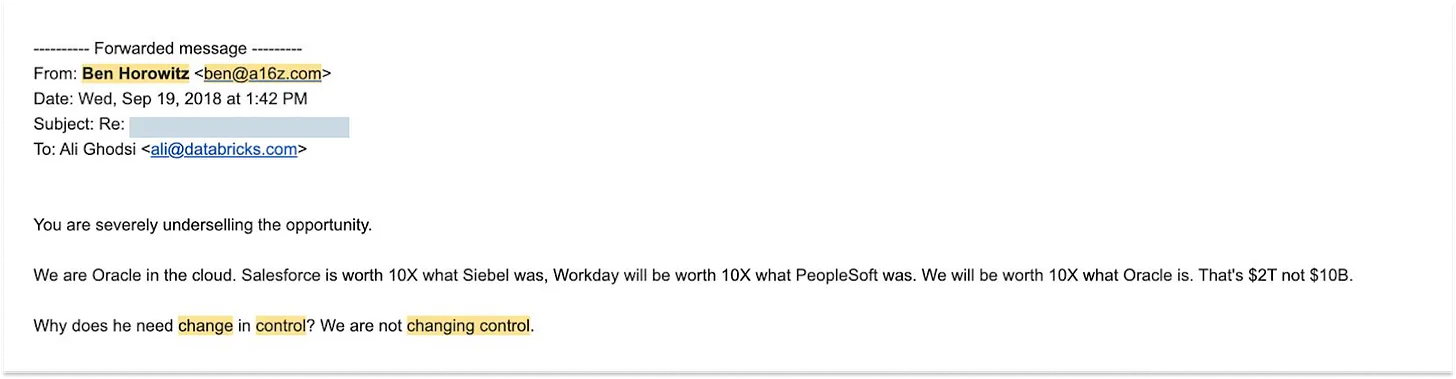
Raising venture capital is a particular game. And don’t get me wrong, VCs love Zeitgeist Pilots. If you’re an effective storyteller and you can inspire an investor with the raw potential of what you’re building, you can play the VC game effectively. In fact, some VCs can even coach you on playing that game better to raise your vision. Like when Ben Horowitz told Ali Ghodsi, the CEO of Databricks, when the company was worth $1B that he was underselling the opportunity saying they could 10x, pushing him instead to say they would be 10x Oracle; a $2 TRILLION company.
But there are some movements that VCs won’t get behind, for whatever reason. If your vision doesn’t align with the increasingly shallow, loud-mouthed VC zeitgeist, then the capital you’re looking for is cash flow. Where is the cash flow in your category sitting, just waiting for command?
In hard tech, it is often in government grants or non-dilutive funding, like debt. In consumer, it can be in things like app rollups or limited releases. In insurance, it can be structured float. I’m not saying these are “get rich quick” schemes in any given category; each has its own risks. But venture capital also has its own risks. Its not a function of easy vs. hard. It’s a question of fit.
But the reality of capital is material. Without capital, you’re just a voice shouting in the wind.
Bear The Standard
Embody the Zeitgeist Pilot. Command the capital machine. Become the standard bearer for your mission. Believe it with your entire being. Like Zuckerberg turning down $1B acquisition from Yahoo because he would just “build another social network,” become fixed in your determination to pursue hell or high water if they’re on the path to achieving your mission. God speed.