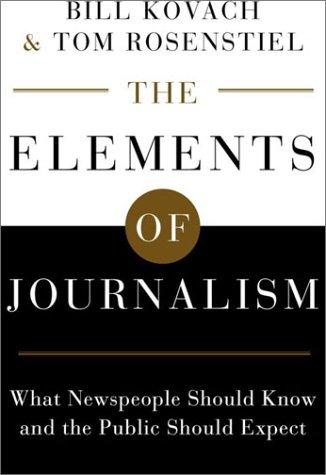
The Elements of Journalism
Key Takeaways
Kyle, in 2017 in Books: This book was published in 2001. In light of the introduction of #fakenews and my run-in with an interesting thought of the past called Grasswire, I felt obligated to learn something about news. “Journalism is so fundamental to that purpose [of freedom], as we will see, societies that want to suppress freedom must first suppress the press.” I started and didn’t finish a book by Al Gore called “Assault on Reason” where he just could not stop reaming the Bush administration for their apparent lack of moral scruples or sense of reality. I wonder how Gore would feel now that we have a President who literally doesn’t know what’s real anymore. This book, more than ever, felt important to read.
When we think of democracy, we think of freedom, the rights that allow us to self-govern. But when you consider the general level of information people have about government, its abysmal, myself included. Can you have a self-governing country when the vast majority are completely uninformed as to what is, in fact, good for themselves? Many thanks to Weller Book Works in Salt Lake City for exposing me to this one.
Remember, this book was written in 2001! — “While it is unquestionably true that internet-connected consumers of the early twenty-first century have more news outlets at their disposal than their counterparts in the early twentieth century, there is little proof that they devote more time to learning about the news. In fact, despite the growth in amount of news available, studies show that the time people spend with the news has remained basically static.”
Connections
No cross-book interconnections identified yet.
Highlights
Roam capture metadata — Author: Bill Kovach Tom Rosentiel · Reading Status: Books Read · Source: https://medium.com/@kwharrison13/2017-in-books-b2316c63784a · Recommended By: Weller Book Works · Tags: #Books
- ==Highlighted Quotes==
- ==START REVIEWING HERE>>>==
- “In the newsroom we no longer talk about journalism. We are consumed with business pressure and the bottom line.”
- “We are facing the possibility that independent news will be replaced by self-interested commercialism posing as news. If that occurs, we will lose the press as an independent institution, free to monitor the powerful forces and institutions in society.”
- “Every generation creates its own journalism.”
- “Journalists don’t usually consider these questions explicitly. It may seem slightly ridiculous to ask: What is the theory of democracy that drives your TV news operation or your newspaper? We have the freest press imaginable, and yet over the last thirty years the number of Americans who can even name their congressman is often as low as three out of ten. Fewer than half of Americans vote — even in presidential elections, far fewer than in countries without a First Amendment. Most people get their news from local television, a medium that largely ignores the process of governing. Only 47 percent read a newspaper, and people know no more about the outside world than they did fifty years ago. Maybe, when you look hard, the idea that the press provides the information necessary for people to self-govern is an illusion. Maybe people don’t care. Maybe we don’t, in reality, actually self-govern at all. The government operates, and the rest of us are largely bystanders.”
- “The solution to democracy’s problems was not to give up on it, but to try to improve the skills of the press and the education of the public.”
- Remember, this book was written in 2001! — “While it is unquestionably true that internet-connected consumers of the early twenty-first century have more news outlets at their disposal than their counterparts in the early twentieth century, there is little proof that they devote more time to learning about the news. In fact, despite the growth in amount of news available, studies show that the time people spend with the news has remained basically static.”
- “As citizens encounter an ever-greater flow of data, they have more need — not less — for identifiable sources dedicated to verifying that information, highlighting what is important to know and filtering out what is not.”
- “Our emphasis has to be on serving citizens, not our bottom line or technology.”
- “I think it’s possible to be an honest journalist and be loyal to a cause. It’s not really possible to be an honest journalist and be loyal to a person, a political party, or a faction.”
- “There is a notion that you should be disinterested to the point…that you should withdraw from civic affairs if you are a journalist. And I find that somewhat troubling. I don’t know why being a concerned citizen should be antagonistic to being a journalist.”
- “Perhaps, some journalists have suggested, there should even be a system to recruit people who have had other kinds of life experiences. ‘If you’re going to change the composition of the journalist workforce there has to be some kind of program that takes people that are already in other careers…offers them an opportunity to help diversify in a class way.’” — First we had Teach For America, then Code For America, now we can Report For America.
- “[A] forum function of the press would make it possible to create a democracy even in a large, diverse country by encouraging what James Madison and others considered the basis upon which democracy would stand — compromise, compromise, compromise!”
- “A debate focused only on the extremes of argument does not serve the public but instead leaves most citizens out.”
- “On the theory that everyone likes a good fight, instead, all problems begin to seem unsolvable.”
- “Technology did not create the attitudes of those who participate. Machines do not change human nature.”
- “Should we emphasize news that is fun and fascinating, and plays on our sensations? Or should we stick to the news that is the most important?”
- “Surprise them in a meaningful way. Not just shock them and stun them.”
- “Journalism is our modern cartography. It creates a map for citizens to navigate society. That is its utility and its economic reason for being.”
- “We’ve reached the point where the entertainment divisions are doing the news and the news divisions are doing the entertainment.” — think The Daily Show or Last Week Tonight.
- “Are you challenging each other, are you talking to each other, are you pushing each other?”
- “If people wanted better journalism, they say, the market would provide it. The problem with this rationalization, as we have seen, is that journalism is not shaped by a perfect market. The kind of local news we get in television, for instance, owes a great deal to the level of profitability required by Wall Street.”
Referenced in
- Bill Kovach note
- Tom Rosentiel note
- Weller Book Works note