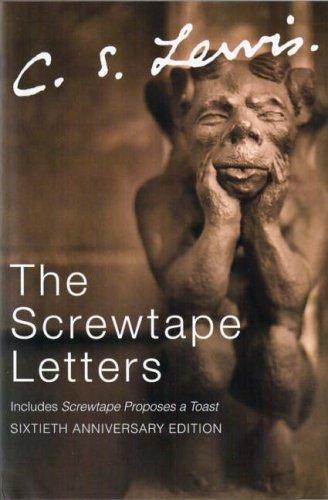
The Screwtape Letters
Key Takeaways
Kyle, in 2018 in Books: Before my LDS mission, I maybe knew that C.S. Lewis had written the Chronicles of Narnia, but only because of the movies. Other than that, I didn’t know much about him. On my mission, I got a CD of “Mere Christianity,” and loved it. While I was in Altoona, PA, Sharon and Emmet Cook had a copy of the Screwtape Letters in their bathroom, and that was the first time I heard about this book. It was a quick read and a clear commentary on the temptations we go through, and how we can choose to respond to them.
C.S. Lewis’s senior devil instructing his nephew on how to lose a soul. Read inverted — as Lewis intends — the highlights form a catalogue of how virtue actually erodes:
- Gradualism. The line Kyle marked that anchors the rest: “the safest road to Hell is the gradual one — the gentle slope, soft underfoot, without sudden turnings, without milestones, without signposts.”
- Attention as the battleground. Argument is a poor tool because it wakes reason; better to “turn their gaze away from Him towards themselves. Keep them watching their own minds.” Jargon, not argument, is the ally.
- Feeling without acting. “The more often he feels without acting, the less he will be able ever to act, and, in the long run, the less he will be able to feel” — a warning against sentiment as a substitute for practice.
- Means and ends. “Once you have made the World an end, and faith a means, you have almost won your man” — and the corollary that all extremes except devotion are useful, so a “moderated religion is as good for us as no religion at all.”
- Entitlement as the engine of anger. “Men are not angered by mere misfortune but by misfortune conceived as injury… The sense of injury depends on the feeling that a legitimate claim has been denied” — paired with the reminder that “the man can neither make, nor retain, one moment of time; it all comes to him by pure gift.”
- The Historical Point of View. Lewis’s attack on reading old writers only for what they reveal about their era, never asking whether they are true — “to anticipate that what he said could possibly modify your thoughts or your behavior… would be rejected as unutterably simple-minded.” The same argument Kyle keeps returning to under Read Old Books.
- Levelling as a weapon. The extended passage on “I’m as good as you” — “No man who says I’m as good as you believes it. He would not say it if he did” — and a democracy “of sub-literates, morally flaccid,” where the able are trained not to overtop their fellows.
The closing note is the one that reframes everything: God “did not create the Humans… in order to produce candidates for Limbo; ‘failed’ humans.”
Connections
Books: Mere Christianity — the direct exposition of what this satirises. The Great Divorce — the same moral psychology in allegory. Brave New World — the “gentle slope” and comfort-as-anaesthetic argument arrives at a similar place from the other direction.
Concepts: Read Old Books — the Historical Point of View passage is the sharpest statement of why. Religious Intellectualism · Human Nature · Temptation.
People: C.S. Lewis.
Essays: The Death of Discourse — the draft’s single biggest open structural question is whether to write the whole essay in this book’s form. Kyle’s Roam notes for it open with “Style of The Screwtape Letters”, i.e. recast the argument as letters from a senior tempter to a junior one, gloating about how willingly humanity has stopped talking to each other. The current draft is the straight version; the Screwtape framing is flagged as the alternative. People: C.S. Lewis — author; he recurs across Kyle’s religious-intellectualism shelf (The Crucible of Doubt, Faith is Not Blind, Future Mormon). Concepts: Free Speech · Rhetoric — via the Death of Discourse thread, where the book supplies the satirical register rather than the argument.
Highlights
- “It sounds as if you supposed that argument was the way to keep him out of the Enemy’s clutches. That might have been so if he had lived a few centuries earlier. At that time the humans still knew pretty well when a thing was proved and when it was not; and if it was proved they really believed it. They still connected thinking with doing and were prepared to alter their way of life as the result of a chain of reasoning.”
- “Jargon, not argument, is your best ally in keeping him from the Church.”
- “Desiring their freedom, He (meaning God) therefore refuses to carry them, by their mere affections and habits, to any of the goals which He sets before them: He leaves them to ‘do it on their own.’”
- “The simplest is to turn their gaze away from Him towards themselves. Keep them watching their own minds and trying to produce feelings there by the action of their own wills.”
- “I had not forgotten my promise to consider whether we should make the patient an extreme patriot or an extreme pacifist. All extremes, except extreme devotion to the Enemy, are to be encouraged. Not always, of course, but at this period. Some ages are lukewarm and complacent, and then it is our business to soothe them yet faster asleep. Other ages, of which the present is one, are unbalanced and prone to faction, and it is our business to inflame them.”
- “Once you have made the World an end, and faith a means, you have almost won your man, and it makes very little difference what kind of worldly end he is pursuing.”
- “The Enemy’s determination to produce such a revolting hybrid was one of the things that determined Our Father to withdraw his support from Him.”
- “He cannot ‘tempt’ to virtue as we do to vice. He wants them to learn to walk and must therefore take away His hand; and if only the will to walk is really there He is pleased even with their stumbles.”
- “An ever increasing craving for an ever diminishing pleasure is the formula. It is more certain; and it’s better style. To get the man’s soul and give him nothing in return — that is what really gladdens our Father’s heart.”
- “A moderated religion is as good for us as no religion at all — and more amusing.”
- “All mortals tend to turn into the thing they are pretending to be.”
- “Indeed the safest road to Hell is the gradual one — the gentle slope, soft underfoot, without sudden turnings, without milestones, without signposts.”
- “The more often he feels without acting, the less he will be able ever to act, and, in the long run, the less he will be able to feel.”
- “We have done this through the poets and novelists by persuading the humans that a curious, and usually short-lived, experience which they call ‘being in love’ is the only respectable grounds for marriage; that marriage can, and ought to, render this excitement permanent; and that a marriage which does not do so is no longer binding.”
- “Men are not angered by mere misfortune but by misfortune conceived as injury. And the sense of injury depends on the feeling that a legitimate claim has been denied. The more claims on life, therefore, that your patient can be induced to make, the more often he will feel injured, and, as a result, ill-tempered.”
- “The man can neither make, nor retain, one moment of time; it all comes to him by pure gift; he might as well regard the sun and moon as his chattels.”
- “A spoiled saint, a Pharisee, an inquisitor, or a magician, makes better sport in Hell than a mere common tyrant or debauchee.”
- “For humans must not be allowed to notice that all great moralists are sent by the Enemy not to inform men, but to remind them, to restate the primeval moral platitudes against our continual concealment of them.”
- “Certainly we do not want men to allow their Christianity to flow over into their political life, for the establishment of anything like a really just society would be a major disaster.”
- “We have trained them to think of the Future as a promised land which favoured heroes attain — not as something which everyone reaches at the rate of sixty minutes an hour, whatever he does, whoever he is.”
- “A woman means by Unselfishness chiefly taking trouble for others; a man means not giving trouble to others.”
- “In discussing any joint action, it becomes obligatory that A should argue in favour of B’s supposed wishes and against his own, while B does the opposite. It is often impossible to find out either party’s real wishes; with luck, they end up doing something that neither wants, while each feels a glow of self-righteousness and harbours a secret claim to preferential treatment for the unselfishness shown and a secret grudge against the other for the ease with which the sacrifice has been accepted.”
- “The Historical Point of View, put briefly, means that when a learned man is presented with any statement in an ancient author, the one question he never asks is whether it is true.”
- “To regard the ancient writer as a possible source of knowledge — to anticipate that what he said could possibly modify your thoughts or your behavior — this would be rejected as utterly simple-minded.”
- “The long, dull, monotonous years of middle-aged prosperity or middle-aged adversity are excellent campaigning weather. You see, it is so hard for these creatures to persevere. The routine of adversity, the gradual decay of youthful loves and youthful hopes, the quiet despair (hardly felt as pain) of ever overcoming the chronic temptations with which we have again and again defeated them, the drabness which we create in their lives and the inarticulate resentment with which we teach them to respond to it — all this provides admirable opportunities of wearing out a soul by attrition.”
- “So inveterate is their appetite for Heaven that our best method, at this stage, or attaching them to earth is to make them believe that earth can be turned into Heaven at some future date by politics or eugenics or ‘science’ or psychology, or what not.”
- “The more he fears, the more he will hate.”
- “In peace, we can make many of them ignore good and evil entirely; in danger, the issue is forced upon them in a guise to which even we cannot blind them.”
- “He (speaking of God) did not create the Humans — He did not become one of them and die among them by torture — in order to produce candidates for Limbo; ‘failed’ humans. He wanted to make Saints; gods, things like Himself.”
- “No man who says __I’m as good as you __believes it. He would not say it if he did. The St Bernard never says it to the toy dog, nor the scholar to the dunce, nor the employable to the bum, nor the pretty woman to the plain. The claim to equality, outside the strictly political field, is made by those who feel themselves to be in some way inferior.”
- “You remember how one of the Greek Dictators (they called them ‘tyrants’ then) sent an envoy to another Dictator to ask his advice about the principles of government. The second Dictator led the envoy into a field of corn, and there he snicked off with his cane the top of every stalk that rose an inch or so above the general level. The moral was plain. Allow no pre-eminence among your subjects. Let no man live who is wiser, or better, or more famous, or even handsomer than the mass. Cut them all down to a level; all slaves, all ciphers. All nobodies. All equals.”
- “No one need now go through the field with a cane. The little stalks will now of themselves bite the tops off the big ones. The big ones are beginning to bite off their own in their desire to Be Like Stalks.”
- “It is in some ways more troublesome to track and swat an evasive wasp than to shoot, at close range, a wild elephant. But the elephant is more troublesome if you miss.”
- “At schools, the children who are too stupid or lazy to learn languages and mathematics and elementary science can be set to doing the things that children used to do in their spare time. Let them, for example, make mud-pies, and call it modeling. But all the time there must be no faintest hint that they are inferior to the children who are at work. Whatever nonsense they are engaged in must have ‘parity of esteem.’
- “The few who might want to learn will be prevented; who are they to overtop their fellows?”
- “As an English politician remarked not long ago, ‘A democracy does not want great men.’”
- “For ‘democracy’ or the ‘democratic spirit’ (diabolical sense) leads to a nation without great men, a nation mainly of sub-literates, morally flaccid from lack of discipline in youth, full of the cocksureness which flattery breeds on ignorance, and soft from lifelong pampering. And that is what Hell wishes every democratic people to be. For when such a nation meets in conflict a nation where children have been made to work at school, where talent is placed in high posts, and where the ignorant mass are allowed no say at all in public affairs, only one result is possible.”
- “I mean the delusion that the fate of nations is in itself more important than that of individual souls. The overthrow of free peoples and the multiplication of slave-states are for us a means (besides of course, being fun); but the real end is the destruction of individuals.”
- “Nowhere do we tempt so successfully as on the very steps of the altar.”
Referenced in
- 1984 book