Saying The Quiet Part Out Loud
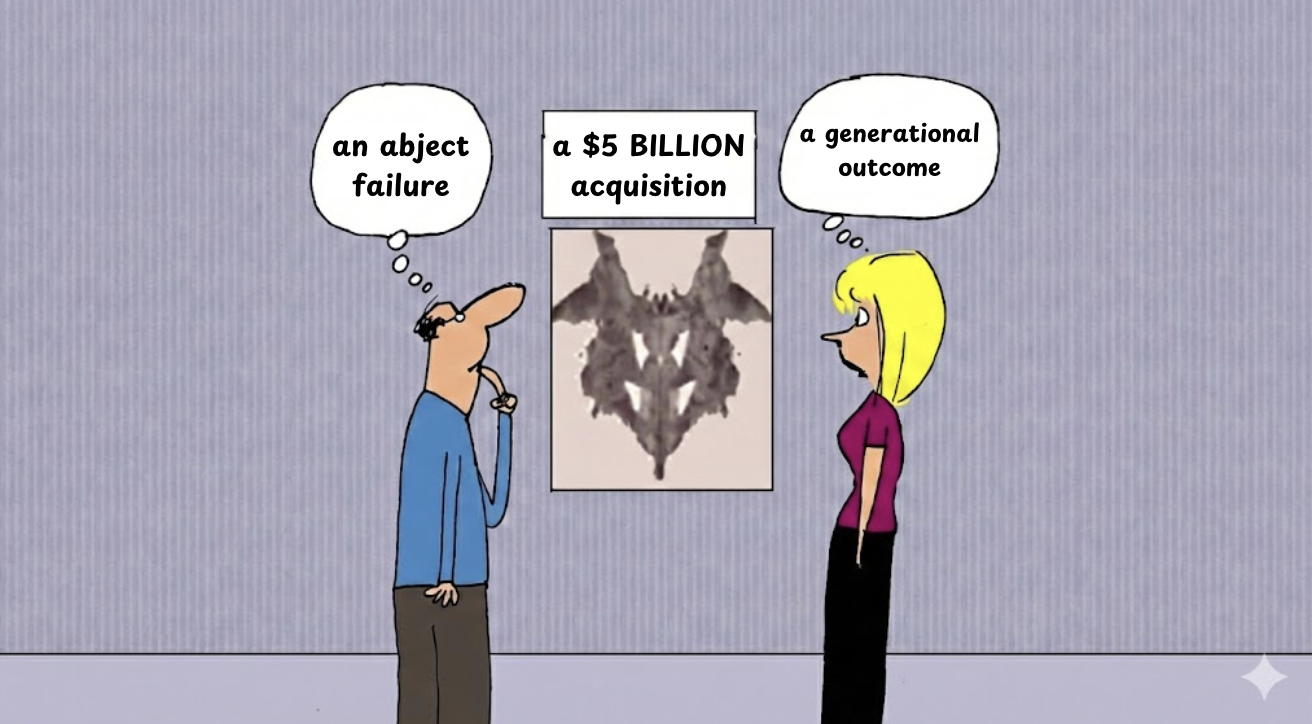
The most popular pieces I’ve written are about what I would describe as the Corporatization of Venture Capital. The Puritans of VC, “Build What’s Fundable“, The Blackstone of Innovation. But there is one piece that is not only my favorite piece, but I believe my most important piece that I’ve ever written: Playing Different (Stupider) Games.
There are three key points to make from that piece: (1) different games exist (different ways to make money, build AI, start companies, hire people, etc.), (2) the differences in the games mean that different approaches lead to winning vs. losing, and (3) most importantly, NOT recognizing when people are playing DIFFERENT games is the only TRULY stupider game.
The quintessential DIFFERENT game that I emphasize in that piece is the playbook of the capital agglomerators about whom I wrote those three most popular pieces I mentioned earlier. Large, multi-billion dollar, multi-stage firms whose identity is largely defined by their AUM. Structurally, that is definitively a different game than traditional venture capital. As I explained in the Playing Stupider Games piece:
“Is this the stupider game? Not necessarily! It’s just a different game. So what’s the stupider game? For other VCs, its not realizing that you’re competing with someone who is playing a very different game. For founders, its realizing that to these firms you are a rounding error.“
I wrote this piece in September 2023. I’ve thought about it probably once a month at least over the last 2+ years. I often feel like I’m shouting it from the rooftops. But all too often, people just can’t help themselves. They really want to pretend they’re playing the same game as the big dogs.
“I’m just like a16z,” says the $100M seed fund with two partners and a dog.
Stupider game.
“I’m just like OpenAI,” says the AI-model ranking company.
Stupider game.
“I’m just like CalPERS,” says the $250M multi-family office with 8% of its capital in privates.
Stupider game.
But every once in a while, a dog whistle appears in the wild that so perfectly illustrates what I’m talking about not because it comes in the form of an explanation, but because it comes in the form of a visceral reaction. “I don’t agree with that perspective!” That’s because you’re playing a different games. That feeling you have is proof. You’re seeing the people playing the real game; this is them telling you who they are!
The Brex of It All
On Thursday, Capital One announced it was acquiring Brex for $5.15B. This lit off a firestorm on Twitter for a couple reasons.
First, because it was a steep discount to where Brex had previously raised at $12.3B in 2022.
Second, because the competition with Ramp has been fierce, who recently raised at a $32B valuation and has reached more than double Brex’s TPV.
There were lots of takeaways about how Brex lost, despite having a 2 year heard start + $100M in initial funding. But there was another note that multiple people struck, and its the proverbial head tilt of dog-whistle recognition: “wait… Brex lost?”
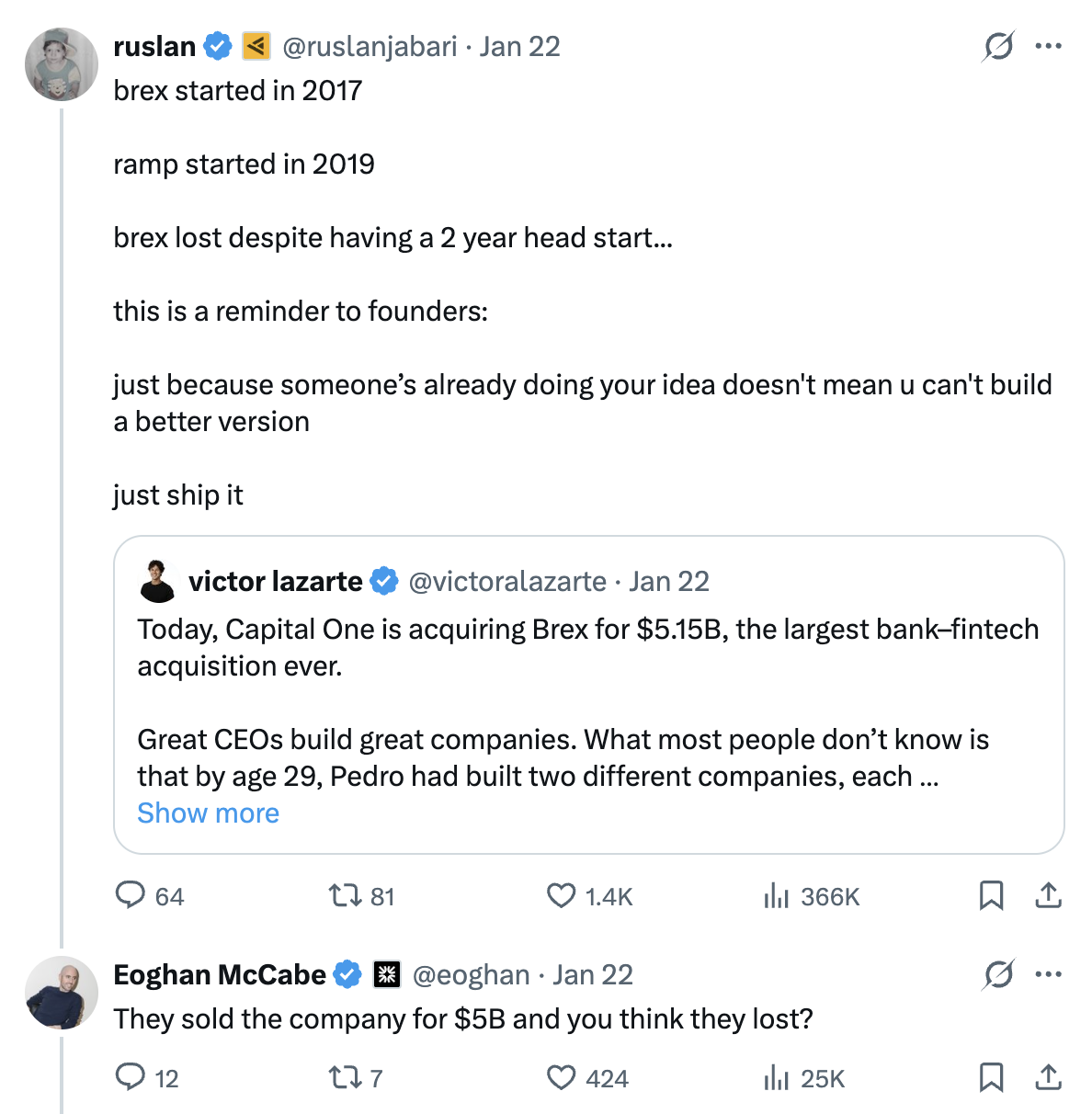
I saw this over, and over, and over, and over, and over, and over, and over, and over, and over, and over again across the internet. I’m a Ramp investor who couldn’t be happier with what Ramp has become. But even I was surprised with the vitriol that others spewed at Brex’s outcome.
Understanding this dynamic is actually one of the very best frameworks for understanding the DIFFERENT games in venture capital. And, if you can do that, maybe you can avoid playing STUPIDER games.
The Games At Play
First, some important context. The “venture capital” game is a complex cornucopia of games because there are multiple people playing at it from multiple angles: founders, employees, investors, etc. So its not all cut and dry. But, effectively, there are three motivators behind the different games being played that people usually slot into:
- (1) Playing To Win: In some cases, the primary driver in people’s lives is to be the best, to be number one. Nothing other than winning is satisfactory. They want to be the best in the world at what they do. VCs want to win every deal and have every portfolio company crush their competitors. Founders want to dominate a category and be better than every company.
- (2) Playing For Power: A very similar, but highly nuanced, way to play comes in the pursuit of power. You don’t want to just win the game, you want to reshape the game in your image. You don’t just want to back winners, you want to king-make them. You don’t just want to dominate a category, you want to became a central piece of global infrastructure that is too big to fail and is capable of shaping regulatory capture to your will so that you’re criticality is indispensable.
- (3) Playing To Survive: Then, finally, you have the drive to survive. These are the VCs who want to deploy capital investing in founders they think highly of in a way they believe will generate returns. These are founders who want to build a business they’re proud of; one that can last and provide jobs for employees and value for customers.
Again, I’ll reemphasize the point. None of these games are, inherently, good or bad. They’re just different. Granted, these are the ends. The means, on the other hand, can very easily veer into bad. Wanting power isn’t bad. Being willing to commit fraud or hurt people in the pursuit of power is what makes it bad.
The danger for individual participants is believing you’re playing the same game when you’re not. So understanding the different games and the inherent implications of each will help you react accordingly to the different participants in the market.
The Brex acquisition is a perfect encapsulation of each game at play:
Playing To Win
Ramp has always been a company that is playing to win; that’s what makes them a business worth studying. Their response was clever and in-line with competitive nature. They used it as a marketing opportunity to continue to win customers.
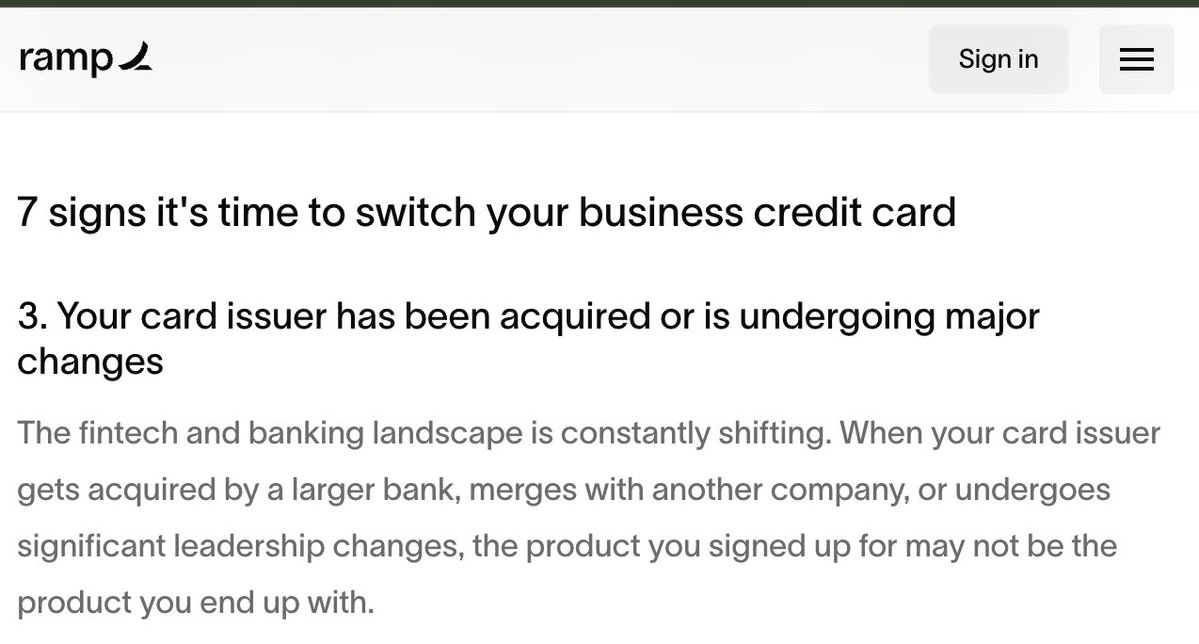
Classic winner behavior; keep focusing on winning.

It was a hard-fought competition over the course of many years, and Ramp has won in terms of becoming a larger company with more revenue, more customers, and a better product. There were many, many people at Brex who were also playing to win, but they lost in the sense that they had less revenue, fewer customers, and a worse product. But that’s the game. Winning is only sweet because you could have lost.
There’s nothing wrong with acknowledging that one company is better than another in terms of overall outcome. That doesn’t mean the loser is trash. The person who wins the silver medal in the 100-yard dash is still faster than 99.9% of people on earth; no one looks at their second place podium and thinks “absolutely worthless.” But they also don’t say “they won.” It’s a healthy game of wins and losses that dictate so much of our lives.
Playing For Power
But then, the power players reared their heads.
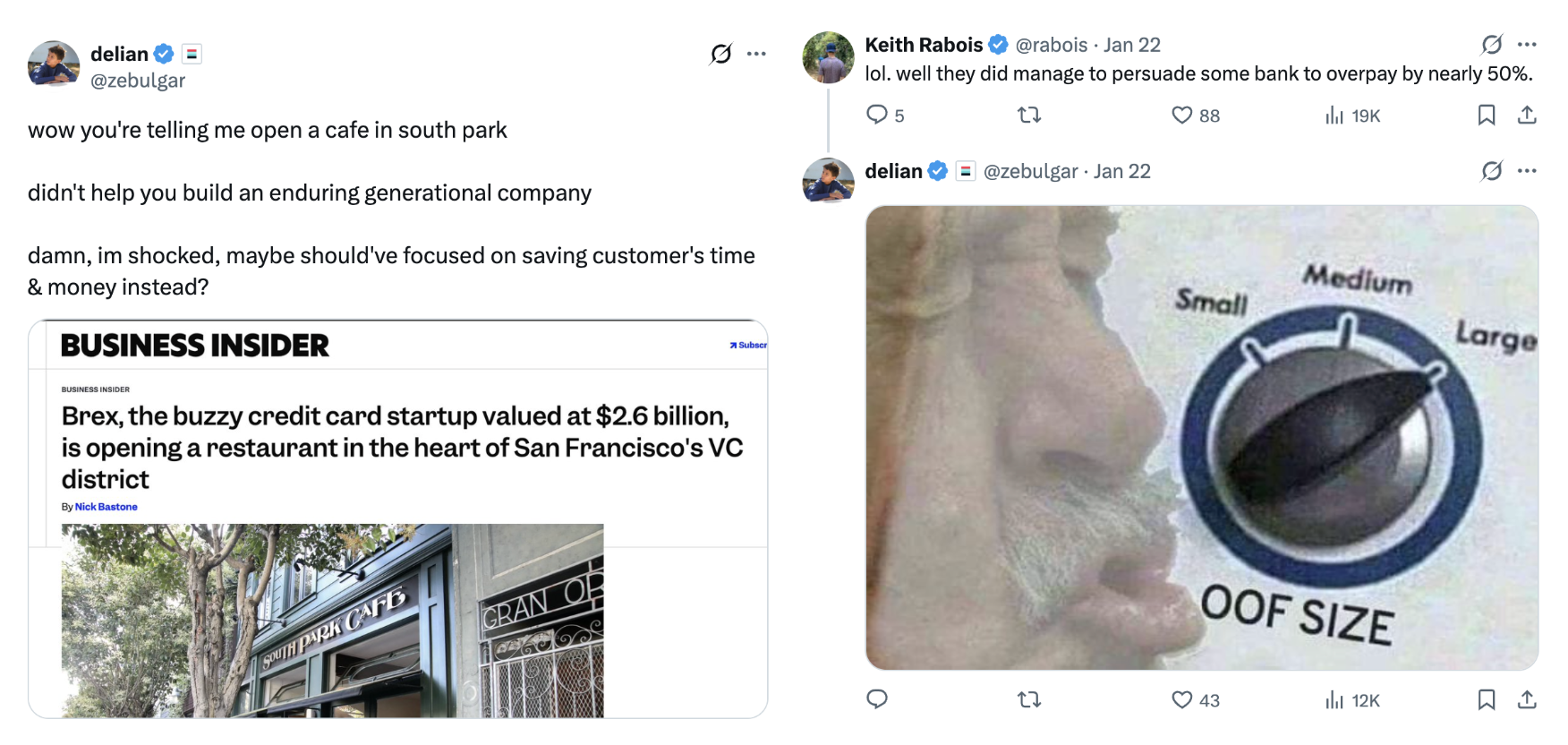
The current (and former) folks at Founders Fund deserve exorbitant credit for backing Ramp early, despite what MANY other VCs saw as too clear of a risk in that Brex already existed. And they’ll be handsomely rewarded for that.
But several people took note of the dog-whistle that was the uncomfortable feeling they felt when the saw the cackling lording-over of this particular crowd. And it was notably different. The response from Ramp’s founders, on the other hand, was classy. Poking fun at Brex’s CEO talking about the acquisition on a show that is “presented by Ramp” or offering the team congrats, while also offering restaurant recommendations around Capital One’s offices, given that they sold their first company to Capital One. Quintessential winner behavior! Respectful nod and then move on.
The way some of Ramp’s investors were acting reminded one person of Salt Bae’s grabbing the World Cup from the players who had actually done the winning and kissing it.

But isn’t this just winning behavior? Winning behavior is “I win, you lost.” Dominating behavior typically comes more from the pursuit of power. To think that a $5B+ outcome is losing across every spectrum, not just ultimate outcomes, but in every way, feels more like dominating. And most large-scale VCs are about dominating.
Jason Lemkin has a great piece about how what many people are actually reacting to is the pros and cons of Hubristic Fundraising. It pulls the rules of each game out into the open in an uncomfortable way.
Why does this feel weird to so many people? Because, regardless of what people say, the majority of people are playing to survive.
Playing To Survive
I saw a great analysis by Hari Raghavan that tried, as best he could, to break out the waterfall of who would make what from a $5B+ acquisition:
- Founders: $1B in total
- Investors / Employees who got in pre-2018: 2.75x - 800x for investors, 3-100x for employees depending on date
- Investors / Employees who joined in 2020/2021 more like a 1.3x on their money (though Hari points out correctly that this time period was tough for almost everyone)
This outcome minted 100+ millionaires out of its employees and gave its founders, who are ~30 years old, a billion dollars to split. The majority of people acknowledge that for what it is: a generational outcome. Those who play to survive would love that outcome.
These are the people who enjoy competition and try to live up to power, but it isn’t their primary motivating life force. They are more balanced; family, faith, life, health, learning, fulfillment. But the reality is most winners, and certainly most power players, are not balanced**.**
Here’s an example of the contrast:
A few years ago after the Bucks exited the NBA playoffs, Giannis Antetokounmpo answered the question of whether the season was a failure with a pretty insightful answer:
“Do you get the promotion every year? No. So is every year you work is a failure? No. Every year you work towards a goal. Its not failure; its steps to success. Michael Jordan played 15 years, won 6 championships; the other 9 years was a failure? No. There’s no failure in sports. There’s good days, bad days. Some days you’re successful, some days you’re not. Sometimes its your turn, sometimes its not. You don’t always win. You’re gonna come back next year, try to build good habits, play better, and hopefully you can win.”
I agree with that worldview. I think its incredibly powerful. But, candidly, having never even come close a national basketball championship myself, I’m not sure its the mentality of someone who plays to win, and definitely isn’t the mentality of someone who plays for power. That doesn’t mean the people who DO win are only those who play to win or for power. It’s just a difference of mentality. Antetokounmpo just has a different mentality, and that’s okay. But contrast that with Michael Jordan’s actual mindset:
“I’ve missed more than 9000 shots in my career. I’ve lost almost 300 games. 26 times, I’ve been trusted to take the game winning shot and missed. I’ve failed over and over and over again in my life. And that is why I succeed.”
Playing to survive? “It’s not a failure. It’s learning.”
Playing to win? “I have failed. That’s why I win.”
People in the comments will accuse me of nitpicking. And maybe you’re right. But I just can feel in my bones as I observe these varying mentalities play out. They are distinctively different and they shape the world-view with which you live your life. And when people who are playing for power; to dominate… when they tell you who they are, you should listen!
Know What Game You’re Playing
The most important thing you can do in life is knowing what game you want to play. Don’t let other people dictate to you the game you’ll play. Be proud of the game. And be capable of playing it.
If you want to play to win, then win! But very few people can win.
If you want to play for power, I pray that you also do the work to transform yourself, body and soul, into the kind of person that can be trusted with power.
If you want to play to survive, you can! Survival is accessible. The greatest danger to your game, in fact, is simply letting the people playing to win or playing for power convince you that you should be playing their game and that playing their game is the only way to truly win. They are lying to you. Because the way they win is enticing people to compete who they think they can beat. Or enticing people to pay attention whom they can have power over.
Politics is the same way. I’m not saying don’t care about human rights or tax policy or immigration or public works or civic duty. But the theater of politics is a grand game of power players convincing you that you have to pay attention to their game. Why? Because that is how they gain power! By getting you to watch and believe you need to give them power. Don’t be beguiled.
Don’t play stupider games.
Referenced in
- Matthew Gallagher note