The Ethos of Nuance
Growing up, I don’t remember being politically inclined in any particular direction. I remember in 7th grade having a friend who wore a pin to school every day with George W. Bush’s face touting a Hitler mustache on it. In high school, I made a video about the election and everyone I talked to was excited about Obama, though none of us could vote. None of it bothered me or offended my world view.
My exposure to politics was less about policy and more about people.
As far back as I can remember, my Dad served in the leadership of our local congregation. Every week, he would dedicate several hours without pay to helping people move, manage their finances, find food when things got tight, and look for work. My Mom constantly had someone over or was over visiting someone, often making two dinners so she could take one to someone who needed some help.
Growing up, my Dad would talk to me about wanting to build a city. We would drive through old towns talking about how revitalization would work. Not out of a desire for wealth or power, but because cities are one of the best ways to create economic opportunities for the largest number of people. To this day that concept still pulls me in.
When I went on a mission for my church I spent two years talking to people about Jesus. Rich people and poor people. Kind people and hateful people. But more often than not, the people most open to talking with me were the ones having a difficult time. On welfare, struggling with addiction, recovering from abuse, struggling to get by, trying to find meaning in life. Those people took comfort in a message I shared; one which I had taken for granted since childhood.
During the 2012 election I was excited about Mitt Romney, but in large part because he represented the best of what my church could produce: a successful, thoughtful leader who prioritized family, faith, and fairness. But I can’t say I could have competently articulated the tenants of his political platform.
Complexity Grows With Age
In 2016, my life really changed in a lot of ways. I got my first real job, I had my first child, and I started to pay attention to the politics behind the issue. I had lived the human experience adjacent to taxes, welfare, race and gender, gun ownership; but I hadn’t spent as much time thinking about how those human issues translated into political parties, candidates, and talking points.
Over the course of the next 10 years, while I tried to find my place in an increasingly polarized political spectrum, I found myself struggling in the messy middle. My parents are Republicans. I have always been a registered Republican. In New Mexico, I felt like one of the more conservative people in my friend group. But when I moved to Utah, I felt like one of the most liberal. But then I moved to California, and I felt like the most conservative. Then I moved back to Utah, and once again felt like one of the most liberal.
And as time went on, I actually felt like that middle ground was one of the most important characteristics about me. I take pride in it. In every sense of the word, I was a centrist. I saw merit on both sides of most arguments and was able to navigate to what I felt like was the right middle ground on most issues. I’ve written before about my approach to that middle.
I don’t ever want abortion to happen, but I don’t think making it illegal is the best path to making it rare.
I don’t want mass shootings to happen, and I think we could have more limitations on the types of weapons the average citizen can buy, but I think it has more to do with mental health than gun restrictions.
Religiously, I don’t believe God wants us to drink, smoke, or have sex outside marriage between a man and a woman. But moralistically, I claim the privilege of living my life the way I want to, and I allow everyone else the same privilege; let them live how, where, or what they may.
The middle ground framework has come from a concept that I’ve lived by, though I hadn’t really articulated until after the October 7th attack. I wrote about it this way:
“So often, people trust nuanced tribal group identity and political association without any basis of first principles. I’m not Mormon, or Christian, or Republican, or a Costco member. I am a system of values and beliefs that determine how I act. Group membership should be a lagging indicator of your beliefs, not a leading indicator. When people substitute their own value system with a cookie-cutter platform from their in-group the first thing to die is nuance.”
Since I started writing in 2022, I have written 478,008 words (not including this post). But I think that paragraph is one of the ones I am most proud of.
I find myself disagreeing with people who strongly hold specific in-group beliefs because I’m trying to reason from first principles. I don’t believe abortion is a sad thing because I’m Mormon. I believe it because, fundamentally, it feels like the ending of a life. I believe Donald Trump has eroded much of the conflict of interest controls the presidency has historically had, not because I didn’t vote for him, but because I don’t think he should be able to issue pump-and-dump crypto tokens while he’s the most powerful person in the world. That’s a bit of a “first principles” thing for me too.
As I’ve navigated this middle, it has also meant that I find myself exposed to ideas across both ends of the political spectrum. I, like most of my peers, have listened to points made by Bernie Sanders, AOC, Ezra Klein, Fareed Zakaria, Bill Maher, Destiny (aka Steven Kenneth Bonnell II), Jon Stewart, and John Oliver. I have also, like most of my peers, been exposed to points argued by Ben Shapiro, Jordan Peterson, Candace Owens, Matt Walsh, Glenn Beck and, most poignantly this week, Charlie Kirk.
Anyone under the age of 40 (and probably a lot of people above) have seen the same clips. People arguing on college campuses, debating on podcasts, or reacting to videos online to contradict points other people have made or criticize those same people personally. I have to admit that, more than any other political voices I listened to, there were three that resonated with me the most: John Oliver, Ezra Klein, and Charlie Kirk.
The Murder of Charlie Kirk
Hearing about what happened this past Wednesday, and being exposed online to the graphic video of Charlie Kirk’s murder, it shook me in a way I wasn’t expecting. There was the core humanity (or at least what I thought was a core tenant of humanity) of feeling distraught that another human being had been murdered on camera, and I had just watched it. But more than that, I empathized with someone who looked very similar to me.
An early 30s white, Christian, conservative, father of small children. Was I as conservative as him? No. But he had never struck me as the hateful bigot that many rushed to frame him as in the wake of his death. One of the quotes from him that came to be so representative of what happened to him, I think, framed so much of what he spent his life doing:
“When people stop talking, really bad stuff starts. When marriages stop talking, divorce happens. When churches stop talking, they fall apart. When nations stop talking, civil war ensues. When you stop having a human connection with someone you disagree with, it becomes a lot easier to want to commit violence against that group. Whether it be the horrible genocides of the last 100 years; people stop talking with each other because they lose their humanity. What we as a culture have to get back to is being able to have a reasonable disagreement where violence is not an option.”
I could not agree with that sentiment more. As much as my more middle ground perspective on so many issues in life have set my diametrically opposed to many of the beliefs Charlie Kirk held, there is a fundamental truth in how he practiced politics that rang so true in my “first principles” mind. And then, one of the other voices that had resonated with me in the past, did me the favor of articulating what I was feeling. Ezra Klein wrote an OpEd entitled: “Charlie Kirk Was Practicing Politics The Right Way”.
“You can dislike much of what Kirk believed and the following statement is still true: Kirk was practicing politics in exactly the right way. He was showing up to campuses and talking with anyone who would talk to him. He was one of the era’s most effective practitioners of persuasion. When the left thought its hold on the hearts and minds of college students was nearly absolute, Kirk showed up again and again to break it. Slowly, then all at once, he did. College-age voters shifted sharply right in the 2024 election.”
In particular, Klein’s description of Kirk as a “practitioner of persuasion” resonates with me. He goes on to say:
“Kirk and I were on different sides of most political arguments. We were on the same side on the continued possibility of American politics. It is supposed to be an argument, not a war; it is supposed to be won with words, not ended with bullets.”
One of, if not my most impactful, “Quake Books” is a biography of John Quincy Adams. In one chapter, it talks about how much Adams loved the art of rhetoric, and even became a professor of it at Harvard:
*“Rhetoric, in Adams’ day, meant classical rhetoric—the study of the means by which the classic authors deployed the arts of persuasion. Oratory was spoken rhetoric… Adams knew very well that for many of his students “rhetoric” described a set of hurdles and obstacles and obscure regulations designed to limit the torrent of writing and speech to an orderly stream. Adams intended to rescue this ancient art from its modern slumber.
In Adams’ richly stocked mind rhetoric and oratory constituted a point of convergence of the classical, the Christian, and the republican—the three orienting points of his life. Had not God given Aaron to the tongue-tied Moses in order to speak his law to the Israelites? For the ancients, of course, “the talent of public speaking was the key to the highest dignities.” That was no longer true, not because eloquence was a form of decoration with which moderns could dispense, but because moderns, unlike the citizens of Rome and Athens, no longer governed themselves through the kinds of “deliberative assembles” in which the gifted orator could shape the destiny of a nation. Since America was the one nation in which a vestige of those republics survived, it needed eloquent men as no other, lesser nation did.”*
That framing of rhetoric felt immediately powerful to me when I read that book about John Quincy Adams. And the same fire I felt reading those words is recognizable when I think about why certain influential “orators” have impacted me more than others. John Oliver, Ezra Klein, Charlie Kirk. Those three in particular resonated with me because they persuaded me. There are things that they said I don’t agree with, there are things they said that I don’t like. But there are many things that they convinced me of. I was powerfully persuaded. Including many of the things that Charlie Kirk stood for.
People call him a homophobe, but I’ve watched him articulate why people shouldn’t be primarily labeled by their sexual orientation, and why gay people should be welcomed into the conservative movement.
People call him a transphobe, but I’ve watched him demonstrate empathy for someone who identified as trans, and emphasize more his desire that they become more comfortable in their own mind and body.
People call him racist, but I’ve watched him argue why there are social constructs that disadvantage the Black community beyond the lasting impact of slavery that are, instead, more modern and that could (and should) be remedied.
People call him sexist, but I’ve watched him demonstrate respect for other women, his wife, and articulate a world view of what a woman’s role can be as a wife and mother that isn’t meant to be domineeringly universal, but optimistically idealistic.
People call him a Christian nationalist, but I’ve watched him explain why he is a Christian and he is a nationalist, but he’s never identified as a Christian Nationalist.
Does that mean he was a perfect, completely unproblematic, Christlike idol? Absolutely not. But let them among us without sin cast the first stone. We are all imperfect, problematic, unworthy, fallen creatures. I did not agree with many of his stances. I wished he had had many different perspectives.
But, as so many have said this past week, the way you disagree with someone is to convince them otherwise. Not to murder them. Bernie Sanders expressed this well this past week in addressing Charlie Kirk’s murder:
*“A free and democratic society, which is what America is supposed to be about, depends upon the basic premise that people can speak out, organize, and take part in public life without fear, without worrying that they might be killed, injured, or humiliated for expressing their political views.
In fact, that is the essence of what freedom is about and what democracy is about. You have a point of view. That’s great. I have a point of view that is different than yours. That’s great. Let’s argue it out. We make our case to the American people at the local, state, and federal levels. And we hold free elections in which the people decide what they want. That’s called freedom and democracy. And I want as many people as possible to participate in that process without fear… Political violence in fact is political cowardice. It means that you cannot convince people of the correctness of your ideas and you have to impose them through force.”*
What continued to resonate with me about Charlie Kirk was the same thing that resonated with me about Ezra Klein, John Oliver, and (on certain issues), Jon Stewart, Bernie Sanders, and JD Vance: I was persuaded. I wasn’t afraid. I wasn’t bullied. I was convinced by their arguments about one issue or another. And for any “first principles” middle-grounder like me, the merit is often in the argument. The debate. The rhetoric.
Unfortunately, in large part since the October 7th attack in Israel, I’ve started to feel less and less persuaded by much of the rhetoric on the more liberal side of the political spectrum.
My Shift Right
So many people have articulated the danger of political violence as primarily coming from the chilling effect it has on public discourse. The more afraid people are to discuss and debate ideas, the less effective our democratic society can be.
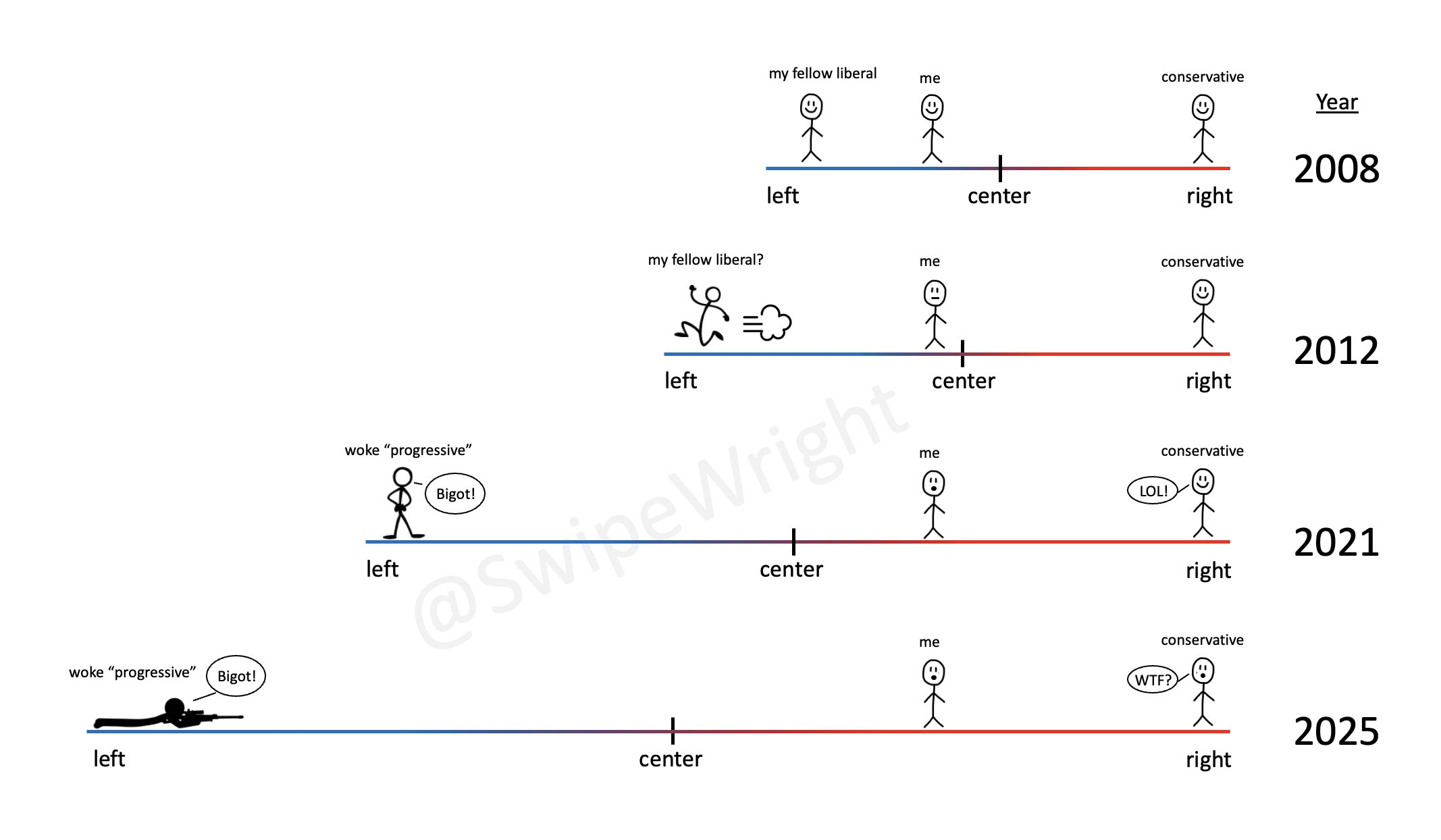
Unfortunately, many folks of the more left-leaning persuasion have becoming increasingly less persuasive to me.
Starting with October 7th. Again, I can understand the merits of both sides of the argument between Israel and Palestine. I can simultaneously not agree with the unfettered support the US government gives Israel while also acknowledging the nuances that pro-Israel supporters don’t recognize when it comes to Palestine.
But when you have American liberals on the street, screaming at Jews that they want the same atrocities that happened on October 7th to happen every day? I am not convinced by that argument.
I generally believe that adults in a free country should be able to do whatever they want. And if a biological man feels inclined to alter their body to be more like a woman, then I support that freedom. When those freedoms start to infringe on someone else’s freedom to believe in aspects of genetics and to not be forced to have their children taught specific ideologies in public state-run schools, I get less comfortable.
But when you have people declaring that any alternative expression of perspective represents violence akin to actual violence, and merits the return of physical violence? I am not convinced by that argument.
I understand the fear that left-leaning folks have about Donald Trump and the rising perspective on the right that seems to erode fair and free elections, limiting conflicts of interest in politics, and using misinformation and fear to aggregate power. As that fear boils out to increasingly manic declarations that “every conservative is a Nazi fascist” and “any Republican is a threat to our nation,” I get more uncomfortable.
But when you have people celebrating the calculated cold-blooded murder of a young father? And for simply “practicing politics the right way?” The kind of celebratory glee that I’ve seen people take in the murder of Charlie Kirk makes me sick. It is the kind of ear-to-ear grin of the psychopath that knew they’d lost the argument, so they needed to win by silencing the opposition. I am not convinced by that argument.
In particular, these cold, callous individuals who can celebrate Charlie Kirk’s murder, who can blame his policy positions for justifying that slaying, and can even hope that other people experience the same fate? That is the quintessential representation of what Bernie Sanders described as “political cowardice.”
There are arguments being debated across the American public. And, whether Democrats like it or not, they are losing many of those arguments. The fact that, in 2024, Donald Trump got reelected and Republicans got majority control of both the House and the Senate? They’re currently winning the debate.
Does that mean every Republican policy is the right answer? Absolutely not.
Does that mean every Democratic policy is completely wrong? Absolutely not.
But amidst the scorecard of the debate, Democrats are losing and Republicans are winning. And the fact that at least one liberal-leaning mentally unstable person decided that Charlie Kirk needed to be silenced with a bullet, it just reinforces the fact that his voice was winning. Like Bernie Sanders said; the political cowards felt the only way they could win that argument was by silencing him. The scorecard of Charlie Kirk’s successful persuasiveness is demonstrated in the increased shift towards the political right of the younger generation. And for centrists like me, the murder of Charlie Kirk is a tragedy. But the response to the murder of Charlie Kirk is a potentially radicalizing experience.
What I want is NOT to be more partisan. I stand by what I wrote before:
“So often, people trust nuanced tribal group identity and political association without any basis of first principles. I’m not Mormon, or Christian, or Republican, or a Costco member. I am a system of values and beliefs that determine how I act. Group membership should be a lagging indicator of your beliefs, not a leading indicator. When people substitute their own value system with a cookie-cutter platform from their in-group the first thing to die is nuance.”
I don’t want to be more Republican and, therefore, hold more Republican views anymore than I want to be more Democrat and hold more Democratic views. I’m not looking for world-views. I’m looking for beliefs. What do I believe? What is the right argument? What is the right stance to take? Because in seeking out truth, my hope is that we find healing. The path to progress is paved in the pursuit of truth. I want progress. I want truth.
The Wish of My Heart
In the Book of Mormon, there is an ancient prophet in the Americas around 76 BC named Alma. In a particular verse of scripture, he articulates something that I often resonate with:
“O that I were an angel, and could have the wish of mine heart, that I might go forth and speak with the trump of God, with a voice to shake the earth, and cry repentance unto every people! Yea, I would declare unto every soul, as with the voice of thunder, repentance and the plan of redemption, that they should repent and come unto our God, that there might not be more sorrow upon all the face of the earth. But behold, I am a man, and do sin in my wish; for I ought to be content with the things which the Lord hath allotted unto me.”
I wrote a few weeks ago about how some people feel uncomfortable and even skeptical of people who say “I just want to make the world a better place.” The section I wrote about that idea was called, “what makes you think you can change the world?” But despite the potential accusations of hubris and the rolled eyes and exasperated sighs, I continue to feel what I felt when I was a child watching my Mom and my Dad serve the people around me. I want to make the world a better place.
I said earlier that Charlie Kirk’s murder shook me in unexpected ways, in part because he looks so similar to me. But that feeling of desire for the welfare of mankind isn’t limited to people who look like me. I empathize with his wife and children losing a father. But my hope is to eradicate suffering universally, not just for the people I love. As Joseph Smith once said:
“Love is one of the chief characteristics of Deity, and ought to be manifested by those who aspire to be the sons of God. A man filled with the love of God, is not content with blessing his family alone, but ranges through the whole world, anxious to bless the whole human race.”
I believe that there are right answers to how best to govern the country we live in. I believe that there are right systems to bring about those solutions. I believe there are powerful technologies that can improve the lives of everyone in the world. I believe that God wants us to build a better world. So I will try and seek that. The wish of my heart will be to persuade the world in the direction of truth and progress.
My chosen vocation is understanding and investing in technology. So I will leverage that field in pursuit of that goal. And as I do so, I will continue to try and join groups not in search of my beliefs, but because of my beliefs. I will form my world view and seek out the systems, institutions, candidates, policies, technology, frameworks, and talking points that align with that world view. And I will constantly reassess that world view in search of an even better world view.
The world needs more people like Charlie Kirk. And the world needs fewer people like the person who killed him, or the people who celebrated his murder. That doesn’t mean we need to kill those people. Far from it. We need to persuade them.