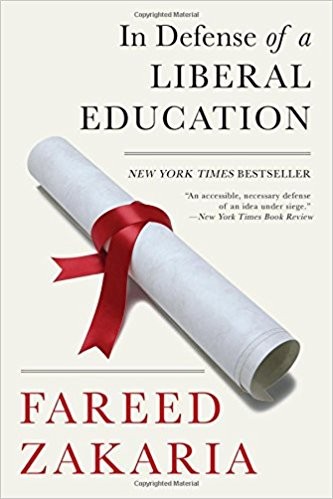
In Defense of a Liberal Education
Key Takeaways
Kyle, in 2017 in Books: I’m not a liberal arts major. I didn’t go to a liberal arts school. I haven’t taken that many liberal arts classes. For 60% of my college education, I could have been borderline illiterate as long as I understood numbers. But I recognize that the most valuable classes I took were the ones that made me think, the ones where I was required to structure my thinking. That was what this book drove home for me.
The book begins with a quote:
- Fareed Zakaria argues that a liberal education is not a luxury or a path away from employability but the foundation common to every profession — echoing the Yale Report’s claim that its essence is “not to teach that which is peculiar to any one of the professions; but to lay the foundation which is common to them all.”
- The most durable thing an education gives is not facts but the ability to acquire knowledge on one’s own — to read closely, find and weigh sources, detect bias, write clearly, and treat learning as a pleasure rather than a task.
- Zakaria pushes back on the “STEM vs. humanities” framing: engineering is not better than art history; society needs both, often in combination (“Facebook is as much psychology and sociology as it is technology”). The emerging core competence is creativity and innovation, which cuts across disciplines.
- The book is uneasy about evaluating education through “return on investment.” Financial return as the metric quietly redefines what education is for — and Zakaria leaves the better metric an open question.
- Writing clearly is singled out as the most transferable skill of all: “Whatever you do in life, the ability to write clearly, cleanly, and reasonably quickly will prove to be an invaluable skill.”
Connections
- liberal arts — this book is the corpus’s central defense of the liberal-arts model and its claim to practical, not merely ornamental, value.
- Creativity — Zakaria’s argument that creativity and innovation are the new “core competence” connects to the wiki’s broader creativity/innovation thread.
- Fareed Zakaria — author; the closing reflection on how a liberal education taught him how to learn is the personal spine of the book.
Highlights
- “We are drowning in information, while starving for wisdom. The world henceforth will be run by synthesizers, people able to put together the right information at the right time, think critically about it, and make important decisions wisely.” (E. O. Wilson)
- “Book learning alone might be got by lectures and reading; but it was only by studying and disputing, eating and drinking, playing and praying as members of the same collegiate community, in close and constant association with each other and with their tutors, that the priceless gift of character could be imparted.” (Samuel Eliot Morison)
- “The Yale report explained that the essence of a liberal education was ‘not to teach that which is peculiar to any one of the professions; but to lay the foundation which is common to them all.’”
- “A well-instructed youth of eighteen can select for himself — not for any other [person], or for the fictitious universal [person] but for himself alone — a better course of study than any college faculty, or any wise man who does not know him and his ancestors and his previous life, can possibly select for him.” (Eliot)
- “Reading — especially, I would argue, reading books — remains one of the most important paths to real knowledge.”
- “[A Yale report] abolishes departments, seeing them as silos that inhibit cross-fertilization, interdisciplinary works, and synergy.”
- “Whatever you do in life, the ability to write clearly, cleanly, and reasonably quickly will prove to be an invaluable skill.”
- “I don’t know what I think on that one. I haven’t written about it yet.” (Walter Lippmann)
- “I now realize that what I gained from [my liberal arts education], far more lasting than any specific set of facts or piece of knowledge, has been the understanding of how to acquire knowledge on my own. I learned how to read an essay closely, search for new sources, find data to prove or disprove a hypothesis, and detect an author’s prejudices. I learned how to read a book fast and still get its essence. I learned to ask questions, present an opposing view, take notes, and nowadays, watch speeches, lectures, and interviews as they stream across my computer. And most of all, I learned that learning was a pleasure — a great adventure of exploration.”
- “Engineering is not better than art history. Society needs both, often in combination. Facebook is ‘as much psychology and sociology as it is technology.’”
- “[Education] needs to allow people to range freely, experiment, and enjoy themselves while learning.”
- “The fact that we now use the language of ‘return on investment’ to describe the experience of getting educated is revealing.”
Kyle: This quote brought up an interesting point in my mind. Financial return as a metric for evaluation does skew our thoughts away from what is really important about an education. But what metric should we use instead?
- “Increasingly, the new core competence is creativity — the right-brain stuff that smart companies are now harnessing to generate top-line growth… It isn’t just about math and science anymore. It’s about creativity, imagination, and, above all, innovation.”
Kyle: These three quotes [this one and the two below] are what I think are the crux of the thing.
- “If you want to succeed in life, most often you need to put in the hours, develop good habits, work well with others, and get lucky. That is true whether you study English, physics, history, engineering, or business.”
- “Of course, most people read books, understand science, and experience art, not to change the world, but to change themselves. But is our current system of liberal education changing young people for the better?”
Additional highlights restored from Roam — 2026-09-21
- “The fact that we now use the language of ‘return on investment’ to describe the experience of getting educated is revealing.” — this quote brought up an interesting point in my mind. Financial return as a metric for evaluation does skew our thoughts away from what is really important about an education. But what metric should we use instead?
- These three quotes are what I think are the crux of the thing: