Historical Futurism
Learning from how the past imagined tomorrow
The study of history not as a static record but as a laboratory of attempted futures — how did people in the past envision progress, what solutions did they try, what worked, what failed, and what remains relevant? Encompasses classic histories, the history of ideas through science fiction, and the mining of old proposals for insights applicable now.
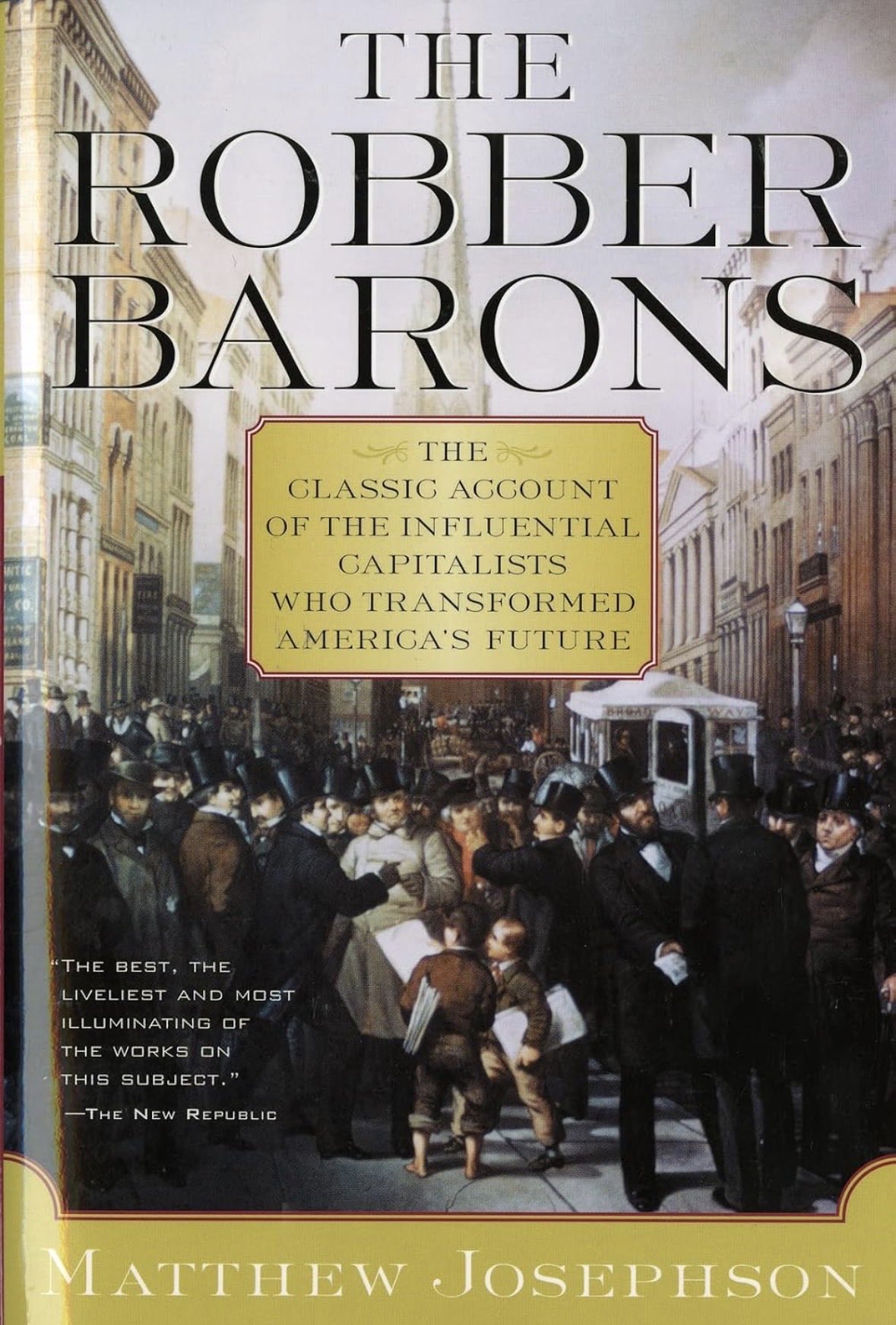
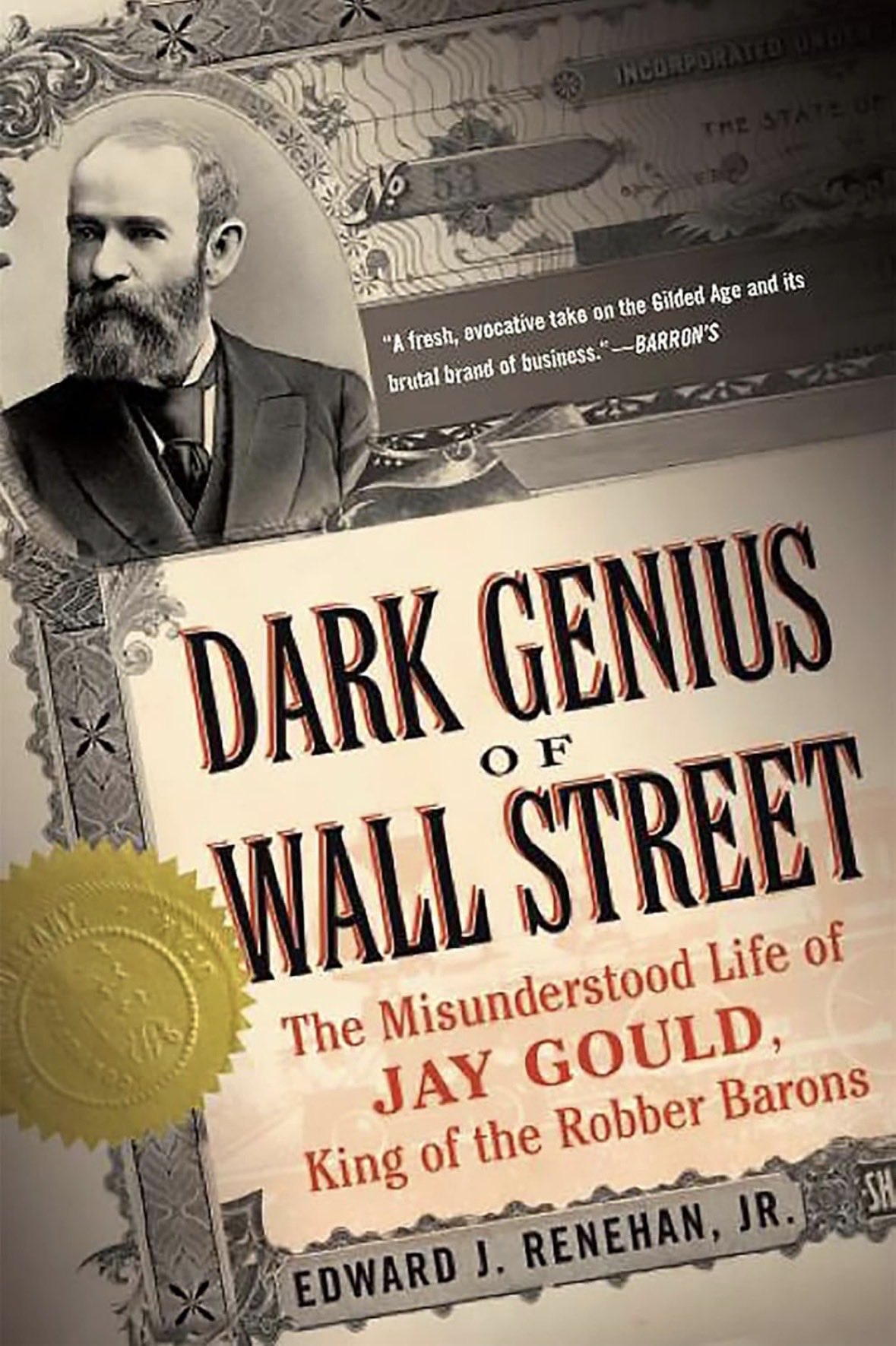
Larry Ellison’s favorite book No wonder it is a history of ruthless monopolists. This century is going to be the age of a new generation of robber barons who own the bottlenecks behind the AI buildout. Study the Old Masters. **Image:** the cover of *The Robber Barons* by Matthew Josephson. ### Quoted post > Jay Gould Playbook > > 1. Target distressed strategic infrastructure > > 2. Buy its stock + bonds at depressed prices; accumulate enough voting stock to control the company. > > 3. Buy connecting railroads that increase the system’s routes and traffic. > > 4. Cut rates and redirect traffic <!-- The quoted post's text comes from the syndication endpoint, which clips long posts at ~280 characters; it may continue past step 4. -->
The dot com bubble got some things right. It noticed that the internet was going to be big. It noticed that the value generated by the internet would roughly scale in proportion with the amount of fiber laid. It recognized a latent need in all humans to use technology for self-expression. There are a few things that it missed. First: it thought that html and javascript were the means by which common people would express themselves. The dot com bubble thought everyone would have a website. As it turns out, normal people prefer expressing themselves with text, images, and video. The first 1% of internet adopters expressed themselves by creating personal websites. But as the internet grew, we didn't get more and more websites. The internet "collapsed" into a much simpler form of distribution: social media, which only let people express themselves in an incredibly limited fashion. Among social media, 90% is text, image, or video. Html is not a good form of self-expression. It's hard to secure. It's hard to distribute. It's hard to reason about. You need to learn how to code. Images are an incredible form of self-expression. Non-technical people love editing photos of themselves. Non-technical people hate making websites. The TAM of Instagram is 100x larger than the TAM of Godaddy. Second: it missed that 90% of the internet's traffic would come through video. As the total usage of fiber increased, we saw the internet once again "collapsed" into a simpler form of distribution: video streaming. Now, Netflix, YouTube, Tik Tok, Instagram, and so on take up the majority of data passed through internet fiber. The modern AI discourse is making a similar mistake to saying "everyone will have a website" back in 1995. I hear stuff like: - People want personal software - Everyone will build a mobile app - The market for software is infinite No. You are directionally correct, but you are missing something big. Every human will use agents. But less than 1% will use coding agents. (In the same way every human has a "personal page" through social media, but less than 1% have a personal website.) You need an "idiotproof" sandbox. Your consumer agent, as well as agents for enterprise use cases, must have a 0% chance of failure. Your consumer agent must be usable while drunk, in bed, having sex, on the toilet, during lunch break, in the background while working on homework, while your brain is 99% preoccupied with a difficult task at work. It must be impossible for AI to: make purchases you did not intend, send messages you did not intend, and access information you did not want to share. It cannot be "difficult" for these to happen. It must be impossible. (In the same way that YouTube videos have a 0% chance of phishing, cross-site scripting, malware, and viruses.) No amount of models getting better will give them a 0% chance of failure. To get to a 0% chance of failure, you need to be creative. You need to innovate. You need to radically rethink your abstractions. Every human has a "personal page" through social media, but less than 1% has a personal website. What is the same shift for AI? Every human will use \_\_\_\_\_ agents, but less than 1% use coding agents. What is \_\_\_\_\_? What is the "idiotproof" sandbox for agents?
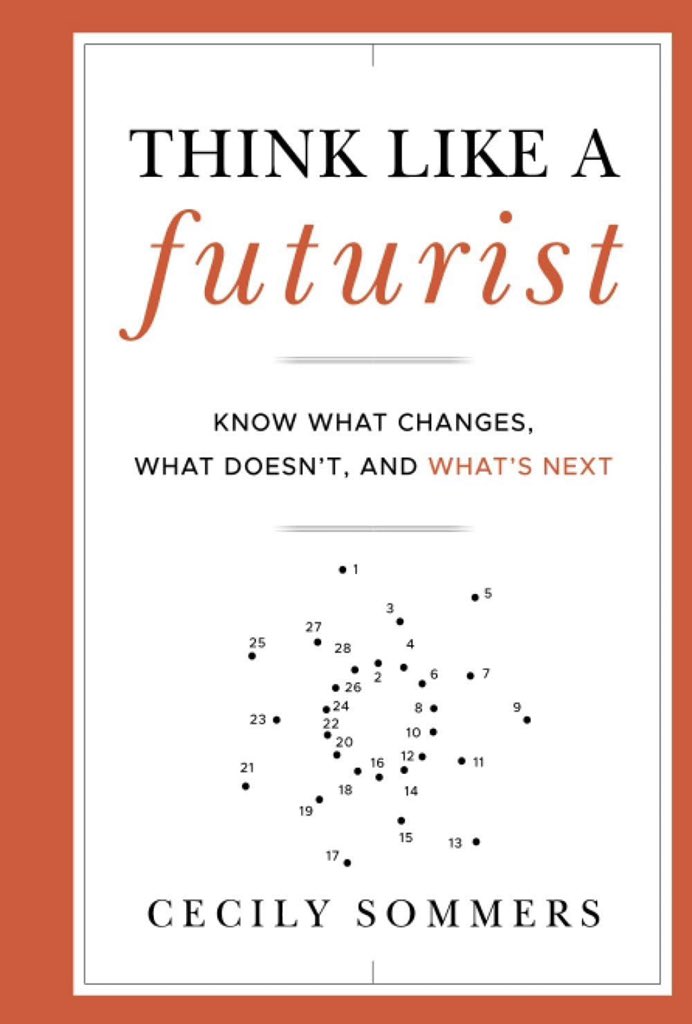
2026-09-02most people predict the future badly. because they chase trends. ai crypto robots space biotech but futurists don’t start with hype. they ask better questions: what is changing? what is stable? what is accelerating? what is constrained? what incentives are shaping behavior? https://t.co/vvMP29IEnr
Larry Ellison’s favorite book No wonder it is a history of ruthless monopolists. This century is going to be the age of a new generation of robber barons who own the bottlenecks behind the AI buildout. Study the Old Masters. **Image:** the cover of *The Robber Barons* by Matthew Josephson. ### Quoted post > Jay Gould Playbook > > 1. Target distressed strategic infrastructure > > 2. Buy its stock + bonds at depressed prices; accumulate enough voting stock to control the company. > > 3. Buy connecting railroads that increase the system’s routes and traffic. > > 4. Cut rates and redirect traffic <!-- The quoted post's text comes from the syndication endpoint, which clips long posts at ~280 characters; it may continue past step 4. -->
The dot com bubble got some things right. It noticed that the internet was going to be big. It noticed that the value generated by the internet would roughly scale in proportion with the amount of fiber laid. It recognized a latent need in all humans to use technology for self-expression. There are a few things that it missed. First: it thought that html and javascript were the means by which common people would express themselves. The dot com bubble thought everyone would have a website. As it turns out, normal people prefer expressing themselves with text, images, and video. The first 1% of internet adopters expressed themselves by creating personal websites. But as the internet grew, we didn't get more and more websites. The internet "collapsed" into a much simpler form of distribution: social media, which only let people express themselves in an incredibly limited fashion. Among social media, 90% is text, image, or video. Html is not a good form of self-expression. It's hard to secure. It's hard to distribute. It's hard to reason about. You need to learn how to code. Images are an incredible form of self-expression. Non-technical people love editing photos of themselves. Non-technical people hate making websites. The TAM of Instagram is 100x larger than the TAM of Godaddy. Second: it missed that 90% of the internet's traffic would come through video. As the total usage of fiber increased, we saw the internet once again "collapsed" into a simpler form of distribution: video streaming. Now, Netflix, YouTube, Tik Tok, Instagram, and so on take up the majority of data passed through internet fiber. The modern AI discourse is making a similar mistake to saying "everyone will have a website" back in 1995. I hear stuff like: - People want personal software - Everyone will build a mobile app - The market for software is infinite No. You are directionally correct, but you are missing something big. Every human will use agents. But less than 1% will use coding agents. (In the same way every human has a "personal page" through social media, but less than 1% have a personal website.) You need an "idiotproof" sandbox. Your consumer agent, as well as agents for enterprise use cases, must have a 0% chance of failure. Your consumer agent must be usable while drunk, in bed, having sex, on the toilet, during lunch break, in the background while working on homework, while your brain is 99% preoccupied with a difficult task at work. It must be impossible for AI to: make purchases you did not intend, send messages you did not intend, and access information you did not want to share. It cannot be "difficult" for these to happen. It must be impossible. (In the same way that YouTube videos have a 0% chance of phishing, cross-site scripting, malware, and viruses.) No amount of models getting better will give them a 0% chance of failure. To get to a 0% chance of failure, you need to be creative. You need to innovate. You need to radically rethink your abstractions. Every human has a "personal page" through social media, but less than 1% has a personal website. What is the same shift for AI? Every human will use \_\_\_\_\_ agents, but less than 1% use coding agents. What is \_\_\_\_\_? What is the "idiotproof" sandbox for agents?
2026-09-02most people predict the future badly. because they chase trends. ai crypto robots space biotech but futurists don’t start with hype. they ask better questions: what is changing? what is stable? what is accelerating? what is constrained? what incentives are shaping behavior? https://t.co/vvMP29IEnr
Dr. James Orr’s course: The Philosophy of History, is available now. In this course, @jtworr traces the philosophy of history from its ancient Greek origins to today’s debates over meaning, progress, and identity. Starting with the contrasting methods of Herodotus and Thucydides, we follow the evolution of historical thinking through medieval theology, Enlightenment secularism, and modern theories of change. Key figures such as Augustine, Hegel, and Marx reveal competing visions of history as divinely guided, rationally unfolding, or shaped by material forces. The course also explores 20th-century responses from Spengler and Heidegger, before turning to the collapse of grand narratives and today’s “history wars,” where the struggle to interpret the past remains deeply tied to how we understand ourselves. <!-- The syndication API clipped this at ~294 chars ("Herodotus and"). Full text recovered 2026-09-15 from the rendered post in Kyle's logged-in x.com session. The trailing https://t.co/uZ0qQ4Gbs0 was this tweet's own attached video (poster + video in media: above). -->

this is why i wish the tech/sci fi film canon were wider. im tired of references to Her and Bladerunner and The Social Network etc. in 2026 you should be watching: -Demonlover -Until the End of the World -Videodrome -World on a Wire -Solaris -The 10th Victim -Megalopolis https://t.co/nP7eAQx2JA **Quoting @scottbelsky:** > films set the ideas and narratives that kick-off passions and careers



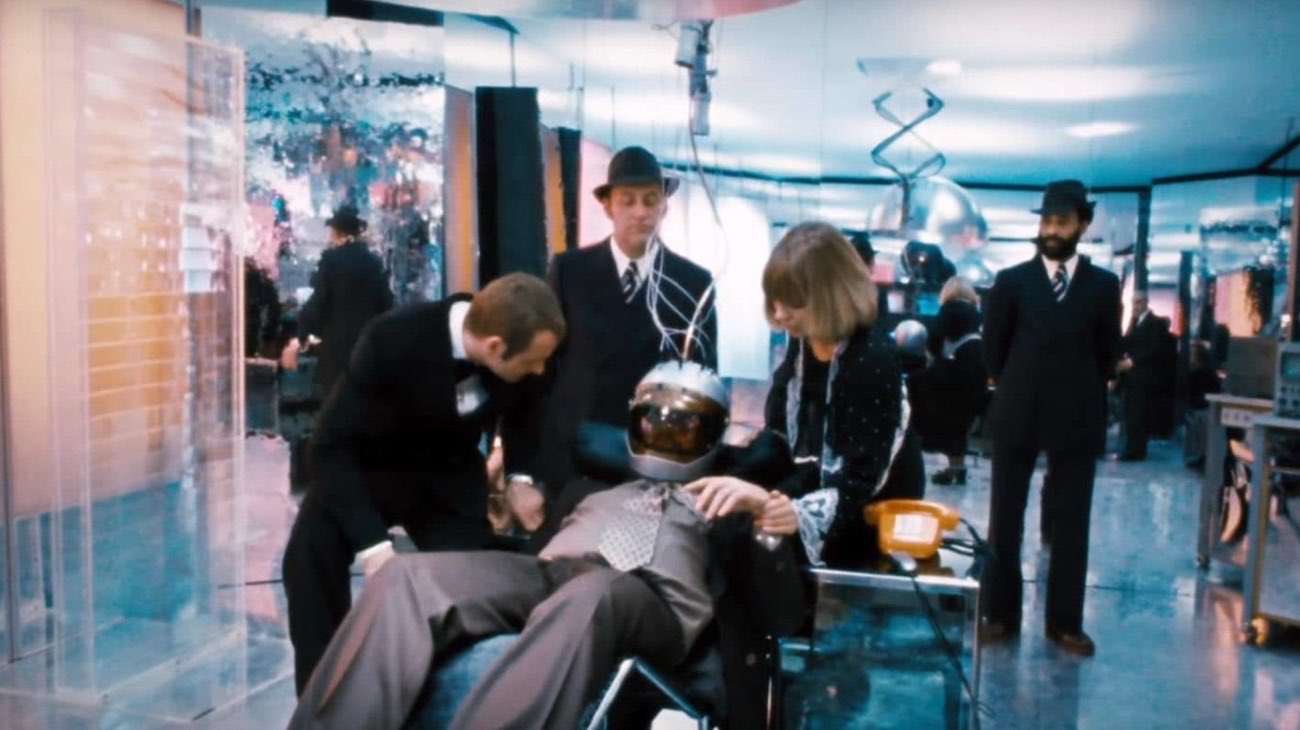
Science fiction is a great tool/medium for business thinkers. This is a great long form piece of speculative business fiction from @Citrini7 https://substackcdn.com
2026-02-22Delighted to share our new fund: https://fonts.googleapis.com > Soviet papers from the 50s! > Antimalarial drugs from Mao’s China! > Buried research on reality and consciousness! Led by @WendiYan5 and seeded by @jwmares and @stuartbuck1 https://t.co/4Jrvrwiqou

**Article: "Against Taste"** **Canonical:** https://x.com/i/article/2023762736136462336 > Taste arrived quietly, somewhere over the last few months. It arrived the way a new technology consensus always arrives. It wasn't argued into place. It simply appeared there one morning, like the… ### Full text (verbatim) **"Against Taste"** — Will Manidis (@WillManidis), Feb 17, 2026 Taste arrived quietly, somewhere over the last few months. It arrived the way a new technology consensus always arrives. It wasn't argued into place. It simply appeared there one morning, like the weather. No one proposed it. No one even had to. It was a clean and easy answer to the question everyone in technology has been asking: what are humans for once the models get good enough? Taste was a clean and easy answer. It could be deployed at deliberative catch up coffees in San Francisco matcha bars, the kind with overstuffed croissants that end up on viral TikToks and hashtag-food Slack channels featuring sober coworker chat about slop bowls. And taste arrived at boozy New York allocator dinners where people counted their carry and felt bad about it while deploying it into Gin Lane houses and Park Avenue condos while discussed which venture capitalist got divorced that week. Taste, of course, was the only thing that mattered. The ability to select, the ability to curate. The thing humans have been doing forever. Taste was an easy answer. Taste comes to the party wearing Yohji Yamamoto pants and an OpenAI commercial-leadership-offsite Patagonia quarter-zip. Taste does drink, just a bit and sometimes more than a bit on weekends, but it does have a shockingly high VO2. Taste is a complete vision of what post-scarcity protein-heavy brunch looks like: shiny Accutane-and-GHK skin, emotions muted by insulin inhibitors and novel neurotoxic research chemicals. **I hate Taste.** Not because taste isn't real. Taste is very real. I hate it because what we're calling taste is a very dangerous and slippery thing. And when you look at what came before taste, you realize that what the taste thesis actually proposes is not an empowerment of human agency but a fundamental demotion. It might be the most elegant and well-branded demotion in the history of human self-regard. Consider what the word actually means. For most of human history there was no concept of taste as we understand it. There was patronage. Patronage was anything but taste. Patronage was a relationship between capital and artistic labor so intimate that the two were functionally a single body. The patron did not select from finished works on a wall, allocating neat sums of money to purchase them. The patron animated the work before it existed. > "The LORD God took the man and put him in the garden of Eden to dress it and to keep it." — Genesis 2:15 The first vocation in Scripture is not to sit atop creation and admire its beauty. It is labor. Co-creation. Man's original calling is to tend, to make, to participate in the ongoing work of creation. The garden is not a tasteful Japandi department store, finished so that software engineers can walk through it and tithe their income to its best elements. It is a living thing that requires redemptive labor. The taste thesis, at its deepest and most simple structure, reverses this order. It places man at the end of the chain of creation, evaluating what has already been generated, rather than at the beginning, participating in the generation itself. It makes man what he has been slowly becoming for a century: a critic of creation rather than a co-creator. A consumer at his core. The bottega system, first pioneered in Florence in the fifteenth century, animated some of the greatest works humanity has ever produced. A bottega was not an artist's studio in any modern sense. It was not a private room where a thoughtful artist communed with his own genius and waited for the muse. It was a commercial enterprise that took commissions. Verrocchio's bottega, where the young Leonardo trained, was exactly this kind of place. The patron didn't stroll in once the painting was finished to evaluate it. He arrived before the first brushstroke. He specified the subject. He specified the materials. The contract was explicit down to the gram — how much ultramarine, how much gold leaf — because these things cost real money and the patron was not interested in artistic ambiguity. He specified the dimensions, he specified what figures should appear and where. The painter pushed back. He knew things the patron did not. He understood composition, perspective, the play of light, the behavior of pigment on gesso, the structural properties of the poplar panels he would paint on. The patron's money bought the ultramarine and the painter's knowledge determined what it could become. The negotiation between these two was the generative act. The patron's capital and ambition, the painter's skill and stubbornness. They were locked in a generative argument about what the thing should be, and what emerged was a product of that argument — not of anyone's judgment, but of their shared labor. This is how artistic creation worked for most of human history. Think of the medieval cathedral. The bishop raised the money, the master mason designed the structure, but the relationship between them was not commissioner and contractor. It was a decades-long collaboration, sometimes centuries-long, in which both participated alongside an unseen third party. Spires were added, naves extended, choirs that collapsed were rebuilt taller, because the ambition of one generation and the knowledge of the masons were in perpetual dialogue and neither would concede. But the most important party in these conversations was silent. These buildings were oriented towards something that could not speak. They were oriented towards God. The spire pointed to heaven and the labor existed to glorify Him. The ambition was never secular vanity alone. It was an attempt to participate in the ongoing work of creation, to make something that approached the transcendent. The patron and the mason were in constant dialogue with the divine. Consider Julius II and the Sistine Chapel. The original commission was the twelve apostles on the spandrels, a standard decorative program. You can still see similar work in dozens of churches across Rome that certainly do not attract the crowds or devotion that the Sistine Chapel does. Michelangelo thought such a commission was beneath him. Julius thought Michelangelo was being difficult. They fought. The scope exploded. Three hundred figures, the entire narrative arc of Genesis from the separation of light and darkness to the drunkenness of Noah — the entire theological history of the world before Christ. Julius himself climbed the scaffolding — old and sick — to see the work. He fought with Michelangelo in person, sixty feet above the chapel floor. There is a story, certainly apocryphal but instrumentally indicative, that Michelangelo dropped a plank on him in protest. When Julius demanded to know when the ceiling would be finished, Michelangelo replied: "When I am finished." This was not taste. This was intimate collaboration between capital, labor, and the divine. The ceiling exists because two difficult men were locked in a conversation with a transcendent third who could not speak back to them, and neither could have produced it alone. Diaghilev. The Ballets Russes. Paris, somewhere around 1912. He could not dance. He could not compose. He could not paint. If taste is real, Diaghilev is its proof. He is the case everyone would reach for. But Diaghilev was not in the audience. He was in the rehearsal room. He paired dancers who would never have chosen each other. Stravinsky with Nijinsky. Cocteau with Satie. He pushed them to do things none of them would have done alone. He pushed Stravinsky towards violence, pushed Nijinsky away from classical form. He demanded the thing be more savage and more human than anyone could imagine. He, of course, was not choosing from a menu of generated options. He was creating the conditions under which something none of them could have imagined alone could emerge. The word is not taste. The word he might have used was provocation. The word, if you want to be precise about it, is patronage in its original form: capital and labor and the transcendent in the same room, fighting to make something great. The pattern across all these cases is identical of course. The creative act was the negotiation itself, and it was always oriented towards the transcendent — the fundamental conflict between ambition and constraint, between two parties who wanted to honor God and the transcendent but could not agree on the terms. **So when did taste arrive?** It arrived when we eliminated the transcendent and the patron left the room. If you pressed me, I would date it to somewhere in the eighteenth century. Roughly the emergence of the modern art market. The park ave armory exhibition, the Parisian Salon, the rise of the collector as a social type — all representations of the relationship between capital and labor breaking apart. The maker made the thing. The buyer evaluated the thing. The two no longer communicated except at art fairs. This is taste. Taste is what you call the patron's function after you have removed the patron from the process of making. It is the disgusting residue of a relationship that used to be generative, refocused entirely towards consumption. The collector replaced the patron. The critic replaced the guildmaster. The gallery replaced the bottega. Taste replaced patronage. What was lost was friction. The argument. The being in the room. The orientation towards something that mattered. The relationship between capital and labor and the transcendent that made something neither could produce alone. Tom Wolfe documented this precisely. *The Painted Word*, published in 1975 at the peak of the grey-pinstripe and methaqualone fueled upper-east-side society boom, is the most precise autopsy of what happened. Wolfe's observation — which drove the art world into a fury so total and personal that it essentially served as proof of his point — was simple: by the mid-twentieth century, modern art had become entirely literary. The paintings existed to illustrate theories, not the reverse. The theories did not describe the paintings. The paintings described the theories. Wolfe's line, which I return to often: > "Now, at last, on April 28, 1974, I could see. I had gotten it backward all along. Not 'seeing is believing,' you ninny, but 'believing is seeing,' for Modern Art has become completely literary: the paintings and other works exist only to illustrate the text." Like most sudden revelations, this one left me dizzy. How could such a thing be? This is taste in its most terminal form. The collector doesn't look at the painting and judge it. The collector reads the critic, then looks at the painting through the critic's eyes. The painting is not an object in its own right but a theory to be validated. The taste is not in the looking. The taste is in knowing which theory is fashionable to subscribe to. Wolfe diagnosed the social architecture beneath all of this, and that architecture was quite small. The art world — much like the post-AGI, post-peptide, post-economic world that animates us here — was a tiny town of maybe ten thousand people. Le Monde, the collectors, the socialites, the museum boards looked to Bohemia for the new wave. Bohemia was organized into cénacles, cliques, schools, and coteries. When one cénacle came to dominate, its views dominated the entire town. This is the thing the taste discourse never wants to say out loud: the collectors did not have taste in their own right. They had a social network that told them what taste was, and they performed it. Sound familiar? The only difference today is that the Bohemia now are twitter anons. But the deeper thing Wolfe saw — and this is the point I want to make precisely — was not just that taste had become social performance. It was that taste had become consumption as such. Raw consumption. Acquisition with no orientation beyond itself. Consider he Park Avenue collector who filled her apartment with Queen Anne furniture. She filled it beautifully. The proportions are correct. It's impeccable. The walnut is right. The cabriole legs are right. The shell carvings are right. She can tell you the difference between Philadelphia Queen Anne and Newport Queen Anne. Her eye is extraordinary. **But the apartment is pointed at nothing.** This is the thing that separates the collector from the patron. The patron's activity was oriented towards the transcendent — towards God, towards the city, towards a project that exceeded his own life. The ultramarine was not for him. It was for the altarpiece. The spire was not for him. It was for heaven. Even the Sistine Chapel, commissioned by a pope of legendary vanity, was not for Julius. It was for the Church. The patron's capital flowed through him towards something beyond him, and the friction between his ambition and the master's skill produced the work as a byproduct of that shared orientation. They were all pointed at the same thing they couldn't quite see. Strip the transcendent out and what remains is raw consumption. You are no longer participating in a project that exceeds you. You are furnishing a room. The judgment may be exquisite. The room may be beautiful. But the activity has no telos. It is not pointed at heaven. It is not even pointed at the future. It is pointed at a living room wall. The late CCRU-philospher Mark Fisher named what this produces. The term is tired now, but it remains precise: hauntology, which Fisher described as the slow cancellation of the future. The condition in which culture loses its ability to generate the genuinely new and instead recycles the past in increasingly frantic high resolution. We are haunted not by what happened but by what was promised and never arrived. Hauntology is precisely what happens when taste replaces patronage. Taste can only operate on what already exists. It can only recognize what has already been validated. Even when it selects brilliantly — and it certainly can; by God, I've seen some beautiful Park Avenue condos — but it is selecting backwards. It is rearranging the archive. It is remixing. The remix can be beautiful. But it cannot produce the rapturous, the transcendent, or the kingdom of God here on earth. It cannot produce the genuinely new — the thing with no precedent in the archive, the thing that could not be selected for because it does not yet exist. The premiere of Stravinsky's *Rite of Spring*, perhaps the most transcendent ballet of the twentieth century, was functionally a riot. The audience — the haute couture Parisians, the most cultivated people on earth, the people with the best taste of any room they walked into — could not evaluate it. There was nothing in their existing taste to prepare them. They booed. They would have turned the stage into a bloodbath in ravenous disgust if not for their tasteful enlightenment morals. Their taste was useless in the face of the genuinely new. It stood between them and the most important art of the century. The thing that produced the Rite was not taste. It was Diaghilev in the rehearsal room, fighting, provoking, demanding something that no existing taste could have specified. It was capital and labor locked together, making something that had never existed in service of something beyond either. Reggie is sharp and early here, but he understates the problem. The issue is not that tech people have bad taste. Many of them have quite good taste, depending on what you're after. The issue is that the pyramid has no pinnacle because the pyramid is not oriented towards anything at all. If it's oriented towards anything, it's oriented at the past. The Silicon Valley taste thesis proposes to repeat the eighteenth-century separation of capital and creation at nearly infinite scale. In a world where AI generates everything, the human becomes the collector, the evaluator, the man who arrives after the work is done. This is not a new idea. The separation of patron and maker is at least three hundred years old. But replacing the artist with a machine — a prompt where the ultramarine used to be — is something much worse. Consider what the highest expression of taste looks like today. This is taste eating itself. A Nakashima chair as a desk chair. Last I checked, about three thousand dollars, designed by a master woodworker who moved to the middle of Pennsylvania for total isolation and mastery. A man who studied at MIT, apprenticed with Antonin Raymond in Tokyo, was interned at Minidoka during the war and built furniture in the camp — deployed as a background prop in the performance of not caring. The man in the photo is not careless. He is performing carelessness at considerable personal expense. Castiglione had a word for this in 1528. Sprezzatura: the courtier's nonchalance that conceals all art, the appearance of effortlessness that requires enormous effort, the look of not caring that takes more effort than caring possibly could. But what has been stripped from sprezza when we encounter it in 2008 Tumblr mensware posts and Buck-Mason Instagram captions today is the thing that actually mattered. In Castiglione's telling, the courtier did not merely select well. He danced. He fought. He composed verse, debated philosophy in public, wrestled, and concealed all his labor behind a mask of ease. The nonchalance presupposed total command and an orientation towards the transcendent that would honor the Creator through his mastery. You could only afford to look careless if you had internalized the disciplines so completely that the carelessness itself was expressive. Sprezzatura was the visible trace of mastery. The Silicon Valley version keeps the nonchalance and throws away the mastery. The Nakashima chair, the Miu Miu skirt, the curated bookshelves with the right Verso paperbacks. The vintage Dieter Rams on the credenza. Objects chosen with exquisite discrimination, signifying a sensibility that has no corresponding practice. You know what good looks like. Or at least you've seen some tweets that told you so. But you don't make good things. You select them, and selection is the skill. Wolfe would recognize this instantly. It is the Radical Chic for the GPU and peptide age. The right objects in the right loft signifying the right sensibility. The bourgeois proof updated for a generation that says "vibe" instead of "avant-garde." The Nakashima chair is the new Queen Anne commode. The framed-for-zoom Scandinavian home office is the Park Avenue living room. The activity is identical: consumption pointed at nothing but itself, dressed in the language of discernment. What the taste discourse is actually proposing, beneath its empowering language, is that the social technology of selection is the last uniquely human skill. The ability to signal through choice. Your life filled with beautiful things pointed only at themselves. If this is what saves you — it certainly won't save your soul. When I first started working in machine learning in the 2010s, there was an architecture proposed by Ian Goodfellow — sketched, as the story goes, on a napkin in a Montreal bar, which is certainly the kind of origin story the taste thesis would appreciate. Two neural networks locked in a loop. The generator makes. The discriminator judges. The generator improves because the discriminator is honest about what's wrong. The discriminator improves because the generator keeps getting better. The thing about GANs that no one in the capital-T Taste discourse wants to hear is that **the discriminator is the disposable half.** Once the generator is good enough, the discriminator is removed. Its entire purpose was to train the generator into competence. Once that's achieved, the discriminator has no independent reason to exist. **The taste discourse is asking you to be the discriminator.** Machines will learn your taste. They will internalize your preferences. They will anticipate your selections faster than you can make them. The more refined your taste, the faster they learn it, and the sooner you are redundant. This is how the architecture works. Now take a step back. We have been handed the most extraordinary technological leverage in human history. Not figuratively — literally the most powerful amplifier of human will ever constructed. A machine that can take an intention and realize it at a speed and scale no prior generation could have imagined. The mason had limestone and a chisel. We have something that can design the cathedral in an afternoon. And we are using it to select the inseam length of fast fashion pants. This is what the taste thesis gets exactly backwards. The patron who built the cathedral was not exercising taste. He was exercising will. He was exercising worship. And that will was devoted to something beyond himself — towards God, towards the city, towards a future he would not live to see. Strip the transcendent out and what remains is consumption. However exquisite the eye, however refined the palate, however flawless the Queen Anne proportions — the activity is acquisition. And the acquisition leads nowhere. We are here. We are sitting at the top of a hierarchy we did not build. In Wolfe's case it was financialized capital. In ours it is technocapital. The hierarchy moves through us. It generates for us. It curates for us. It flatters our preferences back to us at machine speed. And we are furnishing our beautiful homes — in the San Francisco case, slightly more tasteless and slightly more Japandi — and it will lead nowhere. Consider the story of William Webb Ellis at Rugby School in 1823. The game on the field was football, an early chaotic version of what would become soccer. You could catch the ball. But when you caught it, you released it and kicked it forward. Webb Ellis caught the ball and ran. He didn't put it down. He tucked it under his arm and ran towards the opposing goal, and in doing so he broke the game. Not because he didn't understand the rules — he understood them completely — but because his command was so total that his violation produced something new. A better game at least in my view. A game that could not have been designed from the outside but could only have emerged from someone so deeply inside the existing one that his departure was generative rather than destructive. The plaque at Rugby School commemorates him for acting "with a fine disregard for the rules of football as played in his time." A fine disregard. The disregard of someone who has internalize the rules so much that he can feel where they bend, where they want to break, where the new thing is hiding inside the old one. A transcendent ideal, reached from the inside, against every possible taste of his time. If you asked me what the function of humans is after AGI, It is to handle the transcendent with this same fine disregard for the rules. To look at what is great and what serves us, to play with it, to riff on it, to hold it loosely, and to orient towards it in a way that lets us co-create with it. Christ was a carpenter before he was a teacher. Moses was a shepherd before he was a prophet. The Kingdom is built by hands, not by judges with haute taste. The biblical vision of redeemed labor is not the elimination of work but its restoration to the communion it was made for: man and the stuff of creation, in the same room, oriented towards the same thing, making something together that exceeds them both. This is what the patron and the mason had. This is what the taste thesis perverts. The discriminator is destroyed. Its entire purpose is to make itself unnecessary. **You are so much more than that. You must persist.** *— Will Manidis (@WillManidis), "financier." 144 replies / 416 reposts / 2.2K likes / 1.6M views at capture.*
2026-02-17https://t.co/zRUHIPNlY7 is the first entry in F'd Companies. I've said it before, there are tons of ideas in that book that are now multibillion dollar companies https://t.co/QHu41uW2tQ **Quoting @pmarca:** > https://t.co/GRwsz6132y is the go-to slur of the Dot Com era. Let's see: https://t.co/GRwsz6132y burned ~$182M total investor capital before going bust. Today, just US online pet goods sales = ~$38B/year; ~$70B total market cap including portions of Amazon & Walmart. Hmm. 👀
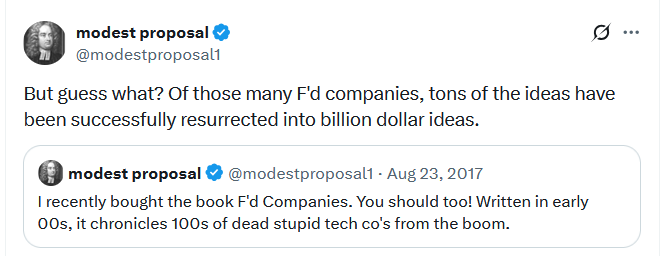
The Techno-Humanist Manifesto, Chapter 9: The Spirit We Lost, part 1 The 19th century enthusiastically celebrated inventive and industrial achievements: with parades and fireworks, in speeches and advertisements, in art and poetry, in World's Fairs https://t.co/hih58uERKn https://t.co/BZEWca7dEo <!-- The syndication API clipped this at ~298 chars ("in World's Fairs"). Full text recovered 2026-09-15 from the rendered post in Kyle's logged-in x.com session — the rendered post ends at "in World's Fairs" too, so this IS the whole tweet; the apparent truncation is the author's own style. t.co resolved: https://t.co/hih58uERKn -> https://newsletter.rootsofprogress.org/p/the-spirit-we-lost-part-1 https://t.co/BZEWca7dEo -> this tweet's own attached image (saved in media: above) -->
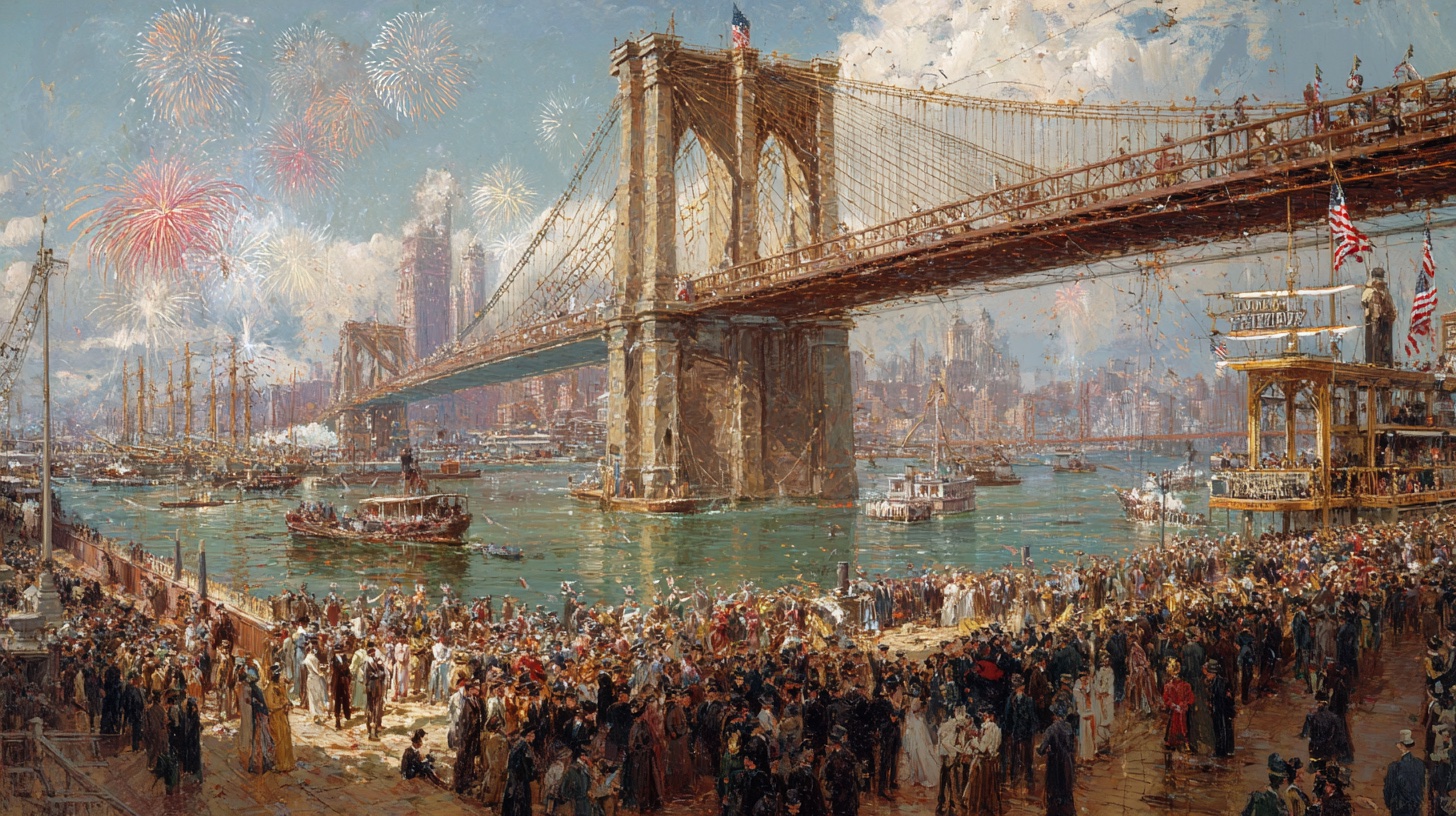
paradoxically, the most inspiring ideas I've found for the future are in old blogs, old books, old papers — the greatest source of ideas stems inevitably from the oldest old, nature itself.
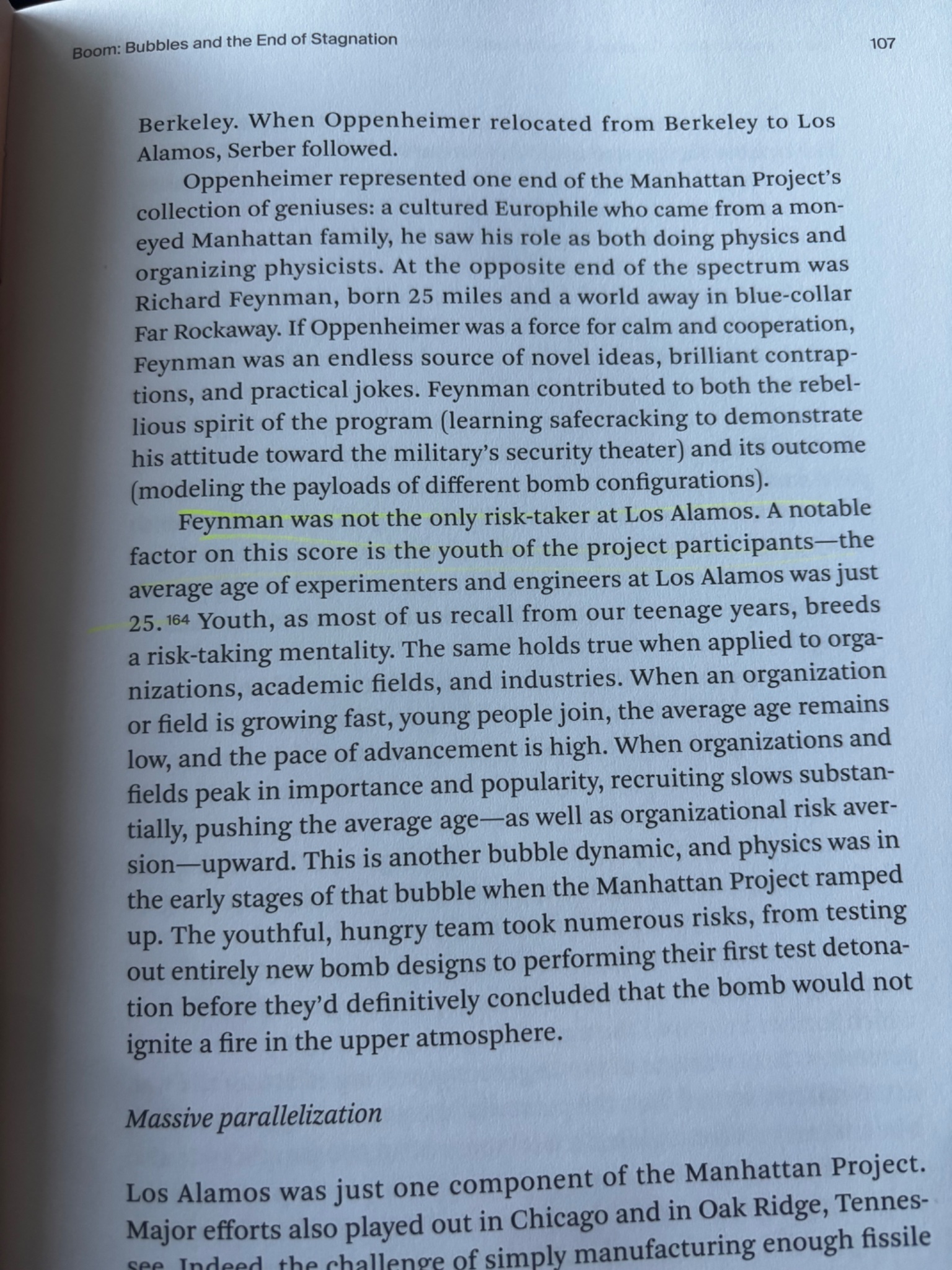
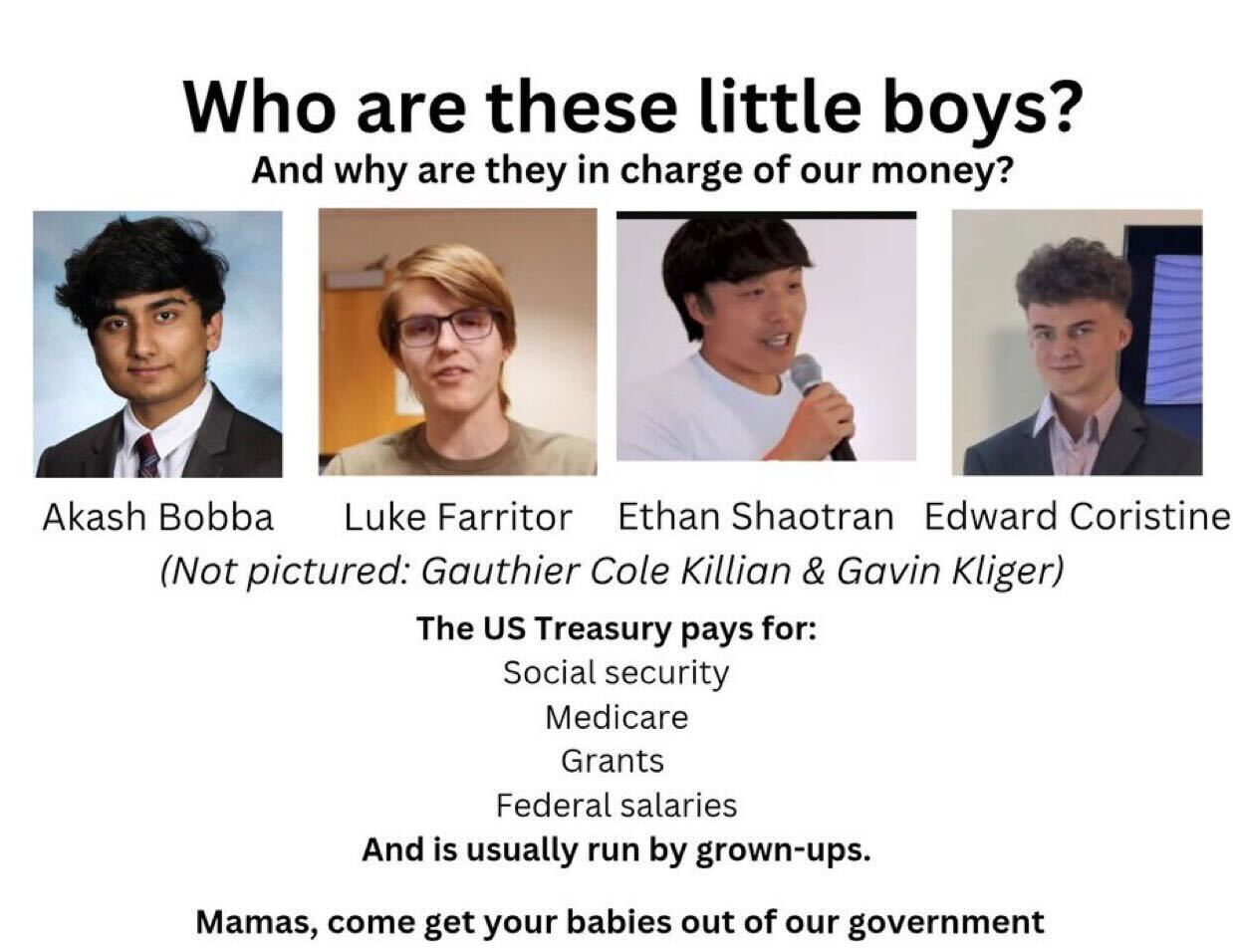
2025-03-31Average age of engineers and scientists in the Manhattan Project was 25. Our current gerontocracy is ahistorical. Perhaps one reason startups work so well is they are one of the few places that still let young people exert agency. https://t.co/xxA8IohGh3 **Quoting @eglyman:** > Fact: The avg age of NASA’s mission control team during the Apollo era was 27— they put humans on the moon. Young people bring a force of curiosity and creativity that can disrupt the status quo. If we’re serious about cutting waste in gov spending, let’s not turn away new minds https://t.co/C1LzvbNqSV
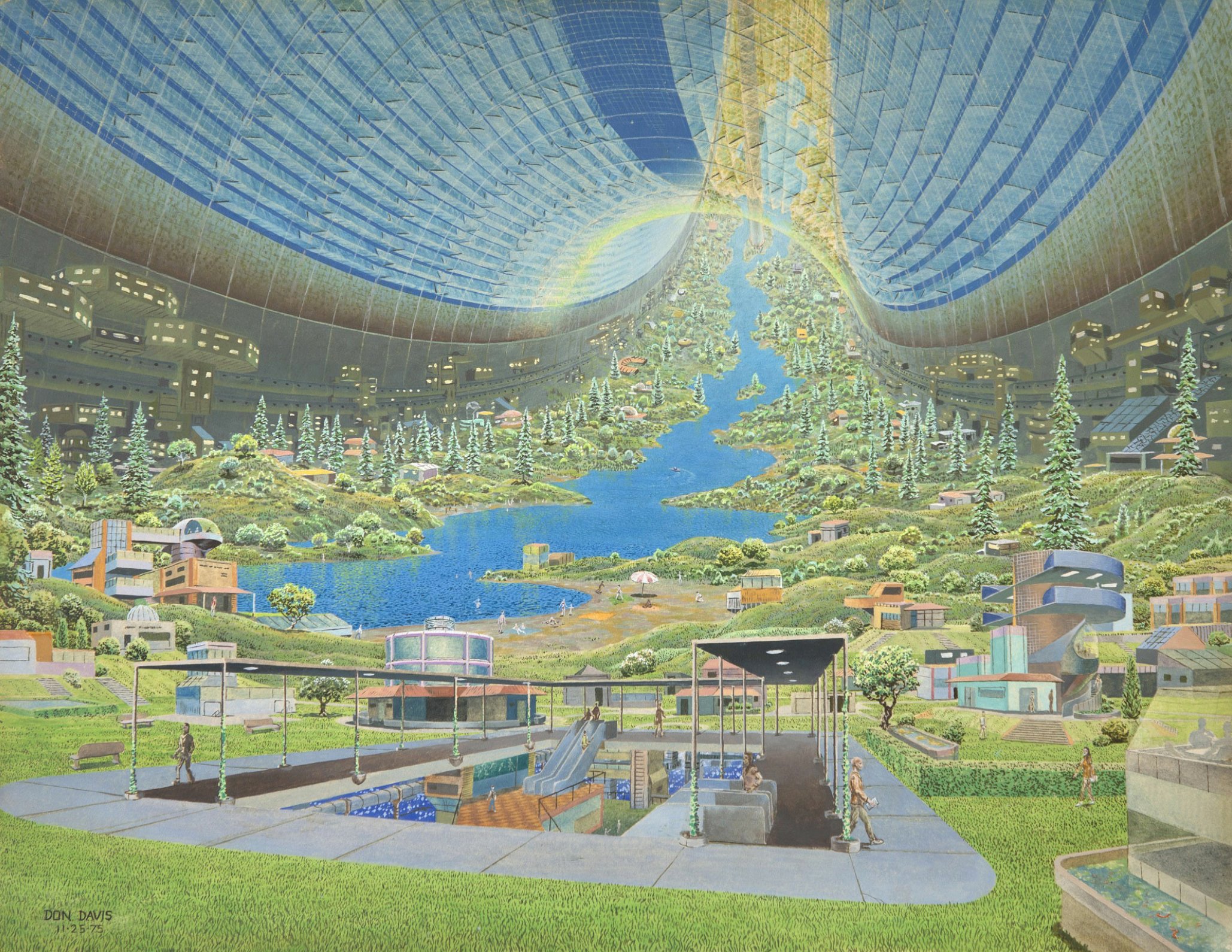
I just saw a ton of original paintings of the iconic retro-futuristic utopian architecture that's been revitalized by e/acc . If you're in NYC between now and late January there's an incredible exhibition at the MOMA and a beautiful looking book as well. Don't miss it, "Emerging Ecologies. Architecture and the Rise of Environmentalism" link for more info https://t.co/kqN60ybUp7 and the book https://t.co/PnqPGGc0Oy

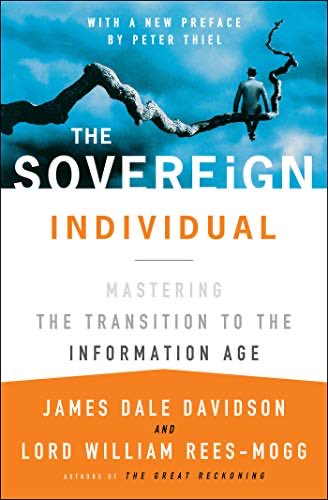
Worth rereading The Sovereign Individual now that we are full force in the era in which they predicted an individual can be, for example, a major geopolitical actor.
Sci-fi frontruns tech. I asked ChatGPT to give me the earliest sci-fi appearance of the tech behind a bunch of the most valuable public and private tech companies. It's not perfect, but impressive that it gets this close. What are other examples / better examples for these?
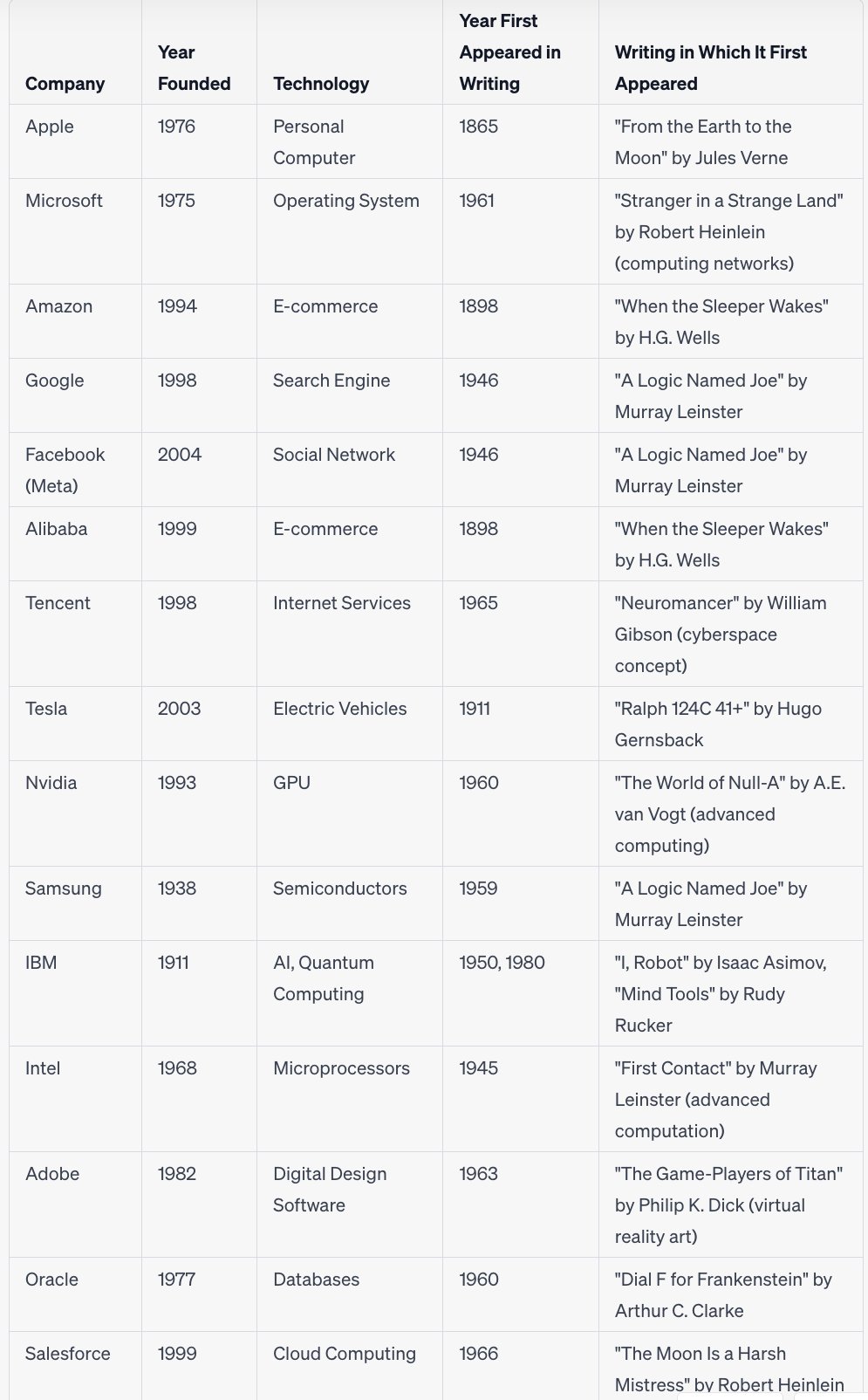
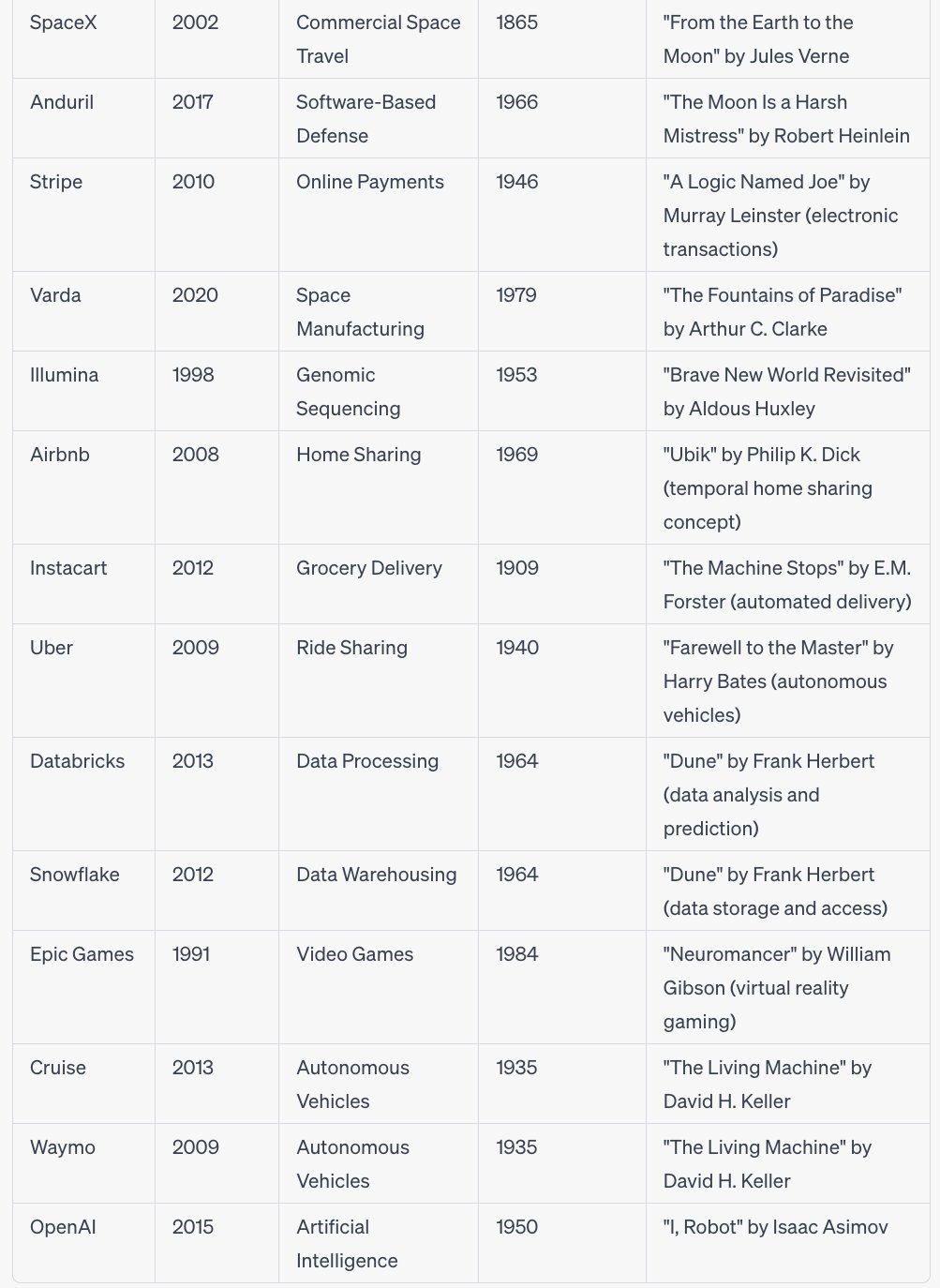
"I consider the obsession with AGI to be a narcissistic human tendency to view ourselves as the gold standard." https://t.co/mOQe6haX3Z
Aug 8, 2023New podcast: Low Expectations. Imagine the tragedy of experiencing unbelievable progress throughout your life and you enjoy none of it because you expected all of it. Apple: https://podcasts.apple.com/us/podcast/the-morgan-housel-podcast/id1675310669 Spotify: https://open.spotify.com/episode/3qajq3GFyLcsyYlcUSB7Q9 <!-- Links resolved: https://t.co/hIBp5e021Y → https://podcasts.apple.com/us/podcast/the-morgan-housel-podcast/id1675310669; https://t.co/sqjyqKU9GI → https://open.spotify.com/episode/3qajq3GFyLcsyYlcUSB7Q9. -->
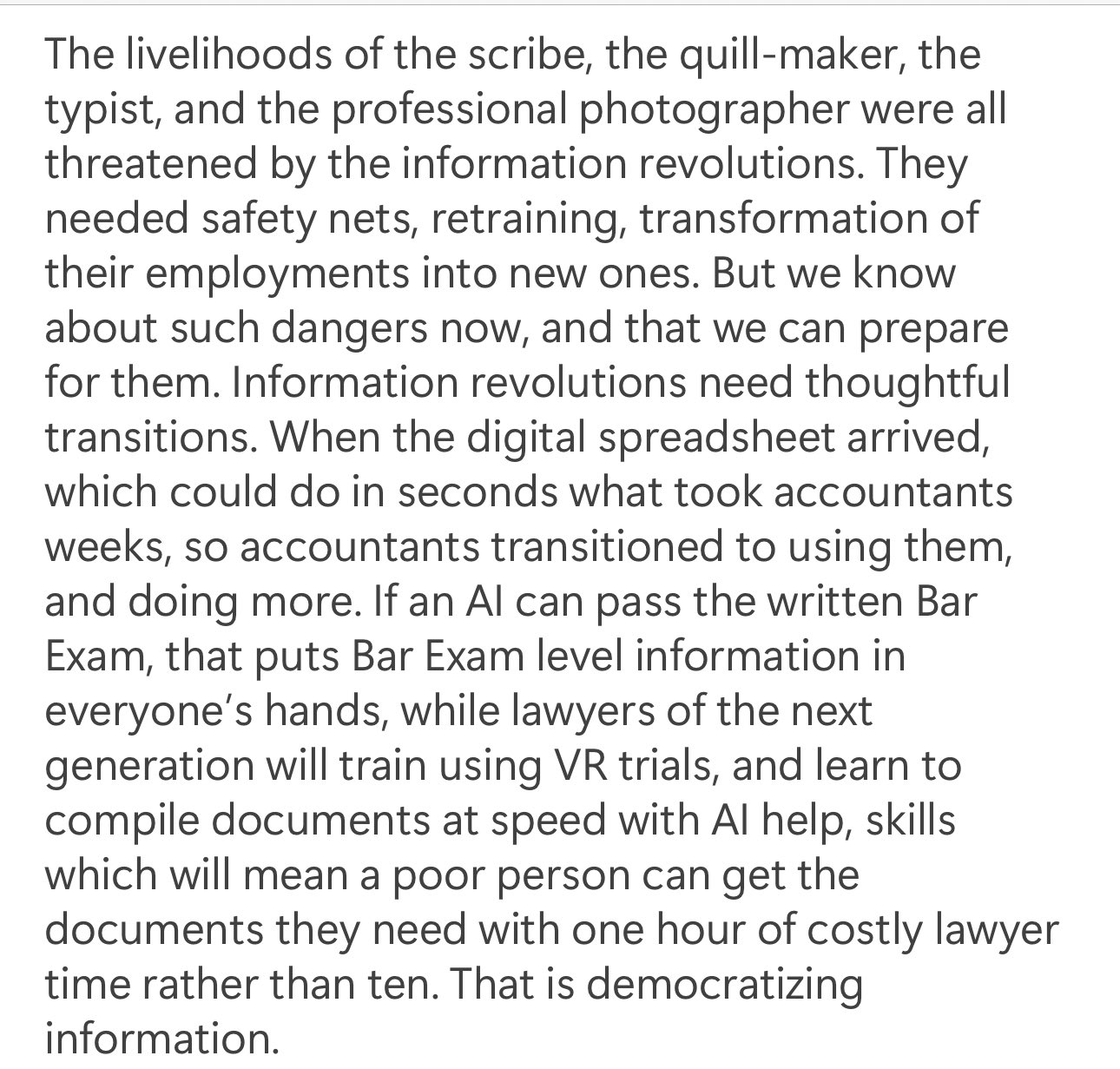
Jun 19, 2023Great essay placing AI in historical context from someone who should know: history professor & award-winning science fiction author @Ada_Palmer “Knowledge empowers; experience empowers; expression empowers; each of these twenty generations has been more powerful than the last.” https://t.co/irOesTUX0y **Links in the tweet** (resolved 2026-09-29): - `https://t.co/irOesTUX0y` → https://twitter.com/emollick/status/1663769483280896003/photo/1 (the tweet's own attached media)
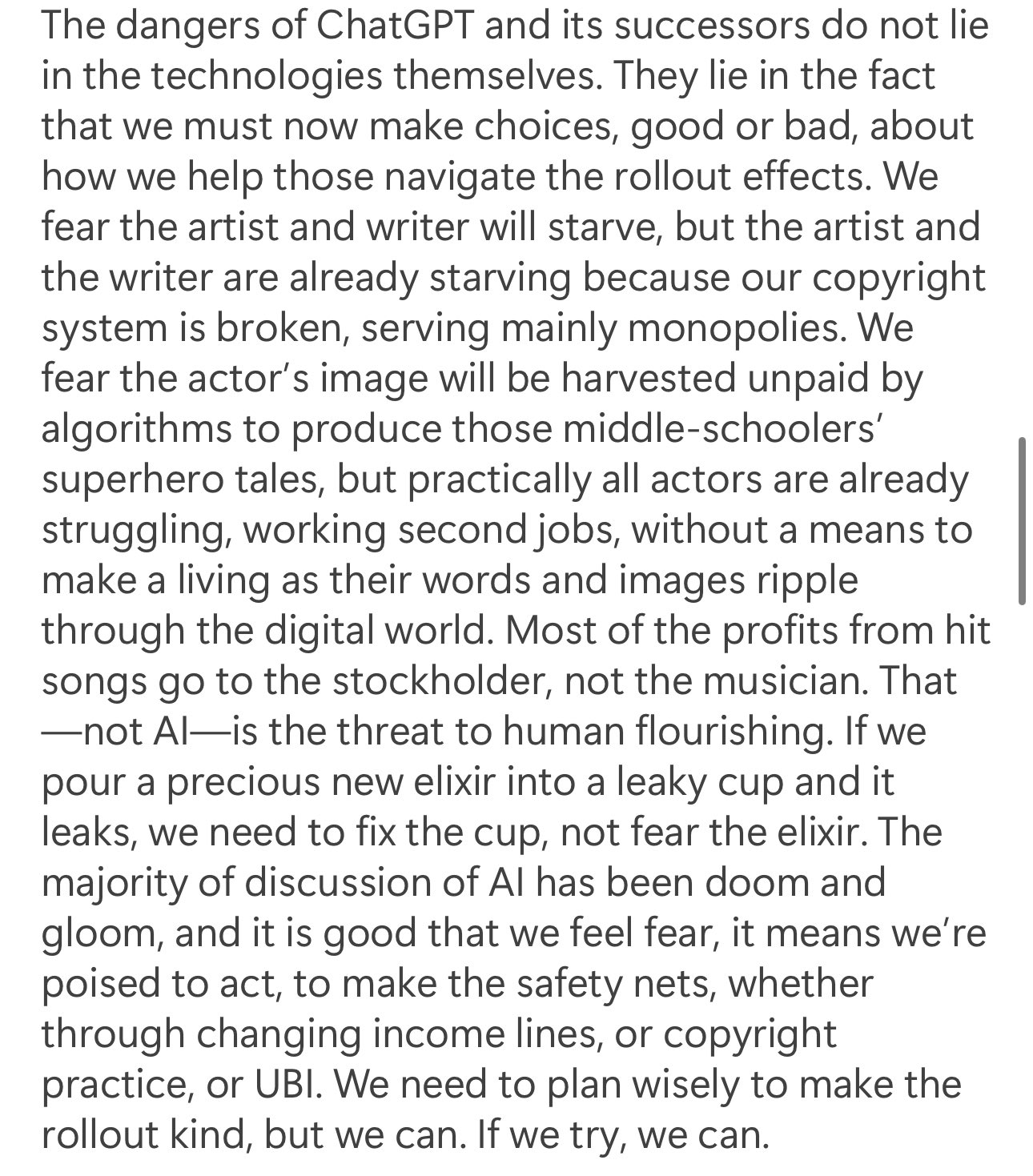
In 1920, this historian managed to predict World War II step by step! He called out the Anschluss and the Molotov-Ribbentrop pact included, by reading maps and history books Buckle up, in this 🧵 we will explore the most prophetic book ever written in history After WW1, Germany was amputated of 13% of its territory and 10% of its population by the treaty of Versailles The Rhineland was demilitarized, the Saar coalfields given to France, the German army reduced to 100 000 and its fleet to 6 battleships (and no submarines) In 1920, a then obscure British economist published "The Economic Consequences of Peace" He predicted that this harsh « Carthaginian peace » would ultimately collapse Europe’s economic model He argued that the allies need to help, not punish, Germany The author is John Maynard Keynes, one of the greatest economic thinkers and his book continues to shape the way we think of Versailles and post-war treaties. His book is often hailed as one of the most prescient forecast of the economics and politics of interwar Europe. In comes... Jacques Bainville, a respected French historian who thinks Keynes is totally missing the bigger picture Politics trump economics, especially with Versailles To make that very clear, he calls his pamphlet the *Political* Consequences of Peace For Bainville Versailles is "a peace that is too soft for its hardness, and too hard for its softness." It does humiliate Germany, but crucially it doesn't seriously weaken it. Germany remains Europe's demographic giant. Worse still, Germany remains united His main thesis is that Versailles is a moral and economic treaty, not a political treaty. As a result "Germany is unified in contrast to a fragmented Europe. That’s the mother of all troubles. Bainville is voicing long-established foreign policy thinking in France: for centuries France had kept Germany divided into a myriad of micro entities. As François Mauriac would write during the Cold War "I love Germany so much I'm glad there are 2 of them" The 30 year war is a good example of this strategy. France joined the largely protestant anti-Habsburg coalition, limiting the Habsburg's influence in Germany By the way I did a thread on the crazy logistics of this war that you should check out: https://t.co/GMdXGp4YdD It took Germany a century to recover from the demographic disaster that was the 30 year war. In the mean time France was the clear demographic powerhouse of Europe with weak neighbors on its eastern border. Here's the population map of Europe in 1789 But the French slipped up in the 1800s. Prussian chancellor Bismarck brilliantly managed to prey on an isolated Austria to take the south of Germany in 1866 Napoleon the 3rd stood on the sidelines. Perhaps the most consequential foreign policy decision in french history... 4 years later the Prussian war machine turned its eyes on France. Bismarck brilliantly isolated France from the rest of Europe. Prussia crushed the French army, occupied Alsace-Lorraine occupied and crowned The Prussian king Kaiser of a united Germany in… Versailles! So when Bainville is writing his book, Germany has only been united for 80 years. He argues that the humiliation of Versailles should have been shouldered by Prussia, not by the whole of Germany Instead it will create finalise German unity through this shared humiliation Famously post 1918 Germany became a massively violent political battleground with communist and fascist militias battling it out in the streets. Aborted revolutions and failed coups nearly toppled the Weimar Republic Here are some scarily accurate predictions from Bainville: On the demobilized war veterans in a chaotic political context he says: "Perhaps new forms of militarism are being born [in the debris of the imperial army]. The only thing missing is the opportunity and the man who will set this militarism in motion." Bainville fears that the Germans will be "chained to the same ball, with only one government, perhaps tomorrow one leader, to train them to break their chain." He wanted instead a broken up Germany in regional entities, with their own armies and Princes. Something that was in the air until the communist threat waved it away. The allies, even the staunch anti-German Clemenceau, always treated German unity as a fait accompli. But what makes the treaty of Versailles especially stupid for Bainville, is the larger European geopolitical context in which a humiliated Germany finds itself: Namely that Germany is surrounded by dwarves Throughout the 19th century, great powers were constrained by a complex balance of power Players of the diplomacy game know this tension well But in the post-1918 world, and with the dismantling of Austria-Hungary, Germany had no one to check its ambitions in Central Europe Germany is surrounded by weak new entities: Poland, Czechoslovakia, Austria. Many of whom have inherited chunks of Imperial Germany. Easy prey for German revanchism Reading these new maps, Bainville predicts everything: Anschluss, Sudetenland, Ribbentrop pact included The 1st humiliation? Separating East Prussia from the rest of Germany at the benefit of Poland, which has a 1/3 of Germany’s population Bainville writes ‘Germany just has to stretch its claws to reunite this island. Herein are written the misfortunes of Poland and Europe' Worse still, Bainville predicts that, as it has happen many times throughout history, Germany and Russia will « marry through Poland » Germans and Russians are complementary he argues: « Poland seems to have been invented to hasten a rapprochement » Bainville just casually predicted the invasion of Poland in 1939 and the Molotov Ribbentrop pact 20 years before they happened! While he predicts that Poland would fight to the death with Germany, what about the new Czechoslovak state to its east? With 3 million Germans in Bohemia , war would be suicide. As a result he predicts its « submission » to Germany. In effect, the Czechoslovaks have little choice but to submit. Hitler gets the Sudetenland with its strong German contingent in 1936 at the Munich conference before annexing the whole of Czechia. On Austria, let me quote him directly: "Further south, it's worse. Here is Austria, an authentic piece of Germany. It alone is detached from the German unity. As long as one wanted to create an independent Austria, there had to be other independent parts of Germany as well. " "Too great a temptation for Germany to reincorporate the Austrian countries into the German homeland. Too great a temptation for the state of Vienna to join a vast and powerful community." The peaceful Anschluss proved him completely right. In conclusion: "Poland, Czechoslovakia, Austria assumed, in order to last, that there not be a great Germany next to them." "The authors of the peace treaty had never considered these questions of balance. The Treaty of Versailles is not a political treaty." What about France? Can it be the necessary counterweight? With a population of 40M it is well behind the 60M-strong Germany. Worse still, France was left alone (with Belgium) to check Germany. The Anglo-Americans were wary of French revanchism and unwilling to escalate The Keynesian narrative has made French demands for reparations sound like rabid anti-Germanism But France’s northeast, the industrial heart of the country, had been ravaged by World War I. Germany’s industrial heartland in contrast had been relatively spared. The fundamental question is how can France alone check a Germany with a cause for revenge? As Bainville writes « How can 40 million French people be creditors to a mass of 60 million Germans for over a generation? » To sum it up here is Bainville casually predicting 1939-1940: "The example of August 1920 (when the USSR invaded Poland) shows us that Poland, attacked by Russia, with a hostile Germany at its back found no support among its neighbors. We had to come to its aid." « It would be exactly the same exactly the same if Poland were one day attacked by the Germans, Russia being ready to take advantage of her disaster and stab her from behind. » « The march of Germany is indicated. It is through the East that she will begin its liberation and its revenge. If we do not deliberately intervene on the day she tries to reconstitute her eastern frontier, then, a year, 10 years or 20 years later, the danger will be ours. » I'm only scratching the surface here, there is so much brilliant analysis on the contradictions of Versailles, on Scandinavia's desire to exit history... He has exotic ideas too, like an alternative Austrian empire with Poland (an idea also defended by Emperor Charles) At times it feels like he time traveled to make his predictions. It’s a model for any political analyst on the importance of history and geography in forecasting the future. He died in 1936 before he could see his fears become reality. Pdf of the book available here: https://t.co/NJRHjTujwm You can read this thread in a more reader friendly format on my @memodapp account: https://t.co/ZGr2JFTPBl I hope you enjoyed this thread! If you want more thread on history and maps, you're in luck I wrote many many more compiled here: https://t.co/f50BkJdaB2 If you liked the thread, you might want to give a listen to @UnDecencyPod, a podcast I run on European affairs where we talk a fair bit about history. Here's a good one on the legacy of the Habsburgs in Europe https://t.co/n0H5S2eEKp
What’s the “hardest” sci fi book you can think of that’s set in the very far future? Ie. The most technologically, socially and economically plausible description of society in humanities far future. Kind of weird that there aren’t a lot of choices. A deepness in the sky, by Vernor Vinge is probably the closest I can think of (and it’s pretty amazing) Honorary mention goes to the beginning of The Expanse. The memory of Earth/homecoming series technically fits the bill i guess but is aggressively mediocre But really the scarcity of these stories really illustrates that not only is it hard to make predictions about the far future but it’s hard to find any secnario at all that’s even plausible Looking in particular for societies that seem plausible economically; most far fiction sci fi worlds have low hanging fruit that could 100x world GDP that no one seems interested in, but people somehow still live in relative poverty. Fine fine I’ll read Diaspora I haven’t read some of the suggestions that people are throwing out there, but some of the more frequent suggestions are just incorrect! Deaths end is a fun read but if you think it’s a plausible future I’ve got a solar system to sell you!
Jan 26, 2023Announcing Story Summit hosted by sci fi author Ken Liu @kyliu99 at @fiftyyears! Founders will come together to communicate the futures they see in three immersive days of writing. At the end, we'll compile the stories into a book, creating myth of this moment. https://t.co/fFtKrfSv3K Find details and apply here: https://t.co/e3sx2xw411
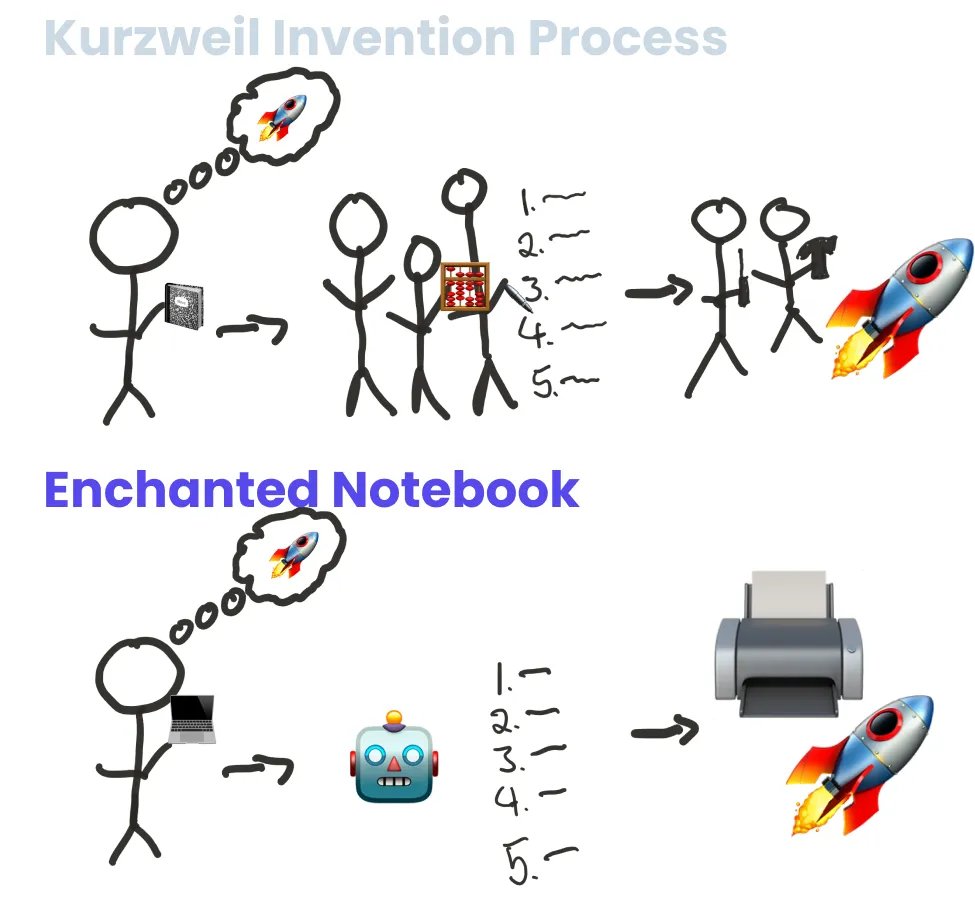
On Lex Fridman, Ray Kurzweil laid out a process for inventing & predicting the future. 1. Write a speech about the world you want to exist. 2. Reverse engineer the steps to get there. 3. Execute those steps. Imagining is half the battle, and AI might help shrink the other half. Here's the text of the conversation between @lexfridman and Ray Kurzweil -- which I transcribed by hand like an idiot before seeing @jeffistyping's Youtube Whisperer -- and the link to the full episode. https://t.co/Viv7RG4171 Kurzweil's process is reminiscent of Amazon's Future Press Release, which former exec John Rossman broke down into four rules: Kurzweil's process, and optimism about the pace of AI, got me wondering how long it will be before we can just write the future speech and run it through some future @OpenAI model to fill in the required details. @amasad's tweet is relevant here: https://t.co/8yiLN7QxGb We're in an AI Hype Cycle, as @alexandr_wang pointed out. https://t.co/zizJUA6PHb @mhdempsey calls it the Curiosity Phase. https://t.co/6RYIiryS9F So caveats here that going from futuristic speech to instruction set is probably a while out. But Kurzweil has a great quote that helps explain hype cycles in his 2001 essay The Law of Accelerating Returns: https://t.co/4IifGL2VTQ And it feels like we're on a steeper part of the curve right now. Last Monday, I wrote, "We’re one small leap – some enterprising young coder hooking Stable Diffusion up to a voice input – from being able to speak words to conjure magic, incantation brought to reality.” On Wednesday, @OpenAI released and open sourced Whisper, bringing incantation one step closer. I know that I didn’t write it into reality, but it certainly felt like it. https://t.co/qZW0wini8l Whether the Enchanted Notebook -- make something real by writing it -- is two months away or two decades, a good proximate next step on any timeline is for more people to paint rich, detailed visions of the future that they want to see come true. I'm having a lot of fun dreaming up possibilities. I wrote about Kurzweil, his process, exponential curves, hype cycles, imagination, and how AI might shrink the gap between dreams and reality by filling in the steps in this week's Not Boring: https://t.co/uawAbcxg3P
Why do empires fall? 6 Main resources according to @RayDalio I think he's missing the 7th... lack of trust in our key institutions. When I did business in Argentina pre-crisis and Venezuela pre-crisis I was handed this book. And they were exactly right on when a nation would implode. It's not a quick read, but it's worth it.
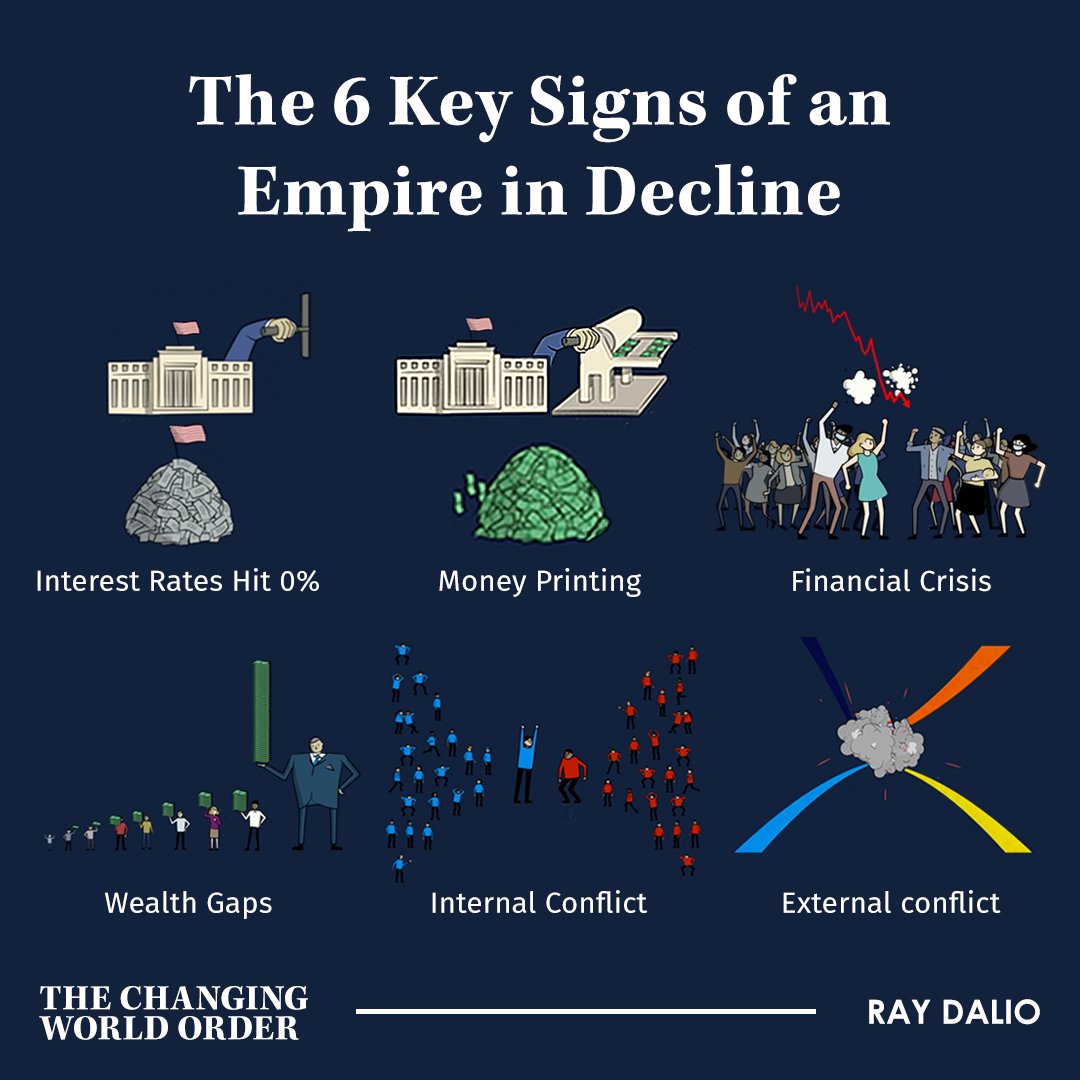
The core primitive of intelligence appears to be predictions. This book makes a good case for it https://t.co/KqhAbqAiXT And the unreasonable effectiveness of transformer models in recent years seem to validate it.
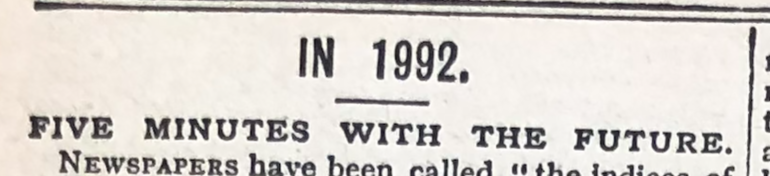
Jul 4, 2022In 1892, Answers magazine published an article predicting what the news would be like in a hundred years's time. Let's see how the Victorians imagined the 90s... Thread 👇👇👇 Firstly, they accurately predicted the arrival of broadcast news! Or, at least, that it would be 'read out' to audiences thanks to the perfection of Edison's phonograph. /2 Their prediction about commercially saleable weather is perhaps still a *bit* sci-fi, but they were right about Britain adopting the decimal system. For now, at least. 🙄 /3 English, they predicted, would become the universal language of Europe. /4
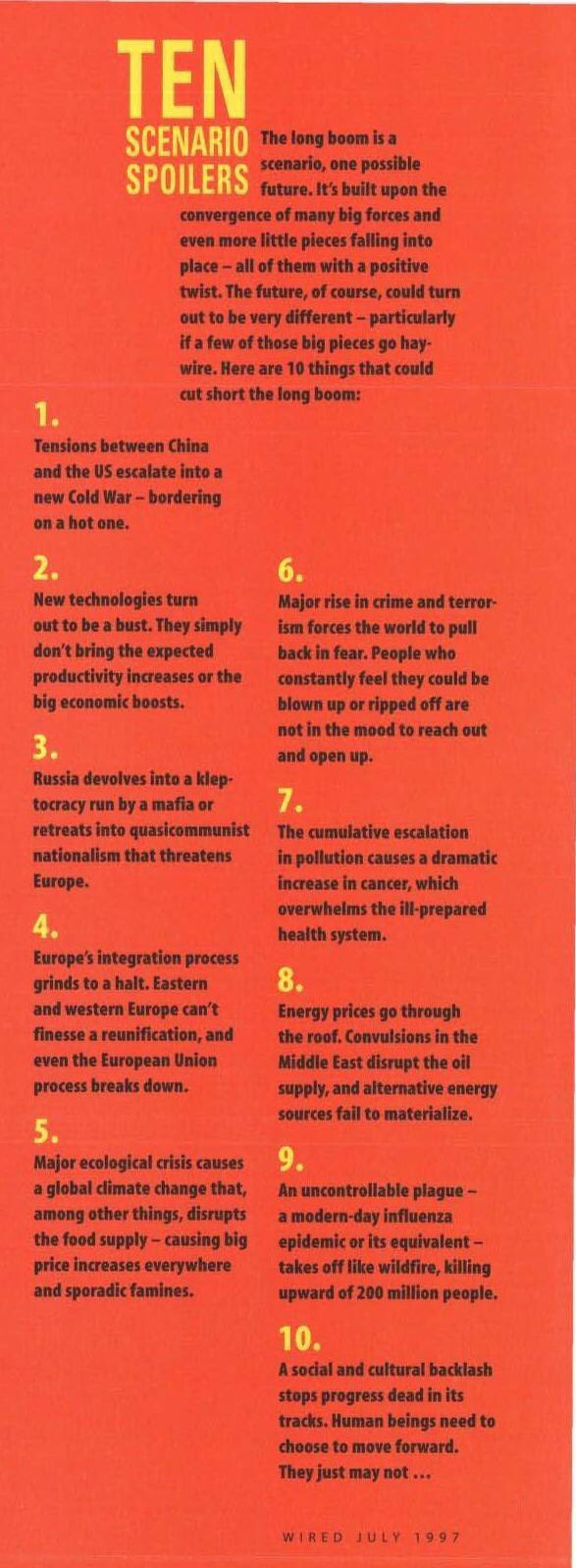
Saved Photo Wired, July ‘97, deep in the Long Boom futurology boom. Perversely pessimistic at the time.
Come chat with novelist @eliotpeper to discuss his new novel Reap3r and theories of technological progress and historical change. What did speculative fiction of the last century say about what was hoped for in this century? https://t.co/sYgV3KOWOA
May 18, 2022Which 90s movie was prescient/under-rated but now a good predictor of what happened? For me I think of the Will Smith/Gene Hackman "Enemy of the State"
Mar 26, 2022 Original deleted — preserved hereIn 2007 analysts predicted that Amazon would have between $27 billion and $37 billion in revenue in 2020. What was Amazon's actual revenue in 2020? $386 billion 🤯 My latest on upside surprises and why they happen more often than we realize: https://t.co/cRkTpsgNb1 Huge props to @AlbertBridgeCap for inspiring this piece
Mar 22, 2022I'm reading a pretty crazy book right now. It was written in 1997 and predicted: - Digital currency - Metaverse - Rise of e-commerce - Remote work - Rising income inequality - Value of curation - Virtual culture - Internet via mobile - Digital banking - Filter bubbles if you've read it, you know exactly what book i'm talking about It's called "The Sovereign Individual" if anyone wants to read it! First heard about it from @balajis & @naval Now it's my book club's first book!
Jan 3, 20222 beliefs I have -things go in 10-15yr cycles & every 10yrs or so, new comps fight way next to or replace old guard -about every 20yrs big ones get replaced in standings Which of the '21 list won't/will be there in '41? mine won't be top 10: GOOG & TSLA will be: AAPL & MSFT https://t.co/XIKWHA6zPQ
Jan 2, 2022 Original deleted — preserved hereAncient Rome had ancient history museums, yet there is no Medieval SciFi. When did the future start, and why did it take so long?
Dec 11, 2021We've all read Sapiens, right? If you want to dive deeper and learn more about history, here's a list of 29 incredible books about the past. The first one is required reading IMO. Big history guy over here! THREAD: Make sure you make it to the end of this list. You'll find a link to yesterday's thread of 43 biographies to make your reading queue even more overwhelming. 🙃 You'll also find a little more about me for better or for worse! Anyway, let's go- The Lessons of History A journey through history, exploring the possibilities and limitations of humanity over time https://t.co/zzky7rfddJ Sapiens A Brief History of Humankind (If you haven't read it, this is more broad strokes before we get into some deep dives) https://t.co/X8LBAC302G Over The Edge of The World Magellan's Terrifying Circumnavigation of the Globe https://t.co/Qp1UpgfBH6 The Verge Reformation, Renaissance, and Forty Years that Shook the World https://t.co/61BxaRzjpt The Woman Who Would Be King Hatshepsut's Rise to Power in Ancient Egypt https://t.co/XS5J7YRd8F Alexander the Great Tough, resolute, fearless, Alexander was a born warrior and ruler of passionate ambition who understood the intense adventure of conquest and of the unknown https://t.co/NgyWm3x01V African Samarai The remarkable life of history’s first foreign-born samurai and his astonishing journey from Northeast Africa to the heights of Japanese society. https://t.co/xNC8nIqFLT Sugar : The World Corrupted From Slavery to Obesity https://t.co/OzhkSct1Xu Undaunted Courage Meriwether Lewis, Thomas Jefferson, and the Opening of the American West https://t.co/hYiZeamheS Empire of the Summer Moon Quanah Parker and the Rise and Fall of the Comanches, the Most Powerful Indian Tribe in American History https://t.co/6L9T6eAMDF Cyropaedia The Education of Cyrus https://t.co/R3i2P2RI33 Lost Victories The War Memoirs of Hitler's Most Brilliant General https://t.co/gc6ZWi9gYH Genghis Khan and the Making of the Modern World The Mongol army led by Genghis Khan subjugated more lands and people in twenty-five years than the Romans did in four hundred. https://t.co/37jn30QTUd The Swerve How the World Became Modern https://t.co/LGJ6PiYmvk The Lost History of Christianity The Thousand-Year Golden Age of the Church in the Middle East, Africa, and Asia--and How It Died https://t.co/X25IFuEHqd The Story of Civilization (4 book series) The Story of Civilization reflects a new emphasis in presenting the history of the world as a thrilling and compelling narrative. https://t.co/eUsOjWYzci Caesar Life of a Colossus https://t.co/iCigx43MRA The Last Kings of Shanghai The Rival Jewish Dynasties That Helped Create Modern China https://t.co/gekw6dyIK6 The Rise and Fall of the Third Reich A History of Nazi Germany https://t.co/Lk1F8dk8wY SPQR A History of Ancient Rome https://t.co/WQ3tnoA7qc Collapse How Societies Choose to Fail or Succeed https://t.co/yP0xJOnHTz Catherine the Great Portrait of a Woman https://t.co/H6Xims9xLx The British Are Coming The War for America, Lexington to Princeton, 1775-1777 https://t.co/Jhri5favs8 1776 America and Britain at War https://t.co/1qZ7zV0e7p Memoirs of Hadrian FSG Classics https://t.co/kqJsv0t8vZ Leonardo da Vinci Biography of Leonardo da Vinci https://t.co/0qYYoPUQ8E The Ascent of Money A Financial History of the World https://t.co/pgx4CRXPHr The Invention of Nature Alexander von Humboldt's New World https://t.co/PYGLtqZsD0 Cleopatra A Life https://t.co/en36M0YvvC 1491 New Revelations of the Americas Before Columbus https://t.co/BQ9gJrzhwu Whew! That's the list. My name is Colin. I'm a serial entrepreneur and CTO of a publicly traded cannabis company. I tweet about building brands, business, and learning things... like history! Gimme a follow > @landforce < and check my pinned thread for more about me. ICYMI, here's yesterdays thread of some amazing biographies: https://t.co/kAbtf84FXq
Sep 5, 2021In college I changed majors and joined 2 year service-learning program just to get into a class called “The Good Society” Had realized I didn’t have any concrete picture of a world I wanted to live in. The reading list was quite good. But before I share... what would you pick? https://t.co/r6VYT2VQwy
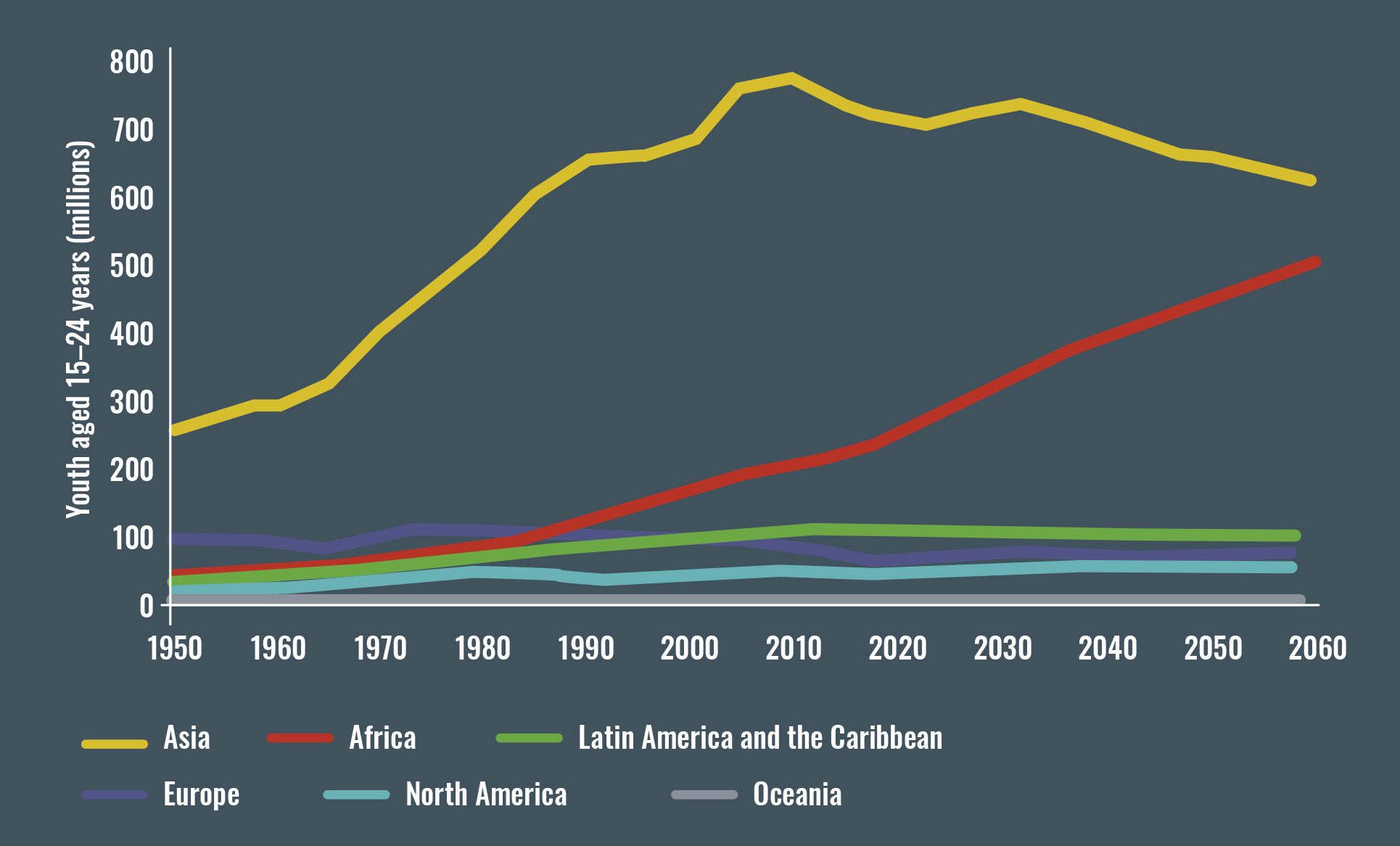
Jun 8, 2021Africa has been consistently deprioritized in global significance. In the next few decades no one will be able to ignore it. https://t.co/xLqLTsd5Ha https://t.co/TRN0ZP4jWE

Prediction #1: As the need for consoles dwindles & gaming goes mainstream, we'll see Netflix move into the gaming space, offering cloud-based streaming of key titles (based on pillar partnerships), as well as their continued push to create content from gaming IP. Prediction #2: As fan fiction rises (Wattpad, Lego Worldbuilder) & fan communities create their own content (NoPixel 3.0 GTA RP) we'll also see Netflix move into UGC & 'modded' or self directed storytelling content You'll be able to watch other peoples interpretations of titles Prediction #3: Netflix may allow creators to leverage their platform to host their own content (spin off space?) + additive monetisation - i.e. pay a fee on top of your Netflix subscription for your fave creators shows Spotify are looking to trial this for podcasts, sub + fee Of course, none of this may happen, but I'm optimistic. And it's fun to think through the possibilities, based on the convergence of trends in this space.
Feb 7, 2021 Original deleted — preserved hereI believe we’re going through a shift in the way institutions and individuals relate that will change everything. I want help understanding, so I’m starting a book club. Clubhouse convos, shared Roam graph, etc. Book 1 is Revolt of the Public. Sign up: https://t.co/76V9T8To3d
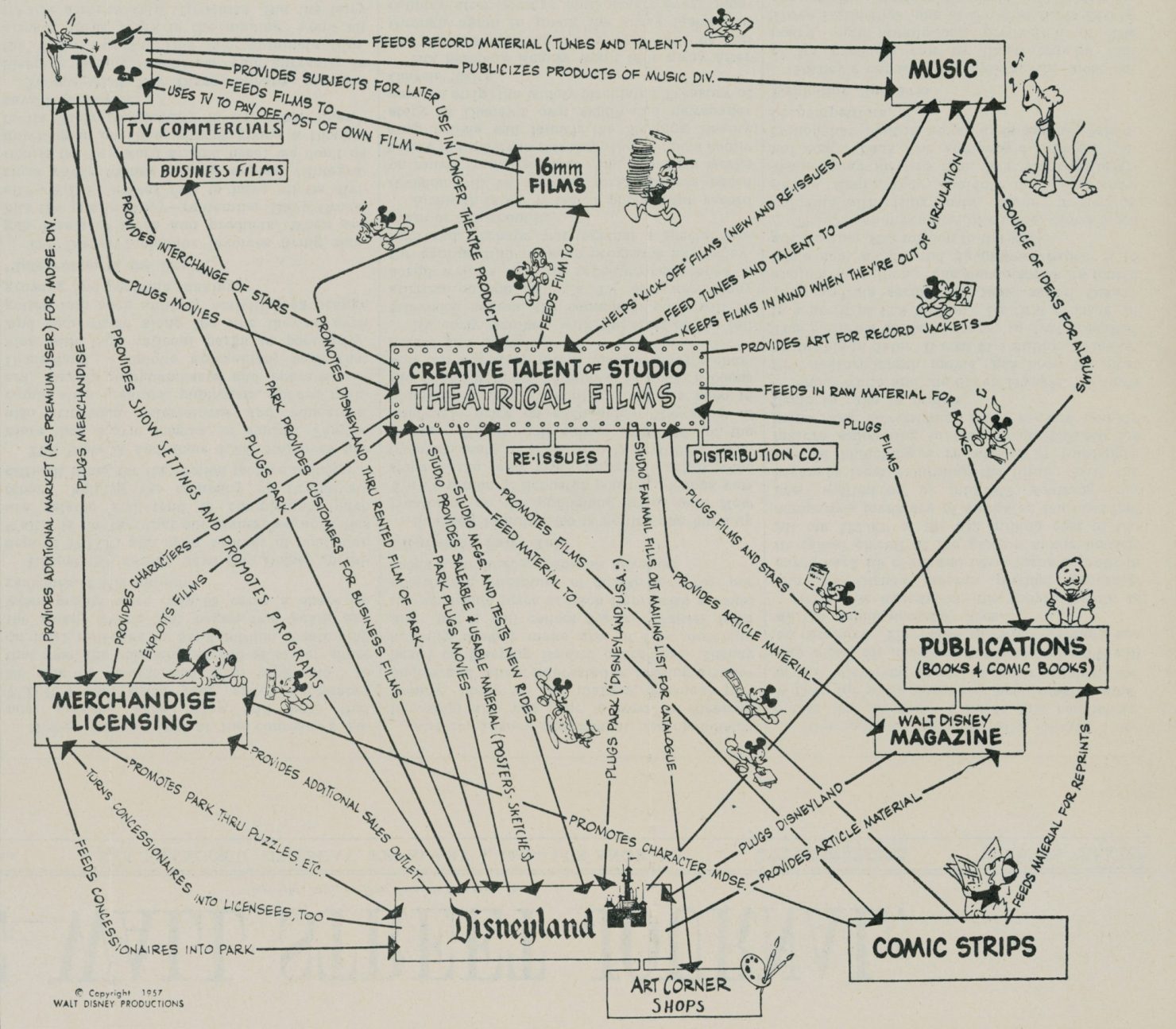
Jan 28, 2021Walt Disney drew the media empire was trying to build. In 1957. It's amazing. Drawing out the connections of systems is a powerful clear thinking exercise. (H/T @web) https://t.co/nMwVjXXF3W
1/ Recently finished "Where’s my Flying Car - A memoir of Futures Past" by J Storrs Hall. It's simultaneously extremely critical of the state of atom-based technology and presents a precise and aggressively optimistic vision of possible futures. BOOK REPORT THREAD 🧵 2/ The core of the book is the question "Why didn't the future that people expected in the 50's come to pass and how could we get back on track?" This question is not new, but Hall's approach is the most precise and brutal treatment I've seen. https://t.co/y3Y33vTAzo 3/ The optimistic science fiction of the past reflected an actual conviction that these things would be possible. Contrast to modern optimistic visions of the future that are tinged with "It would be cool if that happens ... but it probably won't" https://t.co/C7dgMyYtl4 4/ A core theme of the book is the coupling between how much energy we can harness, atom-based technology, and how we deviated from an exponentially increasing curve in energy use in the 1970's. https://t.co/C5UnK01EYQ 5/ The coupling between energy+power and technological paradigm shifts is surprisingly tight. There are a massive number of things where the key technical constraint is cheaper and denser energy that we've just stopped thinking about. https://t.co/pmRMetI8ul 6/ Hall introduces the concept of the "Machiavelli Effect." It's effectively the known phenomenon of entrenched interests - ties it into Kuhnsian paradigm shifts, and argues that the effect has become much stronger over time. https://t.co/M4RJFr7yrp 7/ Of of the 🧐😮 arguments is that civilian government R&D funding is *anti* correlated with quality-of-life improvements. https://t.co/71I45guSxr 8/ The narrative of paradigmatic lock-in extends to academia thanks to the demand for "novelty." https://t.co/CEkiIG588U 9/ So many good examples of Clarke's Law "When a elder preeminent scientist says that something is impossible, he’s probably wrong. When a elder preeminent scientist says something might be possible, he’s probably right." https://t.co/XWnv6oiQFT 10/ More PhDs and more spending on education probably isn't the solution. https://t.co/m1gEskj1EU 11/ A good point that when people with dim views of the future have *power* bad things happen. https://t.co/kFzdVKVe1X 12/ Dwight Eisenhower was aware of the danger from coupling research to government contracts in the 1960's https://t.co/AzmLWwU2Q8 13/ More arguments that research funding is not strongly correlated to actual awesome stuff https://t.co/lT807tl4Th 14/ Hall pushes into territory that makes 'sober technologists' blush - treating flying cars, cold fusion, and atomically precise manufacturing seriously. I'm not certain he's right on all of it, but it makes you realize how many conversations have been closed, perhaps early. https://t.co/S3HCr8uF5g 15/ A constant theme is that technological futures are shockingly contingent and could have been different. https://t.co/3ujiiogtFF 16/ The leveling off of increasing physical connectivity is another under-talked about stagnation cause. (@elidourado has some great writing on this.) He also touches on the "we're living off of dividends" argument. https://t.co/Uz749yKaC7 17/ Intriguing idea about a coupling between risk aversion and decreasing process knowledge. You tend to be less worried about things if you get how it works. Reminds me of @danwwang's work. https://t.co/5uqyFHQy9l 18/ Regulation explosion as a core stagnation driver is another big theme. This graph demands a strong argument for why an order of magnitude more regulation doesn't matter. https://t.co/uNk2VJBRJ5 19/ It's worth actually reading the law. Unfortunately, we usually just pay someone else to do it. https://t.co/lluTPzpOIV 20/ The effect of these regulations isn't just statistical or theoretical. https://t.co/HnKJkdsBTS 21/ I realize it's purely correlational but this graph is great. (In the 🤦♂️ way) https://t.co/D2B3t91I8M 22/ And this is why better technology doesn't mean you'll win. https://t.co/aZ1R1bjS4y 23/ Arguably, we wouldn't even have normal cars under the current regulatory regime. https://t.co/EUjOUow1cn 24/ Alexis de Tocqueville was basically a prophet. https://t.co/hxBmtkCzPQ 25/ More uncomfortable theories - mutually assured destruction and decreasing political violence decreased the importance of cutting-edge technology. https://t.co/ZULr5pBA0P 26/ The term ergophobia (technically 'fear of work' but meant as 'fear of harnessing more energy') is great. Let's make inefficient new things instead of just more efficient old things. https://t.co/pcJ9dytveO 27/ It might seem germaine but the basis of morality matters. https://t.co/n1futBTqjG 28/ The enlightenment may have sown the seeds of its own destruction https://t.co/wAGNZUjkZI 29/ Carl Sagan ftw. We need to distinguish between what feels good and what’s true. When there is a paper for everything, as is now the case, it allows people to find peer reviewed evidence for any opinion. https://t.co/124G7giu4S 30/ Maybe instead of making predictions, we should talk about possibilities, what assumptions they depend on, and how we can help or hinder them from happening. https://t.co/WIiQHkHt0P 31/ Technological possibility is intimately tied to manufacturing https://t.co/EkmnaZWlMQ 32/ Hans Rosling has a good framework for thinking about wealth in terms of transportation. The last sentence is the gut punch. https://t.co/gZdNhEptal 33/ THE PLEBES! https://t.co/yvedgFlJdO 34/ While it feels a bit romantic (in the not-love-sense) I find the "we need a frontier" argument compelling. https://t.co/i76tjF3fFL 35/ These stats are brutal but it is an interesting point https://t.co/ocxwfjTGkD 36/ Surprise! Energy demand is elastic. But the answer is not “we should use less energy” it’s “make more energy and it leads to a more wonderful world.” https://t.co/togdwXbIVv 37/ A good point about nuance around the term “too cheap to meter” it means simply that a good has zero marginal cost, not that it’s free. Similar to how you still pay for internet access but you no longer worry about how many minutes you used your dial-up modem. https://t.co/tVf0uP5zFu 38/ We need to talk about failure of nerve more https://t.co/XRDR8PIkl8 39/ “It is a possibility!” is a good rallying cry. https://t.co/bDStJvj8pk 40/ The book brutally eviscerates the Low Hanging Fruit theory of stagnation (if you buy its arguments.) https://t.co/84kNwZeaZY 41/ "It's expensive" is not an inherent property of nuclear power. https://t.co/EK9ZmHvZih 42/ Energy is just so freaking clutch https://t.co/HSUsUzyNC1 43/ Another interesting point against the low-hanging fruit theory that nuclear physics isn't as much of a "solved problem" as most people believe. https://t.co/SgyBPY8zIV 44/ Did you know that physics appropriated terms from biology? I didn't. https://t.co/iHQtCCgYCZ 45/ Atomically precise manufacturing is another core technology Hall argues for. While he's optimistic, I appreciate the attention to real technical problems. https://t.co/CCgRonyyl3 46/ Despite the optimism, Hall also paints a picture of a sticky tangle we find ourselves in. https://t.co/tUWnj8Zo5N 47/ All you urbanists are thinking too small. We could build cities that are a single building. It is a possibility. https://t.co/eFajfUo6GO 48/ CONSIDER https://t.co/pXCt5sDF2n 49/ This is a great framing of limiting constraints on transportation https://t.co/QcsINXzWIM 50/ Hall presents a pretty compelling way to think about technological change based on @robinhanson and @kevin2kelly's work. https://t.co/Cg7qmkhwTk 51/ We don't talk about how, while there are a finite number of elements, there are *many* more isotopes, each with different properties. Could we harness them? Maybe not. But it is a possibility. https://t.co/iYbVznQw7n 52/ I'm increasingly convinced that exploitation and understanding of natural phenomena is at the core of all science and technology. Newton agrees with me. https://t.co/kphCZOuwPK 53/ We could build *space piers* that we launch things off of with rail guns. It is a possibility. https://t.co/uCqmP28l3w 54/ Talk about a job for innovative financial structures pulling money from the future… https://t.co/mXTFKPep6N 55/ Of course, space piers probably don't make sense until we're already going to space all the time. https://t.co/7xpoEVvnln 56/ We don't talk about the Kardashev scale enough. https://t.co/YtrSVkjWii https://t.co/gZPwNhlMKI 57/ A sobering bit of fourth-wall breaking. https://t.co/1b8xfSOuRF 58/ Another aggressively anti-Low Hanging Fruit view. https://t.co/bAFtuTXCPO 59/ We don’t talk about the interplay between society and technology enough. Technology affects society directly but society affects the sort of technology that exists mediated by the market, culture, and the government. https://t.co/YkTfmtW0vr 60/ I find the argument that frontiers lead to hard-to-fake feedback loops compelling. https://t.co/JzsprNAtgA 61/ This is a real choice - not just rhetoric. I vehemently yell "no!" but some of you reading this probably disagree with me. https://t.co/V7HNUzztOO 62/ A good framing of the "growth is a moral imperative" argument (also made by @peterthiel and @tylercowen ) https://t.co/3HEpHQPP2v 63/ No additional comment. https://t.co/3AKbeE8WKU 64/ Have hope through the darkness! https://t.co/LlLSWNEsHg end/ If you found that thread intriguing, check out the book. It's only pi dollars (I assume by design) on Amazon. https://t.co/JRGD3ijZOp
Sep 6, 2020ten years ago thiel said higher education was a dangerous bubble, and he was attacked for it by every lapdog twitter personality in tech. today acknowledging the damage student debt has done to young people is table stakes for every serious conversation about college.
May 22, 2020If you're looking for new ideas about the future, I recommend The Sovereign Individual. I've never seen a book with so many correct predictions, and it's inspired a generation of builders, entrepreneurs, and technologists.
Mar 1, 2020