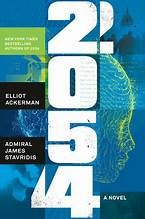
2054
Key Takeaways
Kyle, in 2024 in Books: The sequel to 2034. It was certainly interesting, especially given how much I love Ray Kurzweil. But just like any exercise in forecasting, I think the further you get from the present the harder it is to anchor futuristic science fiction in current existing facts. The same was true here. This was just too far afield for me to get as much out of that felt practical. That being said, it was still plenty enjoyable.
Light-engagement read; no notes to synthesize. The highlights below stand on their own as the source’s argument.
Connections
People: Ray Kurzweil — appears as a character clinging to life at 106 to witness the Singularity, with his book The Singularity Is Near named directly. Alexis de Tocqueville — the novel closes on a quoted line from Democracy in America about the uncertain issue of the struggle.
Concepts: Quantum Computing — the imagined path to a “hard takeoff,” with “bio-integrated quantum computing” the substrate fusing biological and technological evolution.
Books: 2034 — A Novel of the Next World War — direct sequel by the same authors. The Kill Chain, Nuclear War — a Scenario — present-tense defense-scenario cluster.
Highlights
- In America you could forget, and if you could forget you could again be innocent: this was America’s promise,
- Castro’s consolidation of power after his victory in 2044 had led to a decade of single-party rule that he’d codified with sweeping electoral reforms at the federal and state levels, as well as ushering three new states—D.C., Guam, and Puerto Rico—into the Union.
- If molecules really were the new microchips, the promise of remote gene editing was that the body could be manipulated to upgrade itself.
- The objective of the “game,” as Mohammad thought of it, was to arrive at the Singularity first and, with a head start, outpace rivals who would never be able to catch up once biology and technology finally merged; this head start was key, as theorists believed the Singularity would enable what they’d termed an “intelligence explosion,” the equivalent of thousands of years of biological evolution crammed into months or even weeks when machine and human learning integrated into a single consciousness.
- At 106 years old, he clung to life; it was as if da Vinci, who first imagined a flying machine, refused to die until the Wright brothers came on the scene. The difference between a visionary and a theory-peddler was, of course, the future itself and how it manifested. The Singularity, Kurzweil’s famous prediction, had yet to manifest. When biological evolution fused with technological evolution, allowing the human species to accelerate one thousand years of Darwinian progress in intelligence and function into months or even weeks of bio-integrated quantum computing, Kurzweil would want to be there to see it, to be vindicated by it.
- “The key word there is feel,” interjected Hendrickson, hissing the last word. “This younger generation doesn’t believe in facts, but in feelings. If they feel they’re being lied to”—again he spat out what to him seemed an ugly word—“then in their eyes they are being lied to, and so the feeling becomes a fact.”
- “The Singularity,” said B.T. “We may have reached a tipping point.” He explained that much depended on whether there was a hard or soft takeoff. A soft takeoff would lead to an increase in human capacity over time, with gradual technological and biological integration. But a hard takeoff would look very different. The resulting explosion in human intelligence would look like a hockey stick if you were to graph it.
- Politics, like the pandemics of decades past, had become a scourge, one no person or institution could escape. Everyone had to pick a side.
- Lily watched the overhead camera shot. This can only end badly, she thought. Either one of the Secret Service agents would be killed by a Truther or vice versa. How had it come to this? Yes, Truther protests had been roiling the country for weeks; and yes, the leak of Castro’s autopsy on Common Sense exposed a lack of transparency within the Smith administration. But this attack on a presidential motorcade was something different, a far darker escalation. This eruption of violence had been brewing for years, through successive economic collapses, pandemics, and the utter dysfunction that had become American life; really, as Lily thought about it, since all the way back to the war that had claimed her father. If this connection to the war wasn’t evident to anyone watching, one only needed to see the myriad veterans in their old military uniforms woven through the ranks of Truthers. Lily wasn’t unsympathetic to them. They would no longer tolerate being lied to.
- “Truthers … Dreamers … You don’t really buy into that, do you? People talk about the divide in this country as though we were standing on opposite sides of a chasm. When the reality is we’re all standing over the chasm, as if on a bridge. You’re never going to get everyone to cross to one side or the other. Some people can’t accept that. If they can’t get everyone to their side, they’d rather blow up the bridge. Then there’s nothing. Just a void we plunge into.”
- The work of each generation is to keep the species from destroying itself.”
- The Singularity Is Near: When Humans Transcend Biology, was written by Dr. Ray Kurzweil,
- a speech Lincoln gave, more than two decades before the Civil War, in which he’d declared: “All the armies of Europe, Asia and Africa combined, with all the treasure of the earth (our own excepted) in their military chest, with a Bonaparte for a commander, could not, by force, take a drink from the Ohio, or make a track on the Blue Ridge, in a trial of a thousand years… . If destruction be our lot we must ourselves be its author and finisher. As a nation of freemen, we must live through all time or die by suicide.”
- He could barely stomach Hendrickson’s sanctimony. Americans, they were so precious, so self-deluding. Their exceptionalism—if it ever truly existed—had devolved long ago into an exceptional capacity to divorce themselves from reality.
- “And how would you define integrity, Speaker Wisecarver?” He glanced again at the memorabilia on the wall. “I’d say it’s who you are in the dark. Who you are when no one else is looking.
- Hunt wondered how much of history, which was so often framed as an ideological contest, was decided by nonideological forces of the sort Barnes described. How often were the rise and fall of nations determined not by one ideology’s superiority over another—whether it be truth over dreams, or capitalism over communism, or democracy over autocracy—but rather because at the point of decision people would do whatever was required of them so they might see a beloved mother, father, brother, sister, or child again—so they might remain together. When it came to sheer intensity, all the ideologies of the world couldn’t match a force as fundamental as a parent’s instinct to remain with their child.
- But if it be asked what the issue of the struggle is likely to be, it will readily be understood that we are here left to form a very vague surmise of the truth. —Alexis de Tocqueville, Democracy in America
Referenced in
- 2024 in Books essay
- 2034: A Novel of the Next World War book
- Abraham Lincoln note
- Alexis de Tocqueville note
- American Exceptionalism note
- Elliot Ackerman note
- James Stavridis note
- Ray Kurzweil note
- Singularity note
- Technological Singularity note
- The Singularity Is Near note
- The Time Machine book