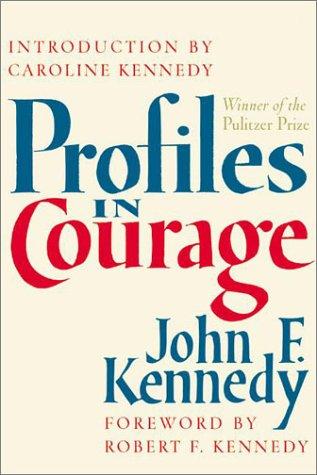
Profiles in Courage
Key Takeaways
Kyle, in 2018 in Books: I stumbled upon this book at Pioneer Book in Provo, UT, one of my favorite places to find oldies buy goodies. What I repeatedly noticed was the feeling that most of these men had that the intelligent members of their constituencies would be able to understand their course of action. Operating under the expectation of an informed electorate is key to an effective democracy, though I sometimes struggle to believe that this is representative of the majority of the population.
Referring to John Quincy Adams — “In spite of a life of extraordinary achievement, he was gnawed constantly by a sense of inadequacy, of frustration, of failure. Though his hard New England conscience and his remarkable talents drove him steadily along a road of unparalleled success, he had from the beginning an almost morbid sense of constant failure.” A letter written by John Quincy Adams to his father John Adams, at the age of 9 — “Dear Sir: I love to receive letters very well; much better than I love to write them. I make but a poor figure at composition. My head is much too fickle. My thoughts are running after bird’s eggs, play and trifles, till I get vexed with myself. Mamma has a troublesome task to keep me a studying. I own I am ashamed of myself. I have but just entered the third volume of Rollin’s History, but designed to have got half through it by this time. I am determined to this week to be more diligent. I have set myself a stint to read the third volume half out. If I can but keep my resolution, I may again at the end of the week give a better account of myself. I wish, sir, you would give me in writing some instructions with regard to the use of my time, and advise me how to proportion my studies and play, and I will keep them by me, and endeavor to follow them. With the present determinations of growing better, I am, dear sir, your son.”
John F. Kennedy’s portraits of senators who took politically fatal stands. The highlights land on the cost of conscience in a representative system:
- The central tension. A senator “governed by the opinions of his friends at home” cannot serve them — set against Burke-style independence. Kennedy’s own weary observation that “forty or fifty letters, six visits from professional politicians and lobbyists” can outweigh a silent majority.
- Compromise vs. principle. “We shall need compromises in the days ahead… But these will be, or should be, compromises of issues, not of principles.” And Lincoln’s realism: “there are few things wholly evil or wholly good. Almost everything, especially of Government policy, is an inseparable compound of the two.”
- Popularity worth having. “I value solid popularity — the esteem of good men for good action. I despise the bubble popularity that is won without merit and lost without a crime.”
- The price, stated plainly. Edmund Ross, who cast the deciding vote against convicting Andrew Johnson: “I almost literally looked down into my open grave. Friendships, position, fortune, everything that makes life desirable to an ambitious man…” — and Kennedy’s note that Ross was afterwards “practically nobody.”
- John Quincy Adams. Kyle marked the letter Adams wrote his father at nine, and the observation that despite “a life of extraordinary achievement, he was gnawed constantly by a sense of inadequacy” — plus the fact that the two Adamses were the only first-five presidents denied a second term.
- Liberalism defined. “Liberalism implies freedom of thought, freedom from orthodox dogma, the right of others to think differently from one’s self.”
Kennedy’s closing move is the one to keep: stories of past courage “can teach, they can offer hope, they can provide inspiration. But they cannot supply courage itself.”
Connections
Books: John Quincy Adams — the biography Kyle read alongside; the Adams material here overlaps directly. Founders’ Son and Lincoln (Movie) on the Lincoln thread.
Concepts: Leadership · People Over Politics · Integrity — the “compromises of issues, not of principles” line is the sharpest statement of the tag.
People: John F. Kennedy · John Quincy Adams · Robert F. Kennedy.
- Romney: A Reckoning — JFK’s analog frame; the same conscience-over-tribe thesis that animates Kennedy’s senators is dramatized in Mitt Romney’s lone impeachment vote. The two books form a natural pair on political courage within Democracy.
- John F. Kennedy — the author; written before his presidency, the book is itself an act of the Leadership it celebrates.
Highlights
- “President Kennedy was fond of quoting Dante that ‘the hottest places in Hell are reserved for those who, in a time of great moral crises, maintain their neutrality.’”
- “The energies and talents of all of us are needed to meet the challenges — the internal ones of our cities, our farms, ourselves — to be successful in the fight for freedom around the globe, in the battles against illiteracy, hunger and disease. Pleasantries, self-satisfied mediocrity will serve us badly. We need the best of many — not of just a few. We must strive for excellence.” Robert F. Kennedy
- “What happens to the country, to the world, depends on what we do with what others have left us.” Robert F. Kennedy
- “In Washington I frequently find myself believing that forty or fifty letters, six visits from professional politicians and lobbyists, and three editorials in Massachusetts newspapers constitute public opinion on a given issue. Yet in truth I rarely know how the great majority of the voters feel, or even how much they know of the issues that seem so burning in Washington.”
- “We shall need compromises in the days ahead, to be sure. But these will be, or should be, compromises of issues, not of principles. We can compromise our political positions, but not ourselves.”
- “I implore that Spirit from whom every good and perfect gift descends to enable me to render essential service to my country, and that I may never be governed in my public conduct by any consideration other than that of my duty.” John Quincy Adams
Kyle: Referring to John Quincy Adams — “In spite of a life of extraordinary achievement, he was gnawed constantly by a sense of inadequacy, of frustration, of failure. Though his hard New England conscience and his remarkable talents drove him steadily along a road of unparalleled success, he had from the beginning an almost morbid sense of constant failure.” Kyle: A letter written by John Quincy Adams to his father John Adams, at the age of 9 — “Dear Sir: I love to receive letters very well; much better than I love to write them. I make but a poor figure at composition. My head is much too fickle. My thoughts are running after bird’s eggs, play and trifles, till I get vexed with myself. Mamma has a troublesome task to keep me a studying. I own I am ashamed of myself. I have but just entered the third volume of Rollin’s History, but designed to have got half through it by this time. I am determined to this week to be more diligent. I have set myself a stint to read the third volume half out. If I can but keep my resolution, I may again at the end of the week give a better account of myself. I wish, sir, you would give me in writing some instructions with regard to the use of my time, and advise me how to proportion my studies and play, and I will keep them by me, and endeavor to follow them. With the present determinations of growing better, I am, dear sir, your son.”
- “It is significant to note that the two Adamses, father and son, were the only Presidents not elected for a second term in the first fifty years of our nation’s history. Yet their failures, if they can be called failures, were the result of their own undeviating devotion to what they considered to be the public interest and the result of the inability of their contemporaries to match the high standards of honor and rectitude that they brought to public life.” John Quincy Adams John Adams
- “Inconsistencies of opinion arising from changes of circumstances are often justifiable. But there is one sort of inconsistency that is culpable: it is the inconsistency between a man’s conviction and his vote, between his conscience and his conduct. No man shall ever charge me with an inconsistency of that kind.” Daniel Webster
- “Mr. Webster has assumed a great responsibility,’ he wired his paper, ‘and whether he succeeds or fails, the courage with which he has come forth at least entitles him to the respect of the country.”
- “Necessity compels me to speak true rather than pleasing things… I should indeed like to please you; but I prefer to save you, whatever be your attitude toward me.” Daniel Webster
- “To some extent he had attempted to shrug off his attackers, stating that he had expected to be libeled and abused. To those who urged a prompt reply, he merely related the story of the old deacon in a similar predicament who told his friends, ‘I always make it a rule never to clean up the path until the snow is done falling.”
- “I value solid popularity — the esteem of good men for good action. I despise the bubble popularity that is won without merit and lost without crime… I have been a Senator 30 years… I sometimes had to act against the preconceived opinions and first impressions of my constituents; but always with full reliance upon their intelligence to understand me and their equity to do me justice — and I have never been disappointed.” Thomas Hart Benton
- “I almost literally looked down into my open grave. Friendships, position, fortune, everything that makes life desirable to an ambitious man were about to be swept away by the breath of my mouth, perhaps forever.” Edmund Ross
- “Who was Edmund G. Ross? Practically nobody. Not a single public law bears his name, not a single history book includes his picture, not a single list of Senate ‘greats’ mentions his service. His one heroic deed has been all but forgotten. But who might Edmund G. Ross have been? That is the question — for Ross, a man with an excellent command of words, an excellent background for politics and an excellent future in the Senate, might well have outstripped his colleagues in prestige and power throughout a long Senate career. Instead, he chose to throw all of this away for one act of conscience.”
- “My countrymen! Know one another, and you will love one another.”
- “If [a Senator] allows himself to be governed by the opinions of his friends at home, however devoted he may be to them or they to him, he throws away all the rich results of a previous preparation and study, and simply becomes a commonplace exponent of those popular sentiments which may change in a few days… Such a course will dwarf any man’s statesmanship and his vote would be simply considered as an echo of current opinion, not the result of mature deliberations.” (Lucius Lamar)
- “I am, however, so firmly convinced of the righteousness of my course that I believe if the intelligent and patriotic citizenship of the country can only have an opportunity to hear both sides of the question, all the money in Christendom and all the political machinery that wealth can congregate will not be able to defeat the principle of government for which our forefathers fought.” (George Norris)
- “Has the time come when we can’t even express our opinions in the Senate, where we were sent to debate such questions, without being branded by the moneyed interests as traitors?” (George Norris)
- “Liberalism implies freedom of thought, freedom from orthodox dogma, the right of others to think differently from one’s self. It implies a free mind, open to new ideas and willing to give attentive consideration. When I say liberty, I mean liberty of the individual to think his own thoughts and live his own life as he desires to think and live.” (Robert Taft)
- “I shall set an example to my children which shall teach them to regard as nothing any position or office which must be attained or held at the sacrifice of honor.” (John Tyler)
- “There are few things wholly evil or wholly good. Almost everything, especially of Government policy, is an inseparable compound of the two, so that our best judgement of the preponderance between them is continually demanded.” (Abraham Lincoln)
- “The courage of life is often a less dramatic spectacle than the courage of a final moment; but it is no less a magnificent mixture of triumph and tragey. A man does what he must — in spite of personal consequences, in spite of obstacles and dangers and pressures — and that is the basis of all human morality.”
- “The stories of past courage can define that ingredient — they can teach, they can offer hope, they can provide inspiration. But they cannot supply courage itself. For this each man must look into his own soul.”
Referenced in
- All The Pretty Horses book
- Edmund Ross note
- Integrity note
- Pioneer Book note
- Romney: A Reckoning book
- Thomas Hart Benton note