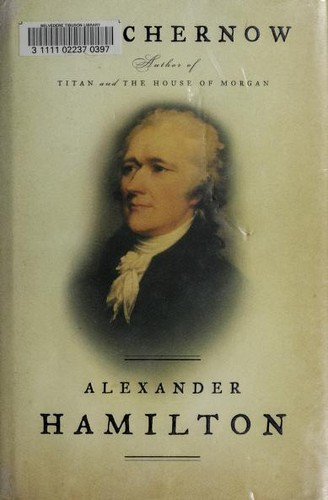
Alexander Hamilton
Key Takeaways
Kyle, in 2017 in Books: I have a deep and complicated relationship with long-form biographies of the founding fathers, first with John Adams, and now Alexander Hamilton. I didn’t think I would like this book, in part because David McCullough made me like John Adams so much, and Alexander Hamilton sunk any hope of a 2nd presidential term for John Adams. But what I’ve learned is that, with all of these men, they’re human with strengths and weaknesses, and many things worth learning from.
Many thanks to Camden Harrison for making me listen to the musical, and to Lin Manuel Miranda for making a musical that made me want to read this book, and to theHarvard Book Store in Cambridge, MA for providing my copy.
In relation to a witnessed mobbing that would go on to influence Hamilton’s fear of anarchy throughout his career — “In times of such commotion as the present, while the passions of men are worked up to an uncommon pitch, there is great danger of fatal extremes. The same state of the passions which fits the multitude, who have not a sufficient stock of reason and knowledge to guide them, for opposition to tyranny and oppression, very naturally leads them to a contempt and disregard of all authority. The due medium is hardly to be found among the more intelligent. It is almost impossible among the unthinking populace. When the minds of these are loosened from their attachment to ancient establishments and courses, they seem to grow giddy and are apt more or less to run into anarchy.” Quoting William Pierce about Hamilton — ”When he comes forward, he comes highly charged with interesting matter. There is no skimming over the surface of a subject with him. He must sink to the bottom to see what foundation it rests on.” Quoting John Adams — “I hate levees and drawing rooms. I hate to speak to a thousand people to whom I have nothing to say.” Hamilton writing to his wife — “I always feel how necessary you are to me. But when you are absent, I become still more sensible of it and look around in vain for that satisfaction which you alone can bestow.” In relation to the Sedition’s Act — “Another editor earned eighteen months behind bars for daring to print the heresy that the government allowed the wealthy to benefit at the expense of commoners.”
Connections
- Ron Chernow’s biography sits on the founding-generation shelf alongside American Sphinx (Jefferson, by Joseph J. Ellis), Founders’ Son (Lincoln reading the founders), and Benjamin Franklin — An American Life — part of the Founding Fathers canon Kyle has read across.
Highlights
- In relation to a witnessed mobbing that would go on to influence Hamilton’s fear of anarchy throughout his career — “In times of such commotion as the present, while the passions of men are worked up to an uncommon pitch, there is great danger of fatal extremes. The same state of the passions which fits the multitude, who have not a sufficient stock of reason and knowledge to guide them, for opposition to tyranny and oppression, very naturally leads them to a contempt and disregard of all authority. The due medium is hardly to be found among the more intelligent. It is almost impossible among the unthinking populace. When the minds of these are loosened from their attachment to ancient establishments and courses, they seem to grow giddy and are apt more or less to run into anarchy.”
- “Something about Aaron Burr — his penchant for intrigue, a lack of sufficient deference, perhaps his insatiable chasing after women — grated on George Washington. Much of Burr’s political future was shaped by his decidedly cool wartime relations with Washington, while other contemporaries, Hamilton being the prime example, profited from the general’s approbation.”
- “Hamilton had kept a pay book with blank pages in the back; while on Washington’s staff, he filled up 112 pages with notes from his extracurricular reading. Hamilton fit the type of self-improving autodidact, employing all his spare time to better himself.”
- “For anyone studying Hamilton’s pay book, it would come as no surprise that he would someday emerge as a first-rate constitutional scholar, an unsurpassed treasury secretary, and the protagonist of the first great sex scandal in American political history.”
- “This early lesson in Realpolitik — that counties follow their interests, not their sympathies — was engraved in Hamilton’s memory, and he often reminded Jeffersonians later on that the French had fought for their own selfish purposes.”
- “As too much power leads to despotism, too little leads to anarchy, and both eventually to the ruin of the people.”
- “Like other founders and Enlightenment politicians, Hamilton could never quite admit the depth of his ambition, lest it cast doubts on his revolutionary purity. In the midst of such rarefied goals as freedom and independence, who could admit to baser motives or any thoughts of personal gains?”
- “’The more I see, the more I find reason for those who love this country to weep over its blindness,’ Hamilton wrote. He recoiled at the cowardice and selfishness he saw rampant in the New York legislature. ‘The inquiry constantly is what will please, not what will benefit the people,” he told Morris. ‘In such a government there can be nothing but temporary expedient, fickleness, and folly.’ Increasingly, Hamilton despaired of pure democracy, of politicians simply catering to the popular will, and favored educated leaders who would enlighten the people and exercise their own judgement.”
- “We have fought side by side to make America free. Let us hand in hand struggle to make her happy.”
- “Hamilton venerated the law, while Burr often seemed mildly bored and cynical about it. ‘The law is whatever is successfully argued and plausible maintained,’ he stated.”
- “He was not a politician seeking popularity but a statesman determined to change minds.”
- “Over time Jefferson yielded to a craven policy of postponing action on slavery indefinitely, constantly foisting the problem onto future generations, hoping vaguely that it would wither away.”
- “Garrison recalled of Burr, ‘His manner was patronizing…As he revealed himself to my moral sense, I saw that he was destitute if any fixed principles.”
- “Hamilton’s besetting fear was that American democracy would be spoiled by demagogues who would mouth populist shibboleths to conceal their despotism.”
- Quoting William Pierce about Hamilton — ”When he comes forward, he comes highly charged with interesting matter. There is no skimming over the surface of a subject with him. He must sink to the bottom to see what foundation it rests on.”
- “His faith in Americans never quite matched his faith in America itself.”
- “No government could give us tranquility and happiness at home, which did not possess sufficient stability and strength to make us respectable abroad.”
- “No etiquette had yet evolved to define the legitimate boundaries of dissent. Poison-pen artists on both sides wrote vitriolic essays that were overtly partisan, often paid scant heed to accuracy, and sought a visceral impact. The inflamed rhetoric once directed against Britain was now turned inward against domestic adversaries.”
- “For Hamilton, [writing the Federalist], was a period of madcap activity. He was stuck with his law practice and had to squeeze the essays into breaks in his schedule, as if they were a minor sideline.”
- “To understand Hamilton’s productivity, it is important to note that virtually all of his important work was journalism, promoted by topical issues and written in the midst of controversy. He never wrote as a solitary philosopher for the ages. But his topical writing has endured because he plumbed the timeless principles behind contemporary events. He had an incomparable capacity for work and a metabolism that thrived on conflict.”
- “The fate of the democratic experiment depended upon political intellectuals who might have been marginalized at other periods.”
- “If mankind were to resolve to agree in no institution of government until every part of it had been adjusted to the most exact standard of perfection, society would soon become a general scene of anarchy and the world a desert.”
- “Like other founding fathers, Hamilton inhabited two diametrically opposed worlds. There was the Olympian sphere of constitutional debate and dignified discourse — the way many prefer to remember these stately figures — and the gutter world of personal sniping, furtive machinations, and tabloid-style press attack’s.”
- “He thought it would be in his power in the financial department of the government to do the country great food and this consideration outweighed with him every consideration of a private nature. A man of irreproachable integrity, Hamilton severed all outside sources of income while in office, something that neither Washington, nor Jefferson, nor Madison dared to do.”
- “The creation of debt should always be accompanied with the means of extinguishment.”
- “This falling out [between Madison and Hamilton] was to be more than personal, for the rift between Hamilton and Madison precipitated the start of the two-party system in America. The funding debate shattered the short-lived political consensus that had ushered in the new government. For the next five years, the political spectrum in America was defended by whether people endorsed or opposed Alexander Hamilton’s programs.”
- “Like Hamilton, Jefferson was a fanatic for self-improvement. He rose before dawn each morning and employed every hour profitably, studying up to fifteen hours per day. Extremely systematic in his habits, Jefferson enjoyed retreating into the sheltered tranquility of his books, and the spectrum of his interests was vast.”
- “Inside his teeming brain, he found it hard to strike a balance between the grand demands of his career and the small change of everyday life. The endless letters that flowed from his pen are generally abstract and devoid of imagery…Only rarely did he enliven letters with anecdotes or idle chatter. It was not so much that Hamilton was writing for the ages — though surely he knew his place in the larger the scheme of things — as that his grandiose plans left scant space for commonplace thoughts.”
- “Hamilton did not assume that his children would emulate his outsize accomplishments and tailored his demands to their native endowments, gently molding their characters.”
- “Perseverance in almost any plan is better than fickleness and fluctuation.”
- “The intellectual caliber of the leading figures surpassed that of any future political leadership in American history. On the other hand, their animosity toward one another had seldom been exceeded either.”
- “But how oddly are all things arranged in this sublunary scene. I am just where I do not wish to be. I know how I could be much happier, but circumstances enchain me.”
- “It is long since I have learnt to hold popular opinion of no value.”
- Quoting John Adams — “I hate levees and drawing rooms. I hate to speak to a thousand people to whom I have nothing to say.”
- Hamilton writing to his wife — “I always feel how necessary you are to me. But when you are absent, I become still more sensible of it and look around in vain for that satisfaction which you alone can bestow.”
- “Self-sufficiency and a contempt of the science and experience of others are too prevailing traits of character in this country.”
- In relation to the Sedition’s Act — “Another editor earned eighteen months behind bars for daring to print the heresy that the government allowed the wealthy to benefit at the expense of commoners.”
- “The more despairing he became about politics and human nature — and his worldview was never very rosy to begin with — the more he appreciated his sincere, unpretentious wife.”
- “If we must have an enemy at the head of the government, let it be one whom we can oppose and for whom we are not responsible.”
- “Both Hamilton and Jefferson believed in democracy, but Hamilton tended to be more suspicious of the governed and Jefferson of the governors.”
- “Many of these slaveholding populists were celebrated by posterity as tribunes of the common people. Meanwhile, the self-made Hamilton, a fervent abolitionist and a staunch believer in meritocracy, was villainized in American history textbooks as an apologist of privilege and wealth.”
- “Part of the problem was that Hamilton was a quintessentially urban man, who preferred to commune with books, not running brooks.”
Referenced in
- 1984 book
- American Sphinx book
- Amusing Ourselves To Death book
- Becoming book
- Founders' Son book
- Joseph J. Ellis note