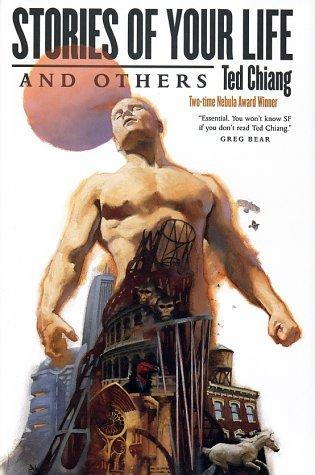
Story of Your Life
Key Takeaways
Kyle, in 2025 in Books: I very much love the movie, Arrival. I’ve written about it before. I think about it often. The idea of a perfect form of communication does feel like it would encapsulate a non-linear view of time. If you knew how things really started and how they were going to turn out, you would have significantly less to disagree with in the moment. This story does a perfect job of telling a compelling story primarily through concepts like language, communication, culture, and meaning.
Ted Chiang’s novella (the basis for the film Arrival) uses a first-contact premise to argue that Free Will and foreknowledge can coexist — that Predestination and Agency are not mutually exclusive, only artifacts of which mode of consciousness you inhabit.
-
Two modes of consciousness. Humans experience events sequentially and read them as cause and effect; the heptapods experience all events at once and read a purpose underlying them — “a minimizing, maximizing purpose.” Neither mode is the “correct” one — like the young-woman/old-crone optical illusion, both are valid but you can’t hold both at once.
-
Causal vs. variational physics. Almost every physical law can be written two equivalent ways: a causal/differential form (Newton’s F = ma — each moment grows out of the last) and a variational form (the Principle of Least Time / Principle of Least Action — nature picks the path that minimizes a quantity computed over the whole trajectory). The variational view is implicitly teleological: it requires knowing the endpoint before the path can begin. “The ray of light has to know where it will ultimately end up before it can choose the direction to begin moving in.” Teleology never left physics — it was hidden inside an equivalent formalism.
-
Language as action, not just transmission. Drawing on Speech Act Theory, the heptapods treat all language as performative: “I now pronounce you…”, “I christen…” — saying equals doing. They already know what will be said, but the conversation must still happen for the knowledge to be true. Every linguistic event, like every physical one, parses two ways: as a transmission of information and as the realization of a plan.
-
Semasiographic writing. Heptapod B encodes meaning directly, bypassing speech (like math notation or a traffic sign), so a whole sentence is conceived simultaneously — closer to a mandala than to a line of text. The writing system fits a species that perceives time all at once rather than one word after another.
-
Time symmetry and the block universe. The fundamental laws of physics are time-symmetric; the arrow of time is a statistical feature of entropy and initial conditions, not of the laws themselves. That points toward eternalism / the block universe: past, present, and future all exist equally, and our sense of an “open” future is a feature of our limited access, not of reality. Einstein: “the distinction between past, present and future is only a stubbornly persistent illusion.”
-
Free will, reframed. Once Louise learns to read the universe variationally, knowing the future and living it are no longer opposed — they’re complementary, the way specifying boundary conditions and computing the action are complementary in physics. She knows her daughter will die before the daughter is conceived, and lives the whole arc anyway, because a life becomes a completed shape — like a sentence, a mandala, a ray of light — not a chain of contingencies whose ending you’re racing toward.
Connections
People: Ted Chiang — author; the novella advances his recurring frame of freedom and predestination as not-mutually-exclusive.
Concepts:
- Free Will — knowledge of the future is incompatible with free will, yet freedom remains “perfectly real in the context of sequential consciousness.”
- Predestination — the heptapods’ “free-but-bound” paradox: they act to enact a chronology they already know, neither willing nor helpless automatons.
- Agency — volition as an intrinsic part of consciousness, set against the simultaneous mode where coercion is no more meaningful than freedom.
- Determinism / Block Universe / Eternalism — the time-symmetric laws and Laplace’s-demon argument that the future is “already there,” and our sense of openness is a limit of perception.
- Teleology — the variational reading of physics smuggles purpose back in: behavior explained by reference to a goal and an endpoint.
- Variational Principles / Fermat’s Principle — the Principle of Least Time/Action as the formal counterpart to simultaneous consciousness.
- Speech Act Theory — performative language as the model for a species for whom all language actualizes rather than informs.
- Game Theory — the “non-zero-sum game” frame on human-heptapod contact, and the daughter asking for the “math word” for when both sides can win.
- Science Fiction — exemplar of idea-driven SF where a linguistic/physical premise (Heptapod B, Fermat’s principle) reshapes how a mind experiences time.
Books: Homo Deus — agency-and-determinism overlap; the “opposition in all things” thread on whether free will and a known future can coexist.
Highlights
- It’ll be when you first learn to walk that I get daily demonstrations of the asymmetry in our relationship. You’ll be incessantly running off somewhere, and each time you walk into a door frame or scrape your knee, the pain feels like it’s my own. It’ll be like growing an errant limb, an extension of myself whose sensory nerves report pain just fine, but whose motor nerves don’t convey my commands at all. It’s so unfair: I’m going to give birth to an animated voodoo doll of myself. I didn’t see this in the contract when I signed up. Was this part of the deal?
- I thought to myself, the ray of light has to know where it will ultimately end up before it can choose the direction to begin moving in. I knew what that reminded me of. I looked up at Gary. “That’s what was bugging me.”
- “Mom, what do you call it when both sides can win?” I’ll look up from my computer and the paper I’ll be writing. “What, you mean a win-win situation?” “There’s some technical name for it, some math word. Remember that time Dad was here, and he was talking about the stock market? He used it then.”
- Instead of carefully trying to design a sentence before writing, I could simply begin putting down strokes immediately; my initial strokes almost always turned out to be compatible with an elegant rendition of what I was trying to say. I was developing a faculty like that of the heptapods.
- The semagrams seemed to be something more than language; they were almost like mandalas. I found myself in a meditative state, contemplating the way in which premises and conclusions were interchangeable. There was no direction inherent in the way propositions were connected, no “train of thought” moving along a particular route; all the components in an act of reasoning were equally powerful, all having identical precedence.
- “I should emphasize that our relationship with the heptapods need not be adversarial. This is not a situation where every gain on their part is a loss on ours, or vice versa. If we handle ourselves correctly, both we and the heptapods can come out winners.” “You mean it’s a non-zero-sum game?” Gary said in mock incredulity. “Oh my gosh.”
- That day when Gary first explained Fermat’s principle to me, he had mentioned that almost every physical law could be stated as a variational principle. Yet when humans thought about physical laws, they preferred to work with them in their causal formulation. I could understand that: the physical attributes that humans found intuitive, like kinetic energy or acceleration, were all properties of an object at a given moment in time. And these were conducive to a chronological, causal interpretation of events: one moment growing out of another, causes and effects creating a chain reaction that grew from past to future. In contrast, the physical attributes that the heptapods found intuitive, like “action” or those other things defined by integrals, were meaningful only over a period of time. And these were conducive to a teleological interpretation of events: by viewing events over a period of time, one recognized that there was a requirement that had to be satisfied, a goal of minimizing or maximizing. And one had to know the initial and final states to meet that goal; one needed knowledge of the effects before the causes could be initiated.
- Was it actually possible to know the future? Not simply to guess at it; was it possible to know what was going to happen, with absolute certainty and in specific detail? Gary once told me that the fundamental laws of physics were time-symmetric, that there was no physical difference between past and future. Given that, some might say, “yes, theoretically.” But speaking more concretely, most would answer “no,” because of free will.
- The existence of free will meant that we couldn’t know the future. And we knew free will existed because we had direct experience of it. Volition was an intrinsic part of consciousness. Or was it? What if the experience of knowing the future changed a person? What if it evoked a sense of urgency, a sense of obligation to act precisely as she knew she would?
- Consider the phenomenon of light hitting water at one angle, and traveling through it at a different angle. Explain it by saying that a difference in the index of refraction caused the light to change direction, and one saw the world as humans saw it. Explain it by saying that light minimized the time needed to travel to its destination, and one saw the world as the heptapods saw it. Two very different interpretations. The physical universe was a language with a perfectly ambiguous grammar. Every physical event was an utterance that could be parsed in two entirely different ways, one causal and the other teleological, both valid, neither one disqualifiable no matter how much context was available.
- Humans had developed a sequential mode of awareness, while heptapods had developed a simultaneous mode of awareness. We experienced events in an order, and perceived their relationship as cause and effect. They experienced all events at once, and perceived a purpose underlying them all. A minimizing, maximizing purpose.
- Looking at a sentence like this one, I understood why the heptapods had evolved a semasiographic writing system like Heptapod B; it was better suited for a species with a simultaneous mode of consciousness. For them, speech was a bottleneck because it required that one word follow another sequentially. With writing, on the other hand, every mark on a page was visible simultaneously. Why constrain writing with a glottographic straitjacket, demanding that it be just as sequential as speech? It would never occur to them. Semasiographic writing naturally took advantage of the page’s two-dimensionality; instead of doling out morphemes one at a time, it offered an entire page full of them all at once.
- At that stage of your life, there’ll be no past or future for you; until I give you my breast, you’ll have no memory of contentment in the past nor expectation of relief in the future. Once you begin nursing, everything will reverse, and all will be right with the world. NOW is the only moment you’ll perceive; you’ll live in the present tense. In many ways, it’s an enviable state.
- The heptapods are neither free nor bound as we understand those concepts; they don’t act according to their will, nor are they helpless automatons. What distinguishes the heptapods’ mode of awareness is not just that their actions coincide with history’s events; it is also that their motives coincide with history’s purposes. They act to create the future, to enact chronology. Freedom isn’t an illusion; it’s perfectly real in the context of sequential consciousness. Within the context of simultaneous consciousness, freedom is not meaningful, but neither is coercion; it’s simply a different context, no more or less valid than the other. It’s like that famous optical illusion, the drawing of either an elegant young woman, face turned away from the viewer, or a wart-nosed crone, chin tucked down on her chest. There’s no “correct” interpretation; both are equally valid. But you can’t see both at the same time. Similarly, knowledge of the future was incompatible with free will. What made it possible for me to exercise freedom of choice also made it impossible for me to know the future. Conversely, now that I know the future, I would never act contrary to that future, including telling others what I know: those who know the future don’t talk about it. Those who’ve read the Book of Ages never admit to it.
Kyle: Pluribus
- If I could have described this to someone who didn’t already know, she might ask, if the heptapods already knew everything that they would ever say or hear, what was the point of their using language at all? A reasonable question. But language wasn’t only for communication: it was also a form of action. According to speech act theory, statements like “You’re under arrest,” “I christen this vessel,” or “I promise” were all performative: a speaker could perform the action only by uttering the words. For such acts, knowing what would be said didn’t change anything. Everyone at a wedding anticipated the words “I now pronounce you husband and wife,” but until the minister actually said them, the ceremony didn’t count. With performative language, saying equaled doing. For the heptapods, all language was performative. Instead of using language to inform, they used language to actualize. Sure, heptapods already knew what would be said in any conversation; but in order for their knowledge to be true, the conversation would have to take place.
- I suddenly remembered that a morphological relative of “performative” was “performance,” which could describe the sensation of conversing when you knew what would be said: it was like performing in a play.
- Like physical events, with their causal and teleological interpretations, every linguistic event had two possible interpretations: as a transmission of information and as the realization of a plan.
- Usually, Heptapod B affects just my memory: my consciousness crawls along as it did before, a glowing sliver crawling forward in time, the difference being that the ash of memory lies ahead as well as behind: there is no real combustion. But occasionally I have glimpses when Heptapod B truly reigns, and I experience past and future all at once; my consciousness becomes a half-century-long ember burning outside time. I perceive—during those glimpses—that entire epoch as a simultaneity. It’s a period encompassing the rest of my life, and the entirety of yours.
- From the beginning I knew my destination, and I chose my route accordingly. But am I working toward an extreme of joy, or of pain? Will I achieve a minimum, or a maximum?
Referenced in
- 2025 in Books essay
- Fermat's Principle note
- Free Will note
- Game Theory note
- Non-Zero-Sum note
- Pluribus note
- Science Fiction note
- Speech Act Theory note
- Ted Chiang note
- Teleology note
- Variational Principles note