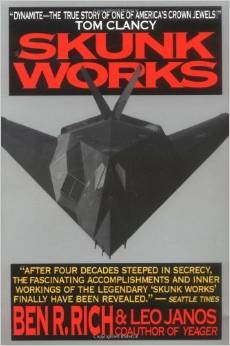
Skunk Works
Key Takeaways
Kyle, in 2024 in Books: A key theme throughout the year was focusing on diving deep into the defense industry and Skunk Works felt like the best starting point. While innovation in American defense has stagnated, Lockheed’s Skunk Works was the golden standard for how to build complex things. One of the best culture of creativity books out there, and a key insight into defense primes before they got carried away with perverse incentives.
Reads as a case study for the modern defense-tech opportunity — heavy explicit tagging back to Anduril, Palmer Luckey, and the “what would a new skunk works look like today” question. Eight recurring threads:
-
Founder-led innovation vs. managed monopoly. Boeing’s drift from “engineering org” to “good bottom line business” is the cautionary arc. Founder-mode (Kelly Johnson) and missionary-mentality work; the descent into “build for the buck rather than the mission” is the failure mode.
-
Speed of delivery as the competitive advantage. 6 months → 3 months → 5 weeks at peak Skunk Works. The last great speed-of-delivery feat was 1977. Today’s defense primes can’t operate at that cadence; that’s the gap Anduril is built into.
-
“Trust the customer to know the problem but not the solution.” Recurs 4-5 times across the notes — the single most repeated principle. Build to the mission, not to the spec.
-
Built to spec vs. built to mission. Built-to-spec rewards adherence to bureaucracy and produces “exquisite platforms” — impressive single-points-of-failure that get invalidated when warfare evolves around them.
-
The evolution-of-warfare framework. Soldiers → planes/tanks → radar/missiles → stealth → drones. The arms race between offensive and defensive technology is the actual structure of military history. Stealth dominated until it didn’t. What comes after?
-
McNamara as the inflection point. Cost-cutting + later Last Supper consolidation gutted the founder-led innovation era. Increased scrutiny = increased costs. The system that’s hardest to escape is the one that punishes risk and rewards bureaucracy.
-
Anduril as modern skunk works. Off-the-shelf where possible, custom where it has to be, decentralized lattice, attritable assets. The thesis: defense primes structurally CAN’T do this anymore; an outsider can.
-
Meritocracy vs. managed monopoly. Anti-Darwinian competitive behavior. The big-egos-big-platforms-low-risk equilibrium is exactly what blocks lower-cost, higher-volume innovation. The fact that we have new big-power confrontations (China, Russia) while still being stuck in the cost-cutting-managed-monopoly mode is the central tension.
Tactical observations also flagged: team size (Skunk Works ran with ~150 people), the importance of investing in self-funded R&D, and the parallel between Lockheed’s drone investment and Anduril’s product investment pattern.
Connections
Books:
- The Kill Chain — parallel thesis on military innovation collapse. The two books read as a single argument: Skunk Works tells the historical version, Kill Chain tells the present-tense version.
- Chip War — the semiconductor side of the same story. Together with Kill Chain and Skunk Works, the three read as a defense-tech trilogy.
- The Idea Factory — Bell Labs analog. Same “what does great industrial R&D look like” question, different era.
- Flying Blind — the Boeing decline arc in detail; complements the “engineering org → bottom-line business” theme that Rich traces through Lockheed.
- The Founders — talent-vortex parallel. Skunk Works was a talent vortex inside Lockheed.
- Boom — Bubbles & The End of Stagnation — same “where did the speed go?” question, broader framing.
People:
- Kelly Johnson — Skunk Works founder; the founder-led, “engineer within a stone’s throw of the airplane,” only-build-what-you-believe-in archetype Rich succeeded and venerates throughout.
- Robert McNamara — the cost-cutting “Mac the Knife” inflection point; Rich frames him as the figure who gutted founder-led innovation, and notes his cost-control philosophy traces back to his time at Ford.
- Bill Perry — Pentagon R&E chief who backed stealth (Have Blue, the stealth bomber, and the Sea Shadow stealth-ship program) and stood up counter-stealth research.
- Bernard Schriever — referenced in the era of Air Force systems-command leadership that shaped the procurement environment around the Skunk Works.
Concepts:
- Founders Mentality — founder-led/missionary innovation vs. the “build for the buck rather than the mission” drift; Kelly Johnson as exemplar.
- Evolution of Warfare — the soldiers → planes/tanks → radar/missiles → stealth → drones arms-race framework Rich’s notes return to repeatedly.
- Speed of Delivery — 6 months → 3 months → 5 weeks at peak; Rich flags 1977 as the last great speed-of-delivery feat.
- Built to Mission vs Spec — “trust the customer to know the problem but not the solution”; built-to-spec produces exquisite single-point-of-failure platforms.
- Managed Monopoly — anti-Darwinian competitive behavior; the B-2 award “on technical merit” and the GE-inspector vs. warranty contrast as illustrations.
- Innovator’s Dilemma — defense primes structurally can’t run a low-cost, high-volume skunk works anymore; the opening exists for an outsider.
- Power Law — the 90% radar-cross-section drop from a single chine; small shape changes producing order-of-magnitude effects.
- Decentralization — stealth and attritable assets as anti-platform, decentralized alternatives to “hulking” carriers and exquisite bombers.
- Autonomy — the automated takeoff-to-attack mission program and Rich’s forecast of pilotless drone combat aircraft.
- Open Source — the stealth breakthrough came from Ufimtsev’s openly published Soviet diffraction paper, translated by the Air Force.
- Bell Labs — analog institution for the “what great industrial R&D looks like” question.
Highlights
- Why only two dimensions and why only flat plates? Simply because, as Denys later noted, it was 1975 and computers weren’t yet sufficiently powerful in storage and memory capacity to allow for three-dimensional designs, or rounded shapes, which demanded enormous numbers of additional calculations. The new generation of supercomputers, which can compute a billion bits of information in a second, is the reason why the B-2 bomber, with its rounded surfaces, was designed entirely by computer computations.
Kyle: It’s been a software problem since the beginning
- *Dr. Ufimtsev came to teach electromagnetic theory at UCLA in 1990. Until his arrival here he had remained blissfully unaware of his enormous impact on America’s stealth airplane development, but clearly wasn’t surprised by the news. “Senior Soviet designers were absolutely uninterested in my theories,” he wryly observed.
Kyle: Nazis and soviets were the biggest unlocks in American military industrialism
- The Skunk Works would be the first to try to design an airplane composed entirely of flat, angular surfaces. I tried not to anticipate what some of our crusty old aerodynamicists might say. Denys thought he would need six months to create his computer software based on Ufimtsev’s formula. I gave him three months, We code-named the program Echo I. Denys and his old mentor, Bill Schroeder, who had come out of retirement in his eighties to help him after serving as our peerless mathematician and radar specialist for many years, delivered the goods in only five weeks. The game plan was for Denys to design the optimum low observable shape on his computer, then we’d build the model he designed and test his calculations on a radar range.
Kyle: Speed of delivery / 6 months to 3 months to 5 weeks
- After a quarter century of working at his side, I knew Kelly’s views nearly as well as my own, and I also knew that he would not be thrilled about stealth because he thought the days of manned attack airplanes were definitely numbered. “Goddam it, Ben, the future belongs to missiles. Bombers are as obsolete as the damned stagecoach.” I argued back, “Kelly, the reason they call them missiles, instead of hittles, is that they miss much more than they hit.” But Kelly just shook his head.
Kyle: He wasn’t wrong but it was drones, not just missiles.
- The Defense Department’s Advanced Research Projects Agency has invited Northrop, McDonnell Douglas, and three other companies to compete on building a stealthy airplane. They’re getting a million bucks each to come up with a proof of concept design, trying to achieve the lowest radar signatures across all the frequencies. If one works, the winner builds two demonstration airplanes. This is right up our alley and we are being locked out in the goddam cold.” This was exactly the kind of project I was looking for. But we had been overlooked by the Pentagon because we hadn’t built a fighter aircraft since the Korean War and our track record as builders of low-radar-observable spy planes and drones was so secret that few in the Air Force or in upper-management positions at the Pentagon knew anything about them. Warren read my mind. “Face it, Ben, those advanced project guys don’t have a clue about our spy plane work in the fifties and sixties. I mean, Jesus, if you think racing cars, you think Ferrari. If you think low observables, you must think Skunk Works.”
Kyle: DARPA -> secrecy led to internal inefficiency
- At the Skunk Works we designed practical, used off-the-shelf parts whenever possible, and did things right the first time.
Kyle: Off the shelf
- I kept telling myself that the financial and personal risks in pursuing this project were minimal compared to its enormous military and financial potential. But the politics of the situation had me worried: stealth would have been a perfect third project for me, after two reassuring successes under my belt. But if stealth failed, I could hear several of my corporate bosses grousing: “What’s with Rich? Is he some sort of flake? Kelly would never have undertaken such a dubious project. We need to take charge of that damned Skunk Works and nd make it practical and profitable again.
Kyle: Aversion to risk
- We begged and borrowed whatever parts we could get our hands on. Since this was just an experimental stealth test vehicle destined to be junked at the end, it was put together with avionics right off the aviation version of the Kmart shelf: we took our flight control actuators from the F-111 tactical bomber, our flight control computer from the F-16 fighter, and the inertial navigation system from the B-52 bomber. We took the servomechanisms from the F-15 and F-111 and modified them, and the pilot’s seat from the F-16. The heads-up display was designed for the F-18 fighter and adapted for our airplane. In all we got about $3 million worth of equipment from the Air Force. That was how we could build two airplanes and test them for two years at a cost of only $30 million.
Kyle: Off the shelf
- At the Skunk Works quality control reported directly to me. They were a check and balance on the work of the shop. Our inspectors stayed right on the floor with the machinists and fabricators, and quality control inspections occurred almost daily, instead of once, at the end of a procedure. Constant inspection forced our workers to be supercritical of their work before passing it on. Selfchecking was a Skunk Works concept now in wide use in Japanese industry and called by them Total Quality Management.
Kyle: Including engineers and machinists together
- Meanwhile an independent engineering review team, composed entirely of civil servants from Wright Field in Ohio, flew to Burbank to inspect and evaluate our entire program. They had nothing but praise for our effort and progress, but I was extremely put out by their visit. Never before in the entire history of the Skunk Works had we been so closely supervised and directed by the customer. “Why in hell do we have to prove to a government team that we knew what we were doing?” I argued in vain to Jack Twigg, our assigned Air Force program manager. This was an insult to our cherished way of doing things. But all of us sensed that the old Skunk Works valued independence was doomed to become a nostalgic memory of yesteryear, like a dime cup of coffee.
Kyle: Trust the customer to know the problem but not the solution.
- The contractor must be delegated and must assume more than normal responsibility to get good vendor bids for subcontract on the project. Commercial bid procedures are often better than military ones.
Kyle: Expectations
- It should only be that easy. We built two Have Blue prototypes in record time, only twenty months from the day the contract was awarded until I made the first flight. But the intensive flight testing of these two revolutionary airplanes took us two years. We needed a year or more to work out all the kinks thoroughly evaluating the structural loads, performance characteristics, flight controls, avionics - and then make all the fixes.
Kyle: Timelines - last great speed delivery? 1977?
- Everyone briefed on the program knew full well the potential implications of this prototype for the Air Force’s future. If this airplane lived up to its billing, we were making history. Air warfare and tactics would be changed forever. Stealth would rule the skies.
Kyle: Stealth WOULD rule the skies until small autonomous drones changed it again -> quote about losing air superiority for first time
- Military aircraft were so expensive and complex and represented such a sizable investment of taxpayers’ money that no manufacturer expected to win a contract without first jumping through an endless series of procurement hoops, culminating in the flight-testing phase, that under normal circumstances stretched nearly ten or more years. From start to finish, a new airplane could take as long as twelve years before taking its place in the inventory and become operational on a flight line long after it was already obsolete. But that was how the bureaucracy did business. Within the Air Force itself, the decision to proceed on a particular project usually followed months, sometimes years, of internal analysis, debate, and infighting, which ensured that every new airplane was designated for a very specific operational purpose.
Kyle: Timelines - McNamara
- William Perry, the Pentagon’s chief for research and engineering, who had come into office with the new Carter administration in January 1977, took one look at the historic low observability results we achieved and immediately set up an office for counter-stealth research to investigate whether or not the Soviets had ongoing stealth projects;
Kyle: Something important about him. Check my notes.
- Why spend money on a costly stealth deliv ery system when the U.S. had so few defensive missile tems and none nearly as sophisticated as their own? The Soviets’ apparent indifference to stealth spurred Bill Perry into action. In the spring of 1977, he called in General Alton Slay, head of the Air Force Systems Command. “Al,” he said, “this stealth breakthrough is forcing me into a snap decision. We can’t sit around and play the usual development games here. Let’s start small with a few fighters and learn lessons applicable to building a stealth bomber.”
Kyle: Russia was slow to stealth because of the old paradigm of missiles and radar. Revolution of warfare: # of soldiers -> planes / tanks -> radar & missiles -> stealth -> drones
- Brzezinski scribbled my replies on a small pad. Then he asked me about the possibilities for developing a stealthy cruise missile that could be air-launched from a bomber and overfly unseen two thousand miles or more inside the Soviet Union to deliver a nuclear punch. I told him our preliminary design people were already at work on developing such a missile, which would be basically the same diamond shape as Have Blue. But without a cockpit in the configuration, the stealthiness was almost an order of magnitude better than even Have Blue-making our cruise missile design the stealthiest weapon system yet devised.
Kyle: Was / is there an era dominated by “stealth cruise missiles?”
- As he was leaving, Brzezinski asked me a bottom-line question: “If I were to accurately describe the significance of this stealth breakthrough to the president, what should I tell him?” “Two things,” I replied. “It changes the way that air wars will be fought from now on. And it cancels out all the tremendous investment the Russians have made in their defensive ground-to-air system. We can overfly them any time, at will.” There is nothing in the Soviet system that can spot it in time to prevent a hit?”
Kyle: Age evolution: trace; history of dominant weapon, all the way to swords and spears. Impact of stealth
- The referees in the middle were Secretary of the Air Force Hans Mark, an atomic physicist and former director of NASA’s Ames laboratory, who was skeptical about stealth and a strong advocate of promoting missiles over manned bombers.
Kyle: People could see the unmanned writing on the wall.
- “Right now, we’ve got a contract and also the inside track on the next step, which is where the big payoff awaits: building them their stealth bomber. That’s why this risk is worth taking. They’ll want at least one hundred bombers, and we’ll be looking at tens of billions in business. So what’s this risk compared to what we can gain later on? Peanuts.”
Kyle: Brian Schimpf; Stratechery -> importance of being first (mention punitive contract terms)
- The Air Force pressured me to accept a deadline of twentytwo months to test-fly the first fighter. It had taken us eighteen months to build Have Blue, which was far simpler, but I reluctantly agreed to meet the deadline. As Alan Brown, my program manager for the fighter production, put it, “Ben said ‘Okay.’ The rest of us said, ‘Oh, shit.”
Kyle: Timelines
- Reagan would initiate the biggest peacetime military spending in our history. During the early 1980s defense industry sales increased 60 percent in real terms and the aerospace workforce expanded 15 percent in only three years - from 1983 to 1986. We employed directly nearly a quarter million workers in skilled, high-paying jobs and probably twice that many in support and supplier industries. Not since Vietnam were we building so much new military equipment, and that fevered activity was, coincidentally, being matched in the civilian airline industry.
Kyle: How does this line up with The Last Supper? Interesting that this is very close on the timeline to cost cutting?
- Those guys swarmed over us like bees on clover, checking up on our payment schedules, investigating whether we bought the lowest-priced materials and equipment from subcontractors, whether we really negotiated cost, tracked it, worked hard to get the best deal for Uncle Sam with our suppliers. I had to double my administrative staff to keep up with all these audits. For better or worse, we were stuck inside a Kafkaesque bureaucracy demanding accountability for every nut, screw, and bolt.
Kyle: Increased scrutiny = increased costs
- We started assembly the same time as McDonnell Douglas started the F-18 fighter. They took ten years to produce their first operational squadron of twenty airplanes. We took only five years. And theirs was a conventional airplane, while ours was entirely revolutionary technology.
Kyle: Timelines
- After the first two batches of deliveries we achieved phenomenal efficiency. So much so that we made about $80 million on the deal. At one point I offered to give the government some of its money back because even in the Reagan years I was scared of being accused of making excessive profits. That was a federal offense, punishable with heavy fines. The Air Force told me it had no bookkeeping methods for taking back money, so I gave them $30 million worth of free engineering improvements on the airplane. We were able to make so much because we had perfected every aspect of our manufacturing techniques.
Kyle: Government spending LOL
- By the time the airplane rolled off the line three months later, Al and his crew would know every wire, gauge, and bolt. They would be followed by all the other pilots and crew in that first squadron, who enjoyed the unique opportunity of actually being in on the production of the airplane they would soon be responsible for flying safely and effectively. Our purpose was to help them overcome fears of the unknown and achieve a level of confidence bred of expert knowledge of what their new airplane was all about. No other aerospace manufacturer came close to establishing such an intimate working relationship between builder and user.
Kyle: Build to the mission
- Building only two airplanes every three months, we enjoyed a better learning curve-78 percent-than other manufacturers had reported while building twenty-five airplanes a month
Kyle: Timeliness vs learning
- During this same period, the aerospace industry in Southern California, including Hughes, Rockwell, McDonnell Douglas, Northrop, and Lockheed, had added about forty-five thousand workers to its payroll as military aircraft revenues peaked at $33 billion in sales by 1986. The era of big defenserelated profits was at hand.
Kyle: Align with Last Supper?
- A year after the stealth fighter became operational, two computer wizards who worked in our threat analysis section came to me with a fascinating proposition: “Ben, why don’t we make the stealth fighter automated from takeoff to attack and return? We can plan the entire mission on computers, transfer it onto a cassette that the pilot loads into his onboard computers, that will route him to the target and back and leave all the driving to us.” To my amazement they actually developed this automated program in only 120 days and at a cost of only $2.5 million. It was so advanced over any other program that the Air Force bought it for use in all their attack airplanes.
Kyle: Automation and cost
- The combination of stealth with its highprecision munitions provided an almost total assurance that we could destroy enemy defenses from day one and the air campaign could be swift and almost devoid of any losses. In the past, you would have been betting your hat, ass, and spats on a lot of wishful thinking to conceive a battle plan that would eliminate most of the highest-value enemy targets over the most heavily defended city on earth on the opening night of the war.
Kyle: Transition from big demonstration of power to drawn out conflict -> what happened to stealth?
- We learned that night, and for many nights after that, that stealth combined with precision weapons constituted a quantum advance in air warfare. Ever since World War II, when radar systems first came into play, air warfare planners thought that surprise attacks were rendered null and void and thought in terms of large armadas to overwhelm the enemy and get a few attack aircraft through to do damage. Now we again think in small numbers and in staging surprise, surgically precise raids. Looking ahead, I’d predict that by the first couple of decades of the next century every military aircraft flying would be stealth. I might be wrong about the date but not about the dominance of stealth.
Kyle: Evolution of warfare: he was wrong, no?
- The stealth fighters composed only 2 percent of the total allied air assets in action and they flew 1,271 missions only 1 percent of the total coalition air sorties but accounted for 40 percent of all damaged targets attacked and compiled a 75 percent direct-hit rate. The direct-hit rate was almost as boggling as the no-casualty rate since laserguided bombs are strictly line of sight, depending on good visibility, and the air war was conducted during some of the worst weather in the region in memory.
Kyle: Stealth
- My expertise was solving heat problems and designing inlet and exhaust ducts on airplane engines. In those years, Lockheed was booming, cranking out a new airplane every two years. I felt I was in on the ground floor of a golden age in aviation - the era of the jet airplane- and couldn’t believe my good luck
Kyle: In 1954
- Back in 1932, Gross had purchased Lockheed out of bankruptcy for forty grand and staked the company’s survival on the development of a twin-engine commercial transport.
- “Engineers shall always work within a stone’s throw of the airplane being built.” ”
Kyle: Boeing going from a good engineering org to a “good bottom line business.”
- “That’s its mission. Edwin Land, who designed the Polaroid camera, is also designing our cameras, the highest-resolution camera in the world. He’s got Jim Baker, the Harvard astronomer, doing a thirty-six-inch folded optic lens for us. We’ll be able to read license plates. And we’ve got Eastman Kodak developing a special thin film that comes in thirty-six-hundredfoot rolls, so we won’t run out.”
Kyle: Working with Polaroid and Kodak then vs working with Google today.
- There was no way to hide from our cameras. And there was no hostile action the Russians could take that could stop us from our flights. We would be flying beyond reach of their defenses.
Kyle: How the tables have turned. Kill chain -> when our planes fly AWAY from China
- The U-2, from nose to cockpit, was basically the front half of the F-104, but with an extended body from cockpit to tail. Using that tooling would save many months and a lot of money. Our goal was to put four birds in flight by the end of the first year. Each airplane would cost the American taxpayers $1 million, including all development costs, making it the greatest procurement bargain ever.
Kyle: Costs
- And at the end of the line we were actually able to refund about 15 percent of the total U-2 production cost back to the CIA and in the bargain build five extra airplanes from spare fuselages and parts we didn’t need because both the Skunk Works and the U-2 had functioned so beautifully. This was probably the only instance of a cost underrun in the history of the military-industrial complex.
Kyle: Cost
- “Well, boys, Ike got his first picture postcard. The first take is being processed right now. But goddam it, we were spotted almost as soon as we took off. I think we’ve badly underestimated their radar capabilities. We could tell from overhearing their ground chatter that they were way off in estimating our altitude, but we always figured they wouldn’t even see us at sixtyfive thousand feet. And you know why? Because we gave them lend-lease early-warning radar during World War II and presumed that, like us, they wouldn’t do anything to improve it. Obviously they have. I want you guys to brainstorm what we can do to make us less visible or help us go even higher.”
Kyle: Radar dominance led to stealth
- “Putting fixes on this airplane won’t do any good. We need a fresh piece of paper,” Kelly told a group of us. His mind was already churning, thinking about the U-2’s successor that could survive flying above Moscow. He had asked our ace mathematician Bill Schroeder to predict how long it would take the Soviets to bring down a U-2 with their latest missile system. Schroeder gave the U-2 less than a year.
Kyle: Radar / missiles -> stealth -> drones
- It was the first time in history that a ground-to-air missile had shot down an airplane, and all of us assumed, knowing how fragile the U-2 was and at the height it was probably flying when it was hit, that the pilot had been killed.
Kyle: Missile dominance
- There is no way to replace the vital data provided by piloted airplanes. Satellites lack the flexibility and the immediacy that only a spy plane like the U-2 can provide. No president or intelligence agency S should have to operate with only one eye in such an uncertain and dangerous world.
Kyle: Has this changed?
- We were much less correct about their missile development because we had assumed - quite incorrectly - that they would continue to develop liquid-fuel missiles, while very secretly they dropped that concept and embarked on more sophisticated, solid-state missiles. That caught us by surprise and generated the socalled missile gap.
Kyle: Underestimating the enemy both on missiles and radar
- On one night flight out of Turkey they had actually scrambled fifty-seven fighters against one U-2. And on many occasions they were flying squadrons fifteen thousand feet underneath the U-2, trying to block the view. Kelly Johnson called that “aluminum clouds.”
Kyle: Piece-meal solutions vs driving real technological progress.
- It took several Pentagon meetings with Kelly before the Air Force reluctantly agreed with him. We had spent about $6 million in development costs and returned $90 million to the government. The punch line to the story is this: not long after the contract was canceled, the Soviets launched their Sputnik 1 into orbit. The rocket engine that had carried it into space was hydrogen-fueled. The engine builder was Pyotr Kapitsa, who had been released from the gulag not to build an airplane but to launch Sputnik.
Kyle: An example of new conflict surface area. Staying focused on planes vs. planes rather than considering space.
- The CIA did in fact close down its secret bases overseas and come home, but we had sold more than twenty U-2s to the Air Force back in the late 1950s and more than twice that number since then, and there never has been a single day since that airplane became operational in 1956 that a U-2 isn’t flying somewhere in the world on a surveillance operation for the blue-suiters, NASA, or the Drug Enforcement Agency. In fact, on more than one occasion over the years, the U-2 may have saved the world from thermonuclear war.
Kyle: Scalable product
- I flew Vietnam missions out of Okinawa as early as 1960. I flew over the Plain of Jars and watched the French get their butts kicked by Uncle Ho. Then, in ‘62, the Russians took a few shots at me with SA-2s during the Cuban missile crisis. Didn’t come close thanks to my black box in the tail that jammed effectively. So I’m a believer
Kyle: Spy plane vs missiles vs jammers
- And in April 1974, after twenty years, the CIA ended its aviation activities and turned over all its twenty re[maining U-2 aircraft to the Air Force. In more recent years the airplane has seen service monitoring the oil leak in the Santa Barbara channel, the Mount St. Helens eruption, floods, topography, earthquake and hurricane damage assessments, and by drug enforcement agencies to monitor poppy fields around the globe.
Kyle: Key opportunities: commercial use cases
- Kelly promised to deliver the world’s first Mach 3 airplane to the CIA only twenty months after we signed a contract. That also seemed to me, in my pathetic innocence, a reasonable deadline. After all, it had taken us only eight quick months to deliver the first U-2. Had I really thought about it, in complexity the U-2 was to the Blackbird as a covered wagon was to an Indy 500 race car.
Kyle: Speed of delivery / timeline
- The president was already spending a billion dollars in covert funds on the Agena rocket that would boost our first spy satellite into orbit. Bissell was in charge of that program, too, and the first twelve test firings had all been failures. Lockheed’s Missiles and Space Company in Sunnyvale, California, had that contract, and Bissell asked Kelly to evaluate and reorganize their operation. Kelly set up a mini Skunk Works and, coincidentally or not, the thirteenth test shot was a success.
Kyle: Ability to fail / take risks. Compare this to SpaceX failure rate.
- Nations would learn to live in the age of satellites, but a spy plane flight would always be regarded as a provocative and aggressive violation of a country’s territory.
Kyle: Evolution of warfare. Where do spy satellites fit in?
- Radar technology is far ahead of antiradar technology, and we’re just going to have to live with that fact. We’ll never achieve the zero degree of visibility the president seems so stuck on. That technology is way beyond what we know how to do at this point. Maybe Convair can deliver it for you. But we can’t.”
Kyle: Evolution of warfare; radar, anti-radar. Todays limitations create tomorrows opportunities.
- One of the structural designers presented the idea of modifying the bullet-shaped fuselage by adding a chine, a lateral downward sloped surface that gave the fuselage an almost cobralike appearance. Now the under belly of the airplane was flat, and the radar cross section had magically decreased by an incredible 90 percent.
Kyle: Power law
- Kelly had sold the idea brilliantly, but now it was up to us peons to deliver the goods. One of the great strengths of the place was the combined experience of Kelly’s most senior and trusted engineers and designers, who, among other attributes, were walking parts catalogs. But suddenly we were all operating in the dark, struggling by trial and error, like Cro-Magnons trying to look beyond the cooking fire to the first steam engine. All the fundamentals of building a conventional airplane were suddenly obsolete. Even the standard aluminum airframe was now useless. Aluminum lost its strength at 300 degrees F, which for our Mach 3 airplane was barely breaking a sweat. At the nose the heat would be 800 degrees-hotter than a soldering iron-1,200 degrees on the engine cowlings, and 620 degrees on the cockpit windshield, which was hot enough to melt lead. About the only material capable of sustaining that kind of ferocious heat was stainless steel.
Kyle: “Off the shelf” products go out the window when you’re inventing an entirely new paradigm. That’s what defense primes should be left to. Big expensive breakthroughs. Connect to Palmer Luckey, “give them credit.”
- There was simply no way to cut any corners. We discovered that there was no off-the-shelf, readily available electronics none of the standard wires, plugs, and transducers commonly used by the aviation industry could function at our extreme temperatures. There were no hydraulics or pumps, oils or greases that could take our kind of heat. There were no escape parachutes, drag chutes, rocket-eject propellants, or other safety equipment that could withstand our temperature ranges, and no engine fuel available for safe operation at such high temperatures. There was no obvious way to avoid camera lens distortions from fuselage heat flows, and no existing pilot life-support systems that could cope with such a hostile, dangerous environment. We would even be forced to manufacture our own titanium screws and rivets. By the time the project ended, we had manufactured on our own thirteen million separate parts. Cannibalization had been a house specialty at the Skunk Works on every airplane we had ever built before this one. To save cost and avoid delays, whenever possible we would use engines, avionics, and flight controls from other aircraft and cleverly modify them to fit ours. But now we would even have to reinvent the wheel-literally. Our fear was that the rubber tires and folded landing gears might explode-as the heat built in flight. We took our problem to B. F. Goodrich, which developed a special rubber mixed with aluminum particles that gave our wheels a distinctive silver color and provided radiant cooling. The wheels were filled with nitrogen, which was less explosive than air.
Kyle: Off the shelf. Not just tech companies that have always worked with defense.
- In fact the entire Skunk Works design group for the Blackbird totaled seventy-five, which was amazing. Nowadays, there would be more than twice that number just pushing papers around on any typical aerospace project.
Kyle: Team size
- “I am very afraid,” Kelly noted in his private log, “about what will be Kennedy’s attitude toward the program, its overall cost increase, which is very high on all fronts, and the fact that our Russian friends have now come up with a new Tall King radar which appears to be capable of detecting a target about one third the size that we are able to accomplish with the Blackbird. With all this we have made remarkable strides in reducing the radar cross section, and our experts say we would have about one chance in 100 of being detected, with practically no chance of being tracked.” Our chief chemist, Mel George, helped us to develop special antiradar coatings loaded with iron ferrites and laced with asbestos (long before it became a dirty word) to be able to withstand the searing heat from the tremendous friction hitting the leading edges of the airplane. These coatings were effective in lowering the radar cross section and comprised about 18 percent of the airplane’s materials. In effect, the Blackbird became the first stealth airplane; its radar cross section was significantly lower than the numbers the B-1B bomber was able to achieve more than twenty-five years later.
Kyle: Constant back and forth between radar and stealth
- I was the CIA’s engineer inside the Skunk Works, the only government guy there, and Kelly gave me the run of the place. Kelly ran the Skunk Works as if it was his own aircraft company. He took no crap and did things his own way. None of this pyramid bullshit. He built up the best engineering organization in the world. Kelly’s rule was never put an engineer more than fifty feet from the assembly area.
Kyle: Good engineering org vs good bottom line business.
- I know that Kelly was determined to spread the Blackbird technology onto the bluesuiters and make the whole damned Air Force sit up and pay attention to what he had produced. But I never gave him much chance to sell a lot of these airplanes because they were so far ahead of anything else flying that few commanders would feel comfortable leading a Blackbird wing or squadron. I mean this was a twenty-first-century performer delivered in the early 1960s. No one in the Pentagon would know what to do with it. That made it a damned tough sell even for Kelly.
Kyle: Platforms get bigger, better, and more exquisite, but if warfare changes around them they’re invalidated.
- But fitted on the jigs of Assembly Building 82 was the frame of our Mach 3 Blackbird, being built as a CIA spy plane, which could be adapted as a high-performance interceptor that would stop the Russian bombers long before they could reach any American targets. Once the U.S. early-warning radar net (so powerful, it could track a baseball-size object from five thousand miles away) picked up a Soviet bomber force streaking toward North America, our Blackbirds could race to meet and intercept them over the Arctic Circle, beyond range of their nuclear-tipped missiles targeted against U.S. cities.
Kyle: Bombers vs radar
- Among a few, highly placed Air Force brass who did know about our airplane there were mixed feelings about Blackbird’s $23 million cost (the technology was not bargain bin) because a general would always prefer commanding a large fleet of conventional fighters or bombers that provides high visibility and glory. By contrast, buying into Blackbird would mean deep secrecy, small numbers, and no limelight. In the military, less was definitely not more. Most military officers were assigned commands or Pentagon desk jobs for three to five years, before moving on. The future uses of a revolutionary airplane like the Blackbird as a fighter or bomber was a question they would gladly leave for their successors to mull over; they aimed to make their mark quickly by putting as much new rubber at the ramp as soon as possible and earn commendations and promotion up the chain of command. Kelly Johnson’s technological triumphs were thrilling to hear about but not immediately advantageous to an ambitious colonel lusting for his first star.
Kyle: Incentives reward exquisite, not effective…
- For example, he put me in charge of a feasibility study for using the Blackbird as a platform for launching ICBM missiles. Launched from, say, sixty thousand feet, a missile could travel six to eight thousand miles by eliminating the tremendous fuel consumption of a ground-based launch. We even dreamed up the creation of an energy that used no explosive device. Flying at Mach 3 and eighty-five thousand feet, we’d drop a two-thousand-pound weight of high-penetrating steel that would hit the ground with the force of a meteor-at about one million foot-pounds of energy and blast a hole 130 feet deep. The Air Force was interested, but fretted about the absence of a guidance system to assure pinpoint accuracy and resisted our suggestions to try to develop such a system/ To the new secretary of defense, Robert McNamara, an energy bomb was futuristic drivel. McNamara had enough to worry about in the present tense
Kyle: Expensive innovation + additional costly add-ons were doomed to fail in the McNamara age of cost control.
- The first time Kelly met McNamara he found him haughty and cold. “That guy will never buy into a project that he hasn’t thought up himself,” Kelly remarked at a staff meeting soon after. “He’s petty, the kind who will throw out any project begun under Eisenhower. He just doesn’t believe that anyone else has his brains and he’d love to stick it to an old-timer like me just to show the entire aerospace industry who’s boss.” Our contract to build the new Blackbird spy plane for the CIA was rock solid, even though our original budget estimate was now almost doubled by delays, expensive materials, and technical problems to $161 million. To compensate for these increased costs the agency had scaled back its original purchase order from twelve airplanes to ten. So it seemed unlikely that McNamara, nicknamed Mac the Knife in the corridors of the Pentagon for his slashing budget cuts, would want to put more money into a Blackbird supersonic bomber.
Kyle: Informed his entire philosophy of cost control. NOTE: connect the dots between Ford being one of the first companies to experiment with cost-plus contracting in WWII and McNamara coming from Ford
- Kelly worried that, with Bissell gone, (Mac the Knife might convince the president to cut out the expensive Blackbird CIA operation altogether and cancel us before we had a chance to prove our worth collecting radar and electronic intercepts along the borders of the Soviet Union. From our great heights we could penetrate hundreds of miles into Russia with sidelooking radar without actually crossing their borders. But in June 1961, the new president attended his first summit, in Vienna with Khrushchev, trying to de-escalate tensions with the Russians over the future status of Berlin. The meeting with the Russian leader was so unnervingly hostile that JFK came away privately convinced that we and the Russians were on the brink of war
Kyle: Crazy what McNamara was doing DESPITE rising tensions
- Spreading the profits among the key manufacturers was the usual military-industrial game, but it really seemed that the era of the Blackbird was at hand: Blackbird spy planes, Blackbird interceptors, and Blackbird bombers. The Blackbird so outmatched any other airplane in the world with its speed and altitude, it would dominate air warfare for at least a decade or more.
Kyle: Evolution of warfare
- All of us began counting our big bonuses long before the check was in the mail. And all of us were in for one big letdown. I remember my producer brother telling me once about a young filmmaker who had been courted by a big studio, actually being kissed on both cheeks by the reigning mogul and declared a genius, and his script given the top priority for quick production. But a month later, that same young genius could not even get his calls returned. He had gone from hot to cold with no apparent explanation. That typical Hollywood story became the metaphor for the Blackbird scenario as played out by the Kennedy administration. Suddenly, Kelly could not get calls returned from key administration players making decisions about Blackbird bombers and interceptors. A few top generals began ducking him, too, and the word drifting back to us from the Pentagon was that McNamara’s young Turks advising him on cost-effectiveness refused to believe that the Russians were actually developing a supersonic Backfire bomber. Without that threat, the Blackbird was not a necessary deterrent.
Kyle: McNamara strikes again. / Backfire Bomber: did they ever develop this?
- Our message to the blue-suiters: tell McNamara he’s backing the wrong bomber. Their message back: tell him yourself; he won’t listen to us. Kelly flew to Washington in the winter of 1966 and stormed in on Air Force Secretary Harold Brown who was also rather blunt, and the two went head to head. Kelly called the F-111 a national scandal if the administration forced it on the Air Force in spite of the evidence of its vulnerability to our missile system. There was no justification for building this dog except maybe because it was being built in LBJ’s backyard, Fort Worth, Texas.
Kyle: McNamara’s attitude
- In fairness to McNamara, the Air Force was pushing for the TFX. They wanted a tactical fighter-bomber that could be used in big numbers in a ground war like Vietnam. The Blackbird was too revolutionary and too costly to fly regularly in harm’s way. The Air Force high command worried that it would be shot down and its technological secrets fall into enemy hands. But General LeMay won a partial concession from McNamara, and we received a contract for six two-man reconnaissance versions of the Blackbird to be built exclusively for the Air Force. The plane would be ultimately designated as the SR-71. It was larger and heavier than the CIA onepilot model that carried only cameras. The Air Force model would be packed with both cameras and supersophisticated electronic eavesdropping equipment. The Skunk Works eventually would build thirty-one of them before this amazing airplane was finally, and some would say prematurely, retired in the winter of 1990.
Kyle: Exquisite platforms
- More than thirty years after its first flight, the Blackbird’s records will not soon be surpassed: New York to London in one hour and fifty-five minutes; London to L.A. in three hours and forty-seven minutes; L.A. to Washington in sixtyfour minutes. The Blackbird was 40 percent faster than the Concorde, which first flew seven years later, and in 1964, its creation won Kelly Johnson his second Collier Trophy, aviation’s most prestigious award. He had won his first Collier five years earlier, for building the world’s first supersonic fighter, the F-104. No one else in the industry had ever won two Collier trophies, and that record will probably endure, too.
Kyle: Key opportunities: supersonic as future capability?
- Later on, in the late 1970s, when the Russians developed their powerful SA-5 ground-to-air missile that could have knocked us down, they never tried to use it against the Blackbird. That missile was so enormous it looked like a mediumrange intercontinental ballistic missile sitting on its pad. Made me queasy just looking down at it through my telescopic sight. But my theory was that the hostiles realized that reconnaissance flights were actually stabilizing. We knew what they were looking at and they knew what we were looking at. If they denied us, we’d deny them. And then everyone would get the jitters. In this game, you didn’t deny access unless you were ready to get serious about preventing it.
Kyle: Missiles vs supersonic, but also measured access and information.
- “Satellites will never fully compensate for the loss of the Blackbird,” Bobby told me. “They have nothing in the wings to replace it and we may be in for some nasty surprises and a whole new set of intelligence problems because of this.”
Kyle: Satellites vs blackbirds
- I was fascinated by drones. To me, a remote-controlled or preprogrammed pilotless vehicle was the pragmatic solution to spying over extreme hostile territory without worrying about loss of life or political embarrassments of the Francis Gary Powers variety. If the drone traveled high enough and fast enough, the enemy could not stop it - indeed might not even spot it. Several of us in the analytical section were drone boosters and from time to time tried to lobby Kelly Johnson into joining our fan club. But Kelly resisted. Drones, he argued, were too big and complex to be economically feasible or operationally successful. But over the years he gradually changed his mind.
Kyle: Drones went from complex to cutting edge to critical.
- Kelly got a negative reception to the drone idea from John Parangosky, who had replaced Dick Bissell at the CIA. The Air Force was only slightly more receptive. Nevertheless, Kelly found an ally in Brig. Gen. Leo Geary, director of special projects in the Air Force, who coordinated programs between the CIA and the blue-suiters. Geary obtained half a million dollars in seed money from “black project” contingency funds, and we put together a small team to plot and plan a design. I was the propulsion man. “This is a most peculiar situation,” Kelly told us. “The agency has turned its back, so Lockheed might wind up launching this damned thing ourselves. I have no instructions from anyone in Washington, but I think I know what they want: we will try to get six-inch ground resolution photographically, a range of at least three thousand nautical miles, a camera payload of 425 pounds, and a guidance system of about 400 pounds. We should detach the payload bay holding the camera, film, and guidance system and float it down by parachute. Make it reusable and save a bundle of money that way. That’s it. Go to it.’
Kyle: Early drone work was so different it forced Lockheed to invest in its own R&D efforts.
- Kelly flew to Washington and, shortly after Christmas 1966, met for over an hour with LBJ’s deputy defense secretary, Cyrus Vance, who was enthusiastic about Tagboard and authorized the use of B-52s as the mothership. Vance told Kelly, “We need this project to work because our government will never again allow a Francis Gary Powers situation to develop. All our overflights over denied territory will either be with satellites or drones.”
Kyle: Emphasis in drones
- I’ve been taking instant view shots of the stealth model, and I’m getting very fuzzy pictures. I think I’ve got a defective lens,” he remarked. I slapped my head, knowing we had accidentally stumbled onto an exciting development. “Time out! There isn’t a damn thing wrong with your new camera,” I insisted. “Polaroid uses a sound echo device like sonar to focus, and you are getting fuzzy pictures because our stealthy coatings and shaping on that model are interfering with the sound echo.” I was always on the prowl, looking for new ideas to expand or exploit technologies we were developing. A stealth airplane was our goal. But how about a stealthy submarine that would be undetectable on sonar? If we had avoided the sonar device built into a Polaroid camera, why couldn’t we avoid sonar returns against submarines or even surface ships specially treated and shaped to escape detection? I had a couple of our engineers buy a small model submarine, put faceted fairings on it, and test it in a sonic chamber. Even with such a crude test setup, we discovered that we had reduced the sonar return from that model sub by three orders of magnitude.
Kyle: Submarines and sonar stealth
- I took our design and test results to the Pentagon office of a Navy captain in charge of submarine R & D. By the time I left his office, I was grimly reciting Kelly’s Skunk Works Rule Number Fifteen. Fourteen of his basic rules for operating a Skunk Works had been written out, but the fifteenth was known only by word of mouth, verbal wisdom passed on from one generation of employees to the next: “Starve before doing business with the damned Navy. They wall don’t know what in hell they want and will drive you up a before they break either your heart or a more exposed part of your anatomy.” I’d been a fool to ignore Kelly’s wise words of warning. That submarine captain epitomized the hidebound Navy at its worst. He frowned at my drawing and backhanded my concept. “We don’t build submarines that look like that.” He admitted that our test results were “interesting” but added, “Your design would probably cost us two or three knots in speed.” I countered, “But why care about losing three knots, when you are invisible to your enemy?” He ignored me. “This looks more like the Monitor or the Merrimac from the Civil War,” he said. “We’d never build a modern submarine that looked like that.”
Kyle: Navy doesn’t believe in a stealth ship.
- I told Dr. Perry that the catamaran would provide a perfect test of the effects of stealth shaping and coatings for surface vessels. We also wanted to test the effects of seawater on radarabsorbing iron ferrite coatings. Dr. Perry agreed and ordered the Defense Advanced Research Projects Agency (DARPA) to authorize a study contract with us. I put our best special projects engineer, Ugo Coty, in charge. DARPA had come up with $100,000, and I kicked in an additional $150,000 to begin developing a workable model catamaran. One of the biggest threats against our surface vessels was the Soviet RORS satellite, using powerful Xband radar
Kyle: DARPA does its job to investigate viability. Skunk works believes in it enough to help fund its own R&D
- In the early fall of 1978, I took our test results to Bill Perry at the Pentagon. I reviewed with him all our tests and the low radar returns we had managed to achieve so far. He was enthusiastic and ordered the Navy to provide research and development funding for the creation of our prototype stealth ship. The ship would be called Sea Shadow.
Kyle: Paid off and brought about government R&D spending
- Ugo Coty did his best, but he ran into heavy weather. His original six-man operation quickly was shunted aside by eighty-five bureaucrats and paper-pushers running the program for the division. Then the Navy marched in, adding its supervision and bureaucracy into the mix with a fifty-man team of overseers, who stood around or sat around creating reams of unread paperwork. No ship ever went to sea-not even a top-secret prototype-without intensive naval supervision to ensure that all ironclad naval rules and regulations were strictly enforced before the keel was ever laid.
Kyle: The bureaucracy kills it…
- Our stealth ship might be able to blast out of the sky a sizable Soviet attack force, but in terms of an officer’s future status and promotion prospects, it was about as glamorous as commanding a tugboat. At the highest levels, the Navy brass was equally unenthusiastic about the small number of stealth ships they would need to defend carrier task forces. Too few to do anyone’s career much good in terms of power or prestige. The carrier task force people didn’t like the stealth ship because it reminded everyone how vulnerable their hulking ships really were.
Kyle: Ambition of the officers muddies the potential of the technology / stealth is similar to decentralized assets; they’re anti-platform
- By the time we solved this problem, however, the admirals who ran the surface fleet were displaying little enthusiasm for going any speed ahead. “Too radical a design,” they told me. “If the shape is so revolutionary and secret, how could we ever use it without hundreds of sailors seeing it? It’s just too far out.” There were sexier ways of spending naval appropriations than on a small secret ship that would win few political brownie points for any admiral who pushed for it. Although the Navy did apply our technology to lower the cross section of submarine periscopes and reduce the radar cross section of their new class of destroyers, we were drydocked before we had really got launched. So I held back: I had a design for a stealthy aircraft carrier that would show up on radar no bigger than a life raft, but I had already proven Kelly’s unwritten Rule Fifteen about dealing with the Navy. Why ignore it twice?
Kyle: Sex appeal over powered innovation
- But I had persisted, and when I returned from Cambridge, wearing a new crimson tie, Kelly asked me for my appraisal of the Harvard Business School. To accommodate him, I wrote out an equation: 2/3 of HBS = BS. He roared with laughter, had my equation framed, and gave it back to me for Christmas.
Kyle: HBS
- We decided to cross France without clearance instead of going the roundabout way. We made it almost across, when I looked out the left window and saw a French Mirage III sitting ten feet off my left wing. He came up on our frequency and asked us for our Diplomatic Clearance Number. I had no idea what he was talking about, so I told him to stand by. I asked my backseater, who said, “Don’t worry about it. I just gave it to him.” What he had given him was “the bird” with his middle finger. I lit the afterburners and left that Mirage standing still. Two minutes later, we were crossing the Channel.
Kyle: God bless America
- I laid out Northrop’s offer, and he closed his eyes and solemnly shook his head. “Goddam it, Ben, I don’t believe a word that guy said to you. I’ll bet my ranch against Northrop starting its own Skunk Works. Companies give it lip service because we’ve been so successful running ours. The bottom line is that most managements don’t trust the idea of an independent operation, where they hardly know what in hell is going on and are kept in the dark because of security. Don’t kid yourself, a few among our own people resent the hell out of me and our independence. And even those in aerospace who respect our work know damned well that the fewer people working on a project, the less profit from big government contracts and cost overruns. And keeping things small cuts down on raises and promotions. Hell, in the main plant they give raises on the basis of the more people being supervised; I give raises to the guy who supervises least. That means he’s doing more and taking more responsibility. But most executives don’t think like that at all. Northrop’s senior guys are no different from all of the rest in this business: they’re all empire builders, because that’s how they’ve been trained and conditioned. Those guys are all experts at covering their asses by taking votes on what to do next. They’ll never sit still for a secret operation that cuts them out entirely. Control is the name of the game and if a Skunk Works really operates right, control is exactly what they won’t get.”
Kyle: Difficulty of building a skunk works. Ego and empire building reinforces cost-plus contracting and government control. Trust the customer to know the problem but not the solution.
- Kelly loved to tell how a general named Frank Carroll was so enthusiastic hearing Kelly describe the speed and maneuverability of the new P-80, America’s first jet, which he had been pushing for, that Carroll decided to bypass all the red tape delays and do all the purchase order paperwork himself. “We came back from a quick lunch at two in the afternoon. He had an official letter of intent for me to start work on the P-80 drafted, approved, signed, and sealed in time for me to catch the 3:30 flight back to California,” Kelly said, chuckling delightedly every time he told that story. The same thing happened with the F-104 Starfighter. General Bruce Holloway, who was then head of SAC, was a colonel in procurement back in the 1950s, and listened to Kelly’s pitch about building a supersonic jet. Holloway needed to obtain a list of Air Force requirements to match Kelly’s performance description as the first step toward forwarding a contract for a prototype. “By God, Kelly, I’ll write it myself,” he declared in a blaze of enthusiasm. Kelly helped him draft it, and the two of them carried it up the chain of command to a general named Don Yates, who signed off on it. Total elapsed time: two hours.
Kyle: Old-school speed of delivery
- I pleaded with Kelly to go along. I said, “Give the Air Force what they ask for initially, and as the procurement process unfolds all kinds of changes and modifications will follow. That always happens; you know that. But if you cut us off before we even get up to the plate, there’s no way we can score.” He got sore. “Ben, if I teach you anything, it’s this: don’t build an airplane you don’t believe in. Don’t prostitute yourself for bucks.”
Kyle: Rising mentality of “build for the buck rather than the mission.” Move from missionary to mercenary
- Rus Daniell would have been first choice for a traditional kind of management. He was smooth and had a thoughtful, introverted quality that often inspired trust. But Ben Rich was a Skunk Worker through and through. He was an extrovert, high-intensity, no B.S. kind of guy. He told outrageous jokes and talked faster than a machine gun when he got excited about something, which was most of the time. He was just like Kelly when it came to problem solving and pushing things ahead - they were a couple of terriers who never let go or gave up. Kelly called me late at home one night and personally lobbied me about Ben. He had a couple of belts in him and he said, “Goddam it, Roy, I raised Ben in my own image. He loves the cutting edge as much as I do, but he knows the value of a buck and he’s as practical as a goddam screwdriver. He’ll do great, Roy. Mark my words.”
Kyle: At some point they lost their “founder” focus mentality and focused on “bottom line” decisions vs what makes the best engineering org.
- What cheered me up was Ben’s enthusiasm, which he instilled in everyone else. Those guys, from engineers to shop workers, stayed focused. They worried about being on time, getting it right, and staying on budget. You just didn’t find that kind of attitude anywhere else at Lockheed or any other company in the industry. That was the essence of the Skunk Works, and the reason why Ben would come into my office so many times over the years, with a big grin, saying, “Guess what our profits will be this next quarter.”
Kyle: Founder mentality
- I said to him, “Kelly, I know what you’re thinking, but it’s a different climate now. The trick is to make the customer think he thought up the changes that we want. That’s the easiest way to get these changes through. But, Kelly, that’s a trick you never had the patience for.” He had to laugh. “I’d never have let any of those dumb bastards secondguess me,” he agreed.
Kyle: Trust the customer to know the problem but not the solution.
- Perry was convinced that a stealthy deep-penetration bomber would give us air supremacy over the Soviet bloc for at least a decade or longer. He sold Secretary Brown and the Joint Chiefs. They, in turn, sold the president. Anti-stealth technology was a hundred times more difficult to develop than the original stealth technology itself, and would demand extraordinary breakthroughs in the area where the Russians were at their weakest in supercomputers.
Kyle: Evolution of warfare. What comes after stealth?
- Northrop was our closest rival in stealth technology. Although they had lost to us in the stealth fighter competition, they were damned good. Their stealth guru was a bearded maverick named John Cashen, a shrewd and tough competitor, who once told me over a few friendly beers that if he had a choice between going to bed with the world’s most beautiful woman or beating the Skunk Works out of a contract, he would not hesitate for a second knowing which to choose. “I’d rather screw Ben Rich any time,” John chuckled.
Kyle: I wonder if defense primes still feel this kind of competition? Compare to MSFT. vs AMZN for Jedi
- The open secret in our business was that the government practiced a very obvious form of paternalistic socialism to make certain that its principal weapons suppliers stayed solvent and maintained a skilled workforce. Aerospace especially demanded the most trained workers, a labor pool totaling about a quarter million, in the employ of the four or five biggest manufacturers and their host of subcontractors. Each of the major players enjoyed its own special niche, which kept contract awards relatively equitable.
Kyle: “Choosing winners?”
- They had lost more than $100 million on that single-engine fighter, called the F-20, built at the administration’s suggestion as a so-called nonprovocative fighter, which meant one that was made to be sold to friendly countries but designed to be vulnerable to our own state-ofthe-art interceptors. Arming our friends was good business, but being able to shoot them down if they became our enemies was good strategy. To build this kind of airplane required the permission and cooperation of the administration, which could otherwise block such hardware sales.
Kyle: Interesting strategy…
- But when the mainland Chinese voiced outrage at the impending sale and called it a serious provocation, the administration got nervous and withdrew Northrop’s license to sell the fighter. Perhaps tacitly acknowledging the administration’s culpability in the fighter fiasco, the Pentagon invited Northrop into the bomber competition. I should have read the tea leaves right then about the final outcome of the competition, but I was naive and perhaps a trifle self-confident that we would win on merit, given our expertise and experience in stealth technology. We had the better team, but Northrop had the greater need.
Kyle: Anti-Darwinian competitive behavior. Meritocracy vs managed monopoly
- Teaming up was a great way to economize and cut financial risks, but it was also tricky. Today’s teammate was tomorrow’s competitor and there was a natural reluctance on both sides to share certain state-of-the-art technology or advanced production techniques. I took thirty of Buzz Hello’s bomber engineers and brought in Lockheed’s best program manager, Dick Heppe, to take charge for us, figuring that after we won the competition, Lockheed’s main plant would share a lot of the B-2’s production with Rockwell.
Kyle: Silos across primes, but those silos also existed internally
- After Perry left, it didn’t take long for the project to change drastically. He was barely out the door when all the Air Force stealth programs were moved out of the Pentagon to Wright Field in Dayton, under General Al Slay, head of the Air Force Systems Command. Slay was a true believer in the new stealth technology, but he immediately changed the game plan. He was not at all interested in our original requirement for a medium-size bomber; he wanted a big bomber with expanded payload and weapons capability and a six-thousand-mile range. We rushed back to the drawing board to meet his demands.
Kyle: Built to spec vs built to missions - again, focused on exquisite platforms
- In May 1981, we and Northrop contested on the Air Force radar range. Our results were spectacular; through the grapevine I heard that we beat John Cashen across the board, on all frequencies. A few weeks later I received a classified message from Wright Field questioning the figures we had submitted on aerodynamic wing efficiency. The message was addressed to Northrop, but mistakenly routed to me. So I saw that Northrop’s team was claiming an efficiency 10 percent greater than our own. Frankly, I would question that, too. lol Our quoted price to the Air Force per B-2 was $200 million. I heard that Northrop’s quote was significantly higher, so I was shocked when we received formal notification, in October 1981, that Northrop had been awarded the B-2 project “on the basis of technical merit.” I was so outraged that I took the unprecedented step of trying to challenge the ruling. Lockheed’s CEO, Roy Anderson, agreed with me and marched on Verne Orr, then secretary of the Air Force, to protest. The two had an angry confrontation. Orr pounded on his desk and said, “Goddam it, not only was Northrop better than you, they were much better than you.” Anderson, barely in control of his own temper, just looked Orr in the eyes and responded, “Well, Mr. Secretary, time will tell.”
Kyle: Meritocracy vs Managed Monopoly -> aka Cartel?
- In the end, the government’s B-2 decision cost the taxpayers billions. Northrop was supposed to build 132 B-2s at a cost of $480 million each-more than twice what we had originally estimated per airplane. But as those projected costs mounted drastically, Congress lowered the number of bombers to be built to seventy-five and the cost per airplane leaped to $800 million. The fewer the airplanes, the higher the cost is a reliable rule of thumb and a painful lesson about the awful cost of failures in the expensive defense industry business. Now the number of B-2s authorized by Congress is only twenty, and the American taxpayers are spending an incredible $2.2 billion on each B-2 being produced, making the B-2 the most expensive airplane in history. When one crashes - and new airplanes inevitably do go down - it will be not only a tragedy but a fiscal calamity. Northrop’s management is in large part to blame for all the delays and cost overruns, but so is the Air Force bureaucracy, which has swarmed over this project from the beginning. When we began testing our stealth fighter, the combined Lockheed and Air Force personnel involved totaled 240 persons. There are more than two thousand Air Force auditors, engineers, and official kibitzers crawling all over that troubled B-2 assembly building in Palmdale. What are they doing? Compiling one million sheets of paper every dayreports and data that no one in the bureaucracy has either the time or the interest to read.and
Kyle: Reaping what they sow in a managed monopoly
- Under the current manufacturing arrangements, Boeing makes the wings, Northrop makes the cockpit, and LTV makes the bomb bays and back end of the B-2 airplane, in addition to four thousand subcontractors working on bits and pieces of everything else. Because of the tremendous costs involved, this is probably a blueprint for how big, expensive airplanes will be built in the future. For better or worse, this piecemeal manufacturing approach - rather than the Skunk Works way - will characterize large aerospace projects from now on. With many fewer projects, the government will have to spread the work across an ever broader horizon. What will happen to efficiency, quality, and decision making? At a time of maximum belt-tightening in aerospace, those are not just words but may well represent the keys to a company’s ability to survive.
Kyle: Bureaucracy knows no bounds -> find updated numbers. / Managed monopoly is more focused on dishing out favors than achieving efficiency. / Ironic this happened during cost-cutting McNamara
- Leapfrogging technology was the name of the Skunk Works’ game, and that occasionally created political problems for both the administration and Congress. That amazing Skunk Works organization was unique in the world in its ability for stretching far beyond that which was thought to be feasible and enjoying a success rate unprecedented for advanced technology projects.
Kyle: Key risk: despite self-invested R&D, Anduril is still at the mercy of the interplay between DOD, politics, and budget
- But how we will be able to maintain the tremendously high standards of the Skunk Works during a new era of downsizing defense and intelligence appropriations is really outside my realm of expertise. What is clear is the nation’s need to keep this kind of unique operation intact and thriving far into the foreseeable the fore future. Downsizing notwithstanding, it simply must be done.
Kyle: Cost cuts vs innovation
- In my forty years at Lockheed I worked on twentyseven different airplanes. Today’s young engineer will be lucky to build even one. The life cycle of a military airplane is far different from the development and manufacturing of anything else. Obsolescence is guaranteed because outside of a secret, high-priority project environment like the Skunk Works, it usually takes eight to ten years to get an airplane from the drawing board into production and operational. Every combat airplane that flew in Operation Desert Storm in 1991 was at least ten to fifteen years old by the time it actually proved its worth on the battlefield, and we are now entering an era in which there may be a twenty- to thirty-year lapse between generations of military aircraft.
Kyle: Intense slowdown in innovation
- To my mind, the leaner and meaner Washington becomes in doling out funding for defense, the more pressing the need for Skunk Worksstyle operations. Any company whose fortune depends on developing new technologies should have a Skunk Works in operation; in all, there are fifty-five or so scattered around various industries, which isn’t very many. But if Lockheed’s Skunk Works has been a tremendously successful model, why haven’t hundreds of other companies tried to emulate it? One reason, I think, is that most other companies don’t really understand the concept or its scope and limitations, while many others are loath to grant the freedom and independence from management control that really are necessary ingredients for running a successful Skunk Works enterprise.
Kyle: If we exert more cost-cutting and control then we need more skunk works, not less. But [challenges of skunk works]. So we have more bureaucracy. Is Anduril a new, outsourced skunk works? - 55 skunk works? Find updated numbers.
- Unfortunately, the trend nowadays is toward more supervision and bureaucracy, not less. General Larry Welch, the former Air Force chief of staff, reminded me recently that it took only two Air Force brass, three Pentagon officials, and four key players on the Hill to get the Blackbird project rolling. “If I wanted an airplane and the secretary of the Air Force agreed,” the general observed, “we had four key congressional committee chairmen to deal with and that was that. The same was true of the stealth fighter project- except we had eight people to deal with on the Hill instead of four. But by the time we were dealing with the B-2 project, we had to jump through all the bureaucratic hoops at the Pentagon and on the Hill. So it is harder and harder to have a Skunk Works.
Kyle: Challenges / obstacles of skunk works
- To buck smothering bureaucratic controls inside or outside government takes unusual pluck and courage. Smallness, modest budgets, and limiting objectives to modest numbers of prototypes are not very rewarding goals in an era of huge multinational conglomerates with billion-dollar cash flows. There are very few strong-willed individualists in the top echelons of big business-executives willing or able to decree the start of a new product line by sheer force of personal conviction, or willing to risk investment in unproven technologies. As salaries climb into the realm of eight-figure annual paychecks for CEOs, and company presidents enjoy stock options worth tens of millions, there is simply too much at stake for executive turtle to stick his neck out of the shell. Very, very few in aerospace or any other industry are concerned about the future beyond the next quarterly stockholders’ report.
Kyle: Big egos want big platforms with big price tags and low risks in production. Not rewarding or protecting risk-taking leads for exclusively short term thinking.
- Yet if times stay tough and the New World Order evolves without any new big-power confrontations, the need for innovative, rapidly developed, and relatively inexpensive systems that are best supplied by a Skunk Works will be greater than ever.
Kyle: Fascinating. Cause we do have new big-power confrontations but we still need lower cost, higher volume innovation -> cause China and Russia changed the nature of warfare. NOTE: connect to “end of history.”
- Extremely difficult but specific objectives (e.g., a spy plane flying at 85,000 feet with a range of 6,000 miles) and the freedom to take risks- and fail-define the heart of a Skunk Works operation. That means hiring generalists who are more open to nonconventional approaches than narrow specialists. A Skunk Works is allowed to be less profitable than other divisions in a corporation only if its projects are not financial back-breakers and are limited to producing about fifty units or so. Going “skunky” is a very practical way to take modest risks, provided that top management is willing to surrender oversight in exchange for a truly independent operation that can make everyone look good if its technology innovations really catch on, as with stealth. By keeping low overhead and modest investment, a Skunk Works failure is an acceptable research and development risk to top management.
Kyle: Defense primes structurally CAN’T do this… but Anduril can…
- For many years the idea of reopening that once popular line of cars was rejected by company executives as being prohibitively expensive. Development costs were projected at more than $1 billion. But in 1990, management put together an ad hoc Skunk Works operation called Team Mustang, composed of designing and marketing executives and expert shop people, swore them to secrecy, then instructed them to design and produce a new Mustang for 1994. Most important, management allowed Team Mustang to do the job with a minimum of second-guessing and management interference. The result: the group took three years and spent $700 million to produce a new vehicle that was extremely well received and became one of Ford’s hottest sellers. That represents 25 percent less time and 30 percent less money spent than for any comparable new car program in the company’s recent history.
Kyle: High autonomy / low oversight, specific objective freedom to take risks, deliberate but controlled budget
- But a Skunk Works is no panacea for much that ails American industry in general or the defense industry in particular. I worry about our shrinking industrial base and the loss of a highly skilled workforce that has kept America the unchallenged aerospace leader since World War II. By layoffs and attrition we are losing skilled toolmakers and welders, machinists and designers, wind tunnel model makers and die makers too. And we are also losing the so-called second tier- the mom-and-pop shops of subcontractors who supplied the nuts and bolts of the industry, from flight controls to landing gears. The old guard is retiring or being let go, while the younger generation of new workers lucky enough to hold aerospace jobs has too little to do to overcome a steep learning curve any time soon. I’ve recently seen young workers install hydraulic lines directly over electric wires-oblivious to the dangers of a hydraulic leak that could spark a fire. We are not producing enough airplanes for workers to learn from their mistakes.
Kyle: Still a problem today
- The F-22 is a performing miracle. It can fly supersonic without afterburners, and using a revolutionary Thrust Vector Control System, can fly at extreme angles of attack while changing directions at high speeds, thereby outperforming any other airplane in the world all this with the stealth invisibility achieved by the F-117A. To perform its incredible feats, the F-22’s avionics is as powerful as seven Cray computers! When we bid on this airplane we did so with the un derstanding that we would build seven hundred of them. That number would justify the enormous development costs that we shared with the government. Uncle Sam gave us $690 million and we put up a similar amount. The development phase was so expensive that we partnered with General Dynamics and Boeing. Northrop, our competitor, also put up $690 million in partnership with McDonnell Douglas. We won the competition, but all five companies involved in the F-22 contest have lost. We, the winners, will never make back our original investment because in the current budget crunch the government has cut back sharply on the number of F-22s it now plans to purchase. Currently, the Air Force has budgeted for four hundred new F-22s, but that number could decrease even further. The fewer the new airplanes produced, the more expensive the unit cost. The F-22 currently costs around $60 million each - the most expensive fighter ever. Meanwhile we and our partners are carrying huge production overheads in tooling and personnel. The sad truth is that our stockholders would have done better financially if they had invested that $690 million in CDs.
Kyle: Economies of scale / Do they still do this kind of cost sharing?
- Grumman, the Navy’s principal supplier of fighters for nearly sixty years, recently abandoned the sluggish fighter business entirely, while several other big manufacturers are also rumored to be planning to quit increasingly high-risk and unprofitable military aircraft production.
Kyle: Who’s in the fighter business today?
- We don’t need to be ruthless to save costs, but why build the luxury model when the Chevy would do just as well? Build it right the first time, but don’t build it to last forever. Why must every aircraft be constructed to fly for twenty thousand hours and survive the stresses and strains of a thousand landings and takeoffs? Why not lower the endurance requirements for the majority of airframes? Wars are now planned to last ninety days because after that time ammunition reserves run out. In battle, most airplanes will be deployed for a few hundred hours at most. It would be cheaper to dispose of them once they’ve seen combat than to stockpile vast quantities of replacement parts and engines. We could make a small number of aircraft to last for years in training flights. But produce the majority - the ones destined for a relatively short spurt of combat flying-with less expensive materials. This same sort of Skunk Works’ cost-reduction thinking could extend to airplane tires and other parts. Why, for example, must tires last for one thousand landings? If we mass-produced them at somewhat lower standards, we could throw away airplane tires after ten landings and still save money.
Kyle: Lower-cost, higher volume. The more affordable (and autonomous) we make our systems, the higher our tolerance for loss in terms of cost
- We cannot enjoy total product perfection and really don’t need it. The only areas where the final result must be 100 percent are safety, quality, and security. That final 10 percent striving toward maximum perfection costs 40 percent of the total expenditure on most projects. General Electric’s jet engine plant at Evendale, Ohio, sells its engines to the commercial airlines for 20 percent less than to the Air Force. Price gouging? No. But the Air Force insists on having three hundred inspectors working the production line for its engines. The commercial airlines have no outside inspectors slowing down production and escalating costs. Instead, the airline industry relies entirely on GE’s engine warranty, a guarantee that the engine will function properly or GE will be required to pay a penalty as well as all costs for replacement, repairs, and time lost. Why can’t the Air Force operate with similar guarantees and save 20 to 30 percent on engine costs and eliminate three hundred unnecessary jobs to boot?
Kyle: Bureaucracy vs incentives
- There is so much unnecessary red tape that by one estimate only 45 percent of a procurement budget actually is spent producing the hardware. Oversight is vitally important, but we are being managed to death and constantly putting more funds and resources into the big end of the funnel to get an ever smaller trickle of useful output from the small end.
- The era of the fixed-price contract rules supreme. As for major cost overruns, it is impossible to really surprise the government by suddenly revealing out-of-control expenses because every production line is swarming with government bean counters and inspectors keeping close tabs every step of the way.
Kyle: Interesting cause this seems not true. Cost plus vs fixed cost?
- Back in 1958, we in the Skunk Works built the first Jetstar, a two-engine corporate jet that flew at .7 Mach and forty thousand feet. We did the job in eight months using fifty-five engineers. In the late 1960s the Navy came to us to design and build a carrier-based sub-hunter, the S-3, which would fly also at .7 Mach and forty thousand feet. Same flight requirements as the Jetstar, but this project took us twenty-seven months to complete. One hint as to the reasons why: at the mock-up conference for the Jetstar - which is where the final full-scale model made of wood gets its last once-over before production - we had six people on hand. For the S-3 mockup the Navy sent three hundred people. S-3 may have been a more complex airplane than Jetstar, but not thirty times so. But we were forced to do things the Navy Way.
Kyle: Timelines
- My years inside the Skunk Works, for example, convinced me of the tremendous value of building prototypes. I am a true believer. The beauty of a prototype is that it can be evaluated and its uses clarified before costly investments for large numbers are made. Prior to purchasing a fleet of new billiondollar bombers, the Air Force can intensively audition four or five, learn how to use them most effectively on different kinds of missions and how to maximize new technologies on board. They can also discover how to best combine the new bombers with others in the inventory to achieve maximum combat effectiveness
Kyle: Build for the mission and iterate
- Under existing laws if a company actually brings in a project at considerably less cost than called for in the original contract, it faces formidable fines and penalties for overbid ding the project. Not much motivation to save time and money, is there?
Kyle: Doesn’t make sense with cost plus contracts
- One of the bitter lessons of failure that Rockwell learned while building the ill-fated B-1 bomber was that in retrospect they surrendered too much authority and responsibility to the customer. The Air Force allowed Rockwell to build the airframe of the bomber, but the critical onboard avionics, both offensive and defensive, were in the hands of blue-suiters and were uncoordinated and out of sync with the airframe builders. Ultimately, it would cost millions to undo their mistakes. The lesson is that there is no substitute for astute managerial skills on any project. In the absence of effective managers, complex projects unravel. And, by the way, there is an even greater shortage of skilled managers than of effective leaders in both government and industry nowadays.
Kyle: Trust the customer to know the problem, but not the solution.
- The Reagan administration’s Strategic Defense Initiative is a case in point, This was the so-called Star Wars concept of employing an impenetrable defensive shield capable of destroying all incoming enemy missiles launched against us. In an actual all-out nuclear attack, hundreds of missiles would be raining down on us, including many decoys. SDI would instantly acquire them all, distinguish between real and decoys, and save our bacon by knocking out all those nuclear warheads at heights and ranges sufficiently far removed from our own real estate. Some of us thought that SDI stood for Snare and Deception with Imagination, even though it was supposedly the brainchild of Dr. Edward Teller, the father of the hydrogen bomb, who sold the concept to President Reagan. The trouble was that the technologies to make this system function as advertised were not even on the horizon and would ultimately cost trillions of dollars to develop over many, many years. The ad ministration allocated about $5 billion annually in R & D, which did result in some advances in laser and missile research.
Kyle: Did this lead to the development of the defensive Dome in Israel?
- But if we are to survive a future every bit as uncertain and turbulent as the past, we will need many more skilled risktakers like the ones first brought together on the initial Skunk Works project during World War II, to build the first U.S. jet fighter.
Kyle: Where are our skilled risk-takers today?
- At last count there were about 110 local wars or potential trouble spots around the globe to keep a close eye on Human conflicts may be smaller in size and scope in the postcold war era, but certainly not in nastiness. Littoral confrontations-local conflicts caused by political, religious, or ideological differences - will probably monopolize inter national tensions and concerns for at least the remainder of this century. Increasingly, we will be facing small hostile countries armed to the teeth with the latest weapons technologies purchased from irresponsible outlets in Western Europe or from Russian, Chinese, or North Korean sources. A small country firing high-tech weaponry can do as much damage on the battlefield as a major power. Just remind the Russian high command of the tremendous losses of Hind helicopters they sustained in Afghanistan to a bunch of ragtag peasants firing shoulder-held Stinger missiles, supplied to them by our CIA. Small localized conflicts are going to be played out on the ground by highly mobile strike forces requiring air superiority, overhead surveillance, and surgical air strikes with highprecision guided ordinance; and a Skunk Works that is expert at low rate production of startling new technologies will undoubtedly serve important national security purposes in the future as it has in the past.
Kyle: Smaller / decentralized / anti-platform
- New technologies will focus increasingly on developing nonmanned fighting machines by using reliable drones, robotics, and self-propelled vehicles. As we proved in Desert Storm, the technology now exists to preprogram computerized combat missions with tremendous accuracy so that our stealth fighters could fly by computer program precisely to their targets over Iraq. A stealthy drone is clearly the next step, and I anticipate that we are heading toward a future where combat aircraft will be pilotless drones. On the ground and at sea as well, remote-controlled tanks and missile launchers and unmanned computer-programmed submarines and missile frigates will provide the military advantage to those possessing the most imaginative and reliable electronics and avionics. Field commanders can conduct battles and actually aim and fire weapons systems from the safety of control centers thousands of miles away-their targets sighted by the highpowered lenses aboard drone surveillance aircraft which they remotely control. This is not a Buck Rogers scenario; this is around the corner. Tomorrow’s most prized military break through may be in the form of a dazzlingly new and powerful microchip.
Kyle: Lattice for Mission Autonomy - AI
- Harold Brown (Secretary of Defense from 1977 to 1981)
- I have thirty years’ worth of memories involving the Skunk Works, beginning in the late 1950s while I was at Livermore Laboratories helping out with interpretations of the Soviet nuclear program, which I based in significant part on information available to me that had been obtained by those historic U-2 overflights of Russia. I remember with much less relish May 1, 1960, and the following difficult days during which the story of the U-2- or at least a part of it-became public knowledge because of the shooting down of Francis Gary Powers. I remember coming to Washington early in 1961 as Director of Defense Research and Engineering and being briefed on the intelligence bonanza achieved by the earlier U-2 missions over Russia. I was amazed by the quantity and its strategic importance.
Kyle: Connect to other reference to Livermore
- But I am frankly concerned that Lockheed and other companies are looking to new civilian areas because there is no future in defense. General Dynamics is already out of the military aircraft business, and we might be down to two or three main contractors. That means we will have an incredibly hard time trying to hold on to our best and most skilled aerospace engineers and shop workers.
Kyle: Threat of commercial enticement
- Back in the seventies, I never would have been able to predict in detail about where we would be in stealth developments in the 1990s. But I did have a vision that what the Skunk Works had produced was the most important military aerospace technology since the invention of radar in World War II. And like radar, stealth would change the way that all subsequent air wars would be fought. I believed then that it was only a matter of time before every new airplane and missile that we built would incorporate stealth features and that stealth would provide our Air Force with a highly leveraged capability to wage air wars.
Kyle: Evolution of warfare
- What makes this stealth airplane so revolutionary is that it will deflect radar beams like a bulletproof shield, and the missile battery will never electronically “see” it coming.
Kyle: What year was radar created? Have Blue first flew in 1978. DOD was in the habit of building things and then building ways to beat itself very quickly
- Kelly Johnson, one of the reigning barons of American aviation, who first joined Lockheed in 1933 as a twenty-threeyear-old fledgling engineer to help design and build the Electra twin-engine transport that helped put the young company and commercial aviation on the map.
- Inside the Skunk Works, we were a small, intensely cohesive group consisting of about fifty veteran engineers and designers and a hundred or so expert machinists and shop workers.
Kyle: 150 people! Though they flexed up and down by project.
- Principal customers were the Central Intelligence Agency and the U.S. Air Force; for years we functioned as the CIA’s unofficial “toy-makers,” building for it fabulously successful spy planes, while developing an intimate working partnership with the agency that was unique between government and private industry. Our relations with the Air Force blue-suiters were love-hate-depending on whose heads Kelly was knocking together at any given time to keep the Skunk Works as free as possible from bureaucratic interlopers or the imperious wills of overbearing generals. To his credit Kelly never wavered in his battle for our independence from outside interference, and although more than one Air Force chief of staff over the years had to act as peacemaker between Kelly and some generals on the Air Staff, the proof of our success was that the airplanes we built operated under tight secrecy for eight to ten years before the government even acknowledged their existence. Time and again, our marching orders from Washington were to produce airplanes weapons systems that were so advanced that the Soviet bloc would be impotent to stop their missions.
Kyle: Private / public collaboration. Who’s to blame for DODs failures / bloat in the 90s / 00s?
- Even though we were the preeminent research and development operation in the free world, few Americans heard of the Skunk Works, although their eyes would light with recognition at some of our inventions: the P-80, America’s first jet fighter; the F-104 Starfighter, our first supersonic jet attack plane; the U-2 spy plane; the incredible SR-71 Blackbird, the world’s first threetimesthe-speed-of-sound surveillance airplane; and the F-117A stealth tactical fighter that many Americans saw on CNN scoring precision bomb strikes over Baghdad during Operation Desert Storm.
Kyle: Timelines / evolution of warfare
- I had been Kelly Johnson’s vice president for advanced projects and his personal choice to succeed him when he was forced to step down at mandatory retirement age of sixty-five. Kelly started the Skunk Works during World War II, had been Lockheed’s chief engineer since 1952, and was the only airplane builder ever to win two Collier Trophies, which was the aerospace equivalent of the Hollywood Oscar, and the presidential Medal of Freedom. He had designed more than forty airplanes over his long life, many of them almost as famous in aviation as he was, and he damned well only built airplanes he believed in. He was the toughest boss west of the Mississippi, or east of it too, suffered fools for less than seven seconds, and accumulated as many detractors as admirers at the Pentagon and among Air Force commanders. But even those who would never forgive Johnson for his bullying stubbornness and hairtrigger temper were forced to salute his matchless integrity. On several occasions, Kelly actually gave back money to the government, either because we had brought in a project under budget or because he saw that what we were struggling to design or build was just not going to work.
Kyle: When did the budget change from bold to bloat?
- Only those with a real need to know were directed to the location of our headquarters building, which had been built for Kelly in 1962.
Kyle: Timeline
- I left unspoken the obvious fact that I could not be taking over at a worse time, in the sour aftermath of the Vietnam War, when defense spending was about as low as military morale, and we were down to fifteen hundred workers from a high of six thousand five years earlier. The Ford administration still had two years to run, and Defense Secretary Donald Rumsfeld was acting like a guy with battery problems on his hearing aid when it came to listening to any pitches for new airplanes. And to add anxiety to a less than promising business climate, Lockheed was then teetering on the edge of corporate and moral bankruptcy in the wake of a bribery scandal, which first surfaced the year before I took over and threatened to bring down nearly half a dozen governments around the world.
Kyle: 6K in 1970 to 1.5K in 1975
- But this airplane was special. I have no doubt that fifty years from now the U-2 will still be in service to the nation. The aircraft was then more than twentyfive years old and remained the mainstay of our airborne reconnaissance activities.
Kyle: Did this come true?
- The Pentagon ultimately renamed the U-2 the TR-1. T for tactical, R for reconnaissance. The press immediately called it the TR-1 spy plane. I left the Pentagon thinking we had a deal, but the study General Jones ordered took months to wend its way through the blue-suit bureaucracy, and we didn’t sign the contract for two more years.
Kyle: Bureaucracy
- The result was that we produced the most significant advance in military aviation since jet engines, while rendering null and void the enormous 300billion-ruble investment the Soviets had made in missile and radar defenses over the years. No matter how potent their missiles or powerful their radar, they could not shoot down what they could not see. The only limits on a stealth attack airplane were its own fuel capacity and range. Otherwise, the means to counter stealth were beyond current technology, demanding unreasonably costly funding and the creation of new generations of supercomputers at least twenty-five years off.
Kyle: Stealth vs radar / when did stealth give way to whatever was next?
- The truth is that an exceptional thirty-six-year-old Skunk Works mathematician and radar specialist named Denys Overholser decided to drop by my office one April afternoon and presented me with the Rosetta Stone breakthrough for stealth technology.
Kyle: Stealth
- Denys had discovered this nugget deep inside a long, dense technical paper on radar written by one of Russia’s leading experts and published in Moscow nine years earlier. That paper was a sleeper in more ways than one: called “Method of Edge Waves in the Physical Theory of Diffraction,” it had only recently been translated by the Air Force Foreign Technology Division from the original Russian language.
Kyle: Open source strikes again
Referenced in
- 2024 in Books essay
- 300 Pages on Anduril: Inside Modern Warfare note
- Autonomy note
- Ben R. Rich note
- Berkshire Hathaway Annual Letters book
- Bernard Schriever note
- Bill Perry note
- Boom: Bubbles & The End of Stagnation book
- Brian Schimpf note
- Built to Mission vs Spec note
- Chip War book
- Christian Brose note
- Competitive Moat note
- Cost-Plus Contracting note
- Decentralization note
- Defense Tech note
- Drones note
- Evolution of Warfare note
- Flying Blind book
- Founders Mentality note
- George F. Johnson and His Industrial Democracy book
- Henry Ford note
- How To Avoid a Climate Disaster book
- Innovation note
- Innovator's Dilemma note
- Kelly Johnson note
- Kill Chain note
- Managed Monopoly note
- Military-Industrial Complex note
- Mobilize note
- North Korea note
- Nuclear War: a Scenario book
- Palmer Luckey note
- Power Law note
- Robert McNamara note
- Speed of Delivery note
- Stealth note
- Strategy note
- The Anduril Thesis essay
- The Anduril Thesis (Book) book
- The Art of War book
- The Black Swan book
- The Idea Factory book
- The Kill Chain book
- The Man From The Future book
- The Man Who Broke Capitalism book
- The Myths of Innovation book
- Turnaround book
- What Is An Extraordinary Man? essay
- Working Toward Zion book