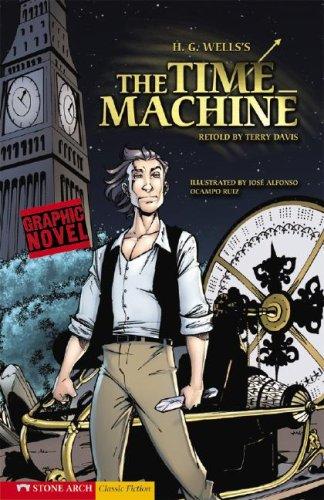
The Time Machine
Key Takeaways
Kyle, in 2025 in Books: Another movie that, while generally reviewed unfavorably, is one I always enjoyed and also think about often, is the 2002 rendition of The Time Machine. I’ve read the book its based on before, but revisiting it fit nicely into my science fiction world-building obsession this year. Wells’ speculations around how a world so effectively bifurcated into an underground cannibalistic work-horse species and a docile, unproblematic love-child above-ground species? That reflection was instructive.
Light-engagement read; no notes to synthesize. The highlights below stand on their own as the source’s argument.
Connections
People: Charles Darwin — the Time Traveller reads the Eloi/Morlock divergence through evolutionary theory (“unless biological science is a mass of errors”), framing degeneration as adaptation to security and ease. Aldous Huxley — author of the dystopian comfort-and-decay parallel below. George Orwell — author of the canonical political dystopia paired below.
Concepts: Science Fiction / Speculative Fiction — the novel is a foundational text of the genre, framing time as a navigable fourth dimension (“there are really four dimensions… a fourth, Time”). Utopia — the Eloi’s “too-perfect security” inverts the utopian promise into civilizational decay (“the dream of the human intellect… had committed suicide”). Entropy — the far-future vision of dwindling stars and the heat-death of activity, where “even the mere memory of Man… had been swept out of existence.” Capitalism — the Eloi (Haves, above ground) and Morlocks (Have-nots, the underground workers) as the endpoint of “the industrial system of to-day,” a “triumph over Nature and the fellow-man.” Historical Futurism / Progress Studies — the book’s central thesis that hardship and necessity drive intelligence (“intellectual versatility is the compensation for change, danger, and trouble”), so security breeds stagnation and decline.
Books: Brave New World — dystopia parallel; comfort, pleasure, and the engineered abolition of struggle producing a degenerate species. 1984 — companion political dystopia of a stratified, controlled future. 2034 — A Novel of the Next World War (stub), 2054 (stub) — speculative-fiction frame.
Highlights
- “I do not mean to ask you to accept anything without reasonable ground for it.
- “Clearly,” the Time Traveller proceeded, “any real body must have extension in four directions: it must have Length, Breadth, Thickness, and—Duration. But through a natural infirmity of the flesh, which I will explain to you in a moment, we incline to overlook this fact. There are really four dimensions, three which we call the three planes of Space, and a fourth, Time. There is, however, a tendency to draw an unreal distinction between the former three dimensions and the latter, because it happens that our consciousness moves intermittently in one direction along the latter from the beginning to the end of our lives.”
- There is no difference between Time and any of the three dimensions of Space except that our consciousness moves along it.
- And you cannot move at all in Time, you cannot get away from the present moment.” “My dear sir, that is just where you are wrong. That is just where the whole world has gone wrong. We are always getting away from the present moment. Our mental existences, which are immaterial and have no dimensions, are passing along the Time-Dimension with a uniform velocity from the cradle to the grave.
- “It sounds plausible enough to-night,” said the Medical Man; “but wait until to-morrow. Wait for the common sense of the morning.”
- I think that at that time none of us quite believed in the Time Machine. The fact is, the Time Traveller was one of those men who are too clever to be believed: you never felt that you saw all round him; you always suspected some subtle reserve, some ingenuity in ambush, behind his lucid frankness. Had Filby shown the model and explained the matter in the Time Traveller’s words, we should have shown him far less scepticism. For we should have perceived his motives; a pork butcher could understand Filby. But the Time Traveller had more than a touch of whim among his elements, and we distrusted him. Things that would have made the frame of a less clever man seemed tricks in his hands. It is a mistake to do things too easily. The serious people who took him seriously never felt quite sure of his deportment; they were somehow aware that trusting their reputations for judgment with him was like furnishing a nursery with egg-shell china.
- The Journalist too, would not believe at any price, and joined the Editor in the easy work of heaping ridicule on the whole thing. They were both the new kind of journalist—very joyous, irreverent young men.
- saddle. I suppose a suicide who holds a pistol to his skull feels much the same wonder at what will come next as I felt then.
- Strength is the outcome of need; security sets a premium on feebleness.
- What, unless biological science is a mass of errors, is the cause of human intelligence and vigour? Hardship and freedom: conditions under which the active, strong, and subtle survive and the weaker go to the wall; conditions that put a premium upon the loyal alliance of capable men, upon self-restraint, patience, and decision. And the institution of the family, and the emotions that arise therein, the fierce jealousy, the tenderness for offspring, parental self-devotion, all found their justification and support in the imminent dangers of the young. Now, where are these imminent dangers? There is a sentiment arising, and it will grow, against connubial jealousy, against fierce maternity, against passion of all sorts; unnecessary things now, and things that make us uncomfortable, savage survivals, discords in a refined and pleasant life.
- For countless years I judged there had been no danger of war or solitary violence, no danger from wild beasts, no wasting disease to require strength of constitution, no need of toil. For such a life, what we should call the weak are as well equipped as the strong, are indeed no longer weak. Better equipped indeed they are, for the strong would be fretted by an energy for which there was no outlet.
- This has ever been the fate of energy in security; it takes to art and to eroticism, and then come languor and decay.
- We are kept keen on the grindstone of pain and necessity, and, it seemed to me, that here was that hateful grindstone broken at last!
- I am too Occidental for a long vigil. I could work at a problem for years, but to wait inactive for twenty-four hours—that is another matter.
- For a queer notion of Grant Allen’s came into my head, and amused me. If each generation die and leave ghosts, he argued, the world at last will get overcrowded with them.
- So, in the end, above ground you must have the Haves, pursuing pleasure and comfort and beauty, and below ground the Have-nots, the workers getting continually adapted to the conditions of their labour. Once they were there, they would no doubt have to pay rent, and not a little of it, for the ventilation of their caverns; and if they refused, they would starve or be suffocated for arrears. Such of them as were so constituted as to be miserable and rebellious would die; and, in the end, the balance being permanent, the survivors would become as well adapted to the conditions of underground life, and as happy in their way, as the Upper-world people were to theirs.
- “The great triumph of humanity I had dreamed of took a different shape in my mind. It had been no such triumph of moral education and general co-operation as I had imagined. Instead, I saw a real aristocracy, armed with a perfected science and working to a logical conclusion the industrial system of to-day. Its triumph had not been simply a triumph over Nature, but a triumph over Nature and the fellow-man.
- The too-perfect security of the Upper-worlders had led them to a slow movement of degeneration, to a general dwindling in size, strength, and intelligence. That I could see clearly enough already. What had happened to the Under-grounders I did not yet suspect; but from what I had seen of the Morlocks—that, by the by, was the name by which these creatures were called—I could imagine that the modification of the human type was even far more profound than among the “Eloi,” the beautiful race that I already knew.
- felt pretty sure now that my second hypothesis was all wrong. The Upper-world people might once have been the favoured aristocracy, and the Morlocks their mechanical servants: but that had long since passed away. The two species that had resulted from the evolution of man were sliding down towards, or had already arrived at, an altogether new relationship. The Eloi, like the Carolingian kings, had decayed to a mere beautiful futility. They still possessed the earth on sufferance: since the Morlocks, subterranean for innumerable generations, had come at last to find the daylit surface intolerable. And the Morlocks made their garments, I inferred, and maintained them in their habitual needs, perhaps through the survival of an old habit of service. They did it as a standing horse paws with his foot, or as a man enjoys killing animals in sport: because ancient and departed necessities had impressed it on the organism. But, clearly, the old order was already in part reversed. The Nemesis of the delicate ones was creeping on apace. Ages ago, thousands of generations ago, man had thrust his brother man out of the ease and the sunshine. And now that brother was coming back changed!
- “Looking at these stars suddenly dwarfed my own troubles and all the gravities of terrestrial life. I thought of their unfathomable distance, and the slow inevitable drift of their movements out of the unknown past into the unknown future. I thought of the great precessional cycle that the pole of the earth describes. Only forty times had that silent revolution occurred during all the years that I had traversed. And during these few revolutions all the activity, all the traditions, the complex organizations, the nations, languages, literatures, aspirations, even the mere memory of Man as I knew him, had been swept out of existence.
- The brown and charred rags that hung from the sides of it, I presently recognized as the decaying vestiges of books. They had long since dropped to pieces, and every semblance of print had left them. But here and there were warped boards and cracked metallic clasps that told the tale well enough. Had I been a literary man I might, perhaps, have moralized upon the futility of all ambition. But as it was, the thing that struck me with keenest force was the enormous waste of labour to which this sombre wilderness of rotting paper testified. At the time I will confess that I thought chiefly of the Philosophical Transactions and my own seventeen papers upon physical optics.
- “I grieved to think how brief the dream of the human intellect had been. It had committed suicide. It had set itself steadfastly towards comfort and ease, a balanced society with security and permanency as its watchword, it had attained its hopes—to come to this at last. Once, life and property must have reached almost absolute safety. The rich had been assured of his wealth and comfort, the toiler assured of his life and work. No doubt in that perfect world there had been no unemployed problem, no social question left unsolved. And a great quiet had followed. “It is a law of nature we overlook, that intellectual versatility is the compensation for change, danger, and trouble. An animal perfectly in harmony with its environment is a perfect mechanism. Nature never appeals to intelligence until habit and instinct are useless. There is no intelligence where there is no change and no need of change. Only those animals partake of intelligence that have to meet a huge variety of needs and dangers.
Referenced in
- 2025 in Books essay
- Antifragility note
- Decadence note
- Evolution note
- H. G. Wells note
- Science Fiction note
- Speculative Fiction note
- Utopia note