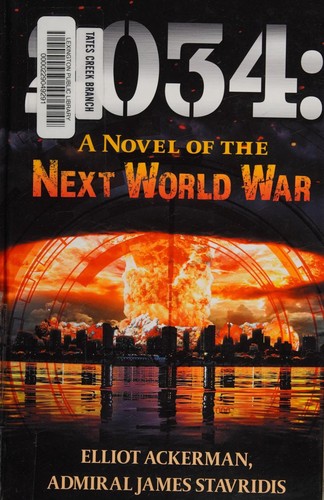
2034: A Novel of the Next World War
Key Takeaways
Kyle, in 2022 in Books: Big thanks to my good friend, Erin Price-Wright, for casually reading this book while we sat next to each other on a bus. As we talked about it, I couldn’t stop thinking about reading it.
I’ve never had the chance to work at venture firms before that were willing to invest in defense companies, but at Contrary we’ve invested in some exceptional companies like Anduril and Modern Intelligence. I’ve never served in the military, and the closest military service was both my grandpa’s, whose generation almost all served.
But I consider myself a realist when it comes to the necessity to build technology for modern warfare in a world where democracy is increasingly threatened.
Kyle, in 2024 in Books: The second re-read of the year, I decided to revisit this one as part of my defense deep dive. It was also a good lead-in to reading the sequel, 2054. This one, more than the sequel, always captures my attention because it feels so possible. Despite how foreboding it is, its based on realistic parameters in geopolitics, and feels important for anyone trying to day dream about the future of conflict.
Light-engagement read; no notes to synthesize. The highlights below stand on their own as the source’s argument.
Connections
People: Elliot Ackerman and James Stavridis — co-authors; the retired admiral’s operational experience grounds the novel’s Pacific naval-war and cyber scenarios.
Concepts: Foreign Policy — the book dramatizes American overreach, the Sino-Iranian-Russian alignment, and the limits of intervention. War — its through-line is miscalculation, the certainty that both sides expect to win, and the maxim that empires “rot from within.” Innovation — argues America’s deregulated, disaggregated tech ecosystem became a cyber vulnerability against China’s centralized infrastructure.
Books: 2054 — direct sequel by the same authors. The Kill Chain and Nuclear War — a Scenario — defense-scenario cluster on modern conflict, networked warfare, and escalation. The Art of War — directly quoted (“If you know the enemy and know yourself…”) as Lin Bao’s strategic frame. Science Fiction — near-future speculative scenario in the tradition of fiction-as-strategic-foresight.
Highlights
- “For there is no folly of the beast of the earth which is not infinitely outdone by the madness of men.” —Herman Melville
- Major Chris “Wedge” Mitchell hardly ever felt it… .
- This elusive it, which had held four generations of Mitchells in its thrall, was the sensation of flying by the seat of your pants, on pure instinct alone.
- “You don’t have time for this,” he said to Chowdhury, still picking through his diminishing bag of M&M’s. “Is that a threat?” “Not at all,” said Lin Bao, shaking his head sadly, feigning disappointment that Chowdhury would make such a suggestion. “I meant that your mother has been texting you, hasn’t she? Don’t you need to reply?
- “Can you get a secure VoIP connection with Seventh Fleet Headquarters?” Hunt asked the radioman, who nodded and then began reconfiguring red and blue wires into the back of an old-fashioned laptop normally used on the quiet midwatches for video games; it was primitive and so perhaps a more secure way to connect.
- Ever since the mid-2020s, when Iran had signed onto the Chinese “Belt and Road” global development initiative to prevent financial collapse after the coronavirus pandemic, they had helped project Chinese economic and military interests; but what was the scope of this seemingly new Sino-Iranian alliance?
- Those qualities Lin Bao had always admired in the Americans—their moral certitude, their single-minded determination, their blithe optimism—undermined them at this moment as they struggled to find a solution to a problem they didn’t understand. Our strengths become our weaknesses, thought Lin Bao. Always.
- What the Americans lacked—or lost somewhere along the way—was imagination. As it was said of the 9/11 attacks, it would also be said of the Wén Rui incident: it was not a failure of American intelligence, but rather a failure of American imagination. And the more the Americans struggled, the more trapped they would become.
- They knew everything already, including the smallest of details. Every exchange. Every gesture. Every word. Down to a single comment made about M&M’s. This was the point of the platters: to let Lin Bao know that nothing escaped their attention, lest he come to believe that any individual might assume an outsize role in this enterprise, lest he ever think that any one person could become greater than a single cog in the vast machinery of the People’s Republic—their republic.
- The egalitarian undercurrents ran much deeper in Western militaries than in his own, despite his country’s ideological foundation in socialist and communist thought. He was anything but a “comrade” to senior officers or officials, and he knew it well.
- On the political left and political right, old adversaries seemed willing to dispense with decades of antipathy in the face of this new aggression. It had taken the television networks and newspapers about a day, maybe two, to understand the magnitude of what had occurred in the South China Sea
- The lesson of the Maine—or even Iraq, where I fought—is that you better be goddamn sure you know what’s going on before you start a war.”
- Inherent in all wars, he knew, was a miscalculation; by their nature it had to exist. That’s because when a war starts both sides believe that they will win.
- The America that we believe ourselves to be is no longer the America that we are… .
- “Don’t you see?” she finally said, exasperated. “The technical details of what they did hardly matter. The way to defeat technology isn’t with more technology. It is with no technology. They’ll blind the elephant and then overwhelm us.” He gave her a confused, sidelong glance. “What elephant?” “Us,” she added. “We’re the elephant.”
- For days and then weeks, Farshad kept to his routine and eventually the phantom itching in his missing leg began to subside. He lived alone in his family’s empty home, hiking his three miles, taking his walk at lunch.
- After lunch he would return home and write through the afternoon. At night he prepared himself a simple dinner, and then he read in bed. His existence was reduced to this. After a career in command of hundreds and at times thousands of men, it surprised him how he enjoyed being responsible for himself alone. No one stopped by. The phone never rang. It was only him.
- The country of Clint Eastwood, of Dwayne Johnson, of LeBron James, it can’t imagine a nation like ours would submit to such humiliations for any other reason but weakness… . “But our strength is what it has always been—our judicious patience. The Americans are incapable of behaving patiently. They change their government and their policies as often as the seasons. Their dysfunctional civil discourse is unable to deliver an international strategy that endures for more than a handful of years. They’re governed by their emotions, by their blithe morality and belief in their precious indispensability. This is a fine disposition for a nation known for making movies, but not for a nation to survive as we have through the millennia… . And where will America be after today? I believe in a thousand years it won’t even be remembered as a country. It will simply be remembered as a moment. A fleeting moment.”
- Chowdhury knew that the board of inquiry had cleared Hunt of all culpability in the Battle of Mischief Reef and the loss of her flotilla, but he also knew the Navy had wanted to consign her defeat to a fluke. That would be far easier than taking a hard look at the circumstances that led to it. It would now be impossible for the Navy—or the nation—to ignore a disaster on this scale. Thirty-seven warships destroyed. Thousands of sailors perished.
- Chinese cyber dominance of the American forces was complete. A highly sophisticated artificial intelligence capability allowed the Zheng He to employ its cyber tools at precisely the right moment to infiltrate US systems by use of a high-frequency delivery mechanism.
- “In war, it’s not that you win. It’s how you win. America didn’t used to start wars. It used to finish them. But now”—Patel dropped his chin to his chest and began to shake his head mournfully—“now it is the reverse; now you start wars and don’t finish them.”
- Farshad had always understood, or at least understood intellectually, that his country and Russia had many shared interests. But with Kolchak, he began to understand the depth of their kinship, the degree by which their two nations had developed in tandem, sharing a trajectory. Both had imperial and ancient pasts; the Russian tsars, the Persian shahs. Both had endured revolutions; the Bolsheviks, the Islamists. And both had suffered the antipathies of the West: economic sanctions, international censure. Farshad also understood, or at least intuited, the opportunity now presenting itself to his Russian allies.
- If you know the enemy and know yourself, you need not fear the result of a hundred battles. If you know yourself but not the enemy, for every victory gained you will also suffer a defeat. If you know neither the enemy nor yourself, you will succumb in every battle.
- If the Americans had really wanted to threaten the Chinese, they would’ve launched a massive cyberattack. The only problem was they couldn’t—they lacked the capability to hack into China’s online infrastructure. The deregulation that had resulted in so much American innovation and economic strength was now an American weakness. Its disaggregated online infrastructure was vulnerable in a way that the Chinese infrastructure was not. “The Americans have proven incapable of organizing a centralized cyber defense,” said Minister Chiang. “Whereas we can shut down much of their country’s electric grid with a single keystroke. Their threat of nuclear retaliation is outdated and absurd, like slapping someone across the face with your glove before challenging them to a duel.
- His liaison duties consisted of little more than being a presence that evidenced two nations’ faithfulness to one another, even though neither of those nations had ever been renowned for faithfulness to anything but themselves. Farshad had once said as much in the wardroom to Kolchak, who had asked in reply, “Has a nation ever been faithful to anything but itself?” Farshad had conceded the point.
- As for the Chinese, they understand our actions intuitively. In their language the word for crisis and opportunity are one and the same.
- Watching the crowd, he began to think of the many names the people in it had for one another—whether it be mother, father, son, daughter, or simply friend—and how that might all vanish in an instant, in a flash, because of that single, other obliterating name we give to one another: enemy.
- Trent Wisecarver had called Chowdhury into his office and told him he would be “heading back to New Delhi.” The way Wisecarver had said “back” hadn’t sat well with Chowdhury. Amid this conflict, a resurgent nativism was beginning to possess the American psyche, as it had in other conflicts, a phenomenon Chowdhury had witnessed that night with Samantha at the empty City Lights restaurant. Perhaps Wisecarver hadn’t meant anything by it; perhaps when he said “back” he was referring to his prior mission to New Delhi to retrieve the downed Marine pilot. But Chowdhury couldn’t shake his suspicions.
- Decades of partisan division had taken their toll, and the administration was under fire from all sides, from the hawks who believed the tactical nuclear strike hadn’t gone far enough to the doves who believed America had abdicated its moral authority by employing such weapons.
- His country was the one that intervened—whether in the First World War, or the Second, in Korea or Vietnam, in the Balkans and later in Iraq, Afghanistan, and Syria. American intervention, if only occasionally successful, was always decisive among nations. But no longer.
- Lin Bao would always wait for the question he knew was coming, in which one of his students would ask why it all ended. What external threat overwhelmed the Delian League? What invader accomplished what the Persian fleet could not at Salamis? And Lin Bao would tell his students that no invader had come, no foreign horde had sabotaged the golden age forged by Miltiades, Themistocles, and Greece’s other forefathers. “Then how?” they would ask. “If the Persians couldn’t do it, who did?” And so, he would say, “The end came—as it always does—from within.”
- “Look over the ages,” he would assert, “from Britain, to Rome, to Greece: the empire always rots from within.”
- Most of his students, he knew, would underwhelm him. They would stare back in disbelief, or even hostility. Their assumption would always be that the time in which they lived could never be usurped; it was singular, as they believed themselves to be singular. Endemic dysfunction in America’s political life hardly mattered because America’s position in the world was inviolate. But a few of his students, their faces clear in his imagination, would return his stare as if his understanding had become their own.
- As he thought of the annihilation of two American cities, Farshad considered the ancient antipathies that existed toward the United States, deep antipathies, not merely those of his own nation but those of all the world. It was America’s perpetual overreach that had led to today’s events. How long could one country continue stoking up resentment before someone eventually struck a mortal blow? His word choice had been correct: inevitable.
- One might argue that the highest achievement for a soldier wasn’t to die on the battlefield, but rather to pass away quietly in a peace of his own creation.
- “You don’t understand,” her mother eventually said. “We are from nowhere and have nothing. We have come here to be from somewhere and to have something. That is what makes us American.”
- All the armies of Europe, Asia, and Africa combined, Lincoln had said, with all the treasure of the earth (our own excepted) in their military chest, with a Buonaparte for a commander, could not by force take a drink from the Ohio or make a track on the Blue Ridge in a trial of a thousand years… . If destruction be our lot we must ourselves be its author and finisher. As a nation of freemen we must live through all time or die by suicide.
- “Because no battle is ever won… . They are not even fought. The field only reveals to man his own folly and despair, and victory is an illusion of philosophers and fools.” —William Faulkner
- our Russian allies have unfettered access to the subsurface 10G internet cables that service the United States.
- You were on the bridge of the Rezkiy when the Russians sabotaged the undersea cables. The Americans never would have launched at Zhanjiang had that accident not occurred. That’s another word for you: accident.”
Referenced in
- 2022 in Books essay
- 2024 in Books essay
- 2054 book
- Belt and Road note
- Cyberwarfare note
- Decline of Empire note
- Elliot Ackerman note
- Foreign Policy note
- James Stavridis note
- Science Fiction note
- Sun Tzu note
- The Time Machine book
- War note