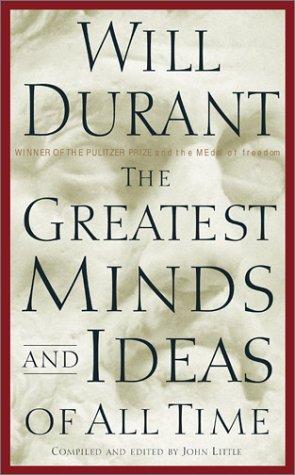
The Greatest Minds and Ideas of All Time
Key Takeaways
Kyle, in 2022 in Books: The second (and last) book in our book club was this overview of powerful ideas from different disciplines of thought throughout history. Will Durant wrote an 11-volume set called The Story of Civilization (there’s that storytelling theme again). After studying the history of civilization’s progress, he put down the most powerful ideas with this perspective:
“I see history not as a dreary scene of politics and carnage, but as the struggle of [humankind] through genius with the obdurate inertia of matter and the baffling mystery of mind; the struggle to understand, control, and remake [themself] and the world.”
Will Durant’s compressed intellectual history, read for two specific frames. Two threads:
-
Educated public as Confucian foundation. “The illustrious ancients, when they wished to make clear and to propagate the highest virtues…” — the same educated-electorate frame that runs through The Death of Expertise and Romney — A Reckoning showing up in pre-modern thought.
-
Progress can’t be defined by one tradition. Durant’s insistence on a non-parochial definition — tagged Progress Studies. The structural problem of evaluating “progress” without privileging the evaluator’s tradition.
Connections
People: Will Durant — author; his “Country of the Mind” framing of intellectual history. Confucius — opens Durant’s list of ten greatest minds; his “illustrious ancients” passage anchors the educated-public thread. Ralph Waldo Emerson — quoted (“Burn the libraries, for their value is in this book”) on the supremacy of great works. Charles Darwin — closes Durant’s list of ten; representative of the modern scientific mind.
Concepts: Progress Studies — Durant’s refusal to define progress by one nation/religion/morality, settling on “increasing control of the environment by life”; flagged in Kyle’s note. Educated Electorate — Confucius via Durant: a republic depends on keeping “ignorant persons from public office” and securing the wisest to rule. Polymath — Durant’s program of building one’s own pantheon across statesmen, scientists, poets, musicians, and artists. Education — the book’s prescription to treat education as “ennobling intimacy with great men,” seven hours a week toward a self-made scholar. Republic of Letters — the transmission of civilization through accumulated genius across “a hundred generations.”
Books: The Death of Expertise — educated-electorate thread; the dependence of self-government on an informed public. Reinventing Knowledge — From Alexandria To The Internet — institutional-knowledge history; libraries and the carrying-forward of learning. Romney — A Reckoning — democratic-epistemology overlap on rule by the wise versus the ignorant.
Highlights
- (he once noted that humor is akin to philosophy for they are both viewpoints born of a large perspective of life),
- he not only presents compelling evidence for his selections, but also stimulates the reader to form his or her own opinions and to look beyond immediate surroundings and present culture and into a timeless realm, which he called “The Country of the Mind,” a sort of cerebral retirement home wherein the heroes of our species dwell after having served their time and purpose in their respective eras and where to be human is something to be lauded.
- We cannot live long in that celestial realm of all genius without becoming a little finer than we were.And though we shall not find there the poignant delirium of youth,we shall know a lasting, gentle happiness, a profound delight which time cannot take from us until it takes all.
- OF THE MANY IDEALS which in youth gave life a meaning and radiance missing from the chilly perspectives of middle age, one at least has remained with me as bright and satisfying as ever before—the shameless worship of heroes.
- How natural it seemed to greet the great Indian poet Rabindranath Tagore by that title which so long had been given him by his countrymen, Gurudeva (“Revered Master”)—for why should we stand reverent before waterfalls and mountaintops, or a summer moon on a quiet sea, and not before the highest miracle of all: a man who is both great and good?
- No, the real history of man is not in prices and wages, nor in elections and battles, nor in the even tenor of the common man; it is in the lasting contributions made by geniuses to the sum of human civilization and culture.
- Therefore I see history not as a dreary scene of politics and carnage, but as the struggle of man through genius with the obdurate inertia of matter and the baffling mystery of mind; the struggle to understand, control, and remake himself and the world. I see men standing on the edge of knowledge, and holding the light a little farther ahead; men carving marble into forms ennobling men; men molding peoples into better instruments of greatness; men making a language of music and music out of lan-guage; men dreaming of finer lives-and living them. Here is a process of creation more vivid than in any myth; a godliness more real than in any creed.
- Thought and invention began: the bewilderment of baffled instinct begot the first timid hypotheses, the first tentative putting together of two and two, the first generalizations, the first painful studies of similarities of quality and regularities of sequence, the first adaptation of things learned to situations so novel that reactions instinctive and immediate broke down in utter failure.
- If ideas do not determine history, inventions do; and inventions are determined by ideas.
- There is no doubt that at the beginning and summit of every age some heroic genius stands, the voice and index of his time, the inheritor and interpreter of the past, the guide and pioneer into the future.
- We must embrace within it philosophers and scientists alone.We shall seek for those men who by their thinking, rather than by their action or their passion, have most influenced mankind.We shall search for them in the quiet places of the world, far from the madding crowd; in those obscure corners where great thoughts came to them “as on dove’s feet,” and where for a moment they saw, as in a transfiguration, the countenance of truth.
- The illustrious ancients,when they wished to make clear and to propagate the highest virtues in the world, put their states in proper order. Before putting their states in proper order, they regulated their families. Before regulating their families, they cultivated their own selves. Before cultivating their own selves, they perfected their souls. Before perfecting their souls, they tried to be sincere in their thoughts. Before trying to be sincere in their thoughts, they extended to the utmost their knowledge.
Kyle: Confucius - America depends on an educated public
- The greatest fortune of a people would be to keep ignorant persons from public office, and secure their wisest men to rule them.
- No wonder Emerson awarded to the Republic the words which the occasionally pious Omar had written of the Koran: “Burn the libraries, for their value is in this book.”
- What Dante did to the hopes and fears of the Catholic Renaissance, Aquinas did for its thought: unifying knowledge, interpreting it, and focusing it all upon the great problems of life and death.
- With him modernity begins.With him secularism begins.With him reason makes its French Revolution against a faith immemorially enthroned, and man commences his long effort to rebuild with thought the shattered palace of his dreams.
- But which of us is original except in form? What idea can we conceive today that has not enjoyed, in one garb or another, a hoary antiquity of time? It is easier to be original in error than in truth, for every truth displaces a thousand falsehoods. An honest philosopher will admit, like Santayana, that truth, in its outlines, is as old as Aristotle, and that all we need do today is to inform and vary the design with our transient needs.
- So vital was Kant’s work that in its outlines and its bases it remains to our own day unshaken and intact; has not science itself, through Pearson, Mach, and Poincaré, admitted that all reality, all “matter,” all “nature” with its “laws,” are but constructs of the mind, possibly but never certainly known in their own elusive truth?
- Well, there are our ten. Shall we see them in one glance? 1. Confucius 2. Plato 3. Aristotle 4. Saint Thomas Aquinas 5. Copernicus 6. Sir Francis Bacon 7. Sir Isaac Newton 8. Voltaire 8. Immanuel Kant 10. Charles Darwin
- It must be so; no list could exhaust the treasure of man’s heritage or equal its infinite variety. And it is well; let us have many lists and many heroes; we cannot honor them too much, or commemorate them excessively.
- Today we lead intricate and often introverted lives, in which action as the Greeks knew it is a rare exception, found chiefly in the press and gathered from afar; man is now an animal that stops and thinks. Therefore our literature is an analysis of motives and thought; it is in mental conflict that we find the profoundest wars and the darkest tragedies. But in Homer’s day life was action, and Homer was action’s prophet.
- Nothing so cleanses the dross out of a man as the creation of beauty or the pursuit of truth, and if the two are merged in one with him, as they were with Dante, he must be purified.
- It would not have been medieval had it not been an allegory: our human life is always a hell, says the poet, until wisdom (Virgil) purges us of evil desire, and love (Beatrice) lifts us to happiness and peace.
- A man should never read his reviewers, nor be too curious about the verdict of posterity.
- What we like in him most is the madness and richness of his speech. His style is as his life was, full of energy, riot, color, and excess; “nothing succeeds like excess.” It is all hurried and breathless, this style; Shakespeare wrote in haste, and never found leisure to repent. He never erased a line or read a proof;
- Life is beyond criticism, and Shakespeare is more alive than life.
- Worst of all, to leave Goethe aside, the very soul of Germany, who wrote in his youth like Heine, in his maturity like Euripides, and in his old age like a Gothic cathedral—confused and endlessly surprising;
- I have left no immortal work behind me—nothing to make my friends proud of my memory—but I have loved the principle of beauty in all things, and if I had had time I would have made myself remembered.’”
- He could not read history; it seemed to him an abominable record of miseries and crimes; in every age that he studied he sought out not the actual conduct and vicissitudes of men, but their poetry and their religion, their ideal feelings and desires;
- “Poetry,” he wrote, in his famous “Defense,”—“poetry, and the principle of Self, of which money is the visible incarnation, are the God and the Mammon of the world…. But it exceeds all imagination to conceive what would have been the moral condition of the world if neither Dante, Petrarch, Boccaccio, Chaucer, Shakespeare, Calderon, Lord Bacon nor Milton had ever existed; if Raphael and Michelangelo had never been born; if the Hebrew poetry had never been translated; if a revival of the study of Greek literature had never taken place; if no monuments of ancient sculpture had been handed down to us; and if the poetry of the religion of the ancient world had been extinguished together with its beliefs.”
- When she died, twenty-nine years later, it was found that her copy of Adonais contained (in a silken covering) the ashes of her dead lover, at that page which speaks of immortality, and the hope that springs forever in defeated men.
- What Homer had been to Greece,Virgil to Rome, Dante to Italy, Shakespeare to England, he was to be for America, because he dared to see in her, with all her faults, her material of song.
- They might learn many fine things if they came to it old enough, but our youngsters take so long to grow up in these complex days that they are too immature, when they enter college, to absorb or understand the treasures offered them there so lavishly. If you have studied with life rather than with courses, it may be as well; the rough tutelage of reality has ripened you into some readiness to know great men.
- Can you spare an hour a day? Or, if some days are too crowded with life and duty to give you leisure for these subtler things, can you atone for such bookless evenings by an extra hour or two on those Sunday mornings when the endless newspaper consumes you to no end? Let me have seven hours a week, and I will make a scholar and a philosopher out of you; in four years you shall be as well educated as any new-fledged Doctor of Philosophy in the land.
- But let us understand each other: you must not expect any material gain from this intimacy with great men. Some lucre may flow incidentally in later years from the maturity and background that you will win, but these dividends, like those of the insurance companies, are not in any way guaranteed. Indeed, you will be “losing time” from your profession or your business; if you long for millions you had better lay aside this map of the City of God, and keep your nose to the earth.
- everywhere.We want here not entertainment only, but education, and we want it in such order that the knowledge we win may fall into logical sequence in our memories, and give us at last that full perspective which is the source and summit of understanding.
- Read actively, not passively: consider at every step whether what you read accords with your own experience, and how far it may be applied to the guidance of your own life. But if you disagree with an author, or are shocked by his heresies, read on nevertheless; toleration of differences is one mark of a gentleman. Make notes of all passages that offer help toward the reconstruction of your character (not someone else’s character) or the achievement of your aims, and classify these notes in such a way that they may at any moment, and for any purpose, be ready to your hand.
- The Romans do not give us so much, for though they admirably laid the foundations of social order and political continuity for the nations of modern Europe, they lost themselves too much in laws and wars, in building roads and sewers and warding off encompassing barbarians, to snatch from their hard lives the quiet thought that flowers in literature, philosophy, and art.Yet
- Apparently beauty is born in suffering, and wisdom is the child of grief.
- These are sad books, but by the time we reach the end of our list we shall be strong enough to face truth without anesthesia.
- This, then, is our Odyssey of books. Here is another world, containing the selected excellence of a hundred generations; not quite so fair and vital as this actual world of nature and human enterprise, but abounding nevertheless in unsuspected wisdom and beauty unexplored.
- THE BOOKS The Road To Freedom: Being One Hundred Best Books for an Education GROUP I. INTRODUCTORY 1. THOMSON, J. A., The Outline of Science. 4 v. 2. CLENDENING, LOGAN, The Human Body. *3. KELLOGG, J. H., The New Dietetics; pp. 1-531, 975-1011. 4. JAMES, Wm., Principles of Psychology. 2 v. *5. WELLS, H. G., The Outline of History; chapters 1-14. 6. SUMNER,W. G., Folkways. 7. FRAZER, SIR JAS., The Golden Bough. 1-vol. ed. GROUP II. ASIA AND AFRICA *8. BREASTED and ROBINSON, The Human Adventure. 2v.Vol. 1, chs. 2-7. 5. WELLS, chs. 15-21, 26. 9. BROWN, BRIAN, The Wisdom of China. *10. The Bible: Genesis, Exodus, Ruth, Esther, Job, Psalms, Proverbs, Ecclesiastes, Song of Solomon, Isaiah, Amos, Micah, the Gospels, Acts of the Apostles, and Epistles of St. Paul. *11. FAURE, ELIE, History Of Art. 4v. Vol. I, chs. 1-3; vol. II, chs. 1-3. 12. WILLIAMS, H. S., History of Science. 5v. Bk. I, chs. 1-4. GROUP III. GREECE 8. BREASTED and ROBINSON, vol. I, chs. 8-19. 5. WELLS, chs. 22-25. 13. BURY, J. B., History of Greece. 2 v. 14. HERODOTUS, Histories. (Everyman Library.) 15. THUCYDIDES, The Peloponnesian War. (Everyman Library.) *16. PLUTARCH, Lives of Illustrious Men (esp. Lycurgus, Solon, Themistocles, Aristides, Pericles, Alcibiades, Demos-thenes, Alexander). 17. MURRAY, G., Greek Literature. 18. HOMER, Iliad. Trans. Bryant. Selections. 19. HOMER, Odyssey. Trans. Bryant. Selections. 20. AESCHYLUS, Prometheus Bound. Trans. Eliz. Browning. 21. SOPHOCLES, Oedipus Tyrannus and Antigone. Trans.Young. (Everyman Library.) 22. EURIPIDES, all plays so far translated by Gilbert Murray. 23. DIOGENES LAERTIUS, Lives of the Philosophers. *24. PLATO, Dialogues. Trans. Jowett. Esp. The Apology of Socrates, Phaedo, and The Republic (sections 327-32, 336-77, 384-85, 392-426, 433-35, 481-83, 512-20, 572-95). 1-vol. ed. by Irwin Edman. 25. ARISTOTLE, Nicomachean Ethics. 26. ARISTOTLE, Politics. 12. WILLIAMS, History of Science, bk. I, chs. 5-9. 11. FAURE, History of Art, vol. I, chs. 4-7. GROUP IV. ROME 8. BREASTED and ROBINSON, vol. I, chs. 20-30. 5. WELLS, chs. 27-29. 16. PLUTARCH, Lives (esp. Cato Censor, Tiberius and Caius Gracchus, Marius, Sylla, Pompey, Cicero, Caesar, Brutus, Antony). 27. LUCRETIUS, On the Nature of Things. Trans. Munro. (Certain passages are admirably paraphrased in W. H. Mallock, Lucretius on Life and Death. ) 28. VIRGIL, Aeneid. Trans.Wm. Morris. Selections. *29. MARCUS AURELIUS, Meditations. (Everyman Library.) 12. WILLIAMS, bk. I, chs. 10-11. 11. FAURE, vol. I, ch. 8. *30. GIBBON, E., Decline and Fall of the Roman Empire. 6 v. (Everyman Library.) Esp. chs. 1-4, 9-10, 14, 15-24, 26-28, 30-31, 35-36, 44, 71. GROUP V. THE AGE OF CCHRISTIANITY 8. BREASTED and ROBINSON, vol. II, chs. 1-11. 5. WELLS, chs. 30-34. 30. GIBBON, chs. 37-38, 47-53, 55-59, 64-65, 68-70. *31. OMAR KHAYYAM, Rubaiyat. Fitzgerald’s paraphrase. 32. MOORE, GEO., Heloise and Abelard. 2 v. 33. DANTE, Divine Comedy. Trans. Longfellow, or C. E. Norton. *34. TAINE, H., History of…
- INTHE YEAR 1794 a young French aristocrat by the magnificent name of Marquis Marie Jean de Condorcet was hiding from the guillotine in a little attic room on the outskirts of Paris. There, far from any friend, lest the coming of a friend should reveal his hiding place, he wrote the most optimistic book ever penned by the hand of man, Esquisse d’un tableau des progrès de l’esprit humain (A Sketch of a Tableau of the Progress of the Human Spirit). Eloquently he described the recent liberation of science from the shackles of superstition and gloried in the triumphs of Newton. “Given 100 years of liberated knowledge and universal free education,” he said, “and all social problems will, at the close of the next century, have been solved…. There is no limit to progress except the duration of the globe upon which we are placed.”
- Search through all ancient Greek and Latin literature, and you will find no affirmatory belief in human progress.
- What shall we mean by “progress”? Subjective definitions will not do; we must not conceive progress in terms of one nation, or one religion, or one code of morals; an increase of kindness, for example, would alarm our young Nietzscheans. Nor may we define progress in terms of happiness, for idiots are happier than geniuses, and those whom we most respect seek not happiness but greatness. Is it possible to find an objective definition for our term—one that will hold for any individual, any group, even for any species? Let us provisionally define progress as “increasing control of the environment by life,” and let us mean by environment “all the circumstances that condition the coordination and realization of desire.” Progress is the domination of chaos by mind and purpose, of matter by form and will.
Kyle: Progress Studies
- If we find that civilizations come and go, and mortality is upon all the works of man, we shall confess the irrefutability of death, and be consoled if, during the day of our lives and our nations, we move slowly upward, and become a little better than we were.
- Our problem is whether the total and average level of human ability has increased, and stands at its peak today.
- As to happiness, no man can say; it is an elusive angel, destroyed by detection and seldom amenable to measurement. Presumably it depends first upon health, secondly upon love, and thirdly upon wealth.
- For civilization came through two things chiefly: the home, which developed those social dispositions that form the psychological cement of society, and agriculture, which took man from his wandering life as hunter, herder, and killer, and settled him long enough in one place to let him build homes, schools, churches, colleges, universities, civilization.
- Without consciousness of it, we partake in a luxurious patrimony of social order built up for us by a hundred generations of trial and error, accumulated knowledge, and transmitted wealth.
- We think there is more violence in the world than before, but in truth there are only more newspapers; vast and powerful organizations scour the planet for crimes and scandals that will console their readers for stenography and monogamy; and all the villainy and politics of five continents are gathered upon one page for the encouragement of our breakfasts.
- We have not excelled the selected geniuses of antiquity, but we have raised the level and average of human knowledge far beyond any age in history.
- What will the full fruitage of education be when every one of us is schooled till twenty, and finds equal access to the intellectual treasures of the race?
- We dislike education, because it was not presented to us in our youth for what it is. Consider it not as the painful accumulation of facts and dates, but as an ennobling intimacy with great men. Consider it not as the preparation of the individual to “make a living,” but as the development of every potential capacity in him for the comprehension, control, and appreciation of his world.
- He should know the centuries of the world’s greatest statesmen—say Hammurabi, Moses, Darius I, Solon, Pericles, Alexander, Caesar, Charles V, Louis XIV, Peter the Great, Frederick the Great, Henry VIII, Elizabeth, Disraeli, Gladstone, Bismarck, Cavour, Washington, Hamilton, Jefferson, and Lincoln; of the world’s greatest scientists and philosophers—say Confucius, Socrates, Plato, Aristotle, Copernicus, Francis Bacon, Isaac Newton, Spinoza, Voltaire, Kant, Schopenhauer, and Darwin; of the world’s greatest saints—say lknaton, Lao-tzu, Isaiah, Buddha, Christ, Marcus Aurelius, Augustine, Francis of Assisi, Loyola, Luther, and Gandhi.
- This man of intellectual interests should also know the centuries of the world’s greatest poets—say Homer, the Psalmist, Euripides, Virgil, Horace, Lipo, Dante, Shakespeare, Milton, Goethe, Pushkin, Keats, Byron, Shelley, Hugo, Poe, Whitman, and Tagore; of the world’s greatest makers of music—say Palestrina, Bach, Handel, Mozart, Beethoven, Chopin, Liszt, Paganini, Brahms, Tschaikowsky,Verdi,Wagner, Paderewski, and Stravinsky; and of the world’s greatest artists or works of art—say Karnak and Luxor and the Pyramids, Pheidias and Praxiteles, Wu Tao-tzu and Sesshiu and Hiroshige, Chartres and the Taj Mahal, Giotto and Dürer, Leonardo, Raphael, and Michelangelo, Titian and Correggio, El Greco and Velázquez, Rubens, Rembrandt, and Van Dyck, Reynolds and Gainsborough, Turner and Whistler, Millet and Cezanne.
- The reader can help me by making here his own pantheon. Let him then examine his friends and himself on the centuries and work of these men (perhaps we should also add a list of great women, from Queen Hatshepsut to Madame Curie), and so rate them and himself with a new Binet-Simon test.
- Nothing is new in China, democracy least of all. They invented gunpowder and used it chiefly for fireworks. They invented printing and never used it for tabloid newspapers, crime club fiction, or Freudian biographies.
- Our empowered middle class has profited by the example and has made literacy an impediment to the acquisition of truth. One hardly knows, today, whether printing does more harm than good, or whether the growth of knowledge and learning has not weakened character as much as it has stocked the mind—but let us try it a little further!
- Voltaire might say, “I have no scepter, but I have a pen.”
- I never cease admiring the French Enlightenment; all in all I consider it the peak of human history, greater even than Periclean Greece, or Augustan Rome, or Medicean Italy. Never had men thought so bravely, spoken so brilliantly, or lifted themselves to a greater height of culture and courtesy. “Alas!” said Louis XVI, standing in his Temple prison before the books of Voltaire and Rousseau, “these are the men that have destroyed France.” Yes, they had destroyed one France, but they had liberated another, not to speak of freeing America through their disciples, Washington, Franklin, and Jefferson.
- be.We are all born within frontiers of space and time and, struggle as we will, we never escape from our boxes.
- I let the reader, then, make his own lists, helping himself to what he likes in mine. Let him try to build for himself another perspective and unity that shall clarify human development for him. And let him remember the words which Napoleon bequeathed to the duke of Reichstadt at St. Helena: “May my son study history, for it is the only true psychology, and the only true philosophy.”
Referenced in
- 2022 in Books essay
- Confucius note
- Dante note
- Educated Electorate note
- French Enlightenment note
- Hero Worship note
- Our Oriental Heritage book
- Polymath note
- Ralph Waldo Emerson note
- Voltaire note
- Will Durant note