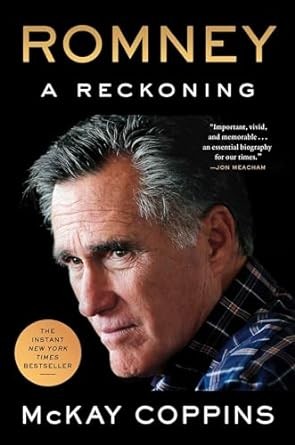
Romney: A Reckoning
Key Takeaways
Kyle, in 2024 in Books: I’ve always been a fan of Mitt Romney. I was a missionary for The Church of Jesus Christ of Latter-Day Saints when he ran for president in 2012 and it created an exceptional opportunity to talk about my faith. Later, I spent some time working with Solamere Capital, which was run by his son, Tagg Romney. That was where I first got to meet Mitt, only very briefly. But every interaction I saw him in, my respect grew. This book is the perfect encapsulation of why he is such a respectable figure despite liberals not thinking he’s brave enough or Republicans not thinking he’s Republican enough.
McKay Coppins’s Romney biography read with explicit admiration — and with a politics-of-character thesis that emerges across the notes. Seven threads:
-
Beliefs as leading vs. lagging indicators of group membership. The single sharpest insight in the notes. The post-2016 GOP shift inverted the relationship — beliefs became downstream of tribe rather than upstream. Romney as the counter-example.
-
Data over dogma. Tagged explicitly. Policy through the lens of human outcomes, not partisan signaling. “Truth, obscured by nuance and buried under trifles” — the failure mode.
-
Politics will always fetter language. A recurring frustration. Language reduced to signal, not content. The Newt Gingrich pattern from The Death of Expertise resurfaces.
-
“Live your life so that your children will live their lives hoping to make you proud.” The single most quoted line, treated as the actual rubric. Tagg’s letter to his father is the emotional center of the notes.
-
Educated and informed electorate. Cross-reference to The Death of Expertise. Romney’s basic premise: voters can be trusted with hard truths if they’re presented as truths. The fact that this premise is now contested is the diagnosis.
-
“What you take pride in defines you as a person.” Identity is downstream of what you choose to honor, not what you happen to be. Connects to The Self-Driven Child’s identity-formation thread.
-
Incrementalism > stagnation or decline. The implicit political philosophy — small forward steps beat both the maximalist revolution and the resigned drift.
A side observation worth flagging: the response here is unusually approving relative to the rest of the library. Most reads carry skepticism or active disagreement; this one is closer to advocacy.
Connections
Books:
- The Death of Expertise — sister book on democratic-electorate epistemology; Romney’s premise that “voters can be trusted with hard truths” and the Gingrich “Language: A Key Mechanism of Control” memo are what Nichols’s argument looks like in practice.
- No Apology — Romney’s earlier book; same author-as-subject corpus.
- Turnaround — Romney’s Olympics turnaround book; the operational, problem-solving “fix things” instinct that defined his Bain and Senate work.
- The Founders — adjacent on character-of-leadership questions, very different domain.
- Profiles in Courage — JFK’s analog frame; same conscience-over-tribe thesis dramatized in Romney’s lone impeachment vote.
- Shortest Way Home — Pete Buttigieg’s adjacent character-driven political memoir.
- The Self-Driven Child — the “what you take pride in defines you” identity-formation thread runs through both.
People:
- Mitt Romney — the subject; beliefs as leading rather than lagging indicators of group membership, and the “weight of conscience” question he posed on the Senate floor.
- McKay Coppins — the biographer and frame.
- Tagg Romney — the son whose letter to his father is the emotional center of the notes; “live your life so that your children will live their lives hoping to make you proud.”
- Donald Trump — the antagonist whose rise inverted the GOP’s belief-to-tribe relationship and made “moral tests” the recurring frame.
- Newt Gingrich — architect of language-as-control politics; his “speak like Newt” memo recurs as the fetter-language pattern.
- Pete Buttigieg — referenced as part of the adjacent character-driven political-memoir lineage.
- Upton Sinclair — invoked behind Romney’s “see circumstances in the light most amenable to maintaining power” observation (“Job preservation above principle preservation”).
Concepts:
- Voice of the People — the trust-the-electorate premise Romney holds and the book interrogates.
- Educated Electorate — “voters can be trusted with hard truths if they’re presented as truths”; the free-press essay defends its preconditions.
- Data Over Dogma — Romney’s policy-through-human-outcomes instinct vs. “the rank commitment to dogma over practical outcomes.”
- Incrementalism — “take what you can get and build off it”; small forward steps over stagnation or decline.
- Term Limits — the Senate “job preservation as existential” pathology Romney diagnoses.
- Conviction — the Yeats line “the best lack all conviction, while the worst are full of passionate intensity” as Romney’s read on the new GOP.
- Authenticity — “let Mitt be Mitt”; the gap between staged personas and saying what he actually meant.
- Civic Virtue — conscience and oath weighed against political fortune; the workhorse-vs-performance Senate ethic.
- Capitalism — “corporations are people”; Romney as committed capitalist who believed free enterprise the best antidote to poverty.
- Authoritarianism — the histomap obsession and “authoritarianism is like a gargoyle lurking over the cathedral.”
- Rationalization — Romney’s “remarkable ability to justify his choices to himself” on abortion and shifting positions.
- Service — the mission lesson that sacrifice has “its own sanctifying effect,” and “a purpose greater than self is what motivates now.”
- Spirit of Humility — Romney’s discomfort ascribing political ambition to God; “one of life’s great imponderables.”
- Mormon — the faith he refused to recast as mere heritage, the one part he wouldn’t compromise.
- Politics — the broader frame of language fettered, beliefs as tribe-membership, and conscience under partisan pressure.
Highlights
- “Do we weigh our own political fortunes more heavily than we weigh the strength of our republic, the strength of our democracy, and the cause of freedom? What is the weight of personal acclaim compared to the weight of conscience?” (Mitt Romney, January 6, 2021)
- But Romney’s disillusionment and alienation during the Trump era had freed him to look at the GOP with clearer eyes-and he wasn’t sure he liked what he saw. “A very large portion of my party,” he told me one day, “really doesn’t believe in the Constitution.” He’d realized this only recently, he said, and it came as a surprise.
- Shortly after moving into his Senate office, Romney had hung a long rectangular map on the wall. First printed in 1931 by Rand McNally, the “histomap” attempted to chart the rise and fall of the world’s most powerful civilizations through four thousand years of human history. When he first acquired the map, he saw it as a curiosity. After January 6, he became obsessed with it. He showed the map to visitors, brought it up in conversations and speeches. More than once, he found himself staring at it alone in his office at night. The Egyptian empire reigned for some nine hundred years before it was overtaken by the Assyrians. Then the Persians, the Romans, the Mongolians, the Turks each civilization had its turn, and eventually collapsed in on itself. Maybe the falls were inevitable. But what struck Romney most about the map was how thoroughly it was dominated by tyrants of some kind-pharaohs, emperors, kaisers, kings. “A man gets some people around him and begins to oppress and dominate others,” he said the first time he showed me the map. “It’s a testosterone-related phenomenon, perhaps. I don’t know. But in the history of the world, that’s what happens.” America’s experiment in self-rule “is fighting against human nature.” “This is a very fragile thing,” he told me. “Authoritarianism is like a gargoyle lurking over the cathedral, ready to pounce.” For the first time in his life, he wasn’t sure if the cathedral would hold.
- Competing for attention amid the cacophony of speakers in Tower Hill Square wasn’t easy, but George proved resourceful. He partnered with a red-bearded socialist who frequented the square, and the two of them took turns heckling each other to stir up interest from the crowd.
- But swimming against the tide came naturally to George. “When a Romney drowns,’ a Mormon leader once observed of George’s ancestors, “you look for the body upstream.”
- “You need to understand,” George replied, “that just being right or just being best doesn’t mean that most people will agree with you.”
- When the journalist Theodore White met him, he observed that George possessed “a sincerity so profound that, in conversation, one was almost embarrassed.”
- George saw himself as carrying on a righteous tradition that had defined his party from Abraham Lincoln to Dwight Eisenhower. But tectonic shifts were taking place in the Grand Old Party. Insurgents were taking over. Just a year after George was sworn in, Barry Goldwater―a radical right-wing senator from Arizona who opposed the Civil Rights Act of 1964 and wanted to purge liberals from the Republican Party-shocked the political world by capturing the presidential nomination. George was appalled by Goldwater, but he was even more dismayed by his followers-a motley horde of John Birchers, conspiracy theorists, and overtly racist segregationists who had arrayed themselves under a banner they called “conservatism.” They were, in his estimation, “extremists” and “purveyors of hate,” noxious outsiders hell-bent on “infiltrating” his party.
Kyle: It’s happened before
- The warning went unheeded, and a couple nights later the delegates enthusiastically lined up to support Goldwater, who declared victory by needling his do-gooding detractors. “Extremism in the defense of liberty is no vice,” he said in his speech. When the convention hall erupted in applause, George remained quietly seated. His teenage son, who’d traveled with him to San Francisco, an “associate delegate” badge dangling around his neck, had only a limited understanding of what was going on, but he was sure of one thing. “If thousands of people were cheering and Dad was standing alone, I knew he was right and they were wrong,” Mitt would tell me.
- The rant felt like one he’d recited a thousand times before. And yet, some part of him-the part that saw his dad’s story as not just a heroic parable but a cautionary tale-also knew that it didn’t matter. George Romney’s presidential campaign-noble, idealistic, maybe a little naive-was felled by his most admirable and selfdestructive quality: a stubborn insistence on telling the truth.
- The Romneys had high hopes for their precocious youngest son. They saw his potential, and in some ways, they saw themselves in him. George delighted in arguing with Mitt, their debates often dominating the family dinner table until both were laughing and gasping for breath. On road trips, Lenore read aloud from the poetry of Sam Walter Foss-Bring me men to match my mountains and Tennyson’s Idylls of the King. But the calls to greatness fell flat. Mitt loved his parents, but he felt little drive to rise to their expectations.
- Mitt spent a year studying at Stanford, and when the time came he submitted his papers to serve a thirty-month mission. He prayed for an assignment to Great Britain, where his father and greatgrandfather had served. George even called in a favor with a friend on the Church’s missionary committee, who said he would do his best. But when Elder Thomas S. Monson, an apostle in the church, reviewed the list of missionary assignments, he stopped at Romney’s name and said, “That’s the wrong mission. He’s supposed to go to France.“
- Romney’s room did not fill with light when he read the passage; he did not receive a vision. But it struck him with the force of something divine. Our sacrifices were accepted. This was the point of his mission, he now realized-doing the hard thing, making the sacrifice. Maybe it would yield fruit, maybe it wouldn’t. But the difficulty and deprivation would have their own sanctifying effect, and that was reason enough to keep trying.
Kyle: “It is enough”
- Now Romney was glimpsing the peace of mind that came from setting aside personal striving for the sake of service. In a letter to his parents, he wrote, “Getting up at 6:00-cold, tired, allergic, broke, but without a worry in the world; living for others, dependent only upon God; joy when you hear of others’ successes-where would I have ever known these things if it weren’t for a mission?” He was beginning to see his time in France as the beginning of a grand future: “If I keep in the same stream, my joy will double, triple, and be multiplied eternally. Eternal wedlock, service to the Church, children, service to the world and my country! The Lord must have loved us to give us all this joy.”
- Romney, who majored in English, considered going into academia. He loved books, saw them as puzzles to be solved, and imagined a life spent poring over Shakespeare, Steinbeck, and Dickens. But his favorite professor talked him out of it. “You can afford to read all the books you’d like,” he said. “Why would you get a PhD and starve?” The professor suggested an MBA or a law degree; Romney decided to get both.
- At Harvard, there’s a lot of people who believe the word ‘Harvard’ entitles them to think they’re smarter than everybody else. Mitt Romney was not that way.
- But there were also moments of quiet. At night, they had a tradition of gathering in the living room, turning off the lights, and having an uninhibited conversation where the boys were encouraged to share whatever was on their minds. “As a teenager, it’s hard to talk openly with your parents,” Tagg would recall. “It was a good time to be able to express doubts, share concerns, question things, and be able to not feel like your parents were looking at you and judging you.”
- But as talented as he was, Romney realized that he would never be one of Bain’s “rainmakers.” The consultants who brought in the most money were the ones who put in the extra hours on the golf course; who took out clients for long, luxurious dinners; who schmoozed. Romney did not schmooze. “As soon as I had solved the problem before me, I wanted to be home with my kids,” he said.
- Romney discovered, during these episodes, a remarkable ability to justify his choices to himself. It’s not that he was without a moral compass; his conscience was well developed and frankly rather pushy. But he found it could sometimes be appeased with sufficient effort. “I have learned through my life experience… that it’s human to rationalize what’s in our best interest,” he’d tell me. It was a trait he’d wrestle with for the rest of his life-never more so than when he entered politics.
Kyle: “Just remember that when we talk about cost synergies we’re talking about people’s livelihoods.” (Mitt Romney @ Solamere)
- That night, she told him that she’d had a strange impression while praying: This will be, for us, like Zion’s Camp. As a convert, Ann was not steeped in Mormon history, and wasn’t even sure she knew what the term referred to. Mitt told her the whole story: that “Zion’s Camp” was a nineteenth-century expedition led by the early Mormons to reclaim territory that had been seized from them in Missouri; that the expedition was disbanded amid a deadly cholera outbreak before any land was reclaimed; that while the expedition failed, the men involved were strengthened by their trials and prepared for things to come. By the time he finished, Romney knew he was going to run.
- He’d seen how his dad, a much greater man than him, had been quelled by a gaffe, and so he was careful to rely on the counsel of the political professionals on his staff. But what this meant, in practice, was that he was never quite allowed to say what he actually meant. Early on, when a Republican primary opponent attacked him for having donated to Democrats, Romney wanted to respond, “There are good people in both parties and I give to the ones I believe in.” But his advisers vetoed the language: there would be no talk of “good people” on the other side while trying to win the GOP nomination.
Kyle: Politics will always fetter language.
- Eventually, Romney staked out a tortured position on the issueneither pro-choice nor pro-life, but tepidly supportive of the status quo. If elected, he pledged, he would not vote for any changes to current abortion law. It didn’t feel at the time like selling out. It never really does. “I had convinced myself that I was right,” he’d later reflect. “I mean, I could have taken a lie detector test. . That’s the point of rationalizing. You don’t have to live with it.”
- Losing was hard enough for Mitt, but what really bothered him was that after all the speeches and ads and endless campaigning, after dragging his exhausted wife across the state and plowing millions of dollars of their own money into the race, most people could still not answer the question “Why did Mitt Romney run for Senate and what does he stand for?” One longtime Republican would later tell reporters, “His main cause appeared to be himself.
- The architect of the so-called “Republican Revolution” was an ambitious congressman out of Georgia named Newt Gingrich. A former history professor, Gingrich had pioneered a ruthlessly effective style of politics that fed on conspiracy theories about Bill Clinton and brought strategic obstructionism to Congress. To train a new generation of conservatives in political warcraft, he’d even sent out cassette tapes to candidates throughout the country who wanted to “speak like Newt,” providing them with a new vocabulary. In one memo, titled “Language: A Key Mechanism of Control,” Gingrich included a list of recommended words to use in describing Democrats: sick, pathetic, anti-flag, traitors, radical, corrupt.
Kyle: Gosh…
- “You know,” Trump went on, “the bank has me on $140,000 a month.” Romney was confused. “What do you mean?” Trump explained that his businesses owed more than a billion dollars to dozens of lenders. “The only chance they have of getting anything back is if we keep up appearances,” he said. “So, they loan me $140,000 a month” to maintain the Trump brand. He seemed tickled by this fact, as if he was getting away with something hilarious.
Kyle: What you take pride in defines you as a person
- In truth, he was scared, too. Ann was the focal point of his life. He’d never lost the infatuated thrill he first felt when they met as teenagershad never really stopped chasing her. Other men in his circle tacked on extra days to their international business trips for sightseeing and extravagant dinners; Romney had no interest unless his wife was with him. When he visited Paris with Ann, they’d stroll endlessly down the boulevards, stopping in at favorite cafés for pain au chocolat. When he traveled to the city for work, he’d eat at McDonald’s and turn in early. The life they’d built together didn’t make sense without Ann. Losing her would feel like losing everything.
Kyle: Camden in NYC
- The death of his father had made him question how he was spending his time. Those 1,200 people who’d gathered for George Romney’s funeral in Michigan had not turned out to mourn a savvy businessman who excelled at outperforming quarterly profit expectations—they were mourning a public servant. And as much as Mitt enjoyed making deals and turning around companies, he worried that he should be doing more with his life.
Kyle: Tagg’s letter
- A week before the opening ceremonies, he led a small group of Mormon leaders on a tour of the venue. When the walk-through ended, the leaders began filing into an elevator. Perhaps sensing Romney’s obsessiveness, Gordon B. Hinckley-the president of the Church, and a man considered by Mormons to be a prophet with a direct line to God-held the door to ask a question. “What would be the ideal weather for the opening ceremonies?” “Crispy cold, with just a hint of snow,” Romney said. “Okay,” the prophet deadpanned, “I’ll take care of it.”
- Critics like Bullock tended not to bother Romney too muchtheir criticism was too blinkered to be taken seriously. But he found them fascinating. Romney considered himself a nice enough guy. He got along with most people. But as he got older, he was forced to acknowledge that something about him inspired a passionate loathing in certain people. “Throughout my life, there’s always one person who just can’t stand me,” he’d reflect.
- The consultant had a condition before he agreed to sign on. “You can’t read any newspaper articles about your campaign,” he told Romney. “None.” Murphy had seen too many candidates become obsessed with their negative press coverage. “We’ll lose every day in the papers,” he warned, and “you’ll be inclined to respond to some twenty-two-year-old [reporter] who wrote some nasty article that no one actually read.” Ignore the Globe, Murphy said. “You’ll win the race on TV.”
- Romney was not an ideologue. He prided himself on this fact. Though he was a Republican, he had no patience for Rush Limbaugh and never read the National Review. If he adhered to any kind of conservatism at all, it was of the small-c variety. He was a believer in fiscal prudence and sober thinking, in well-produced white papers and the Wall Street Journal, in spreadsheets and data and running the numbers one more time. He saw himself, proudly, as a partisan of pragmatism.
- “I don’t look and say, ‘What’s the conservative point of view on this? and then try to promote it,” Romney told me. “I ask, ‘What do I think is the right answer to this particular problem?’ and then promote that For instance, my healthcare plan in Massachusetts-that was just, you know, we’ve got a problem… here’s a great way to solve it. And then I found out, ‘Hey, some people at Heritage agree with you.’ Aha! It’s a conservative plan! But I learned Heritage had proposed something similar well after I proposed my plan.”
Kyle: Beliefs should be leading indicators, not lagging indicators of group membership.
- But something strange, almost alchemical, happened to Romney when he got in front of those crowds. He would walk into the county fairs and the convention halls with a plan to talk about his unemployment record in Massachusetts only to realize that the people in attendance didn’t want to hear it-they wanted to hear about guns and killing terrorists and the evils of abortion. “When you speak to the NRA, you change your tone,” he would later tell me. “I admit it. You say the things that make the audience respond positively.”The more he gave them what they wanted, the louder their ovations got. A new incentive structure took shape on those stages. A new persona formed
- What he did not say was that character and integrity only take you so far-political savvy was what got you to the White House. His father had lacked in that department; Romney was confident that he wouldn’t.
- Years later, after he had watched most of them breathlessly sell out and suck up to an adulterous casino operator named Donald Trump, Romney would marvel at how seriously he’d once taken these men. But that night, as he looked down the row of candidates from his perch on the far end of the stage, he saw an array of fierce challengers and cutthroat competitors.
- But the truth, which Romney could never quite articulate, even to himself, was that he simply didn’t place much of a premium on unwavering political positions. Foolish consistency was not a virtue. Changing your mind could be good. He didn’t see most policy disputes in clearly black-and-white terms-in debates with his staff, he would often wind up arguing against himself, probing each side and usually finding merit in both. If embracing one reasonable position over another got him closer to the White House, well, what was so wrong with that?
- During one rally, he’d later recall, the crowd roared with approval after he called for the repeal of the “death tax.” This was not a position he felt strongly about, but no one ever lost a Republican primary supporting a tax cut, and the line usually got a good response. “It was one of those things you say because you don’t know what you’re talking about when you’re first running for president,” he’d tell me. But at this particular rally, while he watched the crowd cheer, he was struck with an inconvenient moment of clarity: none of these people would ever be subjected to a “death tax.” The estate tax, which was designed as a bulwark against entrenched aristocracy by limiting the amount of wealth passed from one generation to the next, only applied to fortunes of $2 million or more. Repealing it probably wouldn’t help a single one of the farmers or mechanics or middle-class office workers in the audience. So why were they all cheering? The answer, he realized, was a grim kind of team loyalty―This is what my side is for, so this is what I support. It all felt so absurd in that moment, so bleak. He chose not to dwell on the thought for too long.
- Some of Romney’s allies encouraged him to publicly angle away from his Mormonism-recast it as a part of his family’s heritage, but not central to his personal beliefs. But Romney flatly refused. For all his tortured contortions over policy and politics, this was one part of his life he would not compromise. Maybe it was the only part-the part that made everything else feel temporary and pliable by comparison.
- When it came time to vote, the tally was 9-2, with only Ann and Tagg supporting another run.
- “How can I win a Republican nomination with Fox and the WSJ on a Jihad against me?” If he was being “delusional,” he needed to know now. “The problem is that the people around me now have vested interest in me running. I don’t.”
- Having worked on several presidential campaigns, he understood that the highs and lows of the process could send even the most distinguished candidates careening off into hormonal-teenagerly mood swings. “The dirty little secret about politics is that most things don’t matter,” Stevens liked to remind him. Romney, for his part, knew he was being handled, and appreciated it all the same, though he did sometimes wonder what Stevens really thought beneath all the sunny spin.
- There is an old campaign adage: When you’re explaining, you’re losing. Romney’s problem was that he loved almost nothing more than explaining things. He believed it was one of his great strengths-his “superpower,” as he put it himself—and he held a naive conviction in the idea that logic would prevail if it was stated plainly enough.
Kyle: Sad state of affairs
- The response demoralized, and embittered, Romney. It wasn’t just that so many of his critics had their facts wrong. It was the rank commitment to dogma over practical outcomes. “It was a little ironic,” he’d grumble to me years later, “that saving human lives was seen by some as being disqualifying in a Republican primary.”
Kyle: Policy and partisanship over practicality - “data over dogma”
- In his journal, he complained frequently about Perry’s incoherence and paper-thin grasp of policy. “Republicans must realize that we have to have someone who can complete a sentence,” he wrote. Romney wasn’t alone in holding this view. He’d heard through the grapevine that George W. Bush was similarly unimpressed by Perry, joking, “If they thought I was stupid, wait until they see him.”
- At an event in New Hampshire, a man confronted him with an accusatory question. “Are you going to compromise?” the voter asked. “I don’t want to vote for anybody who’s going to compromise.” Romney, unable to restrain himself, replied, “Are you married, sir?”
- During a primary debate, a CNN moderator asked how the healthcare system should handle an uninsured man in a coma who needed intensive care to survive. Scattered shouts of Let him die! rippled through the audience. “So much for ‘pro-life!” Romney wrote in his journal.
- The truth, of course, was that Gingrich-an architect of the modern Republican Party—understood something visceral about Tea Party voters that Romney wouldn’t realize until later. Romney kept trying to project a cool rationality onto their behavior and demands, to take their agenda at face value. He continued to nurse a delusion that he could win them over with policy. “I listened to the words they spoke, instead of looking behind it and saying, ‘Oh, these are people that are basically angry,"" he’d later tell me. “They weren’t interested in policy. They didn’t care about the budget or the deficit. They just wanted someone who was … going to blow everything up.
- On the night of the primary, Romney called Gingrich to formally congratulate him on the win, and gave a brief speech to supporters. “I don’t shrink from competition,” he told the crowd. “I embrace it.” But when he retreated to the hotel with Ann and Tagg afterward, he was deflated. He’d been ambivalent about this campaign from the start, filling his journal with ruminations about the advantages of losing-the prospect of a quiet life in La Jolla, reading and writing and playing with grandchildren, a place under his own vine and fig tree. “Losing would be such ‘sweet sorrow,"" he wrote in one entry. Some of this, of course, was a coping mechanism, a way to preempt the disappointment of defeat. But it also reflected something deeper about Romney. He did not feel, had never felt, that the fates had aligned to place him at this moment in history. He did not believe destiny demanded his ascent to the White House. “I am not driven for the Presidency like those in history that are written about,” he reflected in his journal. Many of his Republican opponents claimed they were answering a divine call to seek the office, Romney found this notion ridiculous and grandiose, even going so far as to write a mock news article about it for the amusement of his staff. (“On the heels of Herman Cain and Rick Perry both affirming that God himself called them to run for president, Mitt Romney today was overheard in a Palm Beach restaurant saying that God did not call him.” Ann did.) He was uncomfortable with ascribing political ambitions to God, and doubted whether He cared about elections at all. The question of how much God intercedes in human affairs was, Romney believed, “one of life’s great imponderables,” and he felt it was best to be humble about such things. When the evangelical broadcaster Pat Robertson called him one day to report that “God told me you are going to be president,” Romney politely demurred. “No revelation or promptings have come my way,” he wrote in his journal. He analyzed his motivations regularly in that journal, especially on bad days. In one entry, he wrote: We don’t want this. Of course, no one believes that we are doing this out of a sense of duty. They assume that we are driven to win because of the proverbial fire in the belly. Yes, I am a passionate competitor, and I will fight to win. But the nomination and the presidency are not themselves what drive and invigorate the campaigning-it’s the competition that does that. The nomination and the presidency are about the country, God, and the future for our descendants. Of course, because I believe that I am the only candidate that can possibly beat Obama and also fix America, I want to win, but if someone else can do the job, that would be fine with me too. If Jeb [Bush] or Mitch [Daniels] were in this, I’d be inclined to let them have the job.
- When he was finally ready to suspend his candidacy, in April, Santorum’s camp called with one last request: that he get a prime-time speaking slot at the convention. Romney-annoyed by all the demands and repelled by Santorum’s apparently bottomless self-interestflatly refused. Santorum dropped out the next day anyway. “His key consideration,” Romney wrote in his journal that night, is “Rick first and foremost. He is driven by ego, not principle.”
- “I think I’ve finally figured you out,” Gingrich told Romney at one point, looking pleased with himself. He explained that Romney was more of a Dwight Eisenhower than a Ronald Reagan-not an ideological visionary, but skilled at listening to a variety of opinions and synthesizing them before he made a decision. Romney could barely get a word in edgewise, which seemed for the best, because Gingrich left the breakfast in good spirits and dropped out shortly thereafter.
- The base, it seemed, had finally come around to Mitt Romney. After years of chasing his party’s right wing, he had won them over. The victory would come with a price.
- During a visit with Nancy Reagan at her home in Bel Air, the former First Lady told Romney over lemonade and cookies that she planned to endorse him that day, but issued a word of warning: stay away from Trump.
- Romney sent his team back to the drawing board. In his journal, he fumed, “Obama theme: Forward. Not bad. Good, actually. Opposite of backward. Nice way to box me in. Dang. Why do I have no message yet?!” It was the same problem that had dogged him since his very first bid for office-the struggle to articulate a big, inspiring reason for his campaign, a grand vision he planned to enact, a future he wanted to create. He seemed to think this was something that could be outsourced to pollsters and ad makers, the type of people who draw up marketing plans for any other product. His mind simply didn’t move in sweeping ideological motions. His heart wasn’t invested in a distant American utopia. The deepest belief motivating his pursuit of the presidency was in his own power to solve problems, to fix things.
Kyle: Execution vs vision. The latter gives you the privilege of pursuing the former.
- Years later, Collins would revisit this episode and confess that her fixation on the Seamus story owed largely to boredom. The campaign felt low-stakes, as far as presidential campaigns go, and Romney, she wrote, “was a truly sleep-inducing candidate.”
- Of course, they all bemoaned their favorite app’s tendency to focus on the stupidest parts of politics-most days, Twitter felt like a perpetual distraction machine-but that didn’t keep them from logging on. In fact, the two campaigns could routinely be found on Twitter whacking each other with sardonic quips and half-clever hashtags. By the summer, even Politico-a website founded on cranking out quick-hit ephemera for political junkieswas complaining that this was “the smallest campaign ever.”
Kyle: Frequency lowered the stakes
- The attacks that proved most effective against Romney were those that presented him as a cold-blooded, out-of-touch plutocrat. “We knew that we probably wouldn’t win a race [about] who had the expertise to manage the economy,” Axelrod would tell me later. But if the choice was framed as being between a corporate raider and a champion of the middle class, Obama would prevail. “Everything we did was kind of set up to create a contrast with Romney on that matrix.’
- And Reid himself would later slyly acknowledge that his claim about Romney’s taxes was a lie-though he expressed no regret: “Romney didn’t win, did he?” he told a reporter with a smirk.
Kyle: Wtf?
- Some Romney backers argued that he should lean into his wealth and status. In a widely circulated National Review cover story that seemed trollish and tongue-in-cheek at the time, and eerily prescient a few years later, the conservative writer Kevin Williamson proposed that Romney abandon the “ordinary schmo” routine and adopt the persona of an “apex alpha executive.” He should not be afraid of being loaded; instead he should have some fun with it. He will discover something that the Obama campaign has not quite figured out yet: Americans do not hate rich people. Americans love rich people. Americans will sit on their couches and watch billionaire Donald Trump fire people on television-for fun… Newsweek, which as of this writing is still in business, recently ran a cover photo of Romney with the headline: “The Wimp Factor: Is He Just Too Insecure to Be President?” Look at his fat stacks. Look at that mess of sons and grandchildren. Look at a picture of Ann Romney on her wedding day and that cocky grin on his face. What exactly has Mitt Romney got to be insecure about?
- The irony of all the candidates’ aesthetic posturing and the media’s focus on microscopic minutiae was that there were genuine, important ideological differences between the two men in the race. When Romney had told a group of hecklers at the Iowa State Fair that “corporations are people, my friend”-handing the Obama campaign a golden sound bite for future use-he’d really meant it. For all his complicated feelings about the broader conservative agenda, Romney was a committed capitalist. He believed the things he said in his speeches-that free enterprise was the most successful antidote to poverty in the history of the world, that federal policy should be designed to support existing businesses and help grow new ones, that the best government was one that made the lives of “job creators” as easy as possible. Everybody benefited from what they built.
Kyle: Truth, obscured by nuance and buried under trifles.
- At the same time, he was becoming less charitable when it came to his opponent. In speeches and interviews, Romney had always maintained that he had nothing personal against Obama. He considered the president a “nice guy” who was simply out of his depth—a man who lacked the practical business experience that this crisis called for. But after enduring a blistering, monthslong assault on his character, Romney was cranky and no longer inclined to give Obama the benefit of the doubt. After talking to the president briefly at an event, Romney observed in his journal, “He is not a warm person-friendly but not a friend. Gracious, but without genuine grace.” In another entry, he wrote, “I have seen a level of dishonesty I had not imagined in him. He and his team lie time and again. His arrogance is breathtaking. This man should not be the most powerful man in the world.” Years later, Romney would reread this entry and laugh at the irrational hatreds that are forged in the heat of a campaign. He really had convinced himself that Obama’s reelection would be catastrophic for the country; that his character was unbecoming of the office and his policies would destabilize America’s place in the world. He had no idea how much worse it could get.
Kyle: Perspective
- In the days that followed, the pile-on intensified, including from the right. Bill Kristol called the comments “stupid and arrogant.” David Brooks suggested that Romney “really doesn’t know much about the country he inhabits.” In a blistering Wall Street Journal column, Peggy Noonan called for an “intervention” with the nominee-shake up the staff, overhaul the strategy, and fire Stuart Stevens. “It’s time to admit the Romney campaign is an incompetent one,” the columnist wrote. “It’s not big, it’s not brave, it’s not thoughtfully tackling great issues. It’s always been too small for the moment.” Romney had no patience for this line of criticism. “Stupid,” he wrote in his journal. “The team is excellent-the problem is me, not them!” “Ninety-nine percent of candidates would have blamed staff for not handling it,” Stevens would say later. “He had the exact opposite reaction.”
- What made Romney’s diligence so impressive was that he hated debate prep. He always had, going all the way back to those vexing mock debates with Myers in Massachusetts. But Romney, like many successful people, had an uncommonly high tolerance for doing unpleasant things and the fruits of his forbearance showed.
- He remained unsure of whether God had an interest in the outcome of the election-he’d felt at times like he was being guided by Providence, but also knew that such feelings could be deceptive. His dad had felt the same way about his own path to the presidency until it slammed headlong into the reality of defeat. Romney tried to be at peace with not knowing what was on the horizon. He thought about the words of a hymn he sang in church: “Keep thou my feet, I do not ask to see the distant scene, one step enough for me.”
Kyle: “But if not…”
- The one question Romney would struggle to answer—even a decade later—was whether he had been true to himself in his pursuit of the presidency. By the end of the 2012 campaign, he’d genuinely bought into his own rhetoric-about how the country was at a crossroads, how giving his opponent another term would set the nation on a dangerous course, how he could save America from oblivion, and how this was the most important election of his lifetime. With some distance, he could see that he’d inflated the stakes of the race-and the malevolence of his opponent—in his own mind. Presidents, he would come to believe, had less influence over broad macroeconomic forces than both parties liked to pretend. “I vastly overstated how bad [Obama] was for the country and the economy,” he’d reflect. “I think what presidents accomplish by virtue of their personal character is at least as great as what they accomplish by virtue of their policies”-and in that respect, he believed Obama’s record would hold up well.
- Still, Romney couldn’t deny that there had been trade-offs. Running for president meant draping your arm around unsavory characters. It meant saying things you wouldn’t otherwise say, talking in ways you wouldn’t otherwise talk-constantly confronting new ethical lines for that might be crossed for political advantage, and sometimes stumbling over them. To do all that only to lose was hard to take.
- Romney tried to be blunt: “Your message won’t get through. You get no coverage.” But it was to no avail. “Delusion runs deep in politicians’ veins, Romney vented in his journal after the conversation.
- It was strange. Watching Trump complete his conquest of the GOP was even more devastating to Romney than losing his own election in 2012. There was something different about the combination of despair and disorientation-a sense that the world was spinning out of control, that he didn’t know his place in it anymore, that all he could do was sit back and watch as the disaster unfolded.
- Later, a Republican Congressman would tell him that after Trump’s speech ended, House Majority Leader Kevin McCarthy, who was seated in the convention hall, leaned over and whispered, “Benito Mussolini.” In public, McCarthy was an avid supporter of Trump, already in the process of turning his sycophancy into an art form. (He would eventually become famous for assigning an aide in his office to sort through packs of Starbursts and fill a jar with just the pinks and reds so that he could present Trump with his favorite flavors.) Romney took little comfort in learning that Trump’s purported allies were secretly just as alarmed as he was. It was hard to celebrate an epidemic of cowardice.
- “Hillary Clinton is wrong on every issue,” Romney said at the Aspen Ideas Festival, paraphrasing the writer P. J. O’Rourke, “but she’s wrong within the normal parameters.”
- Romney started doing this with all of his friends-predicting victory for Trump. He wasn’t sure he actually believed it, but he considered the forecasting a form of psychological “inoculation.” It was a lifelong pattern for Romney-predict the worst, and you’ll be ready if it happens.
Kyle: Prepare for the worst and expect the best to come
- After it was all over, critics taunted Romney for trying to get a spot in Trump’s administration after opposing his candidacy so vocally. “Mitt Romney is somebody I had respect for. I have none anymore, said Harry Reid. “To go and [pay] homage to this guy he said awful things about, I don’t think that shows much character.” (Romney, who hadn’t forgiven Reid for his dishonest attacks in 2012, shot back, “As for Mr. Reid, I lost respect for him when he repeatedly lied about my taxes and later admitted to it cheerily.”)
- M. Russell Ballard, a senior apostle in his Church, had asked him to establish a Mormon counterpart to the Jewish Anti-Defamation League. But after looking into it, he concluded that the Church’s most pressing challenges in the twenty-first century were not misinformation or discrimination from outsiders—they were retaining young people, promoting faith in a secular world, and addressing prickly issues in the Church’s history. “In other words,” Romney would later reflect, “we have met the enemy and it was us
Kyle: Apologetics vs anti-defamation
- “Money is motivating when you don’t have it and when you are young,” he wrote in his journal. “A purpose greater than self is what motivates now. Doing nothing is driving me crazy. I help a little at Marriott, help a little at Solamere, make a million a year with paid speeches, help a few campaigns and offer advice that’s worthless to my sons-I don’t feel like I’m accomplishing much.”
- At the top of his listneither a pro nor a con, or possibly bothRomney had typed out a line from Yeats that he couldn’t get out of his mind: “The best lack all conviction, while the worst are full of passionate intensity.” It captured so much of this political moment, but especially what he saw as “the new GOP.”
- He nurtured a pleasant delusion that he could somehow avoid being defined by his relationship with the president-using his platform to campaign against Trumpism, while largely ignoring Trump himself. He came up with a pat line to deliver anytime he was asked about the president: I’ll support his policies when I agree with them, and I’ll continue to speak out when he does something I think is wrong.
- He could also be himself. Here, Romney’s old-fashioned civic starchiness and golly-gee diction didn’t peg him as some relic of a bygone era-a “latterday Beaver Cleaver,” as a Boston Globe writer had once put it. To many Mormon voters, Romney evoked a broadly familiar, and largely beloved, type-he was their dad, their grandpa, their bishop. Unlike in his past campaigns, Romney’s advisers adopted a “let Mitt be Mitt” philosophy
Kyle: “Let Bartlett Be Bartlett”
- The president’s crusade put Romney on edge. He’d seen how these undemocratic sentiments were trickling down to the electorate. At a town hall in West Valley, a woman asked Romney if he would “take action to shut down ABC, NBC, CBS, CNN, and the New York Times if elected?” Romney was startled by the question. “Of course not. I will do everything in my power to preserve freedom of speech.”
- Trump had begun using this incendiary term-the enemy of the people to describe the press shortly after he was sworn in. Whether he knew its Stalinist roots was unclear, but his strategy behind his demonization of the press was plain. Trump’s political project depended on holding his supporters inside a sealed bubble of propaganda-anything that threatened to puncture it had to be destroyed.
- At Beth Myers’s suggestion, Romney wrote an essay articulating the vital role of the free press in a functioning democracy, and explicating the dangers of Trump’s anti-media rhetoric: “A lesson evidenced by the Arab Spring and by the pseudo-democracies of Venezuela, Russia, and China is democracy and freedom cannot be permanently established in the absence of the basic institutions of freedom, perhaps most notably a free press… . I sometimes become irritated by stories I know are wrong, especially when they are about me. But I cannot conceive of thinking or saying that the media or any responsible news organization is an enemy. The media is essential to our Republic, to our freedom, to the cause of freedom abroad, and to our national security. It is very our friend.”
Kyle: Educated and informed electorate
- After a year on the campaign trail, Romney was beginning to reevaluate what he considered the true threat posed by this president. Trump wasn’t just erratic or stupid or immoral or mean, all qualities that would be bad enough when possessed by the most powerful man in the world. He was hostile to the very underpinnings of American democracy. And his hostility was contagious
- “The question no one seems to address is exactly what a GOP leader is supposed to do,” Romney vented in an email. Trump wasn’t like other presidents, whose legislative priorities might be leveraged to rein him in. Trump had no legislative priorities apart from his beloved border wall. And Romney wasn’t about to start blocking the confirmation of otherwise qualified conservative judges just to make a point about Trump, as some had called for-he saw that as akin to cutting off your nose to spite your face. He told Myers he was “pondering” her suggestion, but planned to keep his powder dry.
- “I’m finding it hard to stay silent as T becomes increasingly unhinged, Romney wrote. “I’ll hold on for a while longer, don’t worry. But gosh!” Nineteen minutes later, he emailed the same group again with a link to a quote from former FBI director James Comey: “Republicans used to understand that the actions of a president matter, the words of a president matter, the rule of law matters, and the truth matters. Where are those Republicans today?” Romney attached some guttural commentary: “Argh.
- On December 12, she wrote to Romney, urging him to keep Trump in check: “He’s what you said he would be. There is an opportunity here to put down markers and show that you will be a leading voice…I’ve been in a fog the last month but the desire for sane leadership from you was expressed by so many of the people who’ve been in contact with me.” She closed with a reminder that was intended as a call to action: “You’re the hope for serious-minded conservatives.”
- Stevens was the first to respond. Like Myers, he’d been trying to steer Romney toward a more confrontational approach to Trump. “It’s all so bad and will just get worse,” Stevens wrote. “Nothing of this era will be remembered except how elected officials reacted to Trump. The tax cuts, the judges, whatever, nothing will matter. Trump is Nixon but worse. He’s Vietnam. He’s the moral test of the moment.”
- He would have dismissed the appeal as hyperbolic moralizing. But the path to higher office was closed now. Moral tests mattered more than they once did.
Kyle: Kind of a bummer that that has to be the case…
- “The Trump presidency made a deep descent in December,” the article began. He argued that the president’s abhorrent behavior and reckless foreign policy had caused “dismay around the world,” noting that in 2016, 84 percent of people in Germany, Britain, France, Canada, and Sweden believed the American president would “do the right thing in world affairs,” and that one year later, that number had fallen to 16 percent.
- David Perdue, the Republican senator from Georgia, published his own piece in the Post scolding Romney for airing his criticisms on the op-ed page instead of taking his concerns directly to the president. “He ran to the media instead of picking up the phone,” Perdue wrote. “That is exactly what is wrong with Washington. Too many career politicians focus on finger-pointing for their own self-interest rather than on getting results.” (Romney later noted, with some wry amusement, that he never received a phone call from Perdue on the matter-when they saw each other next, the gentleman from Georgia acted like nothing had happened.)
Kyle: LOL
- When they arrived at B33 Russell, Waldrip watched as Romney walked reverently to his desk and murmured, almost as if to himself, “My dad would be so proud.”
Kyle: Live your life so that your children will live their lives hoping to make you proud.
- Romney began each meeting roughly the same way: “Look, I’m obviously new to this body,” he’d say. “I’m happy to share with you the things I would like to accomplish as a senator, but I’m here to understand what things are most important to you.” He took notes, asked follow-up questions, and seemed genuinely interested in picking their brains. Many of the senators, who knew Romney primarily from TV, were surprised. “I don’t think there was a single senator who assumed that’s how Mitt Romney would approach his time in the Senate,” Waldrip recalled. In one early meeting, a colleague leveled with him: “There are about twenty senators here who do all the work, and there are about eighty who go along for the ride.” Romney saw himself as a workhorse, and wanted others to see him that way, too. “I wanted to make it clear: I want to do things,” he’d later recall. He quickly became frustrated, though, by how much of the Senate was built around posturing and theatrics. They gave speeches to empty chambers; spent hours debating bills they all knew would never pass. They summoned experts to appear at committee hearings only to make them sit in silence while they blathered some more. The hearings were especially irksome to Romney. “They’re not about learning. They’re not about fact-finding. They’re about performing,” Romney complained. “Sometimes I get a little frustrated. If we have someone there who’s interesting, why are we giving speeches?”
Kyle: What a rockstar. So much better than the performative status quo.
- Even Paul Ryan, whose 2016 surrender to Trump Romney had treated more generously than others’, seemed to have given up on the issue to which he’d devoted most of his political career. During Ryan’s three years as speaker of the House, the deficit increased by nearly 80 percent and that included two years in which the GOP held full control of the legislative and executive branches. Their signature piece of legislation during this period was an overhaul of the tax code that dramatically slashed rates for corporations and individuals with few mechanisms to offset the cuts.
- Life in the Senate could be lonely. Romney didn’t have many close friends in Washington, and he spent most evenings at his townhome by himself. He watched TV to pass the time and read books to fall asleep: sci-fi and fantasy for fun (he particularly enjoyed The Three-Body Problem, and devoured everything by Brandon Sanderson) and biographies for intellectual stimulation and enlightenment (American Ulysses).
Kyle: #books-to-read
- The average age in the Senate was sixty-three years old. Several members, Romney included, were well into their seventies and even eighties. And he sensed that many of his colleagues attached an enormous psychic currency to their position-that they would do almost anything to keep it. “Most of us have gone out and tried playing golf for a week, and it was like, OK, I’m gonna kill myself,” he observed. Job preservation, in this context, became almost existential. Retirement was death. The men and women of the Senate might not need their government salary to survive, but they needed the stimulation, the sense of relevance, the power. “I think for most of us, it’s like, ‘Well, what am I going to do instead?"" Romney said. One of his new colleagues even told him that the first consideration when voting on any bill should be “Will this help me win reelection?” (The second and third considerations, the colleague continued, should be what effect it would have on his constituents and on his state.) Romney would find out soon just how consequential this mentality could be.
Kyle: We need term limits
- Romney was not persuaded by good-soldier appeals, especially from the likes of Pence. He found the vice president’s brand of sycophancywhich he casually intertwined with Christian moralizing-especially sickening. “No one had been more loyal, more willing to smile when he saw absurdities, more willing to ascribe God’s will to things that were ungodly, than Mike Pence,” Romney would tell me later.
- Shahira Knight, the White House director of legislative affairs, turned up in Romney’s office to lobby him. When the senator refused to change his mind on the merits, the conversation turned argumentative, with Knight warning him that Republican voters wanted the wall and that voting against the president would be bad politics. “I agree!” he replied, somewhat amused by the argument. “It’s just right constitutionally.”
- In his journal, Romney spent little time puzzling over the reason for these reversals. “Job preservation above principle preservation,” he wrote. Still, he was surprised by the brazenness-the willingness to turn on a dime, right in front of everybody, without evincing even the tiniest flicker of shame. Romney was no stranger to flip-flopping, but even at his most cynical, he’d labored to justify the changes to his position, or to massage his rhetoric so he could argue that he wasn’t changing his position at all. Longtime critics had noted this habit of Romney’s: “He’s not a natural bullshitter,” the liberal columnist Jonathan Chait once wrote about what he called “Romney’s endearing lies.” “His instinct is to align his position with the facts.”
- At one point Trump declared, somewhat implausibly, that the GOP would soon become “the party of healthcare.”The senators in the room dutifully nodded in agreement. As soon as the president left, the Republican caucus burst into laughter.
- “I think it’s very natural for people to look at circumstances and see them in the light that’s most amenable to their maintaining power and doing things to preserve their power,” Romney said.
Kyle: Upton Sinclair quote
- Later that day, on the Senate floor, Romney thanked McConnell for sticking up for him with Trump. “It wasn’t for you so much as for him,” McConnell replied. “He’s an idiot. He doesn’t think when he says things. How stupid do you have to be to not realize that you shouldn’t attack your jurors?”
- Romney and McCain had come a long way since their bitter primary battle in 2008. The two men had always been somewhat unlikely political rivals. For all their differences, they were cut from the same Republican clothpragmatic, skeptical of ideological dogmas, and protective of institutional norms and decorum. It was hard to bond over such things when they were duking it out on a debate stage, but they’d earned each other’s respect. McCain had been surprised by how hard Romney was willing to work for him in the 2008 general election, surrogates, hopping on planes, holding rallies and fundraisers, and generally doing whatever the campaign asked of him without complaint.
- “Today, two of the world’s great powers, China and Russia, are not only protecting dictators and autocrats, they are vigorously promoting authoritarianism around the world,” Romney said. “The tools that they usebribery, loan-sharking, intimidation, lies, threats-those aren’t new, but in the case of China, the pockets are a lot deeper, and in the case of Russia, the desperation is more intense.”
- Vindman recounted damning details about Trump’s call with Zelensky, had turned him into a hero on MSNBC and a villain on Fox News. Conservatives called him a grandstander, a traitor; the president derided him as a “Never Trumper” whom he’d “never heard of.” In an instant, his once-promising military career had evaporated. Now he was standing in front of Romney, visibly out of breath. He explained that he’d spotted the senator from some distance and sprinted to catch him before he disappeared into the White House. He wanted to shake Romney’s hand, to thank him for his “character” and “honor.” “Neither of us have many friends around the White House these days,” Romney said. Vindman appeared to tear up. He looked, to Romney, like a man overwhelmed by the moment he was in. Romney assured him he would consider the evidence in the impeachment trial “without bias” and “true to the Constitution.’”
- Winfrey explained that Michael Bloomberg, the former New York City mayor, was preparing to enter the race and had approached her about joining his ticket. Before she made a decision, she wanted to gauge Romney’s interest in running with her. Winfrey was committed to stopping Trump’s reelection, but she was also increasingly nervous about the weakness of the Democratic field. She doubted Joe Biden or Pete Buttigieg could beat Trump, and was certain that Elizabeth Warren couldn’t. Maybe a Romney-Winfrey ticket could bring together a bipartisan coalition of voters and save America from a second Trump term? Ann told her there was no way her husband would run in 2020, either as a Republican or an independent. But Winfrey insisted that Romney at least hear her out. Finally, Mitt picked up the phone, heard the pitch, and told her he was flattered, but that he’d have to pass. The senator had another job to do, and it was about to get very complicated.
- “One of the advantages of growing up in my faith outside of Utah is that you are different in ways that are important to you,” he’d reflected. Walking into those caucus lunches each week-deciding who to sit with, and whether to speak up-Romney felt his differentness just as acutely as he had in his teens.
- At the next GOP caucus meeting, the senators acted like they were at a partisan pep rally. McConnell once again sneered at the supposed thinness of the House’s impeachment articles. Someone else chimed in to say that they should all stop calling themselves “jurors” because they actually had no responsibility to be unbiased. McConnell told the senators that whether they called themselves “jurors” or not, they should understand that the upcoming trial was not really a trial at all. “This is a political process,” he told his colleagues and it was thus appropriate for them to behave like politicians.
- After the lunch, Romney tried retreating to the less claustrophobic confines of the Senate floor. But he couldn’t escape the lobbying. Cory Gardner, a Republican who was up for reelection in Colorado the next year, reminded Romney that it would put him in a very difficult spot if the Utahn insisted on calling witnesses. Arizona Republican Martha McSally had recently made the exact same argument. This time, Romney couldn’t keep the revolted grimace from his face. The audacity astounded him. “[Gardner’s] request suggests that his reelection is more important to him than finding the truth, than honoring our oath, that I would place politics before truth and oath,” Romney wrote in his journal. “Disgusting.”
- Kelly Loeffler, a freshman senator from Georgia, went out of her way to attack him on Twitter: “After 2 weeks, it’s clear that Democrats have no case for impeachment. Sadly, my colleague @SenatorRomney wants to appease the left by calling witnesses who will slander the @realDonaldTrump during their 15 minutes of fame. The circus is over. It’s time to move on!” The attack surprised Romney. He’d known Loeffler personally for years; she and her husband were supporters of his in 2012. They’d written checks and raised money. Romney had even been to their home. They seemed, by every observable metric, like reasonable, mainstream Republicans-chamber of commerce types. Why was she suddenly picking a fight with him in public? The answer came later that day when news broke that a right-wing Trump loyalist planned to challenge her in the Georgia primary. “Sad to see what happens to people when they want to win at any cost,” Romney wrote in his journal that night.
Kyle: Least authentic profession ever
- He reminded them that hearing from witnesses could actually exculpate the president—but either way, he said, he had no intention of dropping the issue. (“I don’t bend to pressure,” he noted in his journal. “I get stiffer.”)
- After listening to Manchin describe his predicament, Romney offered his take: “We’re both 72. We should probably be thinking about oaths and legacy, not just reelection.”
- But Romney’s interviews were also driven by that unceasing compulsion he had to explain himself. He was convinced that if people would simply hear him out, listen to the painstaking work he’d put in, follow the reasoning step-by-step, they’d understand. “That’s just how he’s wired,” Waldrip would later observe. “He feels the need to logically explain everything.”
- Before he finished, Romney acknowledged that his vote wouldn’t change the outcome of the trial. The Senate would fall far short of the sixty-seven votes needed to remove the president from office; he would be the lone Republican to find Trump guilty. “But irrespective of these things,” he said, “with my vote, I will tell my children and their children that I did my duty to the best of my ability, believing that my country expected it of me. “We’re all footnotes at best in the annals of history. But in the most powerful nation on earth, the nation conceived in liberty and justice, that distinction is enough for any citizen.’”
- Romney was gratified by the accolades, but he took the strange new respect with a grain of salt. Most of the people celebrating his vote were partisans who habitually rooted against the GOP-he knew the cheering section would dissolve the second he publicly expressed a conservative opinion again. And a few days of glowing media coverage meant little if the ultimate effect was to be alienated from the party to which he’d dedicated much of his adult life.
- Romney also plunged into the legislative process as he advocated for an audacious pandemic policy proposal: direct payments of $1,000 to every adult in America. Some of his colleagues were surprised to see a purported fiscal conservative champion a massive government handout to the tune of $350 billion, but Romney argued that if ever a moment called for dramatic government intervention, this was it. Millions of workers were being forced to stay home; nobody knew when this would end. They’d need money to cover their expenses. Romney’s idea quickly attracted bipartisan support, and soon he was thrust into the center of negotiations for the $2.2 trillion relief bill that would become known as the CARES Act. Watching Romney twist arms and trade favors with his colleagues, Waldrip realized he was seeing a side of his boss that he’d only heard about. The Romney that Waldrip had gone to work for was a septuagenarian elder statesman who cracked corny jokes, not a savvy, hard-nosed negotiator. “I knew Grandpa Mitt,” Waldrip would tell me. “Now I was seeing Boardroom Mitt.”
- Watching the fearmongering by Trump and his allies, Romney was overcome with one thought-that he didn’t want to be associated with this. If America really was in a historic moment of racial reckoning, he wanted to be counted with those who were fighting to make the country fairer and freer for Black people-not with those who were cynically undermining their cause. When the white moderates of his father’s day had called for a crackdown on civil rights demonstrators, George had refused to hear it. He chose his side, and joined the marchers in the streets.
- Romney, who’d spent so much of his political career soliciting the approval of people like Trump, now found that he relished their disdain. It likely helped, of course, that Romney was being cheered on in other quarters. That same day, he received an unexpected text message from George Clooney: “Your father would be so proud of yesterday. I know I was. It won’t help you politically but between us I want to say thank you. I promise I won’t say it anywhere near your re-election!”The truth was that Romney finally felt free to follow his father’s example-the way he’d always wanted towithout worrying about the politics. Trump’s ridicule was merely confirmation that he was doing something right.
Kyle: Who supports or derides you says a lot about who you are.
- In August, Romney was invited to Salt Lake City to brief the fifteen senior leaders of his Church on the upcoming election. Speaking to the men he considered “prophets, seers, and revelators” in a spacious, mahogany-paneled conference room, Romney described the situation bluntly. “The way I look at this choice,” he said, “is that you can choose an awful person or awful policies. It’s one or the other. And your choice will depend on which you consider more important.” After enduring four of Trump’s morally corrosive effect on American culture, Romney knew which quality he prized more in a president.
- By now, there were few depths to which Trump could sink that would surprise Romney. But he was disturbed by how widely the president’s rigged-election narrative was being adopted by his supporters. It didn’t take a constitutional scholar to see the threat this posed to democracy. “If you don’t believe in the ballot, then you do believe that someone should be able to assert power without the ballot,” Romney would later remember thinking. “And once that happens, you’re now in an authoritarian regime.”
- It was, in some ways, a perfect metaphor for his party’s timorous, shortsighted approach to the Trump era-What’s the harm in humoring bim? As a boy, he’d read Idylls of the King with his mother; now he could understand the famous quote from Tennyson’s Guinevere as she witnesses the consequences of corruption in Arthur’s court: “This madness has come on us for our sins.”
- What bothered Romney most about Hawley’s speech was the same thing that had gotten him about Cruz’s the oily disingenuousness. “They know better!” he would later tell me. “Josh Hawley is one of the smartest people in the Senate, if not the smartest, and Ted Cruz could give him a run for his money. They’re both really, really smart guys.” Too smart, Romney believed, to actually think that Trump won the 2020 election. Hawley and Cruz seemed to be thinking about their own presidential prospects, figuring Republican primary voters would reward this type of behavior. But at what cost? “They were making a calculation,” Romney told me, “that put politics above the interests of liberal democracy and the Constitution.”
- Romney’s voice sharpened when he addressed Hawley’s patronizing claim that objecting to the certification was a matter of showing respect for voters who believed the election was stolen. It struck Romney that, for all their alleged populism, Hawley and his allies seemed to take a dim view of their Republican constituents. “The best way we can show respect for the voters who are upset is by telling them the truth!” Romney said, his voice rising to a shout. Applause rose in the chamber. Before sitting down, he posed a question to his fellow senators-a question that, whether he realized it or not, he’d been wrestling with himself for nearly his entire political career. “Do we weigh our own political fortunes more heavily than we weigh the strength of our Republic, the strength of our democracy, and the cause of freedom? What is the weight of personal acclaim compared to the weight of conscience?”
- But after January 6, a new, more existential brand of cowardice emerged. One Republican congressman confided to Romney that he wanted to vote for impeachment, but declined out of fear for his family’s safety. The congressman reasoned that Trump would be impeached by House Democrats with or without him—why put his wife and children at risk if it wouldn’t change the outcome? Later, during the Senate trial, Romney heard the same calculation while talking to a small group of Republican colleagues. When one senator, a member of leadership, said he was leaning toward voting to convict, the others urgently encouraged him to reconsider. You can’t do that, one said. Think of your personal safety, said another. Think of your children. The senator eventually decided they were right. There were too many Trump supporters with guns in his state, he explained to Romney. His wife wouldn’t feel safe going out in public.
- Romney, who’d been consulting with historians about how best to preserve the memory of the insurrection-he’d proposed leaving some of the damage to the Capitol unrepaired-was disappointed by his party’s posture, but he was no longer surprised. He had taken to quoting a favorite scene from Butch Cassidy and the Sundance Kid when he talked about his party’s whitewashing of the insurrection-twisting his face into an exaggerated comic expression before declaring, “Morons, I’ve got morons on my team!”
- Romney relented. “Utahns are pretty respectful people,” he told himself. “I’ll go out there, they’ll boo, but that’ll be over and then they’ll hear my speech.” He even came up with a little joke to defuse the tension. As soon as he went onstage, he’d ask the crowd of partisans, “What do you think of President Biden’s first one hundred days?” When they booed in response, he’d say, “I hope you got that out of your system!” But when Romney took the stage on the afternoon of May 1, he quickly realized he’d underestimated the level of vitriol awaiting him. The heckling and booing was so loud and sustained that he could barely get a word out. Romney found himself chuckling at his miscalculation. Well, this didn’t work out like I thought! His natural instinct when faced with such an overwhelming show of disapproval was to dig in. But as he labored to push through his prepared remarks, he became fixated on a red-faced woman in the front row who was furiously screaming at him while her child stood by her side. He paused his speech. “Aren’t you embarrassed?” he couldn’t help but ask her from the stage.
- He let the words hang in the air for a moment, declining to answer the question his confession begged: How long can a democracy last when its elected leaders live in fear of physical violence from their constituents?
- But where Romney really found his crowd was in a group of bipartisan senators that formed shortly after the 2020 election. The “gang of ten,” as it was eventually nicknamed in the press, was a motley lot-five Republicans, five Democrats, and an eclectic mix of personalities and styles. Under most circumstances, Jon Tester, a loud, thickset farmer from Montana who’d lost several fingers in a meat grinder, would have little in common with Rob Portman, a buttoned-down budget wonk who spoke in the soporific cadence of a bank teller. But the group was united by an increasingly uncommon trait among America’s elected legislators: an interest in legislating. These were people who enjoyed hashing out the language in federal law, who painstakingly pored over numbers from the Congressional Budget Office and dutifully consulted the parliamentarian on the finer Senate procedure. “A lot of my colleagues would prefer to give speeches and go on cable news and not get their hands dirty with legislation,” Portman told me. There was too much political downside in this hyperpolarized era to attaching your name to a bipartisan bill-too much risk of incurring a backlash from the ideologues and activists in your party. Those who joined the gang of ten took pride in not being cowed by partisans.
- Manchin and Romney fantasized about leaving behind their parties for good and starting something new. “We speak about it every day,” Manchin told me. “Spiritually, we probably do belong in the same party… . I tell people I’m fiscally responsible and socially compassionate and I can guarantee you Mitt Romney is the same way.” But Romney always retreated to pragmatism in these conversations. You can’t make a difference outside the two-party system, he reasoned. Can you?
- Once, when Romney asked her if she worried about getting reelected, she shrugged matter-of-factly. “I don’t care. I can go on any board I want to. I can be a college president. I can do anything,” she said. “I saved the Senate filibuster by myself. I saved the Senate by myself. That’s good enough for me.”
- Romney was assigned to work with New Hampshire senator Jeanne Shaheen on the unglamorous issue of lead pipe removal. Romney jumped in enthusiastically, teaching himself everything he could about the subject, consulting experts on best practices, and then presenting his detailed findings to the group. Sinema teased him about his zeal, often quoting an old Mormon hymn: “We all have work, let no one shirk, put your shoulder to the wheel.”
Kyle: That’s the kind of politician that you want!
- But Romney thought this reflected a misunderstanding of his business career. “I think people forget I worked for ten years as a management consultant,” he told me. “Which meant I was able to make no decisions, I was able to get nothing done, and I had to try and convince people through a long process.” In retrospect, it seems, he was destined for the United States Senate.
Kyle: Maybe consultants are good for something after all.
- But what made Romney unusual was how he reacted when he lost one of these battles, which happened more often than not. “Mitt would say, “That’s stupid, we shouldn’t be doing that… . But if it’s better than what we have, I’ll vote for it,” Manchin recalled. “His feeling was “Take what you can get and build off it."" Once upon a time this comfort with incrementalism was the prevailing sentiment in the Senate; today, Manchin said, “that’s a rare quality.”
Kyle: Incrementalism is FAR superior to stagnation or decline
Referenced in
- 2024 in Books essay
- American Ulysses note
- American Zion book
- Amusing Ourselves To Death book
- Authenticity note
- Authoritarianism note
- Braving The Wilderness book
- Capitalism note
- Categorization note
- Civic Virtue note
- Conviction note
- Data Over Dogma note
- Donald Trump note
- Educated Electorate note
- George Romney note
- Incrementalism note
- John McCain note
- McKay Coppins note
- Newt Gingrich note
- No Apology book
- Paul Ryan note
- Pete Buttigieg note
- Politics note
- Profiles in Courage book
- Rhythm of War book
- Shortest Way Home book
- Tagg Romney note
- Term Limits note
- The Black Swan book
- The Death of Expertise book
- The Greatest Minds and Ideas of All Time book
- The Greatest Sentence Ever Written book
- The Three-Body Problem note
- Turnaround book
- Voice of the People note