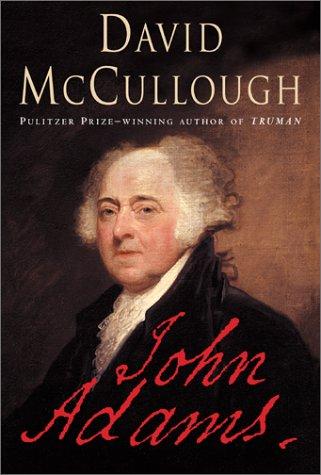
John Adams
Key Takeaways
Kyle, in 2016 in Books: I started with a general history of the beginning of the revolution, and then I got specific. The impact this book had on me deserves its own post. I appreciate very much the kind of person John Adams was. In Hamilton: the Musical they make an off-handed joke about John Adams, and surprisingly, it bothered me a lot. I feel a kinship with John Adams, often in his failures more so than his successes.
Highlights imported 2026-09-13 from the Kindle notebook export (200 highlights, 9 notes). Key takeaways and synthesis to come.
Connections
No cross-book interconnections identified yet.
Highlights
- We live, my dear soul, in an age of trial. What will be the consequence, I know not. ~John Adams to Abigail Adams, 1774
- But what do we mean by the American Revolution? Do we mean the American war? The Revolution was effected before the war commenced. The Revolution was in the minds and hearts of the people. ~John Adams
- You cannot be, I know, nor do I wish to see you, an inactive spectator… . We have too many high sounding words, and too few actions that correspond with them. ~Abigail Adams
- He was John Adams of Braintree and he loved to talk. He was a known talker. There were some, even among his admirers, who wished he talked less. He himself wished he talked less, and he had particular regard for those, like General Washington, who somehow managed great reserve under almost any circumstance.
- Ambitious to excel—to make himself known—he had nonetheless recognized at an early stage that happiness came not from fame and fortune, “and all such things,” but from “an habitual contempt of them,” as he wrote. He prized the Roman ideal of honor, and in this, as in much else, he and Abigail were in perfect accord. Fame without honor, in her view, would be “like a faint meteor gliding through the sky, shedding only transient light.”
- He was hard-headed and a man of “sensibility,” a close observer of human folly as displayed in everyday life and fired by an inexhaustible love of books and scholarly reflection. He read Cicero, Tacitus, and others of his Roman heroes in Latin, and Plato and Thucydides in the original Greek, which he considered the supreme language. But in his need to fathom the “labyrinth” of human nature, as he said, he was drawn to Shakespeare and Swift, and likely to carry Cervantes or a volume of English poetry with him on his journeys. “You will never be alone with a poet in your pocket,” he would tell his son Johnny.
- He was a second cousin of Samuel Adams, but “possessed of another species of character,” as his Philadelphia friend Benjamin Rush would explain. “He saw the whole of a subject at a glance, and … was equally fearless of men and of the consequences of a bold assertion of his opinion… . He was a stranger to dissimulation.”
- They were of one and the same spirit. “You cannot be, I know, nor do I wish to see you, an inactive spectator,” she wrote at her kitchen table. “We have too many high sounding words, and too few actions that correspond with them.”
- “I wander alone, and ponder. I muse, I mope, I ruminate,” he wrote in the seclusion of his diary. “We have not men fit for the times. We are deficient in genius, education, in travel, fortune—in everything. I feel unutterable anxiety.”
- “It is to be a school of political prophets I suppose—a nursery of American statesmen,” he wrote to a friend, James Warren of Plymouth.
- The strong clarity of her handwriting, the unhesitating flow of her pen across the paper, line after line, seemed at odds with her circumstances. Rarely was a word crossed out or changed. It was as if she knew exactly what was in her heart and how she wished to express it—as if the very act of writing, of forming letters, in her distinctive angular fashion, keeping every line straight, would somehow help maintain her balance, validate her own being in such times.
- Washington was virtuous, brave, and in his new responsibilities, “one of the most important characters in the world,” Adams had informed Abigail. “The liberties of America depend upon him in great degree.” Later, when she met Washington at a Cambridge reception, Abigail thought John had not said half enough in praise of him.
- On the morning Washington departed Philadelphia to assume command at Boston, he and others of the Massachusetts delegation had traveled a short way with the general and his entourage, to a rousing accompaniment of fifes and drums, Adams feeling extremely sorry for himself for having to stay behind to tend what had become the unglamorous labors of Congress. “I, poor creature, worn out with scribbling for my bread and my liberty, low in spirits and weak in health, must leave others to wear the laurels.”
- The first of the line, Henry Adams of Barton St. David in Somerset-shire, England, with his wife Edith Squire and nine children—eight sons and a daughter—had arrived in Braintree in the year 1638, in the reign of King Charles I, nearly a century before John Adams was born. They were part of the great Puritan migration, Dissenters from the Church of England who, in the decade following the founding of the Massachusetts Bay Colony in 1630, crossed the North Atlantic intent on making a new City of God, some twenty thousand people, most of whom came as families.
- “Let frugality and industry be our virtues,” John Adams advised Abigail concerning the raising of their own children. “Fire them with ambition to be useful,” he wrote, echoing what had been learned at home.
- Of his father, however, he could hardly say enough. There were scarcely words to express the depth of his gratitude for the kindnesses his father had shown him, the admiration he felt for his father’s integrity. His father was “the honestest man” John Adams ever knew. “In wisdom, piety, benevolence and charity in proportion to his education and sphere of life, I have never known his superior,” Adams would write long afterward, by which time he had come to know the most prominent men of the age on two sides of the Atlantic. His father was his idol. It was his father’s honesty, his father’s independent spirit and love of country, Adams said, that were his lifelong inspiration.
- A small textbook edition of Cicero’s Orations became one of his earliest, proudest possessions, as he affirmed with the note “John Adams Book 1749/50” written a half dozen times on the title page.
- To his surprise, he also discovered a love of study and books such as he had never imagined. “I read forever,” he would remember happily, and as years passed, in an age when educated men took particular pride in the breadth of their reading, he became one of the most voracious readers of any. Having discovered books at Harvard, he was seldom ever to be without one for the rest of his days.
- At commencement ceremonies, as one of the first three academically, he argued the affirmative to the question “Is civil government absolutely necessary for men?” It was to be a lifelong theme.
- His small charges, both boys and girls numbering about a dozen, responded, he found, as he had at their age, more to encouragement and praise than to scolding or “thwacking.” A teacher ought to be an encourager, Adams decided. “But we must be cautious and sparing of our praise, lest it become too familiar.” Yet for the day-to-day routine of the classroom, he thought himself poorly suited and dreamed of more glorious pursuits, almost anything other than what he was doing. One student remembered Master Adams spending most of the day at his desk absorbed in his own thoughts or busily writing—sermons
- On the contrary if conscience disapproves, the loudest applauses of the world are of little value.
- In the meantime, he was reading Milton, Virgil, Voltaire, Viscount Bolingbroke’s Letters on the Study and Use of History, and copying long extracts in a literary commonplace book.
- “All that part of Creation that lies within our observation is liable to change,” Adams began. Even mighty states and kingdoms are not exempted. If we look into history, we shall find some nations rising from contemptible beginnings and spreading their influence, until the whole globe is subjected to their ways. When they have reached the summit of grandeur, some minute and unsuspected cause commonly affects their ruin, and the empire of the world is transferred to some other place. Immortal Rome was at first but an insignificant village, inhabited only by a few abandoned ruffians, but by degrees it rose to a stupendous height, and excelled in arts and arms all the nations that preceded it. But the demolition of Carthage (what one should think should have established it in supreme dominion) by removing all danger, suffered it to sink into debauchery, and made it at length an easy prey to Barbarians. England immediately upon this began to increase (the particular and minute cause of which I am not historian enough to trace) in power and magnificence, and is now the greatest nation upon the globe. Soon after the Reformation a few people came over into the new world for conscience sake. Perhaps this (apparently) trivial incident may transfer the great seat of empire into America. It looks likely to me. For if we can remove the turbulent Gallics, our people according to exactest computations, will in another century, become more numerous than England itself. Should this be the case, since we have (I may say) all the naval stores of the nation in our hands, it will be easy to obtain the mastery of the seas, and then the united force of all Europe, will not be able to subdue us. The only way to keep us from setting up for ourselves is to disunite us. Divide et impera. Keep us in distinct colonies, and then, some great men in each colony, desiring the monarchy of the whole, they will destroy each others’ influence and keep the country in equilibrio. Be not surprised that I am turned politician. The whole town is immersed in politics.
- By writing only to himself, for himself, by dutifully reckoning day by day his moral assets and liabilities, and particularly the liabilities, he could thus improve himself. “Oh! that I could wear out of my mind every mean and base affectation, conquer my natural pride and conceit.” Why was he constantly forming yet never executing good resolutions? Why was he so absent-minded, so lazy, so prone to daydreaming his life away? He vowed to read more seriously. He vowed to quit chewing tobacco.
- There was so much he wanted to know and do, but life was passing him by. He was twenty years old. “I have no books, no time, no friends. I must therefore be contented to live and die an ignorant, obscure fellow.”
- By turns he worried over never having any bright or original ideas, or being too bright for his own good, too ready to show off and especially in the company of the older men in the community who befriended him. “Honesty, sincerity, and openness, I esteem essential marks of a good mind,” he concluded after one evening’s gathering. He was therefore of the opinion that men ought “to avow their opinions and defend them with boldness.”
- he read law at night moving fast (too fast, he later thought) through Wood’s four-volume Institute of the Laws of England, Hawkins’s Abridgment of Coke’s Institutes, Salkeld’s hefty Reports, Coke’s Entries, and Hawkins’s massive two-volume Pleas of the Crown in a single volume that weighed fully eight pounds. “Can you imagine any drier reading?” he would one day write to Benjamin Rush, heavily underscoring the question.
- For the first time, he was on his own with his studies, and he bent to them with the spirit of independence and intense determination that were to characterize much of his whole approach to life. In his diary he wrote of chopping wood and translating Justinian, with equal resolution.
- “Read in Gilbert. I read him slowly, but I gain ideas and knowledge as I go along.”
- Nothing, he decided, would ever come easily to him. “But it is my destiny to dig treasures with my own fingers,” he wrote woefully.
- He drew inspiration from his Roman heroes. “The first way for a young man to set himself on the road towards glorious reputation,” he read in Cicero, “is to win renown.” “Reputation,” wrote Adams, “ought to be the perpetual subject of my thoughts, and aim of my behavior.”
- He felt “anxious, eager after something,” but what it was he did not know. “I feel my own ignorance. I feel concern for knowledge. I have … a strong desire for distinction.”
- But if self-absorbed and ambitious, he was hardly more so than a number of other young men of ability of his time. The difference was that Adams wrote about it and was perfectly honest with himself.
- “Why have I not genius to start some new thought?” he asked at another point in his diary. “Some thing that will surprise the world?” Why could he not bring order to his life? Why could he not clear his table of its clutter of books and papers and concentrate on just one book, one subject? Why did imagination so often intervene? Why did thoughts of girls keep intruding?
- There was little he enjoyed more than an evening of spontaneous “chatter,” of stories by candlelight in congenial surroundings, of political and philosophic discourse, “intimate, unreserved conversation,” as he put it.
- He was lively, pungent, and naturally amiable—so amiable, as Thomas Jefferson would later write, that it was impossible not to warm to him. He was so widely read, he could talk on almost any subject, sail off in almost any direction. What he knew he knew well.
- Yet Adams often felt ill at ease, hopelessly awkward. He sensed people were laughing at him, as sometimes they were, and this was especially hurtful. He had a way of shrugging his shoulders and distorting his face that must be corrected, he knew. He berated himself for being too shy. “I should look bold, speak with more spirit.”
- Determined to understand human nature, fascinated by nearly everyone he encountered, he devoted large portions of his diary to recording their stories, their views on life, how they stood, talked, their facial expressions, how their minds worked. In the way that his literary commonplace book served as a notebook on his reading, the diary became his notebook on people. “Let me search for the clue which led great Shakespeare into the labyrinth of human nature. Let me examine how men think.”
- His portraits of “original characters” in and about Braintree were extraordinary, detailed, full of life and color, and written obviously, like so much of the diary, out of the pure joy of writing. Possibly he knew what a gift he had as an observer of human nature. In another time, under different circumstances, he might have become a great novelist.
- Adams spent a long night and most of the next day with Parson Wibird, talking and reading aloud from Benjamin Franklin’s Reflections on Courtship and Marriage.
- With his father gone, Adams experienced a “want of strength [and] courage” such as he had never known. Still, as expected of him, he stepped in as head of the family, and as time passed, those expressions of self-doubt, the fits of despair and self-consciousness that had so characterized the outpourings in his diary, grew fewer.
- His love of the law, too, grew greater. He felt privileged, blessed in his profession, he told Jonathan Sewall: Now to what higher object, to what greater character, can any mortal aspire than to be possessed of all this knowledge, well digested and ready at command, to assist the feeble and friendless, to discountenance the haughty and lawless, to procure redress to wrongs, the advancement of right, to assert and maintain liberty and virtue, to discourage and abolish tyranny and vice?
- She saw what latent abilities and strengths were in her ardent suitor and was deeply in love. Where others might see a stout, bluff little man, she saw a giant of great heart, and so it was ever to be.
- She, too, was an avid reader and attributed her “taste for letters” to Richard Cranch, who, she later wrote, “taught me to love the poets and put into my hands, Milton, Pope, and Thompson, and Shakespeare.” She could quote poetry more readily than could John Adams, and over a lifetime would quote her favorites again and again in correspondence, often making small, inconsequential mistakes, an indication that rather than looking passages up, she was quoting from memory.
- My soul and body have both been thrown into disorder by your absence, and a month or two more would make me the most insufferable cynic in the world. I see nothing but faults, follies, frailties and defects in anybody lately. People have lost all their good properties or I my justice or discernment.
- HIS MARRIAGE to Abigail Smith was the most important decision of John Adams’s life, as would become apparent with time. She was in all respects his equal and the part she was to play would be greater than he could possibly have imagined, for all his love for her and what appreciation he already had of her beneficial, steadying influence.
- For Adams, life had been made infinitely fuller. All the ties he felt to the old farm were stronger now with Abigail in partnership. She was the ballast he had wanted, the vital center of a new and better life. The time he spent away from home, riding the court circuit, apart from her and the “little ones,” became increasingly difficult. “God preserve you and all our family,” he would write.
- “I never shall shine ’til some animating occasion calls forth all my powers,” he had written, and here now was the moment.
- Adams, who had earlier joined a new law club in Boston started by Jeremiah Gridley, had, at Gridley’s suggestion, been working on an essay that would become A Dissertation on the Canon and the Feudal Law. It was his first extended political work and one of the most salient of his life, written at the age of thirty.
- The Stamp Act was hardly mentioned. Rather, it was a statement of his own fervent patriotism and the taproot conviction that American freedoms were not ideals still to be obtained, but rights long and firmly established by British law and by the courage and sacrifices of generations of Americans. Years later Adams would say the Revolution began in the minds of Americans long before any shots were fired or blood shed.
- “Be it remembered,” he wrote in his Dissertation, “that liberty must at all hazards be supported. We have a right to it, derived from our Maker. But if we have not, our fathers have earned and bought it for us at the expense of… Some highlights have been hidden or truncated due to export limits.
- And liberty cannot be preserved without a general knowledge among the people who have a right from the frame of their nature to knowledge, as their great Creator who does nothing in vain, has given them understandings and a desire to know. But besides this they have a right, an indisputable, unalienable, indefeasible divine right to the most…
Some highlights have been hidden or truncated due to export limits.
Kyle: An educated populace
- He was calling on his readers for independence of thought, to use their own minds. It was the same theme he had struck in his diary at Worcester a decade before, in his turmoil over what to do with his life, writing, “The point is now determined, and I shall have the liberty to think for myself.” Government is a plain, simple, intelligent thing, founded in nature and reason, quite comprehensible by common sense [the Dissertation continued]… . The true source of our suffering has been our timidity. We have been afraid to think… . Let us dare to read, think, speak, and write… . Let it be known that British liberties are not the grants of princes or parliaments … that many of our rights are inherent and essential, agreed on as maxims and established as preliminaries, even before Parliament existed… . Let us read and recollect and impress upon our souls the views and ends of our more immediate forefathers, in exchanging their native country for a dreary, inhospitable wilderness… . Recollect their amazing fortitude, their bitter sufferings—the hunger, the nakedness, the cold, which they patiently endured—the severe labors of clearing their grounds, building their houses, raising their provisions, amidst dangers from wild beasts and savage men, before they had time or money or…
Some highlights have been hidden or truncated due to export limits.
Kyle: An educated populace
- “At home with my family. Thinking,” reads the entry of a few nights later. “At home. Thinking,” he wrote Christmas Day.
- As recalled in the family years later, he was endowed for the profession of law with the natural gifts of “a clear and sonorous voice,” a “ready elocution,” stubbornness, but with the “counter-check” of self-control, and a strong moral sense.
- He acquired more and more books, books being an acknowledged extravagance he could seldom curb. (With one London bookseller he had placed a standing order for “every book and pamphlet, of reputation, upon the subjects of law and government as soon as it comes out.”) “I want to see my wife and children every day,” he would write while away on the court circuit. “I want to see my grass and blossoms and corn… . But above all, except the wife and children, I want to see my books.”
- “Am I grasping at money, or scheming for power?” Yes, he was amassing a library, but to what purpose? “Fame, fortune, power say some, are the ends intended by a library. The service of God, country, clients, fellow men, say others. Which of these lie nearest my heart?
- The following day thirty-four-year-old John Adams was asked to defend the soldiers and their captain, when they came to trial. No one else would take the case, he was informed. Hesitating no more than he had over Jonathan Sewall’s offer of royal appointment, Adams accepted, firm in the belief, as he said, that no man in a free country should be denied the right to counsel and a fair trial, and convinced, on principle, that the case was of utmost importance.
- “The only way to compose myself and collect my thoughts,” he wrote in his diary, “is to set down at my table, place my diary before me, and take my pen into my hand. This apparatus takes off my attention from other objects. Pen, ink, and paper and a sitting posture are great helps to attention and thinking.”
- Better that many guilty persons escape unpunished than one innocent person should be punished. “The reason is, because it’s of more importance to community, that innocence should be protected, than it is, that guilt should be punished.”
- The preservation of liberty depends upon the intellectual and moral character of the people. As long as knowledge and virtue are diffused generally among the body of a nation, it is impossible they should be enslaved.
- Ambition is one of the more ungovernable passions of the human heart. The love of power is insatiable and uncontrollable.
- There is danger from all men. The only maxim of a free government ought to be to trust no man living with power to endanger the public liberty.
- By the time of the destruction of the tea, what was later to become known as the Boston Tea Party in December 1773, he had again moved the family to Boston. His hatred of mob action notwithstanding, Adams was exuberant over the event.
- Adams told Sewall he knew Great Britain was “determined on her system,” but “that very determination, determined me on mine.” The die was cast, Adams said. “Swim or sink, live or die, survive or perish, [I am] with my country … You may depend upon it.”
- Like Adams, Gerry viewed mankind as capable of both great good and great evil.
- With hundreds of ox teams and more than a thousand American troops at work, breastworks had been set up and cannon hauled into place, all in a night and to the complete surprise of the British. Abigail was told that the British commander, on seeing what they had accomplished, remarked, “My God, these fellows have done more work in one night than I could make my army do in three months.”
- Franklin himself, Philadelphia’s first citizen, was the most famous American alive—printer, publisher, philosopher, scientist, and, as inventor of the lightning rod, “the man who tamed the lightning.” It was Franklin also who had led the way in establishing the American Philosophical Society, “for the promoting of useful knowledge,” with the result that Philadelphia had become the recognized center of American thought and ideas.
- Topics of “consideration” at the Philosophical Society, as set forth in Franklin’s initial proposal were, in the spirit of the age, all-embracing: all philosophical [scientific] experiments that let light into the nature of things, tend to increase the power of man over matter, and multiply the conveniences or pleasure of life … all new-discovered plants, herbs, trees, roots, and methods of propagating them… . New methods of curing or preventing diseases… . New mechanical inventions for saving labor… . All new arts, trades, manufacturers, etc. that may be proposed or thought of.
- With twenty-three printing establishments and, by 1776, seven newspapers—more newspapers even than in London—Philadelphia was the publishing capital of the colonies. It was not only that Franklin’s immensely popular Poor Richard’s Almanack emanated from Philadelphia, but political pamphlets of such far-reaching influence as John Dickinson’s Letters from a Pennsylvania Farmer, Thomas Jefferson’s spirited Summary View of the Rights of British America, and now, Common Sense, which was selling faster than anything ever published in America.
- There were as many as thirty bookshops and twice the number of taverns and coffeehouses, with names like Blue Anchor, Bunch of Grapes, Tun Tavern, Conestoga Wagon, Rising Sun, Half Moon, and each had its own clientele.
- “My time is too totally filled from the moment I get out of bed until I return to it, [with] visits, ceremonies, company, business, newspapers, pamphlets, etc., etc., etc.,” he had reported excitedly to Abigail.
- The Reverend Thomas Coombe of Christ Church was “sprightly” and distinct. “But I am not charmed,” wrote Adams. “His style was indifferent.” Indifference was a quality Adams found difficult to tolerate.
- One Sunday, “led by curiosity and good company,” which included George Washington, Adams crossed a “Romish” threshold, to attend afternoon mass at St. Mary’s Catholic Church on Fifth Street, an experience so singular that he reflected on it at length both in his journal and in a letter to Abigail. Everything about the service was the antithesis of a lifetime of Sabbaths at Braintree’s plain First Church, where unfettered daylight through clear window glass allowed for no dark or shadowed corners, or suggestion of mystery. For the first time, Adams was confronted with so much that generations of his people had abhorred and rebelled against, and he found himself both distressed and strangely moved. The music, bells, candles, gold, and silver were “so calculated to take in mankind,” that he wondered the Reformation had ever succeeded.
- Within the walls of Congress, he was at first dazzled by the other delegates, who, he decided, comprised an assembly surpassing any in history. Of the fifty-four in attendance, nearly half were lawyers and most had received a college education. Several, like Washington, were known to be men of great wealth, but others, like Roger Sherman of Connecticut, had humbler origins. He had begun as a shoemaker.
- Adams was amazed by the range and variety of talents. “The art and address of ambassadors from a dozen belligerent powers of Europe, nay, of a conclave of cardinals at the election of a Pope … would not exceed the specimens we have seen.” Here were “fortunes, abilities, learning, eloquence, acuteness” equal to any. “Every question is discussed with moderation, and an acuteness and minuteness equal to that of Queen Elizabeth’s privy council.”
- But after a month of such “acuteness and minuteness” over every issue at hand, irrespective of importance, Adams was “wearied to death.” The business of Congress had become tedious beyond expression, he told Abigail. This assembly is like no other that ever existed. Every man in it is a great man—an orator, a critic, a statesman, and therefore every man upon every question must show his oratory, his criticism, and his political abilities. The consequence of this is that business is drawn and spun out to immeasurable length. I believe if it was moved and seconded that we should come to a resolution that three and two make five, we should be entertained with logic and rhetoric, law, history, politics, and mathematics concerning the subject for two whole days, and then we should pass the resolution unanimously in the affirmative.
- He wrote of the frustrations of “wasting, exhausting” debates. America was “a great, unwieldy body,” he decided. “Its progress must be slow. It is like a large fleet sailing under convoy. The fleetest sailors must wait for the dullest and slowest.” Yet he would not give up or let down. “I will not despond.”
- To Adams independence was the only guarantee of American liberty, and he was determined that the great step be taken. The only question was when to make the move. If a decision were forced on Congress too soon, the result could be disastrous; independence would be voted down. But every day that independence was put off would mean added difficulties in the course of the larger struggle. Abigail, in one of her letters, aptly offered some favorite lines from Shakespeare: There is a tide in the affairs of men, Which, taken at the flood, leads on to fortune; Omitted, all the voyage of their life Is bound in the shallows and in miseries … And we must take the current when it serves, Or lose our ventures.
- Then, paraphrasing a favorite line from the popular play Cato by Joseph Addison—a line that General Washington, too, would often call upon—Adams told her, “We cannot insure success, but we can deserve it.”
- Present nearly every day, notwithstanding his years and infirmities, was Benjamin Franklin, who, at age seventy, was popularly perceived to be the oldest, wisest head in the Congress, which he was, and the most influential, which he was not.
- But Franklin had no liking for floor debate. He was patient, imperturbable, and at times sound asleep in his chair. Never would he argue a point. Indeed, it was rare that he spoke at all or ventured an opinion except in private conversation, which to Adams, who was almost incapable of staying out of an argument, was extremely difficult to comprehend. “He has not assumed anything,” Adams wrote in frustration, “nor affected to take the lead; but has seemed to choose that the Congress pursue their own sentiments, and adopt their own plans.”
- Rutledge, the youngest member, was dandified, twenty-six years old, and overflowing with self-confidence. At first, Adams judged him “smart” if not “deep,” but the more Rutledge talked, the more he expressed disagreement with Adams, the more scathing Adams’s assessment became, to the point where, in his diary, he appeared nearly to run out of words. “Young Ned Rutledge is a perfect Bob o’ Lincoln, a swallow, a sparrow, a peacock, excessively vain, excessively weak, and excessively variable and unsteady—jejune, inane, and puerile.”
- Years before, at age twenty, he had set down in his diary that men ought to “avow their opinions and defend them with boldness,” and he was of the same mettle still.
- Adams had come to believe that Dickinson’s real struggle was with his mother and his wife, both devout Quakers who bedeviled him with their pacifist views. “If I had such a mother and such a wife,” Adams would reflect years later, recalling Dickinson’s predicament, “I believe I should have shot myself.”
- Adams said he expected Common Sense to become the “common faith,” and on learning that in Boston, he, Adams, was presumed to be the author, he felt flattered. Writing to a former law clerk, he declared himself innocent, saying he could never have achieved a style of such “strength and brevity.”
- But Adams was not without misgivings. The more he thought about it, the less he admired Common Sense. The writer, he told Abigail, “has a better hand at pulling down than building.”
- Adams joined in floor debate day after day, arguing a point, pleading, persuading, and nearly always with effect. No one spoke more often or with greater force. “Every important step was opposed, and carried by bare majorities, which obliged me to be almost constantly engaged in debate,” he would recall.
- Rarely did he prepare his remarks in advance other than in his mind, so that once on his feet he could speak from what he knew and what he strongly felt. He had tried writing his speeches but found it impossible. “I understand it not,” he would tell Benjamin Rush. “I never could write declamations, orations, or popular addresses.”
- As a British spy was later to write astutely of Adams, he also had a particular gift for seeing “large subjects largely.”
- No one ever had trouble hearing what Adams had to say, nor was there ever the least ambiguity about what he meant.
- Knowing nothing of armed ships, he made himself expert, and would call his work on the naval committee the pleasantest part of his labors,
- He read Greek, Roman, and British history, and was familiar with English poetry… . And the flow of his soul made his reading our own, and seemed to bring to recollection in all of us all we had ever read. Hopkins never drank to excess, according to Adams, but all he drank was promptly “converted into wit, sense, knowledge, and good humor.”
- Adams’s Thoughts on Government, as it would be known, was first set forth in a letter to a fellow congressman, William Hooper, who, before returning home to help write a new constitution for North Carolina, had asked Adams for a “sketch” of his views.
- For Adams the structure of government was a subject of passionate interest that raised fundamental questions about the realities of human nature, political power, and the good society. It was a concern that for years had propelled much of his reading and the exchange of ideas with those whose judgment he most respected, including Abigail, who had written to him the year before, “I am more and more convinced that man is a dangerous creature, and that power whether vested in many or few is ever grasping… .
- Adams had accused Thomas Paine of being better at tearing down than building. In what he wrote in response, he was being the builder, as best he knew. To do this he had had “to borrow a little time from my sleep.” He was exhausted, he acknowledged, but he seems also to have sensed the importance of what he had done. “It has been the will of Heaven,” the essay began, “that we should be thrown into existence at a period when the greatest philosophers and lawgivers of antiquity would have wished to live… . a period when a coincidence of circumstances without example has afforded to thirteen colonies at once an opportunity of beginning government anew from the foundation and building as they choose. How few of the human race have ever had an opportunity of choosing a system of government for themselves and their children? How few have ever had anything more of choice in government than in climate? He was looking beyond independence, beyond the outcome of the war, to what would be established once independence and victory were achieved. Much as he foresaw the hard truth about the war to be waged, Adams had the clearest idea of anyone in Congress of what independence would actually entail, the great difficulties and risks, no less than the opportunities. When arguing cases in court, he liked to draw on the fables of La Fontaine and to quote the line “in every thing one must consider the end.”
- The happiness of the people was the purpose of government, he wrote, and therefore that form of government was best which produced the greatest amount of happiness for the largest number. And since all “sober inquirers after truth” agreed that happiness derived from virtue, that form of government with virtue as its foundation was more likely than any other to promote the general happiness.
- The greatest minds agreed, Adams continued, that all good government was republican, and the “true idea” of a republic was “an empire of laws and not of men,” a phrase not original with Adams but that he had borrowed from the writings of the seventeenth-century philosopher James Harrington. A government with a single legislative body would never do. There should be a representative assembly, “an exact portrait in miniature of the people at large,” but it must not have the whole legislative power, for the reason that like an individual with unchecked power, it could be subject to “fits of humor, transports of passion, partialities of prejudice.” A single assembly could “grow avaricious … exempt itself from burdens … become ambitious and after some time vote itself perpetual.” Balance would come from the creation of a second, smaller legislative body, a “distinct assembly” of perhaps twenty or thirty, chosen by the larger legislature. This “Council,” as Adams called it, would be given “free and independent judgment upon all acts of legislation that it may be able to check and correct the errors of the others.”
- Finally and emphatically, he urged the widest possible support for education. “Laws for the liberal education of youth, especially for the lower classes of people, are so extremely wise and useful that to a humane and generous mind, no expense for this purpose would be thought extravagant.”
- Borrowing a line from a poem by Daniel Defoe that she knew he would recognize (for he had used it, too), she wrote, “Remember all men would be tyrants if they could.
- “All great changes are irksome to the human mind, especially those which are attended with great dangers and uncertain effects. No man living can foresee the consequences of such a measure.” The future was exceedingly dangerous, Adams felt certain. His mind was much on eventualities, given what he knew of human nature. We may please ourselves with the prospect of free and popular governments. But there is great danger that those governments will not make us happy. God grant they may. But I fear that in every assembly, members will obtain an influence by noise not sense. By meanness, not greatness. By ignorance, not learning. By contracted hearts, not large souls… . There is one thing, my dear sir, that must be attempted and most sacredly observed or we are all undone. There must be decency and respect, and veneration introduced for persons of authority of every rank, or we are undone. In a popular government, this is our only way.
- But having received her letter, Adams became about as tender as he would allow on paper. Is there no way for two friendly souls to converse together, although the bodies are 400 miles off. Yes, by letter. But I want a better communication. I want to hear you think, or to see your thoughts. The conclusion of your letter makes my heart throb more than a cannonade would. You bid me burn your letters. But I must forget you first.
- Among all the disappointments and perplexities which have fallen my share in life, nothing has contributed so much to support my mind as the choice blessing of a wife… .
- “It is a true saying of a wit,” wrote Carter Braxton of Virginia, referring possibly to Benjamin Franklin, “we must hang together or separately.”
- “I have reasons to believe,” he added, “that no colony which shall assume a government under the people, will give it up.”
- Jefferson dabbled in “improvements” in agriculture and mechanical devices. His was the more inventive mind. He adored designing and redesigning things of all kinds. Jefferson, who may never have actually put his own hand to a plow, as Adams had, would devise an improved plow based on mathematical principles, “a moldboard of least resistance,” and find equal satisfaction in arriving at the perfect shape for a stone column or silver goblet.
- Jefferson was devoted to the ideal of improving mankind but had comparatively little interest in people in particular. Adams was not inclined to believe mankind improvable, but was certain it was important that human nature be understood.
Kyle: The money line of the whole Human Nature debate. The idealistic aloof will always cheer “blood letting of revolution.” The pragmatic realists will strain at the things they know mankind will most struggle to do.
- “Nothing was too small for him to keep account of,” one of his plantation overseers would remember of Jefferson. Yet he kept no personal diary, and for all the hours given to what he called “pen and ink work,” Jefferson rarely ever revealed his inner feelings in what he wrote. He had nothing like Adams’s fascination with human nature and, quite unlike Adams, little sense of humor. “He is a man of science,” a close observer would later write of Jefferson. “But … he knows little of the nature of man—very little indeed.”
- With Adams there was seldom a doubt about what he meant by what he said. With Jefferson there was nearly always a slight air of ambiguity.
- Jefferson himself would one day advise a grandson, “When I hear another express an opinion which is not mine, I say to myself, he has a right to his opinion, as I to mine. Why should I question it. His error does me no injury, and shall I become a Don Quixote, to bring all men by force of argument to one opinion? … Be a listener only, keep within yourself, and endeavor to establish with yourself the habit of silence, especially in politics.
Kyle: Maybe a difference of approach, but doesn’t this sound like “talk less, smile more; don’t let them know what you’re against or what you’re for.”?
- Sensitive to Adams’s seniority and his importance in Congress—and possibly to Adams’s vanity—Jefferson was consistently deferential to him. Clearly, too, for all their differences, they had much in common, not the least of which was their love of words, of books, and serious scholarship. They were as widely read, as learned as any two men in Congress. A list of the favorite authors of either could have served for the other. They had read the same law, distinguished themselves at an early age in the same profession, though Jefferson had never relished the practice of law as Adams had, nor felt the financial need to keep at it.
- His commitment now in the spring of 1776 was no less than Adams’s own. And it was because of their common zeal for independence, their wholehearted, mutual devotion to the common cause of America, and the certainty that they were taking part in one of history’s turning points, that the two were able to concentrate on the common purpose in a spirit of respect and cooperation, putting aside obvious differences, as well as others not so obvious and more serious than they could then have known.
- It was the threat Dickinson in his anger had used earlier against Adams, but whether it was Dickinson speaking now, Jefferson did not record. Nor did he record what Adams, Lee, and George Wythe said, only that they declared public opinion to be ahead of Congress: that “the people wait for us to lead the way,”
- JEFFERSON WAS TO DRAFT the declaration. But how this was agreed to was never made altogether clear. He and Adams would have differing explanations, each writing long after the fact. According to Adams, Jefferson proposed that he, Adams, do the writing, but that he declined, telling Jefferson he must do it. “Why?” Jefferson asked, as Adams would recount. “Reasons enough,” Adams said. “What can be your reasons?” “Reason first: you are a Virginian and a Virginian ought to appear at the head of this business. Reason second: I am obnoxious, suspected and unpopular. You are very much otherwise. Reason third: You can write ten times better than I can.” Jefferson would recall no such exchange. As Jefferson remembered, the committee simply met and unanimously chose him to undertake the draft. “I consented: I drew it [up].”
- In all the surviving record of official and private papers pertaining to the Continental Congress, there is only one member or eyewitness to events in Philadelphia in 1776 who wrote disparagingly of John Adams, and that was Adams writing long years afterward. As critical as he could be in his assessment of others, the man he was inclined to criticize most severely was himself. In fact, the respect he commanded at Philadelphia that spring appears to have been second to none.
- He worked rapidly and, to judge by surviving drafts, with a sure command of his material. He had none of his books with him, nor needed any, he later claimed. It was not his objective to be original, he would explain, only “to place before mankind the common sense of the subject.”
- Others see at one intuitive glance into the past and the future, and judge with precision at once. But remember you can’t make thirteen clocks strike precisely alike at the same second.
- The birth of a new nation was at hand, perhaps truly, as Thomas Paine had written, a new world. “Solemn” was Adams’s word for the atmosphere in Congress.
- Words in debate were one thing, the war quite another, but to Adams independence and the war were never disjunctive. The object is great which we have in view, and we must expect a great expense of blood to obtain it. But we should always remember that a free constitution of civil government cannot be purchased at too dear a rate, as there is nothing on this side of Jerusalem of equal importance to mankind.
- He knew how unpopular he had become, Dickinson began. He knew that by standing firm, as a matter of principle, he was almost certainly ending his career. “My conduct this day, I expect, will give the finishing blow to my once great … and now too diminished popularity… . But thinking as I do on the subject of debate, silence would be guilt.”
- Objects of the most stupendous magnitude, measures in which the lives and liberties of millions, born and unborn are most essentially interested, are now before us. We are in the very midst of revolution, the most complete, unexpected, and remarkable of any in the history of the world.
- That it was the most powerful and important speech heard in the Congress since it first convened, and the greatest speech of Adams’s life, there is no question.
- What private agreements had been made the night before, if any, who or how many had come to the State House that morning knowing what was afoot, no one recorded.
- That the hand of God was involved in the birth of the new nation he had no doubt. “It is the will of heaven that the two countries should be sundered forever.” If the people now were to have “unbounded power,” and as the people were quite as capable of corruption as “the great,” and thus high risks were involved, he would submit all his hopes and fears to an overruling providence, “in which unfashionable as the faith may be, I firmly believe.”
- The facts, wrote Elbridge Gerry, were as well known in the taverns and coffeehouses of the city as in Congress itself.
- In London, Samuel Johnson, who had no sympathy for the American cause, had asked, “How is it that we hear the loudest yelps for liberty from the drivers of Negroes?” Abigail, in her letters that spring, had questioned whether the passion for liberty could be “equally strong in the breasts of those who have been accustomed to deprive their fellow creatures of theirs,” and had earlier pondered whether the agonies of pestilence and war could be God’s punishment for the sin of slavery.
- It was Jefferson who had written them for all time: We hold these truths to be self-evident, that all men are created equal, that they are endowed by their Creator with certain unalienable rights, that among these are life, liberty, and the pursuit of happiness. That to secure these rights, governments are instituted among men, deriving their just powers from the consent of the governed.
- The great day of celebration came Monday, July 8, at noon in the State House Yard, when the Declaration was read aloud before an exuberant crowd.
- Another Philadelphia patriot, Charles Biddle, a wealthy merchant who had joined the crowd in the State House Yard to hear the Declaration read, recorded only that he had seen “very few respectable people present.”
- Whether Benjamin Franklin quipped “We must all hang together, or most assuredly we shall hang separately” is impossible to know, just as there is no way to confirm the much-repeated story that the diminutive John Hancock wrote his name large so the King might read it without his spectacles. But the stories endured because they were in character, like the remark attributed to Stephen Hopkins of Rhode Island. Hopkins, who suffered from palsy, is said to have observed, on completing his spidery signature, “My hand trembles, but my heart does not.”
- John Dickinson, though ill and exhausted from the strain of the past weeks, departed at the head of the first troops to march out of the city to join in the defense of New Jersey, a scene that made a deep impression on many, including John Adams. “Mr. Dickinson’s alacrity and spirit,” he told Abigail, “certainly becomes his character and sets a fine example.”
- By mid-August, 32,000 fully equipped, highly trained, thoroughly professional British and German (Hessian) soldiers—more than the entire population of Philadelphia—were ashore on Staten Island, supported by ten ships-of-the-line and twenty frigates, making in all the largest, most costly British overseas deployment ever until that time.
- Adams was more aware of the situation than anyone in Congress and he was miserable, thinking about the consequences of a defeat at New York. He had not wanted the responsibility of heading the Board of War and felt “vastly unequal” to the multitude of problems and decisions to be grappled with. But it was also clear that they were all unequal to the task. No one in Congress was qualified. “We are all inexperienced in this business,” he emphasized to Nathanael Greene.
- Dr. Zabdiel Boylston, Adams’s great uncle on his mother’s side. The idea had come from a slave belonging to Cotton Mather, an African named Onesimus, who had said the practice was long established in Africa, where those with the courage to use it were made immune, and he had his own scar on his arm to show.
- It was the paradox of their lives that, as much as his public role kept them apart, he always needed to be with Abigail and she with him. They would never become accustomed to being separated. “I can do nothing without you,” he was to tell her one way or another, time and again, and always from the heart. She would have him no other way than he was; she believed fervently in what he was doing, encouraged him in the role, and wished no other for him; she wanted him to be where he was doing his utmost for the country. And still she desperately wanted him with her. Each worried incessantly about the other’s health and well-being, at times to the point of making themselves ill.
- The individuality of the colonies was “a mere sound,” he said, according to Jefferson’s notes. “The confederacy is to make us one individual only; it is to form us, like separate parcels of metal, into one common mass. We shall no longer retain our separate individuality, but become a single individual as to all questions submitted to the confederacy.”
- But Benjamin Rush, in an eloquent first speech in Congress, declared, “The more a man aims at serving America the more he serves his colony.” “We have been too free with the word independence. We are dependent on each other—not totally independent states… . When I entered that door, I considered myself a citizen of America.”
- Washington was by then on the scene with reinforcements from Manhattan. Exhorting his men to conduct themselves like soldiers, he told them everything worth living for was at stake.
- Sullivan arrived on September 2, and it was on the following day, Tuesday, September 3, with the outlook as dark as it had ever been, that Jefferson decided to delay his departure no more. As it was, he had stayed three weeks longer than he had intended. Having settled his accounts, he mounted his horse, and with his young servant following behind, started for Virginia. Adams, too, had reached a decision, as he explained to Abigail in a letter of September 4. Events having taken such a turn at Long Island, he would remain in Philadelphia. When Joseph Bass arrived the next day with the horses to take him home, it made no difference. “The panic may seize whom it will,” Adams wrote, “it will not seize me.”
- So the two eminent bedfellows lay side-by-side in the dark, the window open, Franklin expounding, as Adams remembered, “upon air and cold and respiration and perspiration, with which I was so much amused that I soon fell asleep.”
- He felt for America, said the admiral, as he did for a brother. “If America should fail, I should feel and lament it like the loss of a brother.” With a smile, Franklin replied, “My Lord, we will do our utmost endeavors to save your Lordship that mortification.”
- To this Adams immediately responded: “Your Lordship may consider me in what light you please,” Adams said, “and indeed, I should be willing to consider myself, for a few moments, in any character which would be agreeable to your Lordship, except that of a British subject.”
- Turning to Franklin and Rutledge, Howe remarked gravely, “Mr. Adams is a decided character,” the emphasis apparently on the word “decided.” Years afterward Adams would better understand the gloomy look on Howe’s face, when he learned that before leaving London, Howe had been given a list of those American rebels who were to be granted pardons. John Adams was not on the list. He was to hang.
- “They met, they talked, they parted,” wrote one of Howe’s staff, “and now nothing remains but to fight it out against a set of the most determined hypocrites and demagogues, compiled of the refuse of the colonies, that ever were permitted by Providence to be the scourge of a country.” The Declaration of Independence had passed a first test. The war would go on.
- Little that had happened through the summer had distressed Adams quite so much as the behavior of American troops, and especially reports that Massachusetts men had “behaved ill.” “Unfaithfulness” was something he could not abide, and in his spells of gloom he pondered whether the fault was in the times. Unfaithfulness in public stations is deeply criminal [he wrote to Abigail]. But there is no encouragement to be faithful. Neither profit, nor honor, nor applause is acquired by faithfulness… . There is too much corruption, even in this infant age of our Republic. Virtue is not in fashion. Vice is not infamous.
- One day, as he and Benjamin Rush sat together in Congress, Rush asked Adams in a whisper if he thought America would succeed in the struggle. “Yes,” Adams replied, “if we fear God and repent our sins.”
- Later, Rush would say of Adams, “Every member of Congress in 1776 acknowledged him to be the first man in the House.” Jefferson was to remember Adams as “our colossus on the floor.”
- Few Americans ever achieved so much of such value and consequence to their country in so little time. Above all, with his sense of urgency and unrelenting drive, Adams made the Declaration of Independence happen when it did. Had it come later, the course of events could have gone very differently.
- I cannot but wish I were better qualified. ~John Adams
- ‘Affliction is a good man’s shining time,’ ” she wrote, quoting a favorite line from the English poet Edward Young.
- “These are the times that try men’s souls,” wrote Thomas Paine, who was with the retreating army. “The summer soldier and the sunshine patriot will, in this crisis, shrink from the service of his country.”
- “Posterity who are to reap the blessings will scarcely be able to conceive the hardships and sufferings of their ancestors.”
- The pride and pomp of war, the continual sound of drums and fifes … have no charms for me.” He would prefer the delights of a garden to dominion of a world. “I have nothing of Caesar’s greatness in my soul. Power has not my wishes in her train.”
- You are now, I think, far advanced in your twelfth year—a time when the understanding opens, and the youth begin to look abroad into the world among whom they are to live. To be good, and to do good, is all we have to do.
- “A taste for literature and a turn for business, united in the same person, never fails to make a great man,” he counseled Johnny, while to Charles he expressed the hope that with the war over by and by he would have only to study “the arts of peace.”
- “I love to receive letters very much better than I love to write them,” replied Johnny, who reported proudly that he was embarked on the third volume of Tobias Smollett’s History of England.
- History was the true source of “solid instruction,” Adams wrote to the boy encouragingly. He must read Thucydides’s history of the Peloponnesian War. There was no better preparation, whatever part he was called to play on “the stage of life.”
- John Quincy Adams would recall secreting himself in a closet to smoke tobacco and read Milton’s Paradise Lost, trying without success to determine what “recondite charm” in them gave his father so much pleasure.)
- Privately, Adams questioned Washington’s leadership. The Virginian had been “out-generaled” once again. “Oh, Heaven! grant us one great soul!” Adams wrote in his diary. “One leading mind would extricate the best cause from that ruin which seems to await it… . One active, masterly capacity would bring order out of this confusion and save this country.”
- What was said between them, neither divulged. But the decision, difficult as it was, Adams made at once. There was no hesitation, no playing out the ordeal of deciding. If nothing else, he was decisive—they both were. Within twenty-four hours he had written his letter of acceptance to Henry Laurens. To James Lovell he wrote, “I should have wanted no motives or arguments to induce me to accept of this momentous trust, if I could be sure that the public would be benefited by it.
- Assuredly he would encounter temptation, she wrote, but to exclude him from temptation would be to exclude him from the world in which he was to live. Later, in a long letter written after he had gone, she would assure him he was ever in her heart, but tell him also what was expected of him in his obligations to society, his country, and to his family: You are in possession of a natural good understanding and of spirits unbroken by adversity, and untamed with care. Improve your understanding for acquiring useful knowledge and virtue, such as will render you an ornament to society, an honor to your country, and a blessing to your parents … and remember you are accountable to your Maker for all your words and actions.
- The difference between what he understood of the perils to be faced and what the captain understood was hardly less than the difference between his understanding and that of his small son.
- (For every sailor in the British navy killed in action or who died of wounds in the era of the American Revolution, seventeen died of disease.)
- In his diary later, Adams would confess to moments of severe regret that he had ever brought his son, but he wrote also of his extreme pride in the boy: [His] behavior gave me a satisfaction that I cannot express. Fully sensible of our danger, he was constantly endeavoring to bear up under it with manly courage and patience, very attentive to me, and his thoughts always running in a serious strain. In this he was not singular… . I believe there was not a soul on board who was wholly thoughtless of a Divinity.
- “I cannot help suspecting that the more elegance, the less virtue in all times and countries.”
- Indignant over Franklin’s unwillingness to share confidences with him, Lee wrote an angry letter that Franklin left unanswered. “I am old, cannot have long to live, have much to do and no time for altercation,” Franklin at last wrote to Lee in reply, but then never sent the letter.
- But Adams was soon writing in his diary that Lee had confidence in no one. “He believes all men selfish, and no man honest or sincere.” Still, Adams was never to doubt Lee’s integrity or faithfulness to the American cause.
Kyle: Encountering the extreme of his position proves a balanced nuance in Adams
- Even in later years, when his opinion of Franklin had radically changed, Adams could still praise him for his genius and talents: He had wit at will. He had humor that, when he pleased, was delicate and delightful. He had a satire that was good-natured and caustic. Horace or Juvenal, Swift or Rabelais at his pleasure. He had talents of irony, allegory, and fable that he could adapt with great skill to the promotion of moral and political truth.
- His understanding lies, I think, rather in seeing large things largely than correctly… . In the conduct of affairs he may perhaps be able to take so comprehensive a view as to render invention and expedient unnecessary, but were they to become necessary, I think he would fail in these—and I am not clear as to the first, or whether much of his reputation may not arise from a very firm and decisive tone suited to the times, with a clear and perspicuous elocution.
- As time passed, Adams’s appreciation of the importance of France to America’s future only increased. “The longer I live in Europe and the more I consider our affairs,” he wrote, “the more important our alliance with France appears to me.”
- In a conversation with Adams at a dinner, she recounted, he had remarked that in some cases it was the duty of a good citizen to sacrifice his all for the good of the country. She had found such a sentiment worthy of a Roman, yet rather hard to believe. Surely “nature,” love of one’s wife and children, would “operate more powerfully” than love of one’s country. In reply, Adams said his wife felt as he did. And young John Quincy, too, Madame Grand told Abigail, “inherits the spirit of his father, and bids fair to be a Roman like him.”
- He hated playing second fiddle to Franklin, and by the year’s end, to judge by a letter written to James Warren, Franklin’s self-indulgent, self-serving ways had become nearly more than Adams could bear, for though he mentioned no name, it was obvious whom he meant. The longer I live and the more I see of public men, the more I wish to be a private one. Modesty is a virtue that can never thrive in public. Modest merit! Is there such a thing remaining in public life? It is now become a maxim with some, who are even men of merit, that the world esteems a man in proportion as he esteems himself… . I am often astonished at the boldness with which persons make their pretensions. A man must be his own trumpeter—he must write or dictate paragraphs of praise in the newspapers; he must dress, have a retinue and equipage; he must ostentatiously publish to the world his own writings with his name… . He must get his picture drawn, his statue made, and must hire all the artists in his turn to set about works to spread his name, make the mob stare and gape, and perpetuate his fame.
- He felt himself strangely adrift, less able than ever in his life to sense what lay in store for him. In a letter to James Warren, he vowed never again to allow himself to be made the sport of wise men or fools.
- “If I were to tell you all the tenderness of my heart,” Adams confided, “I should do nothing but write to you. I beg you not to be uneasy.”
- But then studying his own face in the mirror, Adams did not like what he saw. There was nothing exceptional about him, he concluded, writing in his diary. “By my physical constitution, I am but an ordinary man. The times alone have destined me to fame.” There was too much weakness and languor in his nature. “When I look in the glass, my eye, my forehead, my brow, my cheeks, my lips all betray this relaxation.” Yet he could be roused, he knew. “Yet some great events, some cutting expressions, some mean scandals, hypocrisies, have at times thrown this assemblage of sloth, sleep, and littleness into a rage a little like a lion.”
- “On board all day, reading Don Quixote,” was the single entry for May 18.
- The work was to be his alone, and if ever he had a chance to rise to an occasion for which he was ideally suited, this was it. So many of his salient strengths—the acute legal mind, his command of the English language, his devotion to the ideals of the good society—so much that he knew of government, so much that he had read and written, could now be brought to bear on one noble task.
- The body-politic is formed by a voluntary association of individuals. It is a social compact, by which the whole people covenants with each citizen, and each citizen with the whole people, that all shall be governed by certain laws for the common good.
- While it did not guarantee freedom of religion, it affirmed the “duty” of all people to worship “The Supreme Being, the great creator and preserver of the universe,” and that no one was to be “hurt, molested, or restrained in his person, liberty, or estate for worshipping God in the manner most agreeable to the dictates of his own conscience,” provided he did not disturb the public peace.
Kyle: Interesting that it’s the same language that would later show up in the 11th article of faith
- the idea of a man born a magistrate, lawgiver, or judge is absurd and unnatural.
- But it was the establishment of an independent judiciary, with judges of the Supreme Court appointed, not elected, and for life (“as long as they behave themselves well”), that Adams made one of his greatest contributions not only to Massachusetts but to the country, as time would tell.
- In addition, notably, there was Section II of Chapter 6, a paragraph headed “The Encouragement of Literature, Etc.,” which was like no other declaration to be found in any constitution ever written until then, or since. It was entirely Adams’s creation, his original contribution to the constitution of Massachusetts, and he rightly took great pride in it. Wisdom and knowledge, as well as virtue, diffused generally among the body of the people being necessary for the preservation of their rights and liberties; and as these depend on spreading the opportunities and advantages of education in various parts of the country, and among the different orders of the people, it shall be the duty of legislators and magistrates in all future periods of this commonwealth to cherish the interests of literature and the sciences, and all seminaries of them, especially the university at Cambridge, public schools, and grammar schools in the towns; to encourage private societies and public institutions, rewards and immunities, for the promotion of agriculture, arts, sciences, commerce, trades, manufactures, and a natural history of the country; to countenance and inculcate the principles of humanity and general benevolence, public and private charity, industry and frugality, honesty and punctuality in their dealings, sincerity, good humor, and all social affections, and generous sentiments among the people. It was, in all, a declaration of Adams’s faith in education as the bulwark of the good society, the old abiding faith of his Puritan forebears. The survival of the rights and liberties of the people depended on the spread of wisdom, knowledge, and virtue among all the people, the common people, of whom he, as a farmer’s son, was one. “I must judge for myself, but how can I judge, how can any man judge, unless his mind has been opened and enlarged by reading,” Adams had written in his diary at age twenty-five, while still living under his father’s roof.
Kyle: The necessity of an educated populace.
- As had no constitution before, Adams was declaring it the “duty” of government not only to provide education but to “cherish” the interests of literature and science—indeed, the full range of the arts, commerce, trades, manufactures, and natural history.
- In the end, the convention approved nearly all of his draft, with only a few notable changes. Preferring what Jefferson had written in the Declaration of Independence, the convention revised the first article of the Declaration of Rights, that all men were “born equally free and independent,” to read that all men were “born free and equal,” a change Adams did not like and would like even less as time went on. He did not believe all men were created equal, except in the eyes of God, but that all men, for all their many obvious differences, were born to equal rights.
Kyle: Interesting element of the Human Nature debate; all people are NOT created equal. Reminds me of Palmer Luckey talking about the lie of cultural equivalence.
- “If the people are as wise and honest in the choice of their rulers, as they have been in framing a government, they will be happy, and I shall die content with the prospect for my children.”
- The constitution of the Commonwealth of Massachusetts is the oldest functioning written constitution in the world.
- “None of us have anything to boast of in these times, in respect to the happiness of life,” he observed in one letter.
- In a heartfelt letter of farewell, she would liken the judicious traveler to a river that increases its volume the farther it flows from its source. “It will be expected of you, my son, that as you are favored with superior advantages under the instructive eye of a tender parent, that your improvements should bear some proportion to your advantages. These are the times in which a genius would wish to live. It is not in the still calm of life, or the repose of a pacific station, that great characters are formed. The habits of a vigorous mind are formed in contending with difficulties. Great necessities call out great virtues. When a mind is raised, and animated by scenes that engage the heart, then those qualities which would otherwise lay dormant, wake into life and form the character of the hero and the statesman.
- Thanks to God that he gave me stubbornness when I know I am right. ~John Adams
- With encouragement from his father, the boy had started a diary, the beginning of what was to be a lifelong enterprise lasting sixty-eight years.
- Everywhere he saw poverty and misery, people in rags. “Nothing appeared rich but the churches, nobody fat but the clergy,” he noted sadly.
- The proud, immensely shrewd French Foreign Minister had become one of the great figures of eighteenth-century Europe by dint of exceedingly hard work and by making himself a consummate man of the world. French support for the American war was his policy and he its champion from the start, despite the fearful drain it imposed on the treasury of France. There was thus no one more deserving of American gratitude. But it was because of no abiding fervor for American liberty that he had persuaded his young king to come to America’s aid. France was an absolute monarchy and Vergennes as stout a monarchist as could be found. His purpose, first, last, and always, was to weaken and humble Britain and, at the same time, expand French trade in America.
Kyle: It was international competition and greed, not principle, that paved the way for the American experiment
- Adams had no illusions about what determined the actions of nations. “It is interest alone which does it,” he had once told Congress, “and it is interest alone which can be trusted.” For Vergennes’s American policy he had a vivid image: “He means … to keep his hand under our chin to prevent us from drowning, but not to lift our heads out of water.”
- If nothing else, he could write—Adams would always write.
- In a letter dated April 18, he gave as clear-headed an appraisal as Congress was to receive from anyone in Europe. Although I am convinced by everything I see, and read and hear, that all the powers of Europe … rejoice in the American Revolution and consider the independence of America in their interest and happiness … yet I have many reasons to think that not one of them, not even Spain or France, wishes to see America rise very fast to power. We ought therefore to be cautious how we magnify our ideas and exaggerate our expressions of the generosity and magnanimity of any of these powers. Let us treat them with gratitude, but with dignity. Let us remember what is due to ourselves and our posterity as well as to them. Let us above all things avoid as much as possible entangling ourselves with their wars and politics … America has been the sport of European wars and politics long enough.
- “There is everything here that can inform understanding, or refine the taste, and indeed one would think that could purify the heart,” he wrote of Paris to Abigail. Yet there were temptations. “Yet it must be remembered there is everything here, too, which can seduce, betray, deceive, corrupt and debauch,” and in order to see to his duties, he must steel himself.
- Then, in a prophetic paragraph that would be quoted for generations within the Adams family and beyond, he wrote: I must study politics and war that my sons may have liberty to study mathematics and philosophy. My sons ought to study mathematics and philosophy, geography, natural history, naval architecture, navigation, commerce, and agriculture in order to give their children a right to study paintings, poetry, music, architecture, statuary, tapestry, and porcelain.
- When a young New England merchant named Elkanah Watson, the son of a friend, wrote to inquire what sort of manners he should cultivate in anticipation of touring Europe, Adams’s answer went far to explain his own conduct under the circumstances and the kind of guidance he was giving his sons. You tell me, sir, you wish to cultivate your manners before you begin your travels … permit me to take the liberty of advising you to cultivate the manners of your own country, not those of Europe. I don’t mean by this that you should put on a long face, never dance with the ladies, go to a play, or take a game of cards. But you may depend upon this, that the more decisively you adhere to a manly simplicity in your dress, equipage, and behavior, the more you devote yourself to business and study, and the less to dissipation and pleasure, the more you will recommend yourself to every man and woman in this country whose friendship or acquaintance is worth your having or wishing. There is an urbanity without ostentation or extravagance which will succeed everywhere and at all times. You will excuse this freedom, on account of my friendship for your father and consequently for you, and because I know that some young gentlemen have come to Europe with different sentiments and have consequently injured the character of their country as well as their own both here [and at home].
- Further, Adams correctly suspected it was the French intention, once the war was ended, to keep America poor and dependent—“Keep us weak. Make us feel our obligations. Impress our minds with a sense of gratitude.” He saw acutely and painfully the dilemma of the French Alliance. Without French help, the United States could not win the war, yet it was purely for their own purposes that the French were involved.
- “Foreigners, when they come to trade with a nation, make themselves temporary citizens, and tacitly consent to be bound by the same laws.”
Referenced in
- 1776 book
- Abigail Adams note
- American Sphinx book
- David McCullough note
- Driven book
- Founders' Son book
- George Washington note
- John Locke note
- John Quincy Adams — Diaries note
- Joseph J. Ellis note
- Larry H. Miller note
- Profiles in Courage book
- Starship Troopers book
- Venture Capital, Mormonism, and Driving Your Own Life note
- Why You're Christian note