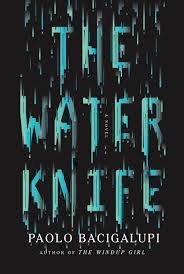
The Water Knife
Key Takeaways
Kyle, in 2019 in Books: The second book we read as part of The Fiction of Future, we focused on finding a more near term landscape. The Water Knife lays that out in a not-too-distant wasteland impacted by the increasing draught and water shortages caused by climate change. To hear the possible outcomes, even if an unlikely possibility, is stark, and begs the question of why we aren’t talking about this as a bigger issue.
Paolo Bacigalupi’s near-future thriller about water rights in a collapsing American Southwest — filed by Kyle under Fiction of Future and Historical Futurism. The highlights are less plot than epistemology:
- Language as a precondition for seeing. The book’s most-marked idea, stated twice: “If we can’t describe our reality accurately, we can’t see it” and “if we don’t have the right words in our vocabularies, we can’t even see the things that are right in front of our faces.”
- Data as something you test, not believe. “Pure data. You don’t believe data — you test data” — followed by the narrator dating the collapse to “the moment we decided” otherwise.
- The ecological setup. The centrifugal pump let Nebraska, Kansas, Oklahoma and Texas throw “on the garments of fertility for a century, pretending to greenery” — borrowed abundance presented as normal.
- Distributional brutality. “Some people had to bleed so other people could drink. Simple as that.”
- Judging people fairly. “You didn’t judge people for caving under pressure; you judged them for those few times when they were lucky enough to have any choice at all.”
- Against nostalgia. The line Kyle bolded: “I don’t need books about how things used to be… I need a book about how I’m supposed to live now.”
- Rules vs. habits. “Maybe there never were any rules. Maybe all we have are habits. Things we do without even knowing why.”
Connections
Books: Fiction of Future is the tag; The Road and Iron Gold share the collapse register. Where the Water Goes for the non-fiction counterpart on western water.
Concepts: Water Rights · Historical Futurism · Language of Discourse — the “right words” passages are a direct statement of why that tag exists. Data in Investing — “you don’t believe data, you test data.”
People: Paolo Bacigalupi.
Books: One of the three sci-fi novels Kyle catalogues under “Books I’ve read (sci-fi)” in the Historical Futurism - Research notes, alongside Leviathan Wakes and Red Rising. In that page’s Connections it sits with Snow Crash, Ready Player One, The Road, Brave New World, and Fall, Or Dodge In Hell as the fiction feeding the Historical Futurism thesis. Concepts: Historical Futurism — the futurist-fiction shelf; Dystopia — the water-scarcity register of it.
Highlights
Kyle: {{slider}}
- “Pure data. You don’t believe data — you test data.” He grimaced. “If I could put my finger on the moment we genuinely fucked ourselves, it was the moment we decided that data was something you could use words like __believe __or __disbelieve __around.”
- “If we can’t describe our reality accurately, we can’t see it.”
- “People only really live when they’re about to die,” he said. “Before then it’s all a waste. You don’t appreciate how good it is until you’re really in the shit.”
- “If we don’t have the right words in our vocabularies, we can’t even see the things that are right in front of our faces.”
- “Some people had to bleed so other people could drink. Simple as that.”
- “Thanks to the centrifugal pump, places like Nebraska, Kansas, Oklahoma, and Texas had thrown on the garments of fertility for a century, pretending to greenery and growth as they mined glacial water from ten-thousand-year-old aquifers. They’d played dress-up-in-green and pretended it could last forever. They’d pumped up the Ice Age and spread it across the land, and for a while they’d turned their dry lands lush. Cotton, wheat, corn, soybeans — vast green acreages, all because someone could get a pump going. Those places had dreamed of being different from what they were. They’d had aspirations. And then the water ran out, and they fell back, realizing too late that their prosperity was borrowed, and there would be no more coming.”
- “It was a view of the world that anticipated evil from people because people always delivered. And the worst part was that she couldn’t really argue.”
- “Everything’s bad, until you find something worse.”
- “…”Why are you so nice? It doesn’t make sense. I’m not your woman. I’m not your people”
- “We’re all each other’s people. Just like we’re all our brothers’ keepers. We forget it sometimes. When everything’s going to pieces, people can forget. But in the end? We’re all in it together…”
- “I used to know this Indian guy… the thing he said that stuck with me was that people are one here in America. They’re all alone. And they don’t trust anyone except themselves, and they don’t rely on anyone except themselves. He said that was why he thought India would survive all this apocalyptic shit, but America wouldn’t. Because here, no one knew their neighbors.” He laughed at that. “I can still remember his head wagging back and forth, ‘No one is knowing their neighbors.”
- “There were stories in sweat. The sweat of a woman bend double in an onion field, working fourteen hours under the hot sun, was different from the sweat of a man as he approached a checkpoint in Mexico, praying to La Santa Muerte that the federales weren’t on the payroll of the enemies he was fleeing… Sweat was a body’s history, compressed into jewels, beaded on the brow, staining shirts with salt. It told you everything about how a person had ended up in the right place at the wrong time, and whether they would survive another day.”
- “Sometimes you found a way to mesh up for a little while, maybe even spin the same direction, as he and Lucy had. Other times you couldn’t find a fit. Sometimes you were the most important past in the machine.
- “You didn’t judge people for caving under pressure; you judged them for those few times when they were lucky enough to have any choice at all.”
- “Desperate people did desperate things, became avatars of unexpected tragedy.”
- “Books on one shelf, a small collection of old titles. Isak Dinesen, bound in leather. Alice in Wonderland, in an old illustrated edition. The kind of things someone kept to show visitors how smart they were. Accessories to identity. But one book — a copy of Cadillac Desert, old. He reached for it. “Don’t,” she said. “It’s a signed first.” Angel smirked. “ ’Course it is.” Then: “My boss makes all her new hires read that. She likes us to see this mess isn’t an accident. We were headed straight to Hell, and didn’t do anything about it.”
- “Start by loving, instead of needing.”
- “You get worked up about what’s right and wrong, but that shit’s only in your head. Rules are what the big dogs say they are.”
Kyle: “I don’t need books about how things used to be. Everybody talks about how things used to be. I need a book about how I’m supposed to live now. Unless you got a book like that, I don’t need the weight.”
- “You know what? No. I don’t give a damn about the lies. Lies are fine. Truth. Lies. One way or the other, at least — ” She broke off again, shaking her head. “It’s not the lies. It’s the silence. Silence is what gets me. All the things you don’t say. All the words you don’t write. That gets to you. After a while it just kills you. All the stories you teach yourself not to tell. All the truth and lies that you never ever print because all of it is too dangerous.”
- “Anyway, the thing he said that stuck with me was that people are alone here in America. They’re all alone. And they don’t trust anyone except themselves, and they don’t rely on anyone except themselves.”
- “Or maybe there never were any rules. Maybe all we have are habits. Things we do without even knowing why.”
- “If she still felt guilt for her betrayals, well, that was her code. Angel had his own, and his code said that betrayals happened all the time, for small reasons and large.”
- “It’s the first rule of bureaucracy: any message worth sending is worth sending in triplicate.”
- “I don’t need a friend,” she said. “I’ve got a dog.”
- “I think the world is big, and we broke it.” She shrugged. “Jaime used to go off on this all the time. How we saw what was coming and didn’t do anything about it.”
Referenced in
- Brave New World book
- Cadillac Desert note
- Climate Change note
- data note
- Fiction of Future note
- Historical Futurism note
- I, Robot book
- Lies note
- slider note
- Snow Crash book
- The Road book
- Water Rights note
- Where the Water Goes note