Ideological Family Tree
Preserving and transmitting wisdom across generations
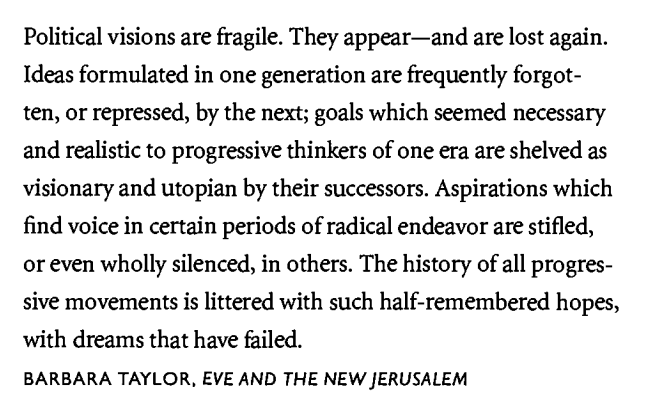
The commitment to creating a multi-generational record of ideas, stories, and wisdom through systematic documentation — weekly letters to children, personal journaling, interviews with family members, and the curation of a family intellectual history. The belief that ideas and values compound across generations only if they're deliberately preserved and transmitted.
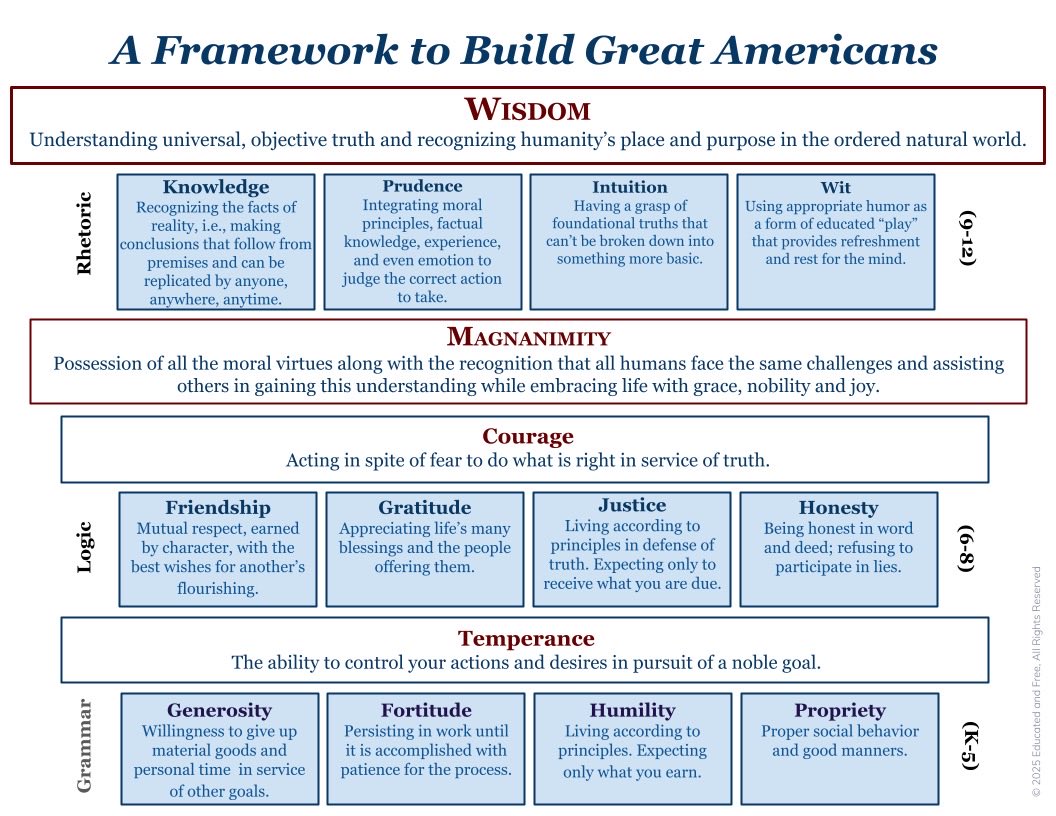
If you want to do for your children what Mr. Sardis wants to do for his, here are two supports: A framework of Aristotle’s Nicomachean ethics students can understand and a library that will help them see it all across time, across countries, and in themselves. https://t.co/gGTaBXF7L3 **Quoting @simonsarris:** > the things I'm most interested in teaching my children via home schooling are things that are mostly absent from school anyway - persuasion, business, art (beyond surface level), composition, pursuit of virtue, proper judgement

The Greeks had two ways of thinking about time: Chronos and Kairos. "The time used by storytellers is more cyclical, close to the time of nature. The Greeks talked about Chronos. Chronology time. The one we can measure. Then they talked about Kairos, which is deep time. That is https://t.co/T06lANI9vl



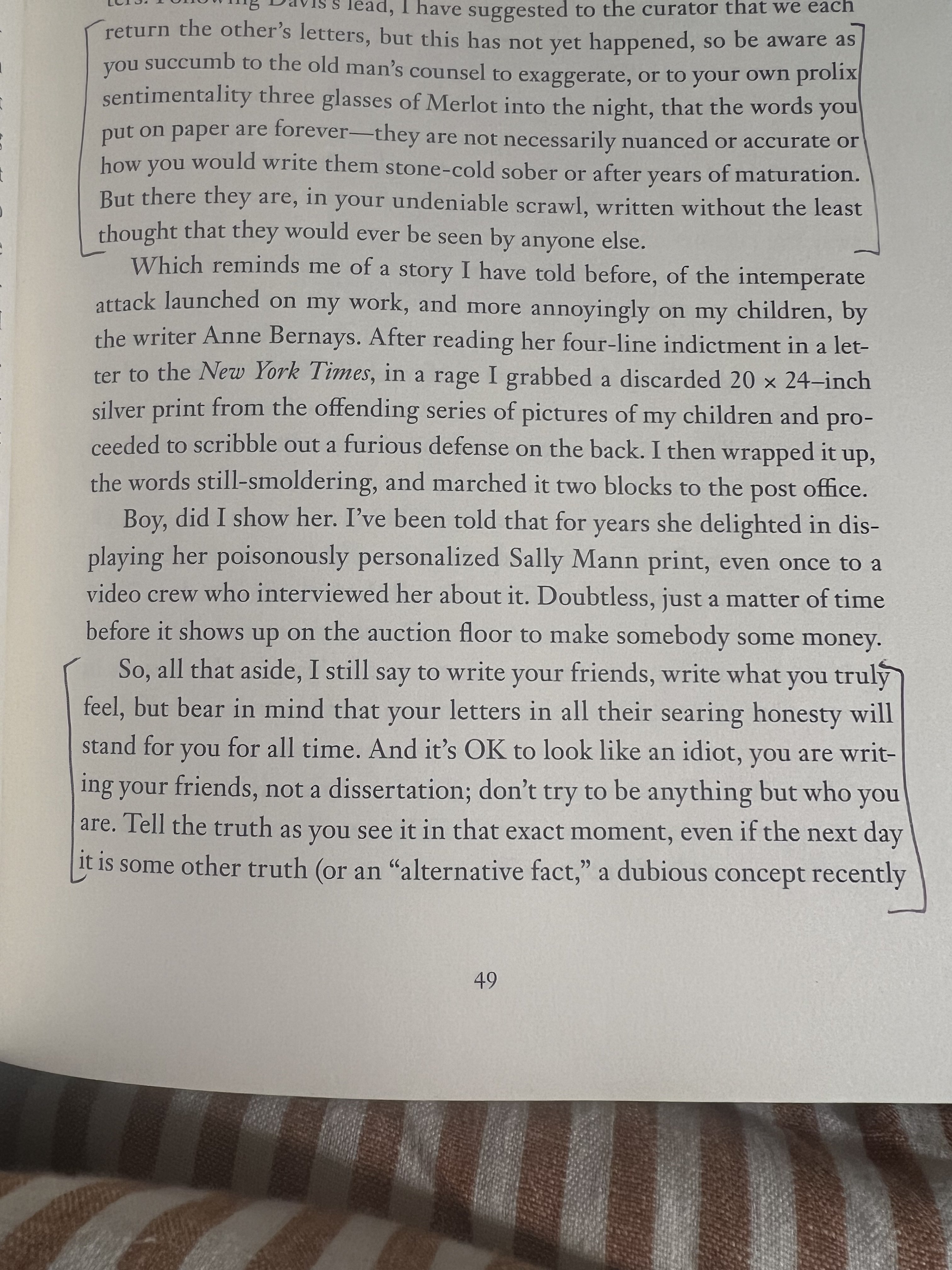
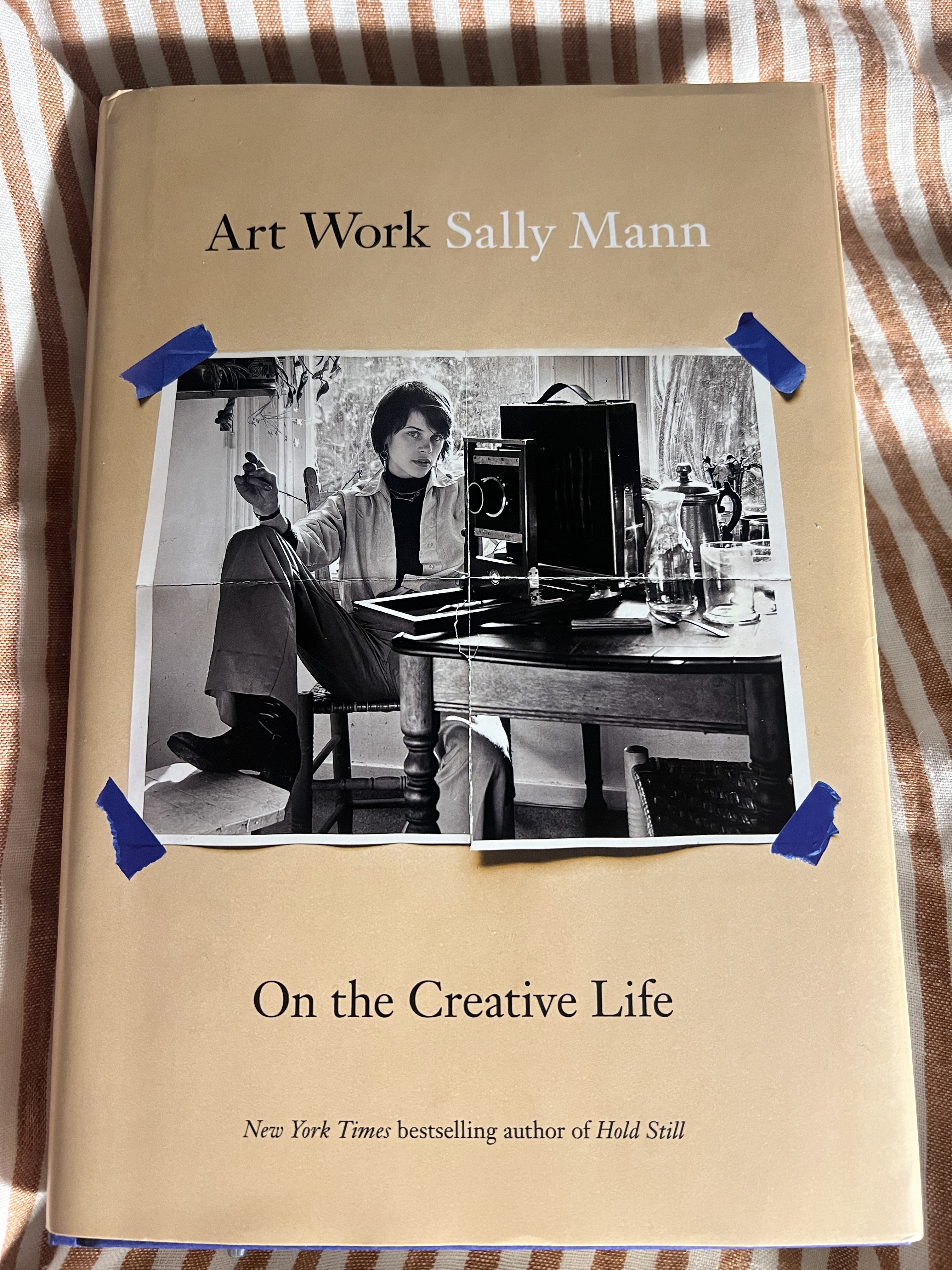
“So, all that aside, I still say to write your friends, write what you truly feel, but bear in mind that your letters in all their searing honesty will stand for you for all time. And it's OK to look like an idiot, you are writing your friends, not a dissertation; don't try to be https://t.co/Uo7z3LDLhl
If you want to do for your children what Mr. Sardis wants to do for his, here are two supports: A framework of Aristotle’s Nicomachean ethics students can understand and a library that will help them see it all across time, across countries, and in themselves. https://t.co/gGTaBXF7L3 **Quoting @simonsarris:** > the things I'm most interested in teaching my children via home schooling are things that are mostly absent from school anyway - persuasion, business, art (beyond surface level), composition, pursuit of virtue, proper judgement
The Greeks had two ways of thinking about time: Chronos and Kairos. "The time used by storytellers is more cyclical, close to the time of nature. The Greeks talked about Chronos. Chronology time. The one we can measure. Then they talked about Kairos, which is deep time. That is https://t.co/T06lANI9vl
“So, all that aside, I still say to write your friends, write what you truly feel, but bear in mind that your letters in all their searing honesty will stand for you for all time. And it's OK to look like an idiot, you are writing your friends, not a dissertation; don't try to be https://t.co/Uo7z3LDLhl
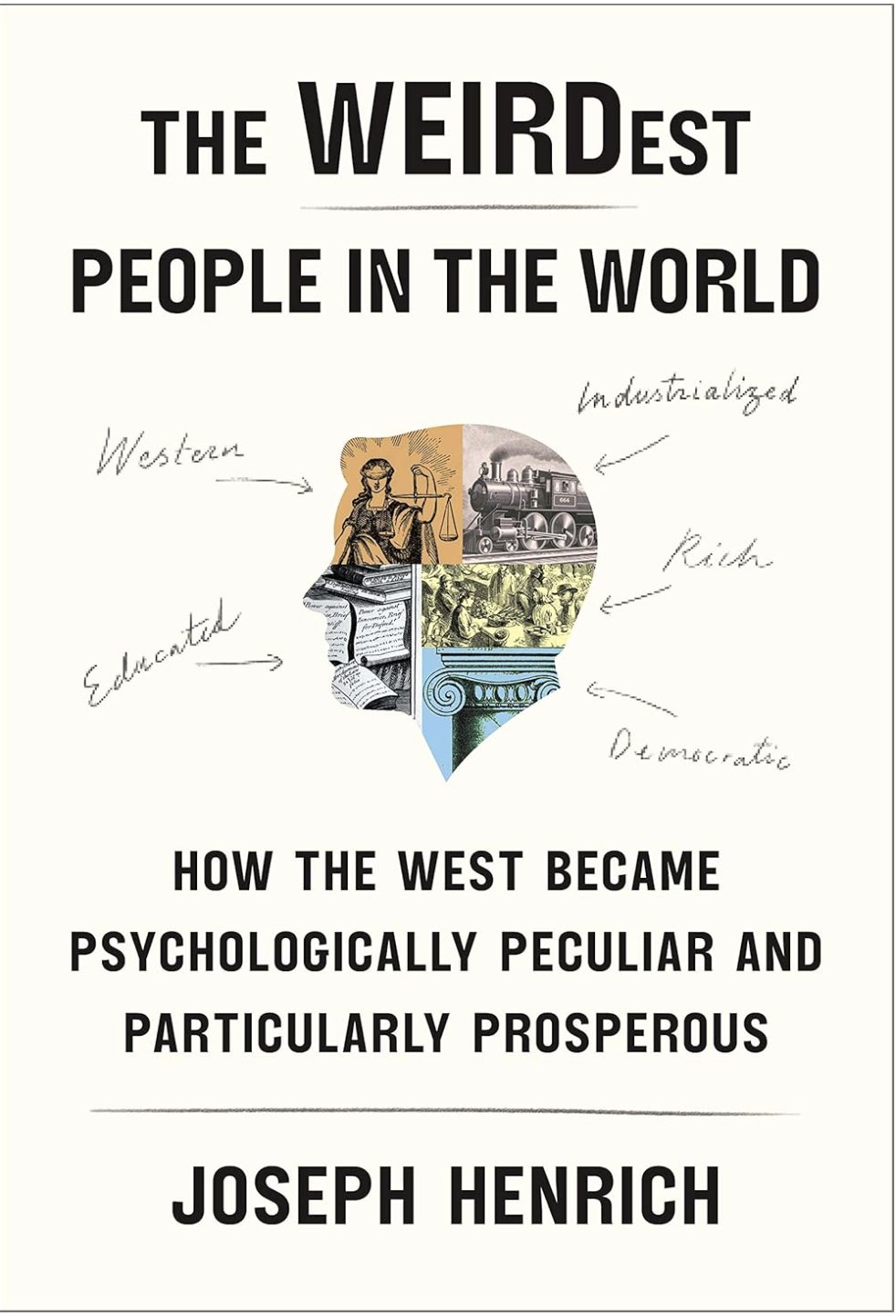
1/ Becoming highly literate changes the physical shape of our brains: "Learning to read forms specialized brain networks that influence our psychology across several different domains, including memory, visual processing, and facial recognition. Literacy changes people’s biology https://t.co/R4dFq1sPfJ
I think those born in the 80s and early 90s were (a) individualist due to growing up offline and (b) encountered the internet as a frontier. But those born after the mid 90s were (a) conformist as a result of growing up online and (b) encountered the internet as a warzone.
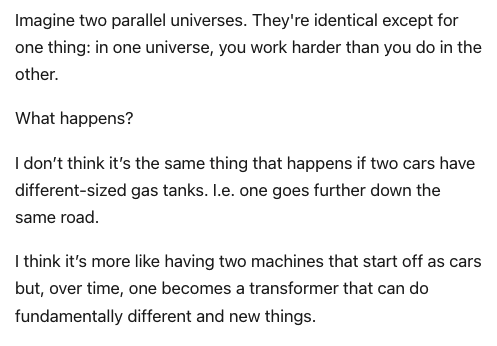
May 19, 2023As the climate turns. I find myself grinding more. Flailing more. And swimming upstream. But should you work harder in a recession? https://t.co/opVRGQ1HdB Some great responses to this post
Oct 29, 2022I wrote about why working hard is important. It's not about out-competing other people; it's about creating new opportunities that would have been impossible without effort. Enjoy: https://t.co/GsRse4bjPs Inspired by: • The @FoundersPodcast on Chung Ju-yung: https://t.co/9TxHseJOUo • @paulg's schlep blindness essay: https://t.co/CsqWexkajd • @stephsmithio's tweet: https://t.co/x5PfsfH0ap
We're living in a commitment crisis: People think they’ll be happy if they don’t have any obligations. In truth total optionality is a recipe for emptiness. Like a log in the ocean, you’ll float all over the place without going anywhere valuable. This is what people mean when they say people are “adrift” these days. To achieve anything meaningful, you have to make a commitment. Here's an example: A lifelong marriage is the deepest relationship you’ll ever have because you and your partner have committed to a lifetime of faithfulness. No, I’m not saying you should instantly commit to everything. Doing so is an oxymoron because attention is zero-sum. Committing too early and for too long at the get-go is foolish (don’t get married after your first date!). But when the right opportunity comes, commit. Where does our commitment phobia come from? 1. The cultural explanation is liberalism, which detaches us from the constraints that once tied us down — family, place, tradition. People aren't bound by the traditional virtues of honor and loyalty, which define committed cultures. 2. The technological explanation is abundance. The "so muchness” of modern life creates commitment anxiety. It’s like the Paradox of Choice, which argues that you can reduce anxiety by reducing choice. Having more options makes it harder to make long-term commitments. 3. The sociological explanation is shortening time horizons. People in most Western countries are having kids at below replacement rate. Instead of thinking about building intergenerational family wealth, they're increasingly thinking about their own desires and freedom. The problem is that a life without commitment is a life spent "hugging the X-Axis." The Y-Axis is value. The X-Axis is time. Commitment is the only way to bear fruit in your life. You can't nurture the seeds you've sown when you're always jumping from thing to thing. Long time horizons change our incentives, usually for good. This is one of the core findings of game theory: people treat each other better when they intend to interact many times in the future. The same goes for objects. As the saying goes: "Nobody's ever washed a rented car." The longer your time horizon, the calmer life becomes. Zoom out far enough and once-gargantuan hurdles turn into tiny speed bumps on the road of life. How can you lengthen your time horizons? The cadence of your work shapes your temperament. Think of investing. When you’re a day trader, every phone notification matters. But when you’re a committed buy-and-hold investor, you can mostly ignore them. The bottom line is commitment is undervalued. If you have commitment phobia, you’re not taking control of your own life. You’re taking your hands off the wheel of reality and letting happenstance define your life. There's no compounding without commitment. In matters of the heart, commitment brings meaning. In matters of the mind, commitment brings expertise. And in matters of the material world, running towards the responsibility that comes with commitment takes courage — and with courage comes achievement. Since I've struggled with commitment all my life, I wrote this essay to help myself commit to people, places, and the company I'm building. https://t.co/3npxOe2frj
Jun 7, 2022Saturday was my 15 year anniversary @sequoia... one of the things I love about Sequoia is getting to learn new things from amazing people, so here are 15 lessons from 15 people over 15 years... hope you enjoy! 1/ A lesson from @ericsyuan: Simplicity Scales https://t.co/HG2Pbwna6T 2/ A lesson from @roelofbotha: It’s Not About Figuring Out What’s Wrong, It’s About Figuring Out What’s Right https://t.co/CGIFGtLYaG 3/ A lesson from @jesskah: Become the Best Version of Yourself, Not of Somebody Else https://t.co/fypCmVF5i1 4/ A lesson from @elonmusk: The Output of an Organization is Equal to the Vector Sum of its Individuals https://t.co/xm5AREdvsV 5/ A lesson from Michael Moritz: Don’t Put a Ceiling on Greatness https://t.co/7wrAN9MLsK 6/ A lesson from @dcancel @eliast: Slow is Smooth and Smooth is Fast https://t.co/jJpPCmtX3A 7/ A lesson from @michellebailhe: If You See a Problem, Solve It https://t.co/lefRPRLYpG 8/ A lesson from @GuptaRK22: Bring Joy https://t.co/xF1UaQru4r 9/ A lesson from Frank Slootman: Push Toward the Extremes https://t.co/Ud4SNnSt14 10/ A lesson from @Alfred_Lin: Effort Compounds https://t.co/IpkchyJKcD 11/ A lesson from Don Valentine: Winning Creates Culture https://t.co/CelQO7Zqtb 12/ A lesson from Doug Leone: Lean In! https://t.co/xgToXWqSc9 13/ A lesson from @saranormous: Suck the Oxygen out of the Air https://t.co/CMxLqB3gKN 14/ A lesson from @jimgoetz: Have the Courage to Use Your Own Understanding https://t.co/aFHoego9ve 15/ A lesson from @LucianaLix: Every Day is Game Day https://t.co/86bpaF0e4o
Mar 7, 2022My thinking on time management has shifted recently, largely inspired by @oliverburkeman's "Four Thousand Weeks". We must decide how much of our time to spend on activities, even saying no to some things we like to make room for the most important. See🧵for quotes + learnings! We each have 4K weeks to live, assuming average life expectancy. Perhaps we should rethink our historical views of time management (i.e., trying to do it all). Perhaps due to the pandemic or because I'll be 40 next year, but I think it's high time I rethink my own time. "Productivity is a trap. Becoming more efficient just makes you more rushed, and trying to clear the decks simply makes them fill up again faster." ✨Decide in advance how much time goes to work - and be willing to stop once you reach the end of that time limit. "The more firmly you believe it ought to be possible to find time for everything, the less pressure you’ll feel to ask whether any given activity is the best use for a portion of your time." ✨This "I can do it all" mentality may reduce our ability to be effective. "Focusing instead on what’s truly of greatest consequence while tolerating the discomfort of knowing that, as you do, the decks will be filling up further, with emails & errands, many of which you may never get around to." ✨The secret is to embrace that we can't do it all. "The more you focus on using time well, the more each day feels like something you have to get through, en route to some calmer, better, more fulfilling point in the future, which never actually arrives." ✨This beautifully sums up my previous quest to master time management. "And the paradoxical reward for accepting reality’s constraints is that they no longer feel so constraining." ✨Once we accept that we can't do everything, we get better at paying ourselves first with our valuable time. "Limit your work in progress to 3 of the most important items." ✨The rule of 3 can help us to resist the allure of lower and middle priorities which we really shouldn't spend time on. "James Hollis recommends asking of every significant decision in life: “Does this choice diminish me, or enlarge me?” ✨This question can help us prioritize in real-time, focusing on the things that truly enhance us, our communities, and our most important goals. "Keep two to-do lists, one 'open' and one 'closed.' ✨By only working from a finite list of the most important open to-dos, we don't feel lost. And a growing list of closed items helps us feel confident that we are meeting what we've deemed to be key objectives. "It’s alarming to face the prospect that you might never truly feel as though you know what you’re doing." ✨An amazing quote about our innate desire to work hard so that we'll "make it" when it fact everyone's trying to figure it out on the fly, and no one ever fully "arrives". "Pay more attention to every moment, however mundane." "Deliberately adopt an attitude of curiosity." ✨A few tangible things that can help us remember to enjoy the journey rather than focusing solely on the destination. "When an impulse arises—to give money, check in on a friend, send an email praising someone’s work—act on the impulse right away, rather than putting it off." ✨Connecting with others, showing gratitude, and giving back are easier as we adopt new ways of prioritizing our time. "When it comes to the challenge of using your 4K weeks well, the capacity to do nothing is indispensable, because if you can’t bear the discomfort of not acting, you’re far more likely to make poor choices." ✨Sometimes doing nothing at all is the best use of our time. <end 🧵>
Mar 5, 2022Having kids is the hardest job I’ve ever done. I was completely unprepared. But after 16 years, I learned a lot -- the hard way. Here are my 49 contrarian beliefs on parenting. A thread... 1/x Admit that as a parent you have no idea what you’re doing. That’s OK because everyone feels that way. (I feel humbled by parenting — all the time.) Family dinner should be a protected, prioritized activity where no “family business” is discussed. Don’t hire your kid for their first or second job. They need to learn how the real world works first. If you can, give your kid the freedom that comes from graduating college debt-free as they start life. Save like mad. Parenting is the hardest job you’ll ever do. It takes decades, has no fixed winning condition, multivariate conditions, and nobody to say “thanks” until your kids are well into adulthood. Make sure your kid knows what college degrees pay. If they pursue one that doesn't pay, do so with eyes wide open. One trick I do is the “Bank of Dad” I hold deposits and pay 3% interest a month. My kids learned passive investing young. Children should be first class members of your life. But not the sole reason for your existence. Pick a name that is simple and easily spelled. Otherwise, you curse them with spelling “E-V-A-N-G-E-L-I-N-A” dozens of times a day. My boys? “Seth” and “Drew.” The best investment you can do for your kids is braces. In the US, good teeth are table stakes. Every teenager needs to have a menial job to appreciate hard work. Send their butt down to McDonald's or a construction site. Do not compete with other parents through your kids’ accomplishments. Every child needs to face adversity. If your kid doesn't have any, find them some. Kids will remember the time you spent with them. Not the things you bought them. If you can, take your kids on trips to see how the “rest of the world” lives. Every kid should see a slum before 18. Getting a huge inheritance is the surest path to ruin a kid. I’m a fan of (a) leaving a nice inheritance but (b) telling them you might spend it all first. Let your kid choose their own religion when they’re old enough. Teachers and other students have more influence on our kids than we do after a certain age. Nudge kids to associate with the best of them. Prioritize getting in the best K-12 school possible, preferably public schools. Push your kid to a college with the best *brand* possible. They’ll get that label, some learning, and a great network. Don’t believe these idiots saying college is bad ROI. It’s not… yet. Let your kids fail often. You’re preparing them for adulthood, not a trip to fantasyland. Dad jokes are your friend to teach kids the nuance of language. No shame in leveraging your advantages (connections, etc) to help your kid. When kids are young, you are a dictator. Some parents never transition to “coach” and that’s how we get teenage rebellion. School won’t teach money nor entrepreneurship. Talk about that stuff openly with them – including your wins and losses. Get as much help as you can afford and ask for help. 10 hours of quality time with you is better than 18 hours of you while exhausted. It’s healthy for kids to be bored sometimes. Nothing should be taboo with your kids. Want to have them bored by “bad” things like drugs, for example? Talk about them freely and the mystery/coolness goes away. It’s OK not to love parenting. Yes, we love our kids but parenting might not be our favorite thing. Gender bias comes at you from all directions. Example: Boy gets “Great job at soccer this week!” and Girl gets “Well, doen’t your dress look pretty today!” Do not give your kid their first car for free. Make them pay for at least a portion of it out of money they earn. Get them a 2-ton car made of American steel. They will crash and you want that safety. Talk to your kids like you would an adult. This includes vocabulary, abstract concepts and so on. Everyone has an opinion on whether it’s better to have kids early (your 20s) or late (late 30s). They’re all full of shit. Don’t live vicariously through your kids. For every stage-dad that coached his kid to be Serena Williams, there are thousands of kids who resent their parents for decades. Remember your mission is to create a kid that becomes a great, well-adjusted adult. Not “win” at being a 5th grader or whatever. Someone cranky? Start first with low blood sugar as the culprit. Don’t be that parent screaming at the refs. It’s just a 9-year old’s soccer game. If you want to get boys to talk, don’t ask questions. Just start sharing. Not every kid should learn to code. Not all kids are wired to be programmers. Too many times the media promotes one study (not reproduced) and suddenly we’re all expected to follow a new fad (child-led whatever, etc). Ignore the bad or weak science. Some will shame you for doing what’s best for your kid. Those people are jerks. Some kids like to be busy. Some like a slower pace. Some like routine. Others don’t. Be the parent your kid needs for their personality. Don’t beat yourself up for taking some shortcuts sometimes (ipads at a long dinner, Benadryl to get through a long flight, etc.). Training wheels slows down learning to ride a bike. Get one of those scoot things. Let your kids get in the dirt as young as possible. Buy a sandbox. Expose them to animals. It helps with immunity and allergies. You will end up happier as a parent. Nature uses the same brainwashing that Army Boot Camps do. Remember childhood isn't an 18-year preparation. It's actually life. Slow down and enjoy it! What did I miss? If you liked this, give me a follow @girdley and click RT on the first post! Much love!
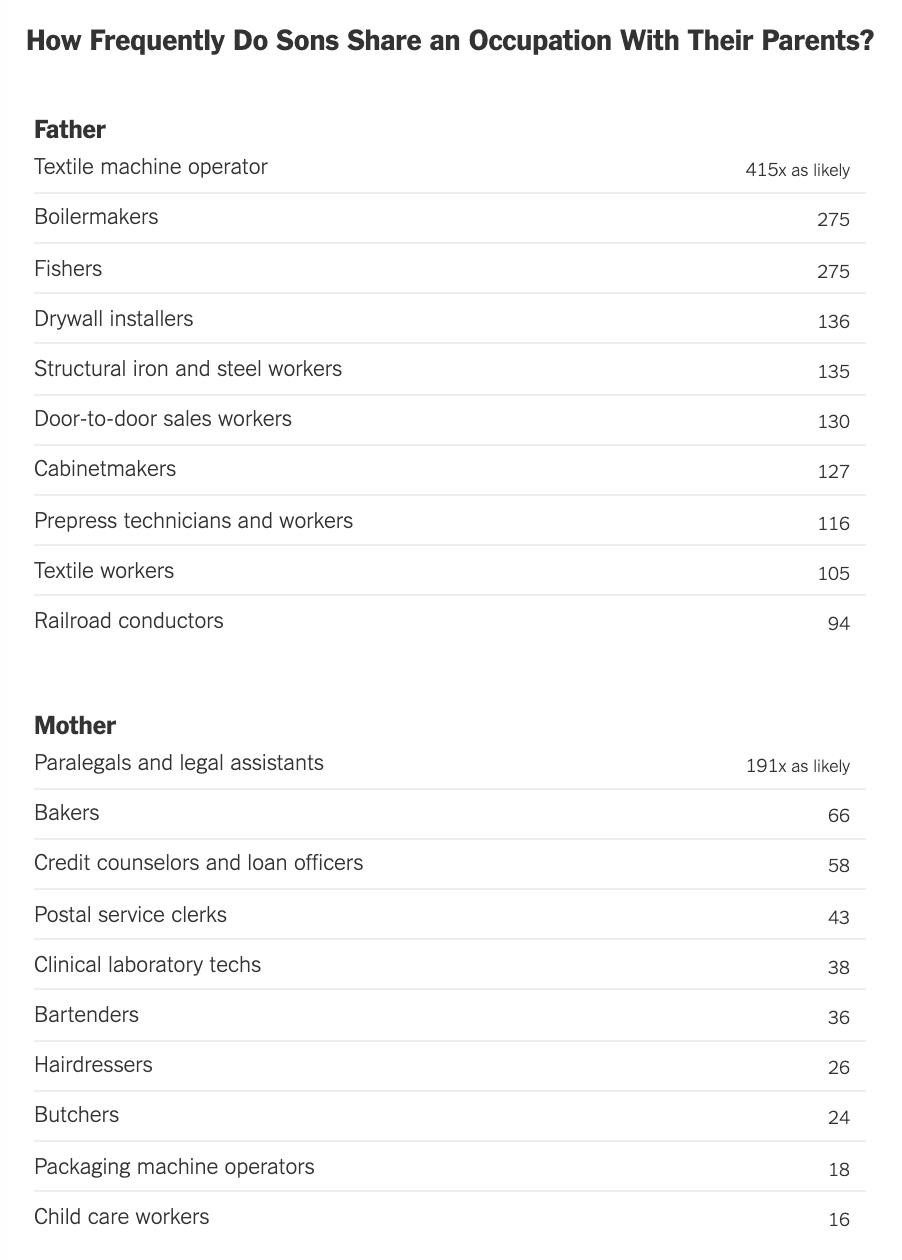
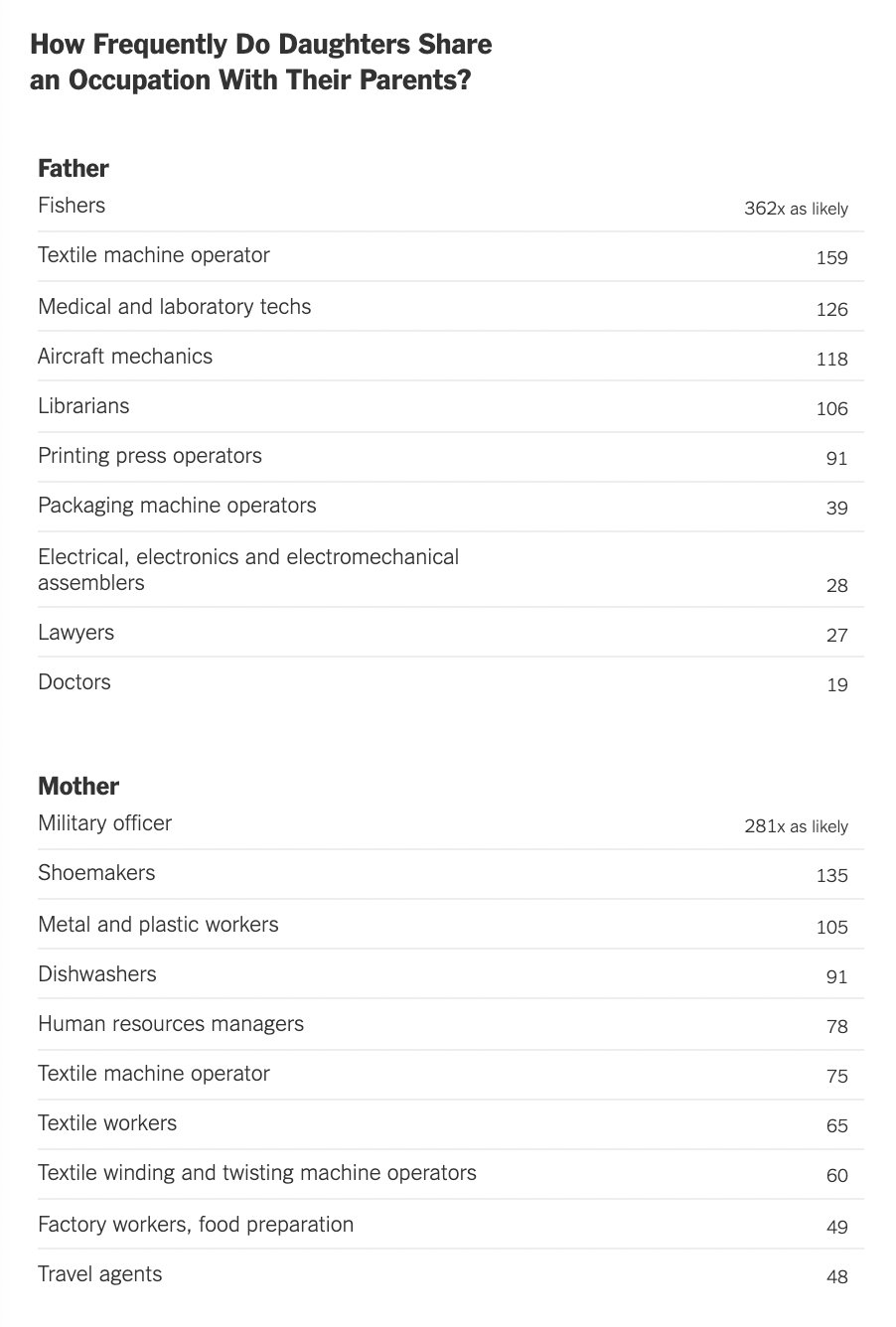
Dec 4, 2021Children whose parents were doctors are 25x more likely to become doctors than others Children whose parents were lawyers are 18x more likely to become lawyers than others Children whose parents were steelworkers are 155x more likely to become steelworkers than others Interesting analysis from @clairecm & @qdbui: https://t.co/zHHAXUaID8
😴 For >99% of human history, people slept in communes. Today, newborns are rushed for individual sleep. It's called seep training. Here's: 👋 An intro to sleep & brain development 👐 What sleep training is 👈 Where it originates from ✋ Why you should avoid it A thread 🧵 👋 An intro to sleep & brain development Before central heating & alarm systems, entire families (even guests & servants) would fit in a single mattress and spend the night together. Only in ~1850 private sleep became a thing. Sleep is the most vulnerable state of humans. The body goes on "stand by" mode to grow, rest, and heal. The nervous system has to *feel safe* to fall asleep. Although babies don't have a logical understanding of "danger," their brains come fully wired to feel fear. The newborn brain size is 25% of an adult's. BUT they are born with a developed hippocampus and amygdala. What do these do? Hippocampus is responsible for learning and long-term memory. Amygdala is responsible for memory processing, decision-making, and emotional responses. The baby brain does what it has to do. It *learns* and it *reacts* to danger. Sleep is a vulnerable state. Babies want to feel safe. They rely on sleep to grow and learn AND they rely on *feeling safe* to able to sleep. This is where the importance of parenting comes in. Why? 👇 Because human babies are born *half-baked.* For 30 million years, social mammals have executed *intensive* parenting. This type of parenting has been crucial for the proper development of our species. For example 👇 🐑 A lamb can walk minutes after it's born but our babies need 9 more months to match the mobility! 💡 For bone development, another 9 months are needed. 🧠 The brain doubles in size in the first year. 🤯 By age 3, it has reached 80% of its adult volume. ☝️ But if our bodies waited for FULL development, 🍉 the baby's head would get SO BIG that it'd be impossible for the mom to deliver them vaginally (ouch!) Immature body & brain make babies heavily dependent on parenting. Some parts of the brain develop through touch & eye contact. 👉For example, babies in Romanian orphanages were dying because they were ONLY fed and diaper-changed. They weren't touched and held. Hunter-gatherers—and many non-Western cultures today are known to: —rely on breastfeeding for 2-5 years —co-sleep —be responsive to baby's cues —rely on social support for mothers So where did this *individual baby sleep* come from? I'll give you a historical walkthrough. But first, let's define sleep training. 👐 What's sleep training? It's the "training" parents give babies for independent sleep. It mostly involves having babies cry themselves to sleep. Most of the time, "sleeping through the night" is the aim. There're several methods with varying levels of parental support. 👈 Where did sleep training originate from? The term “sleep training” first appeared in 1997. But the idea of having babies cry to sleep has been around since the 1800s. In the 1830s, German doctors were known to suggest parents not rush to calm a crying baby and see if they will settle on their own. 🦠 In the 1880s, mothers were advised not to touch their babies too often because *germ theory* and transmission of infections were hot topics. The term "cry it out" first appeared in 1894 in Emmett Holt's book The Care and Feeding of Children. “How is an infant to be managed that cries from temper, habit, or to be indulged? It should simply be allowed to ‘cry it out.'” —from The Care and Feeding of Children. But even before that, in the 1830s, the industrial revolution played its part. —12h shifts had become common —Child-rearing outside of the home was costly —Sleepless nights were decreasing women's productivity So sleeping through the night started to become high in demand. 🙄 Then came the behaviorists. 🙄 In the 1920s, behaviorist John Watson, the president of the American Psychological Association, warned parents that maternal love would make children dependent. He had no science—not even a single experiment—to back his claims. In 1985, Richard Ferber's book, Solve Your Child’s Sleep Problems, came out. The Ferber Method was born. (the most popular method from which other "gentler" methods were derived) Allowing babies to cry for a predetermined amounts of time at intervals before offering comfort. In short, sleep training is a: —A 200-year-old perspective —Disregards how the human brain evolved —Is rooted in behaviorist and non-scientific approaches ✋ Why you should avoid sleep training 1) Babies sleep differently than adults and it's normal. Baby sleep is made up of shorter cycles and is more "shallow" because babies need to be able to wake up to express vital needs—such as hunger. 2) Babies don't have matured self-regulation skills. Most people think sleep should be taught *but it's false.* Babies' bodies already know how to sleep. (They slept in the womb.) What needs to mature is self-regulation. And it cannot be rushed. 3) Sleep training misunderstands the development of independence The right hemisphere develops in response to face-to-face interaction. The right hemisphere governs several self-regulatory systems. Being safely dependent for a while helps them become independent in the future 4) Sleep training asynchronizes mother and baby. In a study, sleep-trained babies showed no stress in their behavior but their cortisol levels kept on rising even after they went to sleep. BUT because these babies showed no sign of distress, the mothers relaxed. 5) Sleep training ignores real problems Sometimes, there really are some red flags to investigate the baby's sleep further. From physical illnesses to missing parts within the parent-child relationship. Fitting all solutions under "training" might not be the best approach. Read more in this article 🥰 https://t.co/fIPxJaogJ9 This article appeared in my weekly newsletter: Bringing you ideas from psychology, neuroscience, and mindfulness. All past issues are here. Feel free to subscribe for free 😊 https://t.co/Hc3j8IXOOS Last week's issue also featured: 📺 A short video of Feynman, Nobel prize-winningAmerican theoretical physicist describing a part of his relationship with his dad 🦉 A piece of weekly wisdom 👁️ And this heartwarming comic on the parent-child relationship https://t.co/w7koOC73NI https://t.co/DbaBYbGExj
Mar 17, 2021Journaling is the practice that cultivates the skill of introspection, awareness, and intuition. It's also the cheapest form of therapy closest to working out. ✍️ Here are different types of journals you can utilize. 1/ Empathy Journal: Writing the story of other people, imagining their experience and viewpoint. Integrating this kind of journal helped me move away from "I" and "Me" and closer to "You" and "We" or a specific person. Training me to mirror the emotions of others as a skill. 2/ Day Journal: Writing about your experiences of the day. The most common type of journal and a great way to minimize false memories from long gaps of time. Also helps to process events on the day they occurred rather than months later. 3/ Gratitude Journal: Writing about what you're grateful for. I find myself wishing I've done more of this writing. We tend to focus on what we don't have, and not what we have until what we have is gone. I feel a gratitude journal is vital for happiness & simplicity. 4/ Mood Journal: Writing about a specific feeling and the activities and thoughts around it. Great for presence in the moment and great way of building up to more long-form types of journaling. A number of great tools & apps available to make mood journaling a daily habit. 5/ Topic Journal: Writing about a specific point of interest of theme. If a topic comes: "Money", "Focus" etc, you can write a sentence of any resonating thought around it. The goal is to keep it simple & time stamp your new entries to see your opinion evolve over time. 6/ Audio Journal: Recording your experiences through audio notes. If you convey your thoughts best through speech an audio journal is a great supplement to a written journal. Think of it as a voice note to your future self. 7/ Video Journal: Recording Video talking about your experiences. Public vlogs are popular. You can experiment w/ private video journals to practice speaking on camera even if you don't plan to share. Video will also capture your body language & voice for richer experience. 8/ Bullet Journal: Task and Event Journal If you tend to prioritize organization and work, you might find it easier to integrate the journaling practice as part of your daily task/todo management. Bullet Journals are a great flexible analog system for the productivity focused. 9/ Decision Journal: Notes on why you made certain decisions. Writing down the important life decisions you have to make will help you think and plan more clearly as well as improve future decisions. A decision journal helps to capture the energy, thoughts & alternatives. 10/ Conversational Journal: Conversational Journal A blend of multiple journal forms but it involves conversations with friends or acquaintances that are recorded or transcribed into a journal entry.
Dec 23, 2020Our society needs more cults. Death cults, theorem cults, nature cults, technology cults, fertility cults, and of course the cult of the state. We have the beginnings of some of these but they are disgustingly underdeveloped. How do we build better cults? The key is professional cultists. They need to eat, have a roof, and be respected. To get that, they have to be useful, either commercially, or in some way that convinces people to support them. But their utility needs to be directly related to furthering the cult. Where you need cults is in things that don't directly work as businesses or normal nonprofits. It's something of social importance, and it requires a dedication of spirit to maintain the flame. Many nonprofits sit in the space that should be occupied by cults. The difference is in the narrative of managerial professionalism, detachment from the thing. A cult doesn't have a pitch deck and impact-focused patrons, it has an initiation, and wealthy cult members. Some businesses are actually cults. SpaceX is a rocket cult for example. What about Amazon? Is Amazon an infrastructure cult or any other kind of cult?
Nov 13, 2020Another great reason to keep journals: "What isn’t carefully recorded is gossip and guesswork. ” ~@david_mitchell
Sep 28, 20201/ 2020 will see the dawn of the metatribe. Here is an ethnography. 2/ I first heard the term "metatribe" on the Intellectual Explorer's Club podcast in a conversation between @peternlimberg and @dthorson 3/ The metatribe is neither nihilist nor locked onto an ethical system. It has political opinions without being left, right, or center. These opinions are provisional, nondogmatic, but strongly investigated, so metatribers often appear to be "heterodox" or "Chad centrist" https://t.co/ZdhFZLHFK1 4/ The metatribe is scientific without scientism. It is spiritual while being neither new age nor traditionally religious. (Though there do seem to be a surprising number of practicing Catholics involved.) 5/ Metatribe members tend to be at the center of a Venn diagram with many circles, often dwelling at the edge of many subcultures at once, acting as nodes between them. https://t.co/elXlZcHnrs 6/ Metatribe members tend to be multi-hyphenate: artist-scientist; dancer-entrepreneur; programmer-monk. Their work often synthesizes multiple disciplines at once. https://t.co/LlxvEwAQFw 7/ Dissatisfied with the partial map of the world from any one subculture or discipline, metatribe members have evolved to fill the spaces in between. 8/ For all this, you might expect metatribe members to be noncommittal to a cause. In reality, they're more likely to do cause prioritization. Popularly prioritized causes include existential risk and the meaning crisis. https://t.co/oXAsFYZLKc 9/ Some try to apply the label “metamodernism” to the metatribe. This could work in theory, but in practice, metamodernists are a sociologically distinct group that is only one part of the metatribe. 10/ There are many In-roads to the metatribe. They include: • @lesswrong • Daniel Schmactenberger • Game B • @Meaningness • Michael Vassar • Effective Altruism • @SamoBurja • Bay Area subcultures • @EricRWeinstein's Portal podcast • @LeverageRes • Ephemerisle 11/ [cont.] • @MonasticAcademy • The Castle festival • @ribbonfarm and @vgr • The former "Thielosphere" • @slatestarcodex • Foresight Institute • Take 3 • @vervaeke_john • The Embassy Network • @newmodality • Postrat Twitter (eg @eigenrobot and @0x49fa98) 12/ Canonical texts of the metatribe include Dune, Thinking Fast and Slow, Foundation, the Sequences, The Matrix, and Impro. Yes, here is me shilling Dune again bc Herbert described the mindset of metatribe back in 1965. The culture has only recently caught up. https://t.co/dM5EW0NuGZ 13/ The metatribe is an inevitable reaction to postmodernism and globalism. As the world fractured into a million narratives, the mind still strove for integration. I will do a separate thread on why I think the metatribe is coming together now. 14/ Toward the end of 2020 and start of 2021, the rise of remote work will finally enable the metatribe to gather from across the world to form in-person community. My group is working on this with our castle search & there are other efforts https://t.co/e7GQfeMBiJ 15/ In March, I gave a talk with Foresight Institute called “The renaissance came from the plague.” https://t.co/UZL0ACcJ5W 16/ The renaissance came from the plague. A new renaissance will emerge from the new plague. The metatribe will lead it. 17/ Here's a follow-up thread on metatribe maladies and antidotes: https://t.co/RqP8ZGIRvy
Sep 13, 2020> 1/ Graduating seniors deserve a Charlie Munger Tweetstorm with appropriate life advice to mark the occasion. "I want you to learn as much as you can vicariously. It’s too painful to do it by personal hardship. “You don't have to pee on an electric fence to learn not to do it” > > — **Tren Griffin** (@trengriffin), 2020-05-09 <!-- The saved tweet is part of a 19-tweet thread. The syndication endpoint returns only the head tweet and clips it at ~280 characters, so the full thread was unrolled from threadreaderapp.com and read through the rendered page rather than scraped — the raw HTML there also carries the author's *other* threads, which a regex pass silently mixed in. -->
2020-05-09This is why - I’m totally serious - it’s important to have proper documentation and handover protocols. I’ve seen local music and political and journalism scenes repeatedly stuck in the same small sad loops because nobody has the foresight Play the 100 year game https://t.co/Z4m7wvXYpH It’s easy to talk a big talk, it’s not so easy to commit to walking a long walk https://t.co/8xSjVdAmnD https://t.co/rS4Cyy1GGA