Have Kids. Or Don't. But Have Kids.

I had an interesting experience this week. I was scrolling the artist formerly known as the Bird App, as anyone with a dopamine addiction is wont to do, and I saw a tweet from Delian at Founders Fund that made me stop and think.
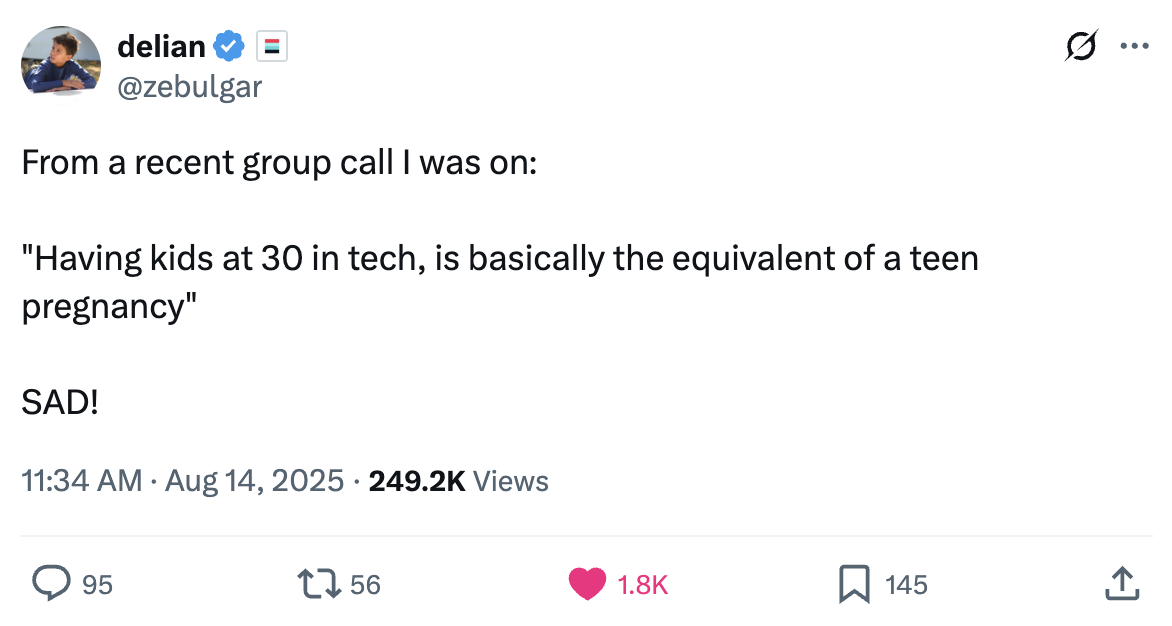
Regardless of the context of that call, I was surprised by the blatant counter positioning to what has felt like a real vibe shift lately. What I’m assuming this person meant was that, just like a teen pregnancy can throw off and potentially irrevocably damage the bright hopeful life of a young person, having kids at 30 is similarly a destruction of potential.
That didn’t square with what has felt like an increasing vibe shift back towards (1) marriage over perpetual dating, (2) religion over culturally atheist or agnostic, and (3) having kids over default fear or self-serving optimization.
That’s not to say that everyone is suddenly waking up desperate for marriage, kids, and Jesus. But enough people are feeling that way, that you would think it would give someone pause before dismissing part of that lifestyle as a default waste.
So, again, as someone with a X dot com addiction so often does, I responded with my gut reaction:
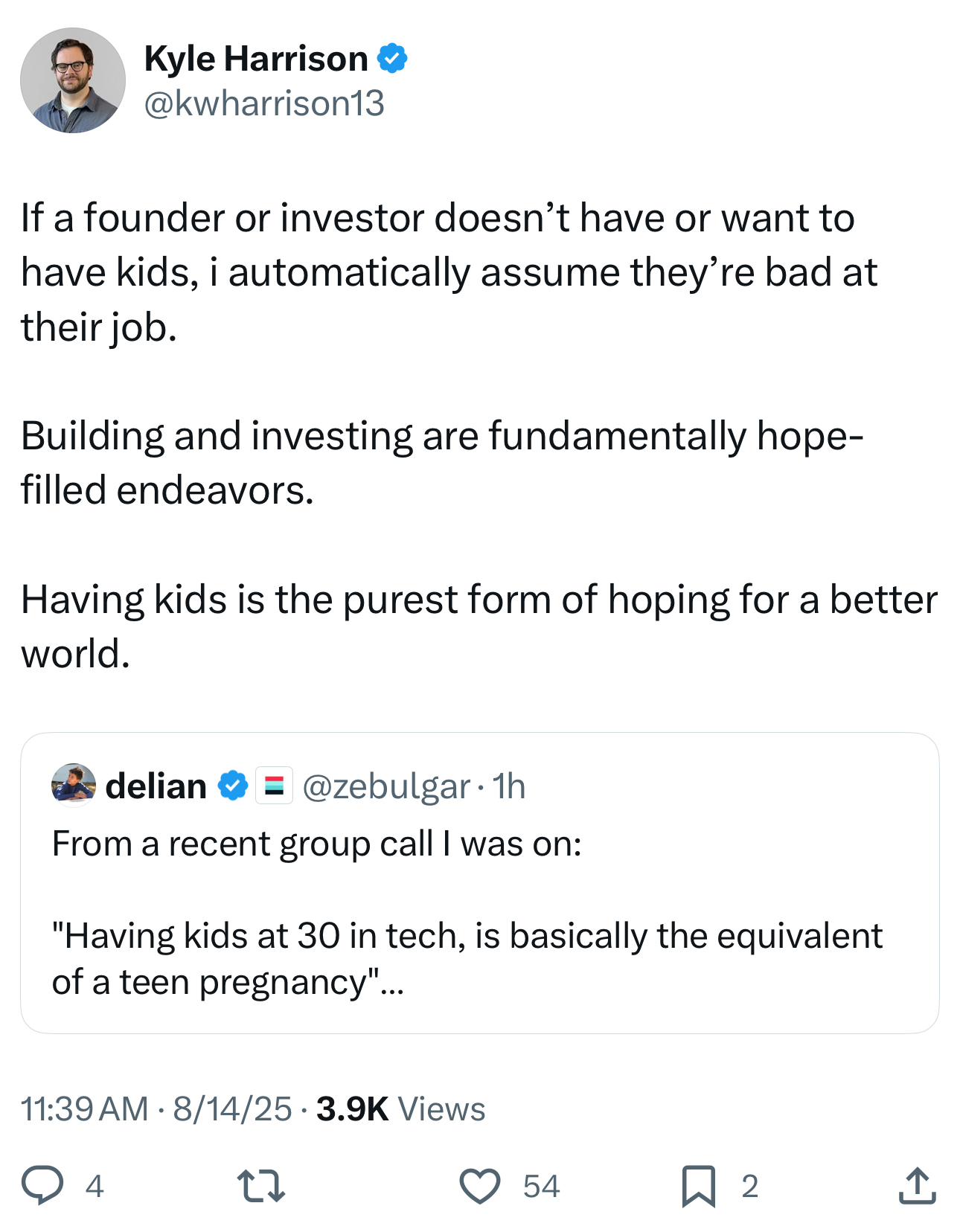
I didn’t think much of it, and I went about my day. But I heard from a few folks that they saw this response as insensitive. One person went as far as to take the position that “this is a really shitty thing to say.” Of all the things I’ve tweeted, I was surprised to see that this was one that touched a nerve. I deleted the tweet to avoid any future misunderstanding, but it still left me reflecting on what I meant with my shoot-from-the-hip tweet, whether or not I really believed it, and what (if any) were the implications that might make it a “shitty thing to say.”
That reflection is what I’m left thinking about today.
Fundamentally Hope-Filled Endeavors
I’ve written before about how investing is envisioning the future you want to exist and then putting resources behind that vision to make it a reality. The same could be said about building. These are what I called in the tweet “fundamentally hope-filled endeavors.”
One caveat would be people who are building things to get rich, even if they lower the quality of life for people. Drugs, porn, gambling. I don’t know that those are necessarily the dreamers that I want dreaming my dreams. But writ large in tech I feel surrounded by hopeful people who want the world to be a better place than it is.
This idea often comes up in regards to the stories we tell ourselves. It’s also why you see so much pessimism around tech; its a reflection of what people see as the problems of today vs. the opportunities of tomorrow. I’ve written about this before too:
“There really is this very limited amount of storytelling that portrays an optimistic view of the future. And while that is likely downstream of a lot of the things going on in the world that leave limited room for optimism, it also has a downstream impact. Fewer optimistic stories about the future lead to fewer people wanting to invent the future. The negative view of the future also leads to poor perception of technology in the media, and an overt pessimism in people’s lives.”
The desire to invent the future is, inherently, optimistic. You want there to be a future. As an investor, I see my job as pouring resources behind the people that are building the kind of world I want to live in. From my conversations with the very best founders, that is also the driving factor for them. But the reality is that I will probably live another 70 years at best. Meanwhile, maximal optimism is to hope for what lies beyond that.
The Purest Form of Hoping For a Better World
I think often of a quote that I first heard from a clip of a Ricky Gervais show (that I’ve never actually watched):
“A society grows great when old men plant trees, the shade of which they know they will never sit in.”
But when I revisit the clip I’m reminded of the piece that I remember much less often:
“Happiness is amazing. It’s so amazing it doesn’t matter if its yours or not.”
It doesn’t take a visionary to be happy for themselves. You got yourself a snack? Sure; anyone can feel that satisfaction. You’ve built yourself a pretty exceptional quality of life for a few decades? We all strive for that. No, the true visionary, the person who sees most clearly what it means to be truly happy; to truly hope for a better world, is the person willing to live, fight, and even die for a world that they will never get to see.
Children are the epitome of that hope. I want the world to be better. I don’t want people to suffer from preventable diseases or die in car accidents or languish in backbreaking jobs or struggle below the poverty line. But even if those things aren’t fixable in my lifetime, I still want them just as bad. In fact, if I could guarantee that I would struggle through a world with all of those things so that my children could live to avoid them, I would pay that price.
So when I think about the kind of reality-warping optimism that it takes for exceptional investors and founders to dream the dream, I think that if you don’t “have kids or want to have kids” then you’re probably not dreaming that dream. And if you’re not, then you’re probably not good at that job.
But when could that not be true?
Don’t Have Kids
Let me envision a few scenarios where someone would check the boxes of both (1) does not currently have kids and (2) does not want kids:
- Financial: They don’t believe they can support children
- Resource Allocation: They prefer to spend their money on other things
- Freedom Maximalists: They don’t want children to stop them from doing what they want to do when they want to do it
- Health: They can’t physically have kids, or having kids would put their lives in danger, or they have some kind of health issue that would make parenting impossible.
- Philosophical: They believe parenting is not a necessary life goal
- Environmental: Believe that having children is ecologically irresponsible
- Skepticism: Worries about bringing children into the current state of the world
- Discomfort: Lack of comfort around children
- Trauma: Difficult upbringings have made them feel unwilling or unfit to have children
The important caveat is that I claim the privilege to live however I want to live, and I allow everyone else the same privilege; let them live how, where, or what they may. That being said, let me reflect on some of the logic here. I would put each of the above drivers for not having kids into a few buckets:
- Self-Serving: I don’t mean selfish, because its fine to make choices that primarily serve yourself. But justifications like resource allocation, freedom maximalization, or philosophical indifference to having kids are built to serve you.
- Limitation Acceptance: Financial, health, and trauma are all about accepting limitations that your situation has placed you in. Everyone is responsible both for their own choices and for the consequences of their choices. There are plenty of people that, whether financially or mentally, probably shouldn’t have had kids.
- Justifications: Environmental, skeptical, or comfort arguments for not having kids are justifications to make it easier to accept not having kids.
Again, my caveat is that everyone is free to live however they want to live. But my qualifying statement in the aforementioned tweet was NOT that “everyone sucks if they don’t have kids!” It was, instead, that founders and investors specifically, are likely bad at their jobs if they don’t have or want kids.
The self-serving justifications of wanting to spend your time and money on something other than kids leads me to believe that you’re not optimizing for outcomes outside of your own. And usually that kind of self-serving prioritization would make you a bad investor and founder.
The limitation acceptances, whether financial, health, or trauma, if sufficiently limiting for you to have kids are probably also sufficiently limiting where you shouldn’t be taking exceptionally high risks, like building or investing in likely-to-fail startups.
The overall justifications are, by far, the ones that are most indicative of a lack of adequate hopefulness for the kind of “dream the dream” optimism that founders need. If you are generally so afraid of the state of the world, the climate crisis, or the advent of AI, then you’re probably not going to be a good founder or investor because addressing those things is literally in the job description.
That doesn’t mean you’re bad, stupid, or evil. It just means that there is likely a fundamental mismatch between the characteristics that make good founders and investors, and the characteristics these types of people have.
Don’t Have Kids, Yet
The final fundamental qualifier from Delian’s tweet isn’t that the person is saying “having kids is like a teen pregnancy,” but that “having kids in your 30s is like a teen pregnancy.” So its not don’t have kids, its just don’t have kids (yet).
So many people focus on the need to grind towards their ambition as the driver for not having kids until they’re old and dried up. Maybe.
One of the best essays on parenting comes from Paul Graham and its called Having Kids. In it, he talks about the way your perspective on kids changes once you have them:
“One doesn’t tend to associate kids with peace, but that’s what you feel. You don’t need to look any further than where you are right now. Before I had kids, I had moments of this kind of peace, but they were rarer. With kids it can happen several times a day.”
He goes on to talk about productivity and ambition:
*“Some of my worries about having kids were right, though. They definitely make you less productive. I know having kids makes some people get their act together, but if your act was already together, you’re going to have less time to do it in. I’ve been able to adapt to working this way. Work, like love, finds a way. If there are only certain times it can happen, it happens at those times. So while I don’t get as much done as before I had kids, I get enough done.
I hate to say this, because being ambitious has always been a part of my identity, but having kids may make one less ambitious. It hurts to see that sentence written down. I squirm to avoid it. But if there weren’t something real there, why would I squirm? The fact is, once you have kids, you’re probably going to care more about them than you do about yourself. On the other hand, what kind of wimpy ambition do you have if it won’t survive having kids? Do you have so little to spare?”*
It’s an important distinction that having kids does impact the way you live your life. Anyone who tells you having kids won’t change anything is selling defective birth control. But the combination of the inherent hopefulness in the act of having children combined with the peace and prioritization that it brings, as PG mentioned, are ingredients to a life worth living.
And, for those ambitious enough to want to build something big, I’d like to point out that, on average, the founders of the 50 largest companies built in America had kids around the age of 28-29 (just a couple examples below):
- Warren Buffet (Berkshire Hathaway) - 23 when his first kid was born
- Sam Walton (Walmart) - 26
- Jeff Bezos (AWS) - 36
- Steve Jobs (Apple) - 23
- John D. Rockefeller (Standard Oil) - 27
- Larry Page (Google) - 36
- James Sinegal (Costco) - 24
- Bill Gates (Microsoft) - 42
- Henry Ford (Ford) - 30
- Bill Durant (GM) - 26
- Bernard Marcus (Home Depot) - 26
- Mark Zuckerberg (Meta) - 31
- Elon Musk (Tesla) - 31
- Walt Disney (Disney) - 32
If they can do it, why can’t you?
Not For Everyone?
One counterpoint that people bring up about lists like this was “Great. & who exactly was watching / bringing up these kids? My guess, not the names in the list.” It’s a fair criticism that gender dynamics are real and having children has a fundamentally different impact on woman than on men.
I’m also cognizant of the fact that not everyone is in the same situation. Having kids, let alone lots of kids, is a luxury for most people. I don’t mean for anyone to think they’re worthless because they don’t have kids. All the caveats above are meant to outline situations where it is 100% understandable NOT to have children.
And for people, especially women, who want to work hard and be ambitious, having children can be a significant additional burden in that pursuit.
But, as Paul Graham pointed out, work finds a way. Love finds a way. Happiness finds a way. Where there’s a will, there is a way.
And for those founders and investors who are most endowed with an inherent optimism and a belief in the dream that they’re dreaming, I do think that a desire to bring children into the world and invent the future on their behalf — thats the most fundamentally hopeful thing you can do.
Therefore, What?
So… reflecting on my tweet. Was it a shitty thing to say? I don’t think so. Though, like everything about the internet, Twitter is probably the hardest place to articulate nuance. So for anyone my tweet and the doubling-down of this piece has offended, I do apologize. I don’t mean to give offense. And I don’t mean to impugn anyone’s worth or life choices based on my own preferred framework.
But I stand by some core beliefs.
First, being an investor and builder, at least when it comes to cutting edge technology companies, is an inherently optimistic and hope-filled endeavor.
Second, having children is the most hope-filled demonstration you can offer in favor of the future you hope to bring about.
Third, I believe that having children is one of the most fundamentally fulfilling experiences you can have in life.
If you have the means and opportunity to do so, I would encourage you to find ways to shape the lives of the rising generation. Whether that’s through your own genetic offspring, those you can adopt or foster, or those in your sphere of influence. Because nothing is more satisfying than planting those seeds, the shade of which you will never sit in, but the potential of which you can bask in every day.