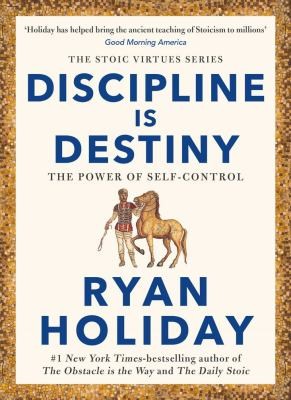
Discipline Is Destiny
Key Takeaways
Kyle, in 2024 in Books: I don’t remember where I first came across Ryan Holiday, but he’s always been at the back of mind as a content creator that I have a lot of respect for. Taking a time-tested tradition, like Stoicism, and helping make it accessible to the masses. Some might dismiss it as being akin to pop economics or pop psychology, but I think instead its the art of being able to act as a window through which other people can look and see how a particular philosophy works.
Ryan Holiday’s Stoic discipline book read with a heavy LDS overlay — Spencer W. Kimball, Joseph F. Smith, Hinckley, “righteous in the dark.” Six threads:
-
“Whatever you are, be a good one.” The Lincoln-via-Munger refrain, returning a fourth time across the corpus. Surfaces multiple times in this read alone.
-
“Don’t die with your music in you.” Tagged twice, literally — and the literal interpretation matters here. The Stoic urgency frame (“decide TODAY who you will be”) meets the religious urgency frame on the same ground.
-
Forget yourself and go to work. The opening religious quote turned into operating principle. Paired with “consider the lilies of the field” — the discipline isn’t anxiety, it’s quiet competence done daily.
-
Self-talk as a discipline. Tagged twice. Negative self-talk isn’t a personality trait; it’s a system that can be observed, interrupted, and rewritten — the same frame as The Self-Driven Child but applied to the adult version of the self.
-
The lift-the-supporting-players frame. Michael Jordan with Dennis Rodman. “Don’t try to force people to be Michael Jordan. Help them be their best.” The leadership analog to “whatever you are, be a good one” — applied to the people you work with rather than to yourself.
-
Daily Schedule and SALY (“Same as Last Year”) principle. The Stoic insistence on the daily over the dramatic. “Everything you do is cumulative” (Alan Rickman). The Topham “continuous improvement” frame. Decide today; do it tomorrow; do it the day after.
The throughline: discipline isn’t a moral position, it’s a system of small choices that produces a self over time. The religious and Stoic vocabularies map onto the same underlying mechanism.
Connections
- Essentialism — direct pair. Essentialism on what to say no to; Discipline on how to say yes to the chosen yes.
- Atomic Habits — habit-design overlap; identity-compounds frame.
- Poor Charlie’s Almanack — Munger’s Epictetus references; spirit-of-humility thread.
- The Self-Driven Child — adult-self version of the autonomy/self-talk arguments.
- How Will You Measure Your Life — adjacent on values-as-strategy framing.
- Way to Be! — Hinckley’s adjacent collection.
- Stoicism — the book’s core lineage; Marcus Aurelius, Seneca, Epictetus, and Musonius Rufus furnish its operating quotes.
- Self-discipline — the book’s title virtue, framed as a system of small daily choices rather than a moral position.
- Deep Work — the “large, uninterrupted blocks of focused time” thread (Booker T. Washington’s No, Steve Jobs/Jony Ive on focus, Oliver Sacks’s “NO!” sign).
- Compounding — “everything you do is cumulative” / kaizen / memento mori as small increments adding up to a self over time.
Highlights
- Life as a poor immigrant was not easy. Gehrig’s father was a drinker, and a bit of a layabout. It’s more than ironic to read of his father’s chronic excuses and sick days. This example shamed Gehrig, inspiring him to turn dependability and toughness into nonnegotiable assets (in a bit of foreshadowing, he never missed a day of school). Thankfully, his mother not only doted on him, she provided an incredible example of a quiet, indefatigable work ethic as well. She worked as a cook. She worked as a laundress. She worked as a baker. She worked as a cleaning lady, hoping to provide her son a ticket to a better life
Kyle: Chips on shoulders put chips in pockets
- Most kids like to play sports. Lou Gehrig saw in the game a higher calling. Baseball was a profession that demanded control of, as well as care for, the bodysince it was both the obstacle and the vehicle for success. Gehrig did both. He worked harder than anyone. “Fitness was almost a religion to him,” one teammate would say of him. “I am a slave to baseball,” Gehrig said. A willing slave, a slave who loved the job and remained forever grateful at just the opportunity to play
- When you love the work, you don’t cheat it or the demands it asks of you. You respect even the most trivial aspects of the pursuit―he never threw his bat, or even flipped it. One of the only times he ever got in trouble with management was when they found out he was playing stickball in the streets of his old neighborhood with local kids, sometimes even after Yankees games. He just couldn’t pass up the opportunity to play…
- Because once you start compromising, well, now you’re compromised…
- A manager in Gehrig’s time described it as an “age of alibis”-everyone was ready with an excuse. There was always a reason why they couldn’t give their best, didn’t have to hold the line, were showing up to camp less than prepared.
- He also knew that those who live the fast or the easy life miss something too—they fail to fully realize their own potential. Discipline isn’t deprivation… it brings rewards.
- He knew that getting comfortable was the enemy, and that success is an endless series of invitations to get comfortable. It’s easy to be disciplined when you have nothing. What about when you have everything? What about when you’re so talented that you can get away with not giving everything?
- “When a man can control his life, his physical needs, his lower self,” Muhammad Ali would later say, “he elevates himself.”
- You say you love what you do. Where’s your proof? What kind of streak do you have to show for it?
- The truly dedicated are harder on themselves than any outside person could ever be. Temperance is not a particularly sexy word and hardly the most fun concept, but it can lead to greatness.
- Morrison found she was just more confident in the morning, before the day had exacted its toll and the mind was fresh. Like most of us, she realized she was just “not very bright or very witty or very inventive after the sun goes down.” Who can be? After a day of banal conversations, frustrations, mistakes, and exhaustion.
Kyle: Daily Schedule
- Babe Ruth’s athletic feats then, as inspiring as they are, carry with them a tinge of sadness. What could Babe Ruth have accomplished had he been more disciplined? What greatness did he leave on the table? Because yes, even the greats could have been greater.
- Life is filled with all sorts of difficulties and challenges. Work will not always go well. But working out? Working out is in our control. It is a contained space in which the only potential obstacle is our determination and commitment.
- But even if they weren’t, even if they were harmless, why should we take orders from our belly or our crotches device that seems almost physically connected to us at this point? The body can’t be in charge. Neither can the habit. We must be the boss.
- But just because you started, doesn’t mean you have to continue. The fact that you didn’t know then doesn’t change the fact that you’re choosing it now.
- When we desire more than we need, we make ourselves vulnerable. When we overextend ourselves, when we chase, we are not self-sufficient.
- By being a little hard on ourselves, it makes it harder for others to be hard on us. By being strict with ourselves, we take away others’ power over us.
- Actually, as Robert Caro observed, it wasn’t technically a desk. Robert Moses preferred to work off a large table, because it made him more effective and encouraged better workflow. Moses believed in processing: Something came in and he dealt with it. Mail, memos, reports-he didn’t let any of it sit, let alone pile up. “Since a table has no drawers,” Caro wrote of Moses’s system, “there was no place to hide papers; there was no escape from a nagging problem or a difficultto-answer letter except to get rid of it in one way or another
Kyle: How do you build a mental or digital table?
- Because a person comfortable with a messy workspace will become comfortable with sloppy work. A person who doesn’t eliminate noise will miss the messages from the muses. A person who puts up with needless friction will eventually be worn down.
- Once the systems are in place, once the order is established, then and only then are we able to truly let loose to turn ourselves over to the whims and furies of creativity, to pushing ourselves physically, to audacious invention or investment.
- Show up and try. Get on the treadmill. Pick up the violin. Answer some emails. Script out some scenes. Reach out to some clients. Read some reports. Lift a couple weights. Jog one mile. Cross one thing off the to-do list. Chase down a lead
- A good hitter hits .300, and hitting .350 is terrific. Hitting .400 is almost unheard of. What does that translate to? Missing on six tries out of ten. A hitter can also go days, weeks, without touching the ball! That’s what the scout told him: The most important thing a young ball player can learn is that he can’t be good every day. You don’t have to always be amazing. You do always have to show up. What matters is sticking around for the next at bat
- There is a bit of McClellan in all of us. A bit of Machado in all of us. We get tired. We get scared. We know it’s going to be hard. We get entitled and vain. We don’t see the point. We don’t want to look foolish
- That’s true with leadership as well as lifting weights, running as well as writing. Hustle isn’t always about hurrying. It is about getting things done, properly. It’s okay to move slowly… provided that you never stop. Do we not understand that in the story of the tortoise and the hare, that it was actually the turtle who hustled? The hare was Manny Machado or George McClellan. Brilliant, fast even in bursts, but not consistently so. “Doing things badly,” Jiménez would say to critics or editors or even impatient readers, “does not give you the right to demand haste from the person who does them well.”
- Because, as Octavian’s teacher Arius Didymus said, “Practice over a long time turns into second nature.” We don’t rise to the occasion, we fall to the level of our training
- Joyce Carol Oates peers, often more famous and male, attended fancy parties. They had scandalous affairs. They cultivated their literary personas. They despaired over writer’s block. They nursed addictions. Joyce Carol Oates worked and taught. Taught and worked. She published. “I come from a part of the world where people did work rather than just talk about it,” she said. “And so if you feel that you just can’t write, or you’re too tired, or this, that, and the other, just stop thinking about it and go and work.”
Kyle: “Forget yourself and go to work.”
- “I have always lived a very conventional life of moderation,” she explained, “absolutely regular hours, nothing exotic, no need, even, to organize my time. We each have a twenty-fourhour day, which is more than enough time to do what we must do.”
- If you do it right, it’s also torture not to do it. The sled dog gets anxious if it doesn’t get to wear its harness. The horse wants to go out and trot. The bee dies if cut off from the hive. When you find what you’re meant to do, you do it.
- Some ask, What is the reward for all this labor? They are incorrect if they think it’s awards and fame and weeks on the best seller list. Others want a guarantee: If I put in my ten thousand hours, then I’ll get the job? Then I’ll be able to go pro? Then I’ll be rich? No, that’s not how this goes. Always and forever, the reward is the work. It is a joy itself. It is torture and also heaven-sweaty, wonderful salvation.
- Decide who you want to be, the Stoics command us, and then do that work. Will we be recognized for it? Maybe, but that will be extra.
- Why shouldn’t life generally be comfortable? Still, we must understand that the modern world is conspiring against us, working to degrade our ability to endure even the slightest difficulty. It spoils us… and sets us up for failure or slavery.
- Success breeds softness. It also breeds fear: We become addicted to our creature comforts. And then we become afraid of losing them. Seneca was no Cato day to day, but he knew from his practice, that he could be if he had to.
- This is a trait that far too many of us are lacking. We think we can make up for it with brilliance or creativity, but what we really need is commitment. What we need is a willingness to put our body where the problem is, throwing ourselves completely into solving it, to show that we are not for turning, that we will not be deterred.
- An observer of Franklin Delano Roosevelt once quipped that the man had a “second-class intellect and a first-class temperament.” Given what disease took from Roosevelt’s body, the truth of the remark is all the more illustrative: Temperament is everything. Our head and our heart combine to form a kind of command system that rules our lives.
- Perhaps most impressive, out of hundreds of thousands of engagements, events, appearances, and meals, which were often preceded by longdistance travel and time zone changes, she fell asleep in public only a single time… at a lecture about the use of magnets in biology and medicine in 2004, the year she turned seventy-eight.
- She also, through the years, innovated in ways that made the long obligations more palatable-because why white-knuckle things if you don’t have to? She spent an average of four seconds meeting each person. She removed needless courses from dinners. She made sure that speeches came after the meal instead of before, so that she could wrap up and sneak out. To palace media officials, she was known as “One-Take Windsor” because, while she never rushed, she thought through what she wanted to do, and then she got it right the first time. As they say, work smarter, not harder.
- “Where she’s been brilliant is in her quietness,” one press secretary would observe. “In a very noisy world where people constantly want to express themselves or overreact, what the Queen has done has been the opposite.” She was not empowered to have political opinions yet she was strong enough to do something most world leaders as well as ordinary people are powerless to do: refrain from expressing opinions about things we don’t control.
- A weak mind must be constantly entertained and stimulated. A strong mind can occupy itself and, more important, be still and vigilant in moments that demand it.
- The idea that you don’t get to do everything you want, that some things are nonnegotiable, that the flip side of privilege is duty, and that power must be complemented by restraintnot everyone gets that. And their shameful behavior reminds us of the consequences.
Kyle: Were it possible to always have righteous queens and kings…
- “There can be no doubt,” she said, “that criticism is good for people and institutions that are part of public life. No institution-City, Monarchy, whatever-should expect to be free from the scrutiny of those who give it their loyalty and support, not to mention those who don’t.”
- We have to understand: Greatness is not just what one does, but also what one refuses to do. It’s how one bears the constraints of their world or their profession, it’s what we’re able to do within limitations-creatively, consciously, calmly.
- We know that between every stimulus and its response, every piece of information and our decision, there is space. It is a brief space, to be sure, but one with room enough to insert our philosophy. Will we use it? Use it to think, use it to examine, use it to wait for more information? Or will we give into first impressions, to harmful instincts, and old patterns.
- We pause. We gather ourselves. We put it up to the light. We ask: Is this true? Is it actually as upsetting as it feels? As scary or annoying as I first thought?
- Booker T. Washington was a busy man. He ran the Tuskegee Institute, which he founded. He traveled constantly, to speak to crowds and meet with donors. He lobbied legislators, gave lectures, led fundraising campaigns, and published five books. How did he manage it all? It wasn’t just endurance and hustle and energy. It was also the discipline to say the dreaded word No. “The number of people who stand ready to consume one’s time to no purpose,” he said, “is almost countless.’” Some thought him aloof. Some thought him selfish. They said things behind his back. He was too busy to notice. He knew that the main thing in life was to keep the main thing the main thing. Especially when your main thing is uplifting an entire race of people. But what is the main thing for the rest of us? That is the main question. If you don’t know the answer, how can you possibly know what to say yes to and no to? How can you know what to show up to? What to wake up early for? What to practice? What to endure? You can’t. You’re winging it. You’re vulnerable to every shiny, exciting thing that comes your way, every “I’ve got a potential opportunity for you,” every “It’ll only take a minute,’ every “Thanks in advance,” every “I know you’re busy but…!”Anyone who has not groomed his life in general towards some definite end cannot possibly arrange his individual actions properly,” the writer Michel de Montaigne reminded himself. If you don’t know where you’re sailing, the Stoics said, no wind is favorable.
Kyle: Patrick O’Shag
- “I wish I knew how people do good and long sustained work and still keep all kinds of other lines goingsocial, economic, etc.,” John Steinbeck once wrote in the middle of the long grind of writing a novel. How do they do it?
- The secret to success in almost all fields is large, uninterrupted blocks of focused time. And yet, how many people organize their days or lives to make this possible? And then they wonder why they are frazzled, unproductive, overwhelmed, always behind.
- This weaker part of ourselves that cannot say no to requests for our time, that tries to go along with everyone, perhaps deep down wants that same excuse-if we agree to their thing, then we don’t have to answer for the poor performance of our thing when it’s time for a full accounting. It allows us to say, “Well, if only I weren’t so busy…” The self-disciplined part of us, on the other hand, says, like the Queen’s motto, “Better not.” Or maybe we just borrow the quip from E. B. White, who was asked to join some prestigious commission. “I must decline,” he said, “for secret reasons.”
- Who cares if you have achieved extraordinary things but are punished for it by having even less freedom day to day? It feels like you’re free because you’re choosing, but if the answer is always yes, that’s not much of a choice.
- Are you even listening to me, a friend once asked. Sorry, Beethoven replied, “I was just occupied with such a lovely, deep thought, I couldn’t bear to be disturbed.”
- It’s just a fact. The muses never bless the unfocused. And even if they did, how would they notice?
- Jony Ive, the top designer at Apple would explain that “focus is not this thing you aspire to… or something you do on Monday. It’s something you do every minute.” Steve Jobs, he recounted, would always be asking Ive and other Apple employees about what they were focused on and specifically, “How many things have you said no to?” because to focus on one thing requires not focusing on other, less important things.
- Prolific cannot be a euphemism for sloppy. It’s not simply that Oates shows up and writes a lot. There is, on top of this hard, physical labor, serious mental discipline that moderates her drive to create and polish what she ultimately publishes.
- Was this easy? Waiting for the right moment, whether one is a writer or a politician, is an agonizing thing. But as Aristotle reminds us, “Patience is bitter, but its fruit is sweet.“
- “The winter is lost,” she whimpered in self-pity. “The whole winter’s work is lost. I’ve destroyed my year. This work is no good.” Even though her dancers loved it, even though they had committed body and soul to it, all she could see was what needed to be changed. All she could see were the ways it wasn’t perfect. And it trapped her in a kind of creative prison.
- What was it? Was it humility? An obsession with getting the little things right? No, those are the reassuring excuses we make for what is often a kind of narcissism and obsession. We’re convinced everyone cares so much about what we’re doing that we get stuck. We tell ourselves it’s self-discipline when in fact, it’s self-consciousness.
- The Stoics remind us: We can’t abandon a pursuit because we despair of perfecting it. Not trying because you’re not sure you can win, you’re not sure whether everyone will love it, there’s a word for that too: cowardice.
- Martha Graham was lucky to have collaborators who pushed her when necessary and helped to rescue her from the excesses of her own exacting self-discipline. When she was trapped with Ceremonies, her musical director, Louis Horst, stepped in and told her, “One cannot always create on the same level. The Sixth Symphony followed the Fifth, but without the Sixth we could not have had the Seventh. One cannot know what one is leading into. Transitions are as important as achievements.”
- There have been fewer quotes more misunderstood and misattributed than Nicholas Chamfort’s suggestion that “A man must swallow a toad every morning if he wishes to be sure of finding nothing still more disgusting before the day is over.” Shortened and often credited to Mark Twain, the idea is that if we eat the frog at the beginning of the day, it will be next to impossible for the day to get any worse. A more applicable interpretation of this idea was expressed by the poet and pacifist William Stafford’s daily rule: “Do the hard things first.”
- Just as days are made of mornings, lives are made of days. To procrastinate at any time, day or night, young or old, to push it until later, is a loser’s game.
- To procrastinate is to be entitled. It is arrogant. It assumes there will be a later. It assumes you’ll have the discipline to get to it later (despite not having the discipline now).
- And when he got in the ring, it showed. He was not the man who deserved to win. “Every fighter should be a little afraid of what could happen to him,” Patterson would reflect on the fight later, “because fear makes your mind sharper. When you have nothing to fear, your mind becomes dull.”
- We’re all going to mess up. We’ll show up to a life-changing opportunity unprepared. We’ll fall off our diet or our sobriety. We’ll lose our temper and embarrass ourselves. We’ll make mistakes. We’ll be beaten. That’s the thing about discipline: It never fails us, but sometimes we fail it. But will that be the end of it? Is that who we are now? Or can we get back up? Losing is not always up to us… but being a loser is. Being a quitter is. Saying, “Ah, what the hell, does it even matter?” That’s on us. Throwing in the towel on a fight we’ve clearly lost is one thing, throwing in the towel on fighting, on your standards, from that point forward? Now you’ve been more than beaten, you’ve been defeated. Don’t be frustrated that you’re not constitutionally calm or perfect. Because no one is, and no one is expecting you to be! If your standards are so high that you give up when you fall short of them, then actually you don’t have high standards. What you have are excuses.
- That’s the thing about both pain and pleasure: They’re felt in the body, but they affect the mind and the mood-our temperament—which is something we must protect always.
- The problem is that Kennedy hoped a magic pill (or pills) would make his problems go away. He used sex and medicine as an escape, not as a tool. The pain wasn’t his fault, but the bad decisions he made to get rid of it were.
- Pope John Paul II was right to remind us that part of temperance is about avoiding the impulse to deprive ourselves of “consciousness by the use of drugs.” Our rational faculties (as well as our bodies) can torture us, but they are also a gift. We ought not dull their power or mess, unnecessarily, with our chemistry. Doing the work? The work is getting through life sober. Go on a trip? Go to therapy! Struggle with it. Heal a little bit each day, get a little better each day
Kyle: Embrace the hard. Be better.
- “By pleasure,” Epicurus said, “we mean the absence of pain in the body and of trouble in the mind. It is not an unbroken succession of drinking-bouts and of merrymaking, not the satisfaction of lusts, not the enjoyment of the fish and other delicacies of a luxurious table, which produce a pleasant life; it is sober reasoning, searching out the motives of every choice and avoidance, and banishing those beliefs through which the greatest disturbances take possession of the soul.”
- As Musonius Rufus reminds us, that “by the standard of pleasure, nothing is more pleasant than self-control and… nothing is more painful than lack of self-control.” Nobody who has given themselves over to excess is having a good time. No one enslaved to their appetites is free.
- Discipline is not a punishment, it’s a way to avoid punishment. We do it because we love ourselves, we value ourselves and what we do. And we find, conveniently enough, that it also heightens our enjoyment of things as well. Indeed, the person content with less, who can enjoy a small pot of cheese as if it were a culinary bounty, is much more easily satisfied and much better able to find good in all situations.
Kyle: “If I do not lose hope on a normal day, why would I lose hope today?”
- Remember always: As wrong as they are, as annoying as it is, it takes two for a real conflict to happen. As the Stoics said, when we are offended, when we fight, we are complicit. We have chosen to engage. We have traded self-control for self-indulgence. We’ve allowed our cooler head to turn hot-even though we know hot heads rarely make good decisions.
Kyle: “I didn’t say anyone beat me sarge. I sleep pretty hard.”
- “It helps to be a little deaf,” was the advice that Ruth Bader Ginsburg was given by her mother-in-law, and it helped guide her through not just fifty-six years of marriage, but also a twentysevenyear career on the Supreme Court with colleagues she adored but surely disagreed with on a regular basis, not least of whom was Antonin Scalia, her best friend and ideological opposite.
Kyle: Eyes wide open then shut? Choose your love and love your choice.
- It’s the easiest thing in the world to respond to intemperance with intemperance. We have to remember: Someone else’s lack of self-control is not a justification for abandoning our own. Nor is it a good look or a recipe for success and achievement.
- Nearly every regret, every mistake, every embarrassing moment-whether it be personal or professional or historicalhave one thing in common: Somebody lost control of their emotions. Somebody got carried away. Somebody was scared, or defensive. Somebody wasn’t thinking beyond the next few seconds. “Drinking is the kindling wood of passion,” St. Ambrose pointed out. A lack of self-discipline when it comes to drugs and alcohol makes it harder to be self-disciplined with our emotions or decisions.
- Robert Greene puts it perfectly: “Powerful people impress and intimidate by saying less.” The irony, of course, is that with power comes license to say whatever you want, whenever you want, to whomever you want. And yet, it is the discipline to not do these thing that creates the presence that powerful people enjoy.
- Online or in person, we can’t just sit there. We jump in because we think we’re supposed to. We jump in because we don’t want to seem dumb (even though by speaking we risk removing all doubt). We jump in because we just can’t live with someone else being wrong and not knowing it.
- You don’t have to verbalize every thought. You don’t have to always give your opinion-especially when it’s not solicited. Just because there is a pause doesn’t mean you have to fill it. Just because everyone else is talking doesn’t mean you have to jump in. You can sit with the awkwardness. You can use the silence to your advantage. You can wait and see.
Kyle: “We’ll see,” story about the farmer and his son.
- Could you have done this? Can you trust yourself enough to stand alone? Can you stoically endure the criticism and the questioning to persist in what you know is right? Even at great cost? A leader who cannot do this They’re a follower.
- There is an old idea that goes all the way back to the Stoics but was wonderfully expressed by the English poet John Dryden: Beware the fury of the patient man. It was hard for Churchill precisely because he was furious. He was a doer. He had his back against the wall. But instead, through the calm and mild light of strategic brilliance, he waited. He held his fire. And when he did take his shot, it blew the target apart.
- “What is Alexander [the Great] doing when he rushes from Thebes into Persia and thence into India? He is ever restless, he loses his wits, he believes himself God,” the future conqueror would write. “What is the end of Cromwell? He governs England. But is he not tormented by all the daggers of the Furies?”
- And if that weren’t enough, Napoleon then moves in for the coup de grâce, with a pronouncement whose meaning is unmistakable: “Ambition, which overthrows governments and private fortunes, which feeds on blood and crimes, ambition… is, like all inordinate passions, a violent and unthinking fever that ceases only when life ceases-like a conflagration which, fanned by a pitiless wind, ends only after all has been consumed.”
- The author deserved to be whipped, Napoleon said of his younger self. “What ridiculous things I said, and how annoyed I would be if they were preserved,” he exclaimed as he threw what he thought was the only copy into a fire.
Kyle: It’s unrighteous to compare yourself to anyone other than Christ and yourself 6 months ago. But what happens when you compare yourself to yourself and find yourself wanting?
- Except he died almost immediately after, and his empire collapsed with him. The poet Juvenal remarked that the whole world had not been big enough to contain Alexander… but in the end, a coffin was sufficient.
Kyle: Damn…
- There is a considerable amount of self-discipline required to quit bad habits, particularly the more gluttonous ones. But of all the addictions in the world, the most intoxicating and the hardest to control is ambition. Because unlike drinking, society rewards it. We look up to the successful. We don’t ask them what they are doing or why they are doing it, we only ask them how they do it. We conveniently ignore how little satisfaction their accomplishments bring them, how miserable most of them are, and how miserable they tend to make everyone around them in turn.
Kyle: REVISIT: Someday the AI may, in fact, turn the world into paper clips. But many of us will sit back and marvel at the productivity and growth rate.
- Marius and Napoleon and Alexander were powerful… but ultimately powerless. Because they couldn’t stop. Because there was never enough. They lusted for control over millions, because they lacked control over themselves.
- What would the world look like if nobody tried to do anything? If nobody pushed to get better or do more? If we didn’t have ambition-some big goal we are after-how would we know what little things, what distractions, to say no to?
Kyle: #Ambition
- We don’t need accomplishments to feel good or to be good enough. What do we need? The truth: not much! Some food and water. Work that we can challenge ourselves with. A calm mind in the midst of adversity. Sleep. A solid routine. A cause we are committed to. Something we’re getting better at. Everything else is extra. Or worse, as history has shown countless times, the source of our painful downfall.
Kyle: Consider the lillies of the field
- Why? Why? It was ill-discipline. It was an attempt to treat himself in a way his parents hadn’t, to buy the love and fun he had missed out on. It was an attempt to prove himself, to keep up with the best and the brightest and richest of his time. Thankfully, Churchill was a vital and energetic man, but how much of this vitality was wasted? For what? And even if he was lucky enough to skate by, his son, who inherited his habits but not his talents, was not nearly so lucky. If only his father could have held, held, held off.
Kyle: “Believe it or not, I need the money…” (Margin Call)
- For centuries, people on both extremes of the money spectrum have fundamentally misunderstood its value, its purpose. Fitzgerald thought that the rich were special, that they were different from other people. Hemingway would write in response, “Yes, they have more money.”
- The problem is that many of us tell ourselves that someday we’ll be beyond this, that if we can just earn enough, be successful enough, we won’t have to consider any of it. We will be beyond moderation and financial conscientiousness. We will have transcended the everyday worries of the common man. We can just do what we want, when we want, as much as we want. Because we’ll be “good,” we’ll have “arrived.” Here’s the thing: This never happens.
- It has been said that Tom Brady, the greatest quarterback in history—the youngest and the oldest to win a Super Bowlisn’t obsessed with winning. That’s not what he focuses on. He’s obsessed with improving the accuracy of his touchdown passes in the fourth quarter. He’s obsessed with getting a little bit faster at releasing the football. He’s not willing to stay the same, even though that “same” is very consistently the best in the league. The process of getting better, that’s his drug. That’s the dragon he chases, that’s how he is able to defy aging and all expectations.
Kyle: What gets measured gets managed
- The Japanese word for this is kaizen. Continual improvement. Always finding something to work on, to make a little progress on. Never being satisfied, always looking to grow. Revolution? Transformation? That’s what amateurs chase. The pros are after evolution.
Kyle: “Continuous Improvement” by President Topham
- It’s the journey of a lifetime. In fact, that’s the way to think about all of this: How much progress could you make if you made just a little each day over the course of an entire life? What might this journey look like, where might it lead, if each bit of progress you made presented both the opportunity and the obligation to make a little more progress, and you seized those opportunities, you lived o to those obligations, each and every time?
Kyle: #Decades
- “Do the best you can,” the emperor says in Marguerite Yourcenar’s beautiful novel Memoirs of Hadrian. “Do it over again. Then still improve, even if ever so slightly those retouches.”
- Woe is the person who wears themselves out on trivial matters and then, when the big moments come, is out of energy. Woe is the person (and the people around them) who is so mentally exhausted and strung out because they’ve taken everything upon themselves that now, when things go wrong, there’s no slack or cushion to absorb the additional stress.
- You’re in the game, always. You’ve got to know the time precisely because you will never know when it’s going to run out on you. That’s what the reminder memento mori means. No one can take time or life for granted… as it runs out for all of us. The pursuit of discipline means being disciplined in all things, especially little things. And time-how we spend it, its tiny increments-is something small that actually amounts to something very large. Some people claim that time is just a construct. If that is true, it is perhaps humanity’s greatest creation. Because time is the way we measure the only truly nonrenewable resource we have. No one is making more of it. Once lost, it cannot be recovered. It is also an incredibly powerful force, as anyone who has ever watched small amounts of interest applied over a long enough period can attest. You see, time that is wasted is also wasting us. When we kill time, we are killing ourselves. We have to learn how to use time or else it will use us… up.
- More practically, the poet W. H. Auden said that “The modern stoic knows that the surest way to discipline passion is to discipline time: decide what you want or ought to do during the day, then always do it exactly the same moment every day, and passion will give you no trouble.” Now, one doesn’t have to follow this advice literally to still see the deeper message: Routine is an essential tool in the management of time and the suppression of those negative forces of distraction, procrastination, and laziness.
Kyle: Decide TODAY who you will be
- We live in a time of vulgarity and silliness and immaturity and selfishness. A time of freedom that we have decided is actually license for stupidity, unseriousness, and excess. Look at our heroes: Reality TV stars. Influencers. Professional wrestlers. YouTubers. Demagogues. These are not heroes. These are cautionary tales. The people we ought to admire are quiet. Dignified. Reserved. Serious. Professional. Respectful of themselves and others.
Kyle: #Unserious - we should most respect the people whose lives speak the loudest, not their voices.
- Understand: Most of the people doing important work are people you’ve never heard of-they want it that way. Most happy people don’t need you to know how happy they are-they aren’t thinking about you at all. Everyone is going through something, but some people choose not to vomit their issues on everyone else. The strongest people are self-contained. They keep themselves in check. They keep their business where it belongs their business.
- Rickover was not particularly impressed by rank. “But did you do your best?” he asked the young man. Of course, Carter felt himself rushing to answer, as we all might if asked such a question. But before he could, something inside stopped short. What about the times he had been tired? What about the classes when he’d been confident enough in his grades that he could coast? What about the questions he hadn’t asked or the times he’d been distracted? What about the professors he’d found boring and paid little attention to? What about the extra reading he could have done-on weapons systems, on history, on science, on trigonometry? What about the morning PT he’d shuffled through? “No, sir,” he found himself confessing, “I didn’t always do my best.”
- “There is no question that the public will ultimately understand and he will be regarded as a far-seeing man who has attempted to protect the people of the US,” he said of Carter’s energy efforts. “It took about four hundred years for the Lord Jesus Christ to have his message accepted. Up to that time he would be considered a ‘failure.’ As long as a man is trying as hard as he can to do what he thinks to be right, he is a success, regardless of the outcome.’”
- “Your best is good enough.” Not perfect. Your best. Leave the rest to the scoreboard, to the judges, to the gods, to fate, to the critics.
Kyle: Whatever you are be a good one
- It’s not uncommon to find someone who has physical comImand of themselves. Nor is there a shortage of brilliant people who have brought their mind and spirit under control in the pursuit of this profession or that one. What is extraordinarily rare is someone who not only combines these two disciplines, and manages to do so in the so-called arena-in public life, as a doer, a contributor to society. Of course, temperance and restraint can be found in the monasteries and the mountain retreat; that’s not what we’re after. Can you achieve this stillness, this balance, in the chaos of real life? Surrounded by temptation? Whether the crowd cheers or jeers? Regardless of what would be tolerated, what you could get away with, what people even think is possible? We call this rare and transcendent plane the Magisterial-mastering yourself, mentally, physically, in command always, in all forms… and somehow finding a gear beyond that, finding more to give, more to draw from yourself. This is the greatness we seek, this is where the body, the mind, and the spirit come together in life’s most stressful situations, when things don’t go our way, in moments of destiny or great difficulty, where we show what all these sacrifices were for, where we show what we were made of, where we prove that is in fact possible to possess the world and keep our soul.
- Such is the irony of temperance. It makes us greater and much less likely to crave recognition for that greatness. Not only was Antoninus notoriously indifferent to superficial honors, he actively avoided them.
- On the contrary. “He had the ability both to refrain from and enjoy the things that most people are too weak to refrain from and too inclined to enjoy,” Marcus said of Antoninus, likening his capacity for maintaining this difficult balance to Socrates, who was notably frugal but notoriously fun. He had “strength of will,” Marcus wrote in Meditations, “the ability to persevere in the one situation and remain sober in the other.”
- Despite his brilliance and authority, Antoninus had no problem yielding the floor to experts and deferring to their advicea skill few with unlimited power happen to have, fewer manage to keep, and fewer still bother to grow.
- Marcus Aurelius reportedly wept when he was told he would become king—he knew his history, it was not a blessing that many emerged from better off. It would be a hard job-not just to be emperor, but to be a good one, to not be corrupted or destroyed by it.
Kyle: Spencer W. Kimball’s struggle with God
- The majority of Marcus Aurelius’s commands were instead to himself. Robin Waterfield, his translator, observes that 300 of the 488 entries in Meditations are rules Marcus gave himself. He got up early. He journaled. He kept himself active. He was not blessed with good health, but he never complained, never used it as an excuse, never let it slow him down more than absolutely necessary. Despite his wealth and power, he lived humblymaintaining that difficult balance of restraint within abundance, spending most of his reign not in glamorous palaces of marble but in the simple tent of a soldier at the front.
- Did he lose his temper from time to time? Of course. Few leaders can claim otherwise. But the ancient historians provide us no evidence that Marcus was ever vindictive, petty, cruel, or out of control. His reign was free of scandals, of shameful acts, of corruption. Isn’t that a pretty low bar? Not when you compare it to the sickening and brutal list of crimes and disasters put together by his predecessors and successors, right on down to today, where it seems that the hardest thing to find in the world is an honest and decent person in a position of significant leadership.
- Speaking of her late husband, Mr. Rogers, Joanne Rogers remarked that “If you make him out to be a saint, people might not know how hard he worked.” Antoninus and Marcus Aurelius are not dusty old parables from the past. They are not twodimensional figures printed on the pages of history books. They were human beings. And they were not perfect. But if they were perfect, they would not give us hope. We love them because they tried. Because they course cor rected in failure, because they were humble in victory, because they did the work and got the results. This is what produces the path for us
Kyle: We don’t admire people despite their flaws. We admire people amidst their flaws.
- Perhaps it was a rule articulated by Cato’s great-grandfather that helped Cato love and support his brother despite their different approaches to life. “I am prepared to forgive everybody’s mistakes,” Cato the Elder said, “except my own.” Ben Franklin, many generations later, would put forth an even better rule: “Search others for their virtues, thyself for thy vices.” Or as Marcus Aurelius put it, Tolerant with others, strict with yourself.
- As it happens, Kobe himself would struggle his entire career with some version of this problem. He was one of the most exacting and dedicated players to ever step on a basketball court. But he had trouble accepting that his teammates “couldn’t all be Kobes.” In fact, many of them did not want to be Kobes. As he tried to drive them as hard as he drove himself, he often drove them into the dirt, or in other cases, like with Shaquille O’Neal, drove them away, depriving himself of a talented supporting cast that in the end could have earned him another ring or two… at least.
Kyle: Michael Jordan learned to lift his supporting players, like Dennis Rodman, DESPITE their flaws and weaknesses. He didn’t try and force them to be Michael Jordan. Just to be their best.
- Other people will choose to live differently. They may attack us for our choices-out of insecurity or ignorance. They may well be rewarded for things we find abhorrent or illdisciplined. And? That’s for them to deal with, and for us to ignore.
Kyle: Don’t hate the player, hate the game. Focus on your own game or performance.
- That’s what great leaders do: They make people better. They help them become what they are. As it is written in the Bhagavad Gita, “The path that a great man follows becomes a guide to the world.”
Kyle: “I want no man to follow me, only inasmuch as I follow the footsteps of the master.” Joseph F. Smith
- “Happy is the man who can make others better, not merely when he is in their company, but even when he is in their thoughts,” Seneca wrote, speaking not only of Cato but all the men and women who inspired him.
- But we can be a positive force in our community. We can show our children, our neighbors, our colleagues, our employees what good choices look like. We can show what commitment looks like by showing up each day. We can show what it means to resist provocation or temptation. We can show how to endure. We can show how to be patient.
Kyle: Show people a glimpse of your heart and motivation for doing what you do (patriarchal blessing)
- Being the “boss” is a job. Being a “leader” is something you earn. You get elevated to that plane by your self-discipline. By moments of sacrifice like this, when you take the hit or the responsibility on behalf of someone else.
- It’d be wonderful if power or success exempted us everything time-consuming, pedestrian, inconvenient, difficult. In practice, it obligates us to those things even more. It demands more of us. That’s just how it shakes out.
- Too many leaders, Plutarch laments, think that the “greatest benefit in governing is the freedom from being governed themselves.”
- You’re the one who has to show you really mean it. The more you’ve done, the higher the standard you must hold yourself to. The more you have, the more selfless you must be. Not for the sake of optics, but because it is the right thing to do. Because that’s what you signed up for when you took the responsibility.
- Cleanthes was normally one to mind his own business. But Was the Stoic philosopher walked through the streets of Athens one morning, he came upon a man berating himself for some failure. He couldn’t help but say something, stopping to intervene with this upset stranger. “Remember,” he said kindly, “you’re not talking to a bad man.”
Kyle: Self-Talk
- And for Marcus Aurelius, too, who reminded himself and all of us not to “feel exasperated, or defeated, or despondent because your days aren’t packed with wise and moral actions. But to get back up when you fail, to celebrate behaving like a humanhowever imperfectly-and fully embrace the pursuit that you’ve embarked on.“
- After a lifetime of studying philosophy, this is ultimately how Seneca came to judge his own growth. “What progress have I made?” he wrote. “I have begun to be a friend to myself.”
Kyle: Self-Talk
- Like Napoleon, Washington had studied the conquerors of history as a young man. He, too, had seen the cautionary tales of Alexander the Great and Julius Caesar. He just actually took their examples to heart. More, he was inspired by the story of Cincinnatus, the Roman statesman who, called upon in a terrible crisis, was given nearly unlimited power, only to relinquish it after saving his county and then returning to his quiet farm.
- The history of Rome-indeed, the history of humankindis almost universally the story of people who were made worse by power. From Nero to Napoleon, Tiberius to Trump, power doesn’t just corrupt, it reveals. It places unimaginable stress on a person and subjects them to unbelievable temptations. It breaks even the strongest.
- Plato said that the best leaders didn’t want power. In truth, it’s that they didn’t need it. Because they have conquered their appetites and their ego, they are stronger, more independent, less corruptible, calmer, kinder, more focused on what matters.
- What matters isn’t the title. It isn’t the power. It isn’t the wealth. It isn’t the control. That greatness isn’t what you have. It’s who you choose to become. Or who you choose to remain.
- For the Greeks, retreat wasn’t a shameful thing. It was how you retreated well mattered. The most grievous sin was rhipsaspia-losing your shield in the chaos of escaping-because that endangered the whole phalanx, placing your comrades in peril. A Spartan could return from a battle lost, but they dared not ever abandon anyone. That’s what they meant when they said Return with your shield or on it.
- At the same time, there are others who refuse to give up, thinking that this stubbornness is a virtue. But it, too, is a vice. The person who can only go forward who never backs up, who has no escape plan, who is not brave but reckless. They are not self-controlled, they are stuck in one gear. You don’t win everything, every time-not in war, in life, or in business. A person who doesn’t know how to disengage, to cut their losses, or to extricate themselves is a vulnerable person. A person who does not know how to lose will still lose… only more painfully so.”
Kyle: This seems counter to the supposed virtue of “burning the boats.”
- Staring over the precipice into blackness, a future where his greatest gift would disappear, somehow despite all his pain and anguish, [Beethoven] mustered the strength to carry on. “It was only my art that held me back,” he wrote. “Oh, it seemed impossible to me to leave this world before I had produced all that I felt capable of producing, and so I prolonged this wretched existence… I hope my determination will remain firm to endure until it pleases the inexorable Parcae to break the thread. Perhaps I shall get better, perhaps not, I am ready.”
Kyle: “Don’t die with your music in you” (literally)
- Staring over the precipice into blackness, a future where his greatest gift would disappear, somehow despite all his pain and anguish, [Beethoven] mustered the strength to carry on. “It was only my art that held me back,” he wrote. “Oh, it seemed impossible to me to leave this world before I had produced all that I felt capable of producing, and so I prolonged this wretched existence… I hope my determination will remain firm to endure until it pleases the inexorable Parcae to break the thread. Perhaps I shall get better, perhaps not, I am ready.”
Kyle: “Don’t die with your music in you” (literally)
- As the artist Charlie Mackesy wrote beautifully, “Asking for help is not giving up, it is refusing to give up.”
- Posidonius’s advice might have seemed rather redundant. “Be the best and always superior to others,” he had told the ambitious general, quoting a line from The Odyssey. But Posidonius wasn’t talking about achieving more victories over the enemy, he was talking about conquering the self. Not honors, but being honorable. Plutarch tells us about a far less famous general and statesman in Greece, many generations before Pompey. Despite his brilliance on and off the battlefield, Epaminondas was appointed to an insulting minor office in Thebes. In fact, it was because of his brilliance that he was put in charge of the city’s sewers. Instead of being provoked or despairing at his irrelevance-a number of jealous and fearful rivals thought it would effectively end his career-Epaminondas took fully to his new job, declaring that it is not the office that brings distinction to the man, it is the man who brings distinction to the office. With hard work and earnestness, Plutarch wrote, “he proceeded to transform that insignificant office into a great and respected honor, even though previously it had involved nothing more than overseeing the clearing of dung and the diverting of water from the streets.”
Kyle: “Whatever you are be a good one.”
- This is what you find when you study the true masters of any profession. They don’t care much about winning, about money, about fame, about most of the things that have come their way as a result of their success. Their journey has always been toward something bigger. They aren’t running a race against the competition. They are in a battle with themselves.
- When you practice doing something a certain way a thousand times and then a thousand times again, this becomes the way you expect it to go, the way perhaps you need it to go. You follow your routine, you set up your system, you develop your style, and you find freedom in it… but also, potentially, slavery.
Kyle: Turkey Time - slave to consistency
- Would he become a prisoner of his method or would he break through it and into what the great strategist Robert Greene generations later would describe as formlessness?
- “With weapons as with other things,” he would write, “you should not make distinctions. It is wrong for either general or soldier to have a preference for one thing and to dislike another. When you put your life on the line, you want all your weapons to be of use,” he said. Or rather, you want to have as many weapons as possible.
Kyle: “Everything you do is cumulative.” Alan Rickman
- A colleague of Churchill once captured the balance perfectly when he observed that Churchill “venerated tradition but ridiculed convention.” The past was important, but it was not a prison.
- Plenty of people have been buried in coffins of their own making. Before their time too. Because they couldn’t understand that “the way they’d always done things” wasn’t working anymore. Or that “the they were raised” wasn’t acceptable anymore. We must cultivate the capacity for change, for flexibility and adaptability. Continuously, constantly.
Kyle: SALY Principle
- It’s easy to be modest when you have much to be modest about. But now you’re in a position to indulge your passions. It’s easy to follow the rules when you are not above rules. Now people will make excuses for you. Now it really is about selfdiscipline, because all the other forms have gone away.
Kyle: Righteous in the dark
- Nearly every single one of the American founders-from Washington to Franklin to Adams and Henry-made some version of the argument that their novel system of government was impossible without virtue in the people. Mainly they were talking about the virtue of temperance, the idea that freedom could not be sustained unless tempered by private restraint. Indeed, a people without self-control, Adams said, would break “the strongest cords of our Constitution as a whale goes through a net.”
Kyle: No system is stronger than the will of those who hold it up
- The four virtues are about instilling character-good character-so that at the critical point, a person’s true nature kicks in. Self-discipline is not something that just happens to you, it is something you cultivate. Just as a writer only becomes one by writing-and a great writer by writing that which is worth reading-being disciplined is something you prove by the life you lead.
Kyle: Do something worth writing about or write something worth reading
- Steinbeck concludes that the most powerful phrase in Christianity is timshel. When we read the commandments translated into English, they are rendered as just that, commandments. But Steinbeck thinks the Hebrew rendering is more accurate, not “Thou shalt” but “Thou mayest.” “Here is individual responsibility and the invention of conscience,” he reflected to his editor as he wrote those pages. “You can if you will but it is up to you. This little story turns out to be one of the most profound in the world. I always felt it was, but now I know it is.”
- I would wake early and dress the children. I’d strap them in the stroller and we’d walk or run as the sun came up wife caught up on much-needed sleep. We counted the deer lounging in the fields and watched the rabbits dart across the paths. We talked and we noticed things. We enjoyed one another’s company-fully, completely, with no interruptions. My rule has long been that I don’t check my phone for the first hour of the morning. It’s not just about managing screen time, but making room for moments like that… and for the ideas that would magically pop in my head-like Beethoven’s raptuswhen work was the last thing I was thinking of. When we got back to the house, I would set the kids up to play and take a shower. I work for myself, but it’s important to feel, as opposed to look, fresh-so I shave each morning. My work means too much to me to show up like a slob. So I put on a simple set of clothes (roughly the same thing each day to reduce unnecessary choice) and then sit down with my journals. Whether t takes five minutes or twenty-five, it centers me. Anne Frank wrote (in her own journal) that paper is more patient than people. She was right-one of the best ways to temper difficult emotions is to do it on the page… and to leave it there. After the journaling, then it was time to work-the most important, hardest thing first. I would pull up to my office at the bookstore, set my stuff down and write. No delays, no procrastination, no digital distractions. Just writing. Sometime during those tough early days of the book, I put a note card up on my wall with a quote from Martha Graham: “Never be afraid of material. The material knows when you are frightened and will not help.” Selfdiscipline is pointless without courage, and, of course, the defining characteristic of courage is self-disciplinesteeling yourself for what must be done. While a book requires many, many hours of work, these hours come in rather small increments. If I get to the office at eight thirty, I could be done writing by eleven. Just a couple hours is all it takes. Just a couple crappy pages a day, as one old writing rule puts it. The discipline of writing is about showing up. The seasons changed. World events raged and spun as they always do. Opportunities, distractions, temptations, they did what they do too-popping up, pinging, nagging, seducing. Day after day, I kept after it. To the right of my computer monitor, between two photos of my boys, is a picture given to me by the sports psychologist Jonathan Fader. It’s the famed Dr. Oliver Sacks and behind him is a large sign he kept in his office that just said NO! By saying no-to interviews, to meetings, to “Can I pick your brain for a minute?”-I was saying yes to what matters: my family. My work. My sanity. And work is more than just writing. There’s always business to do and problems to solve. In the afternoon, I schedule phone calls and interviews. I edit, read, record podcasts for Daily Stoic and Daily Dad. I work on projects for the bookstore and my other businesses. Still, no matter how busy the day, I am home for dinner each night-and ideally, in time to get lost in play with the kids before dinner too. In the evenings, we go for a walk again and then I put the kids to bed. To me, nothing has required and strengthened my discipline more than having kids. I try to think about how hard it is to be little-especially in these uncertain times. I try to remember that rushing through things, whether it’s bedtime or the drive to school, means rushing through time we have together, time we’ll never have again. I catch myself when I get frustrated or provoked: The kids are just tired. They’re hungry. They don’t know how to communicate. As we lay in bed together, I say to myself, “This is wonderful. Nothing is better than this.” It struck me in 2021, as I got on a plane for the first time in eighteen months, that I’d had five hundred consecutive nights at home. No wonder I had been so productive happy, as difficult as things were. For myself and for my kids, I try to stay disciplined in all facets of my life. I eat healthy, usually fasting about sixteen hours a day. Aware of my tendency to do things compulsively, I don’t drink or smoke or take recreational drugs of any kind. I avoid the steady drumbeat of the increasingly negative news media, trying to remain positive and to keep up the good fight in a broken world. I keep my ego in check and, to the best of my ability, my temper too. I do my best to be a good husband and supportive spouse. I get my sleep. I keep my desk clean-or cleanish. I eliminate inessential tasks and delegate the ones that others can do.
Kyle: Daily Schedule
- And it was not to be. The ball was stripped away. The Heat won. The series went on to a Game 7, which the Heat won. He told me that before that, he’d always taken losses hard. But after this one? His house felt like a funeral. It was filled with grief and anger and pain and despair. He was like Floyd Patterson after losing the belt. He couldn’t eat or think. He was miserable. There are a couple ways to go from that. Bitterness. Regret. Resignation. You could train harder, become more driven, take winning even more seriously. Instead, a thought struck him as he moped and ruminated: I just played in the NBA Finals, he said to himself, how am I not having any fun? The following year, the Spurs were back. Following the devastating Game 7 loss, he and the Spurs came back to beat the Heat in just five games to win his fourth NBA championship, and the team’s fifth. But the biggest feat was how he changed his relationship to the game, to winning and losing. It wasn’t anger or revenge that was driving him. He was actually enjoying himself.
- This, too, is what temperance is about. When we say that selfdiscipline saves us, part of what it saves us from is ourselves. Sometimes that’s from our laziness or our weakness. Just as often, it’s from our ambitions, from our excesses, from our impulse to be too hard on others and ourselves. It makes us not just great at what we do, but best, in that fuller sense of the word. Aristotle, who wrote so much on the topic, reminded us that the point of virtue wasn’t power or fame or money or success. It was human flourishing.
Referenced in
- 2024 in Books essay
- Ambition note
- Atomic Habits book
- Braving The Wilderness book
- Brené Brown note
- Charlie Munger note
- Compounding note
- Daily Schedule note
- Deep Work book
- Dennis Rodman note
- Don't Die With Your Music In You note
- Essentialism book
- Eugene England note
- Gordon B. Hinckley: Go Forward With Faith book
- How Will You Measure Your Life? book
- Joseph F. Smith note
- Kaizen note
- Kobe Bryant note
- Leonardo Da Vinci book
- Marcus Aurelius note
- Memento Mori note
- Michael Jordan note
- Poor Charlie's Almanack book
- Robert Greene note
- Self-discipline note
- Self-Talk note
- Seneca note
- Stretching The Heavens book
- The Courage To Be Disliked book
- The Crucible of Doubt book
- The Daily Stoic note
- The Great Mental Models Volume 1: General Thinking Concepts book
- The Self-Driven Child book
- Unserious note
- Walden book