Complaining Is The Mind Killer

When I was in high school, I ran for Student Body President. I was far from a popular shoe-in for a school wide popularity contest. But I gave it my all. After the election, the results were going to be announced in an end of the year assembly in front of the entire school. The morning of the assembly, I was nervous about the outcome. My mom gave me advice that made me feel so much better. “You’ve done everything you can, there’s nothing left you can do. Get a seat by the exit. If you don’t win, I’ll meet you in the hall and we can go to lunch. If you’re prepared for the worst, then we can just make the best of it.”
The principle my mom taught me has since become part of “my music.” The principles that guide me life.
“Prepare for the worst, and expect the best to come from it.”
Since then, I’ve had plenty of experiences in my life that had worst case scenarios. Things to prepare for, things that don’t always go my way. What I learned from that principle that my mom taught me was that there is value in preparing for the worst and then expecting the best. But the other side of that coin that can be the mind killer is the inclination to languish in the worst of it. To sorrow in lamentations. To complain.
Rewiring Your Brain
Multiple studies have found that constant rumination and persistent negative thoughts often “underlie a tendency toward maladaptive stress responses, anxiety, depression, and difficulties disengaging from negative thoughts.”
One finding in particular struck me; this idea of a “salience network.” If someone habitually complains or focuses on negative things, the salience network can start tagging negative cues as more important than neutral or positive ones.
Some people see my framework of “preparing for the worst” as a kind of pessimism. But in my perspective, something can’t be adequately put into the back of your mind until its been considered. Preparing for it is allowing to pass away in importance. Make it less salient; less top of mind.
Meanwhile, I’ve seen the increasing prevalence in people who are almost addicted to what feels like disappointment porn. This addictive, intoxicating need to gossip, whine, and complain. The most successful people are often allergic to that kind of behavior. But its not just about success or striving. Its a legitimate health issue. One of the best posts on this I saw a couple months ago:
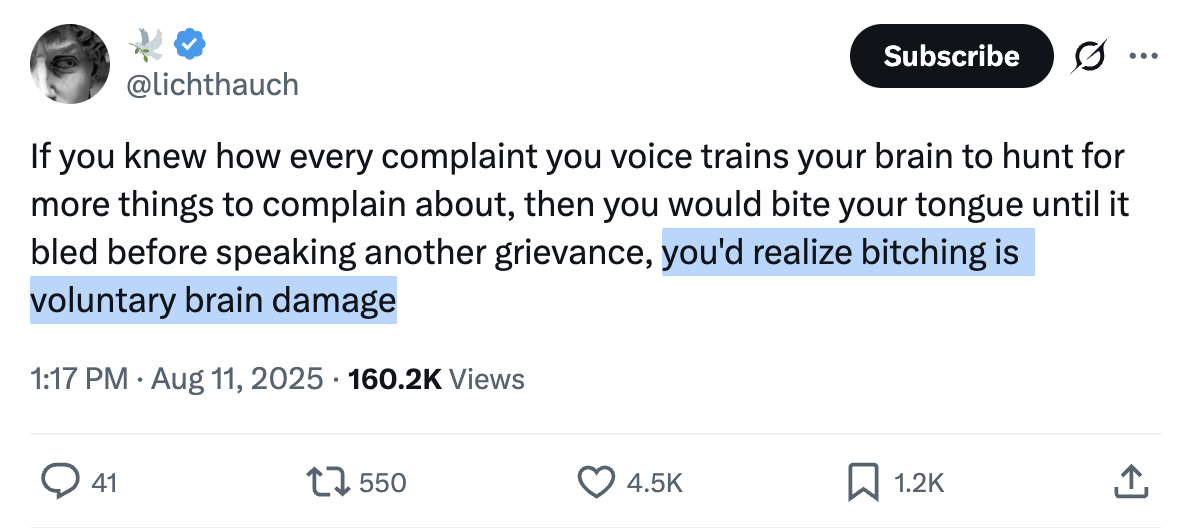
Complaining is literally voluntary brain damage. We’re choosing to damage our psyche. And, like any addiction, it becomes intoxicating not to stop. The more you complain, the better it feels to keep complaining. It’s your default mechanism.
So how do you break the chains of complaining?
“Good”
I came across a playlist a few months ago by Akira The Don (I think John Coogan posted it on Twitter) and I’ve been listening to it on repeat ever since. It’s an exceptional remix of great quotes from Jocko Willink mixed with some EDM lift. The whole playlist is exceptional, but one song in particular struck me that I’ve listened to it easily hundreds of times. The song is called Good. It comes from the Jocko podcast. It’s worth sharing the entire essence of the song here:
*”One of my direct subordinates, one of my guys that worked for me, he would call me up or pull me aside with some major problem, some issue that was going on. And he’d say ‘boss, we got this, that, and the other thing.’ And I’d look at him, and I’d say, “good.”
Finally, one day, he was telling me about some issue that he was having, some problem, and he said, ‘I already know what you’re gonna say.’ And I said, ‘well, what am I going to say?’ And he said, ‘you’re gonna say “good.” That’s what you always say. When something is wrong, and going bad, you always just look at me and say “good.”’
And I said, “Well yeah. And I mean it. When things are going bad, there’s going to be some good that’s going to come from it.”
Mission got cancelled? Good. We can focus on the other one.
Didn’t get the new high-speed gear we wanted? Good. We can keep it simple.
Didn’t get promoted? Good. More time to get better.
Didn’t get funded? Good. We own more of the company.
Didn’t get the job we wanted? Good. We can get more experience and build a better resume.
Got injured? Sprained my ankle? Good. Needed a break from training.
Got tapped out? Good. Better to tap in training than tap out on the street.
Got beat? Good. You learned.
Unexpected problems? Good. You have the opportunity to figure out a solution.
And that’s it. When things are going bad, don’t get all bummed out, don’t get startled, don’t get frustrated. You just look at the issue, and you say, “Good.” I don’t mean to say something that’s all cliche and be Mr. Positive. But do that. Focus on the good. Take that issue, take that problem, and make it something good. And bring that attitude to your team. You go forward.
If you can say the word “good,” it means you’re still alive. It means you’re still breathing. And if you’re still breathing, well then hell, you’ve still got some fight left in you. So get up, dust off, reload, recalibrate, reengage, go out on the attack. And that right there is about as good as it gets.”*
This is the absolute best encapsulation of the mind savior. If complaining is the mind killer, then the mind savior is seeing every issue, every problem, and saying “Good.” Finding the good. Or, as my mom would say, “expect the best to come from it.”
It Is Not The Critic Who Counts
The famous Theodore Roosevelt quote about the “man in the arena” draws a distinction between the critic; the man who points out how the strong man fumbles, and the “doer of deeds.”
But the reality is that, in our own life, we play the full cast of characters. Just as we are the man in our own arena, we are also the critic.
It is true that the critic doesn’t count. When our “face is marred by dust and sweat and blood,” that is what counts. Roosevelt talks of “those cold and timid souls who neither know victory nor defeat.” But the unfortunate reality is that the only person who knows both our victories and our defeats in their entirety is us.
And when we give air to the critic inside of us, we elevate their status. We make them count. When we complain, we muscle out all room to build. To strive and achieve. We take for granted the striving, the effort, the fight we exert because we’re too swallowed up in the intoxication of disappointment porn.
It is so much easier to take the quick high of complaining, whining, or gossiping. We think we’re making for ourselves a tower of perspective that can stand as its own accomplishment. But that tower is built on a sandy foundation. Because, no matter how hard the critic tries, no matter how important they want themselves to feel, they do not matter. And eventually, when you build a foundation on things that do not matter, it will ultimately come crumbling down.
Our minds are like the flames of a fire. They are either growing or dwindling; there is no stasis. Every day, we program our minds with inputs and outputs. The psychological euphoria of complaining is freeing because it temporarily suspends your accountability. But eventually your mind becomes incapable of holding the weight of accountability that, ultimately, only you can hold.
In order to hold it, you have to rewire your brain. Orient your mind towards what is good. Prepare for the worst, certainly. Because preparation allows you to process. But no matter the outcomes, positive or negative, you rewire your mind to focus on the good. When the worst does come, despite your preparation, take Jocko’s advice, and say “Good.”
“[Because] if you can say the word “good,” it means you’re still alive. It means you’re still breathing. And if you’re still breathing, well then hell, you’ve still got some fight left in you. So get up, dust off, reload, recalibrate, reengage, go out on the attack. And that right there is about as good as it gets.”
Special thanks to Talia Goldberg’s “positive vibes” tweet that made me ponder this topic this week.