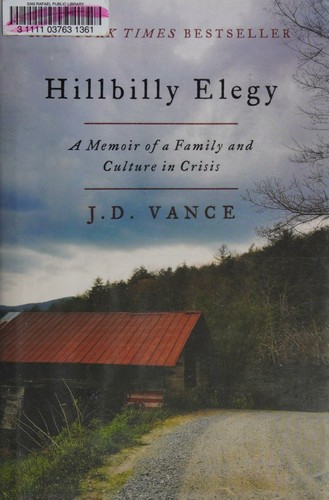
Hillbilly Elegy
Key Takeaways
Kyle, in 2017 in Books: This may have been one of the more important books I read this year. Not because I agree with everything in it, but because it raises an important conversation. Other people have already effectively explained some of the issues to consider more deeply, but all-in-all, I don’t think Vance’s ideas are completely wrong or completely right. I think there is truth to the cultural struggles that people in rural communities face, but there is also a massive disservice being done to these people on the part of the government.
J.D. Vance’s memoir read with attention to structural-trap dynamics in declining communities. Two threads:
-
Housing as the trap. “As jobs disappear in a given area, declining home values trap people in certain neighborhoods.” The mobility-suppression mechanism the book documents.
-
Even recovery creates exodus. “If you bring back the jobs, you have to worry about the mass exodus at the slightest sign of rising home prices.” The reverse-trap that gentrification dynamics produce.
A standalone note: “students don’t expect much from themselves, because the people around them don’t do very much. The internet changes that.” A cautiously optimistic counter to Vance’s pessimism — the assumption that local environment fully determines aspiration is increasingly weak.
Connections
People: J. D. Vance — author of the memoir; recounts escaping Appalachian decline via the Marines, Ohio State, and Yale Law.
Concepts: City Building — the housing-as-trap mechanism (“declining home values trap people in certain neighborhoods”) and the reverse exodus problem of rising prices. Learned Helplessness — Vance names the psychological term directly for the belief that one’s choices don’t affect outcomes. Cognitive Dissonance — the “lies we tell ourselves to solve the cognitive dissonance” between professed values of hard work and the reality of not working. Hard Work — his grandparents’ “almost religious faith in hard work and the American Dream” set against the working-class movement to blame outcomes on society. Identity Formation — the home message that countered neighborhood pressure (“I received a different message at home. And that just might have saved me”). Education — the gap between intelligence and knowledge, and students who “don’t expect much from themselves, because the people around them don’t do very much.”
Books: Janesville — adjacent on industrial-decline community dynamics and disappearing factory jobs. Our Towns — the counter-narrative on what revives struggling places. The Self-Driven Child — the aspiration-and-environment thread, where local environment is assumed to determine self-expectation.
Highlights
- It’s about a culture that increasingly encourages social decay instead of counteracting it.
- Did I want to make them proud? Of course I did, but not because I pretended to like them; I genuinely loved them.
- “There is nothing lower than the poor stealing from the poor. It’s hard enough as it is. We sure as hell don’t need to make it even harder on each other.”
- Despite the setbacks, both of my grandparents had an almost religious faith in hard work and the American Dream. Neither was under any illusions that wealth or privilege didn’t matter in America.
- As jobs disappear in a given area, declining home values trap people in certain neighborhoods.
Kyle: And even if you bring back the jobs, you have to worry about the mass exodus at the slightest sign of rising home prices
- “A lot of students just don’t understand what’s out there,” she told me, shaking her head. “You have the kids who plan on being baseball players but don’t even play on the high school team because the coach is
- mean to them. Then you have those who aren’t doing very well in school, and when you try to talk to them about what they’re going to do, they talk about AK. ‘Oh, I can get a job at AK. My uncle works there.’ It’s like they can’t make the connection between the situation in this town and the lack of jobs at AK.” My initial reaction was: How could these kids not understand what the world was like? Didn’t they notice their town changing before their very eyes? But then I realized: We didn’t, so why would they?
- Students don’t expect much from themselves, because the people around them don’t do very much.
Kyle: The interenet changes that
- I didn’t understand the difference between intelligence and knowledge. So I assumed I was an idiot.
- In other words, despite all of the environmental pressures from my neighborhood and community, I received a different message at home. And that just might have saved me.
- We talk about the value of hard work but tell ourselves that the reason we’re not working is some perceived unfairness: Obama shut down the coal mines, or all the jobs went to the Chinese. These are the lies we tell ourselves to solve the cognitive dissonance—the broken connection between the world we see and the values we preach.
- “But if you want the sort of work where you can spend the weekends with your family, you’ve got to go to college and make something of yourself.”
- Psychologists call it “learned helplessness” when a person believes, as I did during my youth, that the choices I made had no effect on the outcomes in my life.
- Powerful people sometimes do things to help people like me without really understanding people like me.
- But for him to make better choices, he needs to live in an environment that forces him to ask tough questions about himself. There is a cultural movement in the white working class to blame problems on society or the government, and that movement gains adherents by the day.
- I need to touch them without being weird about it.
- Tags: pink
- Social capital isn’t manifest only in someone connecting you to a friend or passing a résumé on to an old boss. It is also, or perhaps primarily, a measure of how much we learn through our friends, colleagues, and mentors.
- “Significant stress in early childhood,” they write, “… result[s] in a hyperresponsive or chronically activated physiologic stress response, along with increased potential for fear and anxiety.”
- People sometimes ask whether I think there’s anything we can do to “solve” the problems of my community. I know what they’re looking for: a magical public policy solution or an innovative government program. But these problems of family, faith, and culture aren’t like a Rubik’s Cube, and I don’t think that solutions (as most understand the term) really exist. A good friend, who worked for a time in the White House and cares deeply about the plight of the working class, once told me, “The best way to look at this might be to recognize that
- you probably can’t fix these things. They’ll always be around. But maybe you can put your thumb on the scale a little for the people at the margins.”
- But are we tough enough to do what needs to be done to help a kid like Brian? Are we tough enough to build a church that forces kids like me to engage with the world rather than withdraw from it? Are we tough enough to look ourselves in the mirror and admit that our conduct harms our children?
- I don’t know what the answer is, precisely, but I know it starts when we stop blaming Obama or Bush or faceless companies and ask ourselves what we can do to make things better.
Referenced in
- Adverse Childhood Experiences note
- American Dream note
- Can This Little Bookstore Save a Rust-Belt Town? note
- Cognitive Dissonance note
- Deindustrialization note
- Demon Copperhead book
- Education note
- Embrace The Nuance essay
- Evicted: Poverty and Profit in the American City book
- Identity Formation note
- J.D. Vance note
- Janesville book
- Learned Helplessness note
- Our Towns book
- Social Capital note
- The Poisonwood Bible book
- The War on Normal People book
- What I Found in a Thousand Towns book