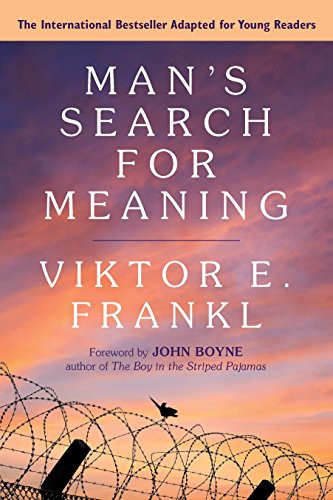
Man's Search For Meaning
Key Takeaways
Kyle, in 2018 in Books: The first time I heard about this book was in talking to a man next to me on a plane. I was reading JD Vance’s ‘Hillbilly Elegy’ and mentioned that it was occasionally really depressing, but insightful. The man said what I was reading couldn’t be anything close to Man’s Search For Meaning. He was right. When I’ve read or watched end-of-the-world scenarios, I sometimes wonder, ‘what is even the point in trying to stay alive?’ But the idea of meaning — finding the value in existing, no matter our circumstances, is important. Dignity is an undervalued concept. Life should be about enabling more and more people to live a dignified and meaningful life.
Special thanks to Erik Hansen for letting me borrow his copy of this book.
From the introduction — “Viktor Frankl’s Man’s Search For Meaning is one of the great books of our time. Typically, if a book has one passage, one idea with the power to change a person’s life, that alone justifies reading it, rereading it, and finding room for it on one’s shelves. This book has several such passages.”
Connections
No cross-book interconnections identified yet.
Recommended again: named in reply to @SpencrGreenberg’s “What non-fiction book taught you the most about how the world really works?” (June 5, 2025). Kyle had already read it, so the sighting is recorded here rather than as an anti-library card.
Recommended again: on Charlie Kirk’s must-read list — captured both in @NJBeisner’s September 20, 2025 video and in @j_bambrick’s September 26, 2025 compilation of every book Kirk recommended across his episodes. Kyle had already read it, so the sighting is recorded here rather than as an anti-library card.
Recommended again: on Brendan McCord’s Philosopher-Entrepreneur Reading List (shared March 9, 2026), in the section on Pursuing the Good Life: Ethics and Personal Growth. Kyle had already read it, so the sighting is recorded here rather than as an anti-library card.
Highlights
Roam capture metadata — Author: Viktor Frankl · Reading Status: Books Read · Source: https://medium.com/@kwharrison13/2018-in-books-7d3590e7f5e8 · Recommended By: Erik Hansen · Tags: #Books
- ==Highlighted Quotes==
- ==START REVIEWING HERE>>>==
- From the introduction — “Viktor Frankl’s Man’s Search For Meaning is one of the great books of our time. Typically, if a book has one passage, one idea with the power to change a person’s life, that alone justifies reading it, rereading it, and finding room for it on one’s shelves. This book has several such passages.”
- “He who has a Why to live for can bear almost any How.”
- “Life is not primarily a quest for pleasure, as Freud believed, or a quest for power, as Alfred Adler taught, but a quest for meaning. The greatest task for any person is to find meaning in his or her life. Frankl saw three possible sources for meaning: in work (doing something significant), in love (caring for another person), and in courage during difficult times. Suffering in and of itself is meaningless; we give our suffering meaning by the way in which we respond to it.”
- “Don’t aim at success — the more you aim at it and make it a target, the more you are going to miss it. For success, like happiness, cannot be pursued; it must ensue, and it only does so as the unintended side-effect of one’s dedication to a cause greater than oneself or as the by-product of one’s surrender to a person other than oneself.”
- “I shall never forget how I was roused one night by the groans of a fellow prisoner, who threw himself about in his sleep, obviously having a horrible nightmare. Since I had always been especially sorry for people who suffered from fearful dreams or deliria, I wanted to wake the poor man. Suddenly I drew back the hand which was ready to shake him, frightened at the thing I was about to do. At that moment I became intensely conscious of the fact that no dream, no matter how horrible, could be as bad as the reality of the camp which surrounded us, and to which I was about to recall him.”
- “Love is the ultimate and the highest goal to which man can aspire.”
- “The salvation of man is through love and in love.”
- “Does this not bring to mind the story of Death in Teheran? A rich and mighty Persian once walked in his garden with one of his servants. The servant cried that he had just encountered Death, who had threatened him. He begged his master to give him his fastest horse so that he could make haste and flee to Teheran, which he could reach that same evening. The master consented and the servant galloped off on the horse. On returning to his house, the master himself met Death, and questioned him, “Why did you terrify and threaten my servant?” “I did not threaten him; I only showed surprise in finding him here when I planned to meet him tonight in Teheran,” said Death.”
- “A man’s character became involved to the point that he was caught in a mental turmoil which threatened all the values he held and threw them into doubt.”
- “Everything can be taken from a man but one thing: the last of the human freedoms — to choose one’s attitude in any given set of circumstances, to choose one’s own way.”
- “The sort of person the prisoner became was the result of an inner decision.”
- “The preferred to close their eyes and to live in the past. Life for such people became meaningless.”
- “Yet, in reality, there was an opportunity and a challenge.”
- “All that oppressed me at that moment became objective.”
- “By this method I succeeded somehow in rising above the situation, above the sufferings of the moment, and I observed them as if they were already of the past.”
- “From all this we may learn that there are two races of men in this world, but only these two — the “race” of the decent man and the “race” of the indecent man.”
- “That no one has the right to do wrong, not even if wrong has been done to them.”
- “What man actually needs is not a tensionless state but rather the striving and struggling for a worthwhile goal.”
- “Create a sound amount of tension through a reorientation toward the meaning of one’s life.”
- “The pity of it is that many of these will not know what to do with all their newly acquired free time.”
- “We can observe in such cases that the sexual libido becomes rampant in the existential vacuum.”
- “Live as if you were living already for the second time and as if you had acted the first time as wrongly as you are about to act now.”
- “How can we dare to predict the behavior of man? We may predict the movements of a machine, of an automaton; more than this, we may even try to predict the mechanisms or “dynamisms” of the human psyche as well. But man is more than psyche.”
- “Our generation is realistic, for we have come to know man as he really is. After all, man is that being who invented the gas chambers of Auschwitz; however, he is also that being who entered those gas chambers upright, with the Lord’s Prayer or the Shema Israel on his lips.”
- “As soon as they could fill their abundant free time with some sort of unpaid but meaningful activity — their depression disappeared although their economic situation had not changed and their hunger was the same. The truth is that man does not live by welfare alone.”
- “So, let us be alert — alert in a twofold sense: Since Auschwitz we know what man is capable of. And since Hiroshima we know what is at stake.”
Referenced in
- The Last Lecture book