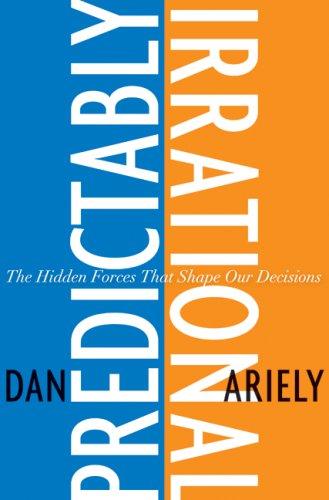
Predictably Irrational
Key Takeaways
Kyle, in 2017 in Books: After falling in love with behavioral economics via Thaler’s ‘Misbehaving,’ I started searching for all the other thought leaders in the space, and stumbled upon Dan Ariely. Many thanks for Pioneer Bookin Provo for helping me find this one.
I don’t know why behavioral economists quote Mark Twain so much, but they sure do — “Tom had discovered a great law of human action, namely, that in order to make a man covet a thing, it is only necessary to make that thing difficult to attain.” Referring to his conversations with some major banks — “Well, they never called me back. (It might have been that they were worried about losing the $17 billion in interest charges, or maybe it was just good old procrastination.) But the idea is still there — a self-control credit card — and maybe one day someone will take the next step.”
Dan Ariely’s behavioural economics primer. Kyle’s highlights favour the social-vs-market norms argument over the famous experiments:
- The project stated. “Recognizing where we depart from the ideal is an important part of the quest to truly understand ourselves.”
- Free markets assume a creature we aren’t. “A free market based on supply, demand, and no friction would be the ideal if we were truly rational. Yet we are not rational.”
- You can’t run both norm systems at once. The advice Kyle marked for companies: “you can’t have it both ways. You can’t treat your customers like family” and then invoke market logic when convenient.
- Which is why incentives corrode schools. “Standardized testing and performance-based salaries are likely to push education from social norms to market norms” — better to focus on purpose than on scores, salaries and competition.
- Cool states make promises hot states break. “When we promise to save our money, we are in a cool state. When we promise to exercise and watch our diet, again we’re cool” — the case for precommitment devices, illustrated with the health-exam example.
- Ownership distorts. “Ownership pervades our lives and, in a strange way, shapes many of the things we do” — the endowment effect as a life principle rather than a lab result.
Connections
Books: Misbehaving — The Making of Behavioral Economics · The Undoing Project · Thinking, Fast and Slow — the same field from three angles. Measure What Matters on the incentives-and-metrics problem in organisations.
Concepts: Cognitive Bias · Incentives · Vanity Metrics — social vs. market norms is the sharpest frame for why metrics change behaviour.
People: Dan Ariely.
- Nudge — the paired read in Kyle’s behavioral-economics cluster; Ariely’s parallel argument that decision-making is systematically irrational maps directly onto Thaler and Sunstein’s Behavioral Economics / Heuristics framework.
- Blink — Gladwell’s adjacent take on rapid, intuitive judgment; together these books trace how Psychology shapes consequential decisions outside conscious reasoning.
Highlights
- “I believe that recognizing where we depart from the ideal is an important part of the quest to truly understand ourselves, and one that promises many practical benefits.”
Kyle: I don’t know why behavioral economists quote Mark Twain so much, but they sure do — “Tom had discovered a great law of human action, namely, that in order to make a man covet a thing, it is only necessary to make that thing difficult to attain.”
- “Yes, a free market based on supply, demand, and no friction would be the ideal if we were truly rational. Yet we are not rational but irrational, policies should take this important factor into account.”
- “If you’re a company, my advice is to remember that you can’t have it both ways. You can’t treat your customers like family one moment and then treat them impersonally — or, even worse, as a nuisance or a competitor — a moment later when this becomes more convenient or profitable.”
- “Standardized testing and performance-based salaries are likely to push education from social norms to market norms.”
- “Instead of focusing the attention of the teachers, parents, and kids on test scores, salaries, and competition, it might be better to instill in all of us a sense of purpose, mission, and pride in education.”
- “When we promise to save our money, we are in a cool state. When we promise to exercise and watch our diet, again we’re cool. But then the lava flow of hot emotion comes rushing in: just when we promise to save, we see a new car, a mountain bike, or a pair of shoes we must have. Just when we plan to exercise regularly, we find a reason to sit all day in front of the television. And as for the diet? I’ll take that slice of chocolate cake and begin the diet in earnest tomorrow. Giving up on our long-term goals for immediate gratification, my friends, is procrastination.”
- “But can you imagine if we all got the required health exams on time? Think how many serious health problems could be caught if they were diagnosed early.”
Kyle: Referring to his conversations with some major banks — “Well, they never called me back. (It might have been that they were worried about losing the $17 billion in interest charges, or maybe it was just good old procrastination.) But the idea is still there — a self-control credit card — and maybe one day someone will take the next step.”
- “Ownership pervades our lives and, in a strange way, shapes many of the things we do.”
- “And in the case of our kids, we give up their time and ours — and the chance that they could become really good at one activity — in trying to give them some experience in a large range of activities. In running back and forth among the things that might be important, we forget to spend enough time on what really is important. It’s a fool’s game, and one that we are remarkably adept at playing.”
- “We are continually reminded that we can do anything and be anything we want to be. The problem is in living up to this dream. We must develop ourselves in every way possible; must taste every aspect of life; must make sure that of the 1,000 things to see before dying, we have not stopped at number 999. But then comes a problem — are we spreading ourselves too thin?”
- “The other side of this tragedy develops when we fail to realize that some things really are disappearing doors, and need our immediate attention. We may work more hours at our jobs, for instance, without realizing that the childhood of our sons and daughters is slipping away. Sometimes these doors close too slowly for us to see them vanishing.”
- “We need to drop out of committees that are a waste of our time and stop sending holiday cards to people who have moved on to other lives and friends. We need to determine whether we really have time to watch basketball and play both golf and squash and keep our family together; perhaps we should put some of these sports behind us. We ought to shut them because they draw energy and commitment away from the doors that should be left open.”
- “The same approach should be used to settle arguments: The perspectives of each side is presented without the affiliation — the facts are revealed, but not which party took which actions. This type of ‘blind’ condition might help us better recognize the truth.”
- “By the time we comprehend and digest information, it is not necessarily a true reflection of reality. Instead, it is our representation of reality, and this is the input we base our decisions on. In essence we are limited to the tools nature has given us, and the natural way in which we make decisions is limited by the quality and accuracy of these tools.”
Referenced in
- Nudge book