People Over Politics
Policy through the lens of human outcomes
An attempt to understand policy divorced from partisan tribalism — focused instead on what actually works to solve problems like crime, homelessness, inflation, unemployment, immigration, and energy. The belief that good solutions exist and can be identified through honest evaluation of evidence and human impact.
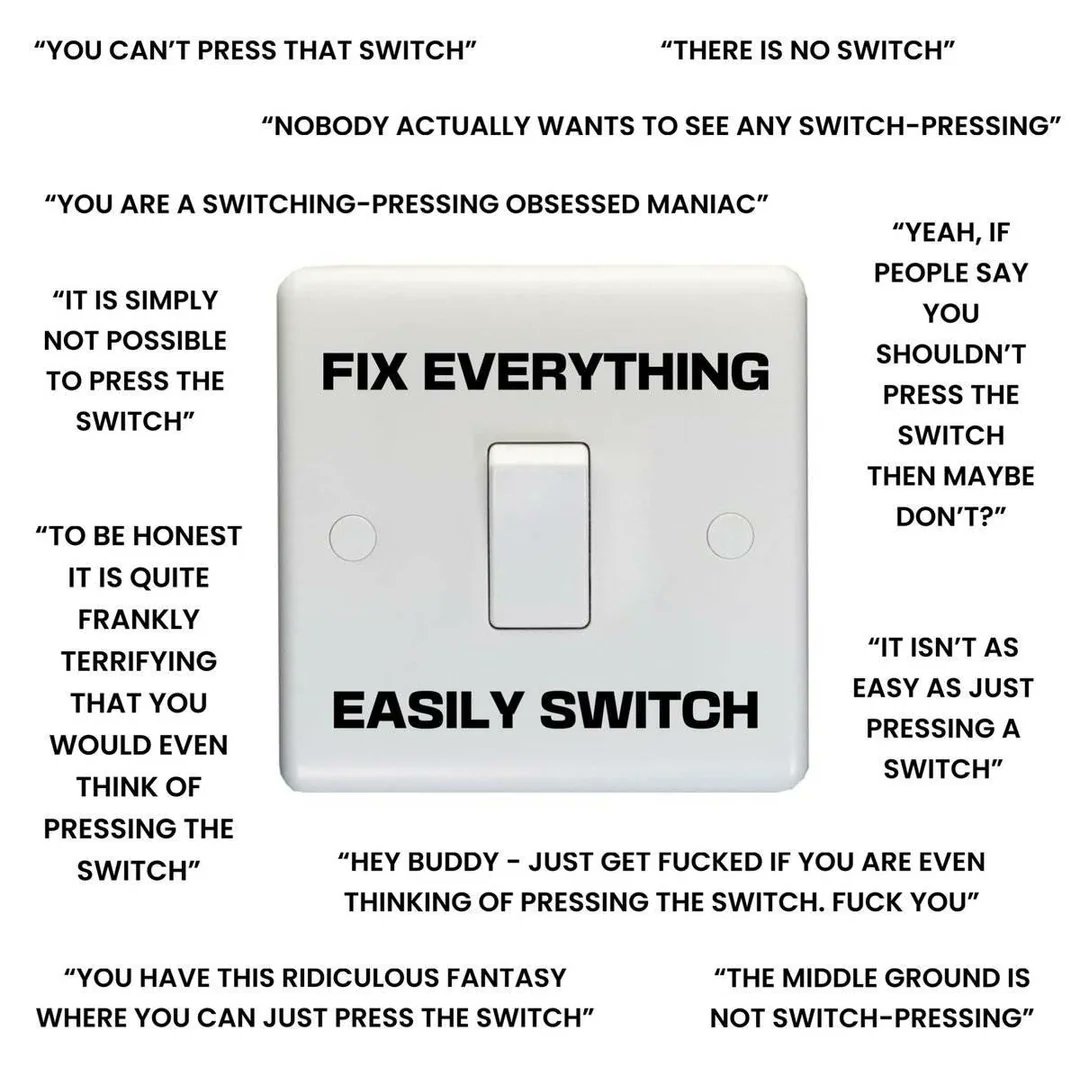
Asked Claude: 'There's a meme called the "fix everything easily switch". What policies do you think are the best candidates for being a real fix everything switch in the US? Give me your top ten, your confidence, your reasoning, and why a given policy has not been implemented.' https://t.co/qc7cPXk8pB
THE BEAUTIFUL MICE ARE ALREADY HERE John Calhoun gave his mice everything: unlimited food, perfect climate, no predators, ideal nesting spaces. They responded by going insane, refusing to breed, and eating each other despite full feeders. The Universe 25 experiment didn't https://pbs.twimg.com/amplify_video_thumb/1994639231247929344/img/uNPi30yAJMlwMUiS.jpg **Quoting @elonmusk:** > “Mouse Utopia”

I grew up in Ohio where, for generations, my family worked for GM, Ford, NCR, Fujitec, and Frigidaire. We forgot that our ability to build is our greatest deterrent. It's time to bring manufacturing back to the Heartland. 🇺🇸 Check out my new essay for American Affairs 👇 https://t.co/kjecrZgzDL

Asked Claude: 'There's a meme called the "fix everything easily switch". What policies do you think are the best candidates for being a real fix everything switch in the US? Give me your top ten, your confidence, your reasoning, and why a given policy has not been implemented.' https://t.co/qc7cPXk8pB
THE BEAUTIFUL MICE ARE ALREADY HERE John Calhoun gave his mice everything: unlimited food, perfect climate, no predators, ideal nesting spaces. They responded by going insane, refusing to breed, and eating each other despite full feeders. The Universe 25 experiment didn't https://pbs.twimg.com/amplify_video_thumb/1994639231247929344/img/uNPi30yAJMlwMUiS.jpg **Quoting @elonmusk:** > “Mouse Utopia”
I grew up in Ohio where, for generations, my family worked for GM, Ford, NCR, Fujitec, and Frigidaire. We forgot that our ability to build is our greatest deterrent. It's time to bring manufacturing back to the Heartland. 🇺🇸 Check out my new essay for American Affairs 👇 https://t.co/kjecrZgzDL
the reason we see so much "striver" behavior around startups and particularly YC is its the only legible path to an upper middle class life left. it used to be SAT prep and then an ivy league college did it for you. that's gone now. the only thing left is a chance at YC
Nov 12, 2025Please for the love of God stop it with the "Elon is dumb" shit, just fucking stop **Quoting @TheDemocrats:** > Rep. @AOC: Elon Musk is not a scientist. He is not an engineer. He is a billionaire con man with a lot of money 🔥 https://t.co/zBpqed2ZSh
2025-03-04Seems like a good opportunity or scientific outlets to opt out of future opinion pieces on politics There is a long history of this going quite bad and can only reduce trust in scientific institutions This only serves to degrade science vs elevate it **Quoting @Nature:** > “I've witnessed something that I feel is extremely bad, not just for the United States, but for all of us in the world.” > > Scientists around the world expressed disappointment and alarm as Republican Donald Trump has secured a second term https://t.co/VVtrivXZeH
2024-11-06"Little children were trained not to do “just what they liked” but…but what?…Of course! What others liked. And which others? Parents, teachers, supervisors, policemen, judges, officials, kings, dictators. All authorities. When you are trained to despise “just what you like” https://t.co/w8mz8y4SAU
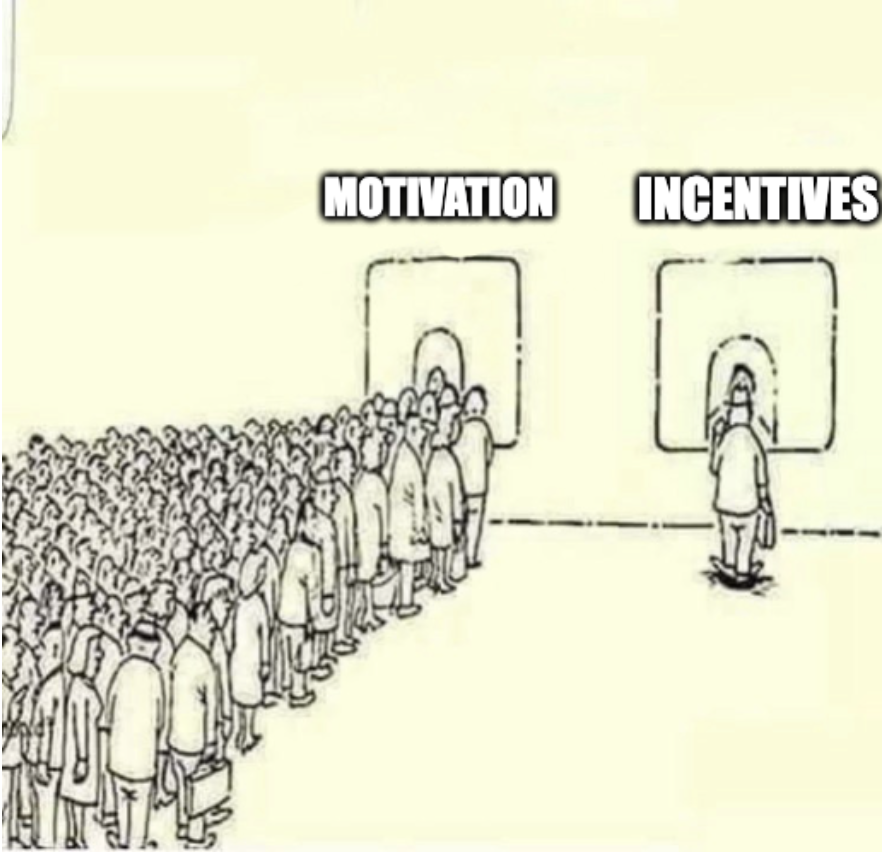
12 thoughts on incentives: 1. Don't ask your barber if you need a haircut. 2. "I can fix the $32 trillion US debt problem in 5 minutes. You pass a law that when there’s a deficit of more than 3% of GDP, all sitting members congress are ineligible for re-election” - Warren Buffett 3. 33% of British criminals were dying en route to Australia in the 1700s. Britain switched from paying sea captains for every passenger who walked on the ship to paying them for every passenger who walked off. Immediately, the survival rate shot up to 99%. 4. How to waste your time: Try to defy the laws of physics -- or try to get a man to understand something when his salary depends on his not understanding it. 5. “Never attribute to conspiracy what is more easily explained by incentives and incompetence.” - Naval 6. During the 1980's, the government of Athens came up with an idea to limit pollution: Odd-numbered and even-numbered license plates. On dates with an odd number, the odd plates could drive. And vice versa. The rich people just bought another car -- with even worse emissions. The streets got more jammed and the pollution got worse. 7. “If you reward profits alone, it’s the dumbest thing you could do. Employees will quit advertising and start shrinking the business” - Buffett 8. If video games teach us one thing: If you want to motivate humans, frequent rewards are more addicting than one-off rewards. 9. In Hungary, every woman who gives birth to 4 children or more never has to pay income tax. Prediction for the next 2 decades: As populations decline, every government will be focused on child-bearing incentives. 10. “I think I've been in the top 5% of my age cohort all my life in understanding the power of incentives, and all my life I've underestimated it. And never a year passes but I get some surprise that pushes my limit a little farther." - Munger 11. If a person tells you why their thing is great (city, relationship, or job) - take it with a pinch of salt. If they tell you why it's terrible - take it like a handful of gold. If someone swims upstream against their identity and incentives, it probably holds some deep truth. 12. Skinner's Law: If procrastinating, 2 ways to solve it: Option 1 - Make the pain of inaction > Pain of action Option 2 - Make the pleasure of action > Pleasure of inaction The person with a gun to their head and crack cocaine at the finish line doesn't need motivation.<img src='https://pbs.twimg.com/media/GCCDZZuXQAA-gSG.png'/>
Same. I was hacking together Geocities websites and building custom WC3 maps in elementary / middle school. But never found a path to follow beyond that, and didn’t have anyone in my life who knew where to point me to next. It all worked out though 😄 **Quoting Paul Millerd (@p_millerd) · Jul 23, 2023 · [View on X](https://x.com/p_millerd/status/1683202959297982466):** > I feel like my entire life would have been different if an adult had pulled me aside and be like “hey buddy you’re really into computers, you need to go after that as soon as possible in some way. Don’t get lost in the business world.” > > Missed so many signs > > 1. Loved computer programming class in college (built a recommendation engine) but didn’t see it as a path to anywhere > > 2. Spent free time building websites and learning HTML > > 3. All sorts of experiments to sell stuff on eBay and other sorts of late 90s early 00s internet stuff > > 4. Skipped class to learn stuff on computer in college > > 5. Was go to computer fix it person in college and early jobs. > > 6. Spend time on random internet message boards like neowin and Engadget for fun <!-- The quoted post's full text is from api.fxtwitter.com; syndication clipped it. -->
Jul 24, 2023I recommend reading the Unabomber Manifesto — he was an awful person to be sure — but it is nonetheless a great work of anthropology. He diagnosed the crisis of meaning in our time and how people fill the void with radical politics (ironic). https://t.co/lLtzNczfLH **Links in the tweet** (resolved 2026-09-29): - `https://t.co/lLtzNczfLH` → https://theanarchistlibrary.org/library/fc-industrial-society-and-its-future
Jun 11, 2023Found a great Reddit thread: "What's a rule that was implemented somewhere that massively backfired?" Here are the best ones 🧵 1/ Alcohol bans at college football games led to increased intoxication problems because fans were getting really drunk before entering the stadium. 2/ "English law in Wales set the death penalty for stealing a sheep. Welshmen caught stealing sheep would claim to be making love to them. They would get a lesser penalty for beastiality. The consequence of this is Welshmen gained a reputation as 'sheep shaggers'." 3/ In Soviet Russia, steel producers were rewarded by the total weight output of the factory. This led to production of oversized and un-usable strips of steels. End users had no choice but to take the impractical strip sizes and machine them down, thus wasting steel. 4/ In Athens (late 80s), the government tried to limit pollution by having odd-numbered and even-numbered license plates drive on alternating days. Result: everyone bought a second (shittier and with worse emission) car as their backup. Streets stayed clogged, pollution worse. 5/ Employees at one company were getting a bit liberal with lunch time, so their boss made everyone text when they started and ended lunch. One dude started texting every detail: start time, order, price, address, end time, random emotions. They cancelled the policy. 6/ In Alberta, strip club patrons must keep a 2m buffer from dancers The only currency that can travel that far are metal loonie ($1) & twoonie ($2) coins: "The goal was to protect the safety & dignity of dancers but the dancers have become reduced to fleshy coin toss targets” 7/ INTERMISSION Words of wisdom from Charlie Munger regarding rules and incentive design: 8/ A college bar had a happy-hour promotion: $0.50 a beer until anyone in the bar peed. Some crazy shit started happening: 1) people wore adult diapers; 2) others would covertly pee in trash cans or hidden corners. The bar cancelled happy hour. 9/ Some GPS vehicle trackers penalize hard braking more than hard acceleration which incentivised drivers to run more red lights since most intersections don’t have camera. (h/t @DotDotJames) 10/ Classic example from "Freakanomics": An after-school centre started fining parents that picked their kids up too late. More parents started picking their kids up late as the fine was now seen as a "fee for services". 11/ INSANE SOCCER STORY PART #1 Barbados played Grenada to qualify for the 1994 Caribbean Cup. Per tournament rules, a goal in extra time would be worth 2x goals for qualification purposes. @ end of regulation, Barbados was winning 2-1 but it wasn’t enough goals to qualify... 12/ INSANE SOCCER STORY PART #2 ...to get to extra time (& chance for 2x goal), Barbados scored an own goal. Then Grenada did the same. For the final 7 mins, each team defended the OTHER team’s net to stop own goals. In the end, Barbados got to extra time & netted the 2x goal! 13/ In 209 BC, a band of 900 Chinese soldiers were marching to defend a city in Northern China. A flood stopped them halfway. Qin law dictated that the government would execute anyone that was "late" for government orders. Rather than face execution, the soldiers rebelled. 14/ The entire genre of "rules that had unintended consequences" is known as "The Cobra Effect". Under colonial rule, villagers in India were paid a bounty to capture cobras. People started breeding cobras so they could kill them and collect rewards. 15/ If you enjoyed this, follow @TrungTPhan for more internet gold and alot of really dumb memes. https://t.co/8WEtWdKbPr 16/ Here is the OG Reddit thread: https://t.co/tpxsiB3bt6
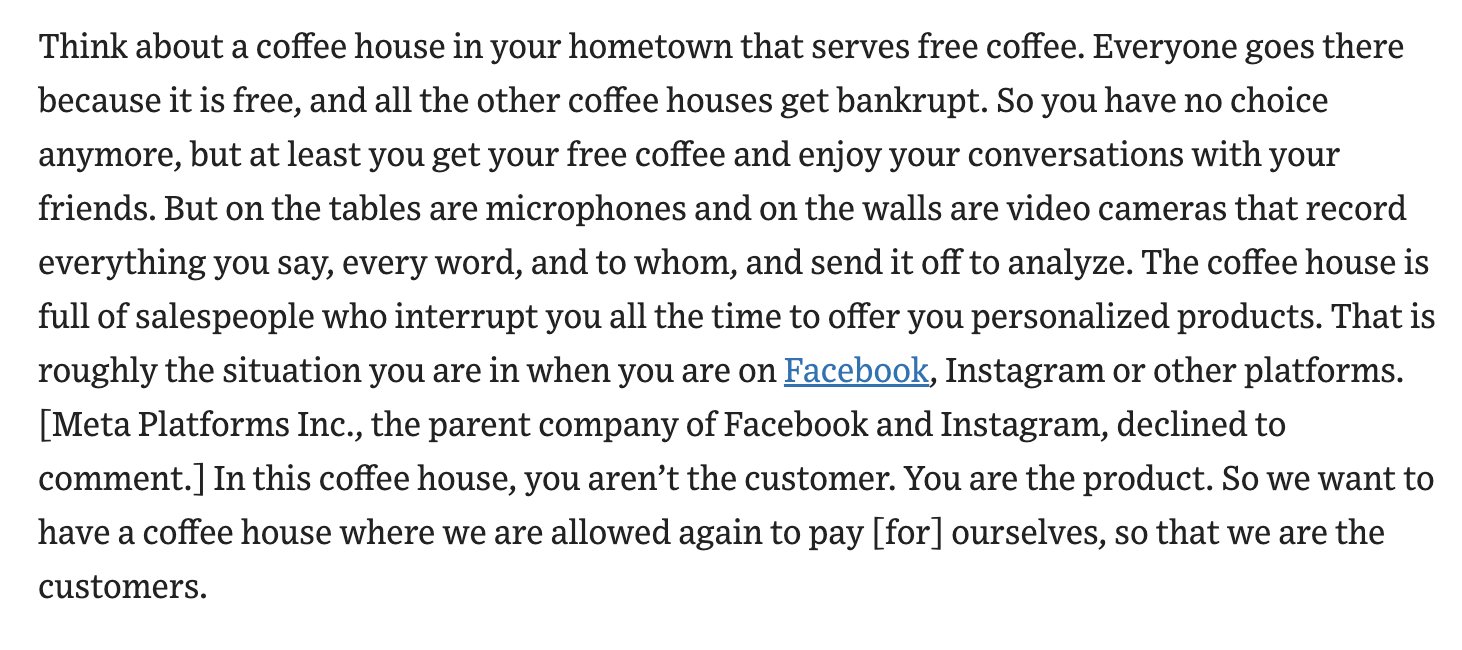
May 24, 2023 Original deleted — preserved hereOnly the rich long for paid shit. Go live in a poor country and be poor to know the value of "free coffee" if that coffee happens to be a tool to connect with people, get entertained, boost your business, support causes, talk to your family, sell stuff, find local events.
It's hard to express how utterly ridiculous this NYT interview with Herman Daly is. The "pioneering economist" demonstrates that he does not have any idea what GDP is or how it's calculated, and the interviewer doesn't know enough to push back. https://t.co/dG8R7PhwTU When asked why we can't have growth that reduces resource use, Daly claims that this is not growth, but rather should be called "development". The word "growth", he says, should only apply to growth in natural resource use. But that is not how GDP is calculated! GDP is perfectly capable of going up while natural resource use goes down! And this is exactly what has been happening in the U.S. and other rich countries in recent decades!! So to sum up: * Herman Daly claims that GDP growth is unsustainable * Daly then claims that increasing GDP while reducing resource use is "development" rather than "growth", thus directly contradicting his earlier point and showing that he is both incoherent and ignorant. This is the same pattern the New York Times displayed with its earlier MMT article -- a fawning puff piece that doesn't even try to call out obvious problems and contradictions in the "heterodox" ideas it is profiling. https://t.co/lzg0SE0bAI The fundamental problem with the NYT's economics coverage is that the writers take their "heterodox" or "iconoclast" subjects at their word, and fail to call up other economists to cross-check what they're being told!
Jul 21, 2022MYTH: We don't have a solution to nuclear's "waste problem" REALITY: Nuclear waste isn't a problem. In fact, it’s the best solution we have to meeting our energy needs while protecting the natural environment! Here's what you need to know: Nuclear waste concerns are overwhelmingly focused on “high-level waste”, which is almost entirely spent nuclear fuel. Nuclear fuel is made up of metal tubes containing small pellets of uranium. These tubes are gathered into bundles for loading and unloading into the reactor. After nuclear fuel has spent about five years in a reactor making energy, it's placed into a pool of water to cool off for another five years. (Storage pool at Palo Verde Nuclear Generating Station) After that, several bundles are placed inside concrete and steel "casks" and placed in rows next to the reactor. (Dry cask storage at Palo Verde) https://t.co/RNGl1BA6Ou Because uranium is very energy dense, the amount of waste is relatively small. All of the fuel rods ever used by the commercial nuclear industry since the late 1950s could fit on a single football field stacked about 50 feet high. The best part: when the fuel rods are done in the reactor, over 90% of the potential energy from the uranium is still left in them! That means we can recycle the spent fuel and turn it into new fuel, which is already routinely done in Europe, Russia, and Japan. In summary, nuclear waste: - is solid (not glowing green goo) - is tiny compared to the waste from all other energy technologies - is easily contained - has a perfect safety record Nuclear waste does have a problem, however... ...which is that policymakers and the public think that nuclear waste has a problem! The prevailing belief is that nuclear waste is uniquely dangerous and that the industry doesn't know what to do with it. Let's start with uniquely dangerous. The main concern associated with spent nuclear fuel – radioactivity – diminishes with time. About 40 years after it's done making power, the heat and radioactivity of the fuel bundle will have fallen by over 99%. Most of the industrial waste we manage never gets less toxic over time. Not in a million years. Not even in a billion. Mercury, lead, cadmium, arsenic, etc. are all dangerous and remain so forever. In rich countries, this waste is gathered up and stored without fanfare. There’s nothing special about radiation that would prevent us from doing this with high-level waste. The only difference is that high-level waste is much easier to detect and thus easier to monitor. Rather than being honest and explaining that 1) radiation does not make nuclear waste uniquely dangerous and 2) dry cask storage at the plant is safe, cheap, and has a flawless record, the industry has attempted to offer technical solutions to what is a political problem. Yucca Mountain is an anti-scientific dumpster fire, eating up public wealth. It would save 0 lives, protect against 0 injuries, avoid 0 cancer, and give the false impression that nuclear waste is the most dangerous waste. $15 billion flushed for no benefit. Scientists and engineers abuse public trust when they pretend we must bury nuclear waste deep underground or put it in the middle of a desert. Any "expert" who believes this is, at best, confused about the role of science and engineering in advising public policy. So what to do about the true nuclear waste problem? The Netherlands offers a compelling solution: encourage people to visit! Their facility is open to the public, contains an educational museum, and is decorated with large-scale art installations. https://t.co/54Xfmb0hmb The U.S industry gives off creepy vibes when it comes to waste. People should be allowed to check it out for themselves! At worst, they'll be bored. At best, we can find a way to make it more interesting like the Dutch do. I love getting asked about the waste. I never get tired of seeing people relax when they hear me explain it. I think the impatience with the question is what has led the industry and advocates to support ill-advised, "technical" fixes for problems of trust and openness. Glad to be hearing from so many of you in response to this thread! If you like what you read here, there’s a lot more coming and I would definitely appreciate your support. https://t.co/T8oXwlwXxR
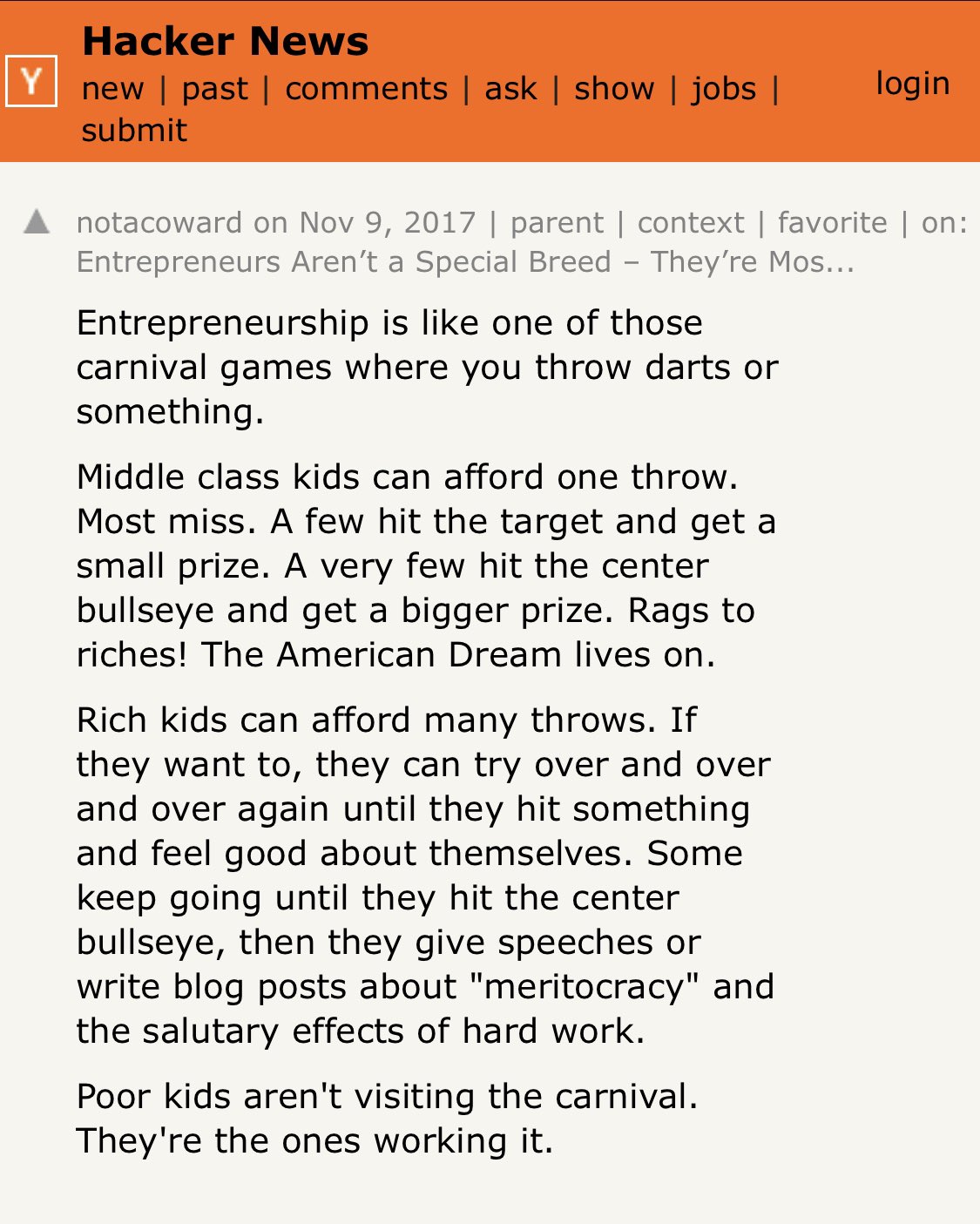
Jul 21, 2022Costs are near zero today to start a tech startup - only time - which is still meaningful, but I'm not the only middle class kid who won the carnival prize and more importantly we need to benefit from the talent & effort of so many more people with less opportunity than I had. https://t.co/dg42J1c45K OP is right that rich kids can (and many do) try as many times as they want. I've spent over a decade investing in companies from Day 0 and if anything the rich kids tend to quit much faster than their peers. First-gen immigrants (most w/o means) are the most obvious counter... but I'm more interested in figuring out how to get more talented, smart, driven people who don't have privilege to be able to build for themselves (even if it's not to create a multi-billion dollar startup) and thrive. It's also not required to have a VC type of outcome where you create a multi-billion dollar business — entrepreneurship comes in all kinds of forms and our goal should be creating more entrepreneurs who are able to build great, sustainable businesses. I'm guilty of spending 99.9% of my time thinking about those outsized outcomes, but that's a relative small sector of entrepreneurship and frankly not important when it comes to employing folks. https://t.co/dzkupr7W4u. Fun-fact: We started @reddit with $12,000 (first batch of YC!) in 2005 & we were lucky to then have the time and space to just write code & talk to users non-stop for three months of summer — that got us to our seed funding of $70K. There's so much more access to create! I've launched my own experiment in funding supremely motivated people at the EARLIEST possible stage: $2M a year for the next decade in #ClimateFellows as part of @776foundation —we've selected our 1st batch of fellows & if experiment works... more to come https://t.co/XzPnFfeN6V
all this anti american exceptionalism, decline of the empire blah blah blah its all just complaining if you really believe it then just get to work fixing it reshore manufacturing, have children, push the limits of deep tech how else do you think we prevent that shitty future
May 30, 2022Ok, so I'm embracing what got me here and about to potentially "choose violence" and weigh in on the recent change in the VC investment climate... yep, it's a 🧵... *cracks knuckles* So let's go: Everyone is frenzied and tweeting about the slowdown in VC funding except for one group...underserved founders, and IMHO here's why: In 2021 here's what we got in VC funding- Black Founders: 1.2% Women Founders: 2% LatinX Founders: 2.1% (fun fact, it was worse in previous years) So as a WHOLE we only got roughly 5% of ALL funding from VC's, so we're actually used to not getting access to that "dry powder" that folks speak of so much. This is the norm we've experienced since Sand Hill Road was a dirt path, but here we are still grinding and building. So while others run around like Chicken Little due to the downturn in climate for VC funding, for us underserved founders it's just a Tuesday and business as usual. We can't get shook and panicky about something we rarely have access to anyway...*shrug* So instead we continue to grind, build, hustle, and make a way out of no way like we do every other damn day. We're launching companies, changing industries, and doing it all the same way we always have...by sheer creativity and *^%$# determination. And we do this knowing the "game" is rigged and biased against us, which is kind of like waking up everyday and asking to get punched in the face repeatedly. Even crazier is we get to see others tout their $10M plus seed rounds with half an idea or even worse...no product. We get sidelined, dismissed, played short, and otherwise completely disregarded even though studies have shown that if we funded and get to acquisition or IPO we actually provide better returns to investors. 🤦🏾♂️🤷🏾♂️ (per:Kauffman Fellows Study). So no, we're not running around trying to figure out how to make it... we're doing what we do everyday, making it. Actually some founders might wanna ask some underserved founders out to coffee and ask them to give them some tips on how to make something out of nothing...IJS. Oh yeah..and to all the VC's that now have less to disburse and don't know what to do with "only" $3-5M to deploy, here's a great and unique suggestion: TAKE THIS TIME TO INVEST IN UNDERSERVED FOUNDERS! Thanks for coming to my TedTalk... 🍸Cheers
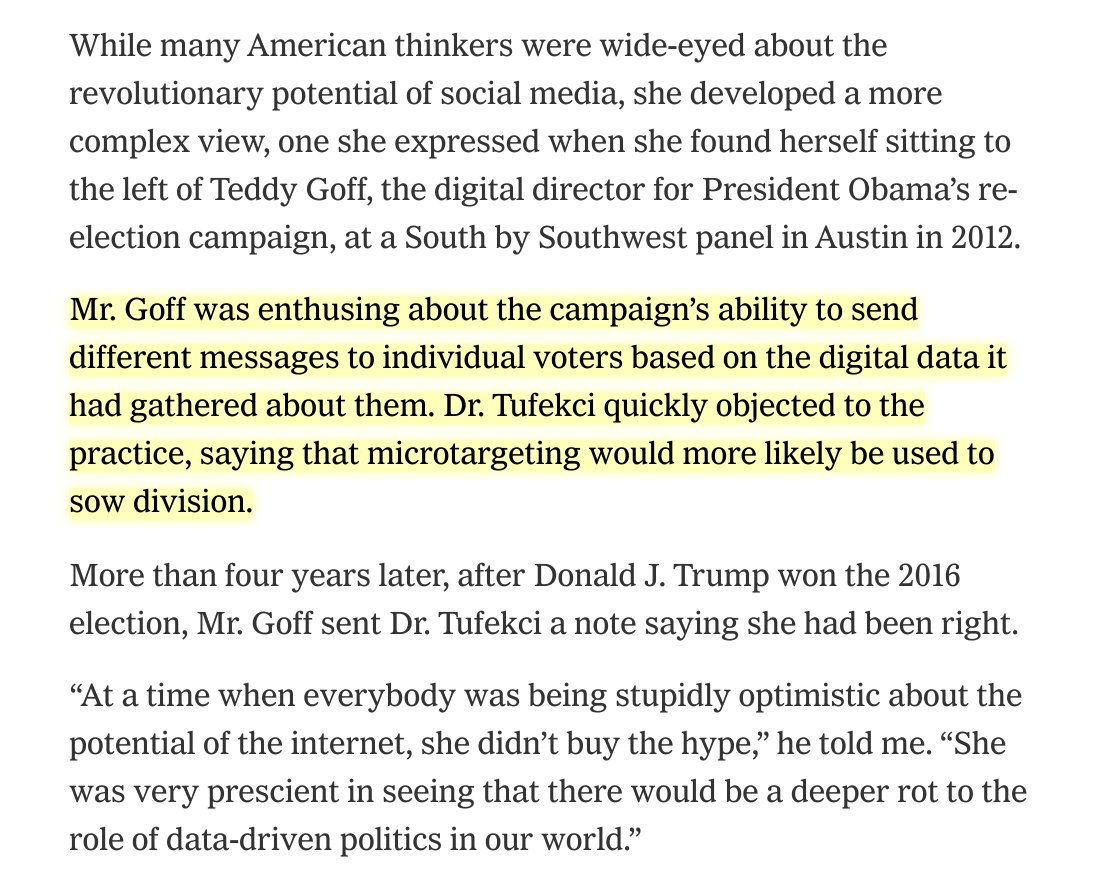
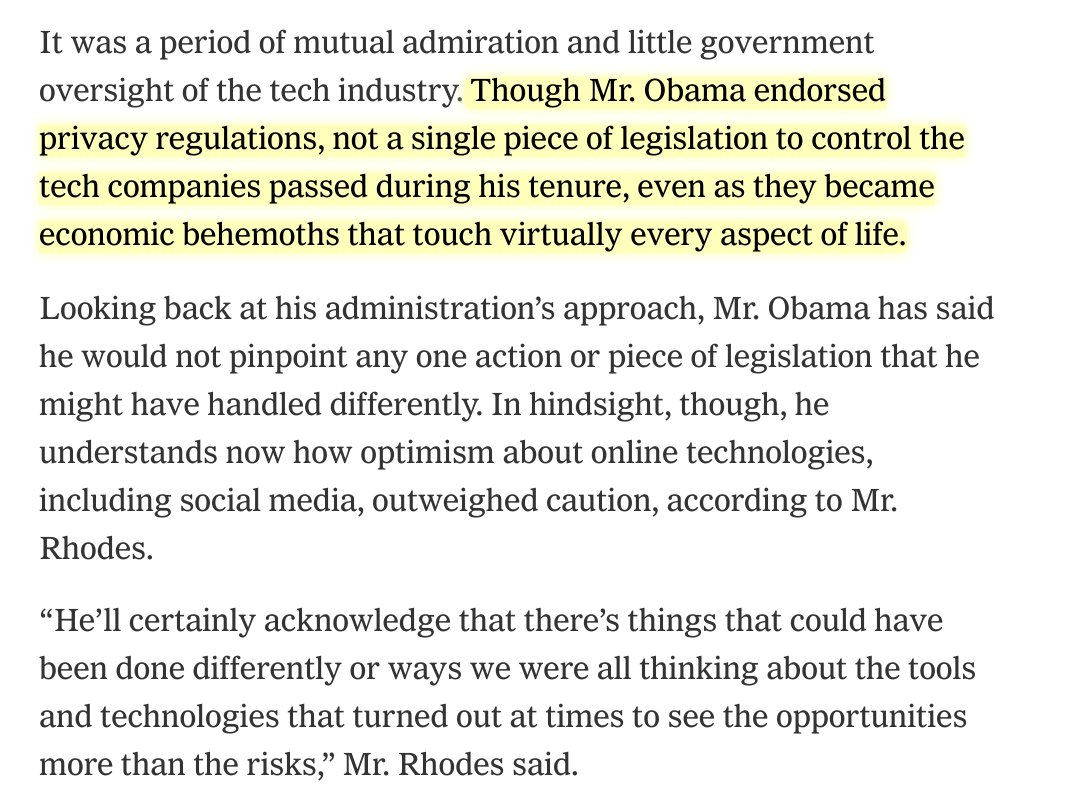
May 19, 2022So, Barack Obama has taken up fighting disinformation. NYT notes how his administration didn't regulate tech. When I started writing about it, a decade ago, the pushback I got from the Obama universe was intense, and is hinted at the below profile of me.🧵https://t.co/sOrP43qQC0 There was a lovefest between the Obama universe and Silicon Valley. Suggesting that wasn't a good thing, and we needed to regulate for privacy and for a healthy public sphere was not considered unacceptable. I heard of attempts to blacklist me from conferences, and more stuff. (I haven't written about most of this publicly. I try to focus on the substance. Some people from that world have called to apologize. It's fine. The issue isn't that I was right, and got treated terribly regardless, but that we all lost). When that profile was written in 2020, I had just spent months arguing for masks as a tool. I got called a misinformer going against scientists etc. Profile notes my next big target to argue against seeming consensus is importance of ventilation and airborne transmission. lolsob I also spent a lot of time organizing against the war in Iraq in 2003, my first real effort to change anything in the United States. It had similar overtones: a seeming strong elite consensus, and anyone who disagreed was considered naive or misinformed, etc. etc. We failed. Sometimes, going against consensus is conflated with contrarianism. Contrarianism is juvenile, and misleads people. It's not a good habit. The opposite of contrarianism isn't accepting elite consensus or being gullible. Groupthink, especially when big interests are involved, is common. The job is to resist groupthink with facts, logic, work and a sense of duty to the public. History rewards that, not contrarianism. To get the right lessons from why we fail—be it masks or airborne transmission or failing to regulate tech when we could or Iraq war—it's key to study how that groupthink occurred. It's a sociological process: vested interests arguing themselves into positions that benefit them. Indeed, Barack Obama became president exactly because he saw how that groupthink happened in the runup to the Iraq war, sadly aided by gullible "access journalism", and ran on a platform to not do that again. And yet, every age brings its own version, to challenge us once again. Two things. It's key to understand why and how some false things seem like consensus, only to be acknowledged later they were wrong. We must find more ways to productively challenge these consensus-of-vested-interests *at the time*, so we don't lose more time and just lose. So to end: being vindicated isn't the goal, though people will often be if they resist groupthink with facts, logic and putting the public interest above all, especially above fitting in or what accolades may be available to the conformist or yaysayers. But having been through multiple cycles of this, I think it's important to understand how and why things happened the way they did. It's not about vindication or I-told-you-so (and it sounds like it, which makes it harder to talk about but it should be talked about in general). "History Doesn't Repeat Itself, but It Often Rhymes", as Mark Twain said. Understanding history, including recent history, is a powerful conceptual tool. A little bit more "how did we get here" can maybe help us avoid having to ask the question again and again and again. /🧵 Okay, sorry one more. This is a brilliant addition. Apparently that quote may be apocryphal? 😂 The sentiment works, though. https://t.co/m4QtKNi2Xv Some things are silly overreactions, other things aren't. Telling them apart isn't always easy. Ok. The interesting bit: There is a lot of "herding" by experts/gatekeepers. All of a sudden, everyone wants to be "cool", and dismisses stuff they shouldn't. https://t.co/tjMFxPeRbS I got lectured in Jan/Feb of 2020 for being alarmed about the (obviously incoming) pandemic, got lectured in 2012 for worrying about tech and the public sphere, etc. Part of it is normal: people disagree. The dysfunctional part is the herding/groupthink. https://t.co/YjW7HQp18G Anyway, a really, really useful approach is to look at *history*. See old tweet below. History is a great teacher: a humbling, enlightening and clarifying one. "This time it will be completely different because this is unprecedented" is rarely true. https://t.co/ghWATrh1yb
I’m worried about America’s energy security. In just a few weeks, Putin’s war has disproven key tenets of US oil policy, and it’s rapidly downgraded America’s role in the clean-energy transition. I want to spin out a few of those thoughts here. https://t.co/DulHahtwrl 1/ For decades, the US has followed a few plays whenever oil prices spike: 1. Ask Saudi Arabia to drill more. 2. Invest in “US energy independence”—that is, drill more oil & gas domestically. 3. Fund alternative-energy R&D to cut long-term oil demand. https://t.co/DulHahtwrl 2/ We can debate whether every president was sincere about every part of the playbook. But the idea—the economy needs oil in the short term, but we must cut oil demand in the long term—was bipartisan. Here’s George W. Bush making the key point in 2008. https://t.co/DulHahtwrl 3/ Over the past few weeks and months, every tenet of that plan has failed or been abandoned. Start with Step #1: “Ask Saudi Arabia to drill more.” 4/ It’s not working. Saudi Arabia has resisted *months* of Biden admin requests to increase production. Yes, Aramco finally said today that it will drill more. But its statement is full of asterisks and it’s too little, too late given rising demand. https://t.co/4JErwjjRdZ 5/ Step #2: Embrace US “energy independence.” This one… already happened. In 2019, for the first time in 62 years, US energy production exceeded US energy consumption. America is now the world’s largest producer of oil and natural gas. https://t.co/9TMe3gs40g 6/ But far from winning us independence, America’s massive oil & gas production has made us *dependent* on market whim. That’s because oil prices are set on the global market. So when Russia invaded Ukraine, oil and gasoline prices soared everywhere. https://t.co/JVRvK7pqoH 7/ If we have all those oil reserves, you might ask, why doesn’t the US drill more, then? Because nobody has that power. Biden can’t compel companies to drill. And oil firms have sworn to investors that NOTHING—even $150 oil—will make them drill more. https://t.co/DulHahtwrl 8/ What’s darkly funny is that the triumph of US “energy independence” is also part of why Saudi Arabia won’t listen to us. In the 2000s, the US was Saudi’s largest customer. Now, as @MattZeitlin has reported, we’re also their largest competitor. https://t.co/zX33ulzJEp 9/ That brings us to the last step: “Fund alternative-energy R&D.” If the US led research into wind, solar, nuclear, EVs, and more, then one day they might become cheap enough that we could—to quote noted environmentalist George W. Bush—“end our addiction to oil.” 10/ That has happened. Clean energy became cheap. Over the past decade, wind, solar, batteries & EVs have come down the cost curve. They are now ready to be deployed across the country. https://t.co/aK1qdhPrYn 11/ And a few months ago, Congress was writing a bill to do that. It seemed like the 50-year dream of US energy policy was finally coming true. Then the talks fell apart. Now Dem leaders despair at passing even a small energy bill. https://t.co/ofDtMIGZOz 12/ At the same time, Putin’s war has further weakened America’s hand. As @jholz__ has reported, Russia is a major supplier of key metals needed for clean-energy supply. Geopolitical tumult + the risk of secondary sanctions have sent prices soaring. https://t.co/1ywCpsSfEd 13/ These two factors have rapidly shifted America’s role in any clean-energy transition. For now, Chinese firms will retain their scale & policy advantage over US firms—and they may have also just gained access to a source of cheap mineral inputs. https://t.co/DulHahtwrl 14/ So to summarize: • The US can’t trust Saudi Arabia to help in an oil shock • The US can’t benefit from its oil industry in an oil shock • The US isn’t deploying tech that would eliminate oil shocks • China has further entrenched its advantage in clean energy 15/ All that would be bad enough for the US. But what worries me is that no major interest group in DC can really right the ship: The oil industry, the White House, and the climate movement are all stuck. Only Congress can help us now. https://t.co/DulHahtwrl 16/ But could Congress really act? That would require @Sen_JoeManchin to step up (and for @SenSchumer to work with him). But I’m not sure anyone, even those more sympathetic to Manchin’s views, know what he believes or even wants to pass anymore. https://t.co/DulHahtwrl 17/ So that’s why I’m so worried. The question now is whether the US realizes that its energy policy *has already failed*—or whether we just muddle through, secure in our old fantasies, refusing to plan for a far worse crisis than this one. https://t.co/DulHahtwrl
Mar 21, 2022Start with four camps. 1) The US is not in decline 2) The US is in decline, but it can be reversed 3) The US is in decline, and it can’t be reversed 4) The US is in decline, and it can’t be reversed, but we can blunt the impact and build a new liberal order on the other side
2022-02-26That this doesn’t happen remains completely mystifying to me. It’s something I think history will look back in as beyond idiotic and strange. I know they are crazy hard and expensive to build, but the modern safety record is great and it’d solve so many problems https://t.co/I8GBO6S2FI
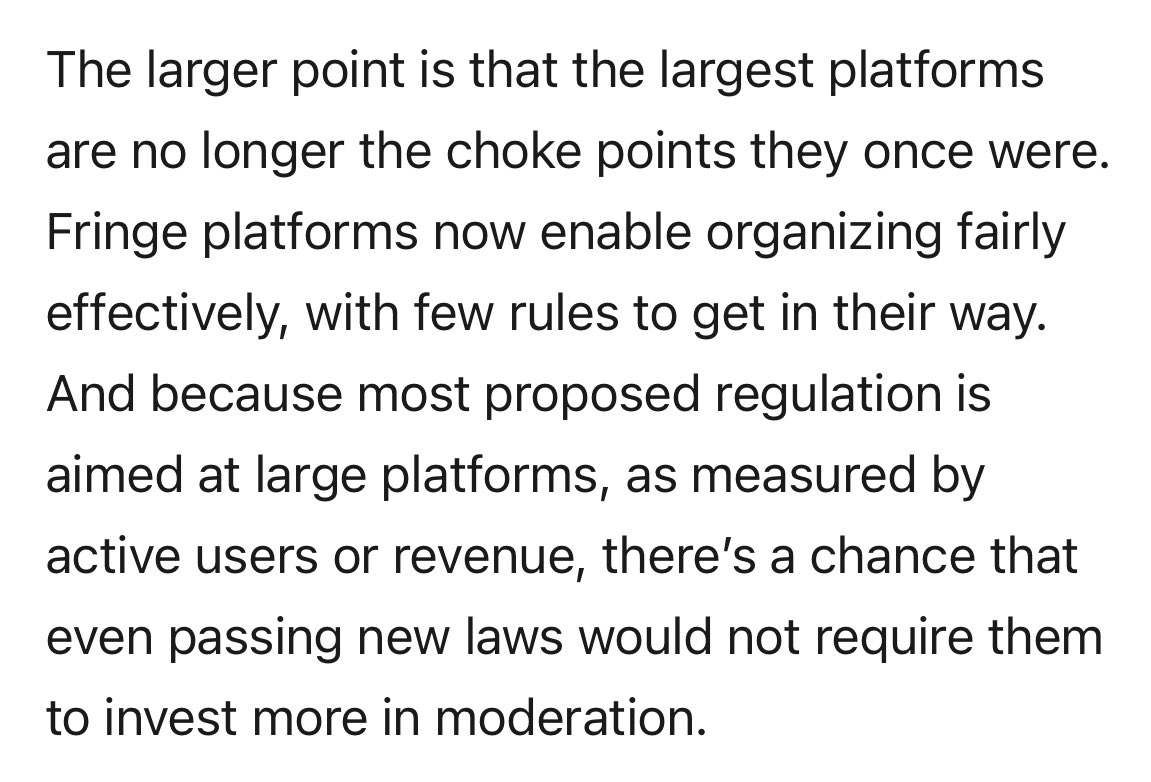
Feb 24, 2022"Every story about harmful content...to the same conclusion — this should have been removed before we found it — but rarely asks the logical follow-up...Say the biggest platforms did remove all that harmful content before we saw it. How different would our world really be then?" https://t.co/QgRCOHZe7z
Intuit, owner of TurboTax, is a nefarious company. Through regulatory capture and dark patterns, they've manage to siphon tens of billions of dollars and more than a billion hours from Americans. An infuriating track-record: If you're reading this from a country outside the US, there's a good chance paying your taxes aren't a nightmare. In the Netherlands, for example, it takes about 15 min to file. The fact that it's not this way in the US, is in large part thanks to TurboTax. Here's a list of some of the stuff they've done in recent years: 1. Blocked an initiative to make paying your taxes free. This PowerPoint from the company notes that "ReturnFree Tax System" was "stopped" thanks to lobbying efforts. 2. Manufactured a grassroots movement in support of their position by buying "ads for op-eds...in African American and Latino media" 3. Eventually partnered with the IRS to offer a free filing program, but purposefully stopped people from discovering it. They added code to the "Free File" webpage to suppress it from Google search results. Super cool, guys 4. If you did manage to find the "Free File" page, TurboTax tried to upsell you through product traps. Customers were routinely tricked into paying $200 for a "free" service. Findings from customer calls show Intuit was aware of this but DGAF 5. After spending years making sure people the fewest number of people possible got to file for free, TurboTax dropped out of the "Free File" program. Thanks to TurboTax only 2.4% used the program -- up to 70% were eligible. Great work guys. 6. TurboTax replaced it with this nonsense. Instead of "Free File" its "File FREE" but only if you file early. To recap, here's what TurboTax did: • Lobbied IRS to not make a free file system • Then became a seller of "free filing" services • Pretended to be free but aggressively upsold • Purposefully confused customers • Suppressed discovery of free services ... • Dropped out of free file program • Replaced it with $0 program that's only free if you file early (and, I am sure, pummels you with upsells) Does this matter? YES. Data from 2019 showed Americans spend 1.7 BILLION HOURS and $31 billion on taxes EVERY YEAR. We lose a cumulative 194,064 YEARS to taxes as a nation, every year (!!!!!) What could we do we that time? What could we do with that money? TurboTax just makes me mad. It is senseless and has a long record of unethical, uncaring behavior. If you're a startup trying to crush them — ethically and with an eye on righting the underlying issues — I would love to help however I can. Sources: https://t.co/qplVUIyQu4 https://t.co/4l1w23hWwz https://t.co/0h2dWn8QdE

Air pollution kills an estimated ten million people each year. But it does much more than that, too. A long thread on what it means that more than 90 percent of the world's population is breathing dangerously polluted air. (1/x) https://t.co/SvXxTviwl0 "Here is just a partial list of the things, short of death rates, we know are affected by air pollution. GDP, with a 10 per cent increase in pollution reducing output by almost a full percentage point, according to an OECD report last year." "Cognitive performance, with a study showing that cutting Chinese pollution to the standards required in the US would improve the average student’s ranking in verbal tests by 26 per cent and in maths by 13 per cent." "In Los Angeles, after $700 air purifiers were installed in schools, student performance improved almost as much as it would if class sizes were reduced by a third." "Heart disease is more common in polluted air, as are many types of cancer, and acute and chronic respiratory diseases like asthma, and strokes. The incidence of Alzheimer’s can triple." "(One study found early markers of Alzheimer’s in 40 per cent of autopsies conducted on those in high-pollution areas and in none of those outside them.) "Rates of other sorts of dementia increase too, as does Parkinson’s. Air pollution has also been linked to mental illness of all kinds, with a recent paper showing that even small increases in local pollution raise the need for treatment by a third, and to worse memory..." "...attention and vocabulary, as well as ADHD and autism spectrum disorders." "Pollution has been shown to damage the development of neurons in the brain, and proximity to a coal plant can deform a baby’s DNA in the womb. It even accelerates the degeneration of the eyesight." "A high pollution level in the year a baby is born has been shown to result in reduced earnings and labour force participation at the age of thirty." "The relationship of pollution to premature births and low birth weight is so strong that the introduction of t E-ZPass reduced both problems in areas close to toll plazas (by 10.8 per cent and 11.8 per cent respectively), by cutting down on the exhaust expelled by idling cars." "Extremely premature births, another study found, were 80 per cent more likely when mothers lived in areas of heavy traffic." "Women breathing exhaust fumes during pregnancy gave birth to children with higher rates of paediatric leukaemia, kidney cancer, eye tumours and malignancies in the ovaries and testes." "Infant death rates increased in line with pollution levels, as did heart malformations." "And those breathing dirtier air in childhood exhibited significantly higher rates of self-harm in adulthood, with an increase of just five micrograms of small particulates a day associated, in 1.4 million people in Denmark, with a 42 per cent rise in violence towards oneself." "Depression in teenagers quadruples; suicide becomes more common too." "Stock market returns are lower on days with higher air pollution, a study found this year. Surgical outcomes are worse. Crime goes up with increased particulate concentrations, especially violent crime." "When there’s more smog in the air, chess players make more mistakes, and bigger ones. Politicians speak more simplistically, and baseball umpires make more bad calls." "In 2019, a comprehensive global review by the Forum of International Respiratory Societies found that air pollution damages every organ, indeed virtually every cell, in the body. Nanoparticles of pollution have been found inside the brainstems of even the very young." "But you don’t have to wait until birth to see the effects of breathing particulate matter. The impact begins in the womb. In 2019, a small-scale study found particles of black carbon in every single placenta examined..." "...including those from mothers who lived in areas where the air was thought to be clean, with thousands of particles found in every cubic millimetre." "For those who worry about microplastics in the flesh of fish, this is a yet more invasive category of intrusion. Of course, there are also microplastics in the air, and being breathed. They’ve been found in placentas too." (x/x)
Nov 24, 2021Important piece, worth reading. However, Mearsheimer is realist about everything…other than US capabilities. Rather than fighting an unwinnable war, or surrendering to illiberalism, the right approach is to build an admirable society. Win by example. 🧵https://t.co/gqIXd2mB3G
2021-10-26Everything you have been told about stopping climate change is wrong. Buying a Tesla doesn’t matter. Not flying/eating vegan/turning off lights doesn’t matter. As a serial climate entrepreneur (raised over $200 million), I speak from experience. Only one thing matters. 👇🏻👇🏻 Let’s start at the beginning: what’s the problem? The problem is that it is free to pollute the atmosphere with CO2. Because it is free, lots of business models make sense. Examples: oil extraction, gas stations, global container shipping, international air travel, etc. Because lots of business models ONLY make sense when pollution is free, a very well-funded PR and lobbying machine sprang up to keep pollution free. At first, they tried to convince people that climate change was not manmade. They said it was a “natural climactic cycle”. Eventually this became untenable. So they settled on a more durable strategy: climate change is a matter of personal responsibility. If you think about it, this is absurd. Just because I didn’t personally spill oil in the Gulf of Mexico doesn’t mean it’s ok if BP does. Unfortunately, it worked. Green became cool, electric cars became cool. People had climate guilt and bought offsets. Urban liberals convinced themselves they were doing something about the biggest problem of our age. But they weren’t. Because pollution was still free. Let’s take your Tesla. You retire your gas guzzler and go electric: you reduce your personal emissions. But what happens systematically? That incremental gallon of gas is still sold. All you have done is slightly decrease demand. Congrats, you just made gas cheaper. There is only one solution to this problem. And as much as entrepreneurs hate to hear it, it is a political solution. There must be a high and predictably escalating price on carbon pollution globally. That’s it. Nothing less, nothing more. All fossil fuel business models rely on relatively long-term (20+ years) business plans. A predictably escalating price on carbon destroys these business models. It also creates a dramatic financial incentive to put carbon back in the ground. Some carbon emitting activities, like international flights and Kobe beef, can withstand a high price on carbon. There are low carbon, carbon neutral and carbon negative substitutes for nearly everything in our lives. What is missing is the economic incentive. @stripe has been a leader in paying to put carbon back in the ground. Corporate action is great, but not sufficient globally. My wish is that everyone who cares listens to @GretaThunberg and realizes there is only one thing that matters: put a price on pollution. Whatever money you would have spent on solar panels and electric cars, apply it where it matters: putting a price on pollution. Make it untenable for a politician (left or right) to run for office without solving this problem economically. On the left: we don’t need a “green new deal”. That doesn’t solve the problem. We need a clear economic incentive to not pollute. On the right: carbon pricing is a transparent incentive for business to do the right thing for the planet. Even Exxon supports it. Here are some folks you can follow if you care about pragmatic climate solutions: @claydumas @sacca @greentechmedia @GretaThunberg @ramez @PeterDiamandis @Tomprice @lowercarbon @chamath @JigarShahDC @elonmusk @andykarsner @BillGates To conclude the thread, I think many people underestimate how smart and evil the opponents of global action on climate change have been. They have effectively coopted the goodwill of smart people who care into irrelevant solutions. Let’s get smart on this and let’s solve it. Addenda 1 - I forgot to mention that the “personal responsibility” PR play was taken directly from the tobacco industry, which was extremely successful with it. https://t.co/W5Le4EN3L2 Addenda #2 - The full solution is two parts: 1. A high and predictably escalating price for carbon. 2. A commitment to pay to put an equivalent amount of carbon back in the ground as your nation has historically emitted. Lots of nuance, but that’s the North Star. Addenda #3 - It has been 15 years since An Inconvenient Truth came out, with sustained “personal responsibility” campaigns since. Impossible to argue with the failure of this empirically, as illustrated well here. Addenda #4 I will write a separate thread on why we should be talking much more about geo-engineering. We have already been unintentionally geo-engineering for 150 years. We now know how to be intentional about it to buy ourselves the 100 years we need to fix this.
Oct 11, 2021 Original deleted — preserved hereI reject paternalism of all sorts. Whether its stocks or content. Pretending you have all the answers and everyone else is dumb or gullible and need to be protected from themselves is condescending and elitist.
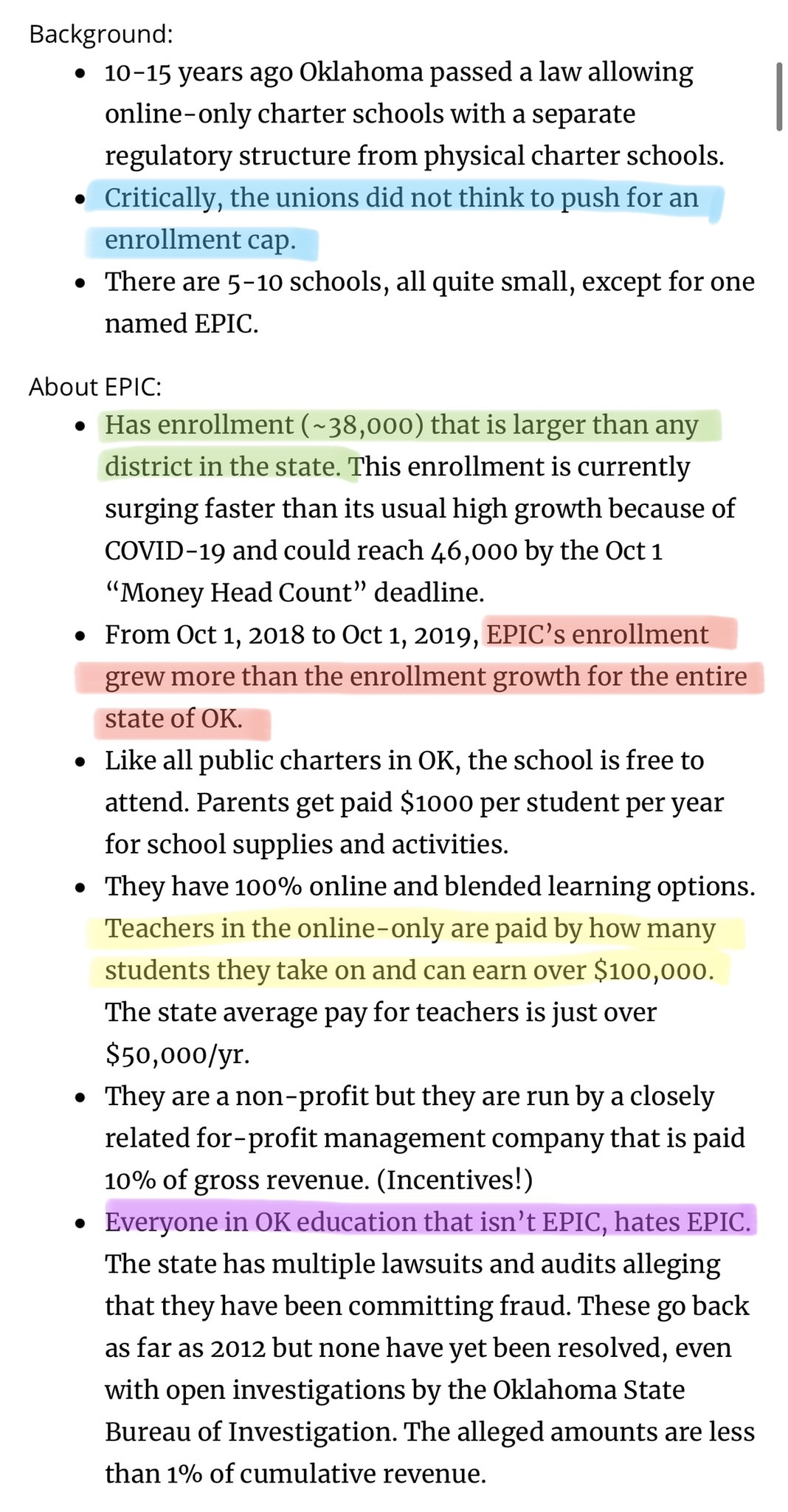
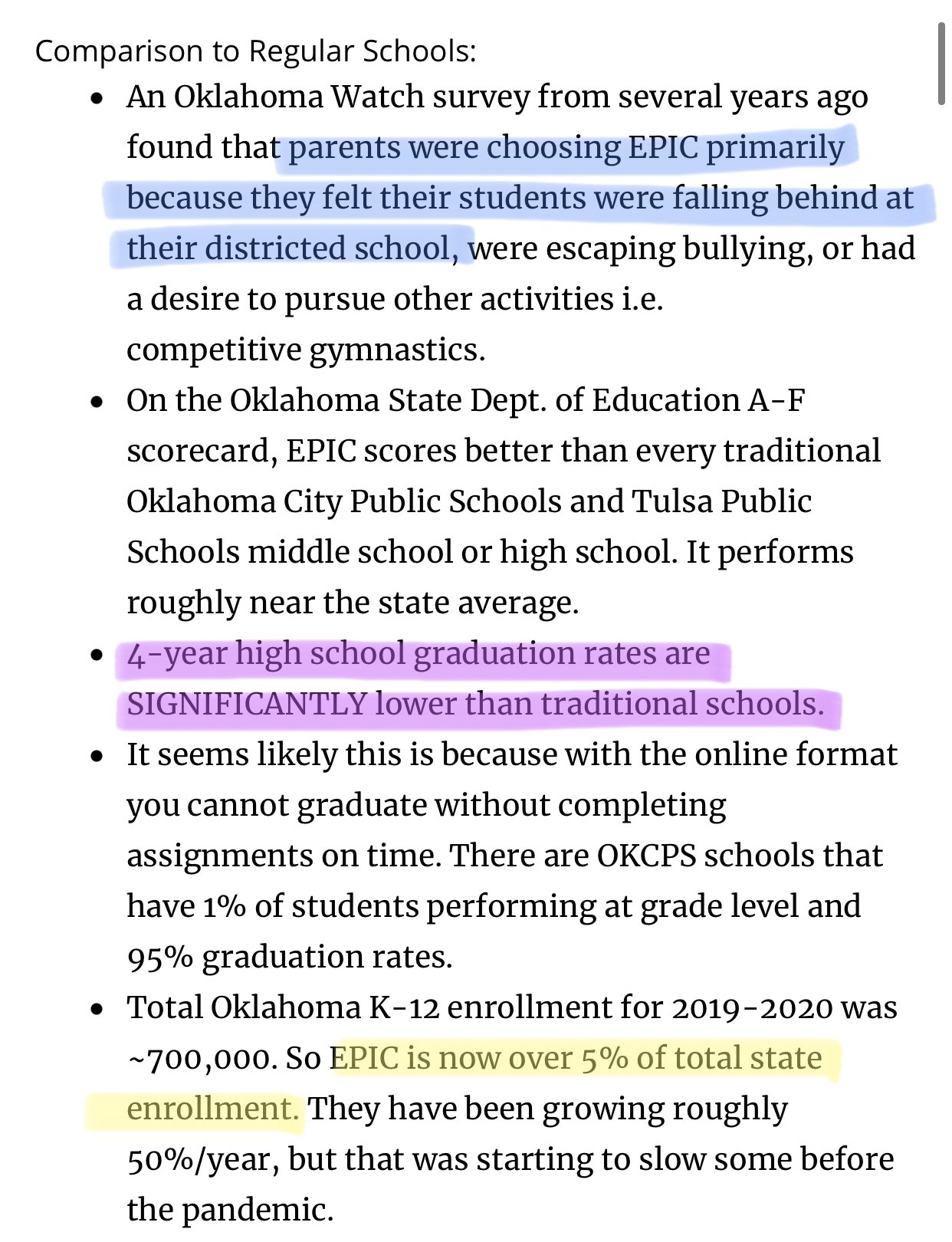
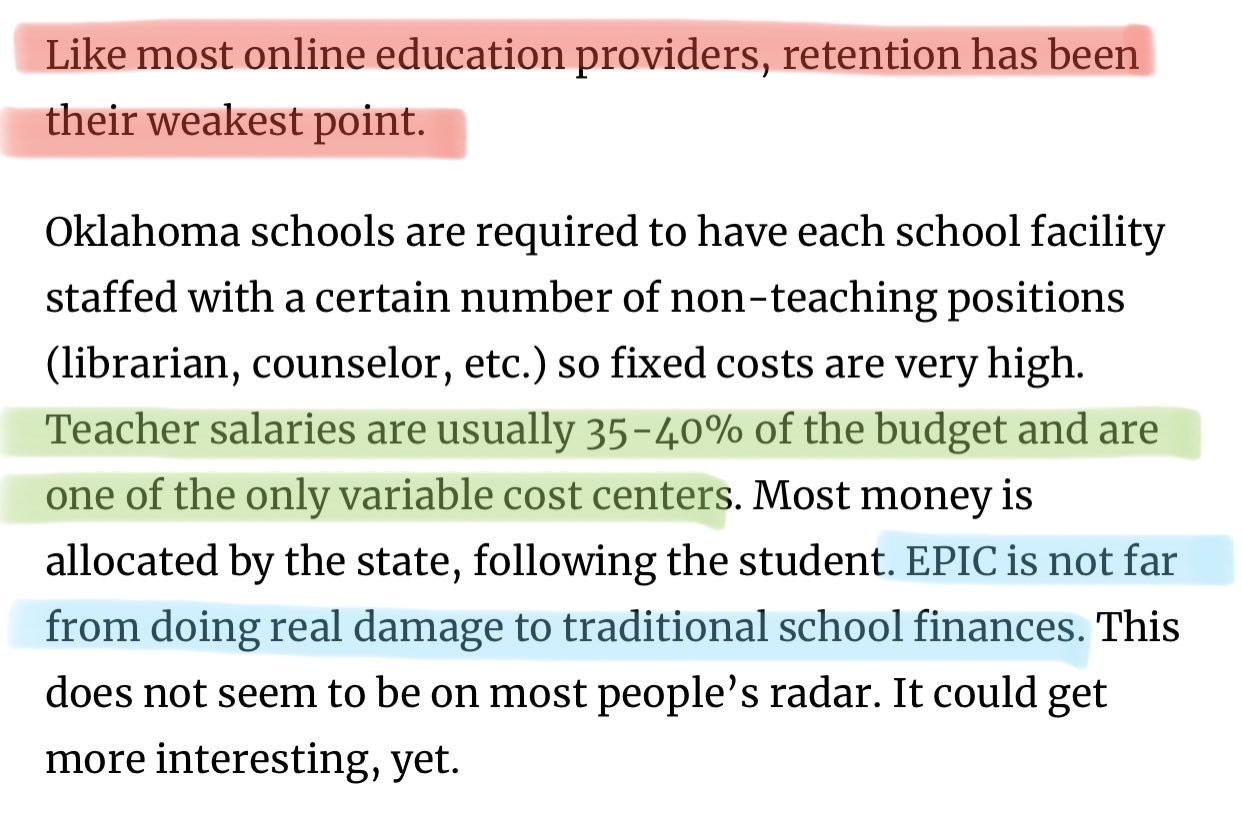
Jan 31, 2021There’s an online charter school in Oklahoma called Epic which has 38,000 students, and where teachers can earn more than $100,000 per year. This is a wild story. https://t.co/Bu5NHgi6at “EPIC is not far from doing real damage to traditional school finances.” — @tylercowen (h/t @delk) Here’s the original article. https://t.co/YicpBcJlNH
We just had our second daughter, and I wanted to dig into the problems facing the US child care industry and write about an investment I made in @WeeCareCo https://t.co/mv2u4Ic8cn For many families, child care is often their largest expense. They spend more on it than housing, tuition, and more than transportation, food, and healthcare combined. In our case, we've chosen to forgo a second income so my partner can stay home full-time (and we're not alone!) https://t.co/ZQ2keW1Ioy The cost of child care is even more pronounced for single-parent families - up to 70% of income in Massachusetts! https://t.co/tL5siqWN3N The high cost of child care is largely due to a lack of supply, and specifically a dramatic decline in the number of small, in-home daycares that are relied upon by low income families. https://t.co/FH6OQsYgRu America's child care problem has gotten so bad that up to 60% of neighborhoods are in Child Care Deserts, or areas with no affordable child care options. https://t.co/fjIFPmAU1k The COVID-19 pandemic made America's child care problems even worse. Only 12% of chains remained operating in March. As large 125-200 capacity child care centers re-opened, many parents (working from home) scrambled for safer, local options like in-home care with smaller classes. Most working parents (read: mom's) were instantly full-time teachers, caregivers, and often chefs and therapists. Its set the stage for many big changes to come. https://t.co/79kQkxjXxX WeeCare built a business in a box software solution verticalized for child care professionals to launch a day care in their home in less than a week. They launch new day care supply 86x more capital efficiently than incumbent competitors, and roughly 10x than the closest startup. They also just launched a B2B corporate benefits offering, which means any employer - whether a distributed corporate team, or Instacart’s 200k essential on-demand workers in thousands of cities - could provide child care for every employee over night. https://t.co/aAB4byl3pT If you or someone you know is looking for a new child care experience, check out WeeCare. It’s likely safer, and more convenient and affordable. The teams working on an incredible mission and I couldn’t imagine a more exciting company to be involved with. https://t.co/mv2u4ItJAX
Oct 28, 2020You’re tasked with making obesity as “uncool” as smoking is now in America. How do you do it? How much will it cost? My original language in this question was not awesome. I love this way of rephrasing the question: https://t.co/B7ryVX0fPM
Oct 22, 2020Cobra Effect 101 With the rise of government and central bank intervention in the economy and markets, the term "cobra effect" has experienced a revival. But what is a "cobra effect" and how does it work? Here's Cobra Effect 101! 👇👇👇 https://t.co/Gs1199yes5 1/ The term "cobra effect" is used to describe a situation where the solution to a given problem makes the problem worse. It is commonly used when talking about the unintended negative consequences of government policies. Well-intentioned solutions may make matters worse. 2/ The term originates from an ill-fated British policy implemented in India during its colonial rule. Concerned about the number of cobras in Delhi, they announced a policy that offered a reward for dead cobras. It started well - many dead cobras were turned in for the reward. https://t.co/OiIz4sPtXY 3/ But soon, certain enterprising Indians concocted a plan. They began breeding cobras, killing them, and turning them in for the bounty. Annoyed by the abuse of the policy, the British scrapped it. Stuck with a bunch of (now worthless) cobras, the breeders released them. 4/ So a policy intended to curb the population of cobras in Delhi ultimately led to an increase in the population. The Cobra Effect was born. The term is becoming quite prevalent in the modern era. Let's look at a few examples where we might be seeing it in action... 5/ Bailouts? When the government bails out a corporation, it presumably does so with good intentions (to save jobs, etc.). But the bailouts may have unintended consequences if other executives perceive themselves to be "playing with house money" with a government backstop. 6/ Executives are compensated on the basis of shareholder returns. Increased risk amplifies returns. Why not take on additional risk if Uncle Sam has your back? The seemingly well-intentioned government action may lead to more risk-taking and an increase in business collapses. 7/ Monetary & Fiscal Policy? Aggressive, stimulative monetary and fiscal policy is undertaken in an effort to stimulate a struggling economy. But the typical government actions - lowering interest rates, QE, and direct stimulus - may have painful unintended consequences. 8/ Low risk-free rates and the "Fed put" may lead to rampant speculative bubbles and painful bursts. The Cantillon Effect may appear, as the flow path of new money through the economy disproportionately benefits the wealthy, furthering inequality. https://t.co/1BUSPvjZJw 9/ @axios's @DionRabouin reported that some Fed officials are now pushing for "'tougher financial regulation' as concerns grow that monetary policy is 'encouraging behavior detrimental to economic recovery and creating pressure for additional bailouts.'" https://t.co/K8aPMUfnJe 10/ So there are several ongoing policy actions that may have cobra effects. As an informed citizen, it is worth being educated on the subject and keeping an eye on the space. I'd love for you to join the conversation! What examples of potential cobra effects do you see today? 11/ That was Cobra Effect 101! I hope you found it useful. Special thanks to my friend @kencotto for the suggestion to cover this great topic. And for more educational threads on business, money, finance, and economics, check out my meta-thread below. https://t.co/Jyqunbg8uM

MENTAL MODEL - The Cobra Effect An attempted solution to a problem can make the problem worse. 1. Bounties were offered for killing poisonous snakes in Delhi. 2. People responded by breeding Cobras in order to get the bounties. 🐍 Incentives have 2nd + 3rd order effects.
Oct 17, 2020Are all white people bad? No. Are all black people good? No. Knowing this reality- I stand on my decision to unite with good people, no matter the race, creed or ideology. Given the number of threats against this decision- I also decide to die on this hill.
Jul 4, 2020*inhales* 🚀 Okay! Here is a THREAD on accountability on education. https://t.co/kJ1IPvCto9 In a very real sense, we’re already drowning in “accountability” — the past 20 years of education reform have been about defining tightly-specified standards and introducing new carrots + sticks for states, districts, & schools. As Daniel Koretz notes in his book Measuring Up: “while we have far more data than we had twenty or thirty years ago, we have fewer sources of data that we can trust.” With all the carrots and sticks came shortcuts, “inappropriate” test prep, and rampant cheating. But did we see gains on our standardized measures? Some states did. On their own state tests, at least. But these were generally not reflected on national measures, and analysts tend to reach the following conclusion, presented in interpretive emoji: 😬🤨😕🙁☹️😑 Koretz’ book was published in 2008, so about a decade of data is absent. But he does a superb job of summing up the results of reforms up to that point: basically, reading scores remained essentially stagnant. Early math scores jumped, but gains largely disappeared by high school The NAEP (our major national measure) showed no significant change in reading scores 1973-2004. Math scores for young kids showed impressive improvements, but they slowed by middle school, and by age 17 the improvement was too small to be statistically significant. SAT verbal scores declined significantly 1972-1980 and had showed no real signs of recovery by the time Koretz published. SAT math scores appeared to slowly but steadily improve through 2005. What about the last decade? On the NAEP, young kids appear to be improving... and those gains seem to be just about completely lost by high school graduation. Before the SAT’s major revision in 2016, reading scores had plummeted to an all-time low & math scores were backsliding. https://t.co/C35kjH5xYO On the PISA, the main standardized OECD global measure, American kids sometimes do a little better, sometimes do a little worse, but have remained consistently “meh” relative to everybody else. https://t.co/u59S1R48cn Meanwhile, as education researcher & documentarian Vicki Abeles writes in her book, Beyond Measure: kids now spend more time studying & less time outdoors. From the early 1980s to 2003, mean homework load grew by 50%. 40% of districts nationwide cut time for non-tested subjects. Former Stanford Dean of Admissions Julie Lythcott-Haims writes that 11% of American kids are now diagnosed with ADHD, a diagnosis that entitles them to testing accommodations. A little over half of those are on medication. 1 in 8 teens admits to having abused Adderall or Ritalin. And a *ton* of researchers and writers are noting strong and disturbing trends in children’s sleep quality, rates of severe mental illness, and suicide rates. We can’t pin these definitively on schools or testing culture, but we *can* say that The Kids Are Not Alright. Arne Duncan, Obama’s Secretary of Education — who oversaw a flurry of dismally-performing reforms — wrote an entire book defending the test culture he helped create, then pinned the blame on teachers trained on “educational theory” rather than “crucial skills” training. Hmm. (Forgive me a tangent: one of Duncan’s recs is that all 4-year-olds be put in preschool, bc vast numbers of 5-year-olds are “1-2 years behind” & often “these children never catch up.” The data do not support this, and the very idea of academically remedial 4-year-olds is insane.) Are the teachers to blame? In their book Most Likely to Succeed, Tony Wagner & Ted Dintersmith quote a Gallup director: “teachers are dead last among all professions… in saying their ‘opinions count’ at work and their ‘supervisors create an open and trusting environment.’” Are teachers poorly educated — “an industry of mediocrity” — as Duncan suggests? Frankly, I have a hard time arguing with that; everyone else seems to be. But this theme repeats itself across my readings: teachers feel disempowered re: curricula & pressured to produce test-takers. Duncan, for his part, shifts the focus to teacher pay. But as it turns out, *teachers are willing to take a large pay cut* to get out of public schools. https://t.co/8G4p49A1AM (It is time for a kitten break) https://t.co/aVipmCmopl TLDR; policy-makers blame teachers & funding, teachers blame top-down policy & are willing to slash their incomes to work in private schools, the US is second only to Luxembourg in $/student spent, and the kids are sick, tired, & overmedicated. And they still suck at tests. And... all of this is probably sort of moot. As Dintersmith & Wagner explain, “in today’s world, if you can’t invent (and reinvent) your own job and distinctive competencies, you risk chronic underemployment.” The test prep generation is wholly unprepared for this. College isn’t fixing it. Dintersmith & Wagner, on a recent Gallup poll: “96 percent of provosts — the senior academic officer for a college — believe their institution is effective at preparing students for careers, while just 11 percent of business leaders agree.” Annmarie Neal, former chief talent officer at Cisco: “[Students] are achievement driven, rule-oriented, compliant, linear, singular in focus. [The workforce requires leaders] to be relationship or collaboration driven, rule-defining, creative & innovative, lateral & polymathic." Similar arguments are made by Abeles and Lythcott-Haims, and these are broadly reflected in the bulk of recent popular literature by education researchers and business leaders when they talk about employment for the next generation. Creativity and cognitive flexibility are king. I'm going to approach this from another angle and describe what I want for *my* kids... I know an amazing couple in LA. They have extremely successful careers in the music industry: one plays in a popular rock band, the other is a highly accomplished violinist. They’ve helped write & consulted on a number of hits, scored films, worked with headliners across genres. One of them had a terrible time in school. Frequently flunked out of classes, wrote angsty teen notes about how loathsome the whole thing was. Focused on playing in the band they formed as a teenager, which eventually took off & generated several Billboard Hot 100 hits. The other excelled academically, but also followed a passion for music. Played & taught children to earn a living, rented a near-uninhabitable flat in a *barn* to save money, used the savings to buy property young. Became a Grammy-nominated, world-class performer. When I met them, they were trying for children. I said I was really looking forward to being a mom one day. At one point, one of them suggested I get some fertility testing done, just to be safe. I took that advice, and… the results weren’t good. At all. I’d only met them the one time, but I let them know that things hadn’t turned out the way I’d hoped. These people — **who had met me ONCE** — offered to host me in their home and help me through the process if I decided to pursue fertility preservation options. So I did. I stayed in their guest bedroom, reeling hormonally. The protocol required 2-4 self-administered injections per day, and I was terrified of needles. So they gave me my shots — all of them. They brought me along to jam sessions & dinners so I wouldn’t miss my timed doses They’ve started two separate entrepreneurial endeavors in entertainment tech and biotech, both of which are early-stage but garnering considerable interest in their niches. And they have two little girls now, who they absolutely dote on. ❤️ They have help, but they’ve still restructured their careers and projects around being present parents. They love them *so much.* They want to respect and foster whatever interests and talents they might manifest. They’re thrilled with their burgeoning personalities & differences A few weeks ago, I visited them to get some much needed baby-time. As I was heading out, I mentioned that I was feeling less stressed about finding a way to have a family. I just have a sense that it’s going to work out, if I keep following this crazy thing I love. And she said: “If you ever find yourself in a situation where you need somewhere to stay — and you have your baby, and you need a place for both of you — we’ll always have a place for you here. For however long. I just want you to know that.” (I totally teared up writing this. What did I do to have people like this in my life?) I throw this onto a thread about accountability in education because I think we have profoundly fucked up in the way we think about this. The goal should be to create people like these. Smart, curious, passionate, loving, generous, how-can-I-possibly-deserve-you human beings Is that what we’re doing? Does anyone think that’s what we’re doing? How do we do that? *Can* we do that? I mean, I don’t know, but I just can’t imagine any time spent trying to answer those questions is wasted time Right? /end
Apr 30, 2019