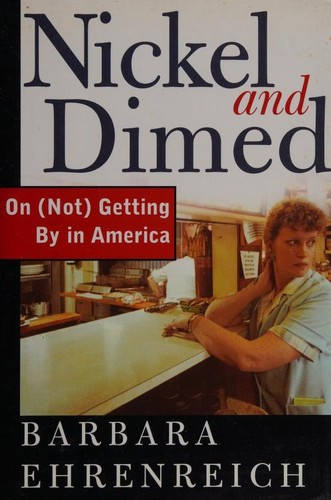
Nickel & Dimed
Key Takeaways
Kyle, in 2017 in Books: When I was in Mrs. Beverly’s 11th grade english class, I narrowed my summer reading down to one of two choices: Freakonomics, or Nickel and Dimed. I chose the former and have been all the freakier for it. Nickel and Dimed was a book that I always imagined I would like but never got around to reading. Thanks be to airport bookstores that rekindle long-lost book romances that never were.
As I read this book, I couldn’t help but wonder what an updated version would look like. I thought about a man I knew in New Mexico who was moderately successful professionally. He was someone who, unless he told you, you’d have never guessed he had been homeless for a big chunk of his life. I always wanted him to write a book about how to help homeless people from someone who had really lived it. Nickel and Dimed serves a similar insight for low-income living, but there isn’t necessarily a solution. Ehrenreich shined a light on the problem. My feeling walking away was; ‘what are some solutions to help people?’
Connections
- Utopia For Realists — Ehrenreich’s ground-level reporting on low-wage work is the lived texture under Bregman’s macro claim that poverty is “a lack of cash,” not a lack of character.
- Evicted: Poverty and Profit in the American City — Matthew Desmond’s ethnography of Milwaukee evictions is the urban-housing parallel: both books use immersive journalism to make low-income American life legible to readers who don’t live it.
- Poverty · Unions — the structural forces the book chronicles: how minimum-wage work keeps workers below subsistence, and how collective action (or its absence) shapes conditions.
Highlights
- “In real life I am moderately brave, but plenty of brave people shed their courage in POW camps, and maybe something similar goes on in the infinitely more congenial milieu of the low-wage American workplace.”
- In reference to her job as a maid: “Do the owners have any idea of the misery that goes into rendering their homes motel-perfect? Would they be bothered if they did know, or would they take a sadistic pride in what they have purchased — boasting to dinner guests, for example, that their floors are cleaned only with the purest of fresh human tears?”
- In reference to owners of the houses they cleaned, and the specific things they wanted the cleaners to be certain to pay attention to: “‘Hot buttons’ are baseboards, windowsills, and ceiling fans — never, of course, poverty, racism, or global warming.”
- “What is this assumption that the hungry are free all day to drive around visiting ‘community action centers’ and charitable agencies?”
- “The poor have disappeared from the culture at large, from its political rhetoric and intellectual endeavors as well as from its daily entertainment. Even religion seems to have little to say about the plight of the poor.”
- __Side note: __I thought this was interesting, and in a lot of instances, it’s true that churches have gone quieter on Christ’s admonition to administer to the poor. But on pg. 132 Ehrenreich points out, “always find a church” because of the community and support it can offer.
- “Yes, I know that any day now I’m going to return to the variety and drama of my real, Barbara Ehrenreich life. But this fact sustains me only in the way that, way, the prospect of heaven cheers a terminally ill person; it’s nice to know, but it isn’t much help from moment to moment.”
- “Something is wrong, very wrong, when a single person in good health, a person who in addition possesses a working car, can barely support herself by the sweat of her brow. You don’t need a degree in economics to see that wages are too low and rents are too high.”
- “If we want to reduce poverty, we have to stop doing the things that make people poor and keep them that way.”