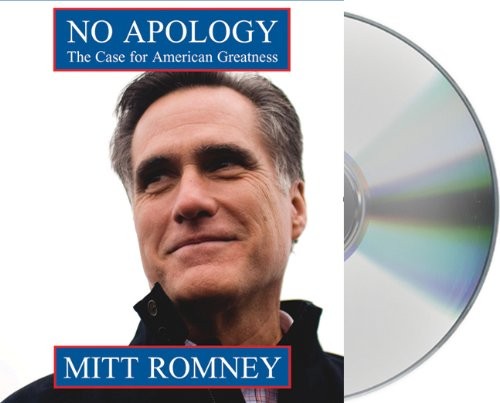
No Apology
Key Takeaways
Kyle, in 2018 in Books: The 2012 presidential election was one of the first I was able to vote in. During 2012, I was serving as an LDS missionary in Pennsylvania. If you’re not aware, LDS missionaries cut themselves off from the rest of the world as much as possible. I was able to vote via an absentee ballot, and I tried to educate myself as much as I could when you don’t watch TV, listen to the radio, or use the internet for more than weekly emails to family. I voted for Mitt Romney. I know a lot more now than I did then. I would still vote for Mitt Romney. I desperately wish I still lived in Utah this year so that I could have volunteered for Mitt Romney’s campaign for Senate.
Mick Moylan, a friend of mine, who is originally from Ireland, and is studying finance at BYU, also had the chance to intern at Solamere, and grew close to some of the folks helping run Mitt Romney’s campaign. He was offered a role with the campaign, and would need to withdraw from his classes for a semester to participate. When he and I talked about it, he asked what I thought, and with every measure of level-headedness, I made it very clear: “No matter what you do, I’ll respect your decision. But if you turn down this opportunity, it will be the stupidest thing I’ve ever heard of.” I think I have a future in diplomacy.
There was a wide range of reasons for me to believe Mick was facing the opportunity of lifetime, but a big one in my mind was the opportunity to work with a giant like Mitt Romney. He’s a man who I respect greatly, and anyone who can benefit from interactions with him is truly privileged. Many thanks to the personal library of Matt Waldrip, and Pioneer Book in Provo, Utah for exposing me to this book.
Referring to his father — “Mitt,” he would reply, “the pursuit of the difficult makes men strong.” Referring to a teacher he had — “He tore our papers apart paragraph by paragraph and line by line with critiques that sharpened our skills without crushing our confidence. He insisted that my classmates and I push our thinking and our writing beyond the superficial. I don’t remember what grades he gave me, but I do remember what he taught me.” “At the core of our system of government is an informed, involved, and responsible citizenry. The real peril to the nation if its citizenry fails to meet its duties was recognized by the Founders.”
Light-engagement read; no notes to synthesize. The highlights below stand on their own as the source’s argument.
Connections
People: Mitt Romney — author; the policy worldview here (turnaround logic applied to the nation, education reform as governor, energy security) is his own.
Concepts:
- Foreign Policy — Romney’s framing of three rival global strategies (Western free-enterprise democracy, China’s authoritarian free-enterprise, Russia’s energy-based authoritarianism) and his case that appeasement alienates allies.
- Soft Power — argued as “real power” that affects world events, alongside the claim that diplomacy measured by documents rather than changed behavior creates false security.
- Education — the book’s most data-driven thread: teacher quality (not class size or spending) as the dominant driver of student achievement, charter-school and KIPP findings, and the “epic failure” indictment of American schooling.
- Innovation — the recurring engine of national competitiveness: out-innovate rather than protect, allow the creative destruction of a free economy, and protect intellectual property against theft.
- Entrepreneurship — capital scarcity kills good ideas in the mind; the growth agenda favors low taxes and investment in research over subsidizing failure.
- Group Think — Romney’s diagnosis of media and institutional elites echoing each other rather than doing in-depth, data-grounded reporting.
- Data in Investing — his “anecdotes are illustrative but data is compelling” stance on education policy mirrors a broader bias toward evidence over prejudice.
- Democracy — Tytler’s warning that democracies vote themselves largesse and collapse over loose fiscal policy; the Founders’ premise of an informed, responsible citizenry.
Books:
- Turnaround, Romney — A Reckoning — Romney corpus; Turnaround on the operational-fix mindset he extends to national policy here, A Reckoning on the later arc of his political career.
- The Death of Expertise — democratic-discourse parallel to the group-think and intellectual-laziness critique of opinion leaders.
Highlights
- “Mitt,” he would reply, “the pursuit of the difficult makes men strong.”
- Just like individuals, companies, and human enterprises of every kind, nations that are undaunted by the challenges they face become stronger. Those that shrink from difficult tasks become weaker.
- America is unique in the history of the world for its willingness to sacrifice so many lives of its precious sons and daughters for liberty, not solely for itself but also for its friends.”
- Ours is a strategy based on two fundamental principles: economic freedom and political freedom.
- A second strategy is pursued by China. As with the West, theirs is based on free enterprise. Unlike the West, it is also based on authoritarian rule.
- Russia is pursuing a third global strategy. Like China, it favors authoritarian rule, but Russia’s economic strategy is primarily based on energy. By controlling people and energy, Russia aims to reassert itself as a global superpower.
- It is violent jihadism: the fanatical, terrorist, and always threatening branch of extreme fundamentalist Islam.
- Broadly construed, the new order had three pillars: active involvement and participation in world affairs; active promotion of American and Western values including democracy, free enterprise, and human rights; and a collective security umbrella for America and her allies.
- By seeking to appease its enemies, the United States will only alienate its allies, and eventually America will have no friends at all.
- To again invoke the words of Margaret Thatcher: Democracies … have never been engaged against each other in warfare in any major way. To reduce the risk of war, therefore, we must work for steady progress towards more democracies. With the advancing tide of democracy, the risk of war recedes. If the tide of democracy recedes, the risk of war advances.
- No nation has shed more blood for more noble causes than the United States. Its beneficence and benevolence are unmatched by any nation on earth, and by any nation in history.
- “There is nothing as vulnerable as entrenched success.” I believe that our many years of success may, in fact, be the greatest obstacle we face.
- And just as the Ottomans had done, the Spanish and Portuguese shut their borders—and their minds—to innovation, technology, and learning.
- The only successful way to overcome foreign advantage, however, is to create an advantage of one’s own—to innovate. And if you conclude that your competitor’s advantage is permanent and insurmountable, the best course is to choose new paths and new products. Over the centuries, the siren songs of protectionism and isolationism have taken down some very impressive empires.
- In the same way that inherited wealth can lead descendants to profligate spending and economic ruin, easy money weakened these nations’ willingness to work and invest.
- late-eighteenth-century Scottish-born English lawyer and writer named Alexander Fraser Tytler. “A democracy cannot exist as a permanent form of government,” Tytler is said to have written. “It can only exist until the voters discover that they can vote themselves largesse from the public treasury. From that moment on, the majority only votes for candidates promising the most benefits from the public treasury, with the result that a democracy always collapses over loose fiscal policy, always followed by dictatorship.”
- If citizens in a democracy foster short-term self-interest rather than promoting the long-term interests of the nation—placing themselves above their descendants—there is little likelihood that they will vote for visionary, transformative leaders who advocate difficult change and sacrifice. When popular opinion places self above nation and the present above the future, nations slide from power to weakness. The self-interest of the common citizen can be just as hazardous to national strength as that of the rich and powerful.
- In some cases, of course, bias about the topic colors the coverage. But equally responsible, I believe, is group think. It’s hard to think independently once you have heard the opinion of the institutional elite.
- Perhaps there are also cases of intellectual laziness. If academics, writers, and opinion leaders have never visited China or worked in the private sector, for example, how can they knowledgably assess the implications of China’s developing industrial strategy? Examination and analysis that go beyond Google, Wikipedia, or a few selective interviews can be difficult and time-consuming, and not everyone is willing to go to the expense and to make the effort that in-depth reporting requires, particularly as media budgets are being slashed. Media outlets have been closing foreign bureaus: Many major newspapers and outlets no longer have Kabul or Baghdad bureaus.
- In most instances, the consensus is spurred by either crisis or national leaders, but there are occasions when citizen leaders, media voices, educators, or opinion leaders have moved a nation, sometimes in spite of its political leaders.
- Our citizens often prefer the politicians who promise them the most and who paper over the needs of future generations.
- Yet their protests may well simply follow the counsel of Deng Xiaoping, the visionary leader of China’s military modernization: “Observe calmly; secure our position; cope with affairs calmly; hide our capacities and bide our time; be good maintaining a low profile; and never claim leadership.”
- When diplomatic success is measured by the agreements and documents we have produced rather than by behavior that has actually changed, we create a false sense of security that prevents us from recognizing and dealing with real threats.
- There should be no misunderstanding of the fact that soft power is real power; that it can and does affect world events.
- For innovation to make a difference, it takes more than a good idea. It takes a good idea that is actually adopted and implemented.
- It is certain that valuable ideas arise in the minds of people all over the world, but that many of them simply lie fallow because conditions for their implementation aren’t favorable.
- It takes a leap of faith for governments to stand aside and allow the creative destruction inherent in a free economy, but it’s a leap that has been successfully made by every advanced economy in the world.
- There is no intrinsic reason why unionization must reduce productivity, of course. Some unions go to great lengths, in fact, to provide their members with training and skills that make them more efficient and productive. Forward-thinking unions look for ways to help their employer become more competitive.
- Trade is good for the nation and for the average citizen, but it is decidedly not good for everybody.
- For some, when they found new jobs, they received better or at least equal opportunity and pay. For many, that was not the case. When the new position was an upgrade, people tended to overcome the unemployment experience. But when people could not find at least equal opportunity in a new position, and do so relatively rapidly, there often were sustained and meaningful personal costs. Marriages faltered, faith dwindled, illnesses appeared, countenances changed. Ever since these experiences, unemployment is not merely a statistic to me.
- Protectionism stifles productivity.
- There is nothing so sought after by companies and unions as protection from competition, and yet there are few things so beneficial for an economy and its citizens as competition.
- Fortunately for all of us, innovation and entrepreneurism are deeply embedded in the American DNA. But more often than not, it also takes capital for an idea to be implemented. Where capital is scarce, hard to find, or not available to entrepreneurs and innovators, good ideas simply die in the mind.
- Subsidizing failure doesn’t stop the failure—it merely prolongs the final act.
- When government heavily taxes investment, innovation, and entrepreneurship, we get less of those things—and fewer new high-paying jobs.
- Profits ahead of people? No, profits for people.
- Michael Porter is convinced that, far from being a drag on the economy, “National advantage is enhanced by stringent standards that are rapidly, efficiently, and consistently applied.” I wish more Republicans and Democrats alike understood that important truth.
- Ultimately, the recovery depends on the very same things that strengthen our long-term economy: investing in productivity, stimulating investment and innovation, exercising fiscal discipline, and securing our energy needs. There are no quick fixes, only enduring values.
- Education pays—particularly in a world where two billion uneducated, unskilled workers have joined the workplace.
- For the past three decades, we have imported far more goods than we have exported. Prior to that time, the United States was the world’s largest exporter; today China is. Much of what America produces is intellectual property, and a good deal of it is simply stolen by companies in other nations. In a service and technology driven economy like ours, we must ensure that ideas, discoveries, inventions, patents, designs, and trade secrets are protected, and that their use is properly compensated when they are incorporated by others; so far, this is something we have failed to do.
- A growth agenda favors low taxes, dynamic regulation, educational achievement, investment in research, robust competition, free trade, energy security, and purposeful immigration. And it seeks to eliminate government waste, excessive litigation, unsustainable entitlement liabilities, runaway health-care costs, and dependence on foreign oil. This, in a nutshell, ought to be the economic agenda for America.
- If the federal government published a balance sheet—just as it requires public companies to do—it would be forced to show its entitlement liability. And if it amortized that liability, it would also appear in the annual budget. We would see it, we would talk about it, and we would be more likely to do something about it. But the politicians keep it well hidden instead.
- Politicians love to talk about transparency and accountability, but when they do, they are rarely referring to themselves. The time has come for that to change.
- If the government is willing to give away money, there will always be a long line to get it.
- The best way to see which of these or other ideas is most beneficial is to allow states to experiment, evaluate the results, and share them with the other states. Using the states as the laboratories the Constitution intended under our federal system is exactly what led us to meaningful and effective welfare reform in the 1990s. Such experimentation can lead us to the right result again. But Congress and the president must advocate for such a move and pass and implement it before such reforms can begin.
- that’s one of the curious characteristics of financial incentives: Sometimes you aren’t even aware that they are bending you toward a particular kind of behavior.
- If health care is free to the patient and profitable for the provider, the only result can be runaway spending.
- I’ve learned that when politicians say they want to help people, there is often cause for a good deal of skepticism. People are used to promises made and promises forgotten.
- Wherever a private sector alternative is unavailable, such as with the national defense, police, and the courts, the need to monitor and manage costs is critical because of government’s natural tendency toward inefficiency, low productivity, and excessive cost.
- When General Motors collapsed, we saw all too clearly what happens when government runs something. Massachusetts Congressman Barney Frank, chairman of the House Financial Services Committee, called on the company to change its plans to close a distribution facility in his home district—and GM relented. It’s not that Congressman Frank wasn’t doing his job; in fact, he was doing exactly what the voters expect him to do. But that’s precisely why government, which must respond to voters, is a poor manager of businesses, which must respond to consumers and the marketplace.
- Such a massively larger government would strike at the very premise of the American experiment. It would demand that we accept the belief that free people, pursuing happiness as they see fit, are less able to build and guide the national economy than politicians and bureaucrats.
- Experience proves again and again that incentives are more effective than controls.
- In my life, education had evolved from being about me to being about my children and ultimately to being about bettering the lives of hundreds of thousands of children.
- “There is little doubt from our research that education and training are decisive in national competitive advantage [emphasis added],” writes Michael Porter in his book The Competitive Advantage of Nations.
- In a “flat world,” as New York Times columnist Thomas Friedman observes in his books, the product of labor moves easily across national borders. If the American workforce receives inferior education and skills, it will necessarily be confined to inferior tasks that pay inferior wages, producing, in turn, an inferior GDP. Education matters, not just for the few, but for the many.
- States and municipalities should launch emergency efforts to keep kids in school at least until they receive their diploma. These could include programs to better match a student’s interests with his or her curriculum, bonus compensation for teachers who are successful in keeping their students in school, and drawing on community heroes and mentors to counsel young people.
- There is no greater indictment of American government than the sorry state of American education. It is an epic failure.
- Progressives de-emphasized the subjects that had previously been considered essential. Rather than teach the history of Western and American civilization, for example, they presented all the world’s cultures to our children and insisted that none was superior to the others. Presidents, generals, founding patriots, and “heroes proved in liberating strife” were less important than the champions of social causes. If our children do not learn about and come to cherish America’s heritage, history, culture, and founding principles, how can they be expected to defend the freedoms on which their country is based? How can young citizens become adult citizens equipped to critically examine contemporary political ideas in the light of history, or become informed about matters of public policy, or even simply understand the value of voting? Even in 2008, a year in which record numbers of young people were engaged in the presidential election, still only 52 percent of eligible voters under thirty bothered to vote. The abysmal voting patterns of young Americans are ample evidence that our education system has not equipped our children with the requisites of citizenship that sustain a democratic republic.
- I studied the education literature to gain perspective. What I found was a virtual quicksand of differing opinion in which it would be easy to sink, but what was missing was an examination of data. Instead, most writers sought to convince their readers by appealing to their inherent prejudices and by recounting anecdotes that supported their particular policy preferences. But as R. Glenn Hubbard of Columbia Business School has observed, real data is the collection and processing of anecdotes into reliable information. Anecdotes are illustrative but data is compelling—particularly if it is comprehensive and presented by an unbiased source. Far too often, I found that neither of these conditions prevailed when it came to discussions of education policy.
- At the outset of my term as governor, my perspectives were shaped by the writings and studies by education experts, by discussions with teachers, principals, parents, and students, and by my study of statewide data on student achievement that was mined, collected, and carefully analyzed. What I learned was in large measure confirmed by data collected at the national and international levels, but even so, I did my best not to close the door entirely on alternative views.
- McKinsey & Company analyzed a total of 112 studies evaluating the effect of class size on student achievement, fully 103 of which found no relationship whatsoever or a negative one. Only nine studies found a positive relationship, and in none of these was the positive relationship statistically significant.
- Simply putting more money into the system we already have has not and will not give our kids a better education. Neither reduced class size nor increased spending will repair our broken education system. There are much better answers.
- “If a child’s parents come to school on the first day of school or reliably come to parent-teacher meetings, we know that that child will do just fine.”
- It is very difficult for a poor, undereducated single mother to devote sufficient attention to her child’s education. Study after study demonstrates that these children are far more likely to perform poorly at school, drop out of school, end up on welfare, use drugs, and commit crimes that send them to prison.
- He tore our papers apart paragraph by paragraph and line by line with critiques that sharpened our skills without crushing our confidence. He insisted that my classmates and I push our thinking and our writing beyond the superficial. I don’t remember what grades he gave me, but I do remember what he taught me.
- Classroom size, school-building quality, community income levels, access to computers, and the ethnicity of the students—all these factors paled in comparison with the individual capabilities of the teacher.
- “The available evidence suggests that the main driver of the variation in student learning at school is the quality of the teachers,” it concluded. “[E]ven in good systems, students [who] do not progress quickly during their first years at school, because they are not exposed to teachers of sufficient caliber, stand very little chance of recovering the lost years.”
- The best education systems, the study determined, did at least three things to guarantee quality teachers: they hired only the best and brightest; they worked to develop and improve their teachers’ skills; and they monitored the performance of each child, teacher, and school, intervening when needed to ensure the best possible education for every student.
- Another key finding from the McKinsey study was this: “A teacher’s level of literacy, as measured by vocabulary and other standardized tests, affects student achievement more than any other measurable teacher attribute.”
- The education writer for The Washington Post, Jay Matthews, recently authored Work Hard, Be Nice, which explains the success of KIPP—“Knowledge Is Power Program”—in charter schools. It is clear that talented, motivated, high-achieving teachers are at the core of KIPP’s success, and at the core of the success of schools that consistently outperform national averages.
- open alternative pathways into teaching, particularly for individuals who have excelled in other fields. The experience of the best-performing education systems is that nontraditional teachers tend to be of high caliber.
- Better teachers deserve better pay, and they should have access to a teaching-career track that provides higher status and greater rewards, such as in programs that create “mentor” or “master” teachers who supervise and support other teachers.
- Reliable studies like the one recently conducted by the Rand Corporation indicate that, on average, charter-school students do not outperform their regular public-school counterparts in math and English scores, even when adjusted for income and background disparities. But even if the results of that study are replicated in other places by other researchers, it’s possible that those literacy and numeracy scores parallel the general results from public schools because charter schools often are designed to emphasize disciplines like music, art, science, or history, and to excel in those areas of study to the satisfaction of both students and parents.
- As those experiences in Washington, D.C., and Michigan attest, the political forces thwarting education reform are extremely powerful, and their exercise of that power is often very discouraging.
- “The aim of the OPEC cartel is to constrain supply,” note the authors of Winning the Oil Endgame, “and thereby force others to produce high-cost oil first, then sell the cartel’s cheap oil for that higher price—and by depleting others’ oil first, make buyers even more dependent on the cartel later.”
- So if you’re serious about global warming, you have to say yes to nuclear; and if like me you’re serious about energy security, you get to the same place.
- What people believe, value, strive for, and sacrifice for profoundly shape the nature of their society and affect its prosperity and security. So while America’s abundant natural resources
- I’ve never met a successful entrepreneur who didn’t like to work.
- Hardworking parents raise hardworking kids; we should recognize that the opposite is also true. The influence of the work habits of our parents and other adults around us as we grow up has lasting impact.
- And we need to remind parents that teaching their children to work is even more important than soccer, video games, or music lessons.
- From classes designed to change parental attitudes to sermons in churches and conversations at family dinner tables, we must all make a renewed and active effort to expand our education culture. If we don’t, we risk wasting precious young lives and the diminishment of our nation.
- Remember Teddy Roosevelt’s famous assertion: “The credit belongs to the man who is actually in the arena … who at the best knows in the end the triumph of high achievement and who at the worst, if he fails, at least he fails while daring greatly, so that his place shall never be with those cold and timid souls who know neither victory nor defeat.”
- Former education secretary Bill Bennett has reported in his books and on his radio program that American schools are failing to teach our children about America’s greatness. America’s contribution to liberty around the world and our past and present sacrifice in treasure and life is simply not taught as it once was. While every child rightly has been instructed in the heroes of social movements, Bennett has observed, very few are taught of the patriots of the wars fought for freedom, particularly those of the twentieth century. Instead, he explains, some educators are smitten with a devotion to multiculturalism, not merely as an appreciation of the cultures and customs of other peoples, but out of a conviction that no single system of values is superior to another, including our own. This reorientation away from a celebration of American exceptionalism is misguided and bankrupt.
- “When fatherless young people are encouraged to write about their lives,” writes author and National Public Radio and Fox news analyst Juan Williams, “they tell heartbreaking stories about feeling like ‘throwaway people.’ ” Best-selling author Walter Dean Myers says that this is because “they don’t have a father to push them, discipline them, and they give up trying to succeed … they don’t see themselves as wanted.”
- At the core of our system of government is an informed, involved, and responsible citizenry. The real peril to the nation if its citizenry fails to meet its duties was recognized by the Founders.
- Two conditions were essential for the new Republic to succeed: voters who were informed and responsible in choosing their representatives, and representatives who were committed to rising above the immediate “passions” of the people and to acting in the interest of the entire nation.
- Like author John Steinbeck, “I believe there are monsters born in the world to human parents… . The face and the body may be perfect, but if a twisted gene or a malformed egg can produce physical monsters, may not the same process produce a malformed soul?”
- The critics may bellow, but “facts are stubborn things.” During my lifetime, America has paid very dearly in blood and treasure to secure freedom for ourselves and to win freedom for others. We have taken no colonies, only cemeteries where we have buried our dead.
Referenced in
- American Exceptionalism note
- Creative Destruction note
- Foreign Policy note
- Free Trade note
- Group Think note
- Michael Porter note
- Romney: A Reckoning book
- Turnaround book