Kyle Harrison
← Bookshelf 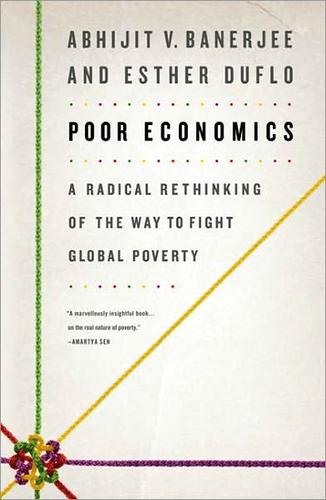
Poor Economics: A Radical Rethinking of The Way To Fight Global Poverty
Related from this site
Key Takeaways
Kyle, in 2017 in Books: This is one of those books that I read and think, ‘how is it that we can have books like this, and still not have solved all the worlds problems?’ What this book does NOT do is, as the last chapter makes clear, provide a ‘sweeping conclusion.’ Instead, it frames the way we should think about problems. If we can first recognize the potential poverty traps inherent in the way societies are organized, we can maybe do something about them. Many thanks to Erik Hansen for referring this book.
Connections
- Utopia For Realists — Bregman draws directly on Esther Duflo’s RCT work (the Hyderabad microcredit study) to argue cash transfers beat microcredit; this book is the evidentiary backbone of his anti-poverty chapter.
- Nickel & Dimed · Evicted: Poverty and Profit in the American City — together these three books form Kyle’s poverty reading cluster: Banerjee & Duflo offer the macro RCT-grounded view, Ehrenreich the domestic-labour ground level, and Desmond the urban-housing lens.
- Cash Transfers · Poverty — the methodological core: randomised controlled trials used to test which anti-poverty interventions (cash, microcredit, in-kind transfers) actually change behaviour.
Highlights
- “The best bet for poor countries is to rely on one simple idea: When markets are free and the incentives are right, people can find ways to solve their problems. They do not need handouts, from foreigners or from their own governments.”
- “Talking about the problems of the world without talking about some accessible solutions is the way to paralysis rather than progress.”
- “We need to make assessments case by case: If our story is based on fertilizer, we need to know some facts about the market for fertilizer. If it is about savings, we need to know how the poor save. If the issue is nutrition and health, then we need to study those. The lack of a grand universal answer might sound vaguely disappointing, but in fact it is exactly what a policy maker should want to know — not that there are a million ways that the poor are trapped but that there are a few key factors that create the trap, and that alleviating those particular problems could set them free and point them toward a virtuous cycle of increasing wealth and investment.”
- “It is possible to make very significant progress against the biggest problem in the world through the accumulation of a set of small steps, each well thought out, carefully tested, and judiciously implemented. This might seem self-evident, but as we will argue, it is not how policy usually gets made.”
- “As we will see, ideology, ignorance, and inertia — the three I’s — on the part of the expert, the aid worker, or the local policy maker, often explain why policies fail and why aid does not have the effect it should. It is possible to make the world a better place — probably not tomorrow, but in some future that is within our reach — but we cannot get there with lazy thinking. We hope to persuade you that our patient, step-by-step approach is not only a more effective way to fight poverty, but the one that makes the world a more interesting place.”
- “In Udaipur, for example, we find that the typical poor household could spend up to 30 percent more on food than it actually does if it completely cut expenditures on alcohol, tobacco, and festivals.” And when they get some money, instead of buying food with as many calories as possible, “they buy better-tasting, more expensive calories.”
- “We are often inclined to see the world of the poor as a land of missed opportunities and to wonder why they don’t put these purchases on hold and invest in what would really make their lives better. The poor, on the other hand, may well be more skeptical about supposed opportunities and the possibility of any radical change in their lives. They often behave as if they think that any change that is significant enough to be worth sacrificing for will simply take too long. This could explain why they focus on the here and now, on living their lives as pleasantly as possible, celebrating when occasion demands it.”
- “Fines or incentives can push individuals to take some action that they themselves consider desirable but perpetually postpone taking.”
- “[Wealthy people] rarely need to draw upon our limited endowment of self-control and decisiveness, while the poor are constantly being required to do so.”
- “The teacher ignores the children who have fallen behind and the parent stops taking interest in their education. But this behavior creates a poverty trap even where none exists in the first place.”
- “The problem is that there are no straightforward ways to identify talent, unless one is willing to spend a lot of time doing what the education system should have been doing: giving people enough chances to show what they are good at.”
- “Trapped by decades of overpromising, many of the leading players in the microfinance world have apparently decided they would rather rely on the power of denial than take stock, regroup, and admit that microfinance is only one of the possible arrows in the fight against poverty.”
- “Perhaps this idea that there is a future is what makes the difference between the poor and the middle class.”
- “There is no point to figuring out the best way to spend a dollar on schools, if 87 cents will never reach the school anyway.”
- “If rural school headmasters could fight corruption, perhaps it is not necessary to wait of the overthrow of the government or the profound transformation of society before better policies can be implemented.”
- “Freedom cannot be imposed from outside, otherwise it would not be freedom. These institutions, then, have to be homegrown and emanate from the bottom up. All that can be done is to campaign for the ideals of individual equality and rights.”