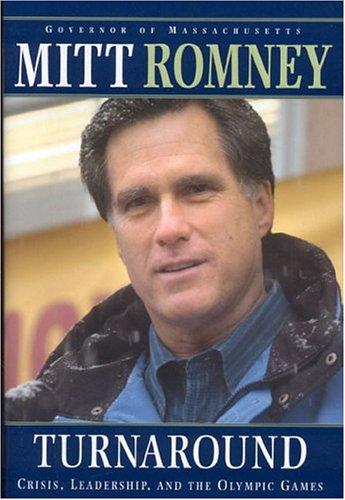
Turnaround
Key Takeaways
Kyle, in 2018 in Books: I’ve always respected Mitt Romney for as long as I’ve had the opportunity to know who he was. I had the great privilege to work at Solamere Capital, which is managed by Tagg Romney, Mitt’s son, and had the chance to sit in several meetings where Mitt was involved as well. I’ll never forget one particular conversation; we were discussing a company we could purchase, and the cost synergies that could be realized. Mitt Romney spoke up and said, “Never speak lightly of those potential cost cutting areas. A lot of times, the costs to cut represent people’s jobs, and we never want to treat that lightly.” Many thanks to Pioneer Book in Provo, Utah for exposing me to this book.
Light-engagement read; no notes to synthesize. The highlights below stand on their own as the source’s argument.
Connections
People: Mitt Romney — author; recounts his turnaround formula across business, the 2002 Olympics, and public service. Henry Kissinger — quoted on heroes who “become myths when they ennoble the lives… of all of us.”
Concepts: Turnarounds — the book’s core framework: strategic audit, then build the team, then “focus, focus, focus.” Operational Skills — emphasis on detail, strategic audit discipline, and “rounding the flat spots” by pairing complementary strengths. Leadership — “the two most critical jobs of leadership are building a good team and keeping the teammates highly motivated.” Sales — “good salesmanship isn’t fast, glib talk” but research, matching benefits to needs, and in-person delivery.
Books: No Apology, Romney — A Reckoning — Romney corpus. Skunk Works — operational-discipline thread.
Highlights
- “It is not in the still calm of life, or the repose of a pacific station,
- that great characters are formed… . Great necessities call out great virtues.”
- Henry Kissinger wrote, “Heroes walk alone, but they become myths when they ennoble the lives and touch the hearts of all of us.”
- We live “lives of quiet desperation” unless we reach for something that is as meaningful as it is unexpected.
- When a person finds greater meaning in what they are doing, and when they are stretched to the limits of their ability, the experience can be exhilarating and transforming.
- He left behind writings insisting that it was the duty of all citizens to ensure that good men were elected to positions in government, men who would faithfully administer the affairs of the people.
- His was the assumption that men should be students of both state and church government in order that they might intelligently carry on in harmony with the fundamental law and discipline of each and not be like ‘dumb driven cattle,’ exercising no mind of their own.”1
- One of her favorite quotes was something she was fond of saying when confronted with an opportunity to serve: “If not me, who? If not now, when? If not here, where?”
- “I aspired, and though I achieved not, I was satisfied.”
- Work was never just a way to make a buck to my dad. There was a calling and purpose to it. It was about making life better for people.
- There was always a sense of doing something important with Dad. It never occurred to me that it was just a political race so that Dad could get a better job. We were engaged in something bigger than that. As governor, he approached his work with a sense of nobility. At least in my eyes—in the eyes of a boy—he was doing important work.
- there was always an innate sense that if the opportunity presented itself, there had to be something greater to life than just earning a living. We would have to make some contribution—and the greater the contribution, the more meaningful and fulfilling the life.
- My dad always said that if he’d have spent his whole life working at an automobile company as chief executive, accruing more and more stock options and making more and more money, that he’d have been enormously bored. His life would have been unfulfilling and uninteresting. He felt strongly that the course he took in public service meant that he had great new vistas and opportunities. It was a thrilling experience for him.
- Great enterprises are driven by great values. Leaders establish vision and values that motivate and create unity of purpose.
- I committed to do four things without compromise. I made four promises that would give shape to our work in the future.
- Our strategic audit took us to customers, to board members, to Wall Street analysts, to bankers, to suppliers, to former employees, and where possible, to competitors. We also got copies of every report that the company produced. We analyzed the numbers according to the tools that had been proven to work before in other diagnostics. Every conceivable way of interpreting market shares, segmentation, business definition, cash flow, investment policy, competitive position, product quality, customer satisfaction, technology position and countless other measures were employed. At the end of the strategic audit, we had a pretty good map of what was right and wrong in the business, of what had to be fixed, and which things were urgent and which were long term. We had hypotheses on which actions would have the greatest impact.
- Every conceivable way of interpreting market shares, segmentation, business definition, cash flow, investment policy, competitive position, product quality, customer satisfaction, technology position and countless other measures were employed.
- But I really had to have her support and counsel. For the past thirty years, at the end of every day, I had unloaded all my worries and concerns on Ann, and she had done the same to me. We’d give each other advice and perspective, not only on how to deal with a particular issue, but also on what was most important to us. Keeping life in perspective goes a long way to being able to confront problems with a calm head and sound judgment. Ann is my most trusted advisor; her judgment on the widest range of business, organizational, and human resources matters was more sound than any other I know. I simply could not turnaround the Olympics without her daily counsel.
- Over the years, I had followed a straightforward turnaround formula. First came the strategic audit, a complete review of every aspect of the business. Then came building the team, both in terms of selecting the right people and building unity and motivation. Finally, it was time to “focus, focus, focus.” Turnarounds that failed did so because management tried to do too many things rather than focus on what was critical.
- And like it or not, it is during the first few days that people form their impressions of a new leader. There’s no time for strategizing: what you do right away speaks volumes. What you do later isn’t being watched as intensely.
- “The reason he asked for that receipt is that he will attach it to his expense report. And everyone back at headquarters who hears about it will know that Bill Marriott cares about 35 cents. He is careful with money.” It was a symbolic statement that was consistent with everything at Marriott—the details are important.
- My old boss, Bill Bain, had often said there is a scientific basis for trusting your gut instincts. He reasoned that there are all kinds of signals, body language signals that your subconscious brain detects without you even being aware of it. The reading of these subtle indicators can form your impressions of someone. And those impressions may thus be just as reasonable as your other inputs. Whether or not that is so, I’ve tended to listen to what I feel in my heart about people.
- “Location, location, location” are to real estate as “people, people, people” are to an enterprise, be it a business, a charity, or an endeavor like the Olympics.
- I like smart people, a lot. Bill Bain, my old boss, used to joke that most things can be fixed, but smart—or dumb—is forever.
- “It’s a good time to be of service,
- Fraser has an immense capacity for detail. He loves to drill into the most mundane issue and spend hours going deeper and deeper into each facet and layer. I enjoy wallowing in the detail when I feel the issue is critical, but I quickly tire when I face row after row of numbers on what seems like minutia. If we were going to create a new budget, bottom-up, it would require Fraser’s type of attention. Fraser also had unusual people skills. He was open and direct with people. He was honest and did not hesitate to give critical feedback, on the spot. I had learned that his brand of open, direct communication didn’t engender defensiveness from the people he managed. That, indeed, was a valuable skill.
- “Who is your greatest living hero?” Mark’s answer, “Ronald Reagan.” A short burst of horror followed from the German. He protested that any young person who isn’t a liberal has no heart. Mark rejoined with the rest of the saying: any mature person who isn’t conservative has no brain, and he, Mark went on, had matured early. As far as I was concerned, Mark had won that round.
- The two most critical jobs of leadership are building a good team and keeping the teammates highly motivated and working collaboratively to achieve the organization’s mission.
- The idea of countering one person’s weaknesses with the strengths of someone else on the team was something we called “rounding the flat spots.” Back in my early business days, I gave people I managed feedback on their weaknesses, drafted action plans with them to correct those weaknesses, and then followed up on their progress. That is what had been done with me by my bosses over the years too. But I found that almost no one actually got rid of their shortcomings. Come to think of it, neither had I.
- “Get someone else to do what they don’t do well: you hired them for what they do better than anybody else.”
- It may be counter-intuitive, but talented people actually like to be asked to do something very, very difficult.
- When I’m presented with a single viewpoint, I invariably take an opposing view. I’ve been told I’m prone to push it vehemently. Some call it arguing. I don’t. I call it debating the issue.
- You can only get so far by cutting costs. In my business life, the fastest way to improve the bottom line was to pare back expenses. But it is never the complete answer. In the long term, the bottom line will only look good if the top line looks good too. In business, the top line is sales or revenues; it’s the ultimate vote of the customer. If revenues are failing, there’s no amount of cost cutting that will make the business successful.
- Good salesmanship isn’t fast, glib talk. The best salesmanship is about research, creative engineering of benefits and features to match the target’s needs, preparation of effective communications, and finally delivering the proposal itself, in person.
- Whether in Washington, D.C., or in Provo, Utah, I found that disputing people’s concerns usually led to defensiveness and entrenched positions. I’d look instead for a transcendent value upon which we both could agree.
- This was the first international event since the attack, and it was in the United States. Seventy-seven countries were there, holding aloft their colors and parading the excellence of their youth. Even in an uncertain world, civilization would proceed, nations would gather, freedom would ring, and young heroes would be celebrated. We would not sacrifice those things that made humanity God’s greatest creation.
- Spend as if you were about to go broke, I told him, but work up your plans as if money were no object.
- There is not one day when I have regretted making a full commitment to public service. The battles, the triumphs, the personal associations are more rewarding than I could have ever imagined. I could have made a good deal more money over the last five years had I stayed at my investment job. It would mostly have gone to the taxman or to kids who are better off earning their own. Instead, I have come to know many more people and to help many more people I do not know. It’s a currency of an entirely different denomination: it can’t be taxed, stolen, or depleted. The more I have of it, the richer I feel.
Referenced in
- 2002 Winter Olympics note
- Bill Bain note
- Bill Marriott note
- Henry Kissinger note
- Leadership note
- No Apology book
- Operational Skills note
- Public Service note
- Romney: A Reckoning book
- Timothy Robinson note
- Turnarounds note