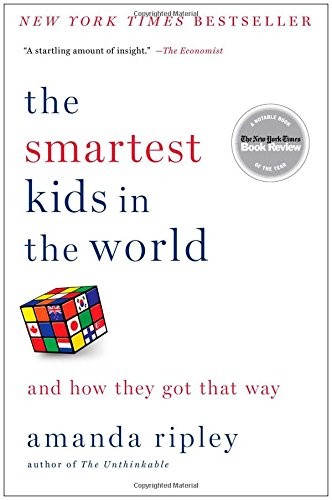
The Smartest Kids in the World
Key Takeaways
Kyle, in 2017 in Books: Recently I had a conversation with some friends, and it can effectively be described as a rabbit hole. We began with talking about education and the problems in our system. But in solving those problems, that led to the failure of the family, which led to poverty, income inequality, and incarceration, which led to a discussion on funding and military spending, which led to a discussion of Donald Trump being the worst, which led to elections and campaign finance. Rabbit meet hole.
At the end of the day, I don’t know what the solutions are. I barely know what all the problems are. As Amanda Ripley summed it up, “How much of our problems could be blamed on diversity; poverty; or the vastness of hte country? Were our weaknesses mostly failures of policy or of culture, of politicians or of parents?”
Books like this one leave me wondering, ‘why doesn’t everyone just read this and then we all go solve this whole thing together?’ But more than prescribe a cut and dry solution to the problem, Amanda Ripley lays out a clear, data-driven investigation of the educational super powers in the world.
Kids like Kim, who put together a petition to defend rats who were being used to detect bombs. Her friends laughed and were grossed out by the idea. “She wouldn’t have minded if they’d thought [it] were a good idea; what had upset her was that they didn’t seem to care at all. Why didn’t they care?”
Kids like Eric, who, after two years realize an international baccalaureate program “had challenged him in a way nothing else had. And it had reminded him how it felt to really learn — to think and discover things for the sake of discovery, not because it was what he was supposed to do.”
I won’t attempt to layout the argument she makes the data she provides. Just what stuck out to me. I’ll only say this — education is a complicated issue that I’m not sure almost anyone is thinking about the right way. Many thanks to Powell’s City of Books in Portland for exposing me to it.
- Education as a deliberate national investment. With no natural resources, Korea “cultivated its people instead, turning education into currency” — and education functioned “like an anti-poverty vaccine,” making family background less and less relevant to a child’s life chances over time.
- Teacher quality is the ceiling. “The quality of an education system cannot exceed the quality of its teachers” (Teacher Celebrities). Making the profession harder to enter makes it more attractive and more respected: Finnish students esteemed faculty precisely because of the academic rigor teachers endured to qualify.
- Rigor over innate talent. Korean students assumed performance was a product of hard work, not God-given talent, and refused shortcuts — especially in math, which Ripley calls “rigor distilled,” the discipline that embeds higher-order habits of reasoning and pattern-detection.
- Parents as coaches, not cheerleaders. Across every country, kids read better when parents read to them daily as young children and discussed books, movies, and current affairs with them as teens. The best parents “teach them good habits and give them autonomy… they want their children to fail while they are still children.”
- School choice needs real information. A true education market only disciplines schools if parents can see “the rigor of a school and the quality of its teachers, not just the aesthetics of the building or the ethnicity of the students” — and that useful information is “shamefully hard to find.”
- Universal discontent. In every country, people complained about their schools — “a universal truth and a strangely reassuring one.” Educating all kids to high levels is hard, and every system still has work to do.
Connections
Books: The Self-Driven Child — the same “parents as coaches, not cheerleaders” finding from the other direction: Ripley’s best parents “teach them good habits and give them autonomy… they want their children to fail while they are still children,” which is precisely Stixrud and Johnson’s autonomy thesis. Battle Hymn of The Tiger Mother — the counterexample both books argue against, where rigor is imported by removing the child’s autonomy rather than building it.
Concepts: Teacher Celebrities — “the quality of an education system cannot exceed the quality of its teachers”; the Finnish move of making the profession harder to enter in order to make it more respected. Unions — the teacher-supply and professional-status thread that carries into the Unions, Unions Everywhere - Research notes. School Choice — a market only disciplines schools if parents can see “the rigor of a school and the quality of its teachers, not just the aesthetics of the building.” Rigor — math as “rigor distilled.” Educational Coaching · University Disruption · Education.
People: Amanda Ripley — author.
Highlights
- “[Korea] had no natural resources, so it cultivated its people instead, turning education into currency.”
- “Education acted like an anti-poverty vaccine in Korea, rendering family background less and less relevant to kids’ life chances over time.”
- “The quality of an education system cannot exceed the quality of its teachers.” — Teacher Celebrities
- “Koreans understood that mastering difficult academic content was important. They didn’t take shortcuts, especially in math. They assumed that performance was mostly a product of hard work — not God-given talent.”
- “More than any other subject, math is rigor distilled. Mastering the language of logic helps to embed higher-order habits in kids minds: the ability to reason, for example, to detect patterns and to make informed guesses. Those kinds of skills had rising value in a world in which information was cheap and messy.”
- “Once it became harder to be a teacher, it could also become more attractive. More people might want to do it, and fewer established teachers might leave the profession.”
- “My Finnish school fostered a great deal of respect for the institution and faculty in the students. This can be partly explained by the academic rigors that teachers had to endure in their journeys to becoming educators. The students were well aware of how accomplished their teachers were.”
- “When children were young, parents who read to them every day or almost every day had kids who performed much better in reading, all around the world, by the time they were fifteen.”
- “All over the world, parents who discussed movies, books, and current affairs with their kids had teenagers who performed better in reading.”
- “Everywhere I went, in every country, people complained about their education system. It was a universal truth and a strangely reassuring one. No one was content, and rightly so. Educating all kids to high levels was hard, and every country — every one — still had work to do.”
- “I wondered what would happen in a true free market in which parents had real insight into the rigor of a school and the quality of its teachers, not just the aesthetics of the building or the ethnicity of the students. Some U.S. education reformers and politicians were convinced that more competition would lead to just this kind of scenario, pushing schools to get better results, or shut down.”
- “In most countries, most parents have some choice as to where to send their children to school. It is a very hard choice, however, and useful information is shamefully hard to find.”
- “Parents who view themselves as educational coaches tend to read to their children every day when they are small; when their children get older, they talk with them about their days and about the news around the world. They let their children make mistakes and then get right back to work. They teach them good habits and give them autonomy. They are teachers, too, in other words, and they believe in rigor. They want their children to fail while they are still children. They know that those lessons — about hard work, persistence, integrity, and consequences — will serve a child for decades to come.”
Referenced in
- Amanda Ripley note
- Educational Coaching note
- Powell's note
- Rigor note
- School Choice note
- Teacher Celebrities note
- Unions note