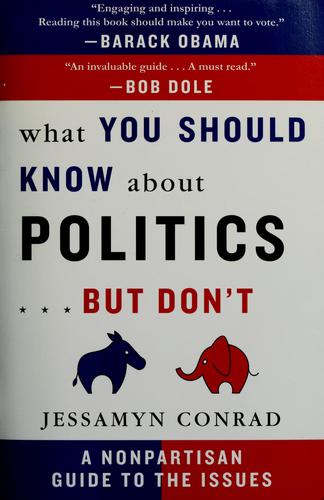
What You Should Know About Politics... But Don't
Key Takeaways
Kyle, in 2017 in Books: The world is complicated. I’m not sure I’ll understand everything I ought to understand. This book helped realize that. The other issue with learning about politics is that things are constantly changing and shaped by perspective. That makes it difficult to ever feel truly conversant in it. I feel for people like Gary Johnson. Granted, he was running for office and should have known what Aleppo was, but I certainly didn’t, and would have a similar reaction to a lot of questions. Many thanks to Brattle Book Shop in Boston for exposing me to this one.
In regards to Citizens United — “This has changed the political landscape so thoroughly that it is difficult for even the best-intentioned and most public-spirited elected official to listen more to his or her general constituents than to the lobbyists who will fund his or her next campaign and TV ads.” Quoting Eisenhower — “In the councils of government, we must guard against the acquisition of unwarranted influence, whether sought or unsought, by the military-industrial complex. The potential for the disastrous rise of misplaced power exists and will persist.”
Jessamyn Conrad’s nonpartisan primer aims to hand ordinary citizens the background needed to follow what happens “behind the curtain” of American politics. Its organizing premise is epistemic before it is ideological: “How you diagnose a problem informs how you propose to solve it.” The book’s recurring argument is that without shared factual grounding, the public cedes the table to better-informed insiders.
-
Money has reshaped representation. The post-Citizens United landscape makes it “difficult for even the best-intentioned and most public-spirited elected official to listen more to his or her general constituents than to the lobbyists who will fund his or her next campaign.” Campaign Finance is framed as the structural force pulling officials away from voters — and citizens regain a seat only by understanding the system. This connects to the Military-Industrial Complex worry Dwight D. Eisenhower voiced about “unwarranted influence, whether sought or unsought.”
-
Civil liberties resist tidy partisan sorting. A central observation is that an individual’s stance across Civil Liberties issues often looks “philosophically inconsistent” — liberals favoring the collective on gun control but the individual on torture or wiretapping, conservatives doing the reverse. Both parties hold libertarian views; they simply disagree on where government should intervene. The book also notes that Free Speech, “our most famous civil liberty,” is not even guaranteed in England, where many Anglo-American notions of liberty originated — a reminder that rights we treat as natural are in fact specific institutional choices.
-
Security is being redefined around root causes. Liberal internationalists increasingly “treat disease, poverty, famine, and resource shortages as strategic threats because they are often the root cause of violent conflict” — folding Healthcare and development into national-security thinking rather than treating them as separate humanitarian concerns. On the domestic side, the same preventive logic argues for “reducing or eliminating co-pays even for the insured,” since prevention is cheaper both medically and economically.
Captured from Kyle’s 2017 highlights; the book is a broad civics survey and these are the passages he flagged, not its full scope. Rated 2/5.
Connections
- Citizens United & Campaign Finance — the book’s strongest through-line is structural capture of elected officials by donors and lobbyists, the same dynamic Dwight D. Eisenhower warned about with the Military-Industrial Complex.
- Free Speech & Civil Liberties — the argument that liberty is an institutional choice (not guaranteed even in England) sits alongside the broader catalog of civil-liberties tradeoffs the book maps.
- Healthcare — preventive-care economics (eliminating co-pays) and the reframing of disease/poverty as strategic threats.
- Unions — labor and collective bargaining as part of the same who-has-a-seat-at-the-table question.
Highlights
- In regards to Citizens United — “This has changed the political landscape so thoroughly that it is difficult for even the best-intentioned and most public-spirited elected official to listen more to his or her general constituents than to the lobbyists who will fund his or her next campaign and TV ads.”
- “The only way for such outsiders as the rest of us to regain our seats at the table is through understanding what is going on behind the curtain, and that is a major aim that this book achieves.”
- “How you diagnose a problem informs how you propose to solve it.”
- Quoting Eisenhower — “In the councils of government, we must guard against the acquisition of unwarranted influence, whether sought or unsought, by the military-industrial complex. The potential for the disastrous rise of misplaced power exists and will persist.”
- “Liberal internationalists have begun to articulate a different approach that treats disease, poverty, famine, and resource shortages as strategic threats because they are often the root cause of violent conflict.”
- “The importance of preventive care — both medically and economically — is a potent argument for reducing or eliminating co-pays even for the insured.”
- “Our most famous civil liberty, the right to free speech, is not even guaranteed in England, where most of our notions of individual liberty originated.”
- “One of the most interesting things about civil liberties is that an individual’s position on any given issue may seem philosophically inconsistent with her position on other civil liberties issues. Many liberals, for example, value the collective over the individual when it comes to gun control, but favor individual rights over collective rights when it comes to torture or wiretapping. Many conservatives support individual rights of gun ownership over collective rights to safety, but feel that breaching an individual’s rights by using torture might be acceptable to protect communities. Both Democrats and Republicans have libertarian views on certain issues, but they differ over the areas in which they think governments should intervene.”
Referenced in
- Brattle Book Shop note
- Campaign Finance note
- Citizens United note
- Civil Liberties note
- Dwight D. Eisenhower note
- Jessamyn Conrad note
- Unions note