Paved With Good Intentions
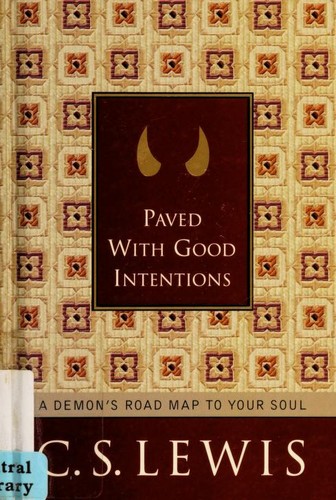
| Author | C.S. Lewis |
|---|---|
| Rating | 3/5 |
| Read | 2026 |
| Highlights | 30 |
| Portfolio ideas | Religious Intellectualism |
Key Takeaways
A book that excerpts C.S. Lewis’s The Screwtape Letters (Kyle, 2026-10-24: “excerpts from Screwtape in another book”). Kyle’s highlights are almost all Screwtape passages, plus one line from The Problem of Pain and one passage of commentary that is not Lewis’s — on how “the Devil: he is a liar. If his lips are moving, he is lying.” Kyle read it in 2026 and rated it 3 stars, below his 2018 read of Screwtape itself (5).
- The locked door. It opens with Lewis’s line from The Problem of Pain that “the doors of hell are locked on the inside” — the damned “enjoy forever the horrible freedom they have demanded.” Kyle’s note ties it to Brad Wilcox: Christ will be pleading with us to use his atonement.
- The gradual road. “The safest road to Hell is the gradual one — the gentle slope, soft underfoot, without sudden turnings, without milestones, without signposts.”
- Keeping things out. “Our best work is done by keeping things out” — the devils work less by planting ideas than by diverting attention: jargon instead of argument, the future instead of the Present, “what will happen to them” instead of “what they do.”
- Faith as a means. “Once you have made the World an end, and faith a means, you have almost won your man.” Kyle’s note: “YOU are the only end in mind.”
- Two failure modes. A believer in a dry spell can be tempted to despair or assured that all is well. Kyle: “‘All is well’ is equally as dangerous as ‘all is lost.’”
- Shame versus repentance. Guilt makes a man hate “every idea that suggests Him.” Kyle: “Shame keeps you from God. Repentance turns you to God.”
- Attrition and courage. The “long, dull, monotonous years of middle-aged prosperity or middle-aged adversity are excellent campaigning weather,” and courage is “the form of every virtue at the testing point.”
Connections
- The Screwtape Letters — the source of nearly every highlight here; Kyle read the full book in 2018 and rated it 5.
- The Problem of Pain — source of the opening “doors of hell are locked on the inside” passage.
- A Grief Observed — the other Lewis book Kyle read in 2026.
Highlights
- I willingly believe that the damned are, in one sense, successful, rebels to the end; that the doors of hell are locked on the inside. I do not mean that the ghosts may not wish to come out of hell, in the vague fashion wherein an envious man ‘wishes’ to be happy: but they certainly do not will even the first preliminary stages of that self-abandonment through which alone the soul can reach any good. They enjoy forever the horrible freedom they have demanded, and are therefore self-enslaved: just as the blessed, forever submitting to obedience, become through all eternity more and more free. (C. S. Lewis, The Problem of Pain)
Kyle: Connect to Brad Wilcox, Christ will be pleading with us to use his atonement
- There is a current bit of wisdom circulating in our culture of addiction: How do you know when an addict is lying? Answer: His lips are moving. Of course, one could find any number of substitutes for “addict”: politician, teenager, corporate executive, cable news host, lawyer. We howl in protest, “He lied!” with the same outrage of a New York tourist complaining about a rigged game of three-card monte: “He cheated!” And of course we aren’t really surprised. We know that the game is rigged and we know that we’re being lied to-unless we’ve wrapped ourselves too comfortably in denial (another lovely word from the world of addiction!). So it is apparently with the Devil: he is a liar. If his lips are moving, he is lying. And as becomes apparent in this fiendish little souvenir, he is happy to employ any strategy to separate humans from “the Enemy” (God), be they direct lies, diversions, half-truths: deceptions all. His goal is to numb, to corrupt, to erode virtue into vice-any means necessary to move us slowly, inexorably away from the Creator and toward the created. The question becomes, Do we believe he is lying to us? Do we believe our game is rigged? Or are we so far gone that we cannot recognize these deceptions and think we’re just fine, thank you very much.
- Murder is no better than cards if cards can do the trick. Indeed the safest road to Hell is the gradual one-the gentle slope, soft underfoot, without sudden turnings, without milestones, without signposts.
- Your patient, thanks to Our Father Below, is a fool. Provided that any of those neighbours sing out of tune, or have boots that squeak, or double chins, or odd clothes, the patient will quite easily believe that their religion must therefore be somehow ridiculous. At his present stage, you see, he has an idea of ‘Christians’ in his mind which he supposes to be spiritual but which, in fact, is largely pictorial. His mind is full of togas and sandals and armour and bare legs and the mere fact that the other people in church wear modern clothes is a real-though of course an unconscious-difficulty to him.
Kyle: Joseph Smith - if you expect anything more than a man…
- In every department of life it marks the transition from dreaming aspiration to laborious doing
- Desiring their freedom, He therefore refuses to carry them, by their mere affections and habits, to any of the goals which He sets before them: He leaves them to ‘do it on their own’. And there lies our opportunity. But also, remember, there lies our danger. If once they get through this initial dryness successfully, they become much less dependent on emotion and therefore much harder to tempt.
- Your man has been accustomed, ever since he was a boy, to have a dozen incompatible philosophies dancing about together inside his head. He doesn’t think of doctrines as primarily ‘true’ or ‘false’, but as ‘academic’ or ‘practical’, ‘outworn’ or ‘contemporary’, ‘conventional’ or ‘ruthless’. Jargon, not argument, is your best ally in keeping him from the Church. Don’t waste time trying to make him think that materialism is true! Make him think it is strong, or stark, or courageous-that it is the philosophy of the future. That’s the sort of thing he cares about.
Kyle: Seek first for truth
- Your patient must demand that all his own utterances are to be taken at their face value and judged simply on the actual words, while at the same time judging all his mother’s utterances with the fullest and most oversensitive interpretation of the tone and the context and the suspected intention.
- At the very least, they can be persuaded that the bodily position makes no difference to their prayers; for they constantly forget, what you must always remember, that they are animals and that whatever their bodies do affects their souls. It is funny how mortals always picture us as putting things into their minds: in reality our best work is done by keeping things out.
- If ever he consciously directs his prayers ‘Not to what I think thou art but to what thou knowest thyself to be’, our situation is, for the moment. desperate.
- You, being a spirit, will find it difficult to understand how he gets into this confusion. But you must remember that he takes Time for an ultimate reality. He supposes that the Enemy, like himself, sees some things as present, remembers others as past, and anticipates others as future; or even if he believes that the Enemy does not see things that way, yet, in his heart of hearts, he regards this as a peculiarity of the Enemy’s mode of perception-he doesn’t really think (though he would say he did) that things as the Enemy sees them are things as they are!
- We want him to be in the maximum uncertainty, so that his mind will be filled with contradictory pictures of the future, every one of which arouses hope or fear. There is nothing like suspense and anxiety for barricading a human’s mind against the Enemy. He wants men to be concerned with what they do; our business is to keep them thinking about what will happen to them.
- Think of your man as a series of concentric circles, his will being the innermost, his intellect coming next, and finally his fantasy. You can hardly hope, at once, to exclude from all the circles everything that smells of the Enemy: but you must keep on shoving all the virtues outward till they are finally located in the circle of fantasy, and all the desirable qualities inward into the Will. It is only in so far as they reach the Will and are there embodied in habits that the virtues are really fatal to us.
- At least, not yet. I have great hopes that we shall learn in due time how to emotionalise and mythologise their science to such an extent that what is, in effect, a belief in us (though not under that name) will creep in while the human mind remains closed to belief in the Enemy.
- Whichever [position towards war] he adopts, your main task will be the same. Let him begin by treating the Patriotism or the Pacifism as a part of his religion. Then let him, under the influence of partisan spirit, come to regard it as the most important part. Then quietly and gradually nurse him on to the stage at which the religion becomes merely part of the ‘cause’, in which Christianity is valued chiefly because of the excellent arguments it can produce in favour of the British war-effort or of Pacifism. The attitude which you want to guard against is that in which temporal affairs are treated primarily as material for obedience. Once you have made the World an end, and faith a means, you have almost won your man, and it makes very little difference what kind of worldly end he is pursuing. Provided that meetings, pamphlets, policies, movements, causes, and crusades matter more to him than prayers and sacraments and charity, he is ours and the more ‘religious’ (on those terms) the more securely ours. I could show you a pretty cageful down here.
- To us a human is primarily food; our aim is the absorption of its will into ours, the increase of our own area of selfhood at its expense. But the obedience which the Enemy demands of men is quite a different thing. One must face the fact that all the talk about His love for men, and His service being perfect freedom, is not (as one would gladly believe) mere propaganda, but an appalling truth. He really does want to fill the universe with a lot of loathsome little replicas of Himself-creatures whose life, on its miniature scale, will be qualitatively like His own, not because He has absorbed them but because their wills freely conform to His. We want cattle who can finally become food; He wants servants who can finally become sons.
- Let him assume that the first ardours of his conversion might have been expected to last, and ought to have lasted, forever, and that his present dryness is an equally permanent condition. Having once got this misconception well fixed in his head, you may then proceed in various ways. It all depends on whether your man is of the desponding type who can be tempted to despair, or of the wishfulthinking type who can be assured that all is well.
Kyle: “All is well” is equally as dangerous as “all is lost.”
- The characteristic of Pains and Pleasures is that they are unmistakably real, and therefore, as far as they go, give the man who feels them a touchstone of reality. Thus if you had been trying to damn your man by the Romantic method… you would try to protect him at all costs from any real pain; because, of course, five minutes’ genuine toothache would reveal the romantic sorrows for the nonsense they were and unmask your whole stratagem. But you were trying to damn your patient by the World, that is by palming off vanity, bustle, irony, and expensive tedium as pleasures. How can you have failed to see that a real pleasure was the last thing you ought to have let him meet?
- A thousand bawdy, or even blasphemous, jokes do not help towards a man’s damnation so much as his discovery that almost anything he wants to do can be done, not only without the disapproval but with the admiration of his fellows, if only it can get itself treated as a Joke…
Kyle: A little truth in every JK
- It increases the patient’s reluctance to think about the Enemy. All humans at nearly all times have some such reluctance; but when thinking of Him involves facing and intensifying a whole vague cloud of half-conscious guilt, this reluctance is increased tenfold. They hate every idea that suggests Him, just as men in financial embarrassment hate the very sight of a pass-book.
Kyle: Shame keeps you from God. Repentance turns you to God.
- He wants each man, in the long run, to be able to recognise all creatures (even himself) as glorious and excellent things. He wants to kill their animal self-love as soon as possible; but it is His long-term policy, I fear, to restore to them a new kind of self-love-a charity and gratitude for all selves, including their own; when they have really learned to love their neighbours as themselves, they will be allowed to love themselves as their neighbours. For we must never forget what is the most repellent and inexplicable trait in our Enemy; He really loves the hairless bipeds He has created and always gives back to them with His right hand what He has taken away with His left.
- Get it quite clear in your own mind that this state of falling in love is not, in itself, necessarily favourable either to us or to the other side. It is simply an occasion which we and the Enemy are both trying to exploit. Like most of the other things which humans are excited about, such as health and sickness, age and youth, or war and peace, it is, from the point of view of the spiritual life, mainly raw material.
- The humans live in time but our Enemy destines them to eternity. He therefore, I believe, wants them to attend chiefly to two things, to eternity itself, and to that point of time which they call the Present. For the Present is the point at which time touches eternity. Of the present moment, and of it only, humans have an experience analogous to the experience which our Enemy has of reality as a whole; in it alone freedom and actuality are offered them. He would therefore have them continually concerned either with eternity (which means being concerned with Him) or with the Present either meditating on their eternal union with, or separation from, Himself, or else obeying the present voice of conscience, bearing the present cross, receiving the present grace, giving thanks for the present pleasure. Our business is to get them away from the eternal, and from the Present.
Kyle: Consider the lillies
- To be sure, the Enemy wants men to think of the Future too-just so much as is necessary for now planning the acts of justice or charity which will probably be their duty tomorrow. The duty of planning the morrow’s work is today’s duty; though its material is borrowed from the future, the duty, like all duties, is in the Present.
- On the other hand we do want, and want very much, to make men treat Christianity as a means; preferably, of course, as a means to their own advancement, but, failing that, as a means to anything even to social justice.
Kyle: YOU are the only end in mind.
- The Enemy has guarded him from you through the first great wave of temptations. But, if only he can be kept alive, you have time itself for your ally. The long, dull, monotonous years of middle-aged prosperity or middle-aged adversity are excellent campaigning weather. You see, it is so hard for these creatures to persevere. The routine of adversity, the gradual decay of youthful loves and youthful hopes, the quiet despair (hardly felt as pain) of ever overcoming the chronic temptations with which we have again and again defeated them, the drabness which we create in their lives and the inarticulate resentment with which we teach them to respond to it-all this provides admirable opportunities of wearing out a soul by attrition.
Kyle: “No one is safe until the end.”
- While they are young we find them always shooting off at a tangent. Even if we contrive to keep them ignorant of explicit religion, the incalculable winds of fantasy and music and poetry-the mere face of a girl, the song of a bird, or the sight of a horizon-are always blowing our whole structure away. They will not apply themselves steadily to worldly advancement, prudent connections, and the policy of safety first. So inveterate is their appetite for Heaven that our best method, at this stage, of attaching them to earth is to make them believe that earth can be turned into Heaven at some future date by politics or eugenics or ‘science’ or psychology, or what not.
Kyle: You cannot overcome mortality while in mortality.
- It is no affair of yours whether those theories are true or false; the great thing is to make Christianity a mystery religion in which he feels himself one of the initiates.
Kyle: What mattereth that to thee? Follow thou me.
- In peace we can make many of them ignore good and evil entirely; in danger, the issue is forced upon them in a guise to which even we cannot blind them. There is here a cruel dilemma before us. If we promoted justice and charity among men, we should be playing directly into the Enemy’s hands; but if we guide them to the opposite behaviour, this sooner or later produces (for He permits it to produce) a war or a revolution, and the undisguisable issue of cowardice or courage awakes thousands of men from moral stupor.
- He sees as well as you do that courage is not simply one of the virtues, but the form of every virtue at the testing point, which means, at the point of highest reality. A chastity or honesty, or mercy, which yields to danger will be chaste or honest or merciful only on conditions. Pilate was merciful till it became risky. It is therefore possible to lose as much as we gain by making your man a coward; he may learn too much about himself!
Related essays
- The Virtue of an Artificial Intelligence · Oct 2026
- Anxiously Engaged in a Good Cause · Apr 2026