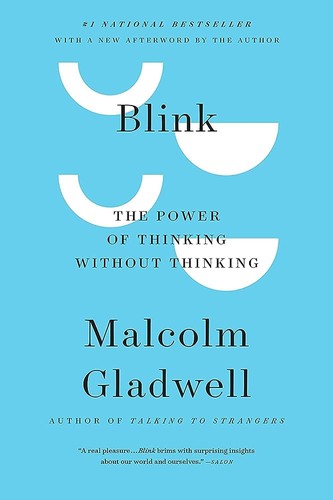
Blink
Key Takeaways
Kyle, in 2018 in Books: Malcolm Gladwell was once described by my behavioral economics professor as muffin top research, just taking the sweet interesting tidbits off the top without any solid foundation. Pop culture psychology is another example. I think what Gladwell provides exceedingly well is anecdotes; illustrations of principles that have true concepts behind them, but may not always be aligned in exactly the right way. For any serious student of the ideas he writes about, he provides a valuable addition to your understanding, but probably wouldn’t base your entire theoretical base on him.
In those moments, our brain uses two very different strategies to make sense of the situation. The first is the one we’re most familiar with. It’s the conscious strategy. We think about what we’ve learned, and eventually we come up with an answer. This strategy is logical and definitive. But it takes us eighty cards to get there. It’s slow, and it needs a lot of information. There’s a second strategy, though. It operates a lot more quickly. It starts to kick in after ten cards, and it’s really smart, because it picks up the problem with the red decks almost immediately. It was the drawback, however, that it operates — at least at first — entirely below the surface of consciousness. It sends its messages through weirdly indirect channels, such as the sweat glands in the palms of our hands. It’s a system in which our brain reaches conclusions without immediately telling us that it’s reaching conclusions.” Quote from Sigmund Freud — “When making a decision of minor importance, I have always found it advantageous to consider all the pros and cons. In vital matters, however, such as the choice of a mate or a profession, the decision should come from the unconscious, from somewhere within ourselves. In the important decisions of personal life, we should be governed, I think, by the deep inner needs of our nature.”
Malcolm Gladwell on rapid cognition — “the ability to extract an enormous amount of meaningful information from the very thinnest slice of experience.” Kyle’s highlights track the book’s two-sided argument rather than the popularised half:
- The adaptive unconscious as a computer. Not Freud’s basement but “a kind of giant computer that quickly and quietly processes a lot of the data we need” — Timothy Wilson’s framing that the mind works best by relegating high-level thinking below awareness.
- But it’s fallible, and it inherits our prejudices. The disturbing middle of the book: split-second decisions leave us “vulnerable to being guided by our stereotypes and prejudices, even ones we do not necessarily endorse,” and the critique of police-conduct debates that focus on individual intent rather than the conditions that degrade fast judgement.
- More information is often worse. “That extra information is more than useless. It’s harmful” — you “need to know very little to find the underlying signature.” The doctor-prediction research is the case in point.
- Expertise is a trained unconscious. The dealer building “a kind of database in his unconscious… learning how to match the feeling he got” — thin-slicing as the product of deliberate exposure.
- The prescription. “The key to good decision making is not knowledge. It is understanding. We are swimming in the former. We are desperately lacking in the latter.” Deliberate analysis for straightforward choices; trained intuition where complexity defeats it. Gladwell’s structural fix — screens in the courtroom, as orchestras adopted for auditions — is the practical takeaway: change the conditions, not just the intentions.
Connections
Books: Outliers and The Tipping Point — same author. Thinking, Fast and Slow and The Undoing Project — the rigorous version of the same subject; Blink is the optimistic read of fast thinking, Kahneman the sceptical one.
Concepts: Cognitive Bias · Decision Making · Data in Investing — “more information is harmful” is the counterweight to data maximalism.
People: Malcolm Gladwell.
Books: The Importance of Arguing With Yourself, Poor Charlie’s Almanack, and Charlie Munger — The Psychology of Human Misjudgment — Kyle groups Blink into the intuition / System-1 cognition cluster (the orchestra-audition-behind-a-curtain story is cited on the Munger page). People: Malcolm Gladwell — the author; Daniel Kahneman. Concepts: Behavioral Economics.
Highlights
Kyle: In those moments, our brain uses two very different strategies to make sense of the situation. The first is the one we’re most familiar with. It’s the conscious strategy. We think about what we’ve learned, and eventually we come up with an answer. This strategy is logical and definitive. But it takes us eighty cards to get there. It’s slow, and it needs a lot of information. There’s a second strategy, though. It operates a lot more quickly. It starts to kick in after ten cards, and it’s really smart, because it picks up the problem with the red decks almost immediately. It was the drawback, however, that it operates — at least at first — entirely below the surface of consciousness. It sends its messages through weirdly indirect channels, such as the sweat glands in the palms of our hands. It’s a system in which our brain reaches conclusions without immediately telling us that it’s reaching conclusions.”
- “This new notion of the adaptive unconscious is thought of, instead, as a kind of giant computer that quickly and quietly processes a lot of the data we need in order to keep functioning as human beings.”
- “Timothy D. Wilson writes in his book Strangers to Ourselves: ‘The mind operates most efficiently by relegating a good deal of high-level, sophisticated thinking to the unconscious, just as a modern jetliner is able to fly on automatic pilot with little or no input from the human, ‘conscious’ pilot. The adaptive unconscious does an excellent job of sizing up the world, warning people of danger, setting goals, and initiating action in a sophisticated and efficient manner.”
- “Our unconscious is a powerful force. But it’s fallible. It’s not the case that our internal computer always shines through, instantly decoding the “truth” of a situation. It can be thrown off, distracted, and disabled. Our instinctive reactions often have to compete with all kinds of other interests and emotions and sentiments.”
- “After the O.J. Simpson verdict, one of the jurors appeared on TV and said with absolute conviction, ‘Race had absolutely nothing to do with my decision,’ psychologist Joshua Aronson says. ‘But how on earth could she know that? What my research with priming race and test performance, and Bargh’s research with the interrupters, and Maier’s experiment with the topes show is that people are ignorant of the things that affect their actions, yet they rarely feel ignorant. We need to accept our ignorance and say ‘I don’t know’ more often.”
- “The results from these experiments are, obviously, quite disturbing. They suggest that what we think of as free will is largely an illusion: much of the time, we are simply operating on automatic pilot, and the way we think and act — and how well we think and act on the spur of the moment — are a lot more susceptible to outside influences than we realize.”
- “If you are a white person who would like to treat black people as equals in every way — who would like to have a set of associations with blacks that are as positive as those that you have with whites — it requires more than a simple commitment to equality. It requires that you change your life so that you are exposed to minorities on a regular basis and become comfortable with them and familiar with the best of their culture, so that when you want to meet, hire, date, or talk with a member of a minority, you aren’t betrayed by your hesitation and discomfort.”
- “You know, you get caught up in forms, in matrixes, in computer programs, and it just draws you in. They were so focused on the mechanics and the process that they never looked at the problem holistically. In the act of tearing something apart, you lose its meaning.”
- “All that extra information isn’t actually an advantage at all; that, in fact, you need to know very little to find the underlying signature of a complex phenomenon.”
- “That extra information is more than useless. It’s harmful. It confuses the issues. What screws up doctors when they are trying to predict heart attacks is that they take too much information into account.”
- “Market research isn’t always wrong, of course. If ‘All in the Family’ had been more traditional — and if the Aeron had been just a minor variation on the chair that came before it — the act of measuring consumer reactions would not have been nearly as difficult. But testing products or ideas that are truly revolutionary is another matter, and the most successful companies are those that understand that in those cases, the first impressions of their consumers need interpretation. We like market research because it provides certainty — a score, a prediction; if someone asks us why we made the decision we did, we can point to a number. But the truth is that for the most important decisions, there can be no certainty.”
- “What he was building, in those nights in the storerooms, was a kind of database in his unconscious. He was learning how to match the feeling he had about an object with what was formally understood about its background and style and value. Whenever we have something that we are good at — something we care about — that experience and passion fundamentally change the nature of our first impressions.”
- “When we make a split-second decision,” Payne says, “we are really vulnerable to being guided by our stereotypes and prejudices, even ones we may not necessarily endorse or believe.”
- “The critics of police conduct invariably focus on the intentions of individual officers. They talk about racism and conscious bias. The defenders of the police, on the other hand, invariably take refuge in what Fyfe calls the split-second syndrome: An officer goes to the scene as quickly as possible. He sees the bad guy. There is no time for thought. He acts. That scenario requires that mistakes be accepted as unavoidable. In the end, both of these perspectives are defeatist. They accept as a given the fact that once any critical incident is in motion, there is nothing that can be done to stop or control it. And when our instinctive reactions are involved, that view is all too common. But that assumption is wrong. Our unconscious thinking is, in one critical respect, no different from our conscious thinking: in both, we are able to develop our rapid decision making with training and experience.”
- “The ability to extract an enormous amount of meaningful information from the very thinnest slice of experience.”
- “Because we are often careless with our powers of rapid cognition. We don’t know where our first impressions come from or precisely what they mean, so we don’t always appreciate their fragility. Taking our powers of rapid cognition seriously means we have to acknowledge the subtle influences that can alter or undermine or bias the products of our unconscious.”
- “Too often we are resigned to what happens in the blink of an eye. It doesn’t seem like we have much control over whatever bubbles to the surface from our unconscious. But we do, and if we can control the environment in which rapid cognition takes place, then we can control rapid cognition. We can prevent the people fighting wars or staffing emergency rooms or policing the streets from making mistakes.”
- “We live in a world saturated with information. We have virtually unlimited amounts of data at our fingertips at all times, and we’re well versed in the arguments about the dangers of not knowing enough and not doing our homework. But what I have sensed is an enormous frustration with the unexpected costs of knowing too much, of being inundated with information. We have come to confuse information with understanding.”
- “The key to good decision making is not knowledge. It is understanding. We are swimming in the former. We are desperately lacking in the latter.”
- “On straightforward choices, deliberate analysis is best. When questions of analysis and personal choice start to get complicated — when we have to juggle many different variables — then our unconscious thought processes may be superior.”
Kyle: Quote from Sigmund Freud — “When making a decision of minor importance, I have always found it advantageous to consider all the pros and cons. In vital matters, however, such as the choice of a mate or a profession, the decision should come from the unconscious, from somewhere within ourselves. In the important decisions of personal life, we should be governed, I think, by the deep inner needs of our nature.”
- “What if we put screens in the courtroom? We have a jury system in the Western world based on an idea that goes back to antiquity: that the accused has the right to confront his accusers and to be judged by a jury of his peers. Back then it was thought that for justice to be achieved, the jury, the accuser, and the accused all had to see one another. But now we know more: we know that what we see — particularly when it is the color of someone’s skin, or gender, or age, — does not always aid understanding. Sometimes we can make better judgments with less information. I think that the accused in a criminal trial shouldn’t be in the courtroom. He or she should be in another room entirely, answering questions by email or through the use of an intermediary. And I think that all evidence and testimony in a trial that tips the jury off to the age or race or gender of the defendent ought to be edited out.”
- “It is not enough simply to explore the hidden recesses of our unconscious. Once we know about how the mind works — and about the strengths and weaknesses of human judgment — it is our responsibility to act.”
Referenced in
- Charlie Munger: The Psychology of Human Misjudgment note
- Cognitive Bias note
- Nudge book
- Outliers book
- Poor Charlie's Almanack book
- Predictably Irrational book
- The Tipping Point note