The McDonaldization of Venture Capital

McDonald’s sells more burgers than anyone, and the burgers are the quintessential physical representation of slop in real life. Fine burgers mass produced into burgers that make you question your life choices. I think venture capital is going the same way: since 2023, AI has taken all of the growth in venture dollars, and a16z alone raised more than 20% of US venture capital this year. Every decision along the way is perfectly rational; the question is whether a system built to sell the most burgers can still imagine a better world.
McDonald’s sells more burgers than anyone on the planet, and the burgers are the quintessential physical representation of slop in real life. Fine burgers mass produced into burgers that make you question your life choices. Back in 1993, a sociologist named George Ritzer wrote a book called The McDonaldization of Society, arguing that the fast-food playbook had escaped the restaurant business and was running everything from hospitals to universities to churches. Efficiency, calculability, predictability, and control. Ritzer’s point was that each one is perfectly rational on its own, and together they can produce something pretty irrational.
I’ve been thinking about that book because I think it’s happening to venture capital.
Back in March 2022, I wrote that “the minimills are coming for venture.” In The Innovator’s Dilemma, the minimills were the scrappy little steel makers that started with the junk nobody wanted, like rebar, and kept climbing up-market until the giant integrated mills woke up with nothing left to sell. My version was that solo GPs, small funds, and partners spinning out of the big platforms would chip away at the incumbents from below. Given my odd penchant for Rage Against The Machine, I called them “Renegades.”
Fast forward ~4.5 years. Through the first three quarters of 2026, a16z by itself has closed $23.8B, which PitchBook says is more than 20% of all US venture capital raised this year. That doesn’t mean the minimill hypothesis hasn’t played out, but it clearly didn’t have the disruptive dynamic I expected it to.
I’ve written over and over and over again about how venture capital is changing; almost five years of it at this point. And I think the pieces add up to something more specific than “big funds bad.” The symptom is size plus consensus, and it’s turned venture capital into two (or several) different industries that just happen to share a name.
So I want to do a few things. First, walk back through what I thought was happening in 2022, and what’s happened instead. Second, run venture through Ritzer’s four ingredients (efficiency, calculability, predictability, and control). And then finally, what all that efficiency does to the one thing venture is supposed to be good at: imagining a different future.
The Renegade Hypothesis
In January 2022, I wrote about The Unbundling of Venture Capital. The idea was that founders were starting to trust individuals more than firm brands, and so the influence within venture was progressively decentralizing away from the core brand into renegades leveraging the power of their own brand. I even predicted a “Magna Carta Moment” for talented partners stuck inside big firms. Think about those announcements where you see so-and-so has left a big fund to start their own thing.
Granted, I wasn’t totally naive about the incumbents. In another piece that same spring, I acknowledged that the kingdoms of folks like Sequoia or a16z were still powerhouses that weren’t going anywhere. And by December 2022, I wrote The Blackstone of Innovation to articulate the supercharger of the asset management business model behind the scalability of venture. Whether you like it or not, business building is the marketing of venture capital, but asset management is the business model. I even guessed that the 2022 downturn would likely exacerbate the aggregation of assets to a few top firms, rather than disperse it.
So by the end of 2022 I was basically holding two predictions at once. The renegades would keep leaving, but the money would keep concentrating. Turns out both were right.
Both Things Happened
The renegades never stopped leaving. Mark Goldberg (Index), Kristina Shen (a16z), and Ethan Kurzweil (Bessemer) left to start Chemistry in 2024 with a $350M first fund and a pitch to “out-hustle the legacy firms that have grown distracted by scale.” This year alone, Niko Bonatsos left General Catalyst after 15 years to start Verdict, Damir Becirovic left Index to raise $80M for Relentless, Bryan Kim left a16z to raise ~$100M for Mido, and Stephanie Zhan is branching out from Sequoia, launching an early stage AI fund. Certainly elements of a “Magna Carta Moment.”happening.
But look at the sizes. $80M, $100M, even $350M. The firms those people left manage tens of billions. The renegades kept rebelling; but they just mostly stayed small. And the money went in the opposite direction:
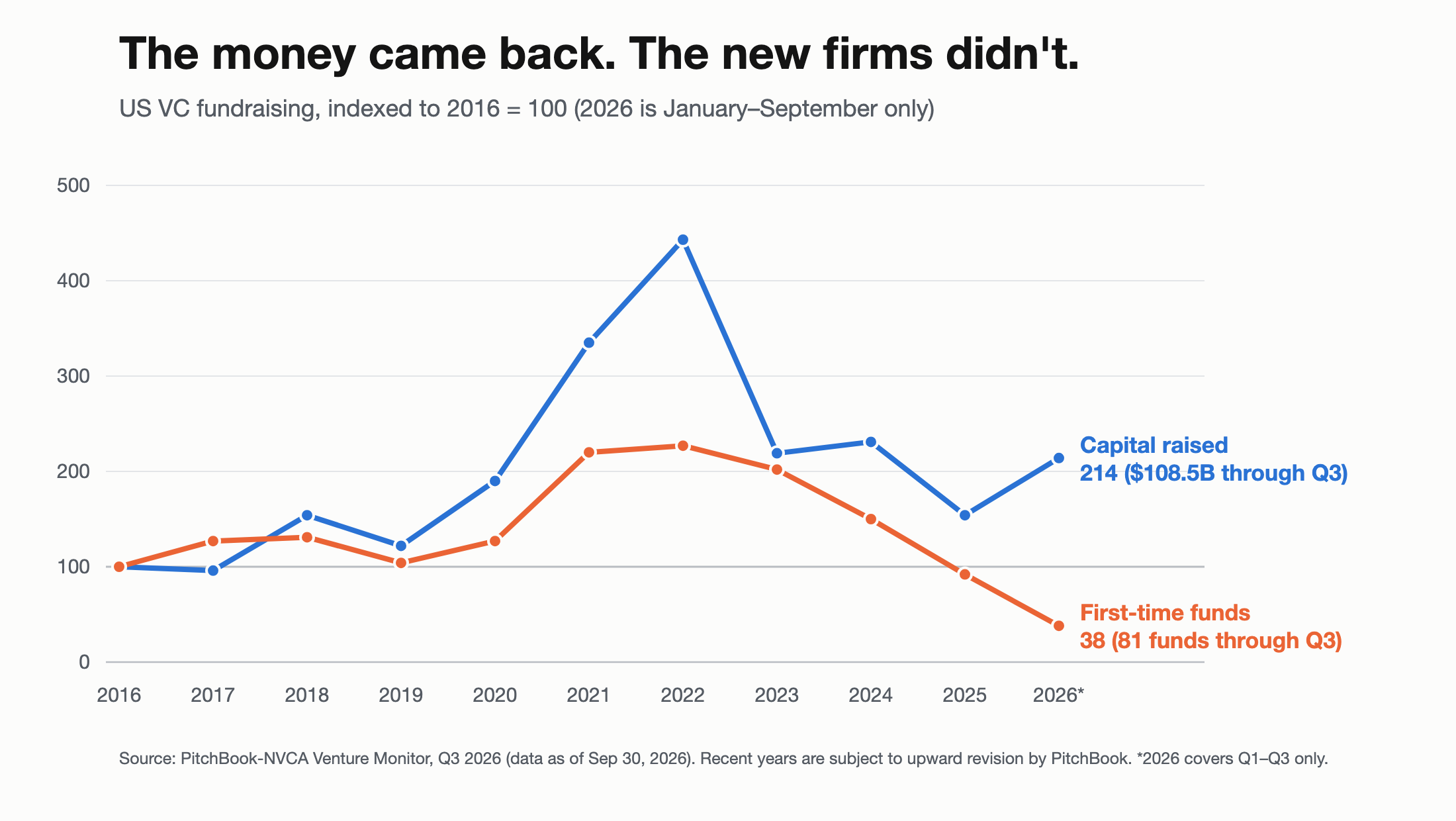
Through Q3, US VC funds have raised $108.5B, already ~39% more than all of 2025. So the size of the asset class is still raging on. But first-time funds went from 479 in 2022 to 195 in 2025 to just 81 so far this year. Established firms (fund IV and up) took 88.2% of all the capital raised, the highest share PitchBook has ever recorded; historically that number bounced between ~50% and 80%. The agglomerators are still soaking up the majority of the dollars.
One report in Q1 put it this way: “the structural divide between managers that can raise and those that cannot is unlikely to narrow.” Then, earlier this month, after USV announced $900M following Benchmark’s $2B back in June, I wrote that there are now basically two types of venture firms: those who CAN raise massive funds, and those who CAN’T.
Since then, my writing has followed the same power law trend. I’ve written dramatically less about Renegade-led new funds and more about the agglomerator effect happening in venture.
The Agglomerator Effect
It started in 2023. In Institutionalized Belief In The Greater Fool, I used Hopin as the poster child for what a 13-year bull market did to underwriting. It went from $2B to $7.7B in about nine months, raised ~$1B across four rounds in 14 months, saw the founder cash out $200M in secondary, and eventually sold to RingCentral for $5M in cash (!) plus an earnout. Nobody in those rounds had to believe Hopin was worth $7.7B. They just had to believe that someone ELSE could believe it. We institutionalized the religion of bag-handers and bag-holders in venture.
A few weeks later, in Playing Different (Stupider) Games, I tried to explain why the herd kept forming. Some firms aren’t playing the 10x game at all. For a capital agglomerator, the goal is just to raise as much capital as humanly possible. An LP writing a $250M check doesn’t expect 10x; they’re more than happy with 2-3x. So those firms just need a $1B entry price to become a $2-3B company. That’s a perfectly fine game. The stupid move is not noticing which game the other side of the table is playing.
Then in January 2024 came The Puritans of Venture Capital, which is still the most-read thing I’ve ever written. The argument was that the middle of venture was hollowing out, leaving two kinds of firms: Cottage Keepers like Benchmark and USV running $200-500M funds, and Capital Agglomerators promising big LPs 2-3x funds. And I was pretty explicit that agglomeration wasn’t a ZIRP-fueled fever dream we’d wake up from. The Puritans would have to co-exist with the agglomerators, not replace them.
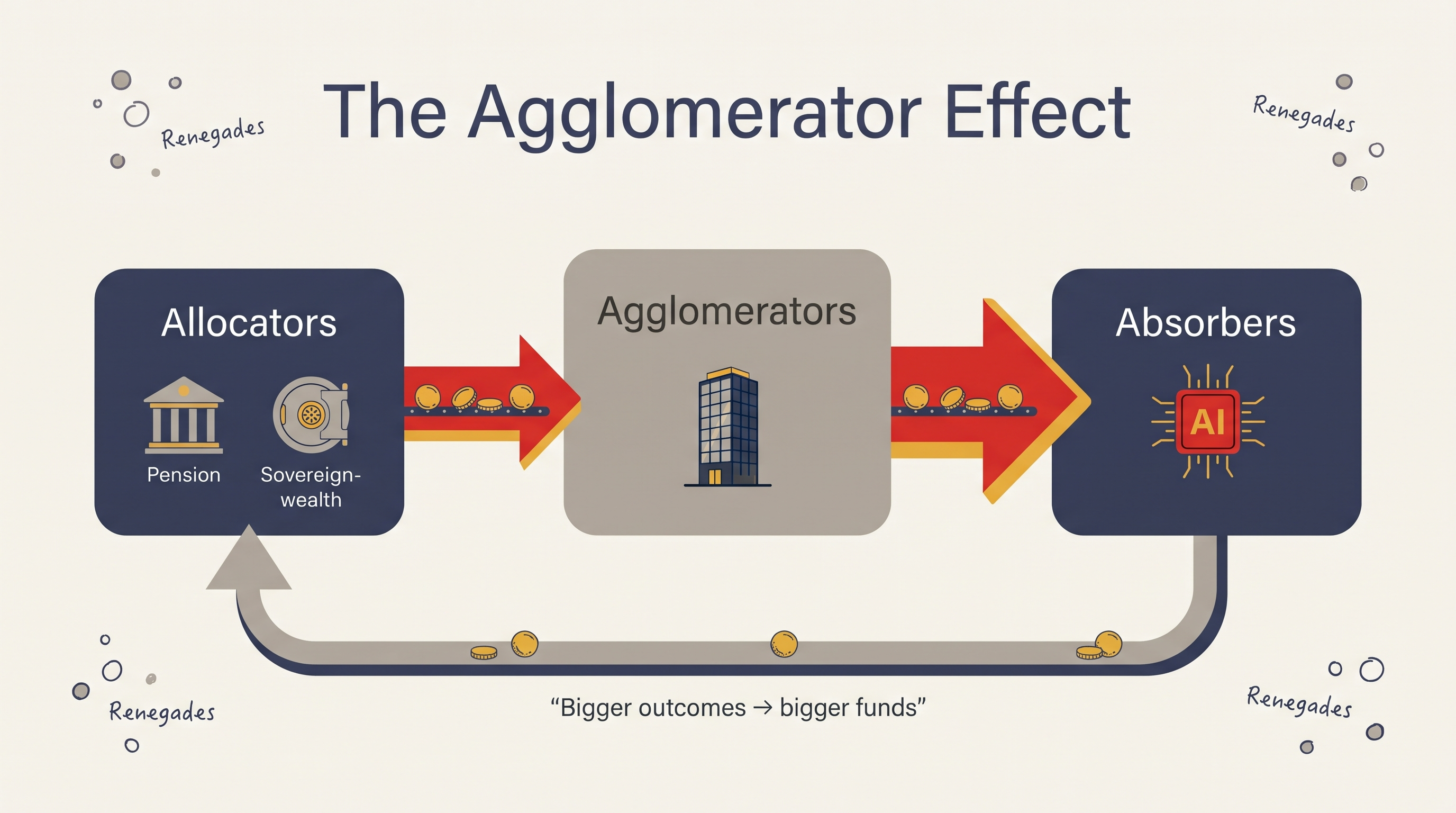
By the end of 2024, I was looking at who was actually doing the pulling. In The Unholy Trinity of Venture Capital, I argued that three groups had fused together: Agglomerators (a16z, General Catalyst, ICONIQ, Sequoia) raising the capital, Allocators (sovereigns and pensions) supplying it, and Absorbers (OpenAI, Anthropic) soaking it up in $1B+ rounds. As venture evolves, it tends to tilt toward whatever the loudest people with the most capital decide they want it to be. I even wondered if traditional venture capital was the bookstores in 1997 that thought Amazon.com was a fad. And the only thing that’s 100% certain to get sucked into a center of gravity like that is something that isn’t moving.
Then, last year, Build What’s Fundable took the same idea downstream to founders. Where startups used to be the tool of choice for rebels, they’ve increasingly become a consensus norming funnel that feeds into the black hole forming around the agglomerator effect.
Looking back, those five pieces are really one argument told from five angles: the bubble, the business model, the firm, the money, and the founder. All five describe the same force: capital pulls toward capital, and the bigger the pile gets, the more the pile decides what gets built.
So why are the agglomerators so dominant? I think Ritzer’s McDonaldization formula has the clearest answer I’ve seen.
The McDonaldization Formula
Ritzer didn’t invent the idea from scratch. He was updating Max Weber, who argued about a century ago that modern life was steadily being organized around rational, rule-bound bureaucracy, and who worried we’d end up trapped in an “iron cage” of our own efficiency. Ritzer’s twist was picking a better mascot than the Prussian civil service. Henry Ford’s assembly line and Frederick Taylor’s stopwatch were the prototypes, but McDonald’s represents the quintessential world domination example of the efficiency formula.
Ritzer pointed to four ingredients:
- (1) Efficiency: The fastest route from need to satisfied
- (2) Calculability: Count everything, and let the count stand in for quality
- (2) Predictability: The same experience every time, everywhere
- (4) Control: Swap human judgment for systems, scripts, and eventually machines
None of those ideas are necessarily bad on their own. A hospital that’s efficient and predictable is a good hospital, right? The problem is what happens when they all compound at once.
And once you see the pattern, you see it everywhere. Ritzer pointed at USA Today, which critics nicknamed “McPaper” for serving the news in short, colorful, same-every-day bites (sick burn). He pointed at walk-in clinics as “McDoctors” and at universities, where learning turns into credit hours, GPAs, and multiple-choice exams that are easy to grade at scale. More recently, songs get written to survive the first 30 seconds of a stream, because 30 seconds is when the algorithm counts the play. Every one of those systems is producing more of the thing, and even making an amorphous version of “the thing” more popular, all while making the actual thing individually worse.
I’d argue that’s the real definition of slop. Not bad by accident, but bad because the system is optimized for something other than good. Look at how we’ve become inundated with social feeds and AI companions optimized for time-on-app; nobody sets out to make people miserable, they just set out to make a number go up. Minutes devoted to the screen just happened to be the number. When Meta launched Vibes, a feed of nothing but AI-generated short-form video, I quote-tweeted it with “I’m all for spending trillions in capex to revolutionize the future but please gawd not this…” Hollywood runs the same play with nostalgia. Earlier this year I wrote that AI will super-charge the race to strip-mine nostalgia and generate the thousandth reboot nobody wants. I’m convinced that even the programmatic execs don’t want the reboot for its merits; they want it because it’s predictable.
Which is why I think venture is ripe for the same McDonaldization. An industry that’s supposed to be about the weird, the unproven, and the one-of-one is now running all four of Ritzer’s ingredients at once.
Efficiency
The first ingredient is efficiency: the fastest, cheapest path from hunger to full. Soylent for the soul. In venture, the efficient path is the platform. One brand, one fundraise, a dozen strategies (seed, growth, crypto, bio, defense, American Dynamism, you name it), and a pile of LP capital that can be deployed in giant chunks instead of $5M at a time.
Back in May 2022, I called it the Big Budget Effect: with such big funds and such fast deployment cycles, it’s so much more difficult to take big bets on much riskier technology. Hollywood learned this a long time ago. When the budgets get big enough, you stop making original movies and start making sequels. Efficient? Absolutely. But very rarely is it soul-shaping or humanity-forming.
Calculability
The second ingredient is calculability: quantity becomes the measure of quality. A Big Mac is “big,” the fries are “super-sized,” and the sign counts burgers served, regardless of burgers enjoyed. In venture, the number on the sign is AUM. Back in 2024, I wrote that for many of these large funds their strategy has become “2% of the biggest number.”
I think the component I under appreciated most in 2022 was LPs. Some of that is just where I sat. Earlier in my career I was at Coatue and Index, both established firms, and I’d never really been involved in fundraising. You’d think of “the LPs” as the adults in a back room somewhere making sure nobody did anything stupid. I now know that isn’t actually the case.
That’s not a knock on LPs. We’re all victims of our circumstantial incentives. In The Unholy Trinity of Venture Capital I talked about Allocators, like sovereign wealth funds and pensions, looking to park $250M a pop and hit a 7-8% yield target without being the majority of any given fund. Most of them are just doing their best not to get fired, and nobody gets fired for writing a big check into a big brand. If your goal is not getting fired, the safest place to put the next dollar is often wherever the last dollar went because you dilute your personal responsibility.
The equation gets even more skewed when outcomes get bigger. Trillion-dollar outcomes used to be “venture-backed possibilities” only on a 30-year horizon:
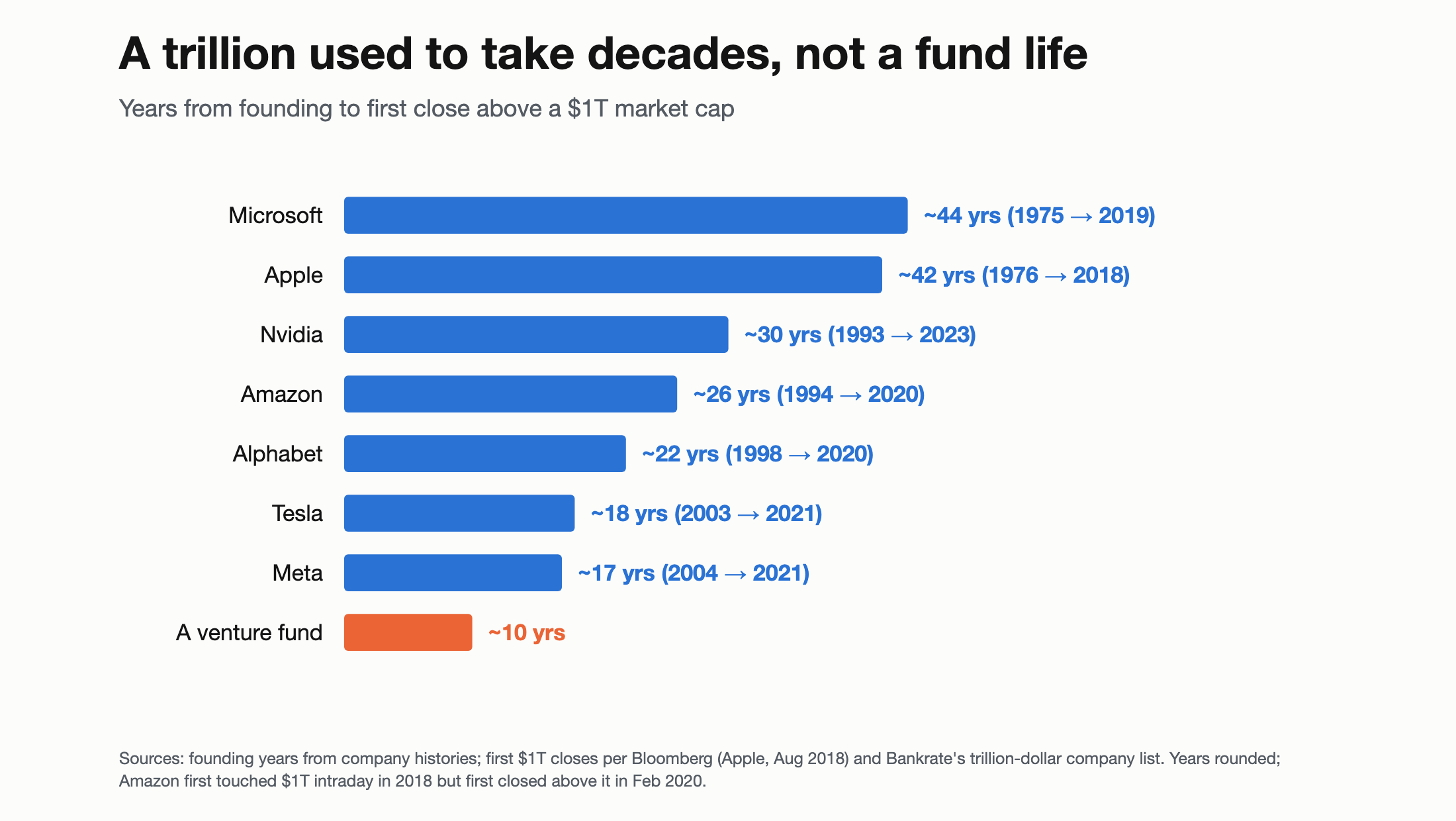
Microsoft took ~44 years. Apple took ~42. Even Nvidia, the poster child of the AI boom, took ~30 years from founding to its first close above $1T. Prior to the AI boom pop-offs like Anthropic and SpaceX, Meta was the quickest at ~17 years. None of them did it inside a fund life.
But what if those outcomes ARE possible in 5-10 years? That’s a fund life! If you believe that, then the rational move is to raise the biggest fund you can and own as much of the most obvious companies as possible, as fast as you can. As I wrote a couple weeks ago, what AI really did was convince everyone that outcomes can become consistently bigger. A trillion is the new billion.
Don’t get me wrong, I don’t believe there are going to consistently be more of those kinds of outcomes. I’m not even convinced the outcomes we’ve seen are durable outcomes. Cursor at ~$60B today is incredible. Cursor at $60B forever? That’s a very different bet. But, going back to the Greater Fool Philosophy, it doesn’t matter what I believe or you believe. As long as enough LPs and GPs believe it, the math gets worse and everyone’s incentives get sullied, pushing all of us faster and faster into the arms of size and consensus.
Predictability
The third ingredient is predictability: a Big Mac in Tokyo should taste like a Big Mac in Tulsa. In venture, predictability looks like consensus. In 2025 I wrote that what has filled the vacuum of conviction is consensus, and a couple months later I described YC as serving up what the broader Consensus Capital Machine demands.
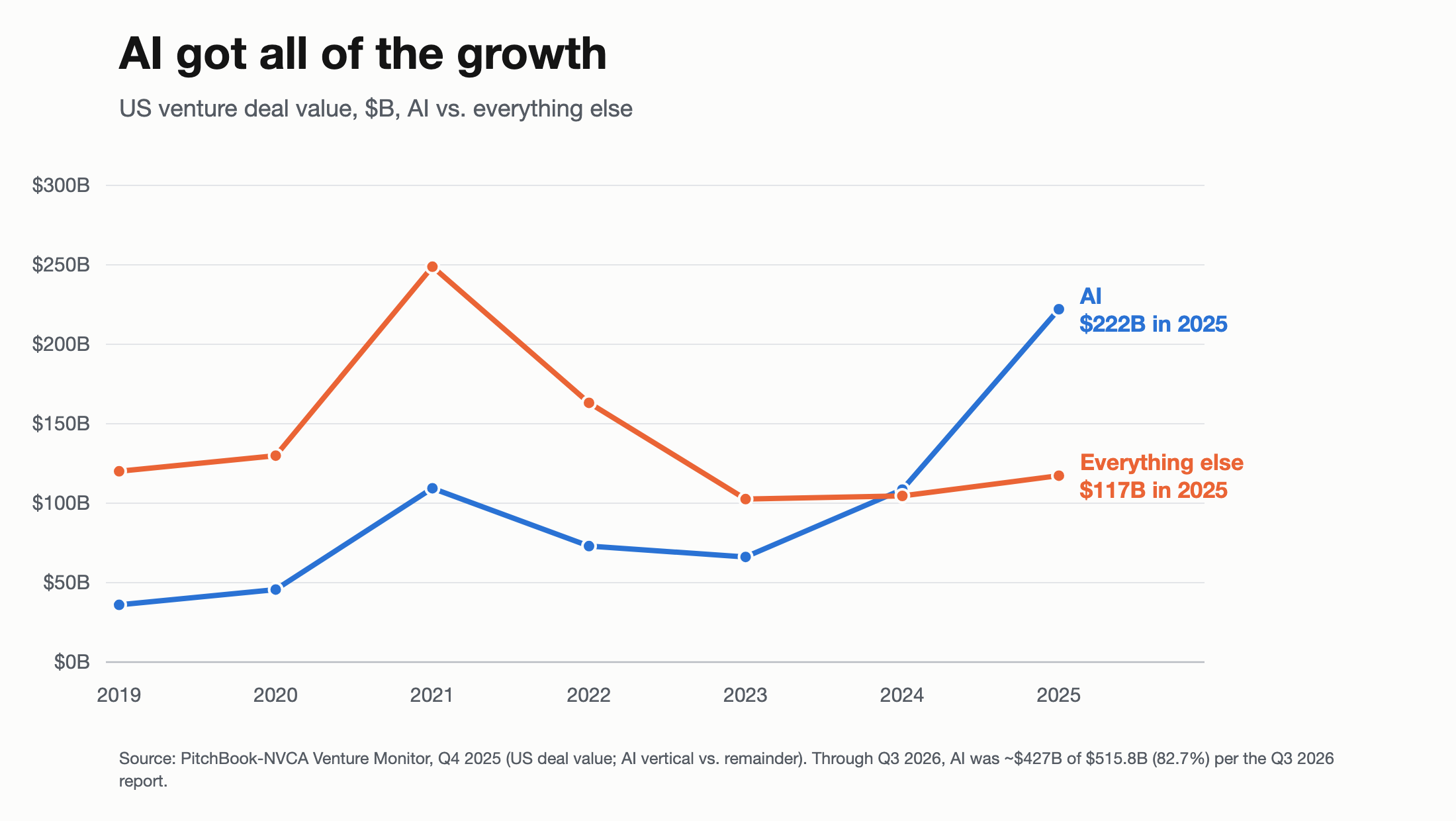
The numbers since then are kind of absurd. AI was 39% of US venture dollars in 2023, 51% in 2024, 65% in 2025, and 82.7% so far in 2026. In Q1 alone, five companies (OpenAI, Anthropic, xAI, Waymo, and Databricks) took 73.2% of all US deal value. The age of garage-band contrarians is over. The age of consensus deal making has come.
Control
The last ingredient is control: standardize the process so the outcome doesn’t depend on any one person’s judgment. The fry cook doesn’t decide when the fries are done; the timer does.
I don’t think size alone decides whether a firm gets McDonaldized, though. There’s a difference between conviction-led firms (Founders Fund, Greenoaks, Thrive, Lux, USV) and scale-led firms (a16z, Lightspeed, General Catalyst, Sequoia). And conviction and scale aren’t mutually exclusive; Thrive raised $10B in February. The question is what LEADS you. Does the size of the fund follow the size of the conviction, or does the conviction get manufactured to fit the size of the fund?
We wrestle with a version of this at Contrary. We avoid calling ourselves a “thesis-driven” firm; we think of ourselves as talent and research-driven, because we’d rather find the best people and the best ideas wherever they converge. The moment you become a servant of your own in-house thesis, everything starts to look like a nail that fits your thesis hammer. Scale is just a bigger hammer. Once the fund size leads, every deal has to fit the fund.
The Irrationality Of Rationality
Ritzer’s best idea is what he called the irrationality of rationality. Every individual step in the system makes sense, but the sum of the steps produces something nobody would have chosen. The LP isn’t crazy for wanting the safe brand. The GP isn’t crazy for raising the biggest fund LPs will give them. The fund isn’t crazy for owning the most obvious companies. But what does the sum of all that rationality buy? AI. AI everywhere.
One commonly proposed criticism is that none of this money is going to the real problems: curing cancer, living forever, solving housing, new energy, education. But the data doesn’t tell that story. A lot of the AI money IS going toward real problems. In 2025, AI companies took ~$18B, or 46% of all healthcare venture investment. Isomorphic Labs raised $2.1B this year for AI drug discovery. Fusion companies raised a record ~$4.5B over the last year, and the AI power crunch is pulling real money into energy; over a third of climate tech funding in the first half of 2026 went to low-carbon data centers.
And the biggest checks aren’t just going to “knowledge work on steroids” either. At least $242B of US AI dollars this year went to just four labs (OpenAI, Anthropic, xAI, and SSI). Sure, those are bets on general-purpose intelligence, and I’ll grant they’re aimed at a lot more than coding assistants. But their first business, today, is still mostly knowledge work: chat, code, and enterprise productivity.
The bigger problem is that everything else is stuck in place. Since 2023, everything in US venture that isn’t AI has been flat at ~$100-120B a year. Life sciences went from 17% of US venture dollars in 2024 to ~11% in 2025, on basically the same ~$36B. Global edtech raised ~$2.4B in 2024, a decade low; about 2% of just one OpenAI round of $122B round. Global proptech raised ~$10B in 2025, 57% below 2019.
It’s less that nobody funds the hard problems, and more that the hard problems are stuck at the same table while AI eats everything else on the menu. In a McDonaldized system, the problems that get the money are the ones that can absorb billions predictably. Some of the real problems fit that shape; AI drug discovery and data-center power can absorb billions. But plenty of problem surface areas don’t. In 2023 I asked the question of what should we be building? In a world of infinitely larger funds, larger outcomes, larger ambitions… what are we building?
Earlier this year I wrote that we now produce founders of companies, not founders of a republic. Size pushes you toward consensus, and consensus is the opposite of imagination. The more we all pursue “most burgers sold,” the more all the burgers are going to suck. That can be fine for people who want to make the cheapest burgers at the largest scale. But there’s a lot more to the world of delicious sandwiched grilled meats than just as much scale as possible.
Billions & Billions Served
McDonald’s isn’t a failure, by any stretch. It feeds something like 70 million people a day, cheaply and reliably, in a lot of places that don’t have much else. Ritzer’s whole point was that rationalization works. That’s why it spreads.
And it’s not like venture was any wiser before. In 2017 we were pouring billions into e-scooters faster than you could call an Uber. Every wave of tech has its herd segmentation exercise: Uber vs. Lyft, DoorDash vs. Postmates, Bird vs. Lime, Figma vs. InVision, a hundred crypto exchanges in 2021. Paul Graham would tell you consensus is just a reflection of where the technology actually is.
The difference is size. Consensus used to be a wave in the ocean; now the wave is the ocean.

When scooters went sideways, Bird had raised $800M+ and ended up worth about a tenth of that, but the rest of venture barely noticed. The scooter money was one bet among thousands. However, when 82.7% of the dollars go to one category, consensus is less about one trend and increasingly becomes the shape of the entire industry.
Maybe this time is different. So I guess the real question is whether this time is actually different. What muddies the water is that some of these outcomes are turning into honest-to-goodness cash. Not to pick on Cursor, but its just… you know… the biggest venture-backed acquisition ever. But I’m just not sure I think Cursor is a $60B company in steady state; the model was expensive, and it leaned on everyone else’s layers (the frontier labs, the compute, etc.) to work. But it DID get bought. That makes it different from OpenSea or WeWork, which were only ever worth $20-40B on paper. Cursor turned into actual benjamins.
If enough of these companies really are worth $20B+ in perpetuity, then the math has changed. Venture can be much bigger and still drive ideal outcomes, both in returns and in the businesses that get built. Maybe this time it really is different. Certainly feels like dramatically more revenue at play.
But we say it’s different every time. In 2021, people pitched SaaS N+1 companies with this mental model: if DocuSign is a $50B company, and this one went from $1M to $3M of ARR in a year, it only has to be worth 10% of DocuSign to be a $5B company. That was a common framework that people laid out with a straight face. Here’s the thing, though. DocuSign was never a $50B company. Not fundamentally. External market dynamics drove the price insanity, but then today it’s worth something like $15B, roughly where it was before the frenzy.
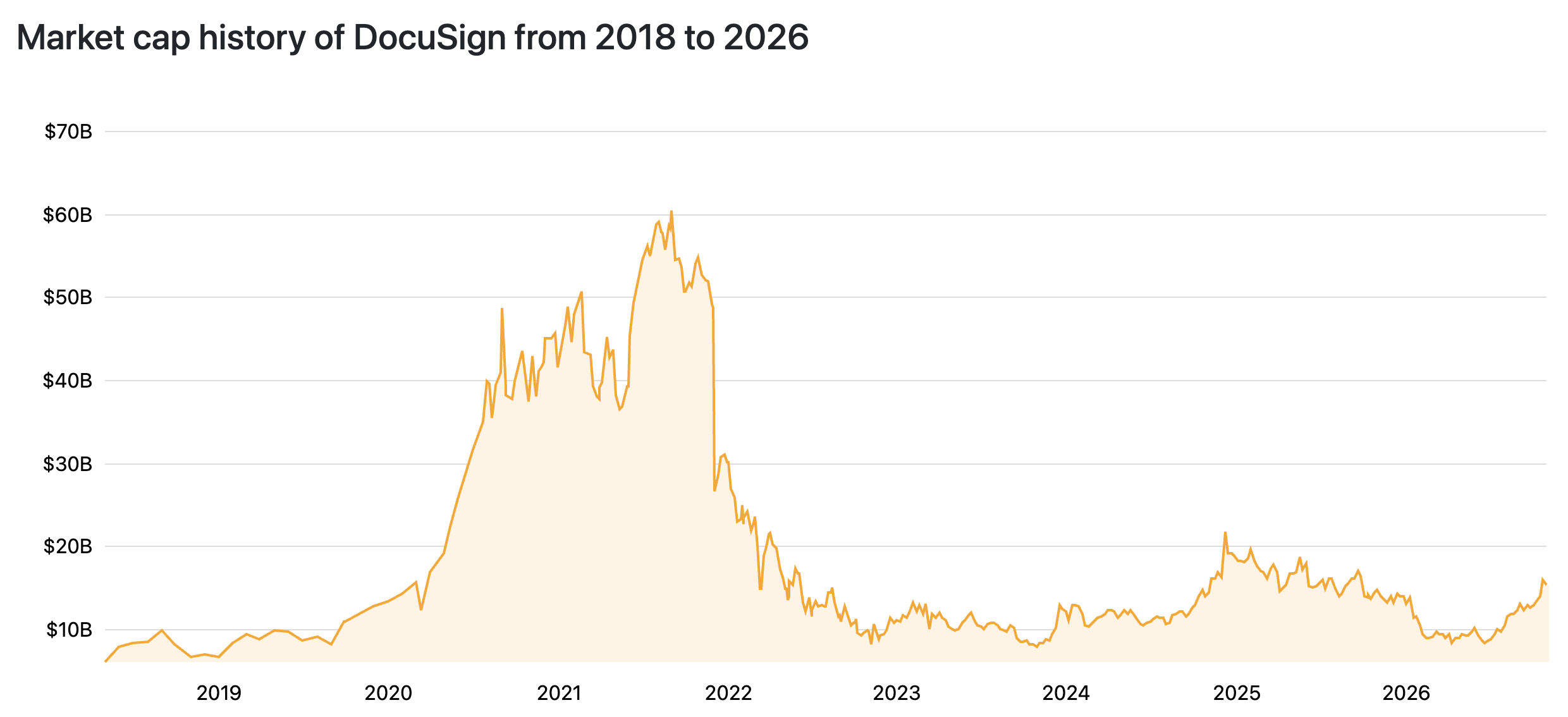
In the short run the market is a voting machine; in the long run, the weighing machine took over, as it so often does.
But AGAIN, what muddies the water is that these companies aren’t going from $1M to $3M of ARR and getting crazy prices. They’re going from $1M to $500M of ARR in two years and getting crazy prices. Maybe the Harveys or Servals really are the new thing: the law firms and consultants of the future, or whatever the multi-billion-dollar analogue is for any category being AI-ified.
“Software is eating the world” was mostly just software eating the low-hanging fruit: the work that was easy to turn into workflows or managed services. Plenty of AI so far has been chasing the same fruit, which is why so much of the early money in AI has gone into code and dev tools; it’s like we’re sprinting through a fever dream reminiscent of venture’s bread-and-butter post-2012. But maybe AI is what finally opens up the aperture of the “world” available for eating. Maybe now technology can eat the WHOLE world, not just the easy parts.
So, yeah… maybe everything is different this time. And if $10B+ outcomes are the new norm, and you’re deploying billions of dollars then you can’t afford NOT to bet on the one thing that becomes the future. But I dunno… in my mind, that’s the trap. Every check into the consensus feels like the responsible thing to do, and the more of them that return some cash in the interim, the more responsible the next one feels.
Pick A Number
Fun fact. Ask a random number generator to pick a number between 1 and 10, and every number comes up about equally. Ask people, and the answers spread out, with a bump around 6-8. But ask an LLM? Nearly every answer is 7.
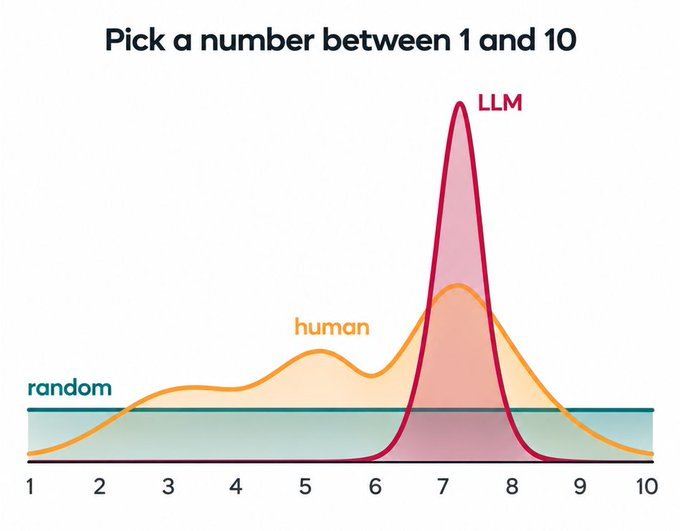
One guy called it the least surprising graph in the world if you understand how these models are trained. They predict the most likely answer, so not only do they pull everything back to the mean, but they dramatically exaggerate it. Feels poetically representative of venture capital today.
The heartache I hear from a lot of investors is that they don’t want to be technology skeptics, but they certainly feel like market skeptics. More on that in a second. But the reason I don’t default to technological skepticism the way that Ed Zitron and Gary Marcus do, whilst dragging their chains as the Ghosts of AI’s Past, I think, is because of the technological room to run in eliminating waste.
See, there’s a LOT of waste to normalize in human affairs. So much of the human economy was limited by things that have nothing to do with imagination. Code was limited by DevOps friction. Legal review was limited by readily available context. Image creation was limited by the slow click-and-drag of arranging pixels. So much of what we did as humans was spent hauling that baggage around. That’s why AI can rapidly generate billions and billions of dollars of revenue: people are thrilled to throw off the slow, mundane parts of the human economy and feel supercharged by how quickly new code, language, and images magically show up. It’s exciting!
Scientific discovery has always had the same problem. It’s so often a problem of context. In 1945, Vannevar Bush wrote As We May Think and imagined the Memex: a system that would hold everything you’d ever read and link it all together by association, the way the mind actually works. His motivating example of lost truth: “Mendel’s concept of the laws of genetics was lost to the world for a generation because his publication did not reach the few who were capable of grasping and extending it.” The vision got dumbed down over the decades because it was limited to human workflows. We ended up with people dragging and dropping files into folders and calling it “connectivity.”
AI might be the first real shot at the true vision of the Memex. In 1986, an information scientist named Don Swanson noticed that one body of medical research said patients with Raynaud’s syndrome had thick blood, and a completely separate body of research said fish oil thins blood. Weirdly, nobody had connected the two before. Isn’t everyone storing their blood disease notes next to their fish oil notes? Then, a clinical trial three years later found fish oil actually helped! It wasn’t a new experiment, it was just seeing people finally combine two existing pieces of knowledge that should have met before and just hadn’t. I’ve written before about the value of this dynamic as what some people describe as “ideas having sex.”
That’s how a lot of big things happen. Not novel ideas, but novel combinations. Webvan went bankrupt in 2001 trying to deliver groceries out of its own warehouses; Instacart worked a decade later using the grocery stores that already existed, plus smartphones and a gig workforce. Pets.com liquidated in 2000; Chewy sold to PetSmart for $3.4B in 2017, selling the same dog food on top of better logistics and a generation that actually shopped online. Even Henry Ford’s assembly line, the prototype for Ritzer’s whole book, was borrowed from the “disassembly” lines in Chicago’s meatpacking plants! Back in 1922, two sociologists catalogued 148 discoveries made independently by more than one person at about the same time, from calculus to the planet Neptune. When the pieces are lying around, somebody eventually puts them together.
AI is huge because it absorbs the waste inherent in human frailty. Lots of room to run there! However, what’s unclear is whether it will aid novelty, in particular, or absorb it.
The Velvet Cage
Remember Max Weber, the German sociologist Ritzer built his whole argument on? Weber spent the early 1900s watching bureaucracy take over everything, and in The Protestant Ethic and the Spirit of Capitalism he warned about where it ends. Once a society organizes itself around efficiency, the system evolves from a tool to a state of being. The bureaucracy meant to serve us starts to enslave us. He called that end state an “iron cage.”
Ritzer’s addition was that not everyone inside feels trapped. The same cage feels different depending on who you are. For some it’s velvet: they like McDonaldization, the predictability is a comfort, and they don’t want out. That’s the Huxley version of the dystopia, not the Orwell one. I’ve written before about Neil Postman’s point in Amusing Ourselves To Death that the real danger isn’t control forced on us; it’s that “people will come to love their oppression.” Nobody has to lock the velvet cage.
Right now, venture’s cage is about as velvet as it gets. Unlike 2021, it’s not just paper markups. People are seeing some legitimate, brag-to-your-mom levels of DPI. For a lot of people, that means the LPs are happy, and the agglomeration equation that survives and thrives atop the Unholy Trinity of Venture Capital rages on. That’s why it’s so hard to call any of this bad. I don’t think it’s producing worse outcomes, per se.
And maybe we’ll keep ripping some AI-fueled cocaine-esque ragers of massive revenue ramp, sensuous profitability, and delectable DPI while AI works out the kinks in the low-hanging fruit of human frailty. But, just like the McDonaldization in every other industry, all of the rational elements taken to the ultimate extreme will yield an extremely irrational outcome.
That’s the messy reality of nuance. The same tool can go either way. AI can be the slop feed that pulls everyone to the population mean, or it can be the Memex that finally connects the fish oil to the blood disease. As I wrote back in June, fire cooks a meal AND it burns down a house, and the difference has never been the fire’s decision.
I’ve said before that investments are a leading indicator of your beliefs. Incentives pull everyone toward the mean, and only beliefs pull you away from it. A McDonaldized system can’t imagine anything; it can only repeat what worked last time. Imagination has to come from someone who believes something specific enough to look wrong for a while. And the biggest danger to our current ecosystem is absolutely NOBODY wants to look wrong while everyone who looks consensus-aligned “right” is getting freakin’ rich.
The future has never come from the most likely answer. Sure, we’re paying everyone billions of dollars to get us to the most likely answer more quickly. And that’s fine for a good, long while. But sooner or later we’ll run out of futures we can invent from the average of the past.
This week in Networked Conviction 007, my investing journal for paid subscribers: I’m working through the death of patience, and why more shots on goal means less reverence for each shot, plus a Request for Startup for a new credit bureau. The first section is free for everyone; read it here.