Sailing Tailwinds

In September 2023, right at the peak of ChatGPT fervor, I remember Palmer Luckey made a comment that stuck with me because of how surprising it was:
“ChatGPT has probably been more helpful to Anduril with customers and politicians than any technology in the last 10 years.”
I distinctly remember reading that and feeling confused. “ChatGPT, surveil enemy perimeter and engage targets. Make no mistakes”? But in that same interview, he made it clear that Anduril’s products didn’t use ChatGPT.
Understanding how Anduril’s completely unrelated products rode such a boon explains more about building a company inside a hype cycle than almost anything else I’ve come across.
Where The Hype Happens
Palmer explained the mechanism this way:
“All of a sudden, you’ll have congressman who will go and use ChatGPT and he’ll type some stuff in and he’s able to use it and he’s able to see that it does things that he never imagined a computer could do.”
So what you’ve got is a member of Congress playing with a chatbot and walking away more willing to go to bat for spending millions of dollars on AI defense systems. Anduril’s actual software, Lattice, has approximately nothing to do with ChatGPT. But Anduril was able to take advantage of the biggest technology wave of the decade anyways.
I remember in January 2023 writing that, as compelling of a product as ChatGPT was, it wasn’t necessarily an isolated technological breakthrough, but it is one of the absolute best customer acquisition growth hacks we’ve seen in a long time.
What felt obvious was that ChatGPT was attracting millions of users. But I just assumed all the customers would be acquired by OpenAI. But turns out, some of them were Anduril’s.
That’s the thing about tailwinds; it’s usually not about the actual product, it’s what moves the buyer.
Someone Else’s Education Bill
In Cultivating Cults I quoted Nikhil Trivedi on why some products can never afford to teach their own customers:
“If the expected economic return on an acquired customer is low, any acquisition path that requires education of that consumer to the virtues of the product will inevitably lead to failure unless a macro tailwind or zeitgeist eventually eliminates the educational cost.”
Same vibe as Palmer’s chatbot-wielding congressmen.
OpenAI and its investors spent billions of dollars teaching the entire American political class that software can do things they never imagined. Meanwhile, Anduril’s sales team got the benefit of that education for a grand spanking deal, paying $0 for it.
Here’s my thinking on what a tailwind is. Not as simple as “the market is growing.” I think of a tailwind as a subsidy. Somebody else, for their own reasons, is temporarily covering a cost you’d otherwise have to carry yourself: customer education, recruiting, political will, the cost of capital.
From that same essay I made this point: if the zeitgeist fails then the cost of education becomes too high. I’ve also referred to this as the “fully burdened cost” of your product sans any subsidies, financial or otherwise.
We’ve all lived through those subsidy cycles, whether we’ve appreciated it or not. Some of them are zeitgeist-fueled capital subsidies: cheap food delivery, ubers, AI apps. Others are awareness subsidies: education, onboarding, tips-and-tricks. For example, in the early days of Roam Research, users like Nat Eliason were building full onboarding courses independent of the company. But as the zeitgeist faded, that happened less and less, and the bill came back to the company.
That’s the thing about subsidies… they don’t last forever. You’ve gotta make hay while the sun shines.
Casual Wave Riders
Back in July 2022, I wrote before about what goes into an investment thesis:
“You can have a powerful tailwind with no good company to ride it and you can have a great company with no tailwind. When developing an investment thesis it’s focused on both.”
Makes sense, right? You might have a wind with no ship or a ship with no wind. What makes the whaling expedition work is a ship with a wind.
But the Anduril example sheds some light on an exception to that framework: a great company riding a tailwind it isn’t necessarily using. Then, of course, there is the evil twin of that exception, which is a company that only exists because of the wind.
Turns out, I’ve spent a lot of time thinking about tailwinds. Just a couple months later, in September 2022, I described a thesis as two questions: (1) what is the powerful tailwind that exists independent of this company? and (2) how is this company well-positioned to take advantage of that trend?
Key phrase: independent of the company. But what I’m talking about here? A company independent of the tailwind. Well, maybe that’s too aggressive. But what I mean is a company that isn’t directly correlated to the tailwind, but able to ride it anyways.
So what does a company independent or uncorrelated to a tailwind look like?
Fair-Weather Ships
In early 2023 I saved a passage from Howard Marks where he quoted Julian Robertson writing to his investors about ship captains who had been rewarded for years for building fast boats instead of safe ones:
“The last several years have been a great period for the audacious captains with their fleets of fair-weather ships. There has not been a storm for years; perhaps climatic conditions have changed and there will never be another storm. In this scenario the audacious crew with its fleet of swift but flimsy ships is the cargo carrier of choice.”
I feel Julian’s vibes in my soul. You’ve come to pride yourself on recognizing a safe ship when you see one. But there hasn’t been a storm in years. Over time, the default assumption is to just optimize for swift and flimsy. That’s the smart trade.
But when the weather turns, just like you’re bed, you’ll have made your ship and you have to sail in it. The ship… not the bed. When the tide turns, the logic on what “works” changes. In the past, I’ve laid out how the stuff seen as virtues in good times flip to a vice:
- Fundraising: In a story-friendly time, fundraising is a point of strength. In a story-skeptical time, fundraising is a weakness.
- Customer acquisition: In a story-friendly time, CAC can be seen as a moat. In a story-skeptical time, marketing is an anchor around your neck.
- Hiring: In a story-friendly time, you want as many people as possible. In a story-skeptical time, every new employee is someone else that has to be bought into a story.
Every dependency you built into your business as an opportunity can be a failure point depending on the weather.
One real-time example of the subsidy sea shifting tides. The One Big Beautiful Bill Act, signed July 4th, 2025, ended the federal EV tax credit for anything bought after September 30th of that year and put hard deadlines on wind and solar credits. Shockingly, EV sales fell ~46% from Q3 to Q4. Ford took a $19.5B charge and killed their electric F-Series. E2 counted $34.8B of clean energy projects cancelled in 2025, nearly $3 abandoned for every $1 announced.
Now, nuance. Not all of that is cause of the credits. But the reality is that a lot of those projects only penciled out with the wind at their back (e.g. the subsidy). When the wind went, so did the math.
Funny thing, that same subsidy wind has shifted before too. Between 2006 and 2011, VCs put more than $25B into clean energy startups and lost over half of it. More than 90% of the cleantech companies funded after 2007 failed to return even the initial capital. Solyndra, A123, Better Place, Fisker. In the book, The Power Law, Sebastian Mallerby’s verdict on John Doerr’s cleantech push at Kleiner is my favorite one-sentence summary of the whole era:
“Whatever its existential importance, cleantech was a tough field for venture investors, and Doerr should not have suggested that large markets were the same as profitable ones.“
A large market might be a tailwind but a profitable business is a whole different ballgame.
So much capital was destroyed in pursuit of sustainability in the early 2000s that even when the technology became viable, a huge swath of capital just won’t touch it. A reversed tailwind doesn’t just sink the fair-weather ships, it keeps everyone else in the harbor for a decade.
(My gawd, I’m stretching like six different metaphors to the absolute margins in this piece.)
Momentum Is A Boat
Now, in those fair-weather times, there’s a common refrain that rears its filthy head. “Momentum is the only moat.” When “momentum is the only moat” was making the rounds last year, Alex Immerman at a16z pushed back with a great clarification:
“Momentum is not a moat. But momentum is a boat. It is what gets you to the island where you can build a fortress. At early stages, there are no moats. But you can have momentum. And momentum is a critical ingredient that catalyzes defensibility.”
For an essay about sailing, how am I supposed to walk away from that one?
And my two favorite examples of companies that survived a bubble make Immerman’s case for him.
First example? Amazon. The cash from Kleiner Perkins hit the place like, in one employee’s words, “a dose of entrepreneurial steroids.” The motto was literally Get Big Fast. And on February 16th, 2000, Amazon closed ~$672M. The NASDAQ peaked on March 10th, 2000.
Three weeks later!!
The stock went from ~$113 in December 1999 to ~$5.50 in 2001, down ~95%. And Amazon walked through the bloodbath with almost a billion dollars of bubble money in the bank, raised at the absolute top.
Bezos used the bubble to weather the pop.
Tesla is no cleaner (lol). The company that “prevailed through the green bubble” was about three days from bankruptcy in December 2008. The round that saved it closed at 6pm on Christmas Eve. In Musk’s words: “Last hour of last day possible.”
Granted, both of them were most certainly riding the winds. But what they did once it turned is almost more instructive.
Amazon swapped Get Big Fast for a new mantra: Get Our House in Order. Discipline, efficiency, eliminating waste. And Bezos scrawled a line on the whiteboard in his office that I think is the single best description of a worldview I’ve ever read:
“I am not my stock price. You don’t feel thirty percent smarter when the stock goes up by thirty percent, so when the stock goes down you shouldn’t feel thirty percent dumber.”
Cuts both ways, too. Not just “ignore the haters,” but “ignore the fans”, too.
Tesla’s version, I think, was building a car people wanted for reasons that had nothing to do with the green wind. When I wrote about Lowercarbon a few years ago, the breakthrough I kept coming back to was simple: greed goes further than guilt. The key characteristic of Tesla in the early days wasn’t that it was a janky, but clean, car. It was a better, flashier car. In the words of Gordon Gecko, “greed is good.”
So if I stretch Immerman’s analogy to the absolute max, the boat gets you to the island. Momentum gets you in the game. But it doesn’t tell you what to build when you get there.
This is also how I square this essay with the one I wrote in February arguing that the AI bubble is productive. Bubbles lay infrastructure on someone else’s dime, and because of that I can understand why hype is not always bad. Every once in a while it just needs to deflate and flush out the hucksters. Both things can be true because they’re describing different units. Bubbles are great for ecosystems, but they can be lethal for individual companies.
What People Build
On a podcast this past summer I made this point: Most people don’t have a deliberate worldview of what their product should be in the long run. Instead, they have a sense of the game they should be playing: the fundraising game, the markups game, the big-press-release-partnerships game.
And it can seem sort of obvious why people trade down into crappier, short-term games. A worldview is slow, lonely, and falsifiable. A game is legible, scoreable, and always in season.
I’ve written before that a fungible mindset leads to a fungible worldview, and that people increasingly stand for very little. We don’t do things because they’re right. We do things because of what they lead to. For people, that can be a comment about character. For companies, I think your character is most on display on your balance sheet.
A company that stands for nothing has nothing underneath the momentum when the momentum goes away. What Buffett referred to as, “finding out who’s been swimming naked when the tide goes out.” There’s no “well, we always believed X, so now we do Y.” There’s just the game, and the game is over. A fungible worldview isn’t just a moral problem. It follows you around, even when you wish it wouldn’t.
Yet another example, the vast majority of 2021 crypto companies weren’t building toward a view of the world. They were just building around a moment in time.
Surviving Being Priced
Palmer jokes that 2022 and 2023 were his “I told you so” tour. After the Russian invasion of Ukraine, he could put his worldview on display that he’d been articulating for 5 years and show how right he was. Funny enough, when Anduril was founded in 2017, defense tech was radioactive, while everyone was busy paying attention to crypto.
What’s crazy is that, in 2022, with a war raging in Ukraine, Anduril still had a hard time raising. As I told the story earlier this year, the broader market was collapsing in the post-ZIRP hangover, and some investors who had promised to invest pulled out. Two winds were blowing at once, one at their back and one in their face.
That’s the same company Palmer describes as having lived through four different “weather systems”: a defense company and an AI company when neither was exciting, then AI exciting and defense taboo, then both exciting at once. His answer every time was that he doesn’t care about those cycles. They’ll ebb and flow; sometimes they make life easier, sometimes harder, but he’ll keep going toward his North Star.
In 2025 I wrote that Anduril was deeply hype countercyclical in 2017, and is now riding a moment of American Dynamism-branded hype. That moment may pass. But for the same reason that it doesn’t matter what people think when they hate what you’re doing, it also doesn’t matter what people think when they love what you’re doing.
But one company’s staunch worldview, come hell or high water, can just be the canary in the coal mine for other companies that may not weather the storm (my goodness, the analogies have just completely fallen off the hinges today.)
Here’s what I mean. In May, Anduril raised $5B at $61B. Then, in July, it was reportedly in talks at ~$100B. On the ~$4.3B of 2026 revenue it forecast to investors, that’s ~23x forward revenue. The median cloud software company trades at 4.2x. Even the high-growth median is 18x. High, but perhaps founded in buying into that world-domination worldview.
But it’s not just Anduril. Helsing at $18B. Castelion at $13B. Shield AI at $12.7B. Saronic went from $4B to $9.25B in about a year. Early-stage defense startups are raising at 17x to 50x revenue. 2025 saw a record $9.6B of defense tech venture funding, then $14.6B in the first five months of 2026. Use a broader definition across defense and aerospace, and you’ve got ~$70B of defense investments over the last twelve months!
Even the people at the center of it are saying it out loud. Brian Schimpf, Anduril’s CEO, said this summer, “I do think there’s a bit of a bubble.” Trae Stephens, his co-founder, put it more bluntly: “At some point, that music’s going to stop, and there are going to be real business expectations.”
The wind in defense has turned before. In Skunk Works, Ben Rich describes the Reagan buildup, when defense industry sales grew 60% in real terms in the early 80s. Then the Cold War ended. As The Kill Chain puts it, “When the Soviet threat disappeared, any sense of urgency in military acquisition went with it.” By 1993 the Pentagon was telling the primes to consolidate, and ~51 of them became ~5.
And the gusts are starting to eerily blow through all our dreams. On September 1st, Congress passed a continuing resolution that holds defense at an $838.5B baseline against a $1.5T request. The Pentagon’s 38th CR in 50 years.
*checks notes
Totally stable operating environment, right?
Now, I don’t think the defense wind reverses because of peace. My guess is it reverses because one of the golden children in the would be Neo Primes blows up badly, and investors suddenly realize not every defense company they back is going to be the next Anduril. When that underwriting muscle goes away, you have a whole swath of carpetbagger VCs that suddenly get very panicked. One way, or another, they’ll learn the hard trickle effects of the power law. There are not going to be 30 new defense primes.
Don’t get me wrong. I literally wrote the book on Anduril. I believe the thesis, and my guess is Anduril is one of the few that makes it through. But the test of a worldview was never whether it survives being hated, but whether it survives being priced.
Being hated can be clarifying. Everyone who stays is a believer, because there’s no other reason to be there. Being loved at 23x forward revenue is where you find out whether the discipline was a conviction or just a constraint. What’s the saying? No atheists in a foxhole? There’s also no atheists when your last post-money was bigger than your TAM estimate from the year before.
Would You Still Build It Tomorrow?
“Have conviction” is kind of a useless place to land, because conviction is cheap to claim and impossible to audit. Here’s what I think is a runnable test.
Would you still build this exact company if the wind reversed tomorrow morning?
If it was no longer cool / hip / sexy / hot to build the Neolab for XYZ, the Foundation Model for ABC, the AI rollup for EFY, the vertically integrated manufacturer for WTF… would you still do it?
Not “would you keep going.” Everyone says yes to that cause they’re Mom told them to have grit. I mean: (1) would the product still make sense, (2) would the roadmap and the hiring plan survive, and (3) would anyone still pay the price you’re charging?
One particular tweet from the dark days of 2022 often comes to mind:
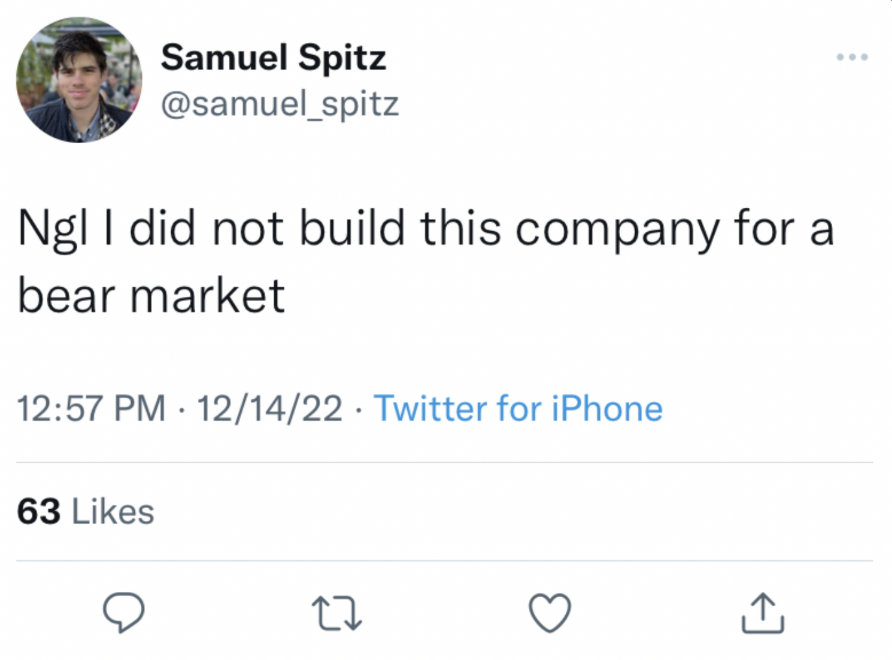
I both hate that sentiment, but respect that honesty. But the reality is if you didn’t build a company to survive in good times and in bad, then you didn’t build a company. You built a bag. Get that bag, if you can, but don’t expect us all to treat it like a long-term durable business.
If the honest answer requires the funding environment to hold, or the category to stay hot, or the press cycle to keep running, then what you have isn’t a worldview. You’re just a fair-weather fella (…or lady).
Palmer’s posture is this: happy to take advantage of it as long as it comes, and clear-eyed that it’s going to come and go.
Just build something that would still work if nobody had ever heard of ChatGPT before.
Referenced in
- Zero To One book