The Death of Venture Capital's Short Kings

Back in November 2010, a rumor was floating around that Union Square Ventures was raising a third fund of ~$500M, more than 3x the $156M fund it had closed two years earlier. When asked about it, Fred Wilson responded about as unambiguously as a VC can respond to anything:
“We will never raise a large fund. We like the small fund model and are completely and totally committed to it.“
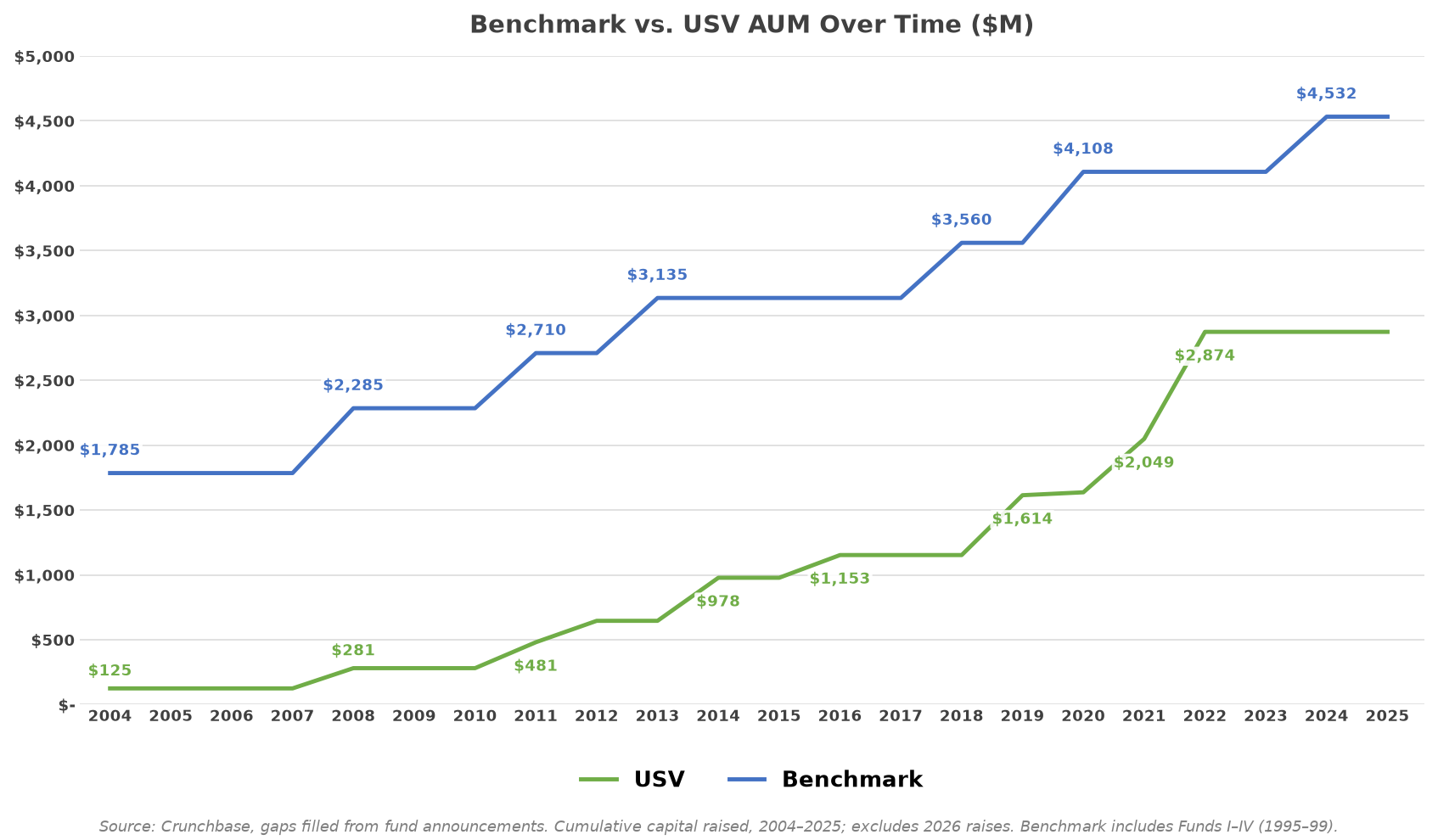
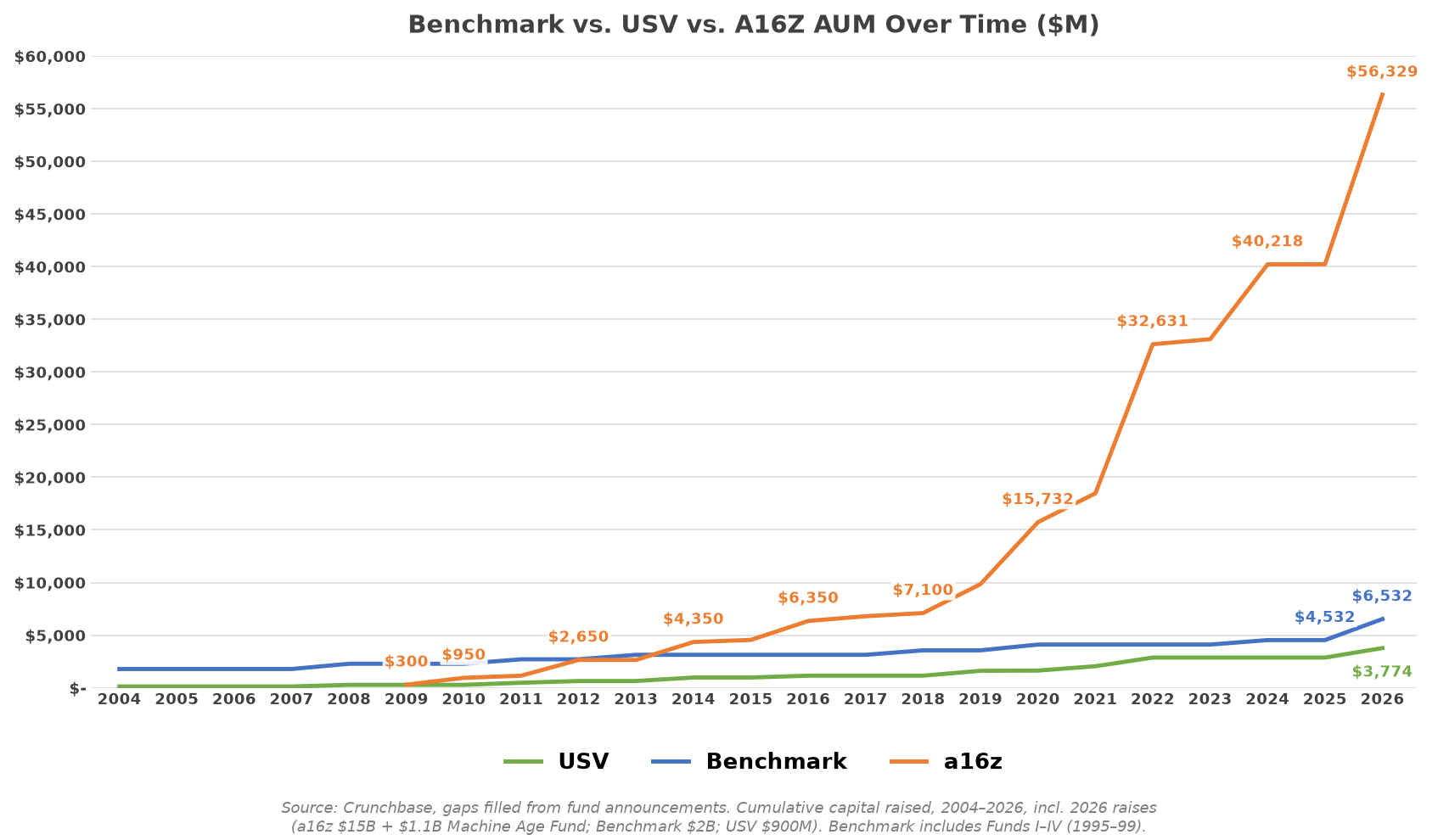
But a lot can change in just under two decades. This week, USV announced $900M across its newest set of funds. The largest fund cycle in the firm’s history.
Now, $900M is NOT a large fund by 2026 standards. a16z raised a $15B fund in January. But it’s a large fund for USV. And it comes ~4 months after the other patron saint of small funds, Benchmark, raised $2B in new funds. That included its first ever growth fund, and it was the first time Benchmark had meaningfully scaled up since 1999.
For years, these two firms were the short kings of venture capital. Benchmark and USV weren’t small because nobody would give them money; LPs were practically begging them to take more. They were small on purpose, and proud of it.
But now the crowns are coming off.
I’ve written over and over again about the split in venture between Cottage Keepers and Capital Agglomerators. Back in June, I had to mark the moment Benchmark broke ranks, and I said the Cottage Keepers were getting rarer, not stronger. USV’s announcement kind of completes the set. There are now basically two types of venture firms: those who CAN raise massive funds, and those who CAN’T.
So I want to do a few things. First, a very brief rehash of how venture was born up out of a cottage industry. Second, what changed. Third, whether all this extra capital is even a good thing. Fourth, what Benchmark and USV themselves say about why they made the jump. And then finally, where I land, which is a bit more nuanced than “big funds bad.”
The Cottage Era
People like to call venture capital a “cottage industry,” almost like calling it a mom & pop shop. As I’ve written before, I don’t think that’s quite right about the industry. The first big wins were Arthur Rock backing the Traitorous Eight with Sherman Fairchild’s money, or Georges Doriot’s American Research and Development putting money into Digital Equipment Corporation. Big dollars, big egos, big outcomes. Not much of a cottage-based yarn spinning operation.
What people mean is the partnerships. Firms like Benchmark or Accel historically ran with ~6-9 partners. A handful of people chasing founders and making decisions, rolling up their sleeves alongside the founders they backed. Tom Perkins put it this way: “We will work with entrepreneurs in an entrepreneurial way… We will be in it up to our elbows.”
Benchmark was the textbook example. Equal partnership, equal economics, and a fund small enough that every deal had to matter. And for a long time, the model was undefeated. Benchmark’s eBay investment is just one canonical story:
“Benchmark’s stake was worth an astonishing $5.1 billion… it had been achieved by risking a mere $6.7 million worth of capital. Benchmark’s cottage-industry style of venture capital suddenly looked inspired. Who needed to write outsized growth-capital checks?“
When the idea of a bigger fund came up, Bob Kagle, a former Benchmark partner, pushed back saying: “We might overcapitalize companies… I don’t want to follow everyone else into big-check-dom.” Little did he know that big-check-dom was just getting started.
USV built the same religion on the East Coast. Despite being asked by LPs to raise $1B+ funds, they kept fund sizes around $250M for years. In 2022, Fred said it plainly: “We don’t need more firms deploying $10B. We need lots of little venture firms deploying $100M. It results in more choice for entrepreneurs.”
The philosophy of the Puritans, as I called them, was that there just aren’t enough truly exceptional companies to justify multi-billion dollar funds. Your fund size is your strategy, and the strategy was to be small enough that only the truly exceptional could move the needle.
The Unholy Trinity
But then things changed.
Back in 2022, a friend explained the asset manager business model to me as the business of multiplying 2% by as large a number as possible. If you’re managing $20B instead of $1B, you’re collecting $400M in fees each year instead of $20M. Whether you like it or not, business building is the marketing of venture capital, but asset management is the business model.
And that business model found a perfect storm of partners to expand it dramatically. In 2024, I wrote about the Unholy Trinity of Venture Capital:
- Agglomerators who could run further and faster with bigger funds, more fees, and bigger platforms.
- Allocators, like sovereign wealth funds and pensions, looking to park $250M a pop and hit a 7-8% yield target without being the majority of the fund.
- Absorbers with an endless supply of places to shove cash, from training and inference to marketing and lobbying.
A match made in heaven. Maybe not the heaven, but certainly a heaven.
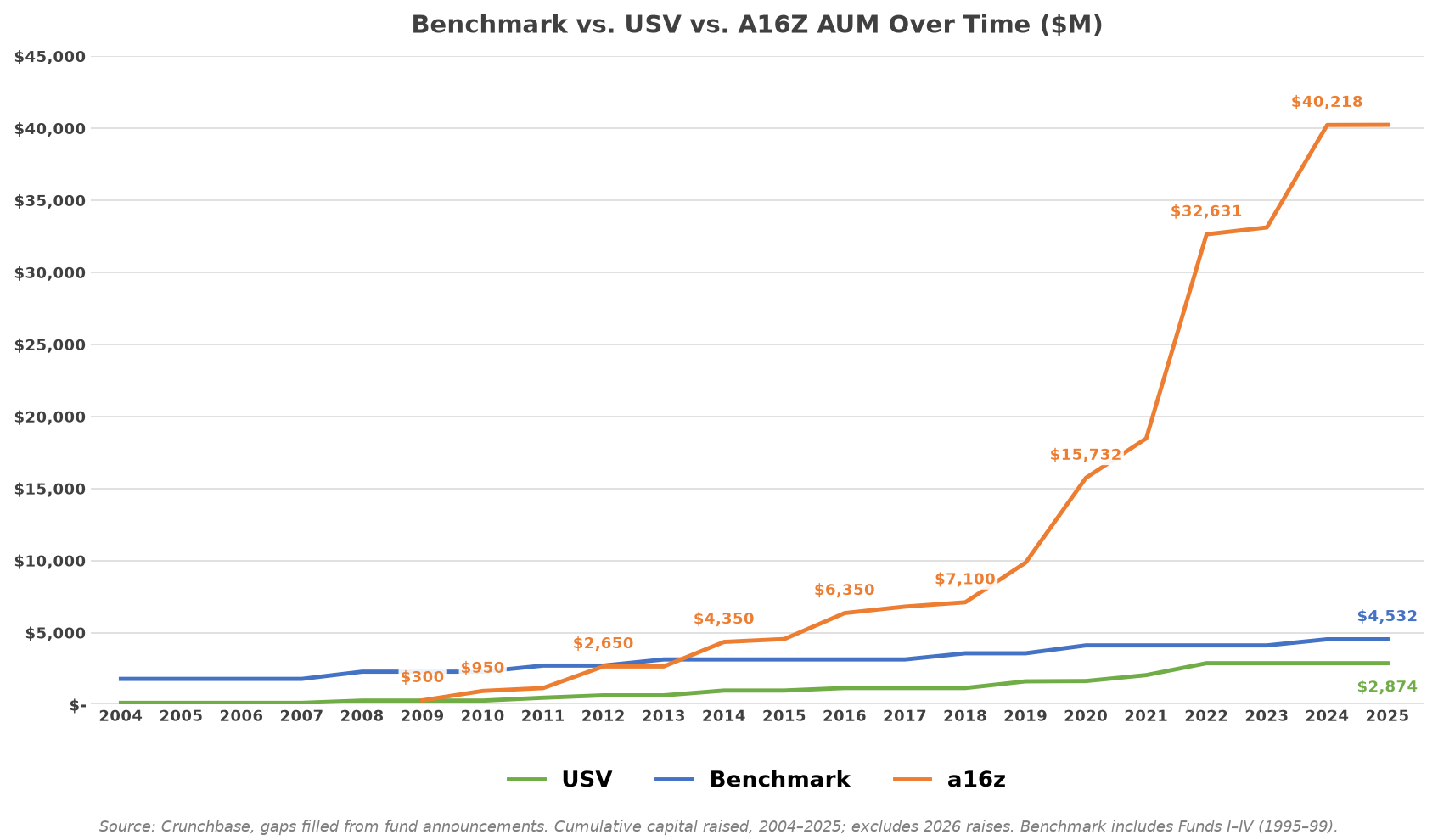
The scoreboard since then is all kinds of absurd. By 2025, a16z was north of $40B in AUM, and captured over 18% of all US venture dollars in 2025. In Q1 2026, ~73% of LP capital raised went to just five firms. Benchmark, before its new raise, was sitting at roughly $4.8B. That’s an 18-19x gap.
And then AI poured gasoline on the fire. In 2023 I described it as an unstoppable force of reality-altering AI and an immovable object of capital agglomeration screaming towards each other. Turns out they were a match made in the same heaven. AI companies absorbed 81% of all US venture capital in Q1 2026, up from 55% a year earlier. OpenAI raised $122B at an $852B valuation, the largest private round in history. I remember when people balked at SoftBank raising $100B fund lol.
What AI really did was convince everyone that outcomes can become consistently bigger. A trillion is the new billion. Back in 2020, Michael Dempsey pointed out that the traditional LP view was that ~90% of exits are under $300M, which is why fund size matters. But “as narrative has risen that TAM of tech is larger than appreciated, GPs will aim to blow that POV up.”
And blow it up they did. Even the short kings are believers. Last year, Peter Fenton told Kate Clark he’s “convinced trillion-dollar AI companies will be built in the next few years, and that losses ‘like we’ve never seen before’ are coming too.” When the most staunch Cottage Keeper on the planet is underwriting trillion-dollar outcomes, the definition of a cottage has changed, right?
Is Bigger Better?
So is all this capital good or bad? Does more money lead to more great companies?
Late last year, Roelof Botha at Sequoia made the case that it doesn’t:
“If you look at the data, there are basically 20 companies per year on average over the last 20-30 years that have ended up being worth, in realized exits, a billion dollars or more. Just 20 companies. Despite a lot more money plowing into venture capital, we haven’t seen a material change in the number of companies that are outcomes that are that large.“
There was $215B of venture funding in 2024, up from $48B in 2014. I’ve pointed out before that despite allocating 5x the capital, we don’t have 5x the outcomes. Capital is NOT the primary constraint in world-bending innovation. From 2002 to 2024, SpaceX raised ~$10B while NASA’s total budget was $435B. If capital was the only mighty unlock needed, NASA would own the moon and we’d be celebrating the opening of the first McDonalds on Mars by now.
But there’s another side to this. Back in June, I wrote about it:
“I got into a debate with another VC once about whether the total volume of VC-backed outcomes has increased and he pointed to dozens of companies valued at $10B+.“
His point was basically: look at the outcomes! Databricks, SpaceX, Anthropic. $100B+ is the new benchmark (lowercase b). Databricks alone, at $134B, would be bigger than all but 38 public tech companies. The ceiling is higher than it’s ever been, and you need big funds to own meaningful pieces of companies that big. So sayeth the capital agglomerators, shouting from the rooftops!
And frankly, I used to make a version of that argument myself. Back in January 2022, I said venture “isn’t a cottage industry anymore.” In 2006 there were 387 US companies generating over $1B in revenue; today there are over 4K. As that number has only grown, there will be more large outcomes, which will continue to attract more capital. More capital, more venture firms. And so on, and so forth.
Granted, the ceiling really has gone up. But the number of companies that reach the ceiling hasn’t grown in proportion to the capital chasing them. Of all the companies that have ever gone public, less than 5% will be worth more than $10B and less than 1% will be worth more than $100B. And my answer to that VC is the same today as it was then: a lot of those giants are still marks, not money. There’s $3.2 TRILLION in unrealized value locked in the private markets. If it materializes, great! But it hasn’t yet.
I guess my read is that both can be true. More capital can make the biggest outcomes bigger without making there be more of them. The power law gets taller, not wider. And if you’re a fund that needs those outcomes to survive, a taller power law is a terrifying vantage point.
Hanging Up The Crown
Here’s the thing. Benchmark and USV have both made more money at the venture game than I have. By a lot. So why would you listen to a VC writing a blog over the partnerships that backed eBay, Uber, Twitter, Coinbase and Etsy? This isn’t me passing judgement. It’s more of an observation. The two grandest, final remaining Cottage Keepers both took off their short king crowns and stepped into the ring with the big boys, which tells me they see it as a necessary strategic decision. So the more interesting question is WHY.
Start with USV, since they just did a whole episode on it. Rebecca Kaden put it simply: “The market has evolved… the outcomes are bigger, the swings are bigger.” Rounds are bigger, more expensive, and faster. A typical Series A, she said, now starts at $10M, and USV wants to write $10-30M checks to lead them.
Fred gave the historical anchor. Twitter’s original financing was $5M, then $25M a year later, then $100M a year after that. Multiply by 10 and you get today’s round sizes. On top of that, compute is a cost line that wasn’t really there before, and AI startups are subsidizing inference to reach critical mass, because nobody pays for what ChatGPT and Gemini give away for free.
But what struck me was how hard they worked to say the religion hadn’t changed. Mike Mignano said they “don’t raise funds as vanity metrics.” And Fred again:
“I don’t think a trillion is what we need to underwrite to at USV. I think if our biggest winners are in the single-digit billions given our fund size and our ownership, we can produce really really healthy returns for our partners.”
My favorite detail? Kaden said she was surprised how many LPs asked, “Are you sure you shouldn’t raise more?” Mignano’s answer was that when funds get really big, “it potentially distorts the incentives a bit.” So USV raised the biggest fund cycle in its history, and still thinks of itself as the small fund in the room. Which, relative to a16z, it is. Classic venture, with a twist.
Benchmark’s story is weirder. In February, all four Benchmark partners sat down with Jack Altman on Uncapped to explain why they stayed small while everyone else scaled. Peter Fenton: “The outcome of maximum cash on cash multiple, I think, is degraded with scaling.” Eric Vishria: “It’s not financially maximizing. It’s happiness maximizing.” Chetan Puttagunta explained that because Benchmark doesn’t play in future rounds, they’re fully aligned with founders on dilution. And Fenton, on what happens once a market has a clear winner: “As soon as there’s a winner, we’re kind of uninterested.”
Four months later, Benchmark raised $750M for early stage and $1.25B for a dedicated growth fund, built to make five or six large bets in existing portfolio companies and new startups. The way they explained it, the trigger was Cerebras. Benchmark put $225M into an SPV for a pre-IPO round, and the IPO returned $3.25B. That kind of windfall makes the “we don’t do the future rounds” ethos a little harder to justify, I guess. 🤷
But I think the deeper reason is something Sebastian Mallaby flagged in The Power Law years ago:
“Benchmark repeatedly found that reckless later-stage investors seized effective control of its portfolio companies by stumping up tens of millions of dollars. Unable to muster equivalent sums, Benchmark lacked the muscle to protect startups from the hubris that came with so much capital. In two notorious cases… Uber and… WeWork… Such was the limitation of the cottage-industry model.”
I wrote in 2024 that Cottage Keepers and Agglomerators have to co-exist, because if a company goes on to be a cash inferno, it NEEDS capital agglomerators. Smaller funds may think they’re immune, but they have to compete with the prices those agglomerators are willing to pay. The short kings didn’t stop believing in small; the value chain of capital made being small a liability for the founders they back. If the decisive rounds are all downstream, and the downstream is owned by giants, then the only way to protect your founders is to grow big enough to sit at that table.
Hammer-Shaped Assets
So where do I land?
It’s not that AI companies are pretend outcomes, though plenty of them are. And it’s not that every AI winner will be, or can be, a trillion dollar company, cause they can’t. It’s more what I’ve written before: “venture capital” has become a grab basket for a LOT of different things. Seed stage investing, traditional venture, supercharged growth investing, and what used to be small cap growth tech stocks. We do ourselves a disservice by keeping it all in one basket. There need to be structurally different mechanisms for different types of outcomes.
However, the most dangerous weight around our neck, unfortunately, is the value chain of capital. Seed investors can’t just invest in what they think is a good company. They have to invest in what they think Series A investors will want. Series A investors have to invest in what Series B investors will want. And on and on, an endless run of bag-handers and bag-holders. Investors aren’t measured by ultimate outcomes, but by intermittent ones. The snake keeps eating its own tail, while nobody along the way is spending much time thinking about what would just… you know… be a good business.
That same dynamic is what poisoned private equity. The old buyout model was to buy a company, work alongside management, grow it, and then sell it. Optimize and harvest. But as PE firms tiered up and down the stack, that strategy got increasingly predatory. You didn’t have to build a good business that would last. You just had to build a business that a bigger PE fund would buy, and on and on. Ted Forstmann saw it coming in the 80s. As Barbarians at the Gate tells it:
“No longer, Forstmann believed, did buyout firms buy companies to work side-by-side with management, grow their businesses and sell out in five to seven years… All that mattered now was keeping up a steady flow of transactions that produced an even steadier flow of fees.“
That’s how you get trashy massive assets that keep trading hands, racking up fat fees for bankers and lawyers while creating very little of value. Payless ShoeSource went through seven years of private equity and hedge fund stewardship, and for every dollar that came in the door, it paid out $1.09 to its owners and 26 cents to its lenders. One former executive put it about as bluntly as you can: “they do not, do not, know how to operate a retail company.” Gross.
And the venture version is already showing up. Eric Newcomer observed back in 2024 that the “lesson of private equity would be that many big VCs should become AUM machines. and that would appear to be what they are doing. of course no one wants to say that’s what they’re doing.” Because exits aren’t coming fast enough, the fund structure itself is getting rebuilt with continuation vehicles, NAV loans, tender offers, and GP-led secondaries. Assets passing from one fund to the next.
The same could very well happen in venture. We’re aggregating billions of dollars in hammer-shaped assets; we can’t then be surprised when everything turns out looking like a nail. I’ve said before that to anyone with a billion-dollar fund, every company looks like a decacorn. And to someone with a billion-dollar war chest, everything looks like a spend-money problem. Wealthfront spent 17 years building a company that does $308M in revenue and $123M in net income, and by the logic of a multi-billion dollar fund, that company is a failure. It’s not interesting. The way you build a company dictates the outcomes that are available to you, and the hammer is deciding how everything gets built.
Building What’s Fundable
There’s got to be a better way to internalize the north star of building good businesses, not hot venture ponies to bet on. But as the short kings fall away, that becomes less likely.
The Cottage Keepers were never perfect. Plenty of small funds were just mediocre with nicer branding. But some of them, like Benchmark and USV were, I think, truly special. They were the clearest proof that you could play a different game. A firm that only needed single-digit billions could back a company that would only become a single-digit billion dollar company. Every time one of them grows into the next weight class, the set of companies that can move its needle shrinks. Buffett said it about Berkshire: “We weren’t smarter then, just smaller.” The size that makes you powerful is the same size that makes whole categories of opportunity invisible to you.
The unfortunate reality is that rather than embrace alternative ways of building businesses (permanent capital, HoldCos, revenue-based financing, or just bootstrapping a calm company for longer), we’re going to keep reinforcing the normative funnel of “building what’s fundable.” Startups of a certain shape and shimmer, built to look like what the next round wants rather than what customers need, necessarily. And I think that’s net negative for the broader business building mechanism.
Now, the more relentlessly capital concentrates at the top, the larger and more underserved the long tail at the bottom becomes. Somebody is going to figure out how to serve it. I hope they do. But they’ll have to do it with two less short kings.
Long live the agglomerators, I guess. Just don’t be surprised when everything they build looks like a nail.