Dynasties Die In The Dark

In November 2018, an Amazon employee stood up at an all-hands in Seattle and asked Jeff Bezos what lessons he took from the bankruptcy of Sears. You see, Sears had recently given up the ghost, filing for Chapter 11 just a few weeks earlier. Perfectly reasonable question that received what I can only assume was a very surprising answer:
“Amazon is not too big to fail. In fact, I predict one day Amazon will fail. Amazon will go bankrupt. If you look at large companies, their life spans tend to be 30-plus years, not a 100-plus years.”
The job, he said, was to delay that day as long as possible.
I think all the time about the audacity of being able to buy into the vision of world domination for Amazon back in 1999. I’ve written before about that audacity: an online bookstore telling you it will build the largest logistics network in the world and power a third of the internet. But boy, did they deliver. Yet, here’s the architect of their domination, still willing to openly acknowledge the organization’s mortality.
Now, lately, I’ve been running the tape the other direction. Imagine a world where Amazon has sold off its major business lines. AWS is gone; sold for parts. The marketplace is gone, hollowed out into a third-party licensing business. Prime Video has been rolled into a subsidiary within Vimeo, who has become the dominant social app in the US (go figure). All that’s left is a warehouse real estate business. Then, one day, Amazon sells that to a REIT and the Amazon company ceases to exist.
That would have seemed insane in 2018 when Amazon was was worth ~$700B. It feels even more incomprehensible as a nearly $3 trillion company.
But there’s a wealth of instruction, I think, in studying the death of dynasties. Sure, it hasn’t happened to Amazon… yet. But to Yahoo, Sears, and on and on. In fact, it’s happened to companies over the centuries that have literally ruled continents; heck, the Roman Empire itself had a similar fate. The playbook of perishing is remarkably consistent.
Two Kinds Of Dying
I’ve written before that extinction for a company can come at any time, whether its a sudden death (Quibi) or a languishing descent (GE). Most of what gets written about corporate death is about the first kind. Enron, Theranos, Lehman, FTX; the bad boys. The RJR Nabisco buyout, as chronicled in Barbarians at the Gate, reads like a historical tragedy. Those deaths, often, have headlines because they happen within a relatively contained moment.
Maybe it’s a dividend redemption act, some kind of reverse stock split, maybe a Form 8-K about a sneaker store’s “athletic identity” or a certificate of dissolution filed in Delaware on a Friday at 4PM or a brand licensing deal where a traditional company name gets quietly retired..
Reading the Berkshire letters a while back, I wrote a note to myself next to a passage where Buffett describes how, on a daily basis, the effects of a company’s actions are imperceptible, but cumulatively their consequences are enormous. My note to self: failure is rarely death by sudden implosion and more often a slow death by a thousand cuts over years.
The thousand cuts don’t make the news which, like most things done in the dark, make them much harder to study. As a result, I wanted to do something specific in this piece. For each dynasty, I wanted to find the exact document that ended it. Not the “in retrospect” summary of all the things leading up to it, but that specific piece of paper with a date that most people don’t really notice when it happens.
What was interesting about these “unnoticeable” corporate death certificates is that the press release is always about something else.
The Press Release Is About Walgreens
Let’s start with GE, cause I’ve picked on GE over and over and over again and I’m not done.
GE was founded in 1892. It was literally one of the original 12 companies listed when the Dow was created in 1896, and a member continuously from 1907 on. At its peak on August 28, 2000, it was worth ~$594B, the most valuable company on earth. Any company that can survive 129 years is doing something right, no?
No. Enter Mr. Ruin Everything himself, Mr. Jack Welch. The corporate specter of death. Anywhere there is large scale failure and truly awe-inspiring financial tom-foolery, somewhere lurking in the P&L shadows is the ghost of Jack Welch, shaking his chains. Under Welch, GE made nearly 1K acquisitions for ~$130B, sold 408 businesses, and let GE Capital grow to 40% of revenue and 60% of profit. It met or beat Wall Street’s expectations for nearly 80 quarters in a row, partly by pulling shenanigans like selling half a parking lot at the close of a quarter and buying it back later. Atoms down, vibes up.
Want to see what “vibes up” looks like on a chart? See below. GE’s return on invested capital divided by its cost of capital, every year from 2000 on. Above the white line at 1, GE earned more on its money than the money cost. Below it, the company was destroying value, including in the quarters it “beat.” Noice.
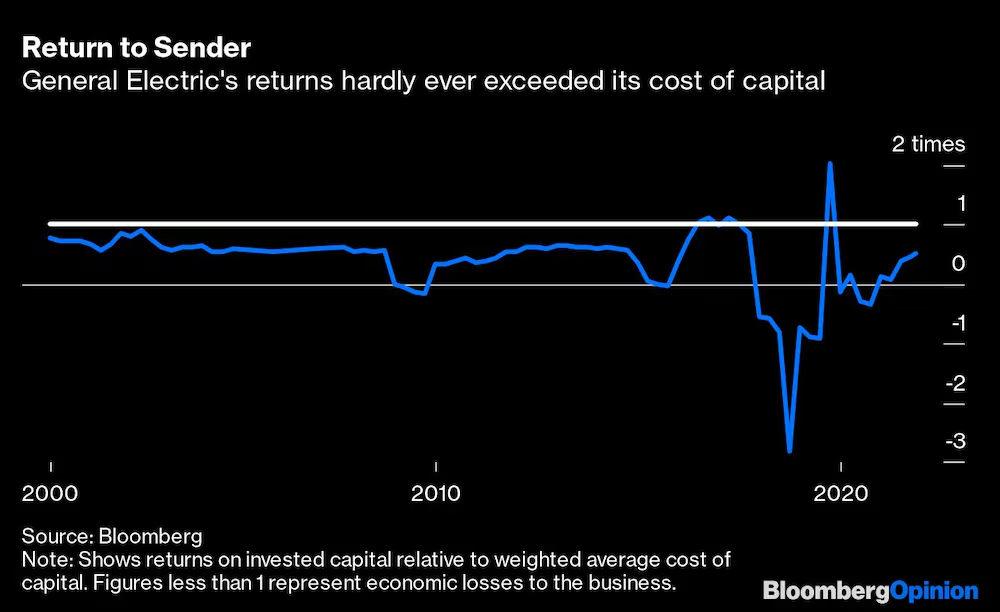
Look at where the line sits. From 2000 until about 2016 it just… hangs out around 0.5. Not in a crisis, but pretty much crap. The most valuable company on earth in 2000, the one beating estimates 80 quarters running, was earning roughly half of what its capital cost, the whole time. Welch’s entire legend happened below the white line.
Then look at the rest of it. The dip below zero in 2009 is GE Capital nearly taking the whole company down. The crater in 2018 is the $22B write-down in the power business, the same year the dividend went to a penny. And the one real spike above 1? That’s 2020. If I’m reading the timing right, that’s the year GE sold its biopharma business to Danaher for ~$21B and booked the gain. In twenty years, the only time GE’s returns clearly beat its cost of capital was the year it sold a huge chunk of itself.
Here’s the thing. Nobody was hiding this chart. ROIC and cost of capital are two numbers any analyst can pull. But the number everybody watched was earnings per share, and that number went up and to the right for 80 quarters. The number that mattered sat at 0.5, and nobody sent a press release about it. That’s what dying in the dark looks like: the lights were on the whole time, just pointed at the wrong number.
Granted, none of that was the fateful death event. All that stuff was the illness. So when did GE actually die?
It wasn’t in 2001 when Welch left. Nor was it in 2008 when it needed Buffett’s money as a lifeline. Not even in 2018 when the dividend went to a penny. Here’s where it landed: June 19, 2018, GE was removed from the Dow after 111 years. Bethlehem Steel, Sears and Kodak had all been dropped before it; GE was the last original. What a huge deal, right? Headlines galore, right? Nope.
Go read the actual press release. The headline is “Walgreens Boots Alliance Set to Join Dow Jones Industrial Average.” GE’s entire tenure is a subordinate clause in a quote from an index committee chairman: “General Electric was an original member of the DJIA in 1896 and a member continuously since 1907. Since then the U.S. economy has changed.” Since then the U.S. economy has changed. Lol. What a douchey comment on a multi-century obituary. The press release was about Walgreens!
But even that isn’t the end. My favorite GE document is a press release from July 30, 2021 announcing a one-for-eight reverse stock split. About 8.8 billion shares became about 1.1 billion. The certificate amendment was accepted by the New York Department of State on a Friday. The CFO’s explanation was that GE had “divested a number of businesses over several years without any corresponding adjustments to reduce the share count.”
I remember reading about this, I literally did a double take. The company had sold off so much of itself that the share count no longer described a company. That’s a dynasty dying in the dark, in one sentence, from its own CFO.
Then the actual breakup. November 9, 2021: three companies. Healthcare spun out in January 2023. Vernova (the power business) spun out on April 2, 2024. David Gelles describes what was left:
“…leaving General Electric (a company that practically invented the modern American economy as we know it) as nothing more than a supplier of airplane engines… Instead, fittingly, it was being taken apart piece by piece, as executives and investment bankers tried to figure out how to make the most of what was left of the house that Jack built.“
They say you die twice; once when your body shuts down and then again the last time someone says your name. There’s a document for GE that is sort of like that second death. On April 11, 2024, GE filed an 8-K with one mega-bummer of a sentence: “General Electric Company now operates as GE Aerospace.” No legal name change was ever filed. And if you pull the 2026 10-K, the registrant on the cover is still GENERAL ELECTRIC COMPANY, incorporated in New York, same CIK number, etc. etc. So the company never died, per se, it just stopped being what it was.
GE, the company even your Grandma would know, no longer exists. The company that made a generations lightbulbs and refrigerators and MRIs and mortgages… poof. The lightbulbs went to Savant in 2020, the appliances to Haier in 2016.
Nobody held a funeral. The press release didn’t say anything like “General Electric is dead.” It was just gone.
Selling The Warehouses
Example #2 brings us back to Bezos’ thought experiment that ended up with warehouses.
The Sears catalog, the thing that made Sears Sears, was killed on January 25, 1993. The Baltimore Sun’s lede the next morning: “Sears Roebuck & Co. slaughtered the sacred cow yesterday.” The catalog was 97 years old and losing ~$150M a year. 50K jobs went with it. That was a headline, I guess.
But the company kept going for another 25 years. Walmart had already passed it in 1990. The Sears Tower was sold in 1994, and in 2009 a British insurance broker got the naming rights on the tallest building in America at no cost as a sweetener on a lease. Sears had already moved out 14 years earlier.
Stripped down to the studs. Or, in Sears’ case, the stores. On July 7, 2015, Sears Holdings announced it had sold 235 Sears and Kmart stores to a “recently formed, independent publicly traded real estate investment trust” called Seritage for $2.7B. The stated purpose? To “accelerate investments in its transformation to an asset light, member-centric integrated retailer.”
An asset light retailer. The company sold its own floor out from under itself and called it a transformation. The chairman of Sears and the chairman of the REIT? Same guy. Bummer.
Three years later Sears filed for bankruptcy under a press release headlined “Sears Holdings Initiates Processes to Accelerate Strategic Transformation.” Lol. “Accelerate transformation.” Like what your Mom says when she’s trying to put a positive spin on you going to prison.
How many Sears stores are there today? Five. Or eight, depending on who’s counting and whether Puerto Rico counts. The company that owns them is private and doesn’t report financial results, so who knows. Maybe they’re using them for Bitcoin mining. The largest retailer in America for most of the 20th century, and I can’t really nail down what happened to it cause no one cares about the details anymore.
And the REIT? Seritage stopped being a REIT in 2022 so it would be easier to liquidate, and its shareholders voted to “liquidate, dissolve and wind up the Company.” As of this spring it had ten properties left and a going-concern warning. The warehouses got sold to a REIT, and then the REIT died too. In the words of one my favorite books; “death begets death begets death.”
Sixteen Years Of Tea
If you want the purest example of a dynasty dying in the dark, we’ll have to go even older than the Dow.
The British East India Company at its height accounted for roughly half of the world’s trade! It had a private army of ~260K men, twice the size of the British Army at one point, and it governed something like 200 million people. It was not a company within an empire, that bad boy was an empire.
So how did it die? You might guess the Indian Rebellion of 1857 (if you’re a nerd), after which Parliament passed the Government of India Act of 1858 and took the Company’s possessions, its administration and its army for the Crown. And if you read professional historians, that’s usually the story they tell. But why would you listen to them when you can listen to a VC writing a blog, instead?
See, the Company didn’t die in 1858. It had actually stopped trading in 1833, when Parliament stripped its commercial functions and made it a purely administrative body. For 24 years it was basically a hollow government vessel that happened to have shareholders. Then in 1858 it lost the government part too. And for the sixteen years after that, per the driest sentence on Wikipedia, “the Company remained in existence in vestigial form, continuing to manage the tea trade on behalf of the British Government (and the supply of Saint Helena).”
Sixteen years of tea, just chilling as a shell collecting a state-guaranteed dividend for its stockholders. The corporate former empire version of a retirement home, just waiting for death.
The actual death certificate was the East India Stock Dividend Redemption Act of 1873. A dividend redemption act is the Jeopardy answer for “lamest discussion topic at a party.” The title of that act is the most boring sentence ever to end an empire: “An Act to provide for the Redemption or Commutation of the Dividend on the Capital Stock of the East India Company… and for the dissolution of the East India Company.” Dividends payable “until the Thirtieth day of April 1874, and no longer.”
The Company was dissolved on June 1, 1874. It stopped mattering sixteen years earlier, they just had to make it official.
A company that ruled a subcontinent was ended by an act about a dividend.
Oh, and the modern day nail in the coffin? In 2010 an Indian-born British businessman named Sanjiv Mehta bought the rights to the name and relaunched “The East India Company” as a luxury tea shop on New Bond Street. He said he felt “this huge feeling of redemption, the feeling of owning a company that once owned us.” Which is a hell of a line. But goddamn it, wouldn’t you know it… the tea shop went into liquidation in October 2025. Like I said. Death begets death begets death.
I’ve written before that venture funds are incorrigible creatures and can take decades to die, because even if you shut down today you still have positions to manage out whether you like it or not. The East India Company was the original zombie fund: it lost its mandate and then spent sixteen years managing the leftover tea.
Rome Fell & Nobody Wrote It Down
The line I first jotted down when I started taking notes for this piece was about the Roman Empire being “the only empire to die of forgetfulness.” Funny enough, I got that line from a Twitter thread that has since been deleted. How ironic; the source for a note on things vanishing, itself, vanished without any record.
Once again, why ask a historian when you can listen to a VC pontificate about history? Anywho; when did the Western Roman Empire fall? On September 4th, 476 a Germanic general named Odoacer deposed the last western emperor, a teenager named Romulus Augustulus. That’s the textbook date.
What actually happened that day? Blood bath? A glorious end in battle? Not at all. In fact, Odoacer didn’t even kill the kid; he gave him a pension and sent him to a villa in Campania. Then he boxed up the imperial regalia and mailed it to the other emperor, Zeno, in Constantinople, with a note from the Roman Senate saying, in effect, they didn’t need a separate western emperor anymore, one emperor would be sufficient for both halves, and could Odoacer please have the title of patrician and run Italy on Zeno’s behalf?
That’s it. That’s the fall of Rome. A mailed package and a job title debate. The Senate kept meeting for another 127 years, taxes were collected, coins were minted, etc. The only difference was a king instead of an emperor on the throne in Ravenna, and he “claimed” to answer to Constantinople.
In fact, nobody at the time thought the empire had fallen. One historian, Edward Watts, points out that “the fall of Rome in 476 is a historical turning point that was invented nearly 50 years later,” by a chronicler in Constantinople named Marcellinus Comes, writing propaganda for Justinian’s plan to invade Italy and “take it back.” You can’t take something back if it never fell, so he had to stir up the land of the fallen Rome propaganda.
Another fun fact, people in the east just kept calling themselves Romans for another thousand years, until 1453. We’re the ones who renamed them Byzantines, centuries after the fact.
Rome didn’t die of conquest. It died of nobody writing it down until they needed it dead.
That’s what “died of forgetfulness” means, I guess. I’ve written before that the Romans forgot how to build aqueducts and the Egyptians forgot how to build pyramids. Not that they were sacked and the plans burned. They just stopped, and the people who knew how to do it died, and nobody noticed the year the last one died cause there wasn’t a reason to.
This pattern repeats with almost comic regularity once you look for it.
Venice, a republic for 1,100 years, ended on May 12, 1797 when its Great Council voted itself out of existence.
The Soviet Union was ended on December 26, 1991 by Declaration No. 142-N of the upper chamber of the Supreme Soviet, because the lower chamber couldn’t reach quorum either. The chairman closed the last session with, “Until we meet again, wherever that may be.” Surprise; it was never.
Cause Of Death: Comfort
So why do these dynasties die in the dark?
Here’s my hypothesis. The loud deaths are the ones where the thing that killed the company was external, or at least legible: fraud discovered, a bank run, a product that killed people. Somebody had to react, and reacting is newsworthy. The quiet deaths are the ones where the thing that killed the dynasty didn’t feel like dying. It just felt easy to forget about.
GE’s investors were in what Gelles calls a trance. When the stock finally cracked after 9/11, GE’s largest investor told Immelt, “we had no idea that GE was so big in the insurance business.” They didn’t know what the company was, and they didn’t really care to; they just cared that earnings went up.
When someone inside GE proposed tearing the garden out by the roots and rebuilding for the 21st century at the cost of five years of quarterly returns, the answer was always the same: “No. We want our dividend.” Sears was “asset light.” The East India Company was collecting its guaranteed dividend. Rome had one emperor instead of two; everyone looked around, figured that was more efficient if you think about it, and just dawdled along into oblivion.
I’ve written before that the most dangerous thing that ever happened to American action was how well it worked. We inherited the shade of trees we hadn’t planted, and mistook it for the default climate. Comfort whispers that progress is the default and decline the aberration, when the truth runs exactly the other way. Pierce Brown’s villain in Red Rising puts it better than I can, and he’s the villain:
“There is another evil against which we war. It is a more pernicious evil. It is a subversive, slow evil. It is not a wildfire. It is a cancer. And that cancer is Decadence.”
Not a wildfire, but a cancer. Before we understood what cancer was, imagine the millions throughout history that died of it silently with very little fanfare. Just their bodies shutting down.
Now, I want to be careful here, because the easy version of this essay is “everything dies, memento mori, go be paranoid.” I don’t actually believe everything dies on a schedule. I’ve written before that centuries are a reality for businesses the way decades are a reality for people, and I still believe that. Kongo Gumi built temples for 1,400 years. The New York Stock Exchange is 200+ years old and still kicking.
Bezos is right that big companies tend to last 30-plus years, not 100-plus. The average tenure of a company in the S&P 500 was ~33 years in 1965, ~20 by 1990, and is forecast to be ~14 by the end of this decade. Only 52 of the 1955 Fortune 500 were still on the list in 2019. But Berkshire is on it. Coca-Cola is on it. Longevity is real; it’s just not the default.
Granted, the age of a company tells you something. But the reality is that I’ve also written that a business in its 25th year has roughly the same probability of dying as it did in its 10th year, and that the only durable moat is the capacity to build the next moat faster than the current one decays. The two ideas fit together once you see the mechanism. Longevity is almost like a mindset. The minute a dynasty starts treating its age as evidence, the age starts working against it.
Because what every case has in common is that none of them was destroyed by a competitor. Rome silently retired, Venice voted itself into the dustbin, GE divested itself into oblivion.
Delay The Beginning Of The End
Back to that all-hands.
An employee asked about Sears, and Bezos said Amazon would likely go bankrupt one day, and the room, I imagine, got real quiet. But his emphasis wasn’t on the eventual death; he said their job was to delay that day as long as possible. One investor glossed Bezos’ whole “it’s always Day 1” thing this way: “Because he’s trying to delay the beginning of the end.” And the end, in Bezos’ own words, has a very specific shape:
“Day 2 is stasis. Followed by irrelevance. Followed by excruciating, painful decline. Followed by death.”
Notice what’s not in that sequence. There’s not, by nature, a crash, scandal, or waiting horde of barbarians at the gate. Stasis, irrelevance, decline, death; they’re all quiet! In the dark! Bezos didn’t describe going out with a bang, it was the inevitable quiet death in the dark, and then he worked to shape his company culture around kicking that can down the road as long as possible.
I don’t think most institutions do that. I’ve written before about asking ~30 VCs what their firm’s cause of death would be, and about Roelof Botha asking his own partners to imagine a decade from now when Sequoia is gone: “We presided over the decline of Sequoia, this team, the people here in this room, it was us. What happened? What did we not do?”
At Index we used to write a “pre-mortem” into every memo. Dream the dream, then dream the nightmare. The point of the exercise was to imagine demise as a way to reverse engineer its cause before it happens.
So take the institution you care about, whatever it is, however old it is. And write that filing; that quiet death certificate that no one would pay attention to. What’s the boring event that marks the end of everything you care about?
If you can write it, you can read it. And if you can read it, you’ll notice what day would entail. I’ve written before about what it would look like to have a 50-year news cycle instead of a 24-hour one. This is what it would cover. Not the crashes, which the 24-hour cycle already loves. It would be the painstaking series of death by a thousand cuts. The Friday-afternoon dissolutions and the sixteen years of managing leftover tea.
Nobody is going to send you the press release ahead of time. So write your own obituary and then learn from it.