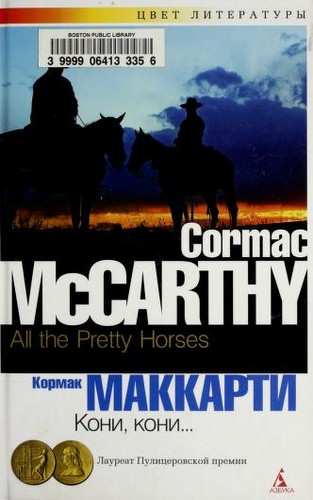
All The Pretty Horses
Key Takeaways
Kyle, in 2018 in Books: Many thanks to my wife Camden for convincing me to read this book, and letting me read her copy. This was one of many books that, as she was reading it, she would make a growling noise, before declaring to me in all earnestness, “I just want you to read this book so bad, so that we can talk about it.” I kept calling it the horse book. Finally, I decided to take her up on it, and I was hooked. Every McCarthy book I’ve read thus far didn’t take me longer than a week to read (and I read quite a few.) And it all started with this one.
As a kid, I read a series called ‘The Storm Testament’ over and over again. The story was set in the mid-1800’s about a boy who lives among a Ute tribe in Utah, before returning to the early Mormon settlements and participates in their journeys as part of this historical fiction. That, along with a deeply entrenched interest in John Wayne movies, led to being a cowboy for basically every Halloween, working at a horse ranch, and falling in love with my rural family-town of Luna, New Mexico. This book was just a cherry on top of my secret equestrian obsession.
Cormac McCarthy’s border novel, read for its moral aphorisms as much as its story:
- Courage as constancy. The line to keep: “All courage was a form of constancy. That it was always himself that the coward abandoned first. After this all other betrayals” follow.
- No control groups. “In history there are no control groups. There is no one to tell us what might have been. We weep over the might have been, but there is no might have been.” — a counterfactual discipline worth carrying into investing.
- Against the passive. “I’ve no sympathy with people to whom things happen. It may be that their luck is bad, but is that to count in their favor?”
- Connectedness and responsibility. The father who “had a great sense of the connectedness of things” and held that responsibility for a decision runs further than the decider allows.
- Ideas returning from abroad. The Mexican reflection on young people who “went to France for their education… They all returned full of ideas” — the ambivalence about imported ideology.
- Merciful ignorance. “It was good that God kept the truths of life from the young as they were starting out or else they’d have no heart to start at all.”
- Trouble as a constant. “All my life I had the feelin that trouble was close at hand. Not that I was about to get into it. Just that it was always there.”
Connections
Books: No Country For Old Men · The Road — the McCarthy shelf Kyle read together. Profiles in Courage on courage as constancy rather than a single moment.
Concepts: Human Nature · Decision Making — “no control groups” is a useful corrective on counterfactual reasoning.
People: Cormac McCarthy.
Books: Cormac McCarthy’s Western fiction — grouped with Blood Meridian, The Road, and No Country For Old Men on the same-author shelf.
Highlights
- “He lay on his back in his blankets and looked out where the quartermoon lay cocked over the heels of the mountains. In that false blue dawn the Pleiades seemed to be rising up into the darkness above the world and dragging all the stars away, the great diamond of Orion and Cepella and the signature of Cassiopeia all rising up through the phosphorous dark like a sea-net. He lay a long time listening to the others breathing in their sleep while he contemplated the wildness about him, the wildness within.”
- “He spoke of his campaigns in the deserts of Mexico and he told them of horses killed under him and he said that the souls of horses mirror the souls of men more closely than men suppose and that horses also love war. Men say they only learn this but he said that no creature can learn that which his heart has no shape to hold.”
- “They went to France for their education. He and Gustavo. And others. All these young people. They all returned full of ideas. Full of ideas, and yet there seemed to be no agreement among them. How do you account for that? Their parents sent them for these ideas, no? And they went there and received them. Yet when they returned and opened their valises, so to speak, no two contained the same thing.”
- “All my life I had the feelin that trouble was close at hand. Not that I was about to get into it. Just that it was always there.”
- “My father had a great sense of the connectedness of things. I’m not sure I share it. He claimed that the responsibility for a decision could never be abandoned to a blind agency but could only be relegated to human decisions more and more remote from their consequences. The example he gave was of a tossed coin that was at one time a slug in a mint and of the coiner who took that slug from the tray and placed it in the die in one of two ways and from whose act all else followed, cara y cruz. No matter through whatever turnings nor how many of them. Till our turn comes at last and our turn passes.”
- “He talked of those things we had spoken of so often at Rosario. So often and so far into the night. He said that those who have endured some misfortune which is their gift and which is their strength and that they must make their way back into the common enterprise of man for without they do so it cannot go forward and they themselves will wither in bitterness.”
- “All courage was a form of constancy. That it was always himself that the coward abandoned first. After this all other betrayals came easily.”
- “In history there are no control groups. There is no one to tell us what might have been. We weep over the might have been, but there is no might have been. There never was. It is supposed to be true that those who do not know history are condemned to repeat it. I don’t believe knowing can save us. What is constant in history is greed and foolishness and a love of blood and this is a thing that even God — who knows all that can be known — seems powerless to change.”
- “I’ve no sympathy with people to whom things happen. It may be that their luck is bad, but is that to count in their favor?”
- “It was good that God kept the truths of life from the young as they were starting out or else they’d have no heart to start at all.”
Referenced in
- Blood Meridian book
- Child of God book
- No Country For Old Men book
- The Road book