The Republic of Letters 2.0
The new infrastructure of distributed intellectual production
The transformation of knowledge creation from institutionally-gatekept to distributed networks of independent thinkers. Historically, the Republic of Letters bypassed official institutions through correspondence networks that catalyzed the Enlightenment. Today, the internet enables a similar dynamic at scale. The questions are: What are the new social technologies for intellectual exchange? How do credibility and quality emerge without formal gatekeeping?
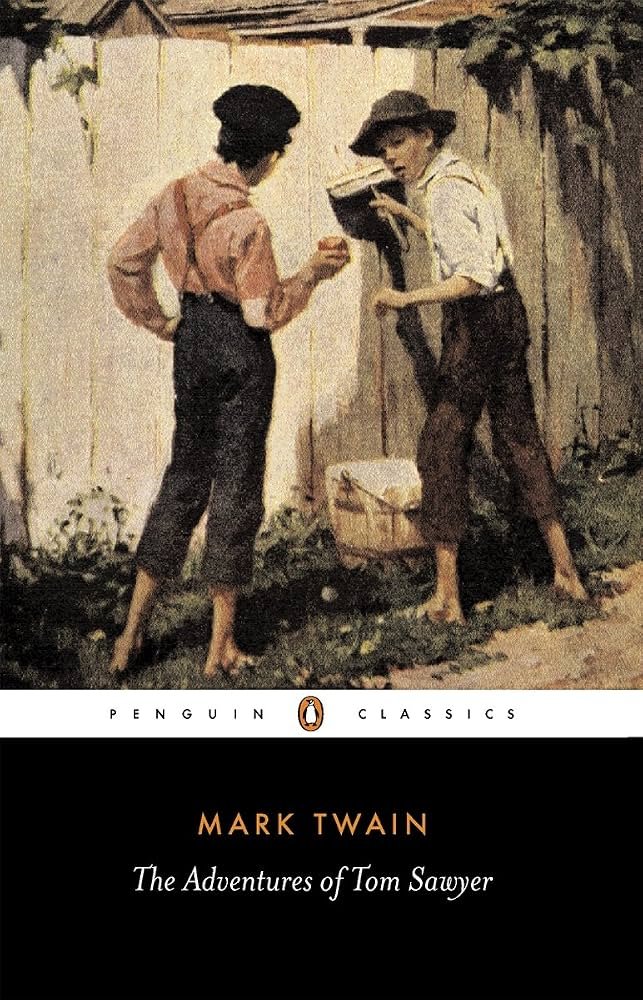
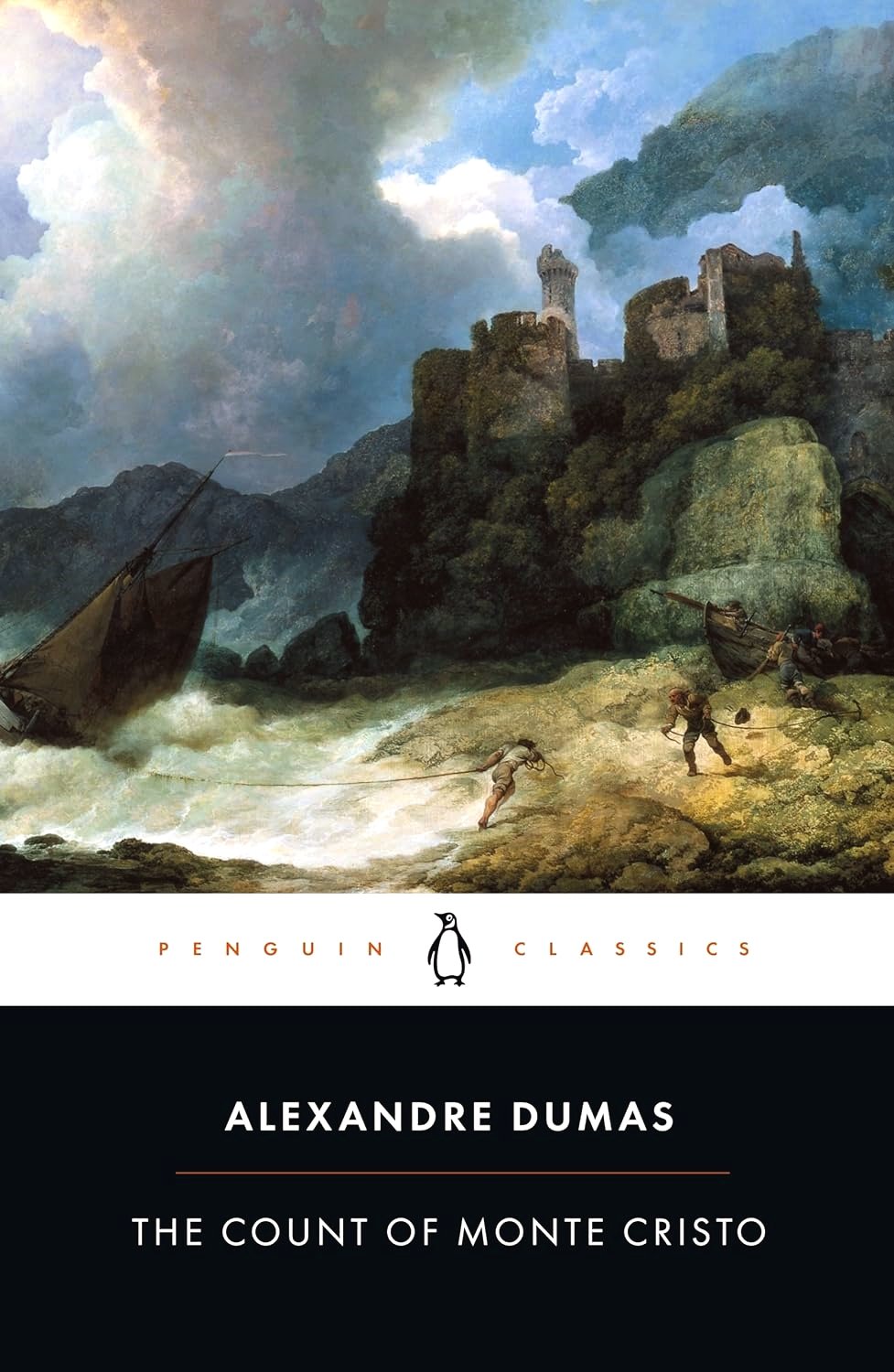
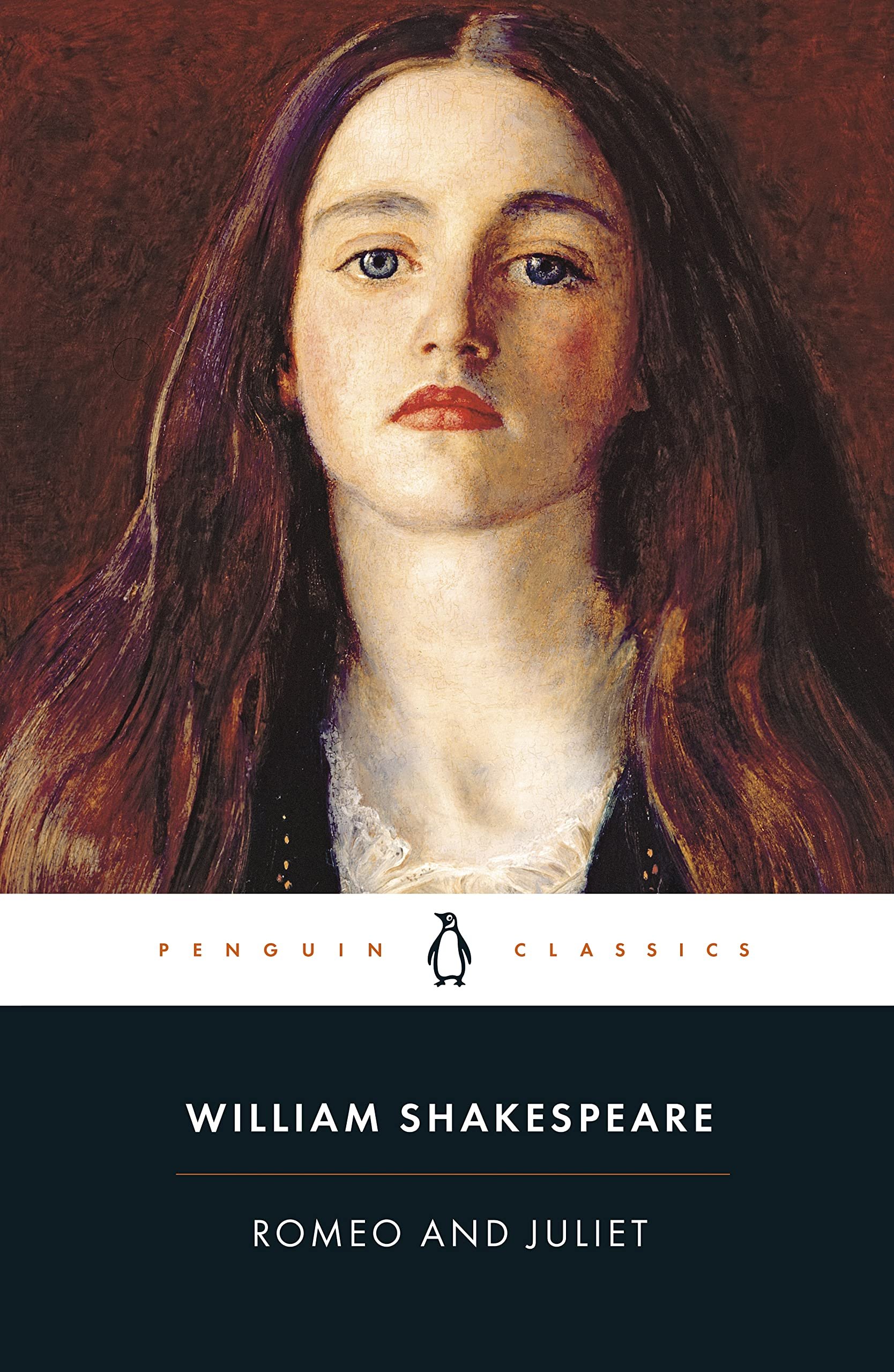
This is what students at Founders Classical Academy of Lewisville, a classical school in Texas, are asked to read. This is what serious education looks like: 5th Grade: — Don Quixote (select episodes for young readers) — Prince Caspian — A Midsummer Night's Dream — Sherlock Holmes — Little Women — The Adventures of Tom Sawyer — Narrative of the Life of Frederick Douglass (abridged) 6th Grade: — Greek Myths (summer reading) — The Children's Homer — Julius Caesar (adapted) — The Scarlet Pimpernel — The Count of Monte Cristo (abridged) — The Prince and the Pauper 7th Grade: — The Jungle Book (summer reading) — The Strange Case of Dr. Jekyll and Mr. Hyde — The Call of the Wild — Fahrenheit 451 — Cyrano de Bergerac — A Christmas Carol — Romeo and Juliet — Animal Farm — The Diary of Anne Frank 8th Grade: — Frankenstein (summer reading) — Lord of the Flies — Uncle Tom's Cabin (selections) — To Kill a Mockingbird — Narrative of the Life of Frederick Douglass — Much Ado About Nothing — The Red Badge of Courage — Benjamin Franklin's Autobiography (selections) 9th Grade: — The Odyssey (summer reading) — The Iliad — Oedipus the King — Antigone — The Clouds — The Aeneid — Julius Caesar (Shakespeare) — Metamorphoses (selections) 10th Grade: — Tales of King Arthur — Sir Gawain and the Green Knight — Beowulf — The Canterbury Tales — Hamlet — Paradise Lost — Shakespeare's Sonnets 11th Grade: — The Adventures of Huckleberry Finn — The Scarlet Letter — Walden — Self-Reliance — Moby-Dick — The Tempest — My Ántonia 12th Grade: — Pride and Prejudice — Metamorphosis — Heart of Darkness — Crime and Punishment — King Lear — Murder in the Cathedral
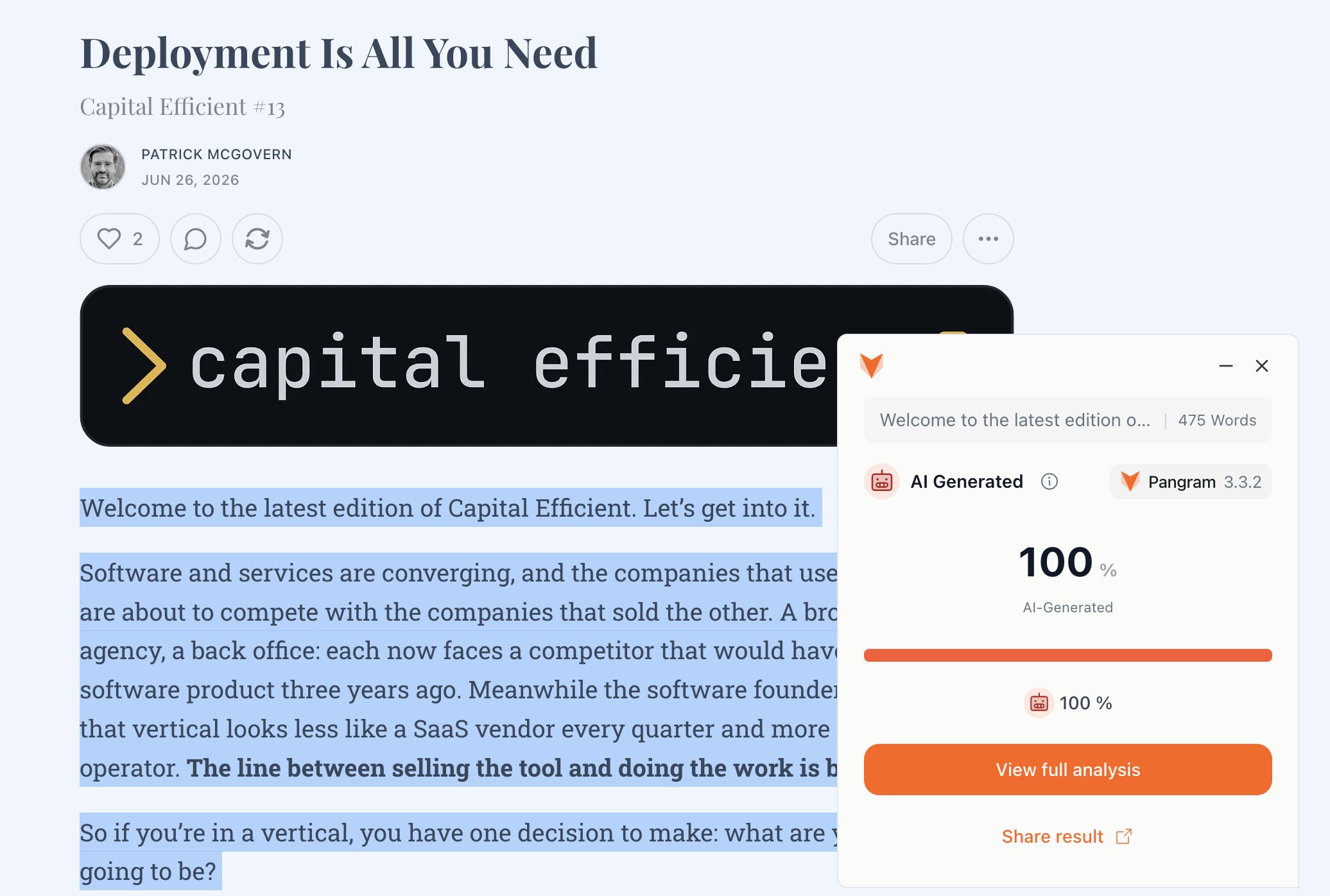
lol so you think that everything across the 1M+ words written by me, @PeterJ_Walker, @jaminball, @packyM, @NextBigTeng, @MeritechCapital, @credistick, @ArfurRock, @LifeSciVC, and @rtnarch are all AI slop... But the real human-quality value writing is *checks notes* the round up of deals that were all announced on twitter several days before?
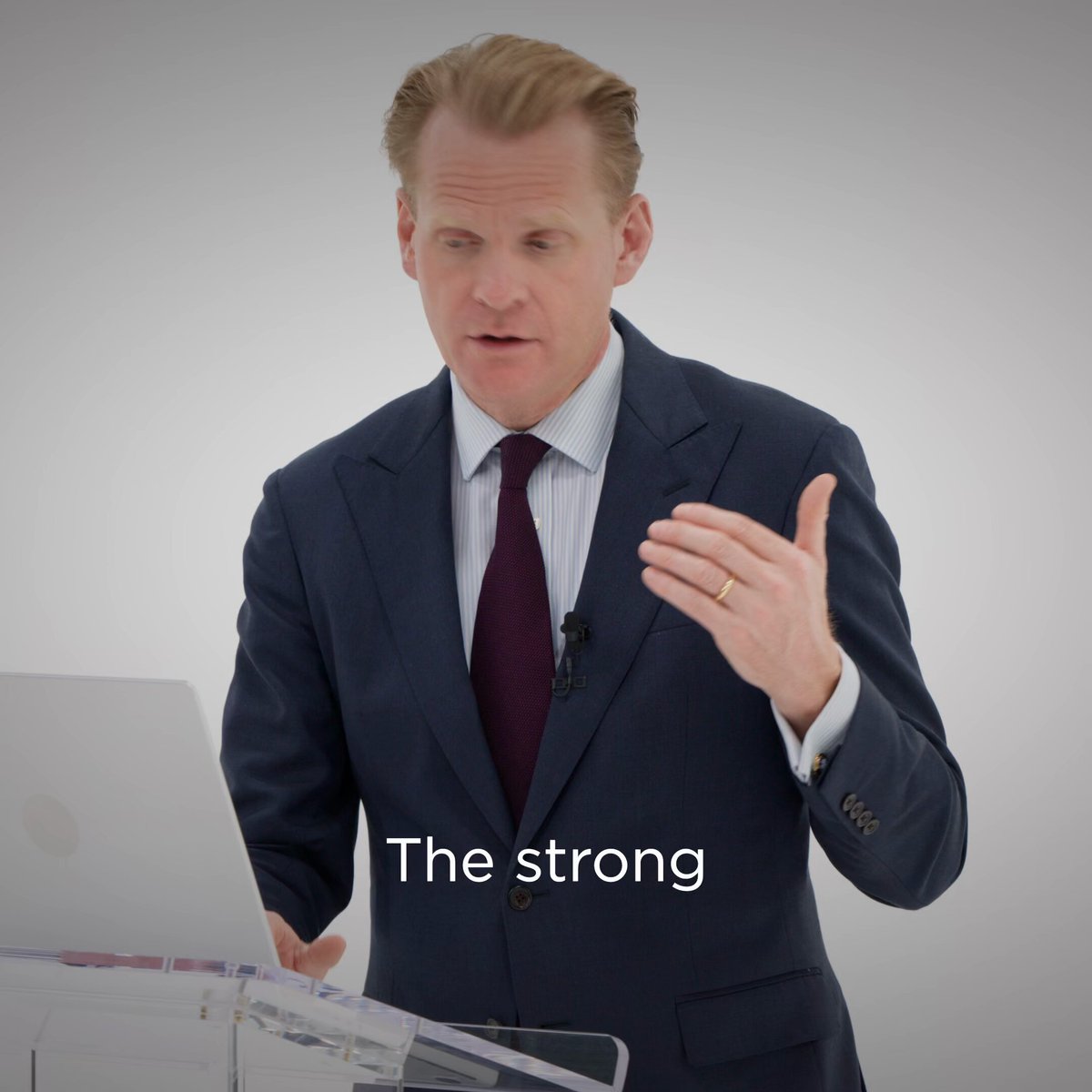
Dr. James Orr’s course: The Philosophy of History, is available now. In this course, @jtworr traces the philosophy of history from its ancient Greek origins to today’s debates over meaning, progress, and identity. Starting with the contrasting methods of Herodotus and Thucydides, we follow the evolution of historical thinking through medieval theology, Enlightenment secularism, and modern theories of change. Key figures such as Augustine, Hegel, and Marx reveal competing visions of history as divinely guided, rationally unfolding, or shaped by material forces. The course also explores 20th-century responses from Spengler and Heidegger, before turning to the collapse of grand narratives and today’s “history wars,” where the struggle to interpret the past remains deeply tied to how we understand ourselves. <!-- The syndication API clipped this at ~294 chars ("Herodotus and"). Full text recovered 2026-09-15 from the rendered post in Kyle's logged-in x.com session. The trailing https://t.co/uZ0qQ4Gbs0 was this tweet's own attached video (poster + video in media: above). -->

This is what students at Founders Classical Academy of Lewisville, a classical school in Texas, are asked to read. This is what serious education looks like: 5th Grade: — Don Quixote (select episodes for young readers) — Prince Caspian — A Midsummer Night's Dream — Sherlock Holmes — Little Women — The Adventures of Tom Sawyer — Narrative of the Life of Frederick Douglass (abridged) 6th Grade: — Greek Myths (summer reading) — The Children's Homer — Julius Caesar (adapted) — The Scarlet Pimpernel — The Count of Monte Cristo (abridged) — The Prince and the Pauper 7th Grade: — The Jungle Book (summer reading) — The Strange Case of Dr. Jekyll and Mr. Hyde — The Call of the Wild — Fahrenheit 451 — Cyrano de Bergerac — A Christmas Carol — Romeo and Juliet — Animal Farm — The Diary of Anne Frank 8th Grade: — Frankenstein (summer reading) — Lord of the Flies — Uncle Tom's Cabin (selections) — To Kill a Mockingbird — Narrative of the Life of Frederick Douglass — Much Ado About Nothing — The Red Badge of Courage — Benjamin Franklin's Autobiography (selections) 9th Grade: — The Odyssey (summer reading) — The Iliad — Oedipus the King — Antigone — The Clouds — The Aeneid — Julius Caesar (Shakespeare) — Metamorphoses (selections) 10th Grade: — Tales of King Arthur — Sir Gawain and the Green Knight — Beowulf — The Canterbury Tales — Hamlet — Paradise Lost — Shakespeare's Sonnets 11th Grade: — The Adventures of Huckleberry Finn — The Scarlet Letter — Walden — Self-Reliance — Moby-Dick — The Tempest — My Ántonia 12th Grade: — Pride and Prejudice — Metamorphosis — Heart of Darkness — Crime and Punishment — King Lear — Murder in the Cathedral
lol so you think that everything across the 1M+ words written by me, @PeterJ_Walker, @jaminball, @packyM, @NextBigTeng, @MeritechCapital, @credistick, @ArfurRock, @LifeSciVC, and @rtnarch are all AI slop... But the real human-quality value writing is *checks notes* the round up of deals that were all announced on twitter several days before?
Dr. James Orr’s course: The Philosophy of History, is available now. In this course, @jtworr traces the philosophy of history from its ancient Greek origins to today’s debates over meaning, progress, and identity. Starting with the contrasting methods of Herodotus and Thucydides, we follow the evolution of historical thinking through medieval theology, Enlightenment secularism, and modern theories of change. Key figures such as Augustine, Hegel, and Marx reveal competing visions of history as divinely guided, rationally unfolding, or shaped by material forces. The course also explores 20th-century responses from Spengler and Heidegger, before turning to the collapse of grand narratives and today’s “history wars,” where the struggle to interpret the past remains deeply tied to how we understand ourselves. <!-- The syndication API clipped this at ~294 chars ("Herodotus and"). Full text recovered 2026-09-15 from the rendered post in Kyle's logged-in x.com session. The trailing https://t.co/uZ0qQ4Gbs0 was this tweet's own attached video (poster + video in media: above). -->
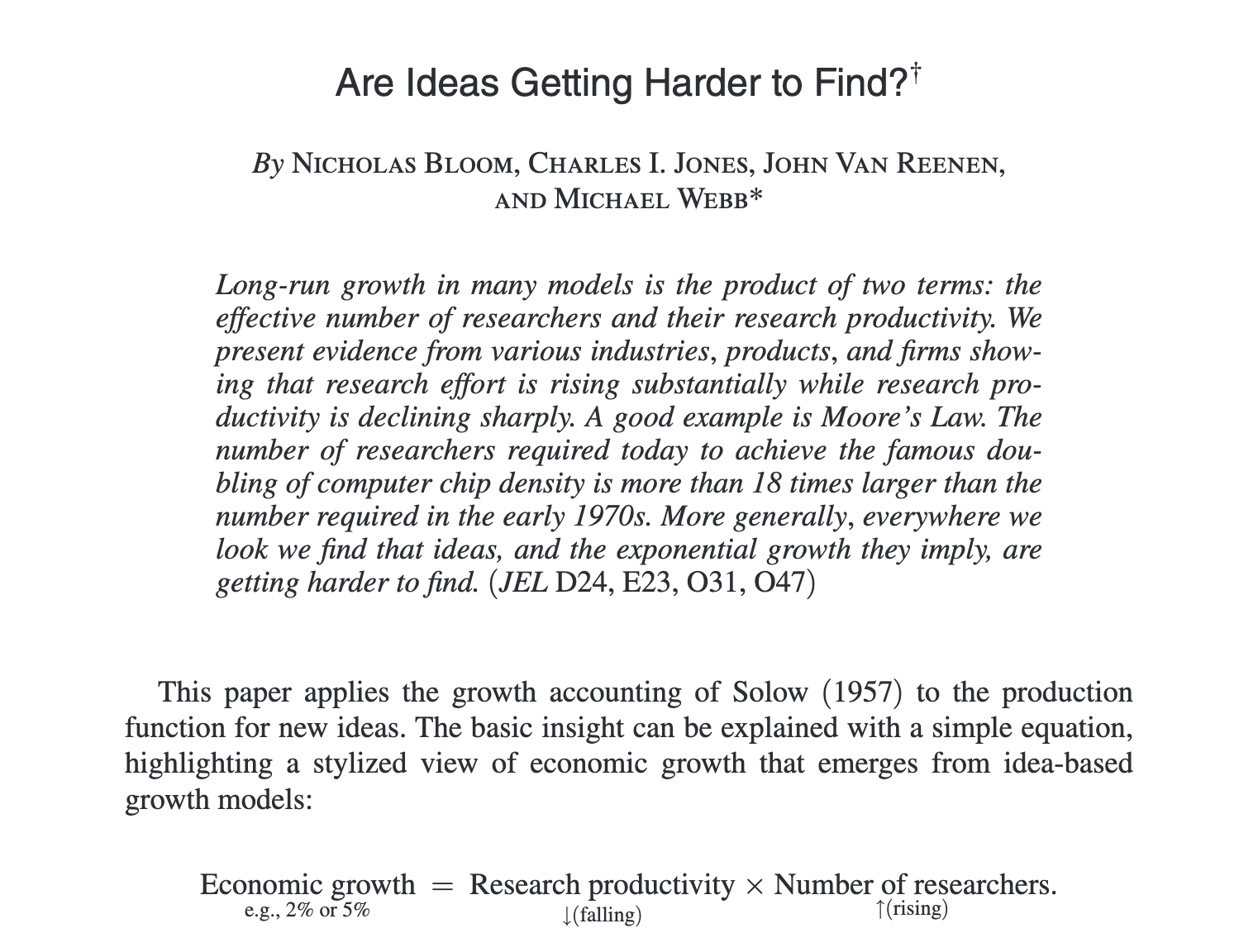
"Are Ideas Getting Harder to Find?" but for everything. If you told someone fifty years ago about the AI we have access to now, they would have guessed that the ceiling on all sorts of creative output would rise. But where are the better-than-ever essays? Books? Movies? Music? https://t.co/RCnXZm96Mk
In 1820s France, a teenager had an epiphany that would reshape how we think about mathematics, chemistry, even quantum computing. But he was killed in a duel before he turned 21. His last communication with the world was a 60-page letter begging the trusted scholars of his day to "decipher all this mess." The letter kicked off a project that required dozens of mathematicians and tens of thousands of pages across multiple languages. Naysayers said it was "little advanced beyond mathematical illiteracy." It took 150 years to untangle the boy's visions. Five people found the final missing pieces in 1985. Rather than limit their findings to journals, they created an absurdly large, bright red book, and called it an Atlas. @TerranMott of @joincolossus and @psumvc has been collecting stories about how the Atlas came together. It is the best story in math, and shows that even the most rational projects can take irrational persistence.
Palantir. Home Depot. GE Aerospace. The strongest indictment against higher ed is that large organizations are now going around the education cartel because they can’t get workers with skills the market demands. This is a good thing. We’re once again matching training and **Quoting @BehizyTweets:** > BREAKING: Home Depot has started giving out free training to Americans who want to work in HVAC, carpentry, electricity, & construction. > > The classes are self-paced and students will earn certifications they can use on their resumes. > > THIS IS AWESOME! https://t.co/yHwA2aG8qG
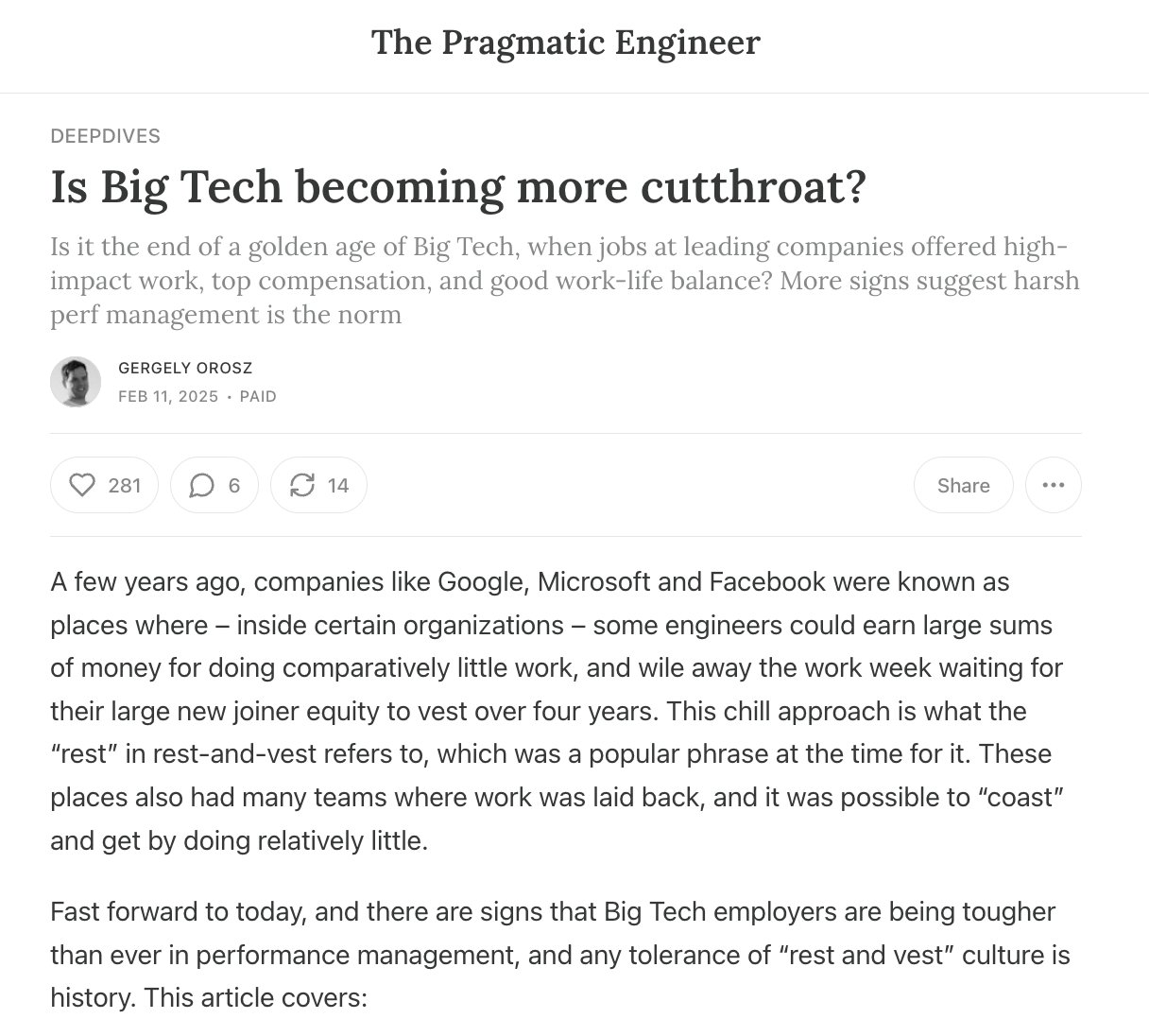
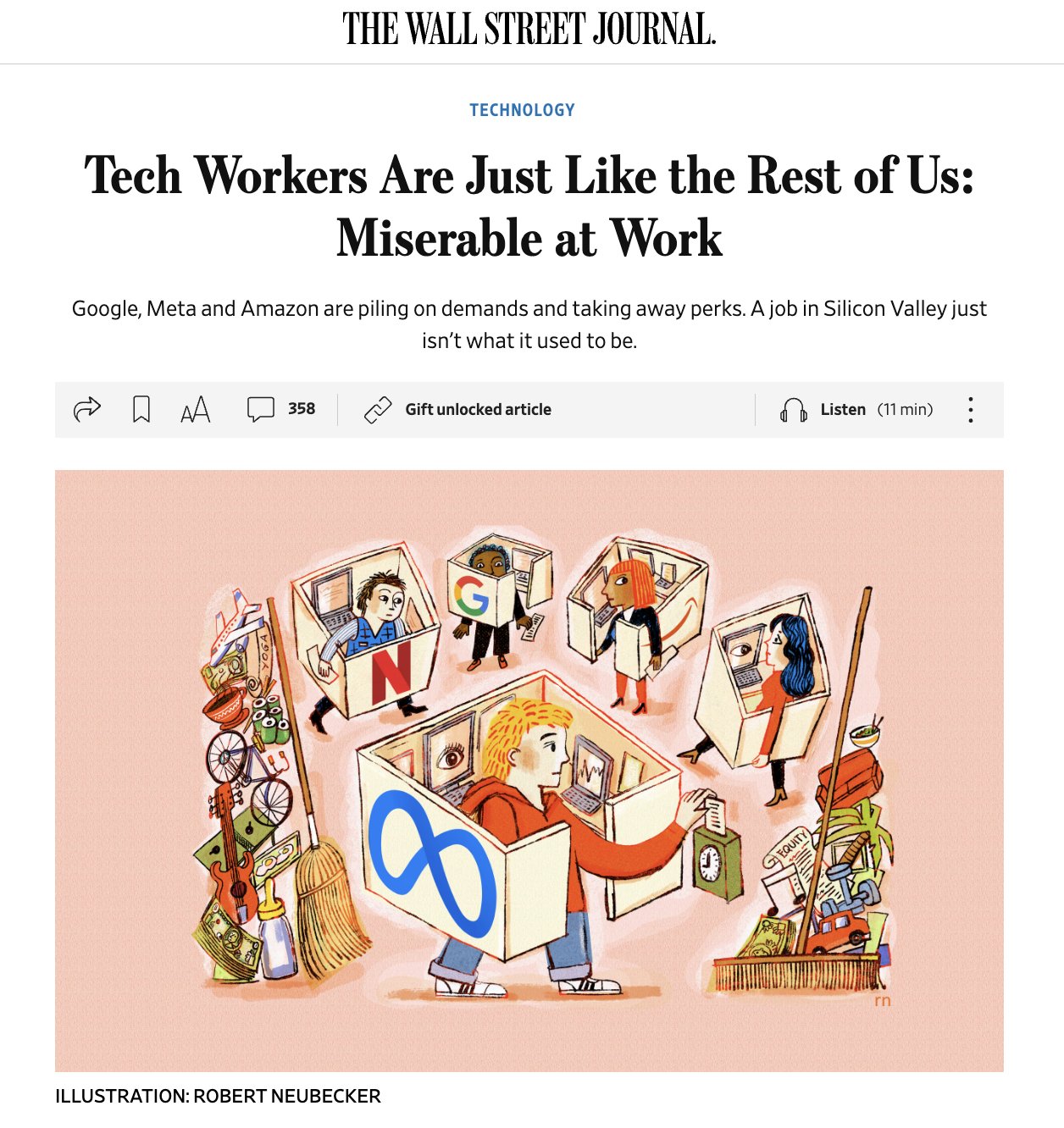
2025-10-14Amusing to read an article in mainstream media months after covering the exact trend in @Pragmatic_Eng 2.5 months ago in @Pragmatic_Eng | Yesterday in WSJ: https://t.co/uVqBOFxfQT
10 years ago I'd rely on Fortune (dba axios), NYT Dealbook and TechCrunch… now access to great thought leadership in the investment sphere is on a different level. My go tos: Substack/X - Carta / @PeterJ_Walker - Compounding Quality - Contrary Deep Dives / @kwharrison13 - Clouded Judgement / @jaminball - Not Boring / @packyM - Next Big Teng @NextBigTeng - Anything @MeritechCapital writes - @credistick - @ArfurRock - @LifeSciVC - @rtnarch Podcasts - Uncapped @jaltma - BG2 - Capital Allocators - Credit Edge - Endpoints - No Priors - Invest Like the Best - 20VC @HarryStebbings Not exhaustive… open to recs
Mar 22, 2025> Some of my favorite books from 2024: **A 10-post thread, one book per reply**, each with a cover image and a quote Packy pulled from it. The head post carries no titles at all, so the list exists only in the replies — archived verbatim below against the thread being deleted. Engagement at capture (2026-09-21): 532 likes, 33 reposts, 18 replies, 178.4K views. **Recovery note.** The syndication and fxtwitter APIs return only the head post, and threadreaderapp has no unroll for this thread, so the reply IDs were harvested from the rendered thread in a logged-in session; the full untruncated text of each was then pulled per-ID (five of the ten quotes are cut off by "Show more" in the DOM). All ten cover images are saved to `wiki/images/tweets/`. ### 1. [[The Fish That Ate the Whale]] — Rich Cohen *(already in the anti-library)* > The Fish That Ate the Whale > @richcohen2003 > "When this mess of deeds came to light, United Fruit did what big bureaucracy-heavy companies always do: hired lawyers and investigators to search every file for the identity of the true owner. This took months. In the meantime, Zemurray, meeting separately with each claimant, simply bought the land from them both. He bought it twice—paid a little more, yes, but if you factor in the cost of all those lawyers, probably still spent less than U.F. and came away with the prize." ### 2. [[Draft No. 4]] — John McPhee > Draft No. 4 > John McPhee > "Factual writing is also a kind of treasure hunt, and when the nuggets come along you know what they are. They often provide beginnings and endings, even titles." ### 3. [[The First Tycoon]] — T.J. Stiles *(already in the anti-library)* > The First Tycoon > TJ Stiles > "Law, rank, the traditional social bonds—these things meant nothing to him. Only power earned his respect, and he felt his own strength gathering with every modest investment, every scrap of legal knowledge, every business lesson taught by the irascible but brilliant Gibbons." ### 4. [[Dealers of Lightning]] — Michael Hiltzik *(already in the anti-library)* > Dealers of Lightning > @hiltzikm > "Then came Alan Kay, sharing with Stewart Brand’s hip and impressionable readers his assessment of his colleagues as 'really a frightening group, by far the best I know of as far as talent and creativity. The people here all are used to dealing lightning with both hands.'" ### 5. [[Boom — Bubbles & The End of Stagnation|Boom]] — Byrne Hobart and Tobias Huber *(already read)* > Boom > @ByrneHobart & @TobiasAHuber > "Optimism can be a self-fulfilling prophecy." ### 6. [[The Prize — The Epic Quest for Oil, Money & Power|The Prize]] — Daniel Yergin *(already in the anti-library)* > The Prize > @DanielYergin > "In short, oil was fundamental to the crisis, not 'cheap oil,' but rather oil as a critical element in the global balance of power, as it had been ever since the First World War. Such is one of the great lessons of the last hundred years." ### 7. [[Kochland]] — Christopher Leonard *(already in the anti-library)* > Kochland > @CLeonardNews > "The Koch brothers derived their wealth through a patient, long-term strategy of seizing opportunities in complex and often opaque corners of the economic system." ### 8. [[The MANIAC]] — Benjamin Labatut *(already in the anti-library)* > The Maniac > Benjamin Labatut > "Most mathematicians prove what they can. Von Neumann proves what he wants." ### 9. [[Means of Ascent]] — Robert Caro > Means of Ascent > Robert Caro > "His morality was the morality of the ballot box, a morality in which nothing matters but victory and any maneuver that leads to victory is justified, a morality that was amorality." ### 10. [[Real Magic]] — Dean Radin > Real Magic > @DeanRadin > "The bottom line is this: Throughout science and scholarship a basic principle of the Perennial Philosophy—that consciousness is fundamental—is slowly becoming acceptable to talk about. Within science this notion tends to be cast into the more conventional language of information and mathematics, but the connection with consciousness is undeniable. After centuries of life-threatening suppression, the societal shift that now allows scientists and scholars to publicly discuss consciousness in a new light might seem like a trifling matter. But it’s a positively astounding transformation."
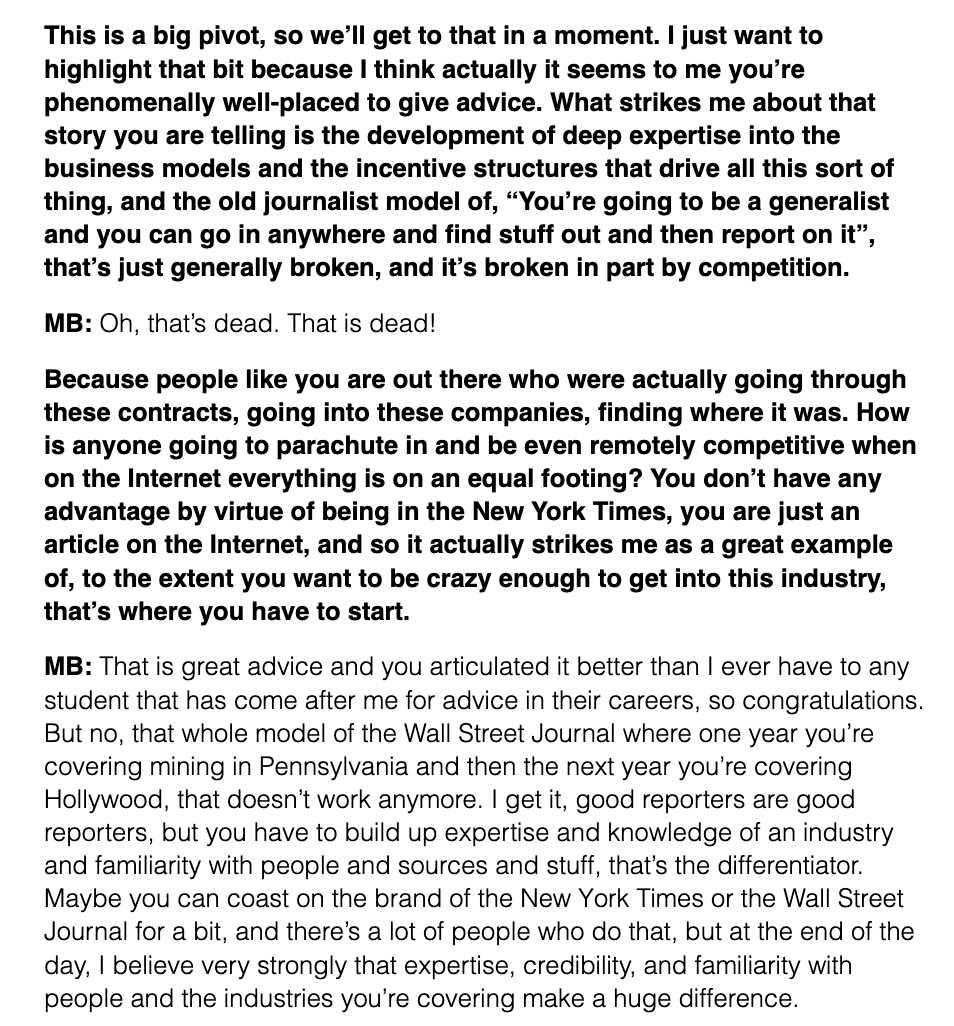
2024-12-31"Maybe you can coast on the brand of the New York Times or the Wall Street Journal for a bit...I believe very strongly that expertise, credibility, and familiarity with people and the industries you’re covering make a huge difference." @MattBelloni in his chat with @benthompson https://t.co/IGrp5Fo5hG
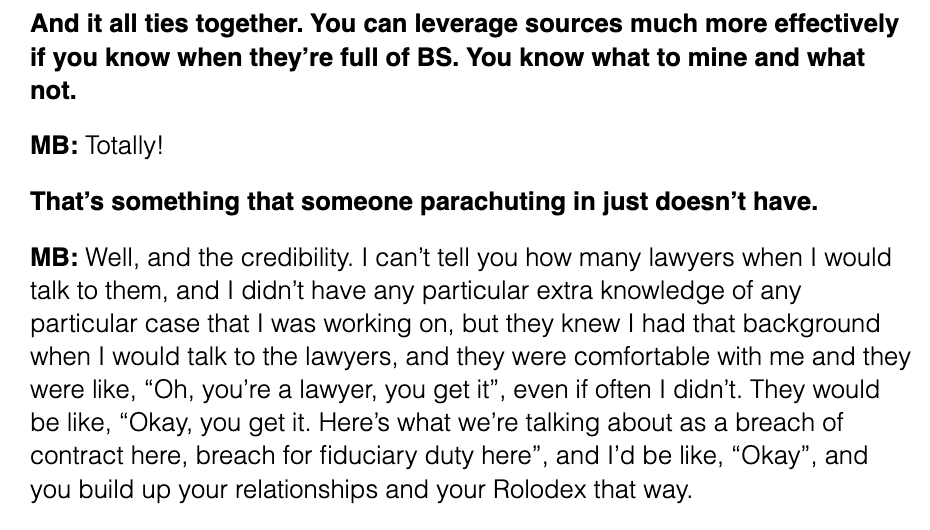
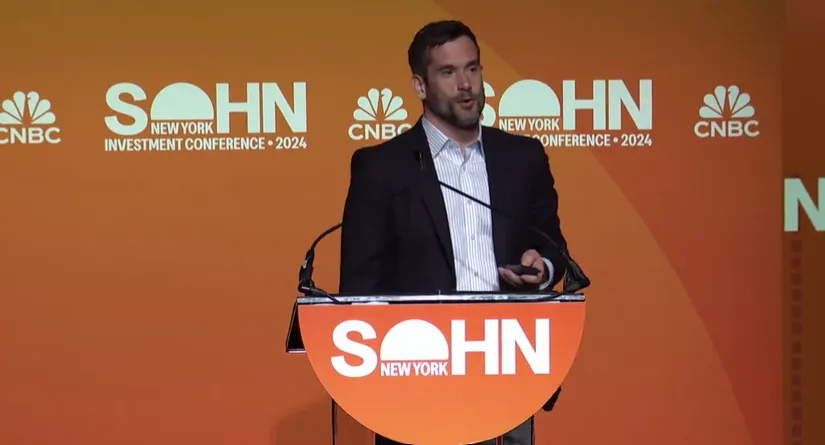
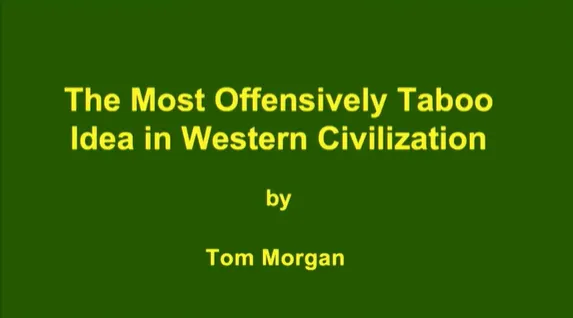
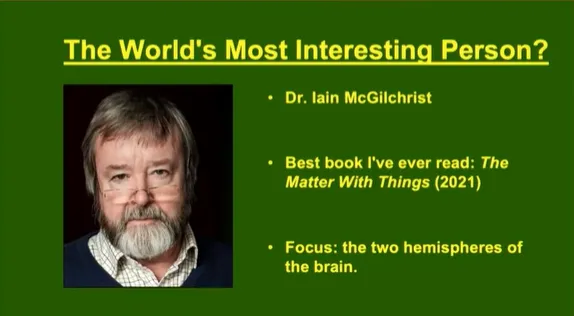
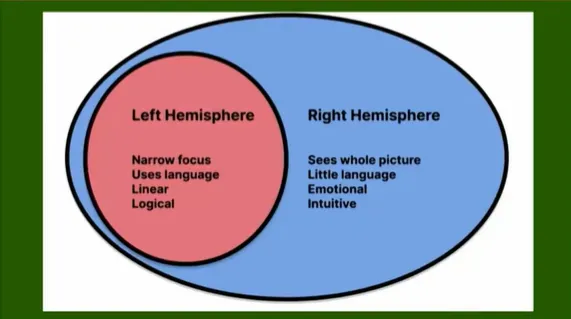
⬇️ Full Transcript with Slides below ⬇️ 1/ On April 3, 2024, Sapient Capital's Tom Morgan gave a presentation at the Sohn Conference titled "The Most Offensively Taboo Idea in Western Civilization" where he distilled 10 years of curiosity research into a 5 minute talk. I found this presentation to be one of the tightest, information-dense, and thought provoking talks I've listened to. I wanted to be able to refer back to it easily, so I transcribed the talk and screengrabbed the slides. I shared the transcript in A Letter a Day (link in bio), but people enjoyed when I shared my transcript of Bill Gurley's "2,851 Miles" presentation on X, so I thought I would share this one here too. ⬇️ Full Transcript with Slides below ⬇️ 2/ So I'm not going to talk about a stock today. Instead, I'm going to talk about the most offensively taboo idea in western civilization. 3/ This is Dr. Ian McGilchrist. He wrote, probably the most interesting book I've ever read, The Matter with Things. His focus of his very long career has been the two hemispheres of the brain. Now, you're probably thinking this brain hemispheres stuff has been debunked. It hasn't. It's just nuanced. 4/ The brain's left hemisphere is narrowly focused. It uses language, it is linear, and it is logical. The brain’s right hemisphere, it sees the whole picture. But it has very little use of language. It is emotional, and intuitive. 5/ I like to think of the left hemisphere as like a junior analyst. Amazing modeling, but lives in the model. The right hemisphere is the intuitive Druck, Soros type that makes these amazing, instinctive decisions, but can't always explain why. 6/ Now, you need both of them--but you don't let the junior analyst run the hedge fund; he will burn it down. 7/ Which is unfortunate. Because McGilchrist's diagnosis is the world is imbalanced towards the brain's left hemisphere. The brain's left hemisphere deals in abstractions. And there's nothing wrong with that. That's why you're all sitting here today. 8/ But taken to an extreme, abstraction leads to disconnection. Disconnection from our environment, our bodies, and each other. And frankly, when I look at the world and its various problems, I can see almost no crisis that isn't being caused, in some part, by disconnection. 9/ How does this happen? 10/ Well, if you experimentally suppress the brain's left hemisphere for 10 to 15 minutes, people start to see things they would ordinarily see as dead as alive. So the sun going across the sky giving you energy, the world becomes more animate. But if you experimentally suppress the brain's right hemisphere for 10 to 15 minutes, people start to see living things as dead. So other human beings become like zombies, or machinery, or furniture. 11/ The implication, if we're already too far over on the left, is that the world is more alive, and we are more connected to it, than we typically think. 12/ And so the taboo. There might, might, be an intelligent, benign force guiding our attention. 13/ Why is this so offensively taboo? Well, we reject any external challenges to our intellect. The left hemisphere by nature, is competitive. It lies, and it denies the existence of anything more intelligent than itself. I think we all know those people. 14/ But there is a problem. Which is our intellect alone cannot navigate the world. 15/ The world is what's called combinatorial explosive, which just means too many choices, too little time. Rational trial and error cannot have worked. If we weighed up the pros and cons of every decision in high stakes environments, the tiger would have beaten us. 16/ The analyst knows all the numbers, but the PM knows what's relevant. But how do we know what's relevant all the time? Our environment helps signal it to us. What we are attracted to narrows our options. We all intuitively understand this in romantic relationships, but I believe the same applies to information. 17/ Evolution's solution to combinatorial explosiveness is curiosity. Now, the dictionary definition of curiosity is: "a strong desire to know or learn something." A definition that I find rubbish. Doesn't tell you anything. "A strong desire." Where does it come from? "To learn something." To learn what? 18/ Question: please ask yourself, and I do mean, please ask yourself--this is not a rhetorical device. Can you force yourself to be interested in something? Can you force yourself to be interested in something? 19/ Wine tasting. Accountancy. Cricket. The Real Housewives of New Jersey. The fact is, is that everything we're interested in and passionate about exists upon a continuum, but we're not in full control of that. 20/ If you don't fully control your interests, what does? 21/ I believe that curiosity is a relational, a two way force between you and your environment. 22/ Evolution, in the form of curiosity, helps guide you into a unique niche. It's why you don't have full control of it, and why pursuing it feels good. 23/ Curiosity is a right hemispheric impulse. It connects you to the world. It is emotional, it is non logical, it is intuitive. But it also sees the whole picture. 24/ In fact, McGilchrist's conclusion: the right hemisphere is responsible for, in every case, the more important part of our ability to come to an understanding of the world. 25/ But don't forget: the left hemisphere always denigrates the contributions of the right. Particularly as they're fuzzy, emotional, nonverbal. So following your curiosity requires faith. 26/ But I will leave you with probably my most heretical belief: curiosity may also be mysteriously rewarded by your environment. The favorite quote of my life is from the great mythologist Joseph Campbell: "Follow your bliss and doors will open where they were only wolves." 27/ I can't prove anything in five minutes, but I hope you might now take your curiosity more seriously. Thank you. End/ If you'd prefer to read this in blog/newsletter form, you can find the full transcript and slides in the link in my bio. If you'd prefer to watch it, you can do so here: https://x.com/tomowenmorgan/status/1775957154521821593 PS 1/ And see here for my previous transcript on Bill Gurley's talk on regulatory capture: https://x.com/kevg1412/status/1710055330434949580
The 12 functions of the modern university: 1. CREDENTIALING AGENCY 2. EDUCATIONAL COURSES 3. RESEARCH BUREAU 4. POLICY THINK TANK 5. MORAL INSTRUCTOR 6. SOCIAL REFORMER 7. IMMIGRATION AGENCY 8. SPORTS LEAGUE 9. HEDGE FUND 10. ADULT DAY CARE 11. DATING SITE 12. LOBBYING FIRM
Dear anyone who wants to be a "creator" or "build an audience" in 2024. There's something you should know... Here are a few of the non-obvious lessons I've learned building a 500k+ followers & 100M+ downloads: #1 - WHO follows you is far more important than HOW MANY people follow you. YC tells founders "you'd rather have 1,000 customers who really love your product than 1,000,000 people who just kinda like it" I have similar advice for making content. WHO follows you is way more important than HOW MANY people follow. Followers & subscribers are the fake t*tties of content. They're a distraction. Ignore them. Would you rather have 1,000,000 people, chosen at random follow you? Or half of Fortune 500 ceo's love your work? You're not 'buliding an audience', you're actually building a 'magnet' which attracts a certain type of audience. Create the content that will attract the type of fan you want. #2 - You want to be "known well", not "well known" Fame is the wrong goal. You want a narrow set of people to know a lot about you. Become famous within your bubble. How do you become "known well"? You have to share stories, hopes, dreams, fears, & obsessions. Teach your audience the 5 D's: *Done - what have you done? what's your track record? *Deliver - what do you offer people who follow you? *Do - what do you do for work? for fun? *Dreams - what do you want outta life? (eg. Gary V wants to buy the Jets) *Dork Out - what are you really into? what do you collect? If you do this, you'll magically notice that the more content you create, the luckier you get. Your fans will know what articles to send you. What deals to invite you into. What concert tickets to give you. What introductions to make. #3 - OK that was a long answer- which reminds me. There's no such thing as too long, only 'too boring'. #4 - Don't worry about your writing style or production quality. A+ content with C- delivery is a great starting point. C- content with A+ delivery is a death trap. Don't waste hours on packaging. Spend years living an interesting life, so that you actually have something interesting to say. #5 - Create a binge bank Your content should be bingeable in a 1-3 hour sitting. Let people stumble down the rabbit hole of YOU. A lot of content will get no attention, until you finally break thru...and then your back catalog of content becomes super important. #6- The rule of 100 People ask @MrBeast for youtube advice. He tells them all the same thing: - everyone sucks at the beginning - make 100 videos - each time, try to make one thing better (eg. the hook, the thumbnail, etc.) By video 100, you won't need his advice. You'll be winning. Put in 100 focused reps before expecting results. #7 - Pick the platform that suits you Every platform works. Long form. shortform. text. video. podcasts. Don't tangle your brain trying to pick the "best" platform. They all work. Pick the one you enjoy doing. If you like writing, write. If you like short videos, do that. #8 - No matter what platform you pick, don't stop writing Writing is thinking. Good writing is good thinking. Writing is like a doctor's checkup for your brain. #9 - People don't want information, they want a feeling. Think of your channel as a little shop at the world's most crowded market. People don't follow you because of what you know. They follow you because of how you make them feel. Give them the feeling once or twice, you get a follow. Give them the feeling daily, you get a diehard fan. MrBeast makes people feel happy. James Clear sells the feeling of control over habits. Tony Robbins sells inspiration. Soul Cycle sells a satisfying sweat. Figure out what emotion you're selling, and then do it consistently. and lastly (and most importantly): the golden rule of life is "treat others the way you want to be treated" well, the golden rule of content "retweet @shaanvp the way you want to be retweeted!" <!-- A long post: X's syndication endpoint clips it at ~280 characters, so the full text above is from api.fxtwitter.com (2026-09-29). -->
Jan 2, 2024This is the internet effect We get larger than ever stars & longer than ever long tail of everything We get both Taylor Swifts and esoteric internet celebs that you have never heard of but have millions of fans Niches and mainstream on steroids The middle of the curve dies **Quoting @deankissick:** > We each live in our own atomized world but also in a cloying, suffocating monoculture. https://t.co/zwrQIr0Mnj
2023-12-27Who could be the @lennysan for investing analysis? A natural born teacher who is young and hungry?
Oct 24, 2023The more you write, the more your brain starts to notice threads it wants to pull on. You find an idea, you want to take it into your writing brain and make something out of it. But you will always have more words that want to get out than you have time to release them.
Oct 10, 2023I took some time this weekend to write out my biggest lessons from my journey of building the newsletter. Here's a summary: 1. Quality + consistency = all that matters 2. Do your “job to be done” better than anyone else in the world 3. Follow your energy 4. Spend more time on it 5. Cut 30%-50% of your words 6. Contribute something new to the conversation 7. Commit to a consistent cadence, and make sure it’s sustainable 8. Get started by just getting started 9. It’s not all rainbows and butterflies 10. This is the most fulfilling work of my life, and I highly recommend it Link to the full post in the comment below Here's my top 10 lessons from building Lenny's Newsletter https://t.co/TCKGviXz2T @LeeJacobs @leepnet @andrewchen That was supposed to be @alexxubyte, not @alexxu 😬
Whenever I find myself in a writing rut, I hit this list and read a few really well-written essays. Many from @waitbutwhy @slatestarcodex @paulg @eugenewei @cdixon @morganhousel @vgr @kevin2kelly but a ton of hidden gems, too. What's your favorite essay/blog post of all time? > **Quoting Packy McCormick (@packyM) · Sep 14, 2022** — [original](https://x.com/packyM/status/1570113307452792837) > > What's your favorite essay/blog post of all time? > > Looking for >2 years old, and that you think will be as good in a decade. Instant classics.
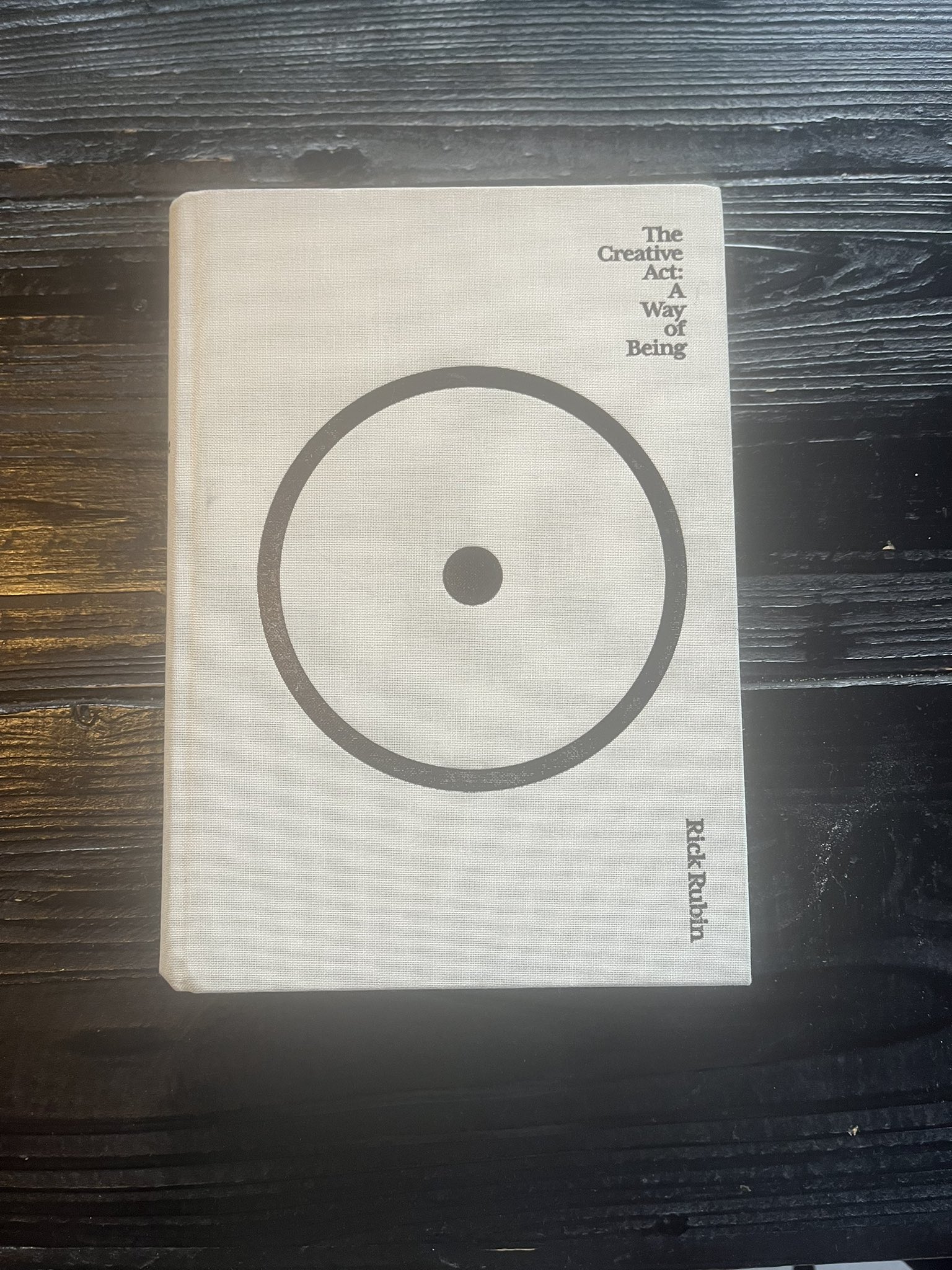
Aug 17, 2023One of the coolest things about writing online. I got sent this through the post a few weeks ago. Fantastic read. Thank you @RickRubin Here’s the original piece I wrote on creativity: https://t.co/SRML6RRFBI You never know who’s reading what you write.
What @cdixon is writing about today is what everybody else will be writing about in 10 years. - The next big thing will start out looking like a toy - Climbing the wrong hill - The idea maze - Full stack startups - Why decentralization matters - What the smartest people do on…
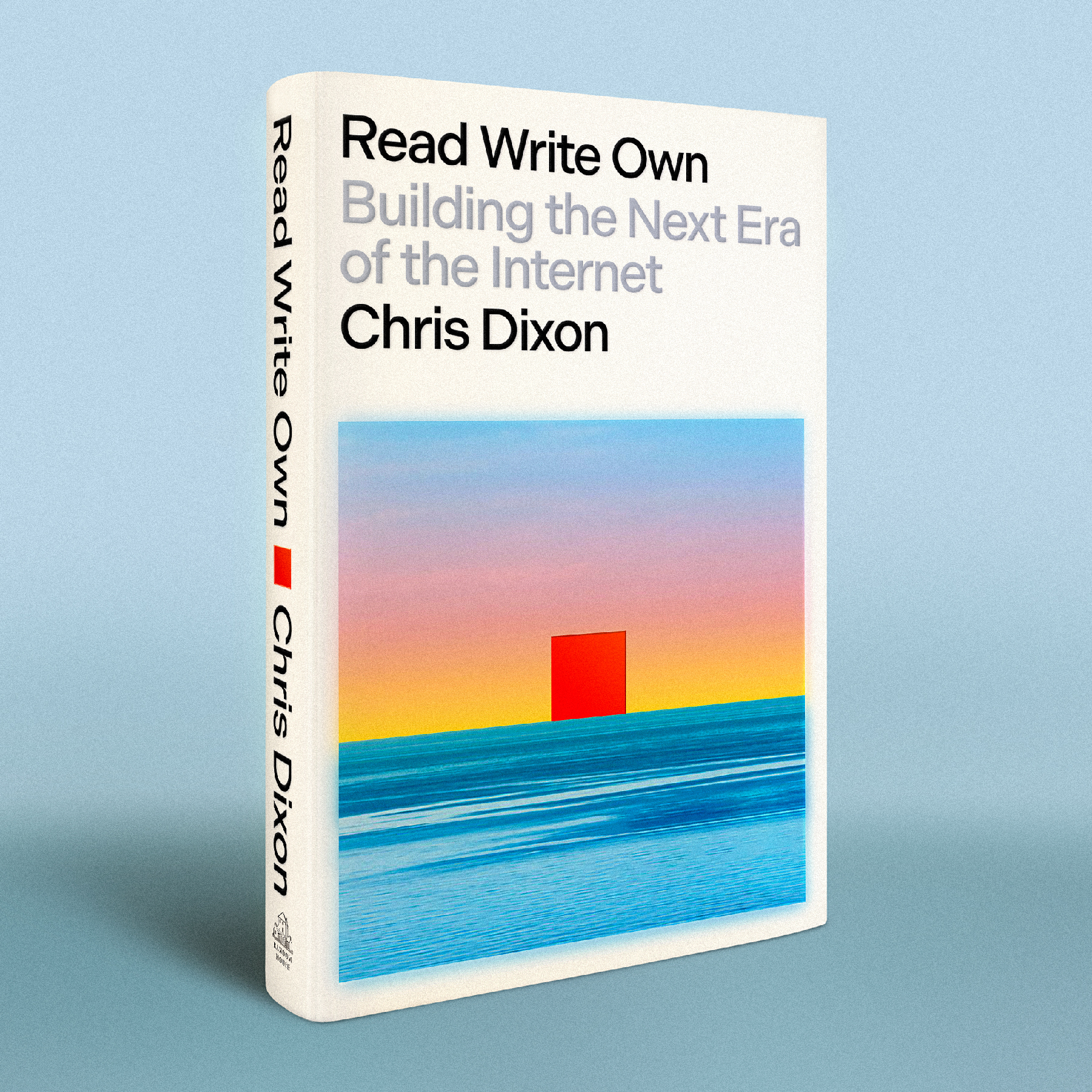
Over the past year I worked with @stewartbrand on a new project. He wanted a way to collaborate with his readers as he wrote his new book, 'Maintenance: Of Everything'. Think pre-prints, but for books. So we built it. It's called Books in Progress. https://t.co/ax0CCYZVsi You've probably already read the widely-loved first chapter, The Maintenance Race. Today we publish the first section of Ch. 2: Vehicles. It investigates why philosophers love motorcycle maintenance https://t.co/zRRWjatyrN Stewart explains the book and project in an animation here https://t.co/fugk80OkMz We'll be publishing new sections every few weeks all summer. Follow @stewartbrand, me, and @WorksInProgMag for updates, and subscribe below to make sure you don't miss anything. https://t.co/zRRWjatyrN @stewartbrand @WorksInProgMag Thanks to all who did hard work on this, including our designers @andnowstudio, our devs, The Glasshouse Project (https://t.co/iTLKHLPD2r) and Lisa LaBracio (https://t.co/I1GK5IS6zn) who did the animation.
Jun 15, 2023I wish there were 'study groups' for people who still want to learn after you graduate. For example, we all spend time researching, sharing, and presenting about topics that interest us.
May 24, 2023 Original deleted — preserved hereSo I am going to watch this but I have some trepidation because this was exactly the thesis I was advancing in 2014/2015 (see for example "The Garden and the Stream: a Technopastoral") right down to targeting the news feed as the start of it all https://t.co/k75qRUxWN4 They were big influential essays too -- dozens of them. Inspired the "digital gardens" movement. Part of the inspiration of creators @RoamResearch and @NotionHQ . I just don't want to be written out of the history of an idea I worked so hard on and was unique at the time. OK, I'm going to hit play now. Oh, crap. I'm a minute in and I don't know if I can finish. This is looking like it's exactly my 2015 argument. Like exactly. Right down to the "web as topology" vs. "web as events" distinction. And to be clear, I'm not saying I wrote a thing in 2015 that no one noticed and was ahead of its time. I'm saying I wrote several dozen things in 2014/15 that were incredibly influential among a small set of people who then propagated the ideas into the mainstream. Ok, pressing play again. "The Garden and the Stream" is literally the visual and narrative metaphor for the entire thing. And again, I'm not saying the filmmaker knows this. I'm saying the idea has moved into the common understanding now. And every point made here, right down to how 2006 was year zero for this, was part of that analysis. And again, these essays helped inspire new products and community practices and vocabularies. They weren't a footnote. I should be really happy that this is mainstream thinking now, putting the Garden/Stream issue at the center of our discussions. And I will be. But I've always been in this weird place, not really an academic building up an academic record, not really a person with a traditional media platform building up a record that way. And it sucks sometimes b/c your ideas go from weird to common w/o getting attached to you. I should say too that others -- like @tomcritchlow and @Mappletons and @Conaw so many others advancing that work over the past few years -- deserve recognition too. I just don't think people realize what a weird idea this was when we all started. (And of course @WardCunningham, grandfather of this all!) Oh and @BillSeitz and so many others, please don't be offended if I didn't name you here, I just have to get started with my work day. But reply in the comments with other names I haven't mentioned. Also one of the reasons this matters is I didn't just identify the problem back then. I worked with an entire community of people coming up with solutions - ways we could use @WardCunningham's work & conceptualize what mixing "the web as topology" with community would look like. OK, done now maybe.
May 24, 2023 Original deleted — preserved hereMasterclass is raising new funding at a $2.5B valuation. The platform's secret sauce: incredible SEO, which uses the power of "second order questions" to drive free traffic to its site. Here's a breakdown 🧵 https://t.co/QYOloCmrkZ 1/ The Masterclass website got ~10m visits in March w/ 61% of traffic coming via search (nearly all of it organic). https://t.co/rh45S4KlAt 2/ The key to this organic search traffic? Masterclass’ hundreds of high-quality articles including pieces on: • Food • Design • Music • Business • Writing https://t.co/eRfhBPiNhr 3/ Masterclass appears at the top of Google searches for: 🥨“what are pretzels” 🖊 “types of poems” 🥄“how many teaspoons in a tablespoon” 🎶“song structure” 📙“how to write an autobiography” These five key search terms combine for 500k+ monthly Google searches. 4/ Let’s dig into one example: “how many teaspoons in a tablespoon” This one has 130k+ monthly searches. 🔗 https://t.co/V5PDjS8cjw https://t.co/3YD1LxA0co 5/ This “teaspoon” article definitely answers the search query. BUT, it is also riddled with calls-to-action for Masterclass courses related to cooking (eg Gordon Ramsay, Madison Bottura). https://t.co/JGGSMQLbje 6/ This is where "second-order questions" come into play. Example: Let’s say you sell washable rugs online. A typical FIRST ORDER question you might rank for is “best pet friendly rug”. A SECOND ORDER question you should target is “best rug shampooer for pets”. https://t.co/6uL80zcaGd 7/ Why do SECOND ORDER questions work? Because you’re targeting a similar audience who is one step away from wanting your product. And @masterclass is brilliantly building a content library around these audience-related searches! 8/ This knowledge was shared to me by @ahogan, who DEF knows the search game. Elsewhere, if you want to know the secret behind Amazon's writing culture...check this thread: https://t.co/zAgilITXe2
May 23, 2023 Original deleted — preserved hereYes, this is absolutely right. You can also become a tribal leader, by becoming a creator or influencer. Not an irrational decision at all for kids born in that window. Like focusing on the internet in the 2000s rather than, say, operating systems.
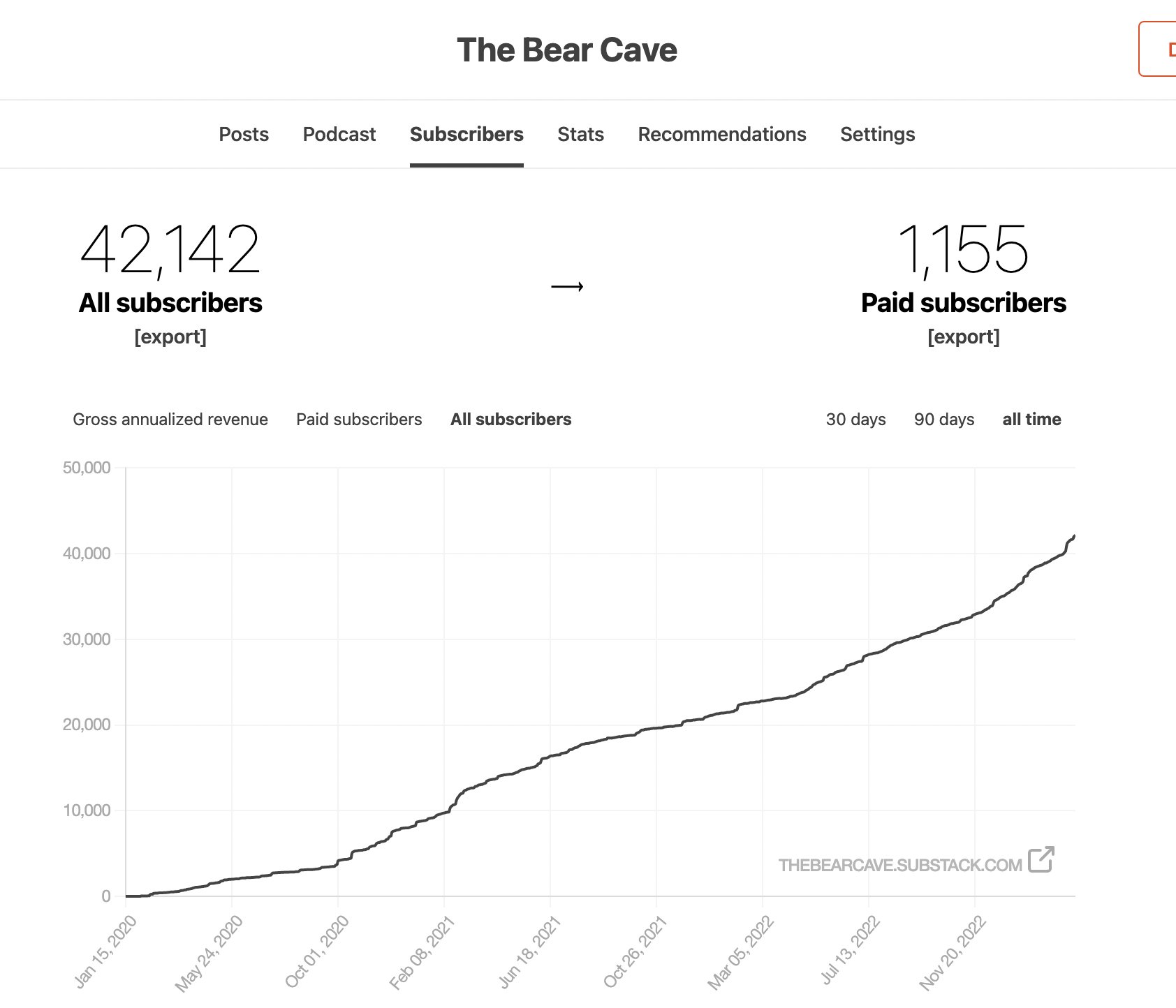
May 19, 2023Launching a Substack changed my life. After three years: 🙏 ~1,100 paid subscribers 🎉 ~40,000 free subscribers 🤯 ~$500k ARR For anyone thinking about launching a newsletter, here’s everything I’ve learned 1/ Do something UNIQUE. You want to be the only person who does what you do. Build a personal monopoly. No one wants more email, so you need something unique and differentiated to make it work 2/ Internet niches are bigger than you think, even when your account for the fact they are bigger than you think. Passionate about agricultural tech? European bonds? Fine wines? Women’s Soccer? Each of these would work if you're passionate and dominate it 3/ Keep it simple and short. Keep the max length below 2,000 words. If you are even thinking about cutting something, then cut it. Brevity is the soul of wit 4/ Fewer emails. I send six emails every month (4 free and 2 paid). Daily emails are not required, especially in professional services. People would much rather read something great once a week, than something mediocre every day. Leave readers wanting more! 5/ Great content + great distribution = great success It’s not just about what you write, but how you get new readers to find your content Here’s a breakdown of where @BearCaveEmail got its traffic in the last 90 days 6/ Use Twitter. Almost all successful Substack authors tweet frequently because Twitter is a superpower for connecting with new readers and building trust with your audience. Use it wisely and professionally 7/ Accept every podcast invitation. Podcasts are great for building deep connections and reaching completely new audiences. Accept every invitation and prepare so you can hit it out of the park. Doing well will lead to more invitations 8/ Respond to emails/DMs quickly. Responding quickly (especially to reporters) leads to a ton of new opportunities. It is flattering for the other person and doesn’t require more time from you I’ve found when I don’t respond to a reader, they often unsubscribe 3-6 months later 9/ Clearly define what paid subscribers get. Have a very clear policy on what free subscribers get and what paid subscribers get. People want to know what they are paying for. Having it wishy-washy is a big turn off and will generate complaints 10/ Occasionally target free subscribers with promo emails. A truthful and intriguing promo email can work wonders. The email below generated $15K+ of revenue in one day. A good promo email will also include social proof, like tweets for others praising the publication 11/ Good promo email + good content is the source of 80% of paid growth. 12/ Newsletter economics. Substack takes 10%. Stripe takes ~4%. Refund requests ~1%. BUT you are paid a lot upfront with annual subscriptions. Low churn in the professional services sector. If people can expense it, they are much less price-sensitive 13/ Charge more and be generous. A newsletter cost is de minimis if it will help someone do their job better. When I raised prices from $34/month to $44/month growth increased! At the same time, I offer .edu emails 75% off and have a generous hardship policy 14/ Customize your welcome email. A good welcome email to free sign-ups set the tone for your reader relationship. Ideally be concise, positive, tell readers what to expect, and share links to popular past content
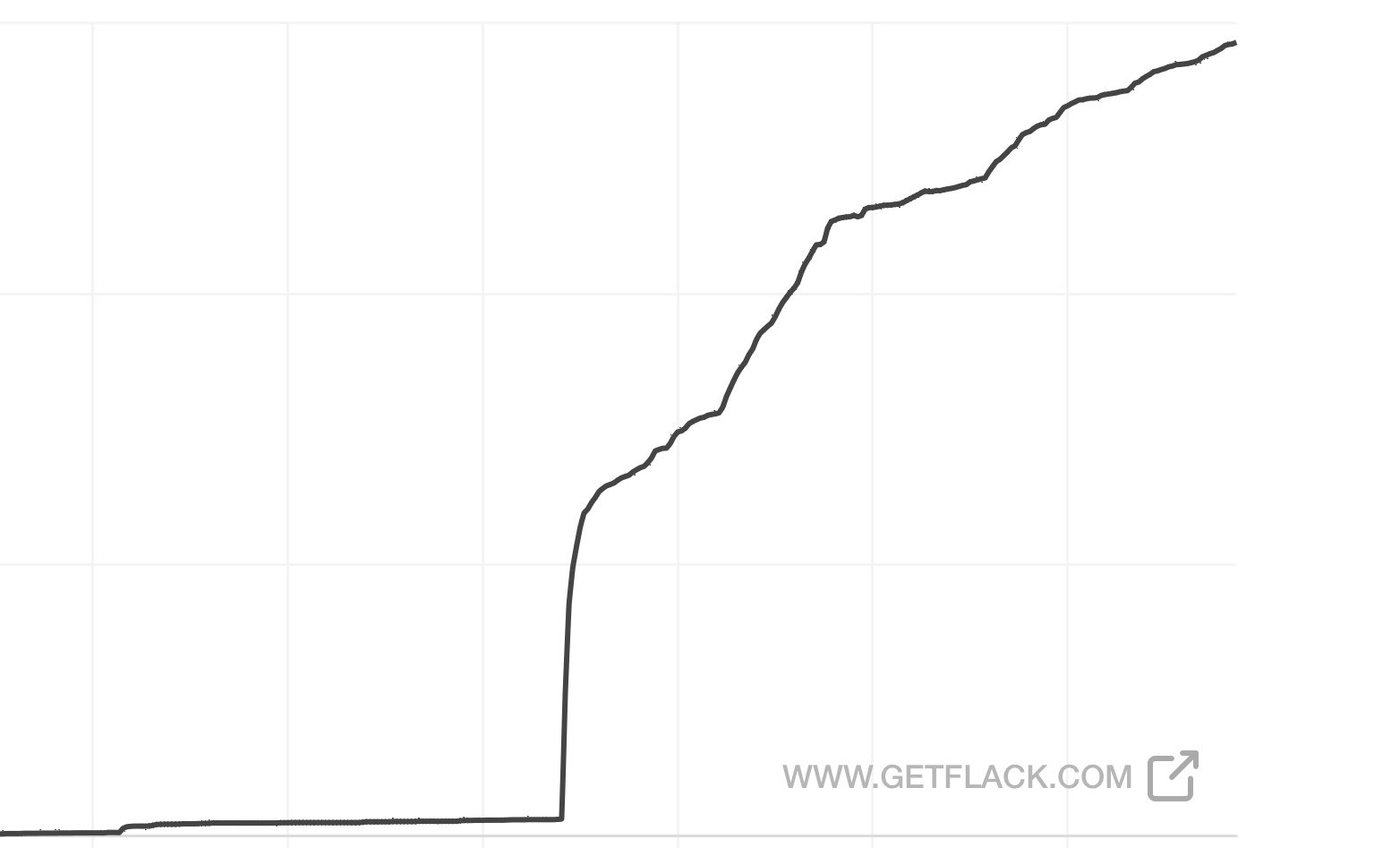
“How do I grow my newsletter audience?” Writing a blog or newsletter is the best way to scale your ideas. But a following doesn’t just happen - you have to build it. When I was running comms at Substack, this is the advice I gave writers for promoting their work: https://t.co/WkoLw0uEcy
Every year I sit down to reflect on the books I read, and without fail a few themes show up. This year I kept coming back to storytelling, leadership, predicting the future, and faithfully asking questions. https://t.co/d5lawHHdiF
Dec 22, 2022I'm the 7th most-saved Thread writer of all-time on Readwise. My threads have been read 98M+ times, and led to 224k+ new followers. Here's my entire writing process in < 2.5 minutes: Writing high-quality Twitter threads is the fastest & easiest way to pick up followers who are interested in your expertise. That leads to more email subscribers & customers. Unfortunately, most people don't have a writing process for threads, so they make common mistakes. Here are the biggest mistakes I see: - Lacking a good “Hook Tweet”. - No "headers" on the "body" Tweets. - Way too wordy, and no white space for reading. - No clear call-to-action or call-to-conversation at the end. Let's fix that. Start by writing the body: The body of the thread is the information you're attempting to convey. If you're not sharing anything of value, even the best "hook" won't get people to engage, comment, and Retweet. Scrolling a thread is tiring, so the format is everything. Each "body" Tweet should: - Have a header - Include enough white space to make it easy to read A header simply tells the reader what to expect in the Tweet they are reading. White space is the space between lines so that it's easier on the eyes. Here's an example of both: Write out the call-to-action next: So many people write good threads and then forget to tell the reader what to do at the end. This is missed opportunity to drive reader action. Think about the possible actions you want at the conclusion of your thread and then... Tell the reader exactly what they should do: - Follow you - Join your email list - Retweet the first Tweet - Read another thread you wrote - Buy a product that is relevant to the thread Here's an example of how I usually end my threads: Finish your writing process by creating your Hook Tweet: We're at the last, but most important step of writing Tweet threads. The "Hook". Without a good hook, nobody stops to read, engage, comment or Retweet. Ouch. Here are 3 (of several) hooks that work for me: Tell people what they'll get, & address a common objection: https://t.co/rc4efDsrza Use eye-catching numbers to share an accomplishment: https://t.co/3nU9Ig5rpi Use past vs. present to compare change: (Again, using #'s help) https://t.co/QbHyuJGRE2 TL;DR Step 1: Write the body using headers and white space Step 2: Use a specific call to action to tell readers what to do. Step 3: Write compelling hook lines by using my recommendations. That's a wrap! If you enjoyed this thread: 1. Follow me @thejustinwelsh for more of these 2. RT the tweet below to share this thread with your audience https://t.co/ekMDIS3c79
Nov 9, 2022If you use it right, Twitter is the world's most powerful social platform. But most people use it horribly wrong. Politics, doomscrolling, arguing with strangers—all of it a waste of time. Instead, unlock the full power of Twitter using these 5 steps: 1. Stop doomscrolling the home timeline This is where most people go wrong. The home timeline is filled with: • Ads & useless "topics" • Things you don't care about • Tweets from people you don't follow Luckily, there's a *much* better way to use Twitter: 2. Create Twitter Lists for each of your interests Twitter Lists are the most helpful Twitter feature—but almost no one knows how to use them. Think of it like grouping the people you follow by topic. Sounds helpful, right? Here are 2 ways to create them: 1. Set up on mobile • Swipe left to open the menu & tap Lists • Then, click the button in the bottom right to create your List. • From there, give it a name and click "Create." • Finally, add the people you want to follow who talk about that given topic Now, for desktop: 2. Set up on desktop Same idea here. • In the left side bar, click Lists • Then click the button at the top to create your List • Give it a name & add the people you want on it From there, repeat the process for each of your interests For example, here are mine: I have Lists for: • Writing • Crypto & macro • Health & fitness • College football • Venture capital • Generally smart people Having all of these in one timeline? Disaster. But once you create your Lists, you can 10x your Twitter experience by doing this: 3. Pin your Lists On mobile, head to your Lists tab • Tap the "pin" icon next to each of your Lists • Now, back on your home timeline, you can swipe right to read tweets from each of your Lists individually Boom, now it's like having multiple timelines—all curated by topic. You can do the same thing on desktop by using TweetDeck. • Go to tweetdeck dot twitter dot com • For each of your Lists, add a column that only looks at tweets from that List • Click the "star" at the top of the column to toggle between top tweets & chronological tweets This takes a few minutes to set up, but it's well worth it. Once you have the foundation, you can: • Add people to your Lists • Create new Lists for new topics • Follow the Lists of other people But most importantly: This setup ensures you will never *doomscroll* the noisy home timeline again. Instead, you can open the Twitter app with intention—taking control of the content you see. Now from here, there are 2 more easy upgrades you can make to get *even more* out of Twitter: 4. Relentlessly use the mute feature Once again, this is one of Twitter's best features—but they never show users how it works. On Twitter, you can mute: • Keywords • People And this allows you to turn Twitter into a (positive) echo chamber free of negativity. Here's how: To mute keywords: → Swipe left to Settings & Support → Settings & privacy → Privacy and safety → Mute and block → Muted words From here you can mute things like: • Politicians • News outlets • The "current thing" • & any topics you don't Poof—gone from your feed. To mute people: → Click on their profile → Click the "..." in the top right → Click mute This works great for: • Trolls & bots • Virtue signallers • Negative people Now they're gone forever, leaving only positive influences. Which brings us to the 5th & last step: 5. Use Twitter to build relationships This sounds simple & obvious, but most people don't do it. A well-curated Twitter experience allows you to have conversations with people from every: • Timezone • Background • Demographic All interested in the same things as you. This was pretty much impossible just 20 years ago. If you grew up interested in a different set of things from the people in your neighborhood, you were out of luck. But now, meeting lifelong friends is just a few taps away. So go set up this system! Here's a recap: 5 steps to unlock the power of Twitter: 1. Never scroll the timeline 2. Create Lists for each of your interests 3. Pin the Lists to the top of your home feed 4. Relentlessly use the mute feature for people & keywords 5. Use your new Twitter to build strong relationships If you found this thread helpful: 1. Follow me @dickiebush for more actionable threads like this 2. Jump back to the top tweet and retweet it so more people can unlock the power of Twitter Here's the link to the top: https://t.co/JPMDR9e0T4 If you use it right, Twitter is the most powerful platform in the world. But Twitter does a horrible job of showing you its advanced features. Here are 10 of them you probably know nothing about: The most underutilized Twitter feature: advanced search. It blows my mind how few people know this. Want to find someone's best tweets? In the search bar, type: from:dickiebush min_faves:500 Replace the handle and the number of likes as you see fit. Another good advanced search tip: Want to see everyone's tweets on a particular topic? In the search bar, type: from:dickiebush "consistency" Again, replace the handle and keyword as you see fit. You can filter by popularity too: from:dickiebush "consistency" min_faves:100 We all have those people we don't want following us, but don't want to block. Here's a good hack: Block them, then unblock them. This will unfollow you, but they'll never know. Get mentioned in a tweet that is receiving way too many replies, turning your notifications into a disaster? I've been there. Click to expand the details of the tweet, then click the three dots on the top right-hand corner. Then, click "mute this conversation." Everything changes when you start to mute words on Twitter. There are too many options to explain in a single tweet, so here you go: https://t.co/s8tqkW4285 Have multiple interests? Start to create different Lists for each of them. Then, pin them to the top of your timeline and swipe easily between them. It's like having multiple Twitter accounts in the same place. And it also stops you from doomscrolling. Now for a few practical tips on writing effective tweets and threads: I see this mistake so often. Someone puts together a great thread, but starts it by tagging someone with an @someone Starting a tweet with an @someone will make Twitter think it's a reply and hide it from your followers. Find a way to start your thread or tweet differently. Go easy on the links. Twitter penalizes links to external content. If you want to share your newsletter, website, blog post, or podcast, try this: Write some copy to pique the reader's interest, then link to it in a reply underneath that tweet. Formatting matters. The difference between an average tweet and a great tweet comes down to style. The easiest upgrade? • Lists • Using • Bullets Look way better than: - Lists - Using - Dashes How to find them: • Mac: Option + 8 • Windows: Alt + 7 This is one of the biggest engagement hacks out there. If you want to resurface a tweet back to the top of everyone's timeline, don't retweet it. Simply reply to it with a follow-up question or additional tweet. Twitter resurfaces the top tweet + two most recent replies. And that's it! If you found this thread useful, jump back up to the top to bookmark it and share it so others can learn from it too. https://t.co/0ecf6MHw5a If you enjoyed this and you're into writing, building, and growing: 1. Follow me @dickiebush for threads like this 4x per week 2. Check out some of my other threads: https://t.co/GIVdfYvXZI These are just a few of the little-known things @Nicolascole77 and I teach to each Ship 30 for 30 cohort. If you’re looking to start writing online (and level-up on Twitter) check out the link below. Sign-ups are open for the next cohort. https://t.co/gFBSuuRAzv Interested in more actional Twitter tips like this? Going to start sharing them in a free 10-day email course. Sign up here to be the first to get it (limit 100) https://t.co/bU3ffFMgtu Note to self: there is a market for advanced tips and writing effectively on Twitter. Behold the scale of the internet: https://t.co/QrGI147LBq
Nov 2, 2022A while back @mhdempsey wrote a post about how society was moving from a default trust state to a default skeptical one I think online communities with some gating mechanism can shift us back from default skeptical to default trust There’s so much more you can do when you’re in a default trust state - the cognitive energy needed to disprove/prove something is removed + coordinating everyone to accomplish some specific goal is easier when you can rely on a person to do it But you have to trust the gating mechanism - and this is also where the principle of self selection applies. If you’re someone excited to join that community BECAUSE of whatever the gating mechanism is, you can assume the other people are value aligned on that already The @mhdempsey post in question - which is a great read years later https://t.co/rUbE0K1Xyv
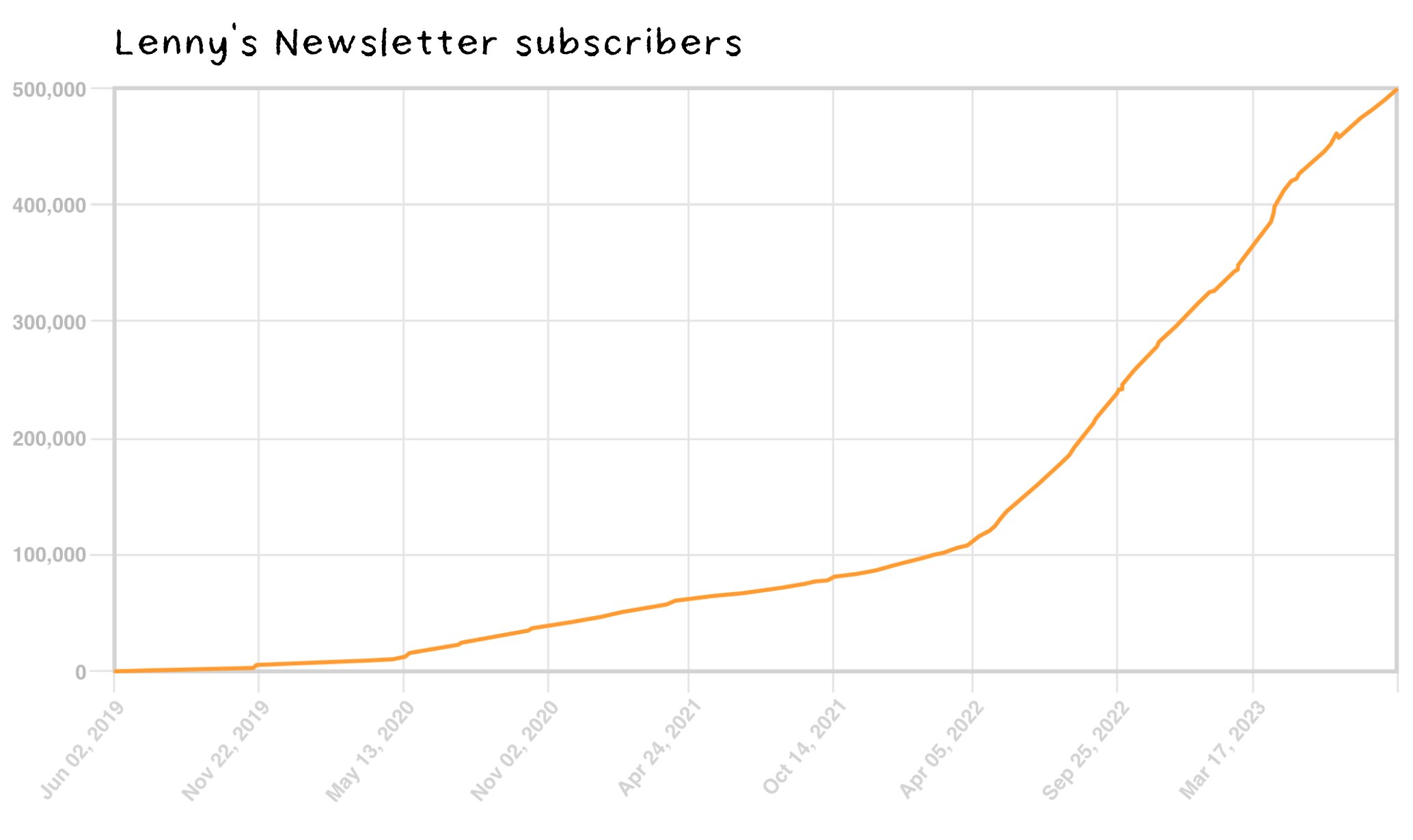
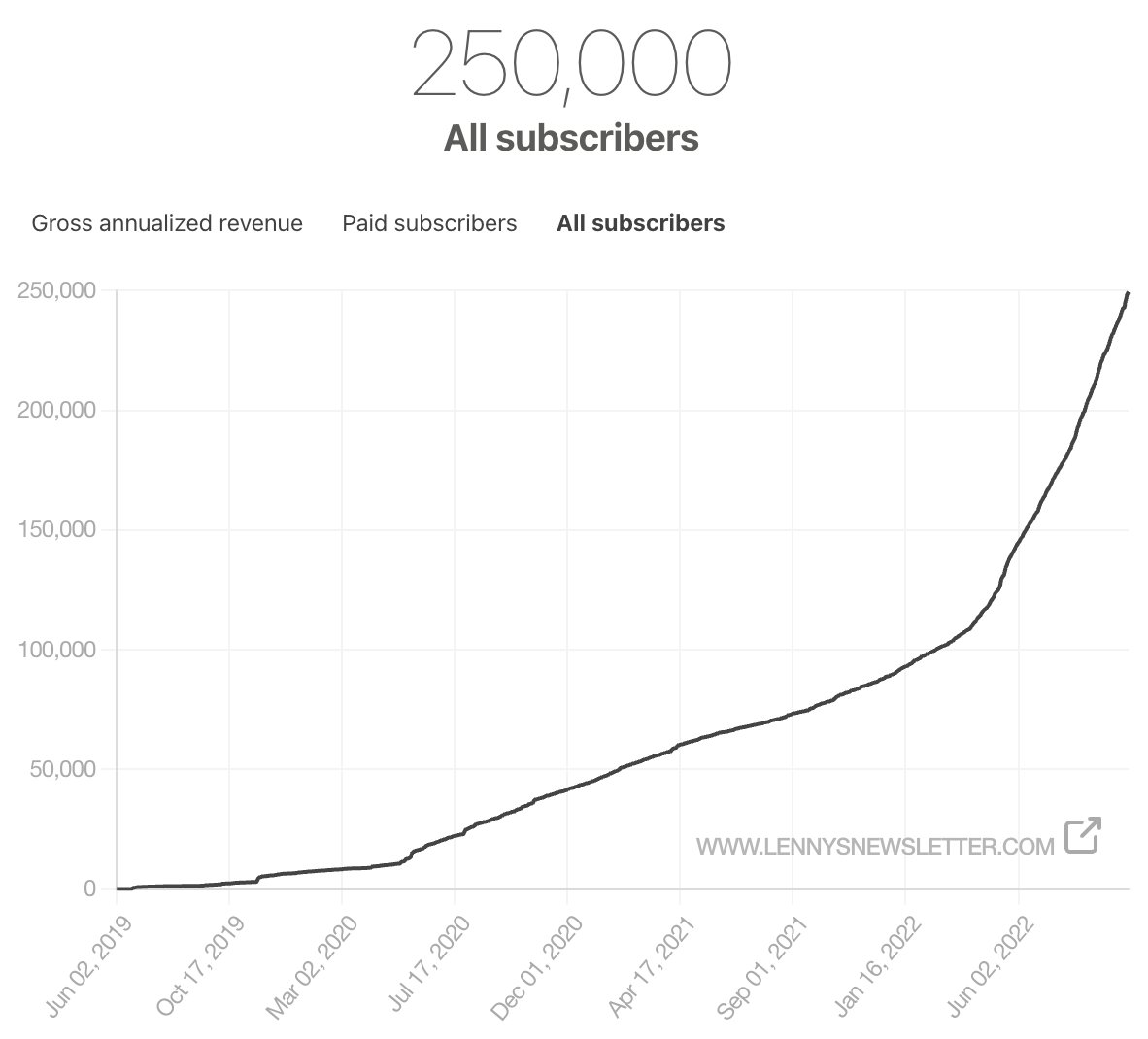
Oct 22, 2022Newsletter milestone: 2️⃣5️⃣0️⃣,0️⃣0️⃣0️⃣💥 Some stats and learnings from my newsletter'ing journey so far: 1/ Newsletter growth story ▫️ First 100: Successful post on Medium → helped me grow Twitter audience → tweet I'm launching newsletter ▫️ Next 1,000: Guest post on @firstround and @andrewchen's blog ▫️ Next 10,000: Writing useful stuff every week for 9 months → WOM + Twitter ▫️ Next 100,000: Writing useful stuff every week for 2 years → WOM + Twitter ▫️ Last 100,000: Writing useful stuff week after week → WOM + Substack recommendations Keys to success: quality + consistency 2/ Recommendations feature 78% of new subscribers are now coming from other Substack newsletters recommending my newsletter. And 11% of paid. Gamechanging feature. I've got @SachinMonga coming on the podcast in a couple of weeks to share how this feature came to be. 3/ Workload Newsletter, podcast, job board, angel investing → essentially full-time job hours (40-50 hours a week). I tried to take it easy, but it didn't work 😅 Each newsletter post takes a median of 10-15 hours. Some posts take 100+ hours. Some just a few hours. 4/ There's a time+quality network effect There's a strong correlation between the time I spend on a post and how well it does, so time -> quality. The fact that I don't have a day job and can do this full-time'ish means I have an advantage over anyone writing part-time. 5/ Income I make more from the newsletter than I made at my fancy tech job at Airbnb, stock included. Instead of one boss, I have thousands of micro-bosses. And as it grows, I get a raise every day. Pretty sweet. 6/ Fulfillment I've never done anything more fulfilling in my life. My personal mission is to help people do better work, and increase net happiness in the world, and I feel like I'm doing this at scale. 7/ Following the pull I have no real goals or vision for where this all goes, and never have. I mostly follow what pulls me, is interesting, and creates value. e.g. Newsletter -> Investing -> Slack community -> Job board -> Podcast -> [Hopefully nothing more 😬] 8/ Community The community that's formed around the newsletter (~10k people in a thriving Slack, 30+ local meetups around the world each month) is probably the thing I'm most proud of. Huge shoutout to @itsDrDrewithaSh @KiyaniBba @jess_newyen and Riya for making it so great. 9/ It's not all rainbows and butterflies No PTO, no benefits, no 401k matching, and unless I shut it down, in theory, I have to write an awesome newsletter every week for the rest of my life. I may also run out of ideas. Or energy. I try not to think about these too much 🤷♂️ 10/ All that matters in the end is creating value for people There's tons of content out there—but not that much GREAT content. You need to nail a job to be done for readers: 1. Entertain them 2. Help them make money 3. Help them be smarter about work/life <- Me 4. Share news 11/ That's all I got for now If you're not already a subscriber, check out the newsletter. Or start your own! Here's my most popular stuff → https://t.co/5y38Eht1D2
Is the Creator Economy cratering? Creator economy platforms that raised millions are pivoting and struggling to raise more money. A few thoughts: The elephant in the room: Almost every creator economy platform is struggling to scale. They almost all built their business model around lowering the barrier to help more people become creators. more creators = more subscribers = more revenue. But this hasn't quite panned out. Maven, the ed-tech startup that raised $25M from Andreessen Horowitz, announced a significant business pivot this week. They’re moving their platform towards industry experts and away from influencers. “We had the hypothesis that a creator with a big audience will have a great course and be able to fill it, and we were surprised that this hypothesis was wrong,” - Wes Kao, Co-Founder of Maven The foundational issue of the creator economy is that most creators aren’t great at what they do. It’s a power law game. Check out the far right column: It’s simply impossible to not be dependent on your top creators to drive revenue in the industry, even if you’re YouTube. Mr. Beast's massive success is a good example of this. He reportedly makes $54 million in revenue from YouTube, which is great for him and for YouTube. He gained massive attention from his videos, then built a lasting connection with millions of fans That connection is so strong that he's started several successful businesses using his name Many assumed that this model was repeatable on a smaller scale with smaller creators So where did creator economy platforms go wrong? The assumed attention = intention But those two are very different • Attention is when your audience takes notice of you • Intention is when your audience is willing to take action for you Attention is cheap. It’s easy to grab. Even easier to fake. The impact: revenue doesn’t scale. Intention is hard to gain. It takes consistency and purpose. It takes connection with your audience. The impact: revenue has a higher ceiling than you can imagine. These platforms assumed that the attention of influencers could drive the intention of the audience to buy a course, a subscription, etc. The result isn’t pretty: • Substack did $9M in revenue in 2021 with $85M raised in funds. • Maven did $9M in GMV over 18 months • Patreon just laid off 17% of its staff • Cameo’s consumer business has stalled • Twitter’s Super Follow feature made a whopping $6K in its first two weeks So who's doing it right? OnlyFans is probably the most successful creator economy platform They are the only creator economy “take platform” that is growing rapidly. Their free cashflow grew from $150M in 2020 to $1.2B in 2022 with GMV growing from $2.2B to $12.5B. Amazing. How? OnlyFans looked at foundational issues for the Creators on their platform. They didn’t only focus on monetization optimization for creators; they solved real security problems that their adult content creators were experiencing. They required social verification, license upload, and strict rules around meeting in person. By increasing security, they enabled new ways to connect with their audience This allowed Creators to communicate with their audience in a safe way that allowed them to build connection To answer the original question: No, the creator economy is not crashing. It’s expanding. The problem is many platforms chose the wrong problem to solve. Excel jockeys were thinking “if we have X amount of subs and we make it easy to sell Y product then we can easily make $X" As Maven realized, that formula isn’t so easy to bring to life. You need audiences with real intention. You can’t assume everyone has a 1,000 true fans, you have to help them get to a 1,000 true fans. Let’s say goodbye to the “Attention Economy” and hello “Intention Economy" Thanks for reading. I cover the creator economy and the business of media in my newsletter, Perpetual. Give it a read if you liked this thread: https://t.co/qxqVVngCdE Fun fact: PewDiePie has 7m more subscribers than Mr. Beast, but only makes 8% of his income. Further proof that follower count isn't everything If if you’re an exec @ a media or creator economy company DM about my Summit coming up. The theme is using content to drive commerce. 25 seats is max capacity with workshops from @bentwitr (Mr. Beast mgmt and ops), @MatthewBerryTMR, @mrsharma, and more. https://t.co/sFT8WxET1m
Sep 18, 2022I built a 10,500+ subscriber free stock market newsletter in a year... With a 58% open rate. I spent $0 on marketing. Annualized revenue just crossed 6 figures. Here are 11 things I learned along the way about how to sustainably grow: 1. Write about what inspires you. Newsletters are labors of love. It takes discipline to consistently put out content. & consistently putting out content is a pre-requisite for building a loyal subscriber base. It's easier to do that when you enjoy the topic & writing. 2. Be transparent & real. Nobody expects you to be perfect. Everyone expects you to be candid. If things go poorly for an investment or idea... own it. Don't cherry pick the good. Give the good with the bad in the most blunt way possible. You're human. Nobody bats 1.000. 3. Save them time If you're willing to work... You can provide immense value. How? Dig through all filings, transcripts, 3rd party data etc. Condense the highlights down into a brief, spark notes version. Your audience will save time by reading your content. That's value. 4. Proofread A typo here & there is inevitable. An illegible passage here & there is a great way to tell your readers you don't care. Proof read. Then proof read again. 5. Define all lingo Maybe you know what GPM or OCF or DBNRR means, but some of your readers inevitably won't. It's tedious, but definitions are very important. Eliminate friction & create value wherever humanly possible. Speaking of which... 6. Keep it free for as long as possible... or forever. Nothing builds friction like a paywall. Keep that top of funnel as seamless as possible. If you need a revenue stream... pursue high quality sponsors. (Cost/1k impressions is usually ~$30-$40 depending on the content) 7. Engage with your readers Respond to your readers' emails. Answer their questions. Ask for feedback. These are the people supporting YOU. Ask them how you can best support THEM. & let them know how much they mean to you. We are nothing without them. 8. Ask for help on special occasions Did you spend 8 weeks on an article? Did it feel amazing to publish? Good! Ask your friends for a RT. Don't leave the article's success up to an algo. & make it clear that you're happy to do the same for them. Teamwork = dream work. 9. Embrace the hecklers The bigger you get... the more jerks you'll encounter. When you're publicly sharing opinions & ideas, it's inevitable. 🤷♂️ Take it as a compliment, ALWAYS ignore them & move on with your head high. It's an unfortunate byproduct* of growth! 10. Inform don't convince It's fine to combine factual info & opinion. But we're not here to sell shares of stock. We're here to provide all relevant details involved in our own investment decision/opinion. Readers make their own decisions. Disagreement is to be welcomed. 11. Use social media Your Twitter followers are the most likely people to be interested in your longer form content. So? Post your articles to Twitter. Use this as the wildly efficient & effective top of funnel that it is. & 12. When you tweet a thread that's gaining traffic... attach your FREE newsletter covering $CRWD $TTD $META etc. to it. 😜😉🙂 https://t.co/sjt1PCvyWs
Aug 14, 2022James Clear built one of the largest newsletters as a single individual. With over 1.5M subs, he's built a $20M+ asset. And his biggest driver for growth is his site. Here's how he's built his site to convert traffic into email subscribers: Unlike most media companies, James Clear didn’t use paid ads to grow his newsletter. His main two levers for growth are: 1. SEO 2. Conversion Rate Optimization This year, James’ traffic peaked at 933,630 in organic traffic a month and is currently on track to hit 640k+. 10 years of writing online. Writing Atomic Habits. James Clear developed himself as a thought leader. And this impacts SEO:
Aug 10, 2022 Original deleted — preserved hereA company asked why it was so hard to hire a good writer. I told them it was because good writing is an illusion: what people call good writing is actually good thinking, and of course good thinkers are rare.
Jul 31, 2022The venn diagram between "ideas I think are super important and fascinating" and "tweets that do well" is surprisingly small sometimes https://t.co/J5LdH5Uwsy i'm curious if anyone else experiences this phenomenon where the ideas you think are the most important just do okay and random / obvious things do well
Jul 11, 2022.@dickiebush went from 2k to 200k Twitter followers in 18 mos. He just released a 56m video where he writes a viral thread. I spent 4 hours studying it & learned that he follows a 3-part thread-writing process (that you can copy today): 1/14
Jun 7, 2022 Original deleted — preserved hereIt used to be: You are the average of the 5 people you surround yourself with. Now: You are the average of the 5 people you consume the most content from (Youtube, Twitter, LinkedIn, Podcasts).
May 21, 2022In January 2020, I started writing online. What followed was 9 months of lonely, frustrating, and painfully slow growth. So if you're a beginner, let me save you hundreds of hours and plenty of headache. If I was starting over again, here's the exact playbook I would follow: Here's the playbook breakdown: • Where you should be writing • How often you should be writing • 1 thing you shouldn't waste time on • The single most important thing you should do during your first 9 months (that I completely ignored) Let's get into it: First, where you should be writing. When just starting out, I followed the conventional playbook. I spent (wasted) hours creating a fancy website to host my fancy new blog. And that's where I published. I had to own my platform, right? Except, there was 1 big problem: No one knew my blog existed! I was publishing into the void, spending hours every Sunday morning slaving over a hot keyboard & nitpicking every word. Then, I would hit publish, waiting for the rush of attention. Except... crickets. The internet's crickets of indifference. And because no one knew my blog existed, there was no feedback loop. I had *no clue* whether what I was writing was interesting, helpful, or valuable to the reader. Instead, I was *assuming* I was on the right track. Newsflash: I wasn't. So here's your first task: do not start a blog. Starting your own blog as a beginner writer is like starting your own music festival as a beginner music artist. You're expecting everyone to come and visit your music festival (that has zero credibility and no big name guests). Instead, you should write on social platforms – specifically, you guessed it, Twitter. If starting your own blog is like starting your own music festival, writing on social platforms is like performing at Coachella. The attention is already there, waiting for you to wow them! So you're writing on Twitter in front of hundreds of thousands of (potential) fans. Now let's keep the metaphor going. You write something on Twitter that goes viral – it's like you hopped on Coachella's main stage and blew the crowd away. The fans want more! So now what? After your performance, you wouldn't just say "see you next year!" What if Coachella gets cancelled, or you don't get invited back? You've built your relationships on rented land! Now, you need a way to *own* those relationships. And for that, we are going to start an email newsletter. This allows you to take your relationships from Twitter & start to nurture & deepen them. And for your newsletter, I would recommend @beehiiv as their product & roadmap look stellar. Alright so now you know where you're going to be writing: Twitter and Beehiiv. This is half the battle – the other half is figuring out: • How often you're going to write • What you're going to write about So let's quickly take care of those: First, Twitter. You should publish something every single day. It doesn't have to be a masterpiece, and in fact, it shouldn't be. It could be anything: • 1 tweet • 1 thread • 1 Atomic Essay It doesn't matter – but you need to build consistency and quantity to start. If you want a prescribed cadence, do this: • Write 1 high quality tweet every day • Write and publish an Atomic Essay 5 times per week • Write 1 high quality, deep dive Twitter thread per week You can do all of that easily in Typeshare: https://t.co/7Tn55DoqIo With your cadence down, you need to generate ideas. So here's a secret: writing consistently is all about finding ideas that are obvious to you (but amazing to others). This guide will help you do that (so come back to it later): https://t.co/Kz1Fs8bD7o As for your newsletter, here's a simple formula: • Publish it weekly • Share your best piece of writing from the week (to highlight yourself) • Share 3 pieces of content you found valuable that week (to highlight others) • End with a question prompting reader response Now, so far we've covered: • Where you should be writing • How often you should be writing 2 more things to cover: • 1 thing to not waste your time on • The single most important thing to focus on in your first year writing online Let's keep rolling: In your first year of writing online, you should spend no more than 10 minutes editing *anything* Why? Because you have no clue *what* you're editing for. Perfectionism crushes 99% of beginner writers (and keeps them from every publishing consistently). Instead, do this: • Wait 24 hours between writing and editing • Read everything you write aloud to identify the clunky bits • Do your final edits on a different screen than the one you first wrote on Here's a full breakdown of how to do this in 10 minutes or less: https://t.co/tYII2Hiui0 Lastly, onto the single most important thing to do in your first year of writing online. Focus on building relationships with others. The key here is *proactively* finding other writers and creators at similar points in their journey as you (and reaching out to them). 95% of the people I talk to and work with on a weekly basis I met because of my writing on Twitter. So set a simple goal: • Meet 1 new person per week How to do this: • Engage with their writing • Send them a DM • Jump on calls & jam on your interests Your focus should be on building a foundation of relationships. The earlier you make these in your creative journey, the better (because these relationships will compound for years). Don't skip this important step! Boom! I hope this was helpful if you're a beginner writer. For a deeper dive into everything you need to start writing online, here's a free 13,000-word Ultimate Guide that over 40,000 people have downloaded: https://t.co/34AcQYuW3r The exact playbook I would use if I was starting over: • Do not start a blog • Write on Twitter & @beehiiv • Publish something every single day (using @typeshare_co) • Find the ideas that are obvious to you • Do not waste time editing • Focus on building new relationships If this was helpful, toss me a follow @dickiebush for more threads on digital writing and digital business. And to bookmark it and share it with others, click below to jump back up to the top: ↓↓↓ https://t.co/bqTacQpP2t
May 7, 2022The BEST way to learn copywriting: copy others. Literally. This is exactly how we learn music (playing other songs). And it’s how I learned copywriting (which absolutely changed my life). I created a thing to help you learn. It starts tomorrow: https://t.co/Cu2R35Ers2
Apr 3, 2022Today, I'll cross $2M in income in 2.5 years as a creator. All 6 revenue streams are managed using systems. Here are my 9 "must-have" systems for creators. [🧵 thread} 1/ Twitter content Generating revenue as a creator starts with being discovered. I have a 4-part Operating System for: - Curation - Templatizing - Rapid creation - Distribution & growth This allows me to create 15-30 pieces an hour. 2/ LinkedIn content If you're creating for Twitter & skipping LinkedIn, you're missing out. My first 7-figures came entirely on that platform. I use @Hypefury to cross-schedule everything from Twitter to LinkedIn. Plus, I can make minor adjustments to be platform-relevant. @hypefury 3/ Newsletter writing Newsletters build trust in the Creator Funnel. But, they are usually time-consuming. To write mine in less than 30 minutes, I use @typeshare_co Built by modern digital writers, it provides the templates I need to work quickly and with high quality. @hypefury @typeshare_co 4/ Private community Communities deepen relationships. I run one with 600 solopreneurs from 55 countries. I built a very complex application, acceptance, onboarding, and churn process using @outseta You can read more about that here: https://t.co/EAvITZI64v @hypefury @typeshare_co @outseta 5/ Digital products All of my creator products are hosted on @Kajabi Students can purchase and watch any time of the day or night. As they get deeper in, I use email automation to inspire them to continue. When they hit the 50% mark, more automation kicks in like... @hypefury @typeshare_co @outseta @Kajabi 6/ Testimonials I use a short 55-second video to ask people for testimonials. Rather than have them email me, I embed https://t.co/DNeY0WF8u7 into the module. When they click it, their camera opens up and they can record right away. These get auto-added to my landing page. @hypefury @typeshare_co @outseta @Kajabi 7/ Upsells I position upsells at the front end of the purchase flow. But I also send automated emails when lessons are completed. They position relevant recurring revenue products. Finish a section on templates? You're getting pitched in your inbox a few minutes later. @hypefury @typeshare_co @outseta @Kajabi 8/ Affiliates When you complete the course, I position my affiliate program. It's all automated with video and email prompts, plus self-onboarding. When new affiliates enter the program, they receive instant templates by email that they can use to sell via social or email. @hypefury @typeshare_co @outseta @Kajabi 9/ Coaching Two weeks after completing my course, students receive an email positioning my coaching services. Candidly, I don't want to do more coaching. But it's where I discover the most ideas for new products. Coach > idea > product > repeat @hypefury @typeshare_co @outseta @Kajabi None of these systems matter if you can't get discovered. So, I took my 4-part Twitter & LinkedIn Content Operating System and turned it into a product. I just released it this morning. If you're interested in getting it for 20% off, head here: https://t.co/6qifnNJ3Sg @hypefury @typeshare_co @outseta @Kajabi That's a wrap! If you enjoyed this thread: 1. Follow me @JustinSaaS for more of these 2. RT the tweet below to share this thread with your audience https://t.co/pE5BrnM3bh
Mar 22, 2022Crossed 40k followers today 🤗 it’s certainly a vanity metric but I’m not above being grateful for your support and encouragement of my work! Thank you! Some thoughts on how my approach to slow, steady, authentic growth on Twitter evolved from 2018 to 2022: First of all, if you’re just starting out, this post may be more helpful as it covers the 1-10k journey from 2018-19: https://t.co/WtbT3xiJAZ you can see early tweets that worked and that i didnt really have much of a thesis around my twitter activity yet. By 2020 I’d reached ~20k and wrote The Developer’s Guide to Twitter (it became chapter 38 of @Coding_Career). Some fave quotes below (and you can get the full thing at https://t.co/PzCMawTUwp 🔌) To this day my favorite Twitter advice comes from @dvassallo (check out his course) https://t.co/IMQbW0LAvq After ~20k I stopped marking the milestones, tho covid was a nice distraction I self report creator stats about once a month (https://t.co/eAm4q7jMuT) but tbh it does more harm than good in terms of motivation and creative process. Leave trailing indicators to the bean counters https://t.co/8cuCmgH8Mh If you nakedly just want to grow follower count, I know of no better playbook than @TrungTPhan, who went 0 to 350k in basically 2 yrs 👇 other A-list practitioners are @chrishlad, @stephsmithio, @SahilBloom are less formulaic, but worth studying. but i wanted something else. https://t.co/EFIL4XywLl Every follow on Twitter is a vote for the kind of person you want to be. I looked at the company I kept comparing myself to and realized I was trapped in someone else’s game. Reach is great, but meaningless without real world achievement. I call it the Meta-Creator Ceiling: https://t.co/tuGVa5QSFD The best outcome of Twitter is getting off Twitter. This means: - I post about what I’m working on - You do that too - Twitter helps us find each other - We meet in person, start working together, send opps to each other, etc. Twitter is *amazing* if you optimize for this In short: Learning and Building in Public. Too many people overdo the “in Public” and forget what they are here for in the first place. So many folks also try to debate on here, mostly a waste of time. This platform maximizes the chance you’ll be misunderstood. Take it offline! https://t.co/M43r2810P5 There’s quite some division whether to be “professional” or “your whole self” on here. I’ve vacillated quite a bit on this. Ultimately I’ve landed on making @swyx professional and @swyxio unprofessional. As long as expectations are clearly set, I think everyone is happy. Some other thoughts on the changing Twitter metagame while we’re here: .@jack gave us 280 characters to shut us up, but the best tweets always fit in 140 the best company Twitter game is probably @supabase right now in terms of being both funny and on message (a lot of the fast food twitters just give up on the latter, while @steak_umm gets downright existential with only message being meat puns) best govt Twitter is @USCPSC ofc Youtube has about 5-7x the reach of Twitter Yet Twitter seems to have 5-10x the monetization (if you account for opps/off balance sheet influence) Implications are brainfucky if you have to make just one bet. Tiktok is, afaict, worthless for non beginner developers Nobody is seeing all your tweets. At @Netlify I leveled up a lot being forced to write 3 diff tweets per blog @lauraroeder used to say that only about 10% of your audience will see any given post @chriscoyier’s stats indicate that may have dropped to 1% https://t.co/Dkk9QvLDJ0 Twitter as an append-only log of chained thoughts: Most people do synchronous threading - write some article, break it up into tweets, post it all at once. This is clearly great for engagement, and in fact with 👆 observation you should repost it quarterly. That’s the easy way I do async threading - each top post establishes interest area, and then I add to it over time. If you do this for your top tweets, it resurfaces them in people’s feed. This way it looks like I constantly have high engagement, when really I’m often recycling past hits… (cont’d) https://t.co/IkTA088w4Y this is “hard” mode bc you’re committing to stone what you thought and how you said it. it’s embarrassing if you were wrong or changed your mind. you also can’t “conclude” a thread since it’s never really over. its a pointless challenge. I like it anyway bc it cannot be faked! https://t.co/KO4iAECLtN Twitter isn’t a platform you own, and it’s hard to surface old stuff. This is antithetical to knowledge work, where leverage increases with the amount of still-relevant content you own. Treat Twitter as the developmental league for higher-effort content: https://t.co/Xr1CmF4RMA The generalized version of this is having a two-phase commit for every substantial thought or piece of knowledge: - once to a continuous, high context, stream like Twitter - again to a discrete, low context, repository like a blog or wiki https://t.co/4SI8AWYojq Be very mindful on hero worship on this or any social platform. They’re likely to be less valuable to you the further ahead they are. Instead of seeking advice from people who “made it” Seek out your peers and “make it” together this is the Tao of wagmi https://t.co/W0WVOLcACh
Mar 16, 202299% of Twitter profiles aren't clear: - What do you do? - What do you Tweet about? - How is your pinned Tweet related? - Why should I press the follow button? Bring people through the funnel with clarity.
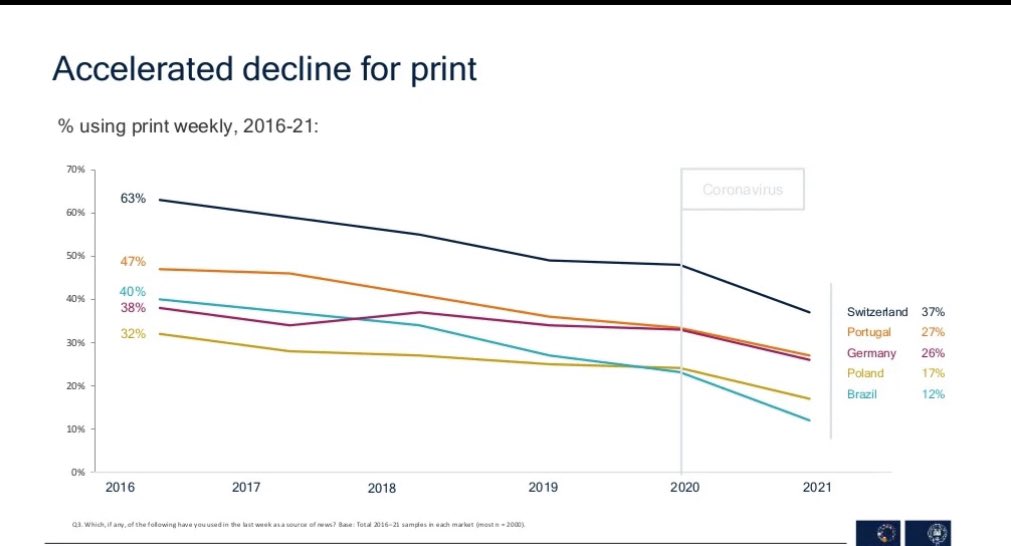
Feb 18, 2022Societies need an educated electorate, but it is unclear how that will happen in the mass market given problems with the advertising supported business model for journalism. Globally, just 17% of users worldwide paid for any online news in 2021. https://t.co/UTVdBko2si News is a public good (a danger zone for profitability). Public goods are non-rival and non-excludable. If I copy news, you still have that news (it is non-rival). If I steal your phone you will no longer have a phone (a phone is rival). Writing is protectable; news isn't.
I know it's been said before, but most people seriously underestimate how easy it is to cold email people and how impactful that can be. Confidently sending cold emails/DMs is a life-changing skill IRL most people are nervous about cold emailing their favorite author or researcher or whatever, not realizing that: (a) the person would probably love to hear from them (b) it's a pure-upside bet (worst case they ignore you!) I wrote Zadie Smith once just telling her how much I liked one of her books and she wrote the nicest note back to me, and I've never forgotten it. One of hundreds of examples. Tell people you like their stuff! Anyway, this is just one of a category of low-hanging fruit that includes: 1) most people love *good* conversations with strangers, but are reluctant to start them 2) most people love receiving *thoughtful* compliments, but are scared to give them In both cases, there's no systemic solution, but these are inefficiencies of sorts and imply that you, personally, should: - send more cold emails - give more thoughtful compliments - start more conversations with strangers etc.
Feb 13, 2022The Generalist by @mariogabriele is like if Wikipedia were written by a fiction writer who worked in Venture Capital. It turns out, it kind of is that: 🧵 The Generalist has crossed over 53,000 subscribers as of publishing. Looking back at The Generalist’s last year, it is hard not to think about all the pieces that were produced and passed around like hot potatoes on tech Twitter: ▪️ Tiger Global ▪️ Terra ▪️ Stripe So, it was a pleasure to spend the past few weeks digging into the existing pieces. I capped that off with a chat with Mario himself, to bring you exclusive insight into: 1// The Makings of a Newsletter Writer 2// The Evolution of a Newsletter 3// Lessons from The Generalist 1// The Makings of a Newsletter Writer Chapter 1 - Early Writer Mario grew up in and around the world of books and reading. As a child. As he told @nathanbarry "From a very young age, I’ve always really enjoyed writing. So, I did a lot of that in school." His household was an international one: his father Italian and mother American. So, perhaps it was no wonder that, at age 18, Mario moved to the United States. The writing would help Mario craft essays that helped him gain admission to Columbia. At school, Mario was interested in public policy. “A Tiger,” as he described himself at school, Mario poured himself into the essays required to make it through the Ivy League Political Science curriculum. As you might expect, he graduated Summa Cum Laude. Chapter 2 - Legal Misstep The striking thing about working at a law firm is that nearly everyone working there does not like what they are doing. Mario felt the same way when he found himself at a law firm. One of the great benefits of being in New York City is that opportunity abounds. Bored with his day job, Mario enrolled in a night class for fiction writing. Another perk of being in NYC, Mario was able to do so at the other prestigious university in town, NYU. It was the classic, “bored in the day, happy at night,” situation for our young hero. He began work on a novel and reconnected himself to the writing roots of his youth. Before long, Mario found himself in a workshop with other writers. Each week, they brought 7 pages of their novel to share. This got Mario into the cadence of waking up early to write for an hour. It was a habit that would help drive many reps of practice. Mario continued to progress down the path of 10,000 hours. Chapter 3 - Life Experiments Like many polymaths before him, Mario decided to pursue an entirely different field from both his first job as a lawyer and his Ivy League degree: cooking. Mario enrolled in culinary school. While the creative work was for Mario, the cooking wasn’t the same as writing. Mario still yearned to make an impact on public policy. He went back to Columbia to pursue his Masters's in International Development. Chapter 4 - The Context to Share After graduating with his Master's, Mario entered the tech world. Luckily, in the world of Venture Capital in 2019, writing was an edge. Mario’s colleagues did not bristle at his interest in writing. They encouraged it. Chapter 5 - The Courage to Write In August of 2019, Mario used a flight to draft his first article. A few days later, on August 16, he published his first article. The piece did well, and opened Mario’s eyes about what it is like to share ideas publicly. As Mario said about his time in Venture Capital: It was during my stint as a venture capitalist that I got up the courage to start sharing my work in public. This is a crucial moment for any future newsletter writer. 2// The Evolution of a Newsletter Chapter 1 - Becoming a Newsletter After the Y Combinator piece, Mario kept writing. Initially, he thought it could be a daily habit. That lasted all of two days. So sharing writing became a weekly habit for Mario. And, bit by bit, The Generalist was born. But, it wasn’t always called The Generalist. The newsletter began as Brunch Briefing. Early versions included tweet and link roundups. As Mario explained, “the value over replacement was low.” Eventually, Mario found a niche. As Mario said to Indie Hackers: "I was able to separate myself by going deep in a way that few were doing… Ultimately, I'm telling a story in as narratively compelling a way as possible that is different from a lot of ... business writing." Chapter 2 - Early Growth To get early subscribers, Mario did “things that don’t scale.” This included activities like reaching out to the VC club president at Harvard or Yale. In April 2020, Mario would launch the RFS 100. This was, remarkably, the same month Packy McCormick merged his social club Not Boring into his newsletter. At the time, Mario had the strategy to build out several different newsletters: In May, he launched the S-1 club. That would catch on in particular. This led to two important insights that shaped the future of the Generalist: multiplayer pieces and companies as a unit of analysis. Multiplayer pieces are a tactic the Generalist relied heavily on during its growth in future phases. Mario developed a unique model to manage large groups of contributors, like the 10 additional contributors to The Generalist’s piece on Tech in Africa. Using companies as a unit of analysis was the other foundational learning for Mario from the S-1 club. He realized there “is a massive TAM.” Fast forward to today, and Mario expects, “at least 75% of The Generalist will remain company pieces for the foreseeable future.” What makes people love company pieces so very much? People like to read stuff that they might be able to act on. That could be investing, joining the company, or applying a lesson to their current roles. Doing it as a side hustle for a year, Mario got 5,000 subscribers. Chapter 3 - Going Full time Exactly one year from the day Mario published his piece on YC, he announced he was going full time - August 16, 2020: https://t.co/1uCPPfsPTL Mario detailed many of the reasons behind his decision in the 62-page deck he includes in the thread. One of the most interesting is his breakdown of the potential for creators. His comparison set included podcasts, YouTube, and streaming. In August 2020, newsletters weren’t quite as established as they are in February 2022. So Mario didn’t include Pomp, Lenny, Polina, or some of the myriad of other highly successful newsletter writers these days. He wandered into the scary new world and dove in headfirst. Chapter 4 - The 6 Billion Dollar Stare In late 2020, Mario worked with a collaborator who formerly worked with the $6 billion dollar hedge fund, Durable Capital. The collaborator, proud of the piece, shared it with a former partner at the fund. Quickly, everything escalated. Mario, a solopreneur working his butt off and earning zero money, was getting threatening messages from the General Counsel of a giant firm. But, as Mario says: The Internet is undefeated. Mario was able to connect with a media pro bono lawyer. They helped him through, and he didn’t cost him. It was likely a case of the Streisand effect. The firm wanted to reduce attention on Mario’s piece, but their lawsuit actually generate much more attention for The Generalist By November 3, 2020, The Generalist had hit 13K subscribers. 2021 In early 2021, Mario continued to hit his stride. One of the items that helped growth takeoff was Mario’s best tweet ever even to this date: https://t.co/iVk0BJSYXH Chapter 5 - The First Slowdown In the summer of 2021, The Generalist hit its first slowdown. The newsletter saw 4% month-over-month growth vs 15% historically. Mario had to have the endurance to get through. Mario started writing about topics that were even hotter. In the summer of 2021, that was crypto. Mario wrote about Robinhood, FTX. Sushiswap, & OpenSea The final one was shared by Tim Ferriss. Mario exited the slowdown continued on the exponential growth path. In September, Mario also shared that fully three quarters of the business relied on subscriptions for revenue. Mario represented the archetype of a premium newsletter. But, in The Generalist’s world, nothing stays constant for too long. Chapter 7 - NFTs The first big change for The Generalist was NFTs. Mario became one of the first writers to experiment with NFTs. A week after his piece on Opensea, the leading NFT marketplace, Mario published the piece, NFTs that Think. The primary sale netted the project $150K, and secondary sales have netted well over $35K. Most importantly, for Mario: "It was one of my favorite things I’ve ever done. " Chapter 8 - Changing the Business Model The second change for The Generalist from the days of 75% subscription revenue occurred at the start of 2022. The Generalist’s content went totally free. It was a bold move for a site which gained many of its subscribers via paywall. This was the topic I couldn’t wait most to dig into with Mario. What was the rationale? 4 reasons: 1. Growth is capped behind the paywall 2. There’s something awesome about making this work for free 3. Better revenue model 4. Community surprised Mario in the first year So far, the change has worked out quite well. There have been less than a handful of cancellations for money back, and many additional people have signed up for the community. As a member, I can vouch that the community is worth it. Present - The Generalist Today Today, The Generalist is amongst the foremost newsletters. Mario was even verified on Twitter. https://t.co/NwgHifNVwz The Foxes NFT also had its second big drop last week. Things seem to be humming for Mario on all fronts. When I asked about revenue now that all writing was free, Mario was confident 2022 would exceed 2021. Future - The Generalist of Tomorrow The plan for The Generalist is more or less public. Mario has shared it: Of course, things change. RFS and the S-1 club have collapsed into Briefings. But the next step seems clear: a fund. Will Mario make the leap that Lenny, Packy, and so many other tech creators have done? We will have to wait and see. Takeaways from The Generalist Lesson 1 - Succeed by Doing Something Different Mario’s work is different from the other newsletters: ▪️ Packy has a personal voice ▪️ Lenny writes about product or growth ▪️ Benedict comments ▪️ Ben strategizes Mario, amongst long-form business writers, is unique. These days, what’s more common is to see shorter form. Prolific writers like Shreyans, Jesse, Sahil, and Trung may even heavily cite a Mario piece to create their pithier, small versions. Mario is playing a different game. Lesson 2 - Double Down on What Works Mario’s story is one of doubling down. First, he doubled down on his side hobby and went full-time. Then, he doubled down on companies as a unit of analysis by focusing pieces on them. After experimenting with several different newsletter types - from RFS to the S-1 club - Mario saw success with briefings and went all-in on them. Now, more recently, he has doubled down on crypto with NFTs. Mario triples and quadruples down. Lesson 3 - It’s Never Too Late to Pivot It’s hard to understate how bold Mario’s various pivots have been, none more dramatic than moving The Generalist from a premium newsletter subscription to a premium community. Even at 50K+ subscribers, Mario is trying new things. If there's one final thing I'll leave you with, it's this gem from Mario: The internet really rewards the more “you,” you give.
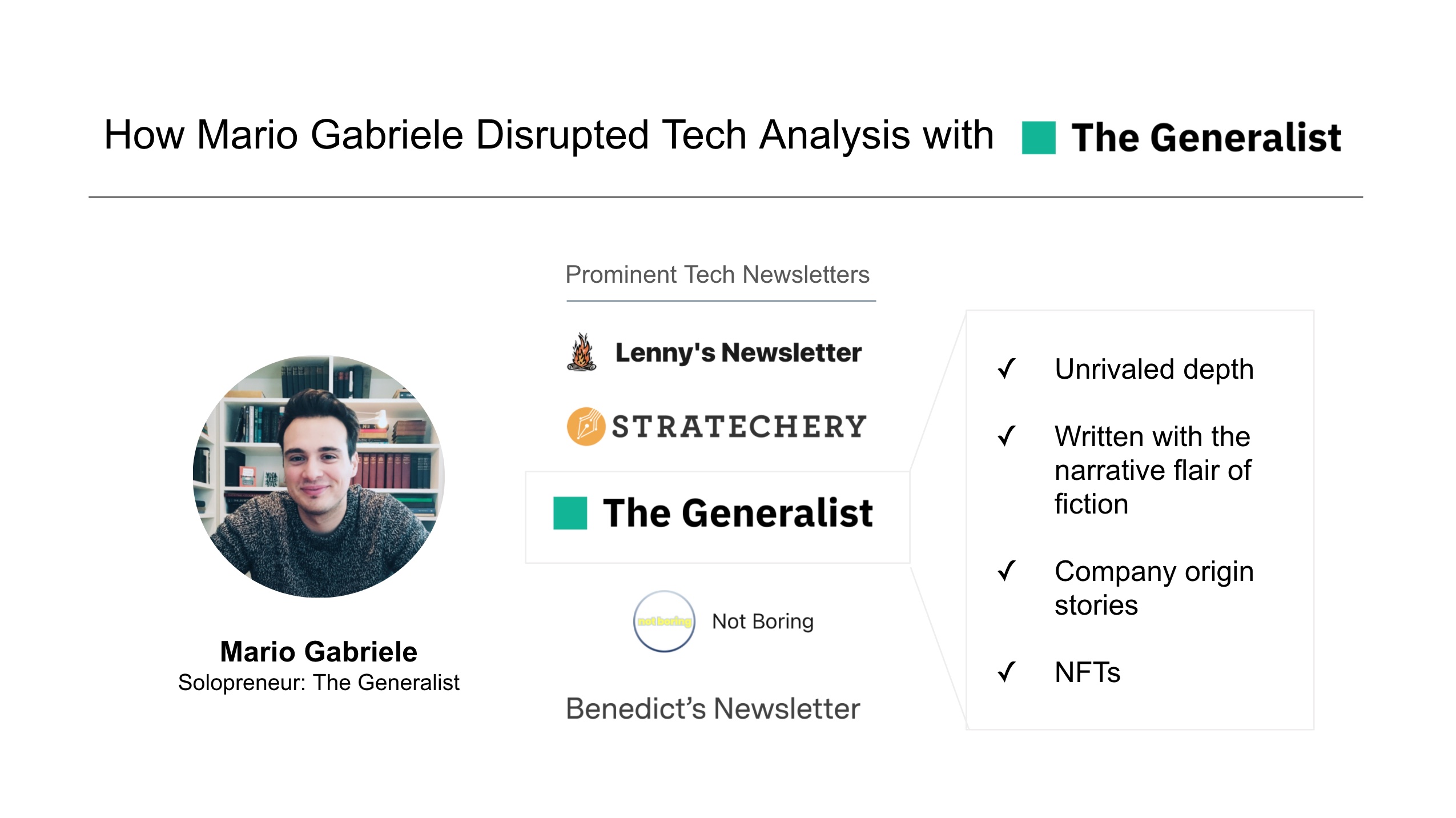
Just hit 200,000 followers. Here's my 13-step Twitter growth playbook: 1) Narrow your focus Don't be all things to all people. Find your personal monopoly & stick to it. Mine is media, startups, mental health. h/t @david_perell 2) Original ideas are exponential This is why @naval will keep his content free forever. Original ideas drive growth because they unlock the virality of the internet. Example: https://t.co/aXErkrlCGL 3) Threads work People sh*t on threads. They mute 🧵, 👇, and THREAD: But threads are just a format. And a format isn't inherently bad. Some of my threads have grown me by 5k+. Example: https://t.co/hCzVkBVQ1i 4) Tweet-jacking Smart replies to tweets work wonders. Gets you on the radar of people you want to connect with. And opens up your content to the audience of the tweeter. Example: https://t.co/jTiWglubc3 5) Trend-jacking Viral trends can lead to viral tweets. My most viral tweet ever was a trend-jack on the back of Robinhood's PR fiasco. https://t.co/mLOlt5mdyc 6) Public appearances Podcasts. Conferences. Video Interviews. Create reasons for someone to market you without asking. Example: https://t.co/NYxT35SKEd 7) Twitter Spaces Host Spaces: you're viewed as an authority & people will follow you for that. Attend Spaces: you're viewed as interested in a niche & people will follow you for that. Bonus: if you're verified, Spaces places you at the top of the audience list. 8) Getting recommended 1-part content, 1-part network - Create good content for long enough & people will include you in recommendations - Plant a seed with friends, so they think of you in the future Example: https://t.co/Sa2y1EaIBw 9) Repetition, repetition, repetition Repetition is a leader's best friend. Say a message 15x before it sinks in. On Twitter, it's especially true. It's how a majority of followers see your content. @agazdecki is the king of this with the word "microacquire." 10) Test sh*t constantly My best replies become tweets. My best tweets become threads. My best threads become podcast episodes. Test shorter, low-commitment content to informer longer, high-commitment content. 11) Ask friends to share I am shameless. It worked for me in building a business & it works for me on Twitter. When I create content that I'm proud of, I ask friends with large audiences to amplify. Worst case scenario: they say no. 12) Cross-platform arbitrage Find great ideas on other platforms that haven't yet caught fire on Twitter. I've focused on Linkedin-Twitter arbitrage. @TrungTPhan is the king of Reddit-Twitter arbitrage. https://t.co/ysxqzAdRb2 13) Clear CTA Lower the friction for people to follow you. Just because your content is great, doesn't mean the default thought is to throw you a follow. Make it dummy-proof. Example: https://t.co/EAi0EVpnyG Now it's time to take my own advice and CTA. Enjoy this thread? Follow @businessbarista for more content on media & growth. Really enjoy this thread? Register for "Build An Audience" Accelerator. I'm teaching: https://t.co/LLiTxTxaUk
Feb 8, 2022Industry Dive is going to make ~$30m+ in profit this year on over $100m in revenue focusing on niches that the vast majority of us don't think about. https://t.co/1OymLapg5O
Feb 7, 2022I think there’s a $1,000,000 opportunity in creating a paid "Explain It To Me Like I'm 5" curation newsletter for tech, business, or marketing. Here’s how I’d do it: The problem: So much great content, so little time. The solution: Weekly TLDR summary of best pieces of content from a given vertical. • Tech • Marketing • Finance It is critical that the summaries abstract the complexity and provide a simplified version of the original. Economic model could look like: Charge $20 per month. 50% of all gross proceeds go into a pool that is distributed back to the original content creators monthly to compensate them for their efforts. Would need ~4,200 subs to do $1m gross, $500k net annually. How I’d get them: Market on Twitter and find a few large accounts willing to share (upfront fee or affiliate). Pay for a few early early cross promotions in smaller, niche newsletters. Partner with the underlying content creators—this is a way for them to reach people and generate “free” $$$. None of this would require a team. It would require a lot of time—to read, understand, simplify, and distill all of the original content. But whoever does this will make great money and be one of the sharpest minds in the space. Learning through the Feynman Technique! https://t.co/Dye0r8klw0 Maybe I’m crazy, but I’d definitely pay for it across all of those verticals. There is so much long-form content I want to read, but rarely have time to get through it all. I’m happy to jam on it with anyone who is seriously interested. @scottbelsky @gregisenberg you guys in? Ok, that was pretty random, but I think it’s really interesting. Follow me @SahilBloom for more business ideas, frameworks, and threads on…well…everything. Cheers! By the way, I think the most important part of this is making sure you establish a concrete and thoughtful structure for compensating the underlying creators. No other curation platforms are doing it (that I’m aware of)—it would be a key way to stand out and get their buy-in. And for everyone mentioning Morning Brew: I love Morning Brew. I love @businessbarista & @austin_rief. I’m just envisioning something more targeted: • 1x per week • Focused distillations on top content • Covers podcasts, articles, etc.
Feb 4, 2022Wikipedia is defined by notability, but creators often establish their own. So where do they fit in? 👇 In today's piece, I write about Wikipedia's struggle to define notability for creators - including in-depth looks at Bella Poarch & Kkatamina: https://t.co/itCmU2HVnE Of the 15 biographies I wrote in the last year, 2 featured content creators. 1 was approved, 1 (Kkatamina) was rejected & has been downgraded to a Draft since. I almost wrote the article for another (Bella Poarch), and her page ended up going through a long timeline of drama. I absolutely acknowledge the important of carefully vetting all published information on Wikipedia; given that it is a free encyclopedia where anyone can contribute, every incoming nugget must be scrutinized carefully. However, it is frustrating that the existence of creator biographies will require waiting for mainstream news (the sources that Wikipedia considers “reliable”) to discover, catch up, and then cover outstanding creator talents and voices, particularly for underestimated groups. This is a bigger problem when you realize that Wikipedia influences the media just as much as the media influences Wikipedia. When journalists conduct research, they often reference Wikipedia. As the Creator Revolution continues to surge forward, this struggle to define a creator’s notability, especially on a large, free source of knowledge in Wikipedia, will also only continue to grow. I write this piece not because I know the solution to fix all these problems, but because I want to bring more awareness to this trend as a longtime Wikipedia writer and as a strong advocate and researcher in the creator economy. Read the full piece here! https://t.co/itCmU2HVnE
Feb 4, 2022I have been writing online for 10 years. In that time, I have gone viral more times than I can count. And accumulated 250,000,000+ views. These are the 5 rules I live by—to write things that reach the masses: Rule #1: Huge outcome, minimal cost All viral-worthy ideas sit at the intersection of A LOT for "a little." For example, what's the subtitle of Atomic Habits, one of the best-selling nonfiction books of this past decade? "Tiny Changes, Remarkable Results." Everyone wants a lot for a little: • How to get more done in less time • How to make more money without working harder • Tiny gestures that keep your relationship exciting for decades Etc. Rule #2: Big question, specific problem. The size of the question dictates the size of the audience. • "How to make more money as a nurse" = niche • "How to make more money" = general The secret to virality is to write for General audiences with a "specific" problem. For example: "7 ways to make more money as a nurse" = niche "7 ways to make more money" = general "7 ways to pay less taxes and make more money" = viral Still broad/general audience, but with a hyper-specific problem that resonates with "everyone." Rule #3: Do a Language Kickflip One of the easiest ways for ideas to *stick* is to do what I call a Language Kickflip. This means you take conventional wisdom and flip it. An iconic example: "Don't ask what your country can do for you. Ask what you can do for your country." There's something poetically satisfying about reading words that, when flipped, present radically different meanings. If you notice, most well-known writers do this: • "Don't avoid the obstacle. The obstacle is the way." • "If you fail to prepare, you are preparing to fail." Rule #4: Avoid complicated language Faulkner wouldn't have done well in the digital age. Content that reaches the masses has to be SIMPLE. (According to an extensive study, only the minority of Americans can read at a reading level of 9th grade or above.) This means swapping out complicated vernacular: • "Crazed" > "frenetic" • "Unnecessary" > "superfluous" • "Rant" > "Diatribe" Your writing should be easily understood by an 8th grader. Rule #5: It has to be skimmable. My goal, whenever I am trying to write something that "goes viral," is for the reader to extract: • What it's about (topic) • Who it's for (audience) • And the value prop ("Why should I read this?") ...all in the first 5 seconds. The reader should be able to skim the headline and "get it." And then skim the subheads of the piece and "get it." And then skim the first sentence of any given section and "get it." Your content could be amazing, but if you skimp on the formatting, nobody is going to read it. Bonus Rule #6: Don't over-invest in any 1 idea. I've gone viral hundreds of times. But I've also "swung the bat" thousands of times. The truth is: you have no idea what's going to go viral. Ideas you think will, won't. And ideas you think won't, will. Instead, focus on swinging the bat. Just keep building your library. For every 100 things you write, 1 will catch fire. And over time, you'll seem like a genius. (When really, you're just swinging the bat more than everyone else.) Rules for going viral & accumulating 250 million+ views: Rule #1: Huge outcome, minimal cost Rule #2: Big question, specific problem. Rule #3: Do a Language Kickflip Rule #4: Avoid complicated language Rule #5: It has to be skimmable. *Rule #6: Don't over-invest in any 1 idea. Want to learn how to write things millions of people read? Start here: https://t.co/T4CysXEIBl
Jan 31, 2022I spent 20 years teaching public school, and have a Master's Degree in Education. Trust me: Homeschool your children I want to address WHY... Schools are no longer about learning, It’s about passing It's about test scores It's a babysitting service It's NOT about education You take a test. Repeat “facts”. Get a good grade. This isn't normal. Everyone in public school is treated like a number. Kids are in classrooms for +8hrs a day, 5 days a week, surrounded by people their own age being forced to pass tests. This conditioning makes you generic. To me, online learning is the future. So now I focus on building online education platforms. Less red tape. If you want to learn more, download my FREE guide on how you can get started on Twitter👇 https://t.co/LzKNqQMkC8
Jan 31, 2022I've now asked 30+ successful newsletter writers how they got their first 1,000 subscribers. Their answers are all similar. Here's how to go from 0 to 1K subscribers (thread): First, the high-level lessons: 1. You have to write good stuff for people to subscribe & stick around. 2. Most growth tactics are simple, not easy. 3. It's easier to succeed with a clear niche, but you can succeed without one. 4. Different wins – make your writing distinct! Now, the tactics. Here's what most people did to go from zero subscribers to 1,000+... 0 to 10 subscribers: • Set up an email capture page • Ask your friends, co-workers, and family to subscribe Getting started is simple. Call your grandma. Text your sister. Ask your Doordash guy to sign up. These people will cheer you on even if your first few emails suck. 10 to 50 subscribers: • Share your subscribe page on FB, Twitter, and Linkedin • Keep inviting your friends, family, and coworkers 1-on-1 Don't overthink this – just share an invite to subscribe with a bit of context. You'll be surprised how much people want to support you. 50 to 100 subscribers: • Reach out to every new subscriber and establish a relationship • Ask your subscribers to share your newsletter • Join a writing community or a community focused on your niche https://t.co/or9fe4DICe Growth at this stage is counter-intuitive: You're too small to start a referral program, but early fans are disproportionately willing to help. Here are some simple things @danielxli and @dickiebush did: 100 to 250 subscribers: • Publish on a consistent schedule • Start writing where people are already hanging out (Twitter) • Post your best work on aggregator sites (Hacker News, Reddit) Two themes start to emerge at this stage... 1. You have to write where people are already hanging out. Nobody is going to magically find your newsletter. You have to bring it to them. Invest time building a presence on Twitter or another social platform. See @amandanat's advice here: https://t.co/T1SA1LsREd 2. Consistency builds a foundation for growth. The majority of writers I asked have some sort of weekly or bi-weekly publishing cadence. Consistency: - Maximizes your shots on goal - Helps you learn what's working - Forces you to uncover more ideas From @janedonuts: A couple more tactics: • Ask a friend with a newsletter if you can write a guest post • Tastefully plug your work in the comment section of already-popular posts Right around here, quality seems to matter a lot more. You're promoting your work to strangers. Lots of people on your list don't know you personally. These people will care more about *what you can do for them.* They'll be less forgiving, so raise your bar. 250 to 500 subscribers: • Don’t stop doing what’s already working (let things compound!) • Break your routine and produce a piece of staple content You now have a bit of distribution and can spend some extra time writing something especially good... The people I talked to had success writing: • Long-form interviews with somebody interesting • Personal essays that went in-depth on their story • Deep dives on a niche topic • Compilations with other influencers (see @nick_dewilde's piece below) https://t.co/bUppXP2bjr 500 to 1,000 subscribers: • Write better stuff! • Stay engaged on Twitter • Re-share your best work Now you're cooking with gasoline... Two amazing things happen once you have hundreds of subscribers: 1. You've built a small but real distribution channel. There are hundreds of people paying attention to your work, some of whom may have relatively big audiences. If you write something great, it now has a far higher likelihood of spreading beyond you. 2. You have a backlog of work, some of which is pretty good. Lots of writers routinely pulled their best work from their archives and shared them with new readers. Here's @nevmed on how this makes you look like a hit machine: A couple of Twitter-specific tactics also worked at this stage: • Keep writing interesting tweets & plug your newsletter if one goes viral • Write tweet threads & plug your newsletter at the end For Tweet threads to work, though, the quality has to be 💯 . The hardest part at every stage is just showing up consistently & doing the work. If you don't quit, compounding eventually works in your favor. 1K subscribers can take a while, but 2K is now inevitable. From @visualizevalue: Happy writing & good luck 🚀
Jan 28, 2022Digital Writing 101 Over the past year, I have written dozens of "101" threads covering everything from ghostwriting, to freelance writing, to self-publishing, etc. But these 14 threads were the best, and accumulated more than 5,000,000 views. Here they all are in 1 place 🧵👇 1/ Memorable Writing 101 https://t.co/w7yvseyYrY 2/ Ghostwriting 101 https://t.co/tTTyN8Jxpk 3/ Freelance Writing 101 https://t.co/KraDOi9gvc 4/ Writing on Quora 101 https://t.co/wjmfIhHXeN 5/ Quora Monetization 101 https://t.co/YnUeiWm7VW 6/ Writing On Medium 101 https://t.co/Ld6Uui87Jd 7/ Languaging 101 https://t.co/fhMDwHwJlB 8/ Creative Writing 101 https://t.co/dK8oG744Gv 9/ Original Ideas 101 https://t.co/OJ7EGduCH3 10/ Social Blogging 101 https://t.co/HlkoE3evEO 11/ How To Become A Prolific Writer 101 https://t.co/egidZYzhLp 12/ Writing Differentiation 101 https://t.co/NpgR7MDvyJ 13/ How To Be A World-Class Reader 101 https://t.co/ftmvGvJ9Wq 14/ Creator Economy Jobs 101 https://t.co/3uClDthUh3 Digital Writing is one of the most powerful skills you can build in today's digital world. Start here: 👇👇👇 https://t.co/T4CysXEIBl
Jan 27, 2022If you're feeling stuck in your professional life, start writing online. Here's how it can accelerate your career: 1. Building a Network: Writing shrinks the world. Historically, if you wanted to break into an industry, you had to move to its hub. Not anymore. By writing online, you can build a network from your couch. Meet people online. Then travel to build relationships in person. 2. Building Expertise: Quality writing begins with clear thinking. Once you write about a topic, you can speak about it more clearly, which will help you crush job interviews and establish yourself as an authority. Learn about topics that interest you and share what you learn. 3. Team Truth-Seeking: If you write well about an industry, your readers will respond with ideas of their own. They'll improve your thinking when they do. In any industry, everybody wants to meet the big names, but quality writers get a fast pass to the front of the line. 4. High-Level Conversations: Many of the most important ideas aren't shared in public. Instead, they're shared in small-group conversations. Writing online will get you into the room where deals are being made and crucial conversations are happening. 5. Access: The CEO of the first company I worked for asked me to help him write articles. I was just 21 years old at the time and gained direct access to him. If you're early in your career, cold email a high-level person and offer to write for them. https://t.co/H1HjrMwe71 6. High-Paying Skills: The higher you climb in an organization, the more your job will orbit around sales and communication. Writing helps you do both. Inspiring imagery drives sales, while clear thinking makes you a better communicator. Writing is executive-level training. 7. Entrepreneurial skills: The skills you need to write online are the skills you need to build a business. Building an audience teaches you marketing, publishing consistently teaches you discipline, and writing well teaches you how to think intelligently about your industry. 8. Build a Personal Monopoly: The ultimate goal of writing online is to become known for having rare and valuable expertise. Writing is how you promote your knowledge. The more passionate your audience, the easier it will be to grow your business. https://t.co/JpW8j1SbZt If you’re feeling stuck and looking for answers, sign up for my free 50-day writing series. https://t.co/5WGbzQ3PVz
Jan 18, 2022I spent over 1,000 hours learning to write effectively— because college completely failed to teach me. Here's everything I learned distilled into 11 tweets (that you can start applying today): The best writing is not a result. It's a byproduct. • Daily consistency • Taking long walks • Blocking the internet • Capturing ideas everywhere • Reading high-quality sources • Spending time without my phone Build the writing system that makes great writing inevitable. There will never be a perfect time to start writing. The "Once I ... then I'll start writing" is the ultimate form of procrastination. • Once work slows down • Once I feel like I am ready • Once this project wraps up The "Onces" will always be there - so get started today. When writing, stop trying to write something to everyone. Instead, be specific and pinpoint your one ideal reader. • Use specific examples • Solve a specific problem • Unlock a specific benefit • Create a specific emotion • Encourage a specific action Specificity wins. Stop thinking of it as "writing." Instead, start thinking of your writing like a startup. • Ship an MVP • Talk to users • Prioritize distribution • Solve specific problems • Focus on reader experience • Say something different, not better The best part: you're the CEO. Copywriting is simple. • Point out a specific problem • Point out the specific benefits of solving it • Position your product as the obvious solution If any of your copy doesn't fall into one of these 3 buckets, cut it. You should write about 2 things: • Things that are obvious to you now, but weren't 2 years ago • Things that are confusing to you now, but you want to better understand in 2 years This is a simple framework for continuous learning while building credibility along the way. Writing and editing are different processes. "Writing" is all addition - getting raw material out of your head and onto a page. In this stage, rip out your backspace button. *Editing* is all subtraction. In this stage, put your backspace key back and rip out everything else. You don't have to be an expert to write about something. In fact, people struggle to learn from experts (because they're too far ahead). It's easier to learn from someone just 1 step ahead of you. So start learning things and distilling them for those on the same path as you. If you want to write consistently, you need to capture ideas. Everywhere. • Quick capture on your phone • Whiteboards in the shower • Notebooks all over the place Once your mind trusts you can have ideas anywhere, it's free to be creative - and you'll soon be overwhelmed. If your goal is to accelerate your personal growth, writing is the most effective tool. • Clearer thinking • New friendships • Daily consistency • Learning new topics • Increased awareness • Foundational skill you can apply anywhere Hard to find anything else like it. And lastly, the single best piece of writing advice: Be clear, not clever. Your attempts to be clever lead to nothing but confusion. And the second your reader is confused, they're back to TikTok and Netflix. Thanks for reading! If you're looking to start writing online, here's an in-depth, 13,000-word ultimate guide to help you get there: https://t.co/34AcQYuW3r For more frameworks like this, follow me. → I'm @dickiebush Also, which one was most useful? Hit reply or quote tweet the top tweet with your biggest takeaway. You can jump back to the top here: https://t.co/mhtCoaXT2u
Jan 15, 2022So Jerry Seinfeld made $267 million in only 1 year. He's the most successful comedian ever. But it all started with his approach to writing. Here is the 6-part Seinfeld system to build any skill👇 The Scene: A yellow legal pad. 20 pages of observations and half sentences. A desk. A fresh cup of coffee. Welcome to Jerry Seinfeld's morning for the past 30 years. He sees himself as an athlete. His sport is standup comedy. And his practice is writing. "Stand up comedy is a profession of writing." And Jerry has a specific system for this morning practice. It has rules: 1) Only 1 technique matters 2) Stop the torture 3) Live for the re-write 4) Run the experiment 5) Never break the chain 6) Treat yourself like a baby Let's get into it👇 1) The technique is stupidly simple: "You can’t do anything else. You don’t have to write, but you can’t do anything else." No checking your phone. Either write or stare at a wall. His creative fuel? A yellow legal pad with 20 pages of observations and half-baked ideas. 2) Stop the Torture You MUST have an end time for your writing session "If you have the guts to sit down and write, you need a reward at the end of the session." And that reward is the alarm goes off and you're done. Extra tip from Jerry: If you can do 30 minutes, make your session 20. If you can do an hour, make it 45 minutes. Never completely exhaust yourself. 3) 95% of writing is re-write Jerry splits time across free play and polishing. Free play is using the yellow legal pad to spur ideas. Polishing is perfecting each word. Making each joke ready for "the experiment". 4) Run the experiment You now have a bunch of words. You then deliver them to an audience. They dump a bunch of data on you. "This is good, this is okay, this is terrible." Then you go back to re-writing and re-framing jokes or adding new ones. 5) Treat yourself like a baby "Writing is the most difficult thing in the world." So be kind to yourself. "When writing, treat your brain like a toddler, and then when you look at it the next day, you want to be a hard-ass." 6) Don't break the chain Jerry has a yearly calendar. For each day he writes, he X's that spot. Over time, he builds a chain. The longer the chain, the more you have invested. The more you have invested, the less you want to break it. Recap: 1) Refuse to do anything else 2) Your reward is the alarm 3) 95% is rewriting 4) Run experiments 5) Treat yourself like a baby 6) Don't break the chain If you picked up a new insight, retweet the first tweet to teach a friend: https://t.co/koHpTsbsDI For more free frameworks and systems, join 6,000 others and sign up here! https://t.co/Zr6gAK3oP0
Jan 8, 2022Last week, I asked people, "What's the one book or essay you'd recommend reading to get ready for the next decade?" We have 102 books in the Airtable (link below) + 95 replies (original tweet below). Only three repeat submissions: Winner (3 submissions): Complexity: The Emerging Science at the Edge of Order and Chaos https://t.co/95skM9FPLu Tied for 2nd (2 Submissions): The Three Body Problem https://t.co/9uZcx3Z3PG Tied for 2nd (2 Submissions): The Fourth Turning https://t.co/TuIsItYmKP Original tweet for the links in the replies: https://t.co/ueWEYcgK0z Full List: https://t.co/ss71zhGcij btw the form is still open if you want to submit books/essays/articles/podcasts: https://t.co/HFWQEpdG9U
Dec 21, 2021Over the course of 2021, I got to read a ton of online writing. That included some genuinely amazing pieces that changed my thinking and made my smarter. These were 10 of my favorite business and tech pieces this year 👇 1. Magic Beans This piece from @vgr only came out a couple of weeks ago, but it's an instant classic. Not only is it the best analysis of what makes NFTs "valuable" but a discussion about IP and the metaverse. https://t.co/nejrr53WZi 2. The Great Online Game @packym gave words to one of the fundamental dynamics of living life online. I think people will still be reading and loving it in 10 years time. https://t.co/MzPc7yZ3DP 3. China and Semiconductors This two-party series from @lillianmli and @JordsNel went extremely deep. I learned a bunch about a topic that can feel esoteric but has huge impact on our world. https://t.co/f1bQtkKbHC 4. Designing Effective NFT Launches Credit to @_anishagnihotri and @hasufl for an amazing, granular guide into NFT launches. It forced me to think about many parts of the process I hadn't considered. https://t.co/1yJBVMZR9X 5. Caught in the Study Web I will consume any amount of content on niche subcultures. @fadeke_adegbuyi unpacks a fascinating one: online education. https://t.co/FEfG45ukC8 6. Playing Different Games @EverettRandle captured Tiger's playbook brilliantly and memorably. I learned a ton from his framing and found his writing elegant and evocative. (Especially for GOT fans 😊) https://t.co/n4I4ISJ0wk 7. Amateur Environments Love this one. @HipCityReg's discussion of "amateur-ization" in product has given me a new lens for thinking about the world of tech. It's exactly the kind of fresh framing that Reggie consistently crushes. https://t.co/TQ3pcJLk2J 8. Collectivizing Finance Two of my favorite people wrote this piece on collective finance discussing DAOs, syndicates, and more. Respect to @AnnikaSays and @divineeconomy for a very thoughtful and timely work. https://t.co/vKOdZTVMDc 9. Picking a wedge @lennysan has a gift for taking scary sounding problems and breaking them down into legible solutions. In this piece, he uncovers the "wedges" different companies have used successfully. It's classic product wisdom. https://t.co/05uXaIGxb5 10. If Einstein Had the Internet This interview of @balajis by @cybersygh is masterful. It gives you the feeling of sitting in the room as two galaxy-brain thinkers go back and forth. https://t.co/ZAKZ3vCGWi This isn't meant to be a definitive list. I'm undoubtedly forgetting one of my favorite pieces, and there are some unreal writers that haven't been mentioned here. To anyone that published something this year is a baller. What were your favorites of 2021?
Dec 14, 2021I've worked with 15+ founders (starting from 10k ~ 100k) to scale their audience and build their brand. Here are my top learnings 👇 1. Story first, thought leadership second. No one cares about your thoughts on FinTech until you tell them your experience building your FinTech Startup. Topics: • How you grew from 0-X users • How you navigated X hurdle Example: https://t.co/c8dPL9AogQ 2. Counter-content wins People respond (like/retweet) to two types of content on Twitter (h/t @julian) : • Counter-intuitive: "I never realized the world worked that way." • Counter-narrative: "That's not how I was told the world worked!" Example: https://t.co/jprsdbqRjf 3. Quantify everything You need to stand out on the timeline. You have ~3 seconds to grab someone's attention. The truth: People respond to results and statistics. Topics: • How we grew to X employees • How we raised $ X Example: https://t.co/1o2mLHglqf 4. Identify your Content ICP Much like how you need an ideal customer profile for your product, you'll need the same for your content. Brainstorm: who am I reaching with each thread? What will they find valuable? Example (ICP: New/Early Founders): https://t.co/zRbl3SPV22 5. Claim digital real estate Own phrases on the internet. Then whenever people begin talking about topics adjacent to that, you are always brought into the conversation. Example: - @david_perell and "Personal Monopoly" - @gaganbiyani 👇 https://t.co/wllIpuoIdG 6. Find Pockets of Consistency Life as a founder is busy. Content is probably one of your lower priorities. But if you can spend an hour a week writing/sharing a quick update. It can create unknown upside. Example (Monthly MRR Updates): https://t.co/ETvms9DTsC 7. Journey > Product Unless Twitter is a primary growth channel for your product, share your experiences growing your startup instead of advertising your product. People care about your interests/learnings > your startup/product. Example: https://t.co/aDNoLlxD6i 8. Education > Accomplishments Your content should empower others. No one wants to hear you brag, but you can impress them AND help them when you frame it into applicable advice. Topics: • Fundraising key points • Navigating obstacles Example: https://t.co/sCvWFfyoaR Quick disclaimer: The fact that I featured certain founders does not mean that I worked with/helped them in any way. (Though I would love to :D) They simply had some of the best-in-class examples that I wanted to share with you all! Let's get more people creating! 1. Quote retweet the first tweet & let me know your thoughts. 2. Follow me @brandonthezhang for more Twitter/Audience-Building/Content Creation threads in the near future!
Dec 1, 2021 Original deleted — preserved hereIf deep, thought-provoking essays are your thing, do subscribe to Every by @danshipper and @nbashaw. I'm not saying this because my article was published on Every. But my article was published on Every today!! 👉🏼 https://t.co/HhKHrlRiux PS: Trial is $1 for 2 wks!
Nov 18, 2021When I sit down to write, I overcome procrastination by writing a terrible first draft as quickly as I can. Because almost all the work happens during rewriting anyway. The greatest friction is in putting ideas down in the first place. So, I use a technique: When an idea requires more thought than I want to put in, I write <to fill out> and glide past it. Your first draft is like speedrunning. The goal is to just generate and connect ideas. Remove the friction. Before I write, I choose an objective for my post: 1. Open people’s eyes. 2. Articulate something everyone is afraid to say. 3. Identify key trends on a topic. 4. Contribute original insights. 5. Distill an overwhelming topic. 6. Share a solution to a tough problem. And so on. The objective gives me a north star to know when I'm done. What does a job well done look like? Then I pair my objective with a motivation to ensure I see the post to completion. Example motivations: 1. Does writing this article get something off your chest? 2. Does it help reason through an unsolved problem you have? 3. Does it persuade others to do something you believe is important? And so on. I use draft 1 to find my novel ideas, which may be: • Counter-intuitive • Counter-narrative • Shock and awe • Elegant synthesis Then I use draft 2 for making those novel ideas stick—via: • Stories • Analogies • Examples How's that for a mini-thread 😂
Nov 14, 2021 Original deleted — preserved hereThe daily creative commandments from legendary writer and artist Henry Miller:
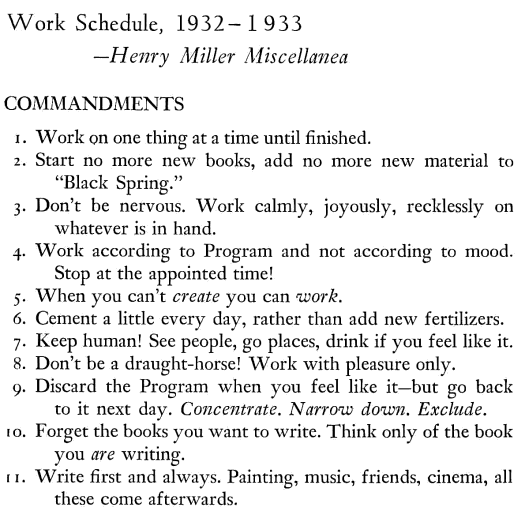
Gonna make a thread of my ongoing slow journey (emigration? perhaps…) to Web3, along with my covered wagon full of Web1 and Web2 stuff. Including NFTs, DAOs etc. So if those topics annoy you, you can mute this thread. The goal is to try and do some pathfinding and sensemaking, and discover a longer-term interesting vision to shoot for. What will ribbonfarm be in 5-10 years? Still a website you visit with a browser? A virtual mansion in a metaverse? A token that unlocks random blobs on IPFS? My first aha was realizing that even names work differently. First-class citizens on Web3 are not “sites” like in Web1 and Web2, but addresses on blockchains. Took some time to wrap my head around why ‘ribbonfarm.eth’ logically *had* to bean blockchain address, not a ‘site’ This is the truest current view of what it is. Some money, some tokens, and a week-old historical record of transactions that kinda tell a story. This is analogous to going to ribbonfarm dot com and clicking “view source” in your browser. https://t.co/MGlEL8FpwO This is a bit like staring at the “code” of the Matrix right? It’s a wtf experience. Yeah sure sometimes there’s surreal voyeuristic appeal to looking at big accounts raw on blockchain to see millions or even billions sitting there but otherwise it’s like reading accounts for fun https://t.co/smLrMeVpJs My true Aha! moment came with this tweet a day ago (which several people helpfully flagged in the replies, “you’re having your aha moment”). The front-end UX that can be created with this backend feels like sorcery to my Web2 brain. https://t.co/WAa9SPM9ba
Nov 7, 2021Incredible to see what @packyM has built in a little over a year. • Dominant newsletter (80K subs) • Novel, beloved brand • Innovative business model • VC fund with true edge One of the best players of the great online game we've ever seen? https://t.co/MQSEprzchj
Oct 21, 2021(1/2) I am thinking of starting a competitor to Seeking Alpha and Value Investors Club. Basically, a communal Substack where anybody can submit ideas. I review for quality and the best ones are published online and over email for free. (2/2) Authors get free exposure (or anonymity). This is great for any young author looking to build a reputation. Readers get decent ideas for free. Seeking Alpha just has the wrong vibe now and VIC is decent but requires anonymity and membership. Please reply with feedback. Okay, I'm going to do this. If you have a great pitch or two and want some exposure please send your best write-ups to me: edwin@585research.com BTW, this will be a long-only or long-biased publication.
Oct 20, 2021GLG, the world's largest expert network, filed for IPO yesterday. It has 1 million experts on its books and facilitates calls between them and its 2,700 clients. Its S-1 highlights the power of aggregation. 👇👇 In the last 12 months, GLG experts were paid $166m. But clients paid $628m; GLG kept 74% of that. Problem is, it's expensive to manage. GLG employs 2,300 people and its margin crunches down to ~20% at the EBITDA level. Technology could be a solution. "Over the past two years, we have invested heavily—and expect to continue to invest—in digitizing the GLG experience." The market is highly competitive – there are over 150 expert networks. GLG reckons it's 2.3x larger than the next biggest competitor. The firm is banking on the market growing though as "the world’s economy is shifting increasingly towards knowledge work." One network in Japan, VisasQ, went public last year at a valuation of 5x revenue and now trades at 20x revenue. GLG has invited its experts to participate in its IPO. I wonder where they'll land?
Oct 19, 2021Most people are still on the fence about building in public But I'm convinced it's the future Don't just listen to me 👀 Here's a thread of some of my favorite "Build in Public" tweets from prolific creators and founders: 🧵 It is still early days for the "build in public" movement. It takes a certain kind of mindset to fully leverage it with a combination of patience and execution If you enjoyed the thread, please: 1. RT the first tweet 2. Follow me @thisiskp_ for more build in public insights
Oct 6, 2021Normalize “game film” for knowledge workers. Why don’t we look more at our own and each other’s ways of working, to learn where to improve? 🤔
Jun 3, 2021I built my Twitter following from 1k to 40k in 50 days. My email list from 0 to 7k in 2 months. And I didn't spend a dollar. Here are the 9 secrets to building an audience fast 🧵 1. Build a rented audience With social media, you’re at the mercy of the algorithm. But, at the same time, these algorithms connect you to people all over the world. That’s the power of social media -- it gives your content wings and helps it travel. But, why is it a rented audience? Because at any moment, the algorithm can change and you reach 10% of your audience. On the other end, its distribution abilities make it essential to building an audience. This makes it a perfect tool to help build an owned audience. 2. Pick 1 channel Find where your target audience lives. Which platform they consume content on. And which content creation efforts fit your strengths (ex. Writing, short-form vid) Select the platform and go all in. When you master communicating on one platform, scale. 3. Form an identity If someone didn’t know your name, how would they describe you? Ex. @mrsharma -> The DTC Guy Ex. @Codie_Sanchez -> The Contrarian Thinker Once you’ve determined the identity, create an expectation for your audience. Constantly meet it, and you’ll be on your way to creating your digital identity. 4. Be like the Beatles Seth Godin says, “The Beatles did not invent teenagers. They merely decided to lead them.” You’re no different. Find an audience that already exists. Decide to lead them. You do this by becoming a reliable source of value. 5. Create more than you consume @naval said, "To be a good creator, you have to be creative. To be creative, you have to be constantly creating. Create content. Geed feedback from the world. Scale what works. Innovation comes from pushing through failure. 6. Quality over quantity One quality video is better than 3 average videos. One quality Twitter thread is better than 3 average threads. Consistently delivering quality content establishes you as a thought leader. This will position you to monetize your knowledge and skills. 7. Build an owned audience The ability to create a large audience on a social platform makes it a perfect gateway to building an owned audience. An audience where you control the reach and communication line. For example an email or text list. One tap and you can communicate to your entire audience. 8. Create content that travels The internet gives our content the ability to travel from feed to feed. So, how do you optimize this? By creating content that triggers one of the 27 basic human emotions. Emotions drive people’s actions. Leverage it to work for you. 9. Use the “So-What” test Create a piece of content and ask “so what” from the lens of your audience. This will help you understand their perspective. Understanding your audience’s perspective will help you deliver clear value. That’s how you always pass the “so-what” test. Would this help you? - marketing breakdowns - copywriting tips - how-tos - growth strategies - campaign dissection If so, follow @alexgarcia_atx :) And R/T that first tweet for me, please. It helps a lot. If you rather join the 7k marketers who receive my weekly newsletter then tap here 👇🏽 https://t.co/yci9t399mp TL;DR 1. Build a rented audience 2. Pick 1 channel 3. Form an identity 4. Be like the Beatles 5. Create more than you consume 6. Quality over quantity 7. Build an owned audience 8. Create content that travels 9. Always use the “so-what” test
Jun 2, 2021The HCI academic community does a great job of presenting paper summaries in accessible 5-minute YouTube clips. Gives you the gist of the argument + a friendly face to humanise the research. Eg. One on absurd outcomes of algorithmic systems: https://t.co/30MBMGEsdE Imagine if every academic paper came with a widely accessible video synopsis Researchers who need to dig into the details would still fund all those $$$ JSTOR subscriptions for access to full papers. The rest of us might get to finally learn what's happening in research labs...
May 16, 2021👋 Personal update: After spending the past year digging into the Creator Economy, talking to 100s of creators, founders & investors, I became obsessed with 2 things: 1) An idea: YC for Creators 2) A company: JellySmack So I'm joining JellySmack to build a Creator Accelerator! It's still day 1 the Creator Economy, but things are moving fast. Everything that happened to the startup world for the past 20 years will happen to the creator one in the next 5. So I'm thrilled to spend this time building the best place for early-stage creators to grow from! I believe Jellysmack is in the best position to build it while becoming an industry giant. Even more so now that we've just raised a Series C with @SoftBank. I've been truly impressed & humbled by the founders' clarity of vision & quality of execution. https://t.co/PWOTUW1BH2 Let's educate & empower the next generation of ambitious creators! PS: If you are or know an early-stage creator, my DMs are open 😇
May 13, 2021Fun to imagine Wikipedia and investopedia, but where instead of a text based, broad entry, there is instead a detailed, high quality conversation between experts. I look forward to helping bring that reality into existence.
May 3, 2021substack could take on GLG so easily GLG does $500mm+ in revenue connecting experts with people who want to pay $ hourly for access to experts so many people with niche, useful expertise on substack, and discovery/vetting is so much easier too a crazy amount of ppl on twitter make their living from GLG but don't really advertise it bc it's taboo or whatever. this stuff could be easily normalized with an easy interface and exchange system! it's definitely an inevitable future but elephant in the room is twitter is best suited for this lol
Apr 21, 2021There is an anonymous Google Doc where journalists self-report their salaries. Apparently, senior New York Times and Wall Street Journal reporters make ~$120,000/year. Good Substack authors earn ~$500k/year and grow 30%+ per year. The tides are shifting. https://t.co/MCzYiWAe6F
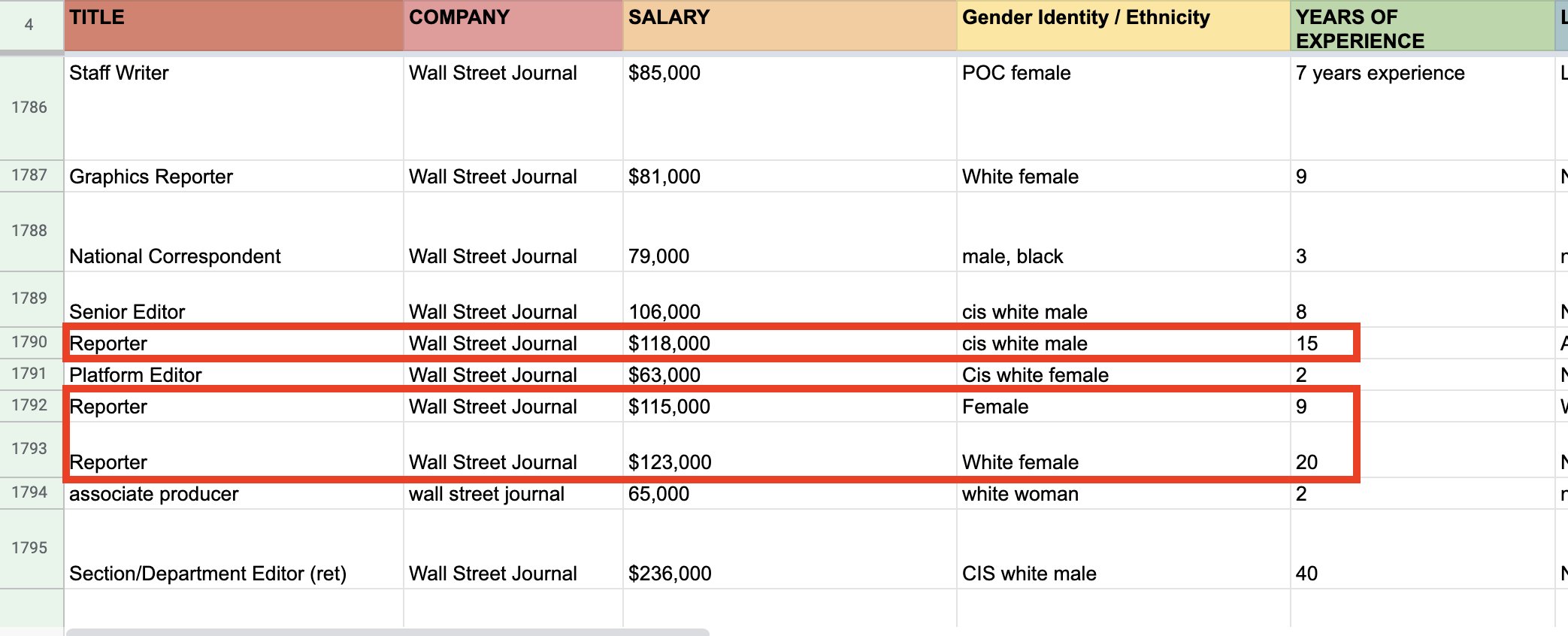
Many critics (especially those in media) have been questioning Substack's $65m raise. "Why raise so much capital??" I think it's genius. Here is why: [THREAD] Substack has done an incredible job at 2 things. 1. Building the easiest way to start a newsletter 2. Building a brand Substack is the Kleenex of ESPs. Many even use the terms "Substack" and "email newsletter" interchangeably. However, Substack's product is currently a commodity. This isn't a knock on the product, they are early! However, they take a % of revenue, whereas many competitors take a flat rate. For example, Ghost is a much better economic alternative. https://t.co/StTw3MVtfp As you scale on Stack, the economic disadvantage to being on Substack gets big. A $100/year newsletter with 5,000 subs would pay ~$50,000/year for the service. The same newsletter on Ghost would pay ~$250/year. So how does Substack build an economically viable business where creators don't leave for a cheaper alternative? 2 ways. 1. Stay lean and bootstrap! This is a huge market, and definitely does not have to be a winner take all 2. Help writers generate more revenue. When they took $15.3m in series A funding from a16z in 2019, they threw #1 out of the window. They need to go BIG + OWN the market. So now, all focus is on #2. How can SS help writers make more money? Substack has 2 options for helping writers make more money: 1. Discovery: Help writers open up their top of funnel by bringing them traffic 3. Help them convert a larger % to paid So how do they do either of these? This where the $65m comes in Substack is going to blitzscale the content creator world via the Substack Pro program. Not just journalists -EVERYONE. Millions of dollars If you have an audience, Substack is going to offer you an advance to leave your job and start a Substack. This will do 3 things. 1. Bring writers to Substack who otherwise wouldn't want to take that risk 2. Bring a lot of new readers to SS 3. Generate a ton of brand awareness So why do this? These contracts are temporary after all... Once their advances are up, they are allowed to take their audience elsewhere. They own the emails! A few reasons... First, they may try to turn SS into a consumer brand. As @benedictevans has pointed out, Substack can leverage big names to become a consumer brand. They will try to get users to show up to Substack dot com. This will bring writers net new subscribers vs. porting their audience over from Twitter. All the sudden, Substack is helping you grow your list... Discovery.... All the sudden, the 10% fee may start to feel cheap. The second reason to raise $65m for creator advances is for bundling. Can Substack figure out bundle economics? Can they find multiple newsletters to bundle together and convince people to pay who otherwise wouldn't? Only time will tell, but they definitely can't without enough writers on the platform. Tough to bundle if you don't have much to choose from. Having thousands of successful writers on the platform gives them the data they need to test bundling. So, do I think Substack will become a multi-billion dollar business and transform the media industry? I'm not sure. But, once you get on the VC treadmill, you can't get off. Raising the $65m to offer advances to hundreds of successful writers is the right move. A few additional thoughts: The substack opportunity is not to poach 1m journalists but rather to create 1m new content creators One way I like thinking about the TAM: If they can get 2500 writers to 2500 paying subscribers at $150, that’s 100m ARR. Getting there doesn’t seem *that* though. Staying there does. More tweetstorms like this here. https://t.co/WtjsNIf4xy
Apr 12, 2021**This is a thread head.** The syndication endpoint returns only the first tweet; the rest was extracted from X on 2026-08-20. Items 1 and 3 through 7 are verbatim below. **Item 2 and anything after item 7 are not yet captured** (X's virtualised timeline would not scroll past this point in that session). > Some paradoxes of modern life: > > 1. The paradox of reading: The books you read will profoundly change you even though you'll forget the vast majority of what you read. > 2. *[not captured]* > 3. The paradox of creativity: Your work is done when it looks so simple that the consumer thinks they could've done it, which means they won't appreciate how hard you worked. > 4. The paradox of decision making: It's better to choose, commit, and get started instead of waiting for the best possible option, so the correct decisions are actually suboptimal. > 5. The paradox of originality: Many of history's greatest artists have found their voice by copying others. We discover who we are by imitating others and watching our uniqueness emerge over time. *(Item 5 carries an image comparing Jean-François Millet (1814–1875) with Vincent Van Gogh (1853–1890), showing Van Gogh's copies alongside Millet's originals.)* > 6. The paradox of news: By telling us to care about everything, the news leads to apathy instead of action. > 7. The Paradox of Abundance: Information abundance, like all markets of abundance, are bad for the average person but great for a small number of people. > > My favorite metaphor is health, where obesity rates and the number of people in incredible shape are \*both\* rising. *(Item 7 carries two images: one headed "INFORMATION OVERLOAD: THE PARADOX OF ABUNDANCE," one on Gresham's Law applied to the news cycle.)* **Related, by the same author:** *"The Wisdom of Paradox: Logic is the key to scientific truths, but paradoxes are the key to psychological ones. That's why the deepest truths are often counter-intuitive. So when you find two opposites that are both true, start exploring."* (May 18, 2021), quoting his own May 10, 2020 "50 ideas that shape my worldview" mega-thread.
2021-04-05I was curious re. Substack’s new valuation of $650mm and how the underlying business justifies the value the key to understanding Substack’s model is that of a labor marketplace (writers as “supply” + readers as “demand”) the drivers: # paying readers, AOV, # subs, % take rate let’s start w. count of paying readers (“# paying subs”) Turner has a good collection of available stats that’s been reported in 2020 as of Jan. 2021, paying readers were at 500k (last publicly disclosed) https://t.co/zv9Ue372Cs according to credit card panel data, Substack’s AOV is ~$18. this is often charged monthly to a reader. what’s also important to know is the count of subscriptions a reader purchases. it looks like a reader pays for ~2 subs/month. 500k * $18 * 2 = $18mm in gross revs per month https://t.co/V7iRydB07p Substack explains their take rate is 10% exclusive of credit card fees. if you play w. their calculator, and if you’re a writer w. a large subscriber base, the effective fees can be higher: net payout of $396k by Substack to a writer off $500k in gross revs = ~21% take rate https://t.co/m8ogDVy9EF it’s hard to triangulate avg. take rate across their supply of writers but it wouldn’t surprise me if it’s higher than 10% + more likely 15% given payment processing revs they keep (reference Tanay’s great chart) Substack is generating ~$2.7mm per month in net revs in this case https://t.co/38ZSZAhOKf on an annualized basis, Substack is doing (1) ~$216mm gross revenue and (2) ~$32mm net revenue the question that VCs often ask when evaluating early stage positions: what could go right + what’s the right value to pay? on closer look, paying ~3x gross revs is not that *crazy* for reference, NYT generates $2bn in run rate revenues and has a much slower growth rate YoY to Substack. it is also structurally a very different set of cost drivers v. a true labor marketplace to Substack. the NYT’s EV to run rate revs is 4.2x. paying 3x is *cheap*.
Apr 3, 2021We listened to 8 hour podcast about an actual cult on this drive... and it could not be MORE different from the values of @RoamResearch and our community I love tongue in cheek humor and the history of #roamcult, but believe it’s time we set an example [[Taking Words Seriously]]
Apr 3, 2021From 0 to 100,000 followers Here's everything I've learned about using Twitter⬇️ Twitter is unlike every other social media platform 🛑It's NOT for connecting with friends you already have ✅It's for connecting with people you don't know It's a micro-blog that gets blasted out to strangers Treat it as such! Strangers aren't interested in: 🛑What food you are eating 🛑Where you are on vacation 🛑Your current activity 🛑Your favorite sports team ....etc They are interested if YOU can make THEIR Twitter feed better (Use Facebook/Insta/Snap for personal posts) The best reason to grow on Twitter is networking Twitter has lots of AMAZING people Most won't accept DMs unless they follow you Twitter has connected me personally with people like @wealthy_barber I read his book 15 years ago and now we know each other Thanks, Twitter! Twitter is also extremely useful for executing my mission, which is "to spread financial wellness" I take mission statements seriously and I'm SUPER passionate about mine That's why it's front and center on my bio! https://t.co/ZblzCqHvI0 My social media growth strategy is based on4⃣pillars: 1⃣Be Authentic 2⃣Be Consistent 3⃣Be Curious 4⃣Be Kind The internet has plenty of fake & mean people I refuse to be one of them To grow, you must understand how people use Twitter We scroll our feeds quickly 1⃣Formatting 2⃣Matters 3⃣Make 4⃣Tweets 5⃣Easy 6⃣To 7⃣Read How strangers decide to follow you: 1⃣Your Tweet gets on their feed somehow 2⃣If they like it, they click your profile 3⃣They judge your last 10 Tweets for quality 4⃣If they think you can add value to their feed, they follow My biggest follower boosts come from other accounts recommending me @bromarMorales @dhaval_kotecha @sweatystartup All had Tweet storms go viral that said to follow me They each got me 2,000+ followers in 24 hours Be worth recommending! Social proof matters A LOT Few want to follow an account with <100 followers Many want to follow accounts with >10,000 followers Social proof dynamics mean that followers COMPOUND 10 ➡️ 100 100 ➡️ 1,000 1,000 ➡️ 10,000 Each order of magnitude change takes a similar amount of time My follower count is a classic compounding curve https://t.co/so0rpUIIE5 Capture your Tweet ideas! Tweet ideas come to me randomly throughout the day I write them down right away I keep a list of Tweet ideas in my drafts folder: 1⃣Create Tweet 2⃣Click the X 3⃣Click "Save" 4⃣To retrieve, click "Unsent Tweets" https://t.co/umbr9oacg4 People want to follow accounts that Make them laugh @Cokedupoptions @dougboneparth @ParikPatelCFA Make them smarter @Julian @gregisenberg @george__mack Make them think @orangebook_ @dmuthuk @naval Are subject matter experts @APompliano @david_perell @mkobach
Mar 12, 2021Love this analysis of the opportunity in local news, which we are aggressively pursuing at @CapitalDailyVic 🗞 Couldn’t have written it better myself: https://t.co/VWVBrTV4hn
Jan 31, 2021How to build an audience using a content flywheel (how people like @SahilBloom, @JamesClear and @jackbutcher build massive attention & audiences) 👇 👇 👇 This model is used widely, but is often overlooked because it takes time (years), effort, and focus. It's not "sexy". It's hard. The great thing about building an audience using a content flywheel is that you can learn everything as you go. Here's the steps: 1. Write concise, valuable content on very specific topics. 2. Publish those pieces natively on a platform. 3. Bundle the specific topics into larger "pillar" content. 4. Promote pillar content to capture & convert attention. 5. Engage w/ audience throughout. 6. Repeat. Here's what happens: The smaller pieces of content demonstrate expertise, knowledge, and clarity. Fans promote them. The pillars demonstrate vision, authority, and value beyond the knowledge published. The pillars attract outside traffic and convert traffic to followers/fans. @JamesClear begins publishing articles on his website convering specific topics related to habits, productivity, etc. He then bundles those articles into pillar content that attracts massive SEO traffic. He then converts that traffic to his email list (which just hit 1 MM). @SahilBloom begins publishing tweet threads on specific topics related to finance. He then bundles those threads into pillar-threads that attract lots of attention. He then converts that attention into followers. @jackbutcher begins publishing designs on Twitter outlining valuable quotes and concepts related to product & design. He then bundles those quotes into educational threads that attract lots of attention. He converts that attention into followers & customers. @JamesClear keeps publishing articles. @SahilBloom keeps publishing threads. @jackbutcher keeps publishing designs. The flywheel starts with the smaller content and expands to massive value. All the while, they are engaging with the audience and finding out what resonates. How can you emulate their success? Start by gaining specific knowledge, and then publishing concise writing on that topic to educate others. Keep gaining knowledge, keep writing pieces. Learn as you go. Write as you go. Bundle as you go. Engage as you go. Eventually, you become an expert, and are seen as an expert. You don't *start* as an expert. You start as a student. You start as a teacher of the things you're learning right now. As your audience grows so does the reach of your content. Your smaller pieces reach more people. With an audience, you can start to converting into customers. Sell a book, sell a course, sell a physical product, sell access to your skills, sell access to your time, etc. The list is endless in the ways you can obtain value from attention. Start writing. Start growing. This is what I am doing with @quantsecrets during my "deep year". I'm learning the specific pieces of knowledge to start quantitative analysis and algorithmic trading, and then writing small pieces outlining what I've learned. I'll also publish my results from taking action. Did you find value in this thread? If so, retweet the first tweet! I'd appreciate it. If you want more content like this, let me know what you'd like to learn more about below 👇
Jan 20, 2021Thread of the most beautiful Libraries of the World 1. The Royal Portuguese Cabinet of Reading , Rio De Janeiro. Credit: Alamy https://t.co/Y1d3rENLkc 2. Public Library of Stuttgart https://t.co/QMxPGDGdUR 3. Trinity College Library, Dublin. Credit: David Iliff https://t.co/YTu9rOxyW3 4. The Tianjin Binhai Library of Tianjin, China Credits: Muzzleflash https://t.co/Llm59lZZTm 5. The Girolamini Library, Naples Credit: Massimo Listri https://t.co/NIbQ6tjS7g 6. Palace Of Mafra Library, Mafra, Portugal Credit: Massimo Listri https://t.co/N5MjHvIZXc 7. Vasconcelos Library, Mexico City https://t.co/1wj4GDvglJ 8. Royal Library of San Lorenzo de El Escorial, Spain. Credit: Massimo Listri https://t.co/j2HfZO231Y 9. Lello (Bookstore), Porto https://t.co/1XKCVrlEUz 10. The Abbey Library of Saint Gall, St. Gallen, Switzerland Credit: Massimo Listri https://t.co/NLUVeWqCTC 11. Library of Parliament, Ottawa, Canada https://t.co/NdwlDfWu1L 12. El Ateneo Grand Splendid, Buenos Aires. Credit: Paul Hahn https://t.co/CDpvkxtN8g 13. Zhongshuge (Bookstore),Chongqing, China. Credit: Feng Shao https://t.co/FpXkhVXIrp 14. Bibliothèque nationale de France, Paris. https://t.co/zbG8K3KIS5 15. Library of Congress, Washington DC https://t.co/ns7p3lpDUW 16. Baroque Library of Metten Abbey, Germany Credit: Massimo Listri https://t.co/O1My0jThIV 17. The Vennesla Library, Norway. Credit: Getty https://t.co/6Uj6ynlgmS 18. State Law Library of Iowa, US https://t.co/YiRCRLo2UQ 19. Austrian National Library, Vienna, Credit: Richard Hopkins https://t.co/Rx976SCnoY 20. Bodleian Library Oxford, UK Credit: David Iliff https://t.co/7OzV6PBhPa 21. National Library of China, Beijing https://t.co/hHE9uGXuTw 22. Public Library of Fermo, Italy Credits: Massimo Listri https://t.co/iLBGMIY6Nl 23. State Library of South Australia, Adelaide. https://t.co/IPWyxe0k7o 24. Wiblingen Monastery Library, Ulm, Germany. https://t.co/gTo9uxK0CY 25. The Library of Seitenstetten, Austria Credit: Massimo Listri https://t.co/lZgMyaOOCd 26. Library of Pompeu Fabra University, Barcelona https://t.co/zXlg7jMi0d 27. Copenhagen University Library, Denmark https://t.co/sm69YcIkAF 28. Joanine Library of the University of Coimbra, Portugal https://t.co/OSF5apzgZW 29. The Philological Library of Berlin https://t.co/mN8YiQzgRN 30. Rijksmuseum Research Library. Amsterdam https://t.co/ezKSxJ8SPC 31. The Vatican Library https://t.co/KeCQwoteLP 32. The Library Of The Kremsmünster Abbey, Austria Credit: Massimo Listri https://t.co/4Qetphwf1K 33. State Library Victoria, Melbourne. Credit: Getty https://t.co/Qs6nyNVdVR 34. Strahov Monastery Library, Prague. Credit: Getty https://t.co/ZneU8PipHy 35. The Beinecke Rare Book & Manuscript Library, Yale University https://t.co/TbAXraBuOv 36. The Morgan Library, New York City https://t.co/SIj1JN4eDF 37. Library of Catalonia, Barcelona. https://t.co/ui1cQEUhh4 38. Plafoxiana Library, Puebla, Mexico https://t.co/0GIIp1IhPQ 39. Klementinum Library, Prague. Credit: Alamy https://t.co/5ahygSu2li 40. Admont Abbey Library, Austria. Credit: Getty https://t.co/b2s68akbyi 41. Handelingenkamer Library, The Hague. Credit: Alamy https://t.co/hs6C0BFen0 42. Jacob and Wilhelm Grimm Center Library, Berlin. https://t.co/kig480yKps 43. Stockholm Public Library https://t.co/eUssTajeDN 44. Melk Benedictine Abbey Library, Austria. https://t.co/Ip6vi8SrRw 45. Ateneu Barcelonés Library, Barcelona https://t.co/LebReawOGh 46. Mitchell Library, Sydney https://t.co/TrLH7crZpn 47. State Library of Victoria, Melbourne https://t.co/VKxxGYU9Zt 48. Library of Alexandria, Egypt https://t.co/a77yw4rpEO 49. Malmö City Library, Sweden https://t.co/OCjVXssJaK 50. Toronto Reference Library https://t.co/fWlzmpEryA 51. Akita International University Nakajima Library, Japan. https://t.co/6Rm4ExwWcc 52. San Francisco Library, Lima, Peru. credits: Massimo Listri https://t.co/G0M5Ho271t 53. Phillips Exeter Academy Library, New Hampshire, US https://t.co/ZtjJfHyDPz 54. Helsinki Central Library Oodi https://t.co/HOcgrW6pxw 55. Thomas Fisher Rare Book Library, University of Toronto https://t.co/hgeeElxTlt 56. Boston Public Library https://t.co/pnHHGyHACJ 57. Sant Florian Library, Austria https://t.co/NdOojToXId 58. George Peabody Library, Johns Hopkins University, Baltimore, US https://t.co/GfWVPUBuEK 59. Old Library of University of Salamanca, Spain https://t.co/tnFiejuUCq 60. National Library of Ireland, Dublin https://t.co/ivGO6Z7MIV 61. The New York Public Library https://t.co/gseS1MPR5Y 62. Old Library, St. John’s College, Cambridge University https://t.co/mE0q5NX1n1 63. The Harper Library, University of Chicago https://t.co/9bkxqj66rs 64. Queen’s College Library, Oxford University https://t.co/V8mgJ9h8uC 65. The Bibliothèque de la Sorbonne, Paris https://t.co/lbaaKnsDUN 66. Selexyz Library, Maastricht, Netherlands https://t.co/XMOx130xxq 67. Library of Shiba Ryotaro Memorial Museum, Osaka, Japan https://t.co/3nWmJ7FUnW 68. Liverpool Central Library https://t.co/3rmkmXw6el 69. Calgary Public Library, Canada https://t.co/q0NJ2MJWWh 70. British Museum Library, London https://t.co/E2i4JwLdOv 71. John Rylands Library, Manchester https://t.co/i1jqweGAmQ 72. Rampur Raza Library, India. https://t.co/TiqBVqIwhA 73. National Library of Bosnia and Herzegovina, Sarajevo *This is a sad and special addition to my thread of libraries: On this day, 1992, the library was completely destroyed and burned. Hundreds of thousands books and rare manuscripts lost. Fucking War. #OnThisDay https://t.co/7m1oNNPfxt 74. Luxembourg Palace's Library, Paris https://t.co/E2S1h5bQV1 75. Wren Library, Trinity College, Cambridge https://t.co/uUsJs04l5i
Jan 17, 2021 Original deleted — preserved hereThe strategies that have helped me write 10 books in 10 years ⬇︎⬇︎⬇︎ 1. Always be researching The bulk of the work is researching—collecting stories, anecdotes, and data to marshal your argument. The writing is stringing those pieces together. 2. Know where you’re going You don’t “find the book as you write.” You have to do the hard work of solving the problem first. You have to figure out the best route, too. 3. It’s all material Turn all your bad experiences, your struggles, your pain, your mistakes into material. The obstacle is the way / antifragile… 4. Have something to say “To have something to say,” Schopenhauer said, “by itself is virtually a sufficient condition for good style.” 5. Make commitments I turn in a book proposal for my next book before my latest one comes out. When I have a commitment that I know I have to meet, Resistance doesn’t have the time or space to creep in. Meet deadline or death. 6. Work with great people Success requires greater investment in the creative process. Pay for professional help. There’s that saying: if you think pros are expensive, try hiring an amateur. 7. Strenuous exercise I can’t tell you how many times I’ve thought of a great line or solved an intractable writing problem while running or swimming. 8. Have a model in mind Thucydides had Herodotus. Gibbon had Thucydides. Shelby Foote had Gibbon. Every playwright since Shakespeare has had Shakespeare. Everyone has a master to learn from. (For me it’s been @robertgreene) 9. Don’t talk about the book (as much as you can help it) Don’t talk about projects until you’re finished. Save that carrot for the end. Talking and doing fight for the same resources. 10. Love the process If you’re in it for external rewards, god help you… A Confederacy of Dunces was rejected by publishers… after the author’s suicide, it won the Pulitzer. People don’t know shit. YOU know. So love it while you’re doing it. Success can only be extra.
Jan 16, 2021A solo media founder like Rogan or Mr Beast can make as much money as a strong tech founder, with significantly less managerial stress. Tech created this ecosystem but there’s a historical cultural bias in tech towards media as unprofitable. That changed a long time ago. Many more angels that invest in people will invest in media founders. Many traditional media people will *become* media founders. But not necessarily big companies. Just solo individuals or small groups doing content, like Notch doing Minecraft. Because media scales like code. Increasingly feeling like “keeping the team size as small as possible, even to one person” is the unarticulated key to making media profitable. Substack and all the creator tools are just the start of this ecosystem. https://t.co/8gvgC4z5zE The process of converting social influencers into media founders (a trend that has been going on for 10+ years at this point) will be increasingly streamlined. V1 is link-in-bio, Substack, and sponcon. V2 likely involves more angels & tokenization a la @tryrollhq. What else? Why lack of awareness? Influencer monetization numbers are not as public as tech numbers. There isn’t a TechCrunch & CrunchBase for media founders, chronicling the valuations of influencers. But that’d be quite valuable. If you are interested in doing this, please DM with demo. Investing in independent media founders is a critical leverage area for decentralization, and where a considerable amount of crypto winnings should go. Why? Because decentralization isn’t just a technological phenomenon, it’s a cultural one. The independent is more independent. Decentralizing media means funding countless diverse influencers both in the US and around the world. It’s how we remediate the demographic, linguistic, ideological, and intellectual non-representativeness of legacy media. https://t.co/Ev8EacIsZs Crypto needs to go all in on working with influencers. They distrust tech platforms as much as we distrust governments. Of course, many people in crypto are also influencers. Crypto Twitter shows this is not a disjoint set. And people in crypto have of course distrusted tech platforms for a while. But this is a crucial demographic to target, to cross the chasm. Crypto tools for content creators. A tech platform’s policy changes can be as economically impactful & arbitrary as any government. Crypto can give influencers the tools to reach their audiences and monetize them without interference from legacy tech platforms. The sovereign individual, the sovereign influencer. If a nocoiner has no coins, a noinfluencer has no influence. Own a media company or be owned by one. For every billion in valuation, a tech co should spend a few million on original content, with their own editor-in-chief. Not on PR; that’s just an interface to legacy media corporations. Tell your own story, it’s your defense budget. Bloomberg isn’t Bloomberg without Bloomberg.
Jan 8, 2021Earlier today, I gave a talk at the @SubstackInc's writer conference about building a writing habit. Below are the ten concrete strategies I shared that have helped me publish a post every week for 1.5 years 👇 0/ First of all, just sharing advice about this topic gives me serious impostor syndrome because writing is still pretty new to me, and I have much to learn. But these are things that have helped me, and I hope they'll help you. 1/ Strategy 1: Commit publicly This was maybe 50% of my initial motivation. Having told people I was going to write weekly made me feel bad when even thinking about skipping a week. It gave me just enough nudge to keep going. https://t.co/R0EWblrHnW 1b/ You don't need to make this super public. Just sending an email to a few friends regularly with your concrete goals about writing (and anything else) works wonders. https://t.co/40MG8h0Pz8 1c/ If you *really* want to be motivated, ask people for money. Nothing motivates you more than people paying you for regular content. https://t.co/ZH6Dm87jFr 2/ Strategy #2: Stay close to what interests you Writing is hard enough. Write about things that you're genuinely energized by, excited to learn more about, or curious about. Don't force yourself to write things you think you *should* or *need* to write about. It won't last. 2b/ On that, the classic advice is to find a tiny niche and become the best person in that niche. I ignored this advice. I didn't want to spend all of my time thinking about *just* PM, or just growth, etc. I stayed broad so that I'd stay interested in the topic(s). 3/ Strategy #3: Maintain a sustainable pace Here's what your pace should feel like, IMHO. Writing a newsletter is a marathon. Don't burn yourself out. I personally love the weekly cadence. Daily newsletters blow my mind. https://t.co/FQY1wAAmDO 3b/ Important: People don't want MORE emails. They want better, more valuable, emails. Consistency + quality = you win. 4/ Strategy #4: Protect deep work time Valuable, interesting, creative work always comes from focused, distraction-free time. But the world is always trying to take this time away from you. You need to find strategies to protect this time. Read this book. https://t.co/cWaAYRzZMd 4b/ If you don't have a full-time job, my advice is to avoid booking any meetings until 3pm. Try it. It's game-changing. If you do have a job, can you add 3-hour blocks of time the mornings of M/W/F? Or on a weekend? https://t.co/GwYXMBqi4y 4c/ The 1 highest-grossing Substack writer does it part-time, every day, and makes over $1m. It's possible. https://t.co/oZ9qOgC7nW 5/ Strategy #5: Turn on do-not-disturb mode on both your phone and computer We have puny brains with no ability to avoid distractions. Embrace "ignorance is bliss." Shut off notifications by turning on DND. At a minimum, do this during your deep work time. Ideally, all day. https://t.co/e8TMdRWOrg 6/ Strategy #6: Find tools that help you stay focused, organized, and distraction free 1. A TODO app to prioritize your tasks (I use @centered_app) 2. A doc tool to organize your content (I use @coda_hq) 3. A note-taking tool for quick notes (I use https://t.co/YHvgJvV9dt) 6b/ 4. Tools to help you with writing (I use @Grammarly and https://t.co/tTNv9lH9Ik) 5. Nutrients to boost energy and focus (I drink tea and @magicmind) 6. A platform for hosting/sending content (I use @SubstackInc) 7/ Strategy #7: Have an idea dumping ground When you have time to write, you want to avoid the blank page as much as possible. What helps me is having a place to dump random idea as they come, which I can build and add to over time. I use Coda pages for this. https://t.co/iX2pilmjq7 8/ Strategy #8: Turn this idea backlog into a prioritized list of your upcoming content Give your brain a chance to marinate on what's coming up next, and let go of the things that are way out in the future. And once it's fleshed out enough, throw it into your email system. https://t.co/cBNqipAJza 9/ Strategy #9: Go where the energy takes you Give yourself permission to change course on your next topic if you aren't feeling it. Go where your energy takes you. You don't owe anyone anything (usually). More excited about something else? Roll with it! It'll be better also. https://t.co/R1fCcLgUZc
Jan 8, 2021🤔What business-in-a-box startups do you think will enable individuals/creators to build/grow their businesses in 2021? Some that come to mind... @SubstackInc newsletter @gumroad digital goods store @superpeer video calls @teachable online courses @getsquire barber shops
Dec 29, 2020In January, I’m doing an ultralearning project to improve my writing. My curriculum so far: • Rewatching @david_perell’s Write of Passage materials; • @dickiebush’s Shipping 30 for 30 program; • On Writing Well by William Zinsser. What other resources should I check out?
Dec 28, 2020🚨 So excited to announce Colossus (@joincolossus) 🚨 We are building the learning hub we've always wanted for ourselves, filled with definitive conversations on business and investing. Here's our launch post and video explaining it all: https://t.co/onquVOLzFu
Dec 15, 2020Hot tip. Interested in a company? Google "company name" + "Substack" for a pretty solid smattering. Better than the @substack find a writer search cause they seem to prioritize description word mention rather than content (+ page rank) https://t.co/f8yHEyE1JZ
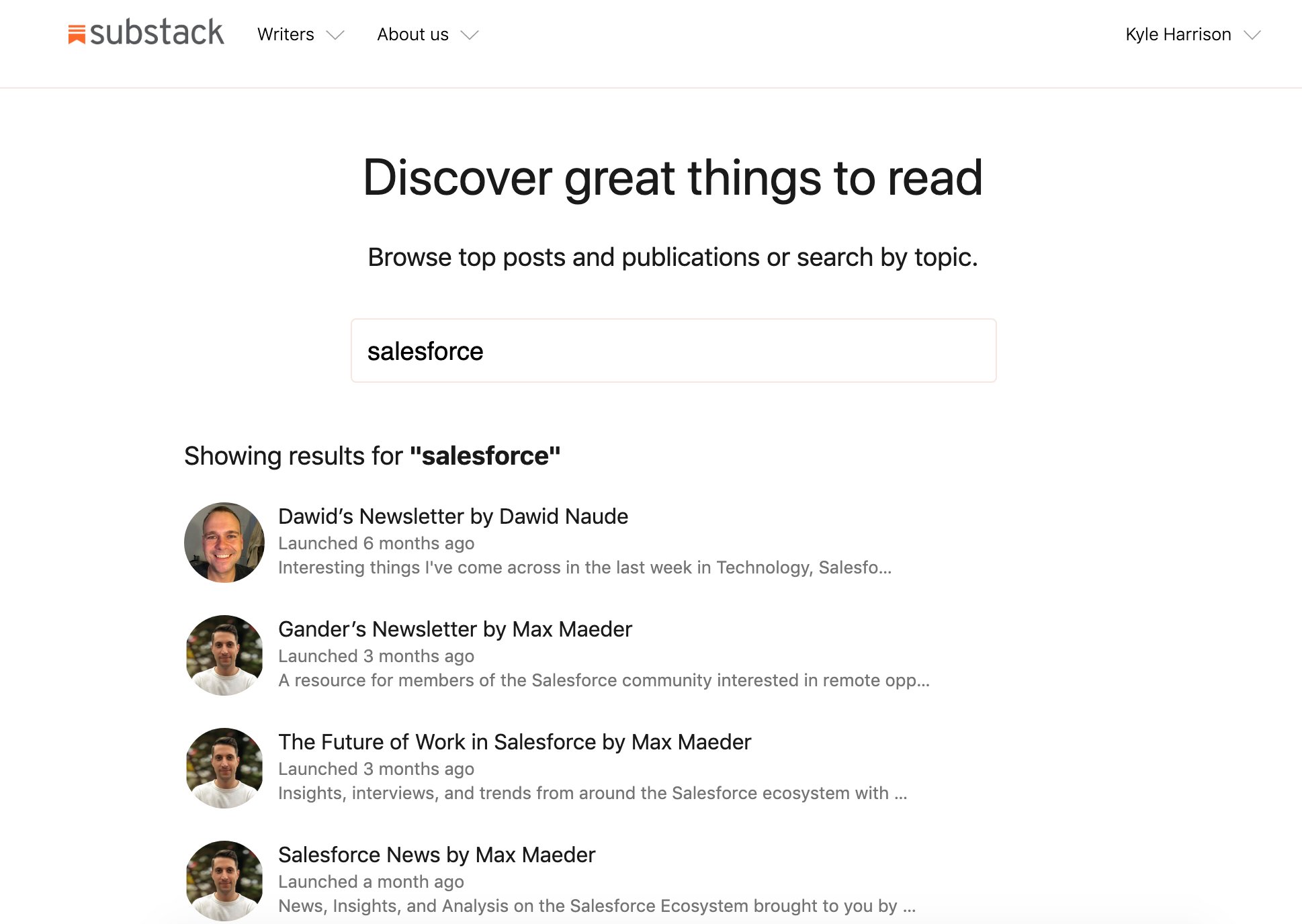
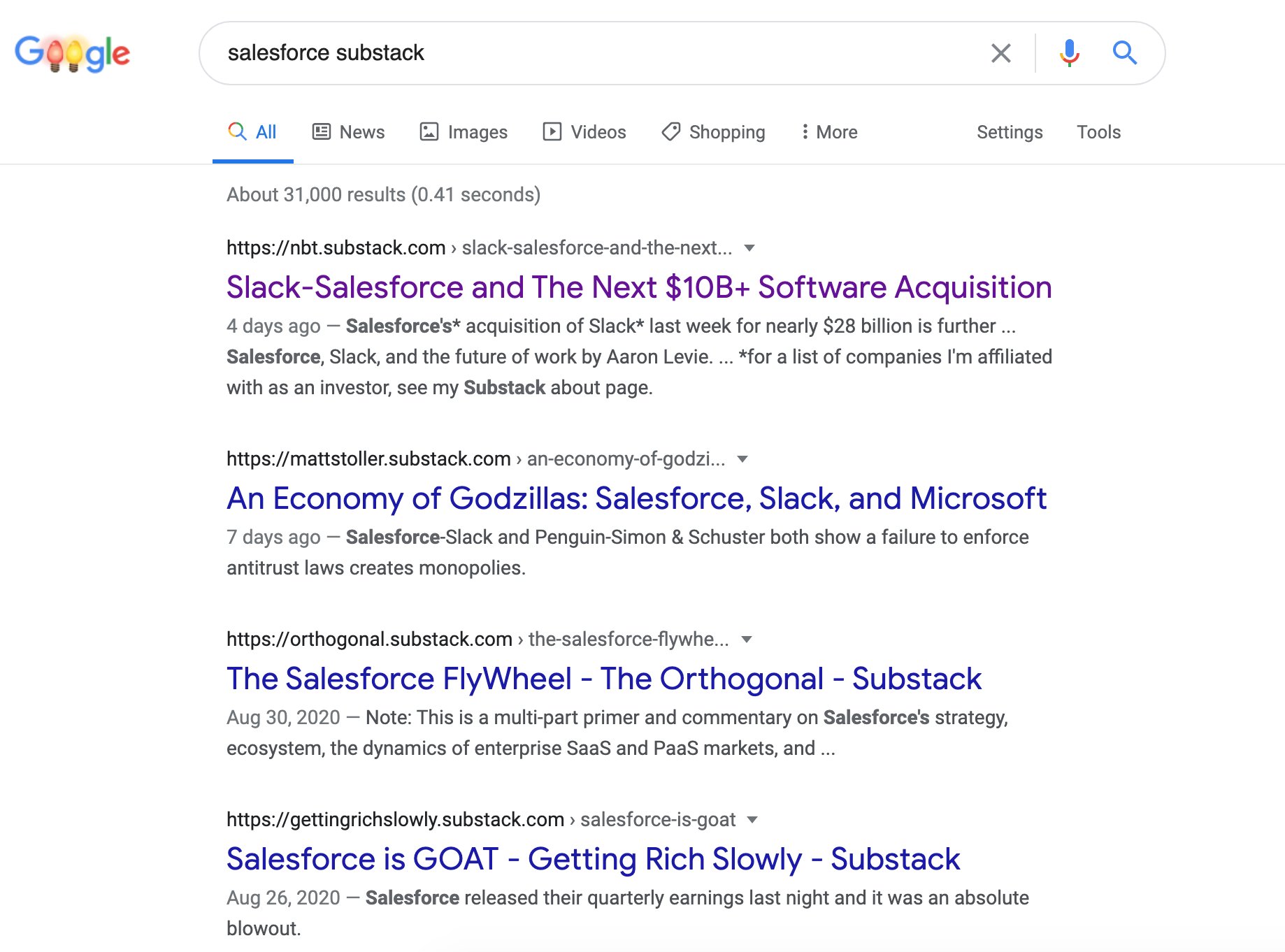
I was thinking about how @RoamResearch doesn't ever **need** to pay for community management if it doesn't want to. #RoamCult forms, storms, norms, and performs ad hoc. Unsure how many tech companies can confidently say that. Community management itself seems unwieldy to value as an occupation. I notice that on the one extreme it's done selflessly for free by active members of the community, sort of like Twitch or Discord mods. OTOH, it's not __easy__. https://t.co/Fvnl4RpYjK (HT: @oliverking1192 ) If culture eats strategy for breakfast, I think it eats system design for lunch and finishes up with community management for dinner. I've heard some active leaders in communities compare their role to that of the conductor of an orchestra. A bit of a humblebrag. Sometimes the movie is playing and you just need to be an on-demand usher (and otherwise stay quiet). The @RoamResearch team does this brilliantly. And perhaps that brilliance is completely unintentional - the best kind! As an afterthought, I suspect #RoamCult is especially anti-fragile towards potential failed attempts at herding it into an enterprise-grade community. So I'm not concerned about losing what makes it great.
Dec 3, 2020 Original deleted — preserved hereI think the bigger opportunity is trying to build a YCombinator for Creators. The structure of these types of deals seems inevitably messy though. https://t.co/pVRCMKnBO5 I just jammed with @Mazzeo on this, I think we have an idea for how we can make it work. If you're interested in building the YC for Creators, shoot us a DM.
Dec 1, 2020 Original deleted — preserved hereI've only just discovered YouTube essays as a form of expression. Have fallen down a rabbithole of creators like Contrapoints, Nerdwriter1, Now You See It & 100 Year of Cinema. Any favorite video essays or essayists to follow? Would love to find more.
Nov 29, 2020Tips From 15 Newsletter Writers On How To Build Your Own A group of newsletter authors with a combined audience of hundreds of thousands shares advice on writing, promoting, and community Full post at the link; read on for highlights https://t.co/VHy4GTf6yS 1/18 Credits to the team for putting this together: @lennysan @nbashaw @nbt @JayCoDon @thatguyBG @ataussig @SarahNoeckel @sariazout @ljin18 @sidharthajha @DruRly @Kantrowitz @TurnerNovak @iankar_ @bradwolverton 2/18 Do awesome work: “Above all else, it’s all about your content. If it’s valuable, people will read it and share it. Produce great content, consistently, and your audience will grow.” @lennysan 3/18 Do awesome work: "When someone subscribes to your newsletter, you enter into a contractual obligation with your readers. Your 1 job is to honor your readers’ time and write like nobody wants to read your sh*t” @sariazout 4/18 Do awesome work: "Write something that is 10x better than anything else out there on this topic. If it doesn’t meet this bar, don’t publish.” @ljin18 5/18 Have a differentiated opinion: “Write about what no one else knows yet” @TurnerNovak 6/18 Push personality: "Put that reference which only a few hardcore readers will get. Make that inside joke [...] At the end of the day, it’s no good if you’re not having fun with it and it’s very easy to tell who is not having fun with it.” @sidharthajha 7/18 Create consistent content: “Create a format that works for you from a creative perspective and allows you to put out consistently good content. Consistency creates the expectation of goodness for a user, which can be a driving force to smash that subscribe” @ataussig 8/18 Reward the regular: “I like leaving surprises for the diligent reader. This could be details in the footnotes that only a few will understand, an interesting link just slightly related to the main topic, or an inconspicuous reference to something else." @Leonlinsx 9/18 Take the time to think on titles: “Title and subtitle and image and opening lines all have to deliver on a hook that will draw people in from twitter” @nbashaw 10/18 Take the time to think on titles: “Aka ‘newsletter #257’ with nothing else doesn’t work unless you’re @benedictevans " @thatguyBG 11/18 Give away your most interesting stuff on Twitter: "Number each tweet. Create a sense of progression. Or gap, if they drop in your thread towards the middle.” @DruRly 12/18 Start a community: “Build and nurture a community around your work. And be intentional about it -- don’t just hope it will grow organically. People will come for the content, and stay for the community.” @bradwolverton 13/18 Involve your readers: “Include reader/community generated content: incorporate comments and quotes from your community. It’s a great way to add a human touch to the newsletter, makes everyone feel involved and drives engagement.” @SarahNoeckel 14/18 Replies are a superpower to build community: “I try to respond to every comment and email that I get in response to a post. I’ve even encouraged private email responders to post public comments so that the community can see our back-and-forth.” @nbt 15/18 Enable relationships: "Community is a massive part of Fintech Today, but we focus on figuring out ways that we can connect other people in our ecosystem" @iankar_ 16/18 Make the Welcome email special "I ask every new subscriber to share what sparked their interest and what they’re hoping to learn. The responses help me know audience, and not write for some abstract ideal of who might be on the receiving end of my newsletter" @Kantrowitz 17/18 Full post is here, and feel free to add on to the thread with tips of your own: https://t.co/VHy4GTf6yS 18/18
Nov 25, 2020Sometimes, I have tons of scattered thoughts about an idea but I don’t know how they connect. That’s when I write with the “Islands and Bridges Strategy.” Here’s my mini-essay. https://t.co/Al8ZDie409
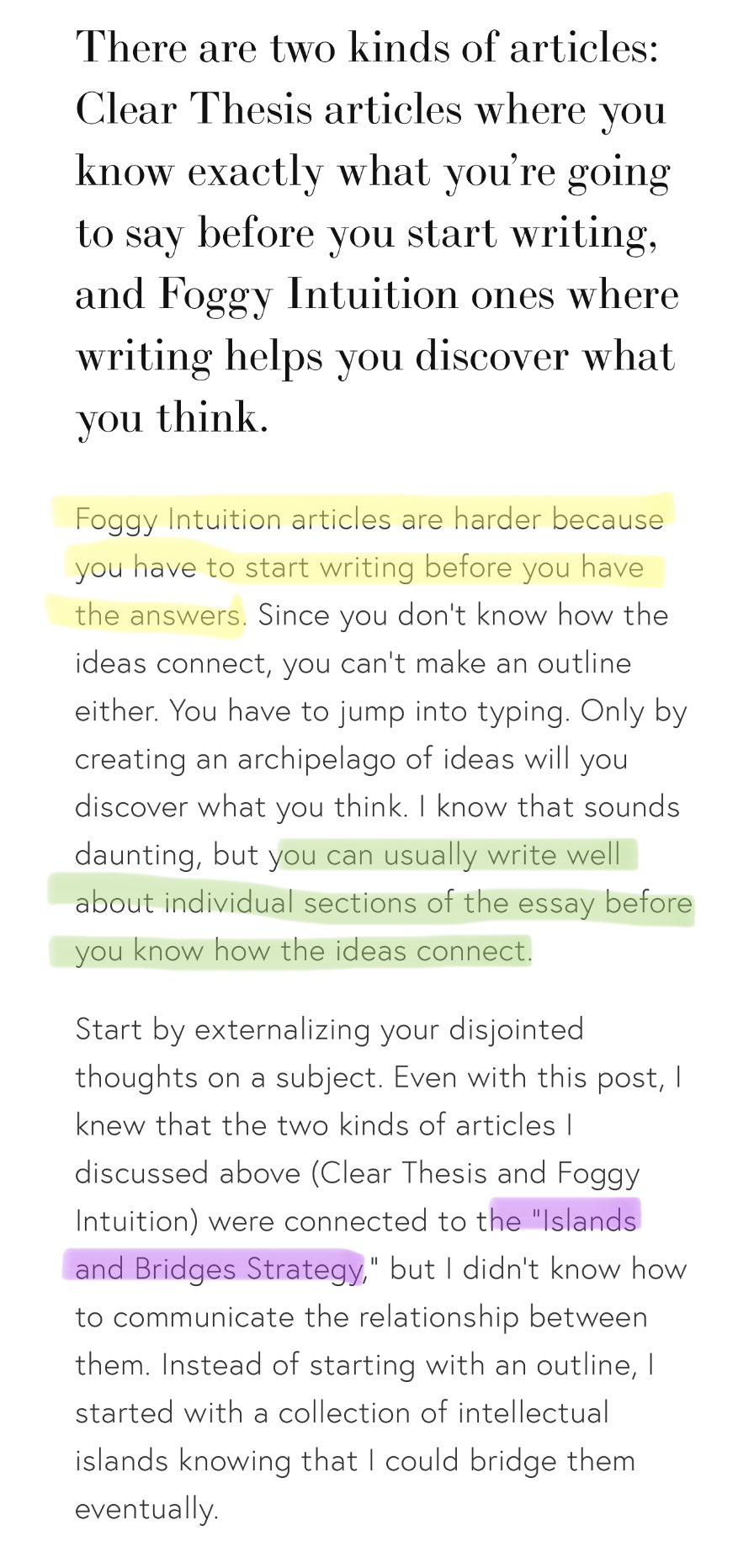
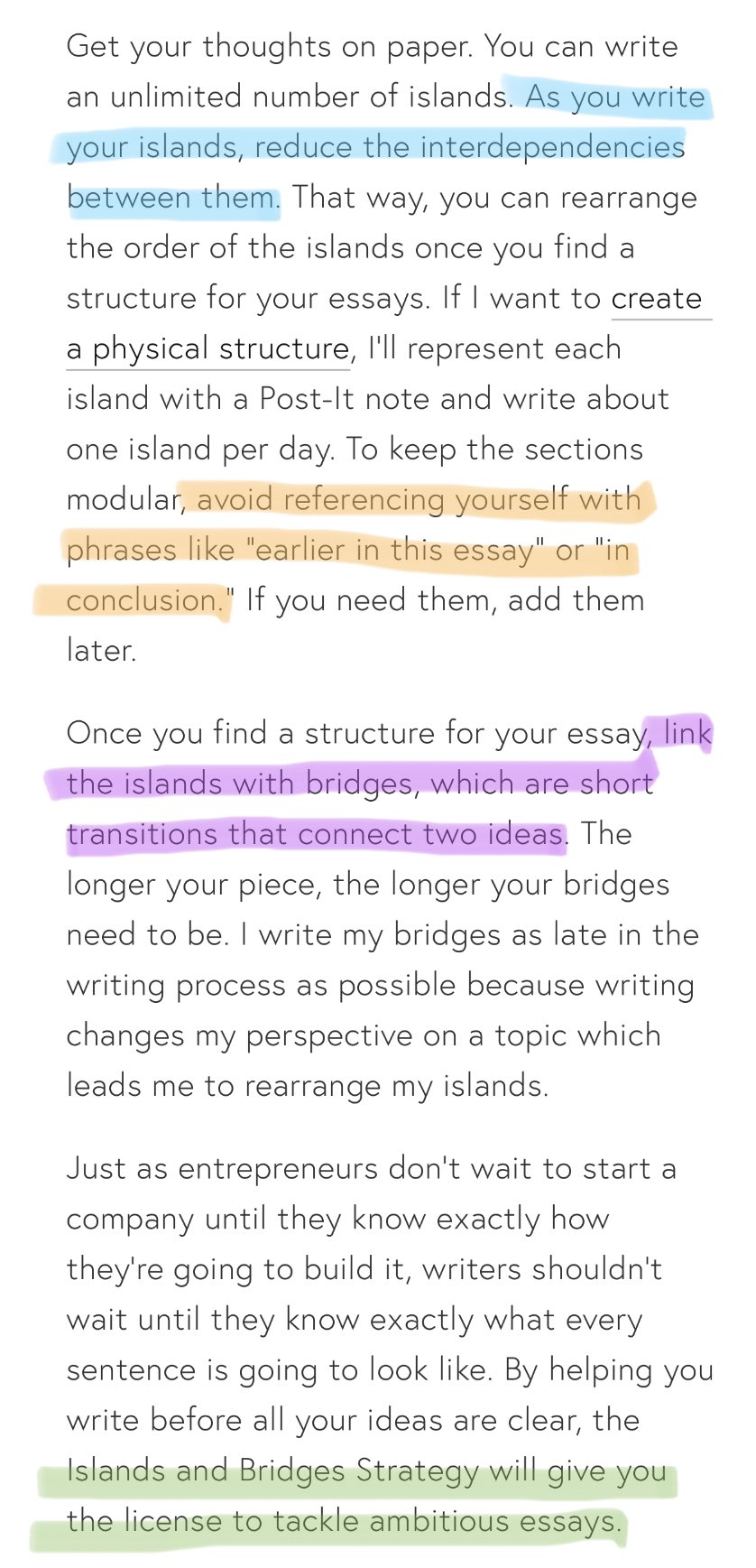
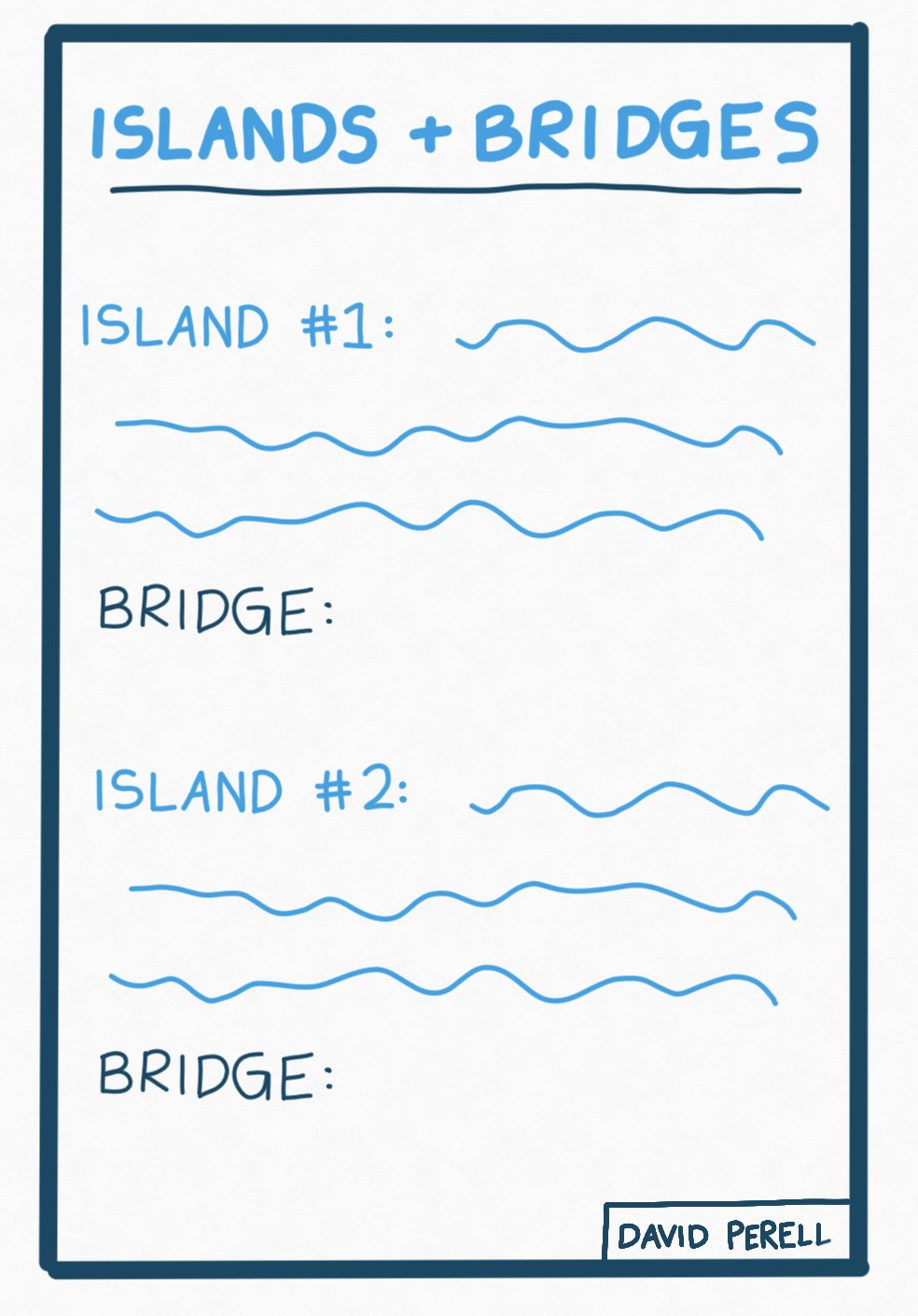
Our schools taught us what to to learn but not how to learn. Learning how to learn is among the most important skills you could learn. [A Thread 🧵👇] Presenting: https://t.co/NUlVx1Ua64 Here are some core ideas from the guide. Please RT the guide for karma 🙏 Abraham Lincoln once said, "If you give me six hours to chop a tree, I will spend the first four hours sharpening my axe." This quote tells us the importance of learning how to learn, which is akin to sharpening the axe. 2/9 This guide covers: 🔸The common mistakes that learners make 🔸The 3 Pillars of Learning 🔸The Top Learning Techniques & Resources & more 3/9 🔸The Common Mistakes Learners Make Discover the obstacles in learning and see how you can utilize them. 🔹Not Unlearning How You Currently Learn 🔹Not Creating Ideas & Only Consuming 🔹Not Having a Structured Learning Journey & more 4/9 🔸The 3 Pillars of Learning Dive deep into the pillars that changes everything. Consuming: The overall consumption of the information you process Thinking: How you approach the information Handling: How you handle and apply the information 5/9 🔸The Top Learning Techniques & Resources Explore the most effective learning techniques and resources you can learn from in order to maximize the outcome you desire. 6/9 How does this help you? Learning is an independent journey with lots of detours & obstacles. With the right approach, every detour & obstacle can be used in your favor. 7/9 This guide was built by two curious minds, hoping to explore the arena of self-education. Sharing this guide would make everyone a better learner. Click here to share this guide with your friends https://t.co/2r1DsOrnaC 8/9 We're curious to hear what you think. Please do reach out to me or @williamliedner if you have any questions, suggestions or feedback. We would love to hear from you. Happy reading! 9/9
Nov 20, 2020Publicly documenting your journey and learnings is underrated. Working in public enables people to live vicariously through you.
Nov 20, 2020 Original deleted — preserved hereWe are living through the emergence of a new business category which I believe will become an important part of our digital lives: community-curated knowledge networks (a thread on why) https://t.co/ZNg3FHiGUD 1/ The Internet put thousands of years of human thought at our fingertips. While this presents enormous opportunities, our brains are not equipped to deal with this abundance. 2/ Curation is a potential solution - we’ll pay people with good taste to help us sort through the abundance. But there’s a few problems 👇🏽 3/ We seem to have accepted the job of the curator as providing a list of links with some commentary on an organized schedule. But this format is subject to the same accidental property of social media; ephemerality. 4/ The conversation around curation has focused too much on reducing the amount of information, and too little on what other architectures might be possible outside of the feeds or newsletters we’ve grown accustomed to 5/ Our feed-based information architecture has made us obsessive consumers of the present, yet largely indifferent to the archives of the past. 6/ We have forgotten that the goal is not to read more. The goal is to think better, so we can achieve our goals. 7/ The Internet offers us the first major opportunity to introduce new, digitally-native information architectures that improve our understanding of the world through added context and relation 👇🏽 https://t.co/3Xnz4yy3LL 8/ The past few years have seen the rise of many knowledge management tools, online communities, and curation businesses. But what’s interesting is how these categories are remixing into new combinations of content, community, and software. 9/ We need curation to help us filter what we consume We need knowledge management to add structure, memory, and goal-orientation to our information stream We need community to tap into networked knowledge 10/ The intersection of all three: community-curated knowledge networks 👀 this space. 11/ There are reasons to be optimistic; the economic feasibility of paid communities, a renewed interest in curation, a slow move away from big social, and an improved understanding of platform incentives. You can read the full post here: https://t.co/WLrvQQ2dt1 Thank you to @_brandswell @MarieDOLLE @tobyshorin @prakharshivam @wacko_gabriel @Jad_AE for reading drafts of this post 👊🏽 One last thing: I’m working on something in this space. Subscribe to my newsletter to be the first to know 👇🏽 https://t.co/dQ02IsLAC0
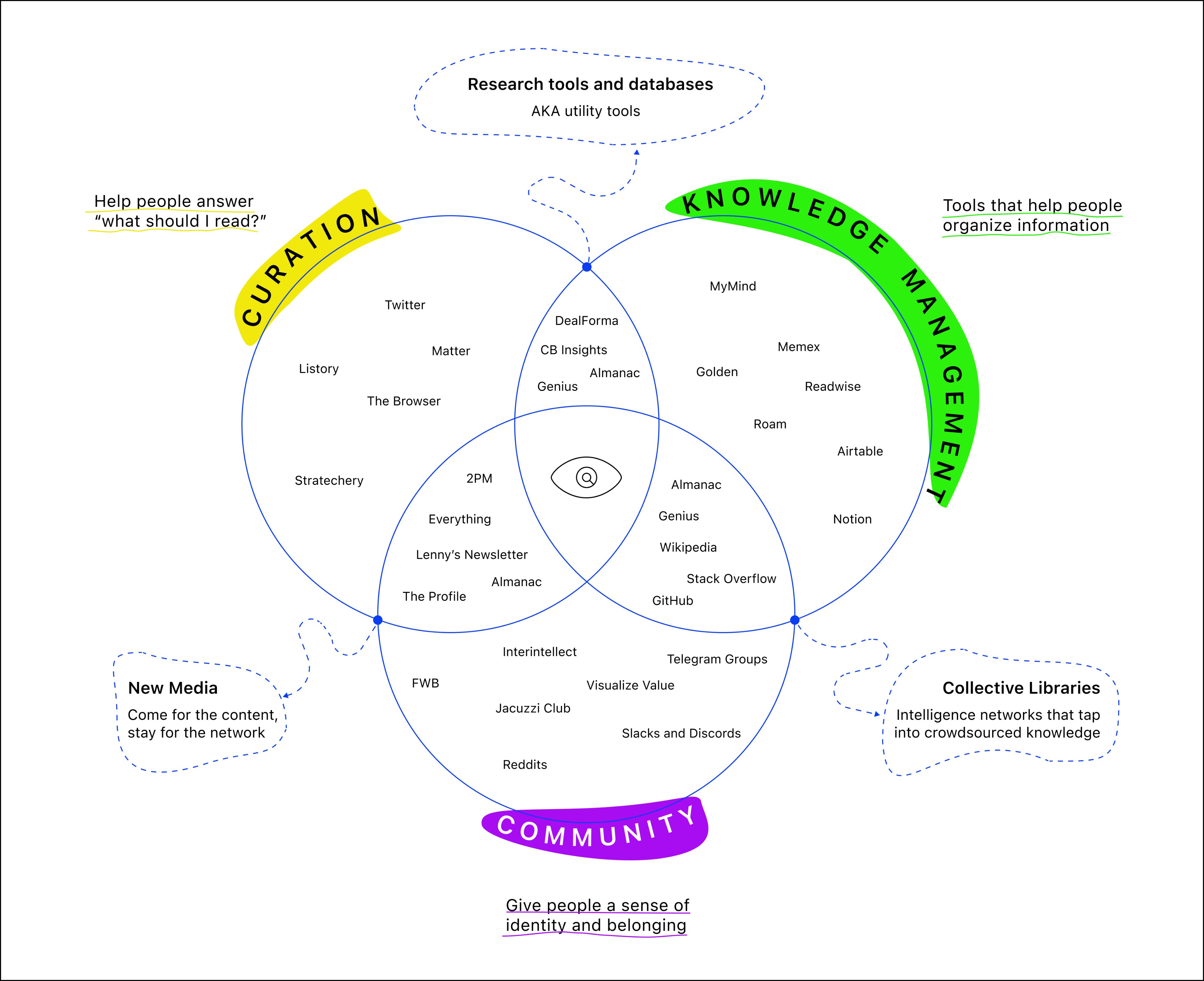
I increasingly believe that people should change their media consumption to be: 1. Relating to historical vs current events 2. Longform with a full arc that tells the story in full vs unfinished or of the moment analysis Makes you far happier. Books > Newspapers
Nov 8, 2020Writing the best guide on the internet for a topic Is the same as: - 10,000 average tweets - 1000 blog posts - 100 youtube videos The hard part is figuring out what topic and how to stand out. Examples: @Julian's Growth Marketing Guide @david_perell Online Writing Guide
Nov 1, 2020 Original deleted — preserved hereSimple way to be a thought leader in a niche: 1) Interview 20-30 experts in your niche. 2) Summarize your findings. 3) Publish your findings and label it State of X. 4) Share with the media. You are now the author of a unique, high quality report about your industry. Example: User interviews interviewed 300 experts and published their findings in a report titled, “The 2020 State of User Research”. https://t.co/prx0h8GFU0
Oct 19, 2020A couple of my favorite "educational" YouTube channels: Every Frame a Painting Now You See It bill wurtz Wendover Productions Half as Interesting kaptainkristian Smarter Every Day Mark Rober CCP Grey Kurzgesagt I'm always looking for interesting video essay channels.
Oct 17, 2020 Original deleted — preserved hereIf you become a lurker in fewer communities and an active participant and contributor into a handful, you'll reap way more benefits Care less about being in the most number of the information flows, and more about adding to them It seems initially like the best way to get access to information/know what's going on is to be in the most number of information flows Reality is the actual best information comes from 1-1 convos, which only happen if you contribute to the information flow and people know you
Oct 12, 2020You want to build a personal brand. You need to answer these 3 core questions: 1.) What is the core objective of this? 2.) What specific content/subject matter do I want to focus on and specialise in? CRUCIAL 3.) What is my authentic platform? Medium, Twitter, Pods etc.
Oct 7, 2020I wrote 30 Twitter threads in 30 days. The goal? Learn how to craft interesting threads, and grow a following. It (mostly) worked. - New followers: +2.5K (+100% MoM) - Top thread: 373K impressions - Top tweet: 2.5K likes Here's what I learned. Quick thread 👇👇 To start, here's the most popular thread I've written. Thoughts on what made it work, below. https://t.co/AIOAYiWEcQ 1. Quality The threads that performed best were (usually) the ones I put the most effort into. One example is this one about Jeff Bezos's origins. I spent hours researching and drafting it. It's worth taking the time to craft your words. https://t.co/6zWbc4AXLE 2. Timeliness Capitalizing on the news can be one way to expand viewership. When Fornite launched its #FreeFortnite campaign, I wrote this thread. At the time, it was my 2nd best performing thread. It also introduced me to the lovely @JoshConstine. https://t.co/IEoEYYHtzj 3. Narrative Arc Have a clear start and end in your mind. I made this mistake with a few Amazon threads. I thought because my first one worked, I could keep the story going. But they didn't have as clear a narrative arc and were much less popular. https://t.co/CuR4C9jwZD 4. Imagery Creating a special title image made no difference. The threads that took off used photos. And some of the most fascinating stories that used a title image went nowhere. One example: the story of the kidnapping of Freddy Heineken. https://t.co/Xchm3r3hlb 5. Polls Polls are good for engagement, but not likes or RTs. 100 people played this Twitter trivia game I tried out, but it yielded very few likes or RTs. A few people liked it a lot though. https://t.co/8duUtG0vfo 6. Quotes In their brevity, quotes are well-suited to Twitter. This one about Abraham's Lincoln wisdom did reasonably well for me (at the time). They also take much less time. https://t.co/tUPCVXzCN8 6. Good News If you have something big to share, share it. Even though other threads performed better, the 1K that liked my thread about going full-time on The Generalist meant the most. Twitter can be a supportive place. https://t.co/lbO0eeyOCd 7. Answer a Question After I announced going FT on The Generalist, I had other writers reach out asking what tools I used. So I shared that list publicly. It made it easier for me to give people detailed information. https://t.co/D48vNUgYVD 8. Curate Information This was written after the 30 days, but is something I'd like to do more of: compile info into a single thread. This covers 2020's IPOs. It features my writing along with others' work. There's value in simplifying consumption. https://t.co/WcikPizTHW 9. To 👇 or Not to 👇? I've heard some folks find the use of the 👇 annoying. I think it may feel manufactured to some. Personally, I think it is a useful visual to let readers know that there's more to the story. To each their own. 10. The Perfect Topic? Why did the Tesla tweet work? Written on a plane, quicker than usual. Not based on any news. But it hit a sweet spot: something ppl know a *little* about, but not as much as they'd like. Familiarity gets ppl intrigued, uncommon insight seals the deal. 11. Astroturfing If you want to, you can post your thread into other threads to get visibility. I did this for the Fortnite thread. Then I felt sick for being spammy and deleted them all. It may be a viable strategy but feels icky to me. Again, do you. 12. Where Next? The threads I found most fun to write were narrative and evergreen. I think a year from now, readers will still be interested in: - Jeff Bezos' Origins - The Life of Tesla + some others. So that's what I plan to write more of. I'll also write my newsletter, which is my number 1 priority. If you'd like to be a part of that journey, sign up here. You'll join +11K creators and thinkers interested in technology. Entirely free. https://t.co/Tnl6ePFgif
Oct 2, 2020If you spend much time on tech twitter (or if you're my mom) you've probably heard about @RoamResearch -- a LOT. Check out this rabbit hole to better understand the #RoamCult dream. https://www.roambrain.com/building-the-global-knowledge-graph/ My most powerful experiences for thinking about the "Global Knowledge Graph" has been listening to podcasts. I listen to people like @patrick_oshag and @collision jamming on @InvestLikeBest and I start to daydream about the knowledge sharing going on: The dream that the #RoamCult is obsessed with isn't a super sleek note-taking app (we know it isn't sleek). It's the ability to connect all the disparate ideas in the world. https://twitter.com/Conaw/status/1253190382956867585 In my experience the people who love @RoamResearch, from my experience, are those that love problem solving. Academics, researchers, developers. https://twitter.com/kwharrison13/status/1269072518817525760 And when you remove the barriers to ideas "having sex" you could see some world-changing outcomes.
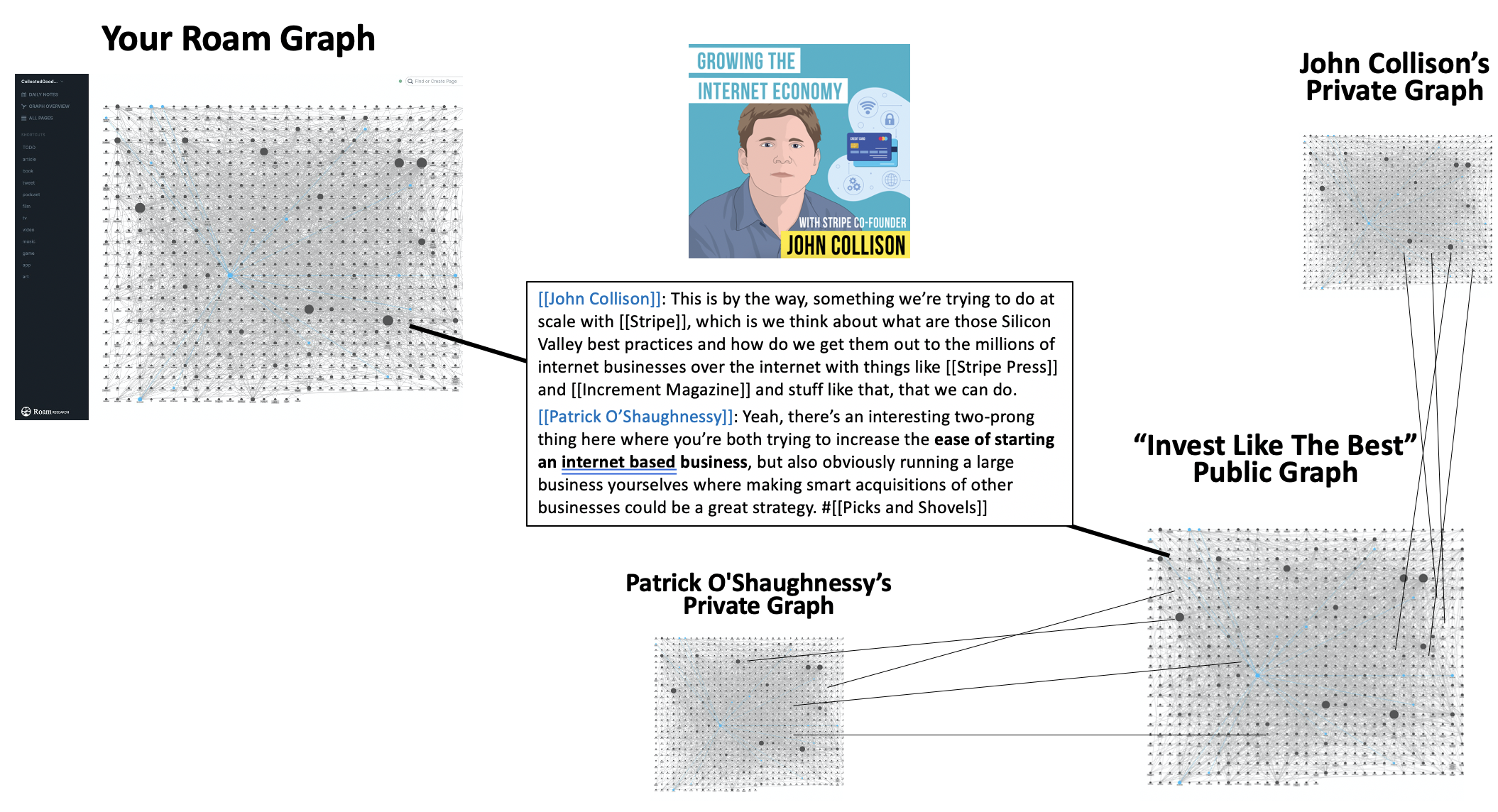
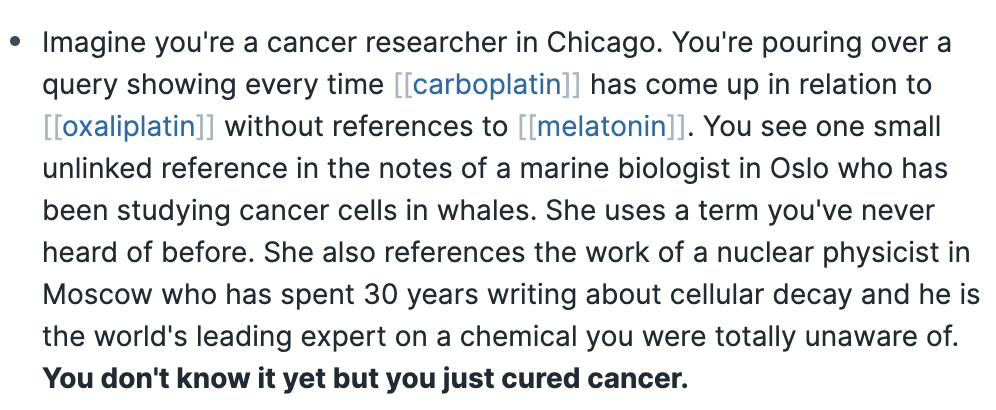
I've tweeted in the past on the importance of writing I started writing publicly (mainly about venture 7 years ago). Looking back, it’s one of the most fulfilling things that I’ve ever done. Here are some of the things I’ve learned: /Thread
Sep 17, 2020 Original deleted — preserved hereSomebody should start a podcast where every episode is a 10 hour deep-dive into a new industry. 10 interviews per episode with the widest variety of guests you can find. Themes: Industry history, business models, marketing channels competitive landscape, and key companies.
Sep 16, 2020 Original deleted — preserved hereEvery discipline has a book that everybody references, but nobody reads: Physics: The Feynman Lectures Philosophy: Godel, Escher, Bach Sociology: Das Kapital English: Infinite Jest Media: Understanding Media Investing: The Intelligent Investor Economics: The Wealth of Nations
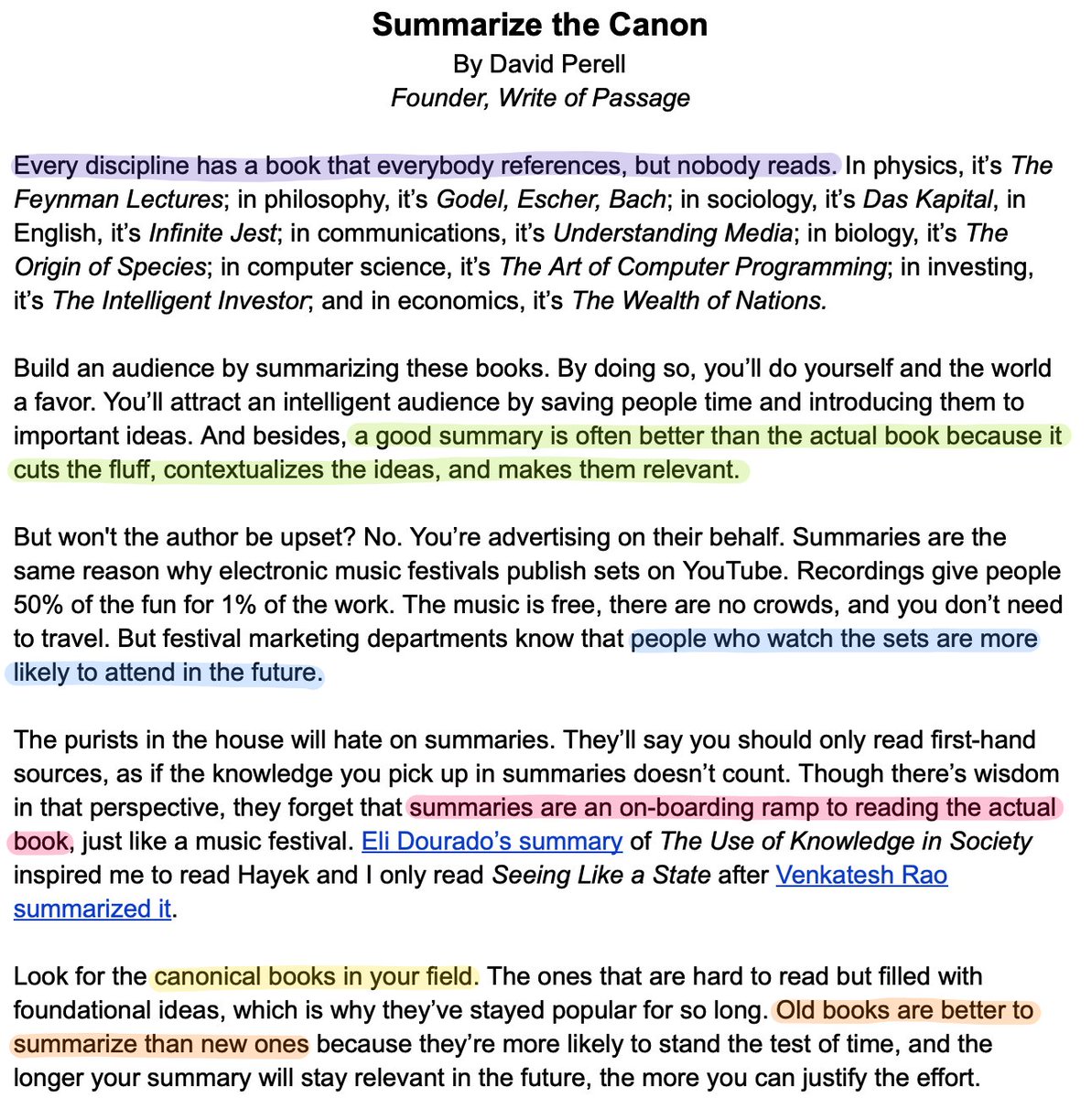
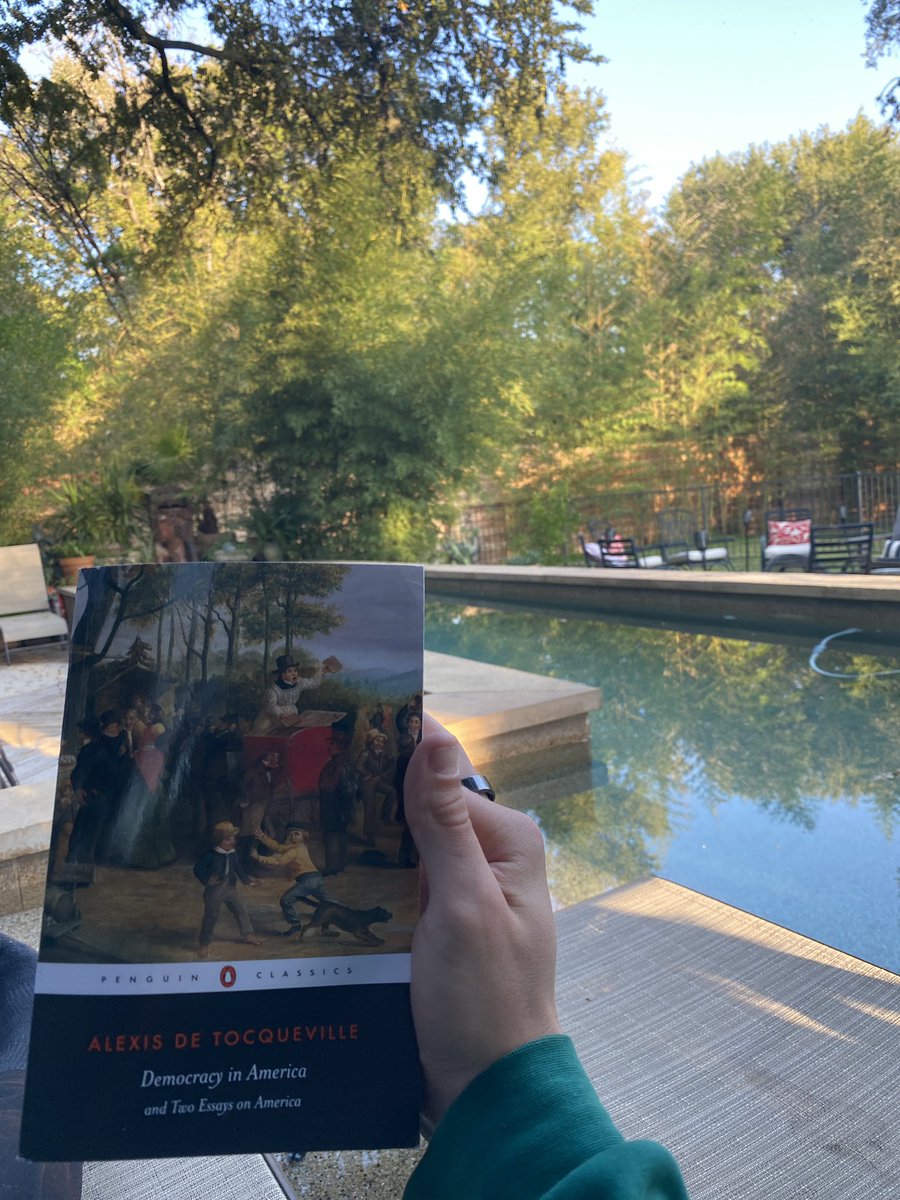
So @AirrAudio just updated it’s sync to @readwise to include transcripts when available. And then @readwiseio sends that to @RoamResearch The output is this which is just beautiful! I was waiting for transcripts to sync and this makes everything so much simpler. Great podcast btw with @AlexHonnold - Free Solo is hands down one of my top five favorite movies.
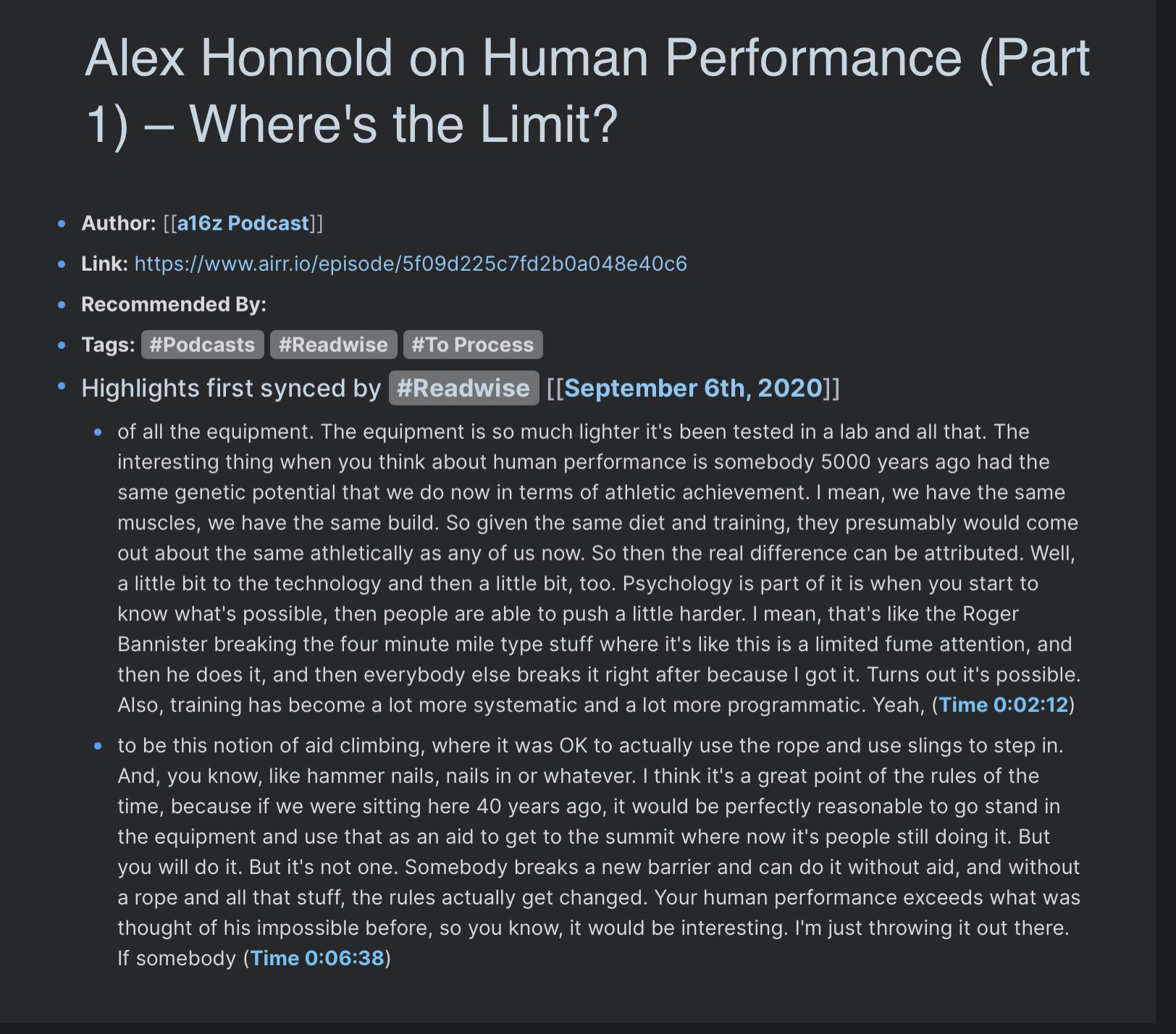
The Newsletter Stack... In the last few weeks, folks have reached out asking what tools I use to write The Generalist. I thought I'd share the full-list. A thread 👇 1/ Email I use @convertkit. When I started out I used @substack. Also checked out @mailchimp and @MailerLite. I like CK's intuitive interface + automation features. You can get 1K free subs w the link below. @nathanbarry + team are also the best. https://t.co/ZUCZ7V4UHD 2/ Writing I use Google Docs to draft my pieces. I'm also a @grammarly subscriber. I don't always agree with their suggestions (they are belligerent about passive voice), but it always catches something. https://t.co/sqJ466Xdcf 3/ Graphics I've found @canva easy to use. You can set up brand colors and fonts which streamline creation. They also have a solid free tier. In the past have used @figmadesign, which is great for more complex designs and mock-ups. https://t.co/K4E5zDT8Ts 4/ Graphics To treat headshots, I often use @remove_bg which has a generous free-tier. I also tried out @letsenhance_io which improves the quality of images. Ultimately, I felt I didn't need it. https://t.co/J6aMi9wp3k 5/ Webite To date, I've used @carrd which is *great.* So easy to spin up a simple, solid looking site. I'll keeping using it for new projects. Now that I'd like to have something a little fuller-featured with a CMS, I'm switching to @webflow. https://t.co/MaSd1yTAcD 6/ Payments I'm going to be using @tryPico to handle memberships. The product is already impressive, but talking with @jasonwbade about what's ahead got me especially excited. I also considered Memberflow. https://t.co/pdZ0kUv1wo 7/ Community So far, we run 2 communities: one on @public, one on @telegram. Both great. Eventually, I'd like to create a single home for The Generalist. I'm impressed by what @genevachat and @CircleApp are doing. I'll keep using @public fwiw — slightly different audience. 8/ Interviews I started out using @DescriptApp to record the interviews I do for The Miss and The Prologue. Since then, I've tried out @otter_ai which I prefer. It does an equally good transcription job but the UX is more intuitive. https://t.co/muyktaczds 9/ Surveys Google Forms would probably work just as well, but I find @typeform more pleasant to use. I also think it's a nicer experience for the reader/submitter. https://t.co/q6kgIw6J8z 10/ Threads I've been testing out @chirrapp for writing my longer Twitter threads. Very nice to use, though it sometimes struggles with photos and other media. https://t.co/L5E5mVynnf 11/ Publishing I cross-post to @SubstackInc which remains best-in-class in terms of ease-of-use. You don't accumulate SEO value but still a great place to begin. https://t.co/mWtMxXVYo4 12/ Videos @packyM and I have been using @mmhmmapp to add slides to our recordings. The background gets messy if you move too much, but it's very fun and otherwise works well. Also such a new tool, so I'm sure it'll improve. We also use Zoom. https://t.co/TE4HDIAMeb 13/ Video events I had the chance to use @streamdotclub for last week's "Creator Club" which was great. I love the team and plan on using them as often as possible. https://t.co/8almAGyW4X 14/ Referrals I haven't tried this out for The Generalist but plan to. I just have to figure out how to do it in a way that adds value to the reader. I've signed up for @SparkLoopHQ which seems promising. https://t.co/xYcEgmBatE 15/ Pre-launch I use @ProductHunt's "Ship" tool when I'm kicking off a new feature. It's a good way to get a few early supporters and makes it a little easier to launch when the time comes. https://t.co/4GyCgcep5X 16/ Domains I use Google Domains. They don't have all the endings you might want, but so easy. https://t.co/5evGrOOMN1 17/ Incorporation Going through this as we speak. I'm planning to incorporate as a NY LLC and am using a family friend who does this kind of work. Theoretically, @atlas would work, but I'm glad to work with a familiar human. 18/ Banking I'm not sure what I should use here. @brex? Does that make sense for a 1-person co? Eventually, I'd love to try @stir which is building for creators. Also very open to suggestions. (Same qs for accounting). https://t.co/YpnHnoQKfO 19/ Podcasting I haven't figured this out yet. What are the best ways to get started? @getredcircle looks like a great tool. Will eventually do more work here and update the thread. There are also some short-form audio tools emerging that I'm excited about. 20/ Email Use and love @superhuman. Don't have a lot to add here. It just works really well. https://t.co/CTGhQPgRN3 21/ Task management I do a mix of things. In addition to using my calendar as a to-do list, I've also been digging @DennisHXu's https://t.co/vNgmwocx3I. It's much more than task management. More to share there. 22/ Browser I feel the need to shout this from the rooftops: @brave has worked so much better for me than Chrome or Safari. Saving me a lot of time right now. https://t.co/QwLB6wsu3R 23/ Unsolved problems... - Making nice graphs. Canva's features are limited here. - Starting a podcast. - Banking and accounting. - Probably a million things I'm not thinking of. If you'd like to follow my journey of Building in Public, sign up for The Generalist. I'd love to have you aboard. https://t.co/Tnl6ePnETF
Aug 28, 2020Just crossed 450 books read 📚 The result of Consistency, Focus, Patience, Persistence & deep reading over 10 yrs The journey started w/ my desire to escape poverty by taking my education into my own hands Each Decade adds a Column 🧵45 lessons on Becoming a (Better) Reader👇🏾 [IMG:https://pbs.twimg.com/media/Efjwk53WsAE00xd.jpg] (https://pbs.twimg.com/media/Efjwk53WsAE00xd.jpg) Reading is a core part of your intellectual feedback loop that feeds all parts of your ability to learn & express yourself ↪️Writing ⇄ Thinking ⇄ Reading ⇄ Doing ⇄ Speaking ⇄ Listening ↩ Each activity directly helps the next & indirectly helps any along the chain 1/45 Read is a human experience. You are someone who can be a reader if you accept it as natural as speaking. Read to understand yourself, others & the world around you. Reading is a skill than can be developed. Use tools to organize & amplify your reading. 2/45 Change your environment & surround yourself w/ books. Create a system that works for your personality to support reading. Start small, 1 pg, 5 pages, or start with audiobook & build-up to e-book or print. Join a book club for shared accountability & social motivation. 3/45 Explore and find what you love. Find books on what you love. Read what you love so that you can love to read. Share what you love to read, so others can find what they love. 4/45 Read Non-fiction for mental models & perspectives on how the world has worked, currently works, and how you can create new works within it. Read Fiction for emotional models on how to feel deeper within yourself and in relation to others. 5/45 Problem Driven Reading makes the value of books more real, the forcing function to take action more sooner & the memorability greater through overcoming the emotional motivation needed to solve a problem. 6/45 Books with Quake Potential rock your belief window & view of the world. The epicenter gets you closer to the source of some truth. Shakes let weak beliefs fall, strong ones remain & room for new supporting pillars to build a stronger foundation to house your thinking. 7/45 Lindy Effect is a theory that longer a non-perishable thing has been in existence, the more likely it is to be in existence. Old Ideas & Books that are still relevant today, have a lower chance of becoming expired knowledge and are therefore more valuable in the present. 8/45 Read books whose ideas can stand the test of time, because you have limited time on this earth to spend on an idea that disappears faster than you. 9/45 Overly complex ideas are fragile, simple ideas are robust, foundational & multi-disciplinary ideas are anti-fragile & useful. Anti-Fragile ideas are tested by time, get better through stress & are used to build new connections through time. 10/45 How useful is it to have a library of books you've already read taking up space that you no longer reference? What you want is the opposite of that, an Anti-Library. 11/45 Stock up potential themes, lingering problems, curiosities & what you love to build an Anti-Library. Your Book Pantry of Potential Learning. In times of need, or times of wonder you'll be glad to have your anti-library. 12/45 Book Purgatory is where incoming book recommendations go to await judgment day on whether they are worthy of your time and attention to read. 13/45 Find good books to add via negativa, through reduction. 5-star reviews can be gamed & don't tell you why you shouldn't read the book. Read passionate, constructive, and specific 3 & 4-star reviews to find out what the book lacks to see if what remains is worthwhile. 14/45 The medium you chose to read on: Print, E-Book, or Audiobook Can have a significant effect on how you interpret, absorb & enjoy the content: Genre Physical Energy/Attention Available Publish Date & Popularity Page Length Senses Portability Notes & Highlightability. 15/45 Genre Print: Technical/tactical content, great books, art, philosophical. Likely reference or reread E-Book: Possible expiring knowledge, business, recently published, skimmable Audiobooks: Narrative focused books: history, biographies/memories, fiction, spiritual books. 16/45 Portability Print: Limited physical space to store. Damageable, heavy in bulk. E-Book: Large digital storage available. Hard to share with multiple people if bought through official means. Audiobook: Digital storage, but tend to be exclusive to a platform. 17/45 Length Print: Ideal for medium-sized books 200-350 pg. E-Book: Ideal for full range of length, but especially for very short or very long books. Audiobook: Ideal for mid or long. Economics of sub <3hr audio may not be worth it using credits. 18/45 Energy Print: Higher energy to maintain focus, physical presence can support an environmental reading habit. E-Book: Balanced energy, low-friction skim & searchability. Audiobook: Low energy/focus required, good for passive listening, or when hands/eyes are preoccupied. 19/45 Senses Print: Physically interacting w/ a book creates stronger emotional resonance & spatial awareness for your reading. E-Book: Light & focused reading, fonts & background w/ night-time readability. Audiobook: Great audio performances stimulate your senses better. 20/45 Notes & Highlighting Print: Can fold pages, write in margins, highlight, flag, or use paper notes E-Book: Built-in highlighting w/ diff colors for more meaning, notes & exportability Audiobook: High friction note-taking, audio clips & notes. Difficult to stop & take notes. 21/45 Elementary Reading is the process of getting through the book with the appropriate speed. You can build awareness for different paces and reduce repeating words in your head, and use better eye scanning through pages. 22/45 Cultivate a Triathlon Reading Pace Learning to see: Flat planes of a book to speed up, Wet hills to climb up slowly with care, as to not fall back to re-reading, Rocky patches with varying shapes for a hop and skip & more dynamic reading speed for the changing terrain. 23/45 Inspectional Reading, is learning about how, what & who the book is written for so you can determine how to approach reading the book and if it is for you. 24/45 There are no such things as spoilers in non-fiction, so you can read the end of the book to help you get to the core ideas of the book quicker & skim, reading the front/back covers & review the table of contents as if you're planning a road trip. 25/45 Synoptic reading is surveying the territory around a subject, finding books that apply to the subject you want to get a wide perspective on. The collection of books become a tool for answering specific questions or finding new ones about a subject 26/45 With Synoptic Reading, you are both the Cartographer creating the map, and the Detective using the map to scan for clues across multiple subjects of interest. 27/45 Analytical Reading is investigating the words & mind of the author to get as close to a complete understanding of what the problem is, what the book is trying to communicate, and why it was said or structure in the way it was. 28/45 Outline & Organize the keywords, main ideas, & arguments to create a map of thoughts. Identify what hasn't been said & use what you know as a form of associative learning to build a branch of knowledge. 29/45 Do the work to synthesize the author's words in your own words to show Proof of Understanding. 30/45 A book's ideas come into collision w/ your worldview. This can be perceived as an attack or an awkward hug from a friend. If it doesn't feel right, but you interpret the intention as good, you can come to a better understanding w/ the author. Give feedback like a friend. 31/45 Reading multiple books in parallel is done more effectively by using location & time to utilize context-dependent memory, which enables you to read more over the year. i.e: Read "A" in the morning. "B" before bed. "C" on weekends. "D" in transit. "E" in the living room. 32/45 Reading List Overview: Backlog: Read within the year. Up Next: Read within the next couple of months. [Multiple Genre Lists]: Separate currently reading lists for categories to structurally ensure I'm reading broadly across genres. Reference: Use to create something. 33/45 I use @goodreads as a digital bookshelf to keep a log of all the books I've read, dates, ratings, or reviews, custom shelves to also track year specific shelves, what medium I've read on & what my favorites are. Want to Read are books I own & to read. 34/45 I use @readwiseio which syncs your highlights from @AmazonKindle, iBooks and other highlighting services and helps you rediscover your highlights & notes and exports/sync them to popular note-taking apps like @NotionHQ and @evernote. 35/45 I use @RoamResearch a tool for thinking, for interconnected writing & sentence re-use with a feature called blocks. Page references break you from hierarchical to more graph structures & see references w/ backlinks. Smarter writing happens in Roam. 36/45 Capture fleeting emotionally resonate notes in your notes app/paper. On print, use post-it flags as a non-destructive & multi-meaning way(colors) to mark important sections of a book. Store references & surprising highlights, but capture & share in your own words. 37/45 Notes Building blocks for future content, legos. Focus on one idea, like a blue lego, not a rainbow lego. Notes can combine w/ multiple notes, blue + red lego. Focused on a concept, rectangle, square lego. Should be active statements, use these legos to make a house. 38/45 Book Summaries are like an inside joke a summary writer has w/ an author. Sometimes you're in on the joke, more likely if you've read the book or something similar, & most of the time you're not in on the joke and you laugh thinking you got it and forget the joke later. 39/45 Write Summaries to Think. Read Summaries to Refresh. 40/45 Always Be Reading. Take short reading intermissions then start back your reading to prepare within the Play of Life. The show must go on. 41/45 Classics books are high signal. Written before the "blog-post as book" era, or got diluted in a game of telephone w/ students pretending to be master. Before publisher/author/marketer incentivizes became shallow w/ fluff, upsell/brand builds. 42/45 Meditation, Writing & Listening has helped train my focus to read faster, more clearly & with more comprehension than any speed-reading course could ever do. 43/45 Some books are meant to be sat and soaked in. Immerse yourself over, many days, weeks, months. Read books that are on your like clothing & worth re-reading. 44/45 No matter how much you read. Life is meant to be experienced. It can't be experienced at one time, so use the opportunity to learn from the experiences of the past, and contribute your own experience. Play the longest infinite game in humanity: Learning & Sharing. 45/45
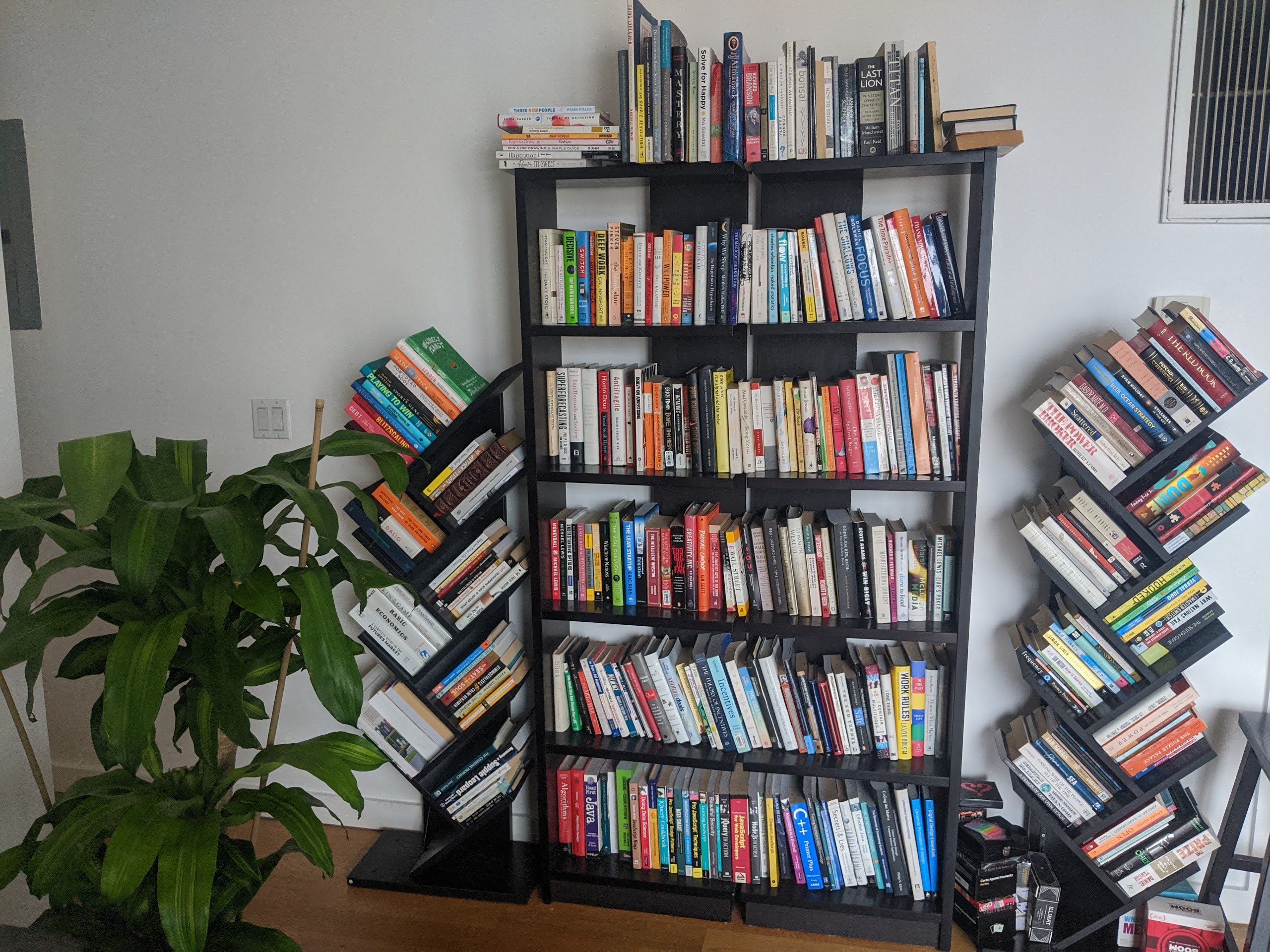
Wow, so, @hypothes_is is preeeetty cool. Slick web highlights, but also annotations with public conversations on articles. cc @fortelabs @david_perell @TaylorPearsonMe
Aug 16, 2020Founders: @ycombinator just launched the YC Startup Library for you! It includes +15 years worth of: videos, podcasts, essays.
Aug 7, 2020I purchased these books on @amazon in 2004 when I worked at Microsoft. This was pre-Twitter and before VC blogs were ubiquitous. The industry was a black box. It’s great to see how openly learnings are now shared. We’ve come a long way. https://t.co/QO4fiQs0l2 **Links in this post** (t.co shortlinks resolved 2026-09-28): - `https://t.co/QO4fiQs0l2` → https://x.com/schlaf/status/1289922214482116608
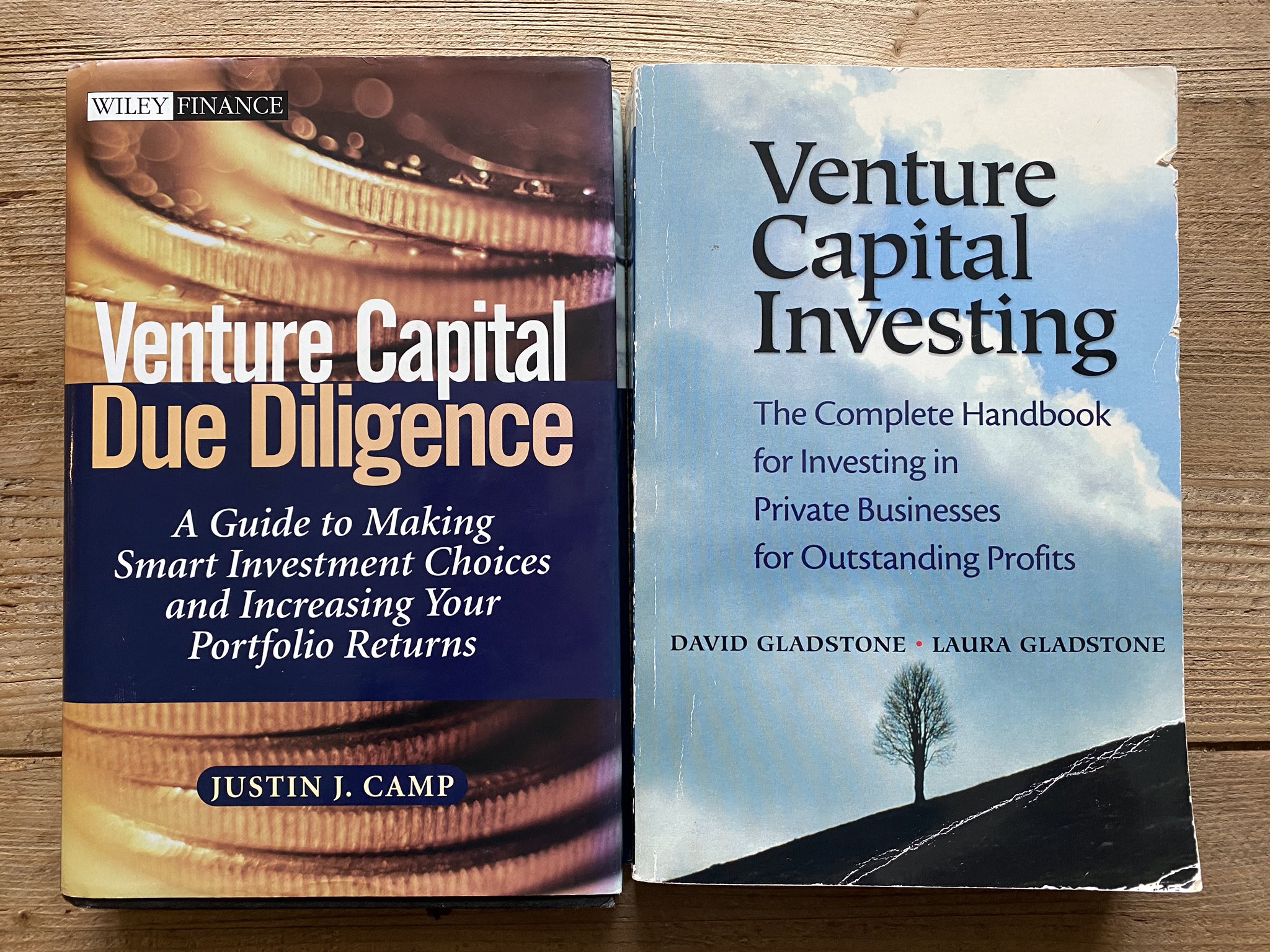
Good article. Substack seems like an increasing threat; especially given they have so many levers yet to pull. Bundling, etc. I would pay for a “Best of Substack” subscription algorithmically tailored for me with no preset group of writers. https://t.co/PoBJlSF2wF **Links in this post** (t.co shortlinks resolved 2026-09-29): - `https://t.co/PoBJlSF2wF` → https://www.niemanlab.org/2020/07/newsonomics-the-new-york-times-new-ceo-meredith-levien-on-building-a-world-class-digital-media-business-and-a-tech-company/
Jul 29, 20201/ Analysis of course communities (THREAD) Community is important for premium yet scalable digital experiences. It’s one of the main selling points for premium experiences charging $1,000-$5,000/student vs on-demand courses sold for $50. But it can mean different things... 2/ Community is used as a catch-all term, usually to mean: - there’s live interaction - a Slack room - active participation - it’s not a MOOC But when you *conflate* different elements of community, you miss the opportunity to maximize each element as a lever. If you *unbundle community* You can design more finely-tuned tactics & fully maximize each element of community. Community can mean: 1. Companionship Loneliness is a struggle for many people. Isolation can be physical or social. You can be at a bustling party but feel alone. It’s not just other warm bodies. It’s about feeling understood. Communities offer an antidote to loneliness 2. Affiliation and prestige Every YC founder puts YC in their bio. YC11, YC17, YC19, etc. There are hundreds of accelerators and incubator programs. But most founders don’t mention it in the limited real estate of a bio. Saying you’re a YC founder signals your rigor and status 3. Weird in the same ways I’m part of plant groups 🌱on FB. We make plant jokes, talk about battle scars from fighting spider mite infestations & being addicted to buying plants. What’s weird elsewhere is normal there. Communities allow ppl to be proudly weird together 4. Access Networking is useful bc of access. Knowing the right people means getting your foot in the door. Being in a community means you have access to other community members, including people who can make you better. Access includes pooled resources too. 5. Exclusivity Certain communities are exclusive. For example, living in a gated neighborhood or being a member of Soho House. Exclusivity is linked to status and power. We want to be part of some communities because they are exclusive, even if they don’t offer much else. 5. Shared purpose Religious communities, political communities, fitness communities.... All of these have shared missions that unite and empower members. The feeling of righteousness is a powerful confidence booster for members. 6. Feeling seen and heard All of us want to make a good impression. So we put on a brave face. We wear armor. It’s a survival mechanism but it’s tiring. A community let you take off the armor and feel accepted. It’s a sigh of relief. 7. Shared context Shared vocab. Shared values. Shared assumptions. You can talk in shorthand & community members know what you mean. When you have agreed upon values, there’s a lower likelihood of conflict (conflict = stress for most people) Some community elements might typically be bundled but not always. For example we tend to assume elite/prestigious & exclusive are overlapped. But a community can be exclusive but not elite. Communities based on ethnicity/language are exclusive, not necessarily prestigious Companionship and feeling seen/heard might seem overlapped. But you can have companionship w/o feeling seen. Example: Being in a mediocre relationship bc you don’t want to be single. Hanging out w/friends for social interaction but you know they don’t truly understand you. How can this list help you? Do a thought experiment to consider how you can include each factor in your product, course, or experience. Even if you think it won’t work for you at first glance. See what sparks a response. You will have more ideas in some areas vs others. A well-designed experience makes people feel there's a vibrant community that's hard to find elsewhere. Under the hood, there are different ways to create that feeling. Mix and match. Crank up certain levers to the extreme & see how that changes the dynamic as a whole. Thanks for reading! If you want to sharpen your marketing and product instincts, subscribe to my weekly newsletter https://t.co/e9CDQiKEyx
Jul 7, 2020Most influential essays I've ever read: 1. Walking by Thoreau 2. Self-Reliance by Emerson 3. Katha Upanishad What are yours?
Jul 1, 2020Unbundling academia: To turn professors into indie educators/thinkers— Academia needs a role model of someone who has gone outside the system D2C and has done more interesting research and/or teaching at a bigger scale b/c of it. In other words, academia needs a Ben Thompson.
Jun 26, 2020Lessons from @APompliano's interview with @david_perell about growing a large audience and media company 👇 Pomp has several media assets: The Pomp Podcast - 5 interviews a week, 2.5m downloads per month The Pomp Letter - 5 days a week, over 50k free subs Lunch Money - daily YT channel with biz news, 250k views per month Everything circles around his 330k+ Twitter account Common wisdom is that it takes years to be successful in media While it does take time to build trust, don't let that hold you back Pomp started on Twitter in early 2017 and built over 100k followers in about a year before becoming an early writer on Substack Principle #1: Persistence is the most important thing It's going to be a grind, and most content you produce won't result in very many new subscribers But the only way to succeed is to keep at it Principle #2: Productize yourself Pomp didn't invest much money in his media co. Instead, he optimizes his time to always be creating a product "I want to optimize: for every hour invested, the most amount of content I can create" Principle #3: Focus on one platform at a time Big takeaway: instead of fumbling around on a bunch of different platforms, tackle one at a time Focus yields better results Plus, it's easier to convert an existing audience to a new platform Principle #4: More content is better than less People get nervous about posting too much content, but you probably aren't You must find a way to get in front of anyone who might enjoy your content, no matter what "If you overwhelm the algorithm, you *will* grow" Principle #5: Create once, publish five times The goal is to focus on really strong content creation, then to expand it as much as possible Reuse your content and post across several platforms Principle #6: You owe the audience everything Respond to every. single. person. on Twitter, YouTube, etc. and you will build a loyal audience This is hard, and most people won't do it Then they move onto more tactical ideas in the second half My favorites for Twitter: - Publish 10+ tweets per day - Links hurt virality - A good gif is worth 1,000 favorites Actionable ideas for growing a subscription email: - Build your free list; it's a hard sell to go to paid right away - Provide a lot of value for free, but don't be afraid to upsell - Put links everywhere! If you have impressions, some of them will be get clicked Actionable ideas for growing a YouTube channel: - YT is one of the biggest search engines on the planet and you should optimize videos for that - Create an "outro" for each video to remind people you provided value and to subscribe - Find guests with large audiences Actionable ideas for growing a podcast: - Authors with new books are always looking to promote their work - Good equipment (microphone, lighting, etc.) is important - Add transcripts and show notes. It helps with SEO Full video here, it's worth a watch https://t.co/qYiqB0FqQy
Jun 23, 2020Summarizing academic papers is the fastest way to build an online audience. Three steps: 1) Build a website. 2) Launch an email list. 3) Publish one summary every day. Do it every day for one year and your life will never be the same. -@david_perell
Jun 19, 2020Here is the optimal cold self-intro: * write something great on your blog * share on twitter until they follow you * send DMs with no requests and just send updates and interesting links * >6 months later, make an ask It’s a long game but very effective. <!-- Fetched 2026-09-15 via X's keyless syndication endpoint (cdn.syndication.twimg.com). --> **Roam filing:** #[[Cold Outreach]]
Jun 14, 2020The school I want to build: 1) Start writing 2) Build an online audience 3) Start a company in your niche Graduate once you have a profitable business. **Notable replies:** - **@tomosman** — Well if you need a few makers for Step 3 👋 - **@tejas3732** — The School of the Future. Entirely Online. - **@avthar** — From experience, I think Write of Passage is on track to be this school. More guidance in "finding your niche" is probably the things that most people are missing - **@stephenolmon** — Charge nothing for a % of gross revenue in perpetuity - **@TribalDidact** — And the version for younger kids: 1) Play + learn with a small peer group in your community 2) Learn from and with local people of all ages 3) Learn to take risks, socialize, and be independent — Graduate when you're ready to move out, support yourself, and/or start a family
Jun 11, 2020> **Lenny Rachitsky** (@lennysan) > After ten months of a free newsletter, and now six weeks into paid, this thing is for real: > > 🙏 ~450 paid subscribers > 👋 ~13,000 free subscribers > 🤯 ~$56k ARR (before fees) > > For anyone thinking about newsletter'ing, some early learnings in the thread below 👇 https://t.co/CCKHca6E79 **Kyle's filing:** `https://twitter.com/lennysan/status/1265072097849602048?s=21 - #[[Writing]]`
Jun 2020> **David Perell** (@david_perell) > ~ My Business Model ~ > > I write, tweet, podcast, teach, and invest. Here's how my personal media engine fits together. > > Dark blue = The current flywheel > > Dotted blue = The future flywheel > > For an explanation of every element, read the thread below. https://t.co/0rIDqAoG1G **Kyle's filing:** `https://twitter.com/david_perell/status/1264712805174870016?s=21 - #[[David Perell]]`
Jun 2020Joseph Campbell's Advice For Finding Amazing Books 1) Read everything your favorite author has written “When you find a writer who really is saying something to you, read everything that writer has written and you will get more education & depth of understanding out of that" 2) Read the books that influenced your favorite author “Then go to people who influenced that writer, or those who were related to him, and your world builds together in an organic way that is really marvelous.” –Joseph Campbell
May 23, 2020I find myself re-reading this post from https://twitter.com/cdixon at least once a week. "Hobbies are what the smartest people spend their time on when they aren’t constrained by near-term financial goals." https://t.co/iGk9TwQQ3khttps://t.co/GqEGtjWcx9
May 18, 2020Consider building a website. Some things to think about: ∙ Add a start here page ∙ Write 3-5 essays on the topic you know best ∙ Give readers a way to contact you ∙ Keep the style simple, and let the ideas speak ∙ Make it easy for people to sign up for your email list
May 17, 2020The paradox of book publishing. Publishers want authors who have a popular idea, a big email list, a big-name blog, lots of connections, and the skills to promote themselves. But authors who have all those things don’t need a publisher. And that’s why publishers want them.
May 17, 2020Substack, Medium and Twitter are becoming to investing - and many other professions - what Github is to programmers. The easiest way to interview someone is to just read their publicly available work.
May 9, 2020My thesis for online education: Teaching is an art form and a skill The best teachers are on par with the best musicians, artists, dancers, actors, and writers in the world Each of these mediums has been transformed by giving power to creators Now it's time for teachers
May 6, 2020Deep work is a misguided idea. Here’s where it’s right: If you’re going to achieve anything, you need to focus. Smartphones make that hard. Here’s where it’s wrong: Building anything is a dance between you and the world. You have to listen. This quote nails it. https://t.co/d7UNXVQxPA
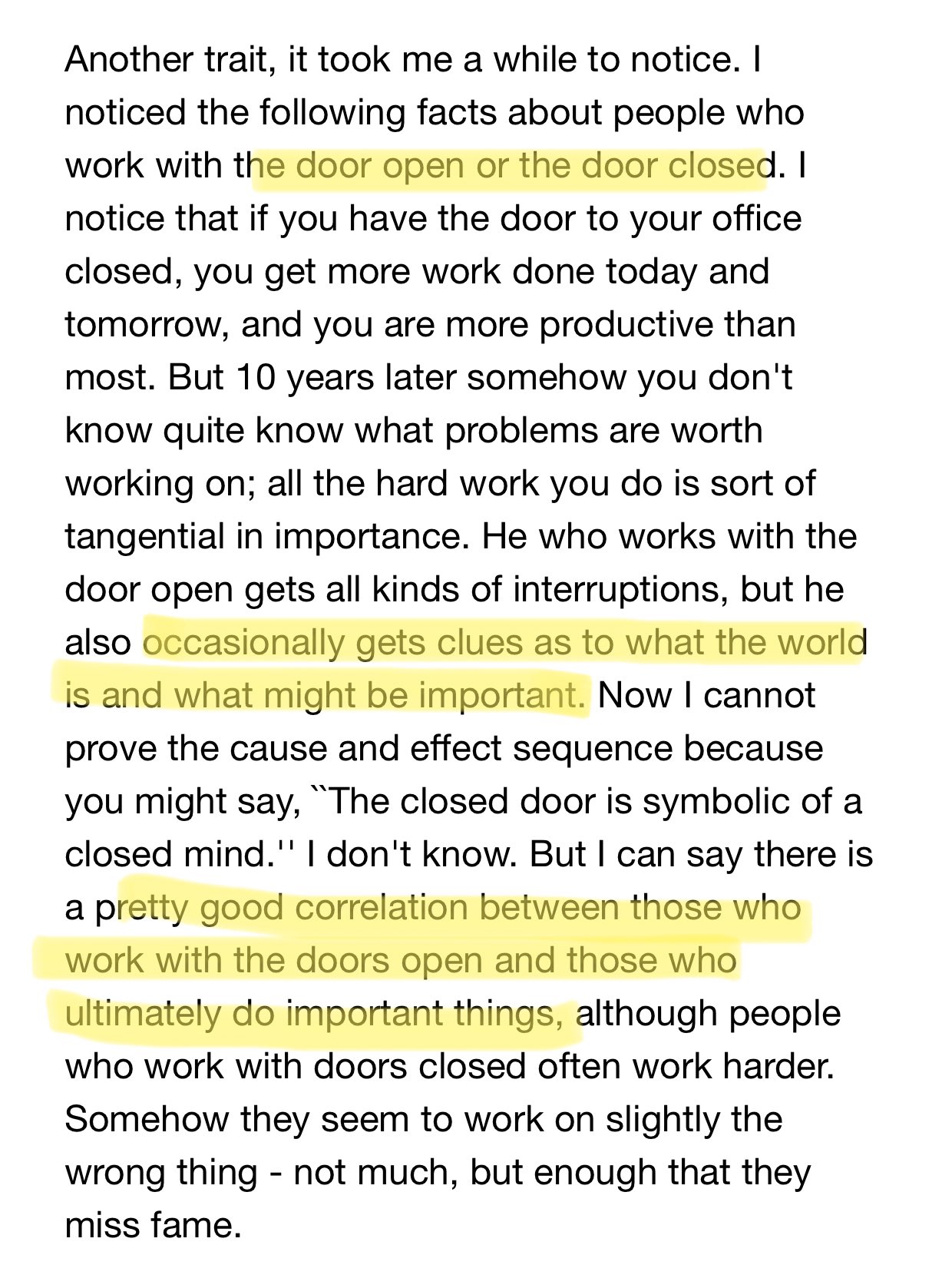
✍️How to Market Yourself (without Being a Celebrity): https://t.co/C870FAq99T People want to put you in a box. Help them put you in an expensive, high-sentimental-value, glittering, easy to reach box. Preferably at eye level, near Checkout, next to other nice looking boxes. You don't have to market to the whole world. You can target specifically the audiences you want to work for, and no more. As long as you are well-known in those circles, you don't need a public presence at all. Branding is the stuff that uniquely identifies you. Marketing just gets your awesome in front of people. The strongest branding *creates its own market*. It's really easy to sell to a market in which you are the only seller. Nobody can compete with you at being you. Your Personal Brand is how people talk about you when you're not in the room. You create a Personal Brand *from thin air*, with the full dimensionality of all human personality has to offer. Average is Boring. Anything not "average" is a good candidate for your Personal Brand. In particular: Diversity is strength. Adversity is strength. Weakness is strength. Nothing is off limits. Stay positive: Entertain, Educate, Inspire, Motivate. One formula for a Personal Brand: Identity + Opinions. Who you are + What you're about. These are as good as tagging them on Twitter: - Knitter + Accessibility - Pianist + State Machines - Applitools + Test Automation - Coursera + GraphQL Your profile is seen more than your face. Take it seriously: - Take a great photo and use it *everywhere*. - Show your real/professional name if possible. - Your bio should display your affiliations/current projects. Thought experiment: Can people make memes of you? If yes: that's a Personal Brand. You Need A Domain: 1. Set up a domain (yourname dot come) that has all your best work 2. Pick a field that you are About. Plant your flag. Put up your personal Bat Signal. Picking a Domain: Connect yourself to something important that you love, that you are also ABSURDLY unsatisfied with. That love-hate tension can fuel you for years. Plant a flag on your domain, and say: "This is What I Do". Give Up Freedom - For Now. Once your flag is planted, don't plant it anywhere else. People like to see commitment. You signal commitment by giving up optionality. What you lose in freedom you gain 10x in marketing. You can still pivot if you need to. Marketing Business Value: Have at your fingertips all the relevant statistics, data, quotes, and anecdotes for when you solve major product pain points, or contributed a major revenue generating/cost saving feature. It will come up without warning, and you want to be ready. Marketing Coding Skills: Do Cool Stuff. Cover Your Bases. Cool can mean: solves common problem, uses new tech, has great metrics, you were paid, live in production. Shortcuts: Clone Well Known Apps, Win Hackathon, Build X from Scratch Portfolios display work and diversify appeal. Portfolios also overemphasize breadth and visual elements. Depends what you are trying to market. More important to show instantly verifiable Proof of Work. Blog is universal medium for this. Marketing Yourself in Public: Pick a Channel, stick to it. Don't Lie. Don't Share Secrets. Aim for Inbound Personal Marketing. Do more than you're comfortable. Customize your message. Careful what you market for - you just might get it! Marketing Yourself at Work: Easier, because smaller pond. Harder, because it can backfire. Don't overstep. Don't be obnoxious. Do share credit. Don't take credit for something that wasn't yours. Log your own metrics. Your company probably has an expensive, comprehensive and well instrumented metrics logging system (This is a joke - one does not exist). Don't trust it. It will fail you. Hand collect metrics, links, press coverage. Take screenshots. Collect qualitative anecdotes, quotes, shoutouts. The best time to do this is right after you see a good result - you will never have time in future to go back for it. Make Status Updates Awesome. Most people put no effort. You can buck the trend, "flip the bits" in team morale. No scheduled status updates? Great - Make Your Own. Management always appreciates this. Do Demos. This is internal marketing people regularly turn down. Not you. Since we're all remote + async - Do recorded demos. Good demos will spread virally, and so will you. *NOTE: don't demo others' work that isn't ready for a demo Signature Initiative: Showcase your abilities and ideas outside usual org chart. Examples: - https://t.co/FCFx4vrqJV - Book club - Lunch & Learn - Talk series - @MatthewGerstman started JS Guild at @Dropbox Recap: Assemble your Personal Brand, your Domain, and your Coding Skills/Business Value. Then Market Yourself in Public + at Work. https://t.co/e3RpDTCs3E This is a public draft of a chapter I'm working on for the @Coding_Career book: https://t.co/f4TYfqgopF The main points end here. Read on only if you want extra "hacks" that can get you quick wins with Marketing Yourself Help Others Market: find others who are brilliant but uninterested in marketing, and offer free marketing help! Crosspost on Industry Blogs: Industry blogs (and newsletters) are pretty much always looking for quality content. For Frontend Dev, the ones with rigorous editing are @CSS Tricks, @SmashingMag, and @alistapart. Collaborations: If possible, raise your profile by working with others who already have very high profiles. The most common version of this is Pick Up What They Put Down: https://t.co/vQx925sots Industry Awards. Microsoft MVP, Google GDE, AWS Heroes. Having a bunch of logos on your site/slides generally helps you, so long as they are not your biggest claim to fame. Memorable words/catch phrase/motto. Nike spends billions to make sure that every time you think of the words "Just Do It", they come up. You can do that on a smaller scale. Friendcatchers. Win friends while you sleep. https://t.co/84XjdijyR7 Visualize your work. If you draw, you can be WORLD BEATING at marketing. Draw everything you can. Even the invisible stuff. ESPECIALLY the invisible stuff: https://t.co/cLqjttphpZ If you say you cannot draw, that's a lie. Use @Excalidraw. I livestreamed 5 hours of writing this essay here https://t.co/cDqjyxdSKa Examples of Planting Your Flag successfully - when people can easily refer to you as "the X gal" or "the Y guy". - https://t.co/WvUtrii67J - https://t.co/NrQmCLe7XO What do you want to be known for? Stating the obvious, but you have a better shot if you are intentional abt it incredibly valuable thoughts here for being a great podcast guest: - bullet point responses to common questions - create a podcast interview cheatsheet - make a public list of conversation topics this helps in other areas of personal marketing too! https://t.co/1cDJHq50Js applying the “help them put you in a box” branding strategy to devastating effect on twitter https://t.co/YXb8DP8StK Today at our meetup @Chad_R_Stewart shared this: “It’s not about who you know, it’s about who knows you.” I loved that so much - because of Dunbar’s number, you can’t aim to know everyone But you can at least make sure everyone knows that they come to you for the thing you do
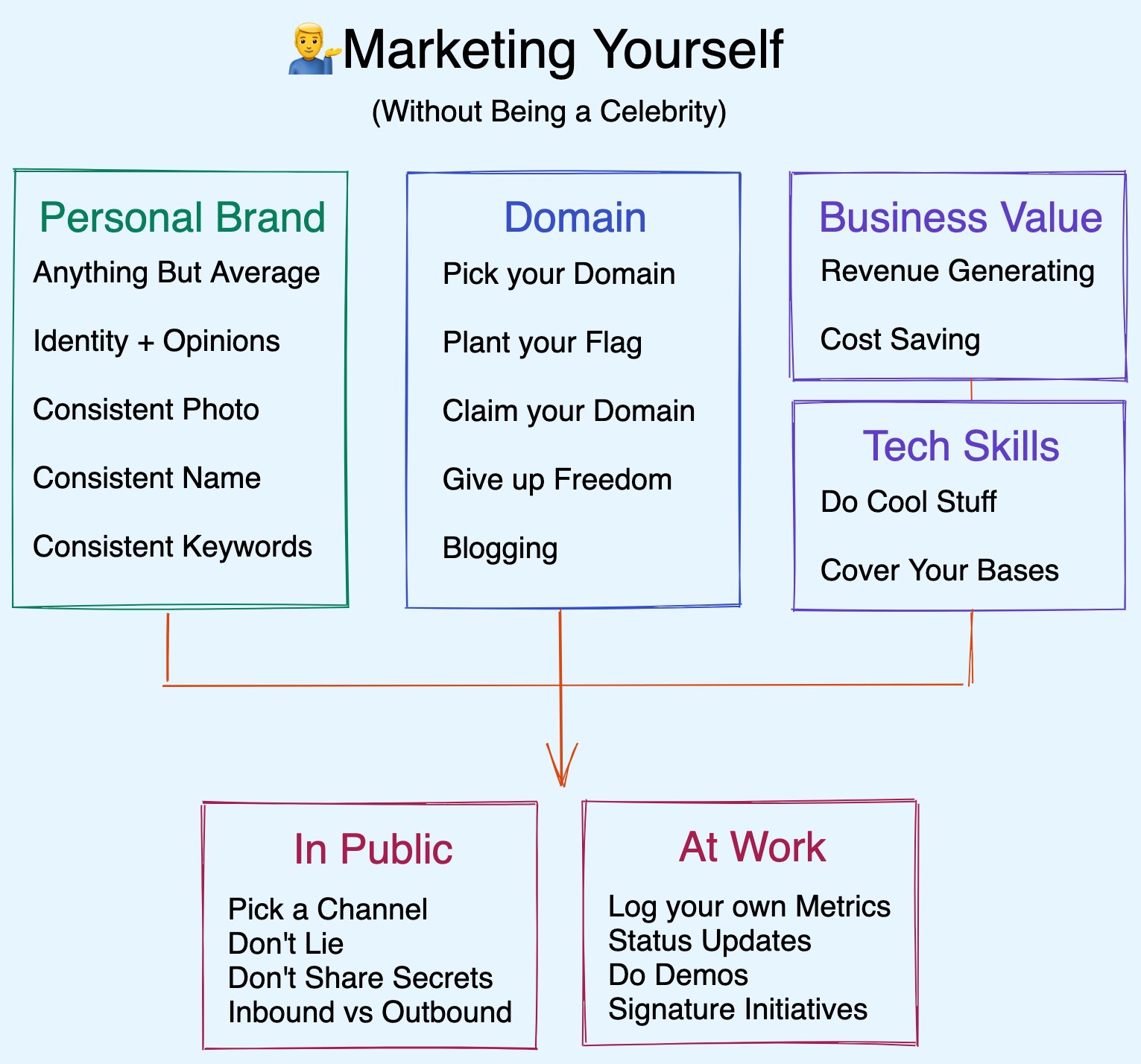
~ New article ~ We're seeing the rise of a New American Dream. Digital technology has reached a tipping point. We're about to see an explosion of people running profitable software businesses. https://t.co/7VeNib1NNp
Jan 13, 2020My Favorite Reading Quotes 1. “The reading of all good books is like a conversation with the finest minds of past centuries.” — Descartes 2. “If you only read the books that everyone else is reading, you can only think what everyone else is thinking.” — Haruki Murakami
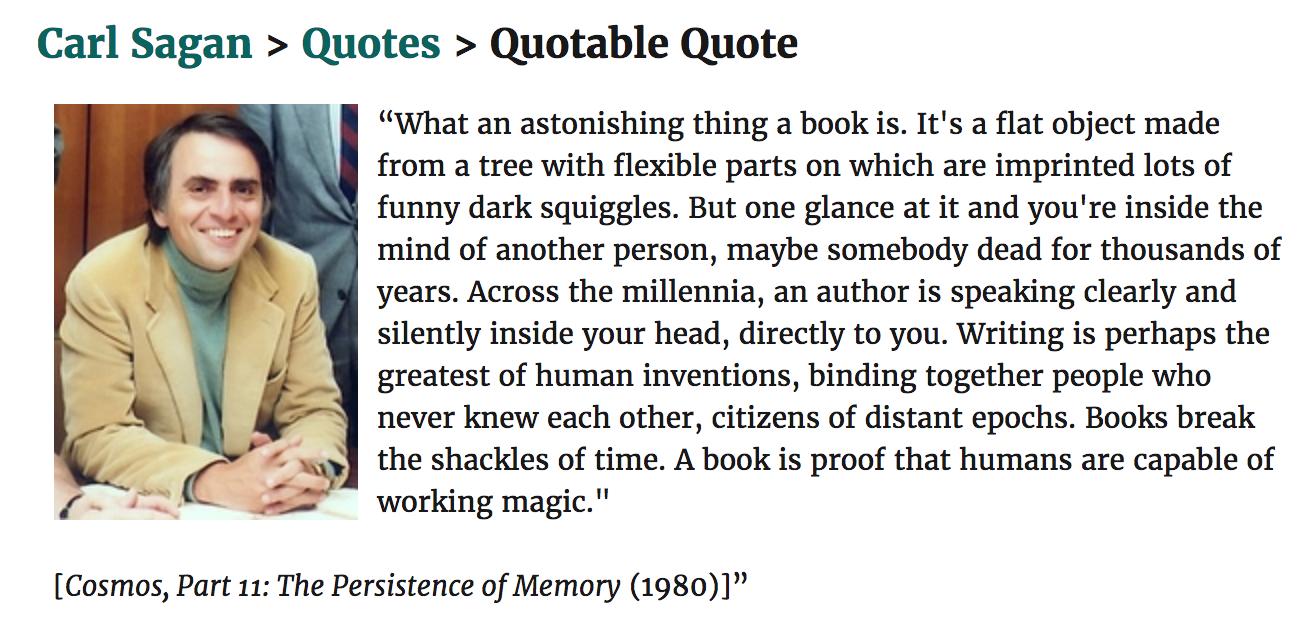
Can you imagine being able to write like this at any age, much less at 24? Me neither. I didn't appreciate @david_perell's depth until we spent the day together in Columbia, MO. In awe of his rate of learning, intellectual honesty, and humble kindness. https://t.co/C6gXV9xYyk