The Forgotten Industrialist

There are a couple of concrete arches straddling the main roads into two little towns in upstate New York. In 1920, a bunch of shoe factory workers chipped in their own money to build them (~$17K each), and stamped them with the words “Home of the Square Deal.” Fun fact. To this day, no municipality claims to own them. Technically, the arches still belong to a bunch of long-dead, anonymous shoemakers. How many Fortune 500 companies do you think see their employees paying out of pocket to build a monument to their boss?
That boss was George F. Johnson, the president of the Endicott-Johnson Shoe Company. When he died in 1948, ~40K people showed up to his funeral, and the coffin passed under the arch on its way through town. Today, outside of Broome County, almost nobody knows his name.
In 2024, I wrote about how a Planet Money episode from 2015 put George F. on my radar, and how ~80% of his 15K workers voted against forming a union at the same moment the rest of the country was unionizing. Then, last year, I read a 1935 biography of the guy and came away with a conviction: the George F. Johnson story is a story of The Forgotten Industrialist; studying him and what he did is a vastly under appreciated necessity that has never been more relevant than it is in an age of AI.
So I wanted to start pulling that thread in public. First, who George F. was and what he built. Then, the obvious objection: his company is dead, so how good could his ideas have been? And I’ll end with what I think he can teach us about a world where a lot of smart people are convinced AI is about to make most humans economically useless.
The Shoemaker
George F. Johnson left school at 13 to work in a shoe factory, became a foreman by 21, and showed up in Binghamton, NY in the early 1880s as a hired hand. A Boston leather dealer named Henry B. Endicott took over the struggling factory as a creditor, and, instead of ever moving to town, he basically handed George F. the keys. Within a couple decades, the business was making ~52M pairs of shoes a year, outfitting most of the US Army in both World Wars, and employing somewhere around 20K people. And he ran all of it on a set of principles he called the Square Deal.
I’ve talked before about the carousels and the golf courses and the libraries he built, but the details of the deal are even more impressive than the highlights. Endicott-Johnson was the first shoe company with an 8-hour day and a 40-hour week, announced in 1916. Profit sharing started in 1919, split 50-50 between the workers and the common stockholders, with every eligible worker getting the same check. By 1926, it was gated on two years of continuous employment, as was eligibility for company-financed housing, because George F. wanted people to STAY. Every newborn baby got a bank account with $10 in it and a pair of shoes. Trump Accounts before they were cool. And then there was the medical program.
According to the company’s records, the medical department had 28 physicians, 67 nurses, and 3 dentists on staff. In 1927 alone, it made 83K house calls covering ~60K people; workers and their families, at no deduction from their pay. Gerald Zahavi, a historian who wrote the definitive book on the company, said it plainly: “Their medical plan was the most extensive in the country.” This was at a time when most Americans had no health insurance at all.
Why do all that? Was it charity? Not according to George F. In William Inglis’ 1935 biography, the argument gets made over and over again, and my favorite version is this one:
“There is no patent on the plan. Anyone who will may use it. And it has a virtue that commends it to all good business men—it pays.”
That last line is the part I love. George F. wasn’t a saint who happened to own a factory, nor was he content to run his business into the ground just to be nice to his employees. He was a hard-nosed operator who happened to believe that the most efficient way to dominate the shoe business was to treat workers like the asset they were. He talked about it constantly, and the way he described splitting the gains is a pretty great piece of business philosophy:
“Every improvement and every saving we effect, is divided into three parts ―the workers’, the consumers’ and the company’s. That is one of the best ways to make a business successful and keep it so.”
He told his managers, “We’ve got to make all we can of this concern, not try to take all we can out of it.” Same business, same industry, same economy as everyone else, but with a fundamentally different philosophy about what the business was for. He wasn’t trying to extract value from the company; he was trying to build a foundation for it.
A Forgotten Category
So why is George F. a footnote while Andrew Carnegie and Henry Ford get statues, biographies, and Ken Burns documentaries? I think a big part of it is that the company died. Endicott-Johnson doesn’t exist anymore in any meaningful sense, so there’s no brand keeping the name alive. There’s no Johnson Foundation, no Johnson University. But I think the bigger reason is that the stories we tell about business have a pretty specific shape: the bigger, the better.
We see the same thing in how we talk about business icons today. I wrote last year about the contrast between George F. and Jack Welch, who built GE into a corporate empire optimized around short-term earnings and memorably said that “ideally, you’d have every plant you own on a barge,” so it could chase cheaper labor and currencies wherever they went. George F. saw that coming fifty years earlier, describing a competitor “out in the West” who kept its factories spread apart so it could close one down and do the work elsewhere. His verdict? “Foolish. They can’t last.” He was describing a floating island fifty years before Welch made it a strategy.
Or take Henry Ford, who wrote that an employer doesn’t need to love his employees, just do justice by them. George F. was pretty blunt in his response: “if what he wrote is part of his philosophy, then he will die one of the greatest failures the world has ever known.” Strong words from a guy who sold shoes for a living!
Sound vs. Survived
Now, as strong as the smack talk is from the shoe man, here’s the rub: Ford Motor Company still exists, while the Endicott-Johnson company very much does not. So how can I say the shoe company was the sounder business? Isn’t the scoreboard pretty clear on this one?
I think it depends on what you mean by sound. If sound means “biggest” or “still around,” Ford wins in a landslide. Ford’s 1930 profit alone was ~16x what Endicott-Johnson earned in 1929. But I’d argue a sound business is one that holds up when things go wrong, and we got a pretty good test of that in the Great Depression. So how did the two do when the economy fell off a cliff?
Ford’s average payroll went from ~174K workers in 1929 to ~49K in 1933; a ~72% drop. The company lost ~$53M in 1931 and ~$57M in 1932, cut its minimum wage from $7 a day to $4, and slid to a weak third in the car market behind GM and Chrysler. In March 1932, Ford’s security men and Dearborn police fired on a hunger march outside the Rouge plant and killed four people.
Endicott-Johnson, meanwhile, went from ~14.7K workers in 1929 to ~15.8K in 1933 and ~18.6K by 1937. It stayed profitable through the worst of it; by the company’s own later account, it didn’t post a loss until 1960. Through 1933 and 1934, when shoe factories across New England were shut down half the time, the Endicott-Johnson people kept working “four full days every week in the worst times.” One company protected its people and stayed profitable; the other did neither.
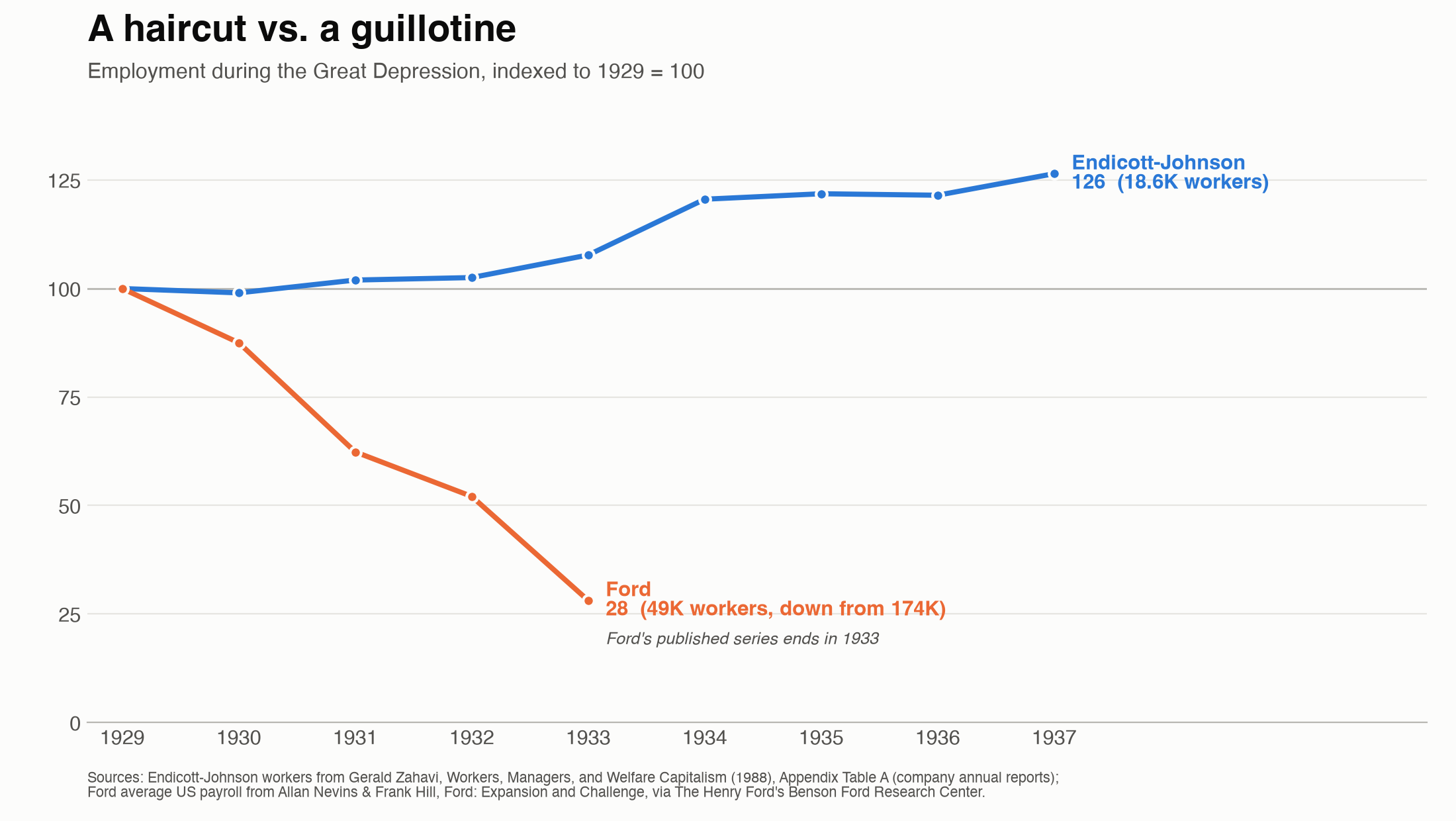
Ford survived the Depression because it was enormous, not because it was well run. By the mid-40s it took Henry Ford II and the “Whiz Kids” to clean it up. Being too big to die isn’t the same thing as being sound.
A Letter To His Son
The fairer criticism of Endicott-Johnson isn’t the Depression; it’s what happened after George F. died. In November 1930, he wrote a letter to his son, George W., that, in hindsight, reads like a prophecy. As quoted in Zahavi’s book:
“It has come to a point where no man may without great risk to the business, change the fundamental ideas which have controlled, and which have been thoroughly accepted and adopted by the workers themselves. I should feel very sorry for the leader of E.J. who attempted to make serious changes in management and control.”
He died in 1948. Zahavi says that year “probably represented the last peak for the company.” Outside management came in by the late 1950s. The company posted its first loss in 1960, the tanneries closed in 1968, the medical department in 1969, and the company was eventually sold off and moved to Tennessee in the 90s. A former worker described the new guys pretty succinctly: “We’re not making any money on that? Let’s shut that department.” And then, sadly, “It wasn’t like that when George F. was here.”
Granted, the shoe industry was getting crushed by imports either way; US shoe production fell 37% between 1968 and 1978 while imports doubled. Maybe nobody could have saved it. But the question I keep coming back to is whether the Square Deal was a set of principles or just a person. If it only works as long as George F. is alive, then it’s a footnote. But if it COULD have persisted then it’s actually a viable model.
Still Standing
So it matters a lot that there are businesses still running the play today. Not many, but enough to be interesting.
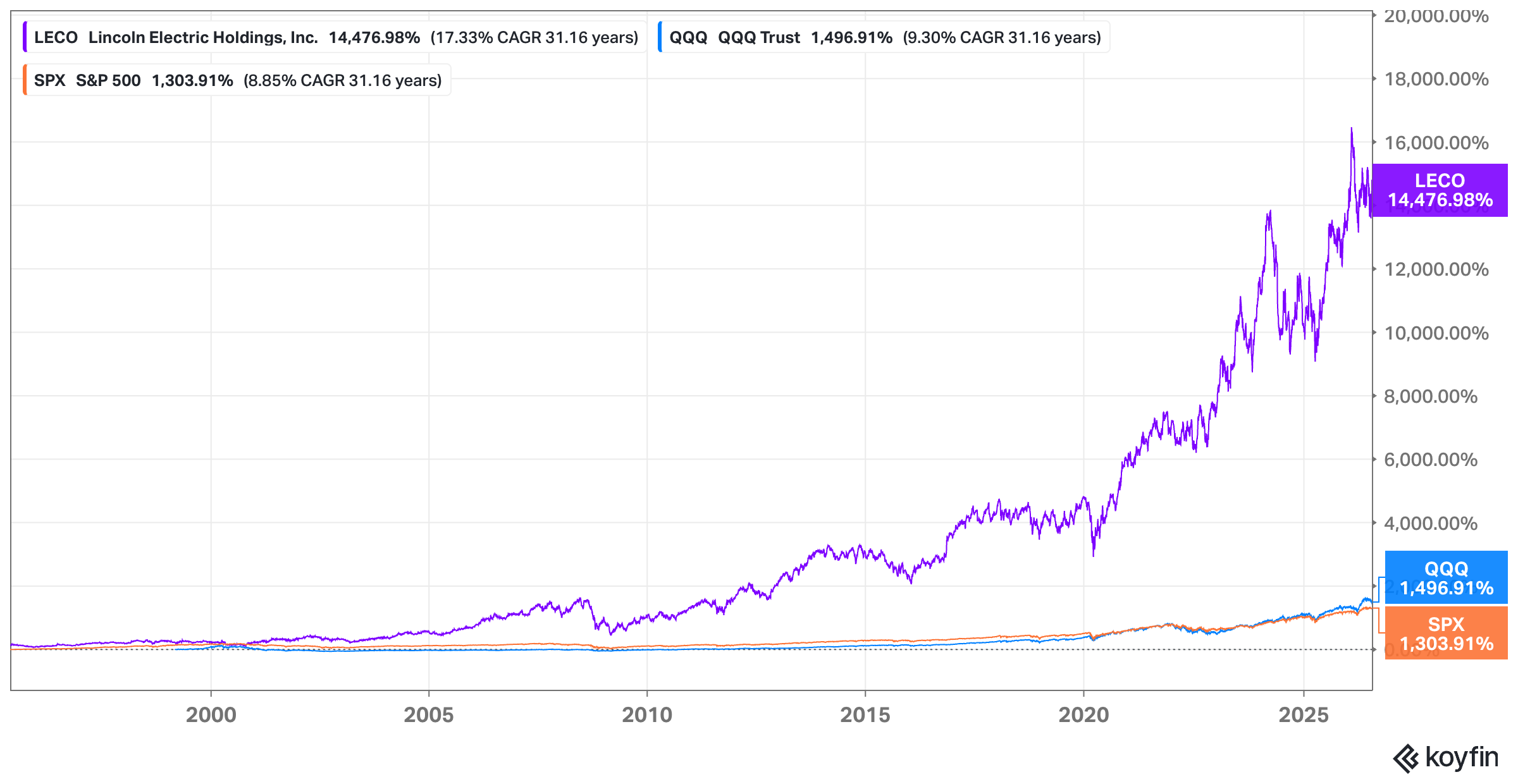
Lincoln Electric, a welding company out of Cleveland, has paid production workers by the piece since 1914, paid an annual bonus since 1934, and offered guaranteed continuous employment since 1958. The bonus averages something like two-thirds of base pay. When demand collapsed in 2020, total employment fell by less than 3%, mostly through attrition. And since its 1995 IPO, the stock has returned ~60x with dividends reinvested vs. ~24x for the S&P 500. So much for the idea that taking care of workers is a drag on returns.
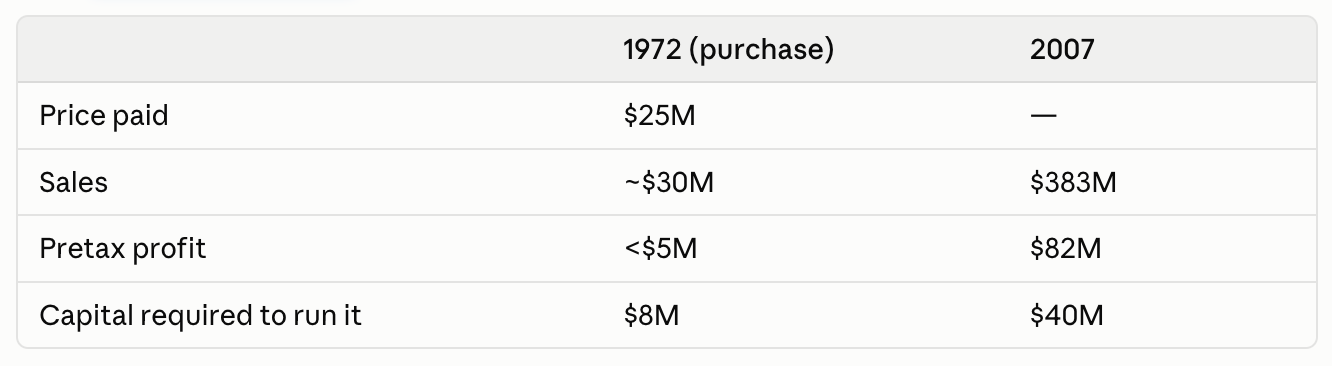
Then there’s See’s Candies, which might be the most famous “boring” business of all time. Buffett bought it in 1972 for $25M, when it was doing ~$30M in sales and less than $5M in pretax profit. By 2007, it was doing $383M in sales and $82M in pretax profit, and it only needed $32M of additional capital to get there. Over those 35 years, it threw off $1.35B in pretax earnings. Volume grew ~2% a year. In an “unexciting” industry, as Buffett put it. Nobody’s making a movie about that, but it’s the kind of business that funds an empire.
It’s not just a handful of anecdotes, either. Alex Edmans at London Business School found that Fortune’s “100 Best Companies to Work For” beat the market by ~3.5% a year from 1984 to 2009, and a follow-up through 2020 found the edge hadn’t faded and was biggest during crises. Employee-owned companies cut ~5% of jobs during COVID vs. ~20% at other companies. The Square Deal doesn’t just survive bad times; that’s when it shines.
Now, that’s not the full scoreboard. Amazon ran warehouse turnover of ~150% a year and became one of the greatest compounders in history. Welch’s GE went from under $15B to ~$600B in market cap before it fell apart. If I’m being real with myself, the financial performance of the relentless executors over the welfare capitalists is the biggest indictment of the worldview I’m trying to espouse. The relentless approach can win for a long time. I just don’t think it’s the only way to win, and I don’t think it’s the best way to build something that lasts.
Fake Jobs?
Which brings me to AI. I saw a tweet recently that’s been rattling around in my head. Someone laid out the fear that a lot of people have right now:
“I’m quite worried about the future we are inevitably heading towards where the threshold for economic utility rises above what ~99% of the human population can meet… one of the main reasons the economy has still been fairly agnostic to ‘AI efficiency improvements’ is because most jobs are fake anyways.“
The tweet frames it as Dario Amodei telling the truth that AI is coming for everyone’s jobs and Sam Altman pretending it’ll create more. Dario warned last year that AI could wipe out half of entry-level white-collar jobs. Sam, for his part, said in May that he thought “there would have been more impact on entry-level white-collar jobs being eliminated by now… my intuitions were just off.” So, depending on who you ask, either the tsunami is coming or it already should have arrived and just didn’t.
I’m sympathetic to part of that argument. When I see headlines about “AI job cuts,” I can’t help but wonder: are they actually AI? Or is it just an acknowledgement that every company got bloated and AI gives them cover? Between 2019 and 2022, Amazon and Meta nearly doubled their headcount. Oxford Economics suspects firms are dressing up layoffs from past over-hiring as an AI good news story, and points out that if AI were replacing workers at scale, productivity should be accelerating; it isn’t. Having too many employees is just as unsound as trying to automate ALL of them, or treating them as fungible annoyances meant to be squeezed down onto Welch’s barges.
But “most jobs are fake” is a different claim, and I don’t buy it. When researchers asked tens of thousands of European workers whether their job was useless, only ~5% said yes, down from ~8% a decade earlier. And the people who felt useless weren’t doing useless work; they had bad bosses and toxic workplaces. A lot of what looks like a fake job is really just a badly managed one. It’s not a question of technology-driven inefficiencies, it’s one of mismanagement. But people blame the workers.
What’s more, at least 50% of new college grads are unemployed or underemployed. The New York Fed puts underemployment at ~42%, and it’s been in that range for decades, long before ChatGPT. That doesn’t mean young people are fine. One study found that employment for 22-25 year olds in the most AI-exposed jobs has fallen ~16% relative to everyone else, while experienced workers in the same jobs are doing fine. Back in May, I wrote that most people begrudgingly believe they will not be enabled or advantaged by any technological progress. But people blame the workers.
So where’s the value? A fund letter I came across put it well. A model can tell you in minutes how many times a management team has called its outlook “strong,” but ask it whether to buy the stock and you get a confident answer that isn’t very useful:
“In this kind of work the bottleneck is the person doing the checking… A model that has read everything written about a company will tend to give the consensus answer, and the returns in our business come from the cases where the consensus is wrong.“
There’s a lot of work like that. Judgment, trust, taste, knowing where to leave room to negotiate. It’s also worth remembering how often we’ve been here before. In 1964, a group of Nobel laureates and economists sent LBJ a memo warning that automation was about to cause mass unemployment. Within about two years, unemployment was under 4%. MIT’s David Autor found that ~60% of Americans now work in job titles that didn’t even exist in 1940. Every generation’s new jobs look fake to the generation before it.
And the businesses doing that work aren’t going to flip a switch overnight. Today, ~24% of US firms report using AI in any of their business functions AT ALL. Economist Paul David pointed out that in 1899, electric motors provided less than 5% of the mechanical power in American factories, and the productivity boom from electricity didn’t really arrive until the 1920s; roughly four decades after the first central power station. Four decades!
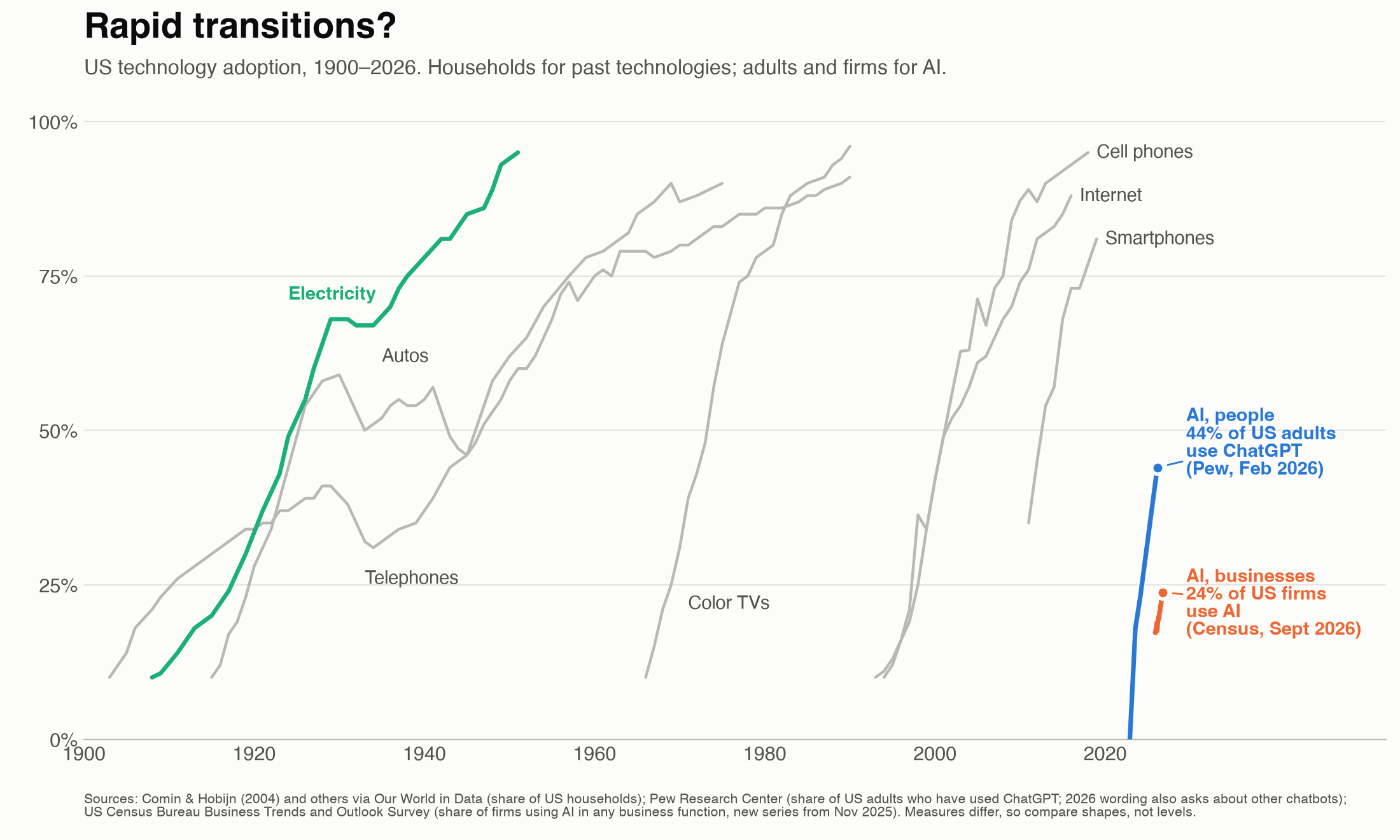
I wrote earlier this year that until we confront the reality that AI, like software and consumer before it, is butting up against the ornery stubbornness of human behavior, we’ll keep assuming that the deployment curve is moving as fast as the development curve; but that just isn’t true. The Lindy Effect is a big part of that. The longer something has been around, the longer it’s likely to stick around. And a lot of what’s been around is a shoe factory, a candy shop, a welding company, and a grocery store. The boring stuff is the Lindy stuff.
Where The Value Gets Made
So if the job market is the wrong place to look, where should we be looking? I think the better question isn’t “where are the jobs?” but “where is the value being created, and who gets to keep it?”
When most people picture the American rich, they picture tech billionaires or real estate moguls. (That old line about 90% of millionaires getting rich through real estate? Andrew Carnegie probably never said it.) But when economists linked tax data for 11M firms to their owners, they found most top earners are owners of private businesses: the regional law firm, the dental practice, the distributor, the contractor. And here’s the kicker: when the owner retires or dies, those firms’ profits fall by ~75%. The value isn’t sitting in a building or a bank account; it’s the person showing up every day.
The Fed’s data tells the same story. Families that own a business with more than five employees have a median net worth of ~$1.3M, and that’s NOT counting the business itself. Every other family? ~$156K. That’s an ~8x gap. Meanwhile, the share of the Forbes 400 who grew up rich fell from 60% in 1982 to 32% by 2011, while the share who started their own business went from 40% to 69%. Regional business owners are the quiet engine of American wealth, creating a TON of micro value.
And the billionaires? People look at them and say “all these billionaires getting rich,” but the majority of billionaires have made other people millionaires, and given MANY other people a great life even if they’re not millionaires. That’s GOOD. One Yale economist estimated that innovators capture only ~2.2% of the total value their innovations create. The rest goes to everyone else. Amazon says 75K+ independent sellers passed $1M in sales last year. YouTube paid out $70B+ to creators and media companies over three years.
Tech’s best invention might not have been the transistor; it might have been the stock option. When Fairchild Semiconductor’s owner refused to give employees equity, calling it “creeping socialism,” their best people left. One of them scrawled on his exit questionnaire: “I… WANT… TO… GET… RICH.” Decades later, ~1K of Google’s ~2.3K employees became paper millionaires at its IPO. In 2025, over 600 OpenAI employees sold $6.6B of stock in one tender. Back in 2025, I wrote that great businesses generate good jobs for employees, and even make many of them millionaires in the process! Letting people get rich alongside the business should be the goal.
But here’s the problem. That kind of wealth creation is happening in pockets. 70-75% of vested startup options never get exercised. Only ~18% of US workers own any stock in their employer, basically the same as 20 years ago. Amazon took away stock awards from hourly warehouse workers in 2018 in exchange for a $15 minimum wage. And labor’s share of national income just hit its lowest level since the government started tracking it in 1947. Right now, we’re a lot closer to Welch’s barges than George F.’s arches.
Universal Enrichment
In 2018, I asked a question about automation that I still think about: “Will there be anywhere for the general worker to go?” The usual answers were “we’ll teach everyone to code” or “universal basic income, duh” or “we’ll just go to mars.” None of them were satisfying then, and they aren’t now. We don’t need to teach everyone to code. And I don’t know that we need universal basic income. We need universal enrichment.
What does that mean? It means the goal shouldn’t just be making a small group of technical employees rich. The goal should be making EVERYONE rich. Capitalism isn’t the problem; it’s the most powerful engine for creating wealth that’s ever existed. But we should distribute that wealth even more broadly, and not through force, or taxes, or welfare programs. Through enrichment; by amplifying people’s agency and hard work instead of replacing it. So what’s the mechanism?
I think the biggest one is making more regional business owners. Right now, over half of the owners of US businesses with employees are 55 or older. Millions of profitable, Lindy businesses are going to change hands over the next decade. Some will close. Some will get rolled up by private equity and squeezed. But they could also become the on-ramp for a new generation of owners. Search funds, which help younger operators buy one of these businesses, have returned a ~34% IRR across 862 funds since 1984, and the SBA backed a record $37B in 7(a) loans last year.
The second mechanism is turning employees into owners. Not a sliver of stock in a megacap; real ownership. The ~8M people in public-company ESOPs hold ~$19K on average, but the ~2.6M people in closely held ESOPs average ~$176K. When KKR sold C.H.I. Overhead Doors, a garage door company in Illinois, all ~800 employees averaged ~$175K, and some hourly workers walked away with $750K+. A garage door company! But it has to be ownership on top of fair pay, not instead of it. United Airlines learned that the hard way, when employees traded wage cuts for stock right before the company went bankrupt.
And the third mechanism is the best of all! AI doesn’t have to be an economic apocalypse; it ought to be an economic renaissance. Solo founders went from ~24% of new startups in 2019 to ~36% in the first half of 2025. If AI makes it 10x cheaper to run the back office of a plumbing company or a dental practice, that doesn’t have to mean fewer people. It could mean more owners. The same tools that let a big company cut headcount could let a 28-year-old buy the HVAC business down the street and run it better than the last guy.
I can’t imagine a world where we just invalidate humans as a labor pool. There has to be a revolution we can’t see yet. I think Sam doesn’t believe it but doesn’t want to say it, and Dario doesn’t believe it and says so. But can we not envision a grander world, where people are winners alongside the businesses they help build? I’ve written before that our humanity has been productized, and the very least the people building AI can do is compensate us for it. I’d go a step further: the businesses that win with AI will be the ones that treat people as partners in creating value, not as a line item to optimize out.
George F. didn’t have a patent on the plan. Anyone who wanted to could use it. Very few did, my kind included; VCs spend all their shiny-object-chasing energy funding companies that are trying to be the exciting kind. But I’d love to see a generation of founders building with AI who take as much from Endicott-Johnson as they do from OpenAI. Maybe then the next George F. won’t get forgotten.