What Happens To The AI Trade When Everything Gets Cheaper?
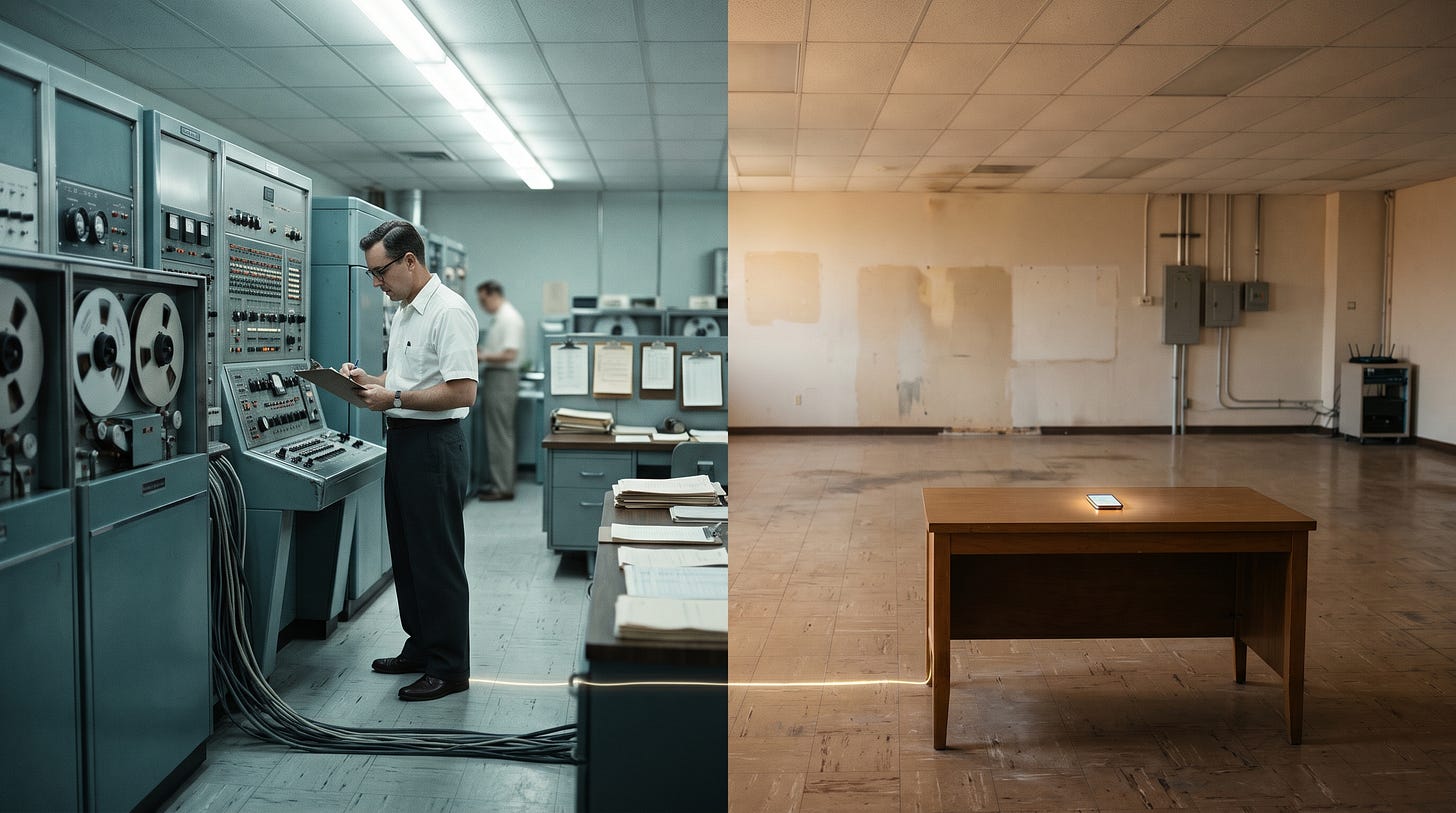
Every time computing got radically cheaper, the people who sized the market off the old cost curve guessed too small, and the value moved away from whoever owned the expensive machine. Intelligence is now about 1,000x cheaper than it was in 2021, while Big Tech’s free cash flow has nearly vanished paying for it. I’m trying to figure out who’s on the wrong side of that formula.
This is Networked Conviction 007, my weekly investing journal: one idea I’m still working out, one startup I’d want to see built, and one thing from my notes worth resurfacing. The first section is free for everyone; the rest is for paid subscribers.
Networked Conviction, Take Two
I launched Networked Conviction back in January as a paid offering to build the habit of more habitually chronicling my “investing journal” rather than just one big meaty piece per week. After kicking things off, I wrote six entries and then life got in the way. The problem, looking back, was I was just writing six essay-length posts in four months, which did nothing but add to my workload of big, meaty essays I’m getting out. So around April, I gave up. To everyone who’s been paying for Investing 101 anyway: thank you, and sorry about that. Let me try again.
I’m relaunching Networked Conviction, starting today, with a smaller and more specific promise. Every Wednesday you’ll get one idea I’m still working out, one startup I’d want to see built, and one thing I pulled out of my notes. Every now and then, a look back at something I wrote years ago, or an early look at that Saturday’s essay (like this week).
But the bigger change is that I want this to be less of a newsletter and more of a forum. I’ve been writing in public for years, and I’ve always said its just vibing in public. One of the most satisfying parts of vibing in public is seeing who vibes back in the form of replies, DMs, etc. A couple weeks ago, I got some vibes back from Fred Wilson on one of my pieces. That’s where the magic is!
The paid side of Investing 101 should be where that happens on purpose. So the first section of every issue is an idea I haven’t figured out yet; what I’m calling “Under Construction.” My hope is that the best replies in this forum go on to help shape my bigger Saturday pieces into an even better outcome.
Under Construction: When Everything Gets Better
You’ve probably heard that IBM’s Thomas Watson once said there was “a world market for about five computers.” Like many zangy zeitgeisty turns-of-phrase, this is yet another instance where there’s probably no evidence he ever said it. But the real story captures the point even better: in 1953, Watson Jr. told shareholders IBM had gone out expecting orders for five of its new 701 machines, and came home with orders for 18. Such small numbers, in large part, because this is when computers still required a massive room of space. See, every time computing got radically cheaper, the people sizing the market off the old cost curve were wrong. And it was always in the direction of underestimation.
So here’s one thing I keep coming back to: what happens to the AI trade when EVERYTHING gets better?
The formula for intelligence is roughly energy → compute → tokens, and every item in that equation is improving at once. Better chips, better algorithms, better data efficiency, better compression. For the same level of performance, a16z found that inference got about 1,000x cheaper in three years; GPT-3-level intelligence went from $60 per million tokens in 2021 to six cents. Michael Burry, the Christian Bale-wanna-be in a neck-to-neck race with Ed Zitron to be that Master Perma Bear of this cycle, posted an odd little song this week arguing a pretty good point: compression turns the data-center build-out into billion-dollar monuments. One key line: “This is not a war. This is just math.”
Meanwhile, the trade is priced like the formula stays expensive. Meta’s free cash flow went negative last quarter (-$2.12B). The five biggest AI spenders went from $46.8B of combined free cash flow at the end of 2025 to $2.2B by the middle of 2026, and Goldman expects $420B of hyperscaler debt next year.
The obvious counter is Jevons Paradox. When something gets cheaper, we use a lot more of it; Satya said as much the week DeepSeek dropped. IBM’s 18 orders became billions of devices. I think that’s right about demand. I’m just not sure it’s right about who gets paid. The demand for computing exploded, and almost none of the value stayed with the people who owned the room-sized machines.
Where I’m stuck: Where does the value accrue? Do you land on “both” (efficiency grows the pie AND strands the capital priced on scarcity), or lean harder one way? If intelligence gets another 1,000x cheaper, what’s the room-sized machine of this cycle, and who’s left holding what bag it?
Below, you can check out a sneak peak on my latest overview on the commoditization of venture capital, a new model for building American factories, and some learnings about booms and busts from fiction.
The rest of this issue is for paid subscribers. Read the full issue on Substack.