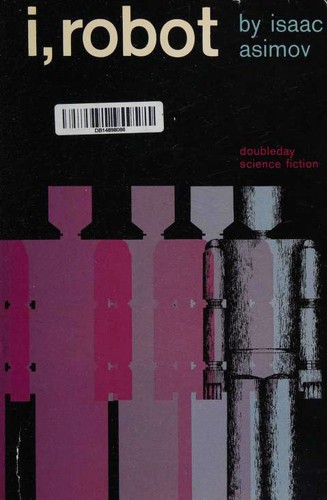
I, Robot
Key Takeaways
Kyle, in 2019 in Books: If you’ve seen the Will Smith movie based on I, Robot, then I can easily draw a comparison — this book is nothing like that movie, beyond the three laws. While this is the third book we read in our Fiction of Future book club, it was also the oldest and slowest. You realize something about technology; once you get more than 20 years away from the technology you’re talking, you realize how very old that technology is, and how very fast technology progresses.
Isaac Asimov’s linked stories, read by Kyle under Fiction of Future and Artificial Intelligence. The highlights split between the famous scaffolding and a set of sharper asides:
- The Laws, including the Zeroth. All four preserved verbatim below — and Asimov’s own deflation of them: “the three Rules of Robotics are the essential guiding principles of a good many of the world’s ethical systems.”
- The epistemology bomb. The two lines Kyle bolded: “You can prove anything you want by coldly logical reason — if you pick the proper postulates” and “postulates are based on assumption and adhered to by faith. Nothing in the Universe can shake them.” Tagged to debate and compromise — the point being that disagreement is usually upstream of the argument.
- You can’t tell a good robot from a good person. “Actions such as his could come only from a robot, or from a very honorable and decent human being. But you see, you can’t distinguish” — the behavioural test that anticipates every later AI-alignment conversation.
- Domination and resentment. “All normal life, consciously or otherwise, resent domination. If the domination is by an inferior, or by a supposed inferior…”
- Responsibility. “You are the only one responsible for your own wants” — which Kyle pairs with a note that what we insistently desire over time is what we become.
- Memory of power. “There is nothing so eternally adhesive as the memory of power.”
- The historical frame. Every era “has had its own particular type of human conflict,” and mankind’s future “was always at the mercy of economic and sociological forces it did not understand.”
Connections
Books: Leviathan Wakes · The Water Knife — the Fiction of Future shelf. The Man From The Future on the same mid-century computation lineage.
Concepts: Artificial Intelligence · Robotics · The Three Laws of Robotics · Historical Futurism — Asimov is the origin point for most of it.
People: Isaac Asimov.
- Isaac Asimov — author; the robot cycle alongside his Foundation / Foundation & Empire trilogy.
- Historical Futurism (Essay) — cites the film as an example of robot-rebellion futurism.
- Life Imitates Art — holds up the film as “solid, albeit imperfect” sci-fi storytelling.
Highlights
Kyle: {{slider}}
- “The Three Laws of Robotics:
- 1: A robot may not injure a human being or, through inaction, allow a human being to come to harm;
- 2: A robot must obey the orders given it by human beings except where such orders would conflict with the First Law;
- 3: A robot must protect its own existence as long as such protection does not conflict with the First or Second Law;
Kyle: The Zeroth Law: A robot may not harm humanity, or, by inaction, allow humanity to come to harm.” Kyle: “You can prove anything you want by coldly logical reason — if you pick the proper postulates.” #debate #Compromise Kyle: “Postulates are based on assumption and adhered to by faith. Nothing in the Universe can shake them.” #debate #Compromise
- “Every period of human development has had its own particular type of human conflict — its own variety of problem that, apparently, could be settled only by force. And each time, frustratingly enough, force never really settled the problem. Instead, it persisted through a series of conflicts, then vanished of itself — what’s the expression — ah, yes, ‘not with a bang, but a whimper,’ as the economic and social environment changed. And then, new problems, and a new series of wars.”
- “It’s your fiction that interests me. Your studies of the interplay of human motives and emotion.”
- “Actions such as his could come only from a robot, or from a very honorable and decent human being. But you see, you can’t differentiate between a robot and the very best of humans.”
- “All normal life, Peter, consciously or otherwise, resent domination. If the domination is by an inferior, or by a supposed inferior, the resentment becomes stronger.”
Kyle: “You are the only one responsible for your own wants.”
- “Therefore, what we insistently desire, over time, is what we will eventually become and what we will receive in eternity.” - Neal A. Maxwell
- “There is nothing so eternally adhesive as the memory of power.”
- “I, on the other hand, am a finished product. I absorb electrical energy directly and utilize it with an almost one hundred percent efficiency. I am composed of strong metal, am continuously conscious, and can stand extremes of environment easily. These are facts which, with the self-evident proposition that no being can create another being superior to itself, smashes your silly hypothesis to nothing.”
- “It is always useful, you see, to subject the past life of reform politicians to rather inquisitive research.”
- “Because, if you stop to think of it, the three Rules of Robotics are the essential guiding principles of a good many of the world’s ethical systems. Of course, every human being is supposed to have the instinct of self-preservation. That’s Rule Three to a robot. Also every ‘good’ human being, with a social conscience and a sense of responsibility, is supposed to defer to proper authority; to listen to his doctor, his boss, his government, his psychiatrist, his fellow man; to obey laws, to follow rules, to conform to custom — even when they interfere with his comfort or his safety. That’s Rule Two to a robot. Also, every ‘good’ human being is supposed to love others as himself, protect his fellow man, risk his life to save another. That’s Rule One to a robot. To put it simply — if Byerley follows all the Rules of Robotics, he may be a robot, and may simply be a very good man.” #ethics
- “People say ‘It’s as plain as the noise on your face.’ But how much of the nose on your face can you see, unless someone hold a mirror up to you?” Self-Reflection
- “The unwritten motto of United States Robot and Mechanical Men Corp. was well-known: “No employee makes the same mistake twice. He is fired the first time.”
- “All that had been done in the mid-twentieth century on “calculating machines” had been upset by Robertson and his positronic brain-paths. The miles of relays and photocells had given way to the spongy globe of plantinumiridium about the size of a human brain.”
- “[Mankind’s future] was always at the mercy of economic and sociological forces it did not understand — at the whims of climate, and the fortunes of war. Now the Machines understand them; and no one can stop them, since the Machines will deal with them as they are dealing with the Society, — having, as they do, the greatest of weapons at their disposal, the absolute control of our economy.”
Referenced in
- Artificial Intelligence note
- Debate note
- Ethics note
- Fiction of Future note
- Foundation book
- Foundation & Empire book
- Historical Futurism note
- Robotics note
- slider note
- The Road book
- The Three Laws of Robotics note